Melencolia I
Albrecht Dürer · 1514

Albrecht Dürer
German · 1471–1528
The Nuremberg goldsmith's son whose engravings and woodcuts carried the German Renaissance across Europe, and who painted his own face with a confidence no painter had shown before.
Play 21 works from this collection on your TV, phone or tablet with Momentable Art TV.
Play CollectionA goldsmith's son
Dürer was born in Nuremberg on 21 May 1471, into the house of a successful goldsmith, and his first lessons in metal and line came at his father's bench. The boy drew so well that the goldsmith's trade was given up for him, and he was put instead to a Nuremberg painter's workshop.
Still in his twenties, and known across Europe already, he owed that early fame to the woodcut: prints of a fineness nobody in Germany had cut before. Emperor Maximilian I took him under his patronage from 1512, and he kept in touch with Raphael, Giovanni Bellini, Leonardo da Vinci and the other leading Italians of the day.
Italy and the print
Three months after his marriage in 1494 he set off alone for Italy, it may have been plague at home that pushed him, and he crossed the Alps stopping to paint watercolours on the way. In Venice he found the old Bellini still, in his judgment, the best painter there. Back in Nuremberg in 1495 he opened his own workshop, and for five years folded what Italy taught him into the Northern frame he had brought with him.
The woodcuts of those years outgrew everything German printmaking had done: bigger, finer, more complex and better balanced on the sheet. At the same time he mastered the burin, the engraver's tool that became his favourite in later life, and the prints that came from it, among them Saint Eustace with its teeming landscape and animals, are why his name still stands for the medium.
The master prints
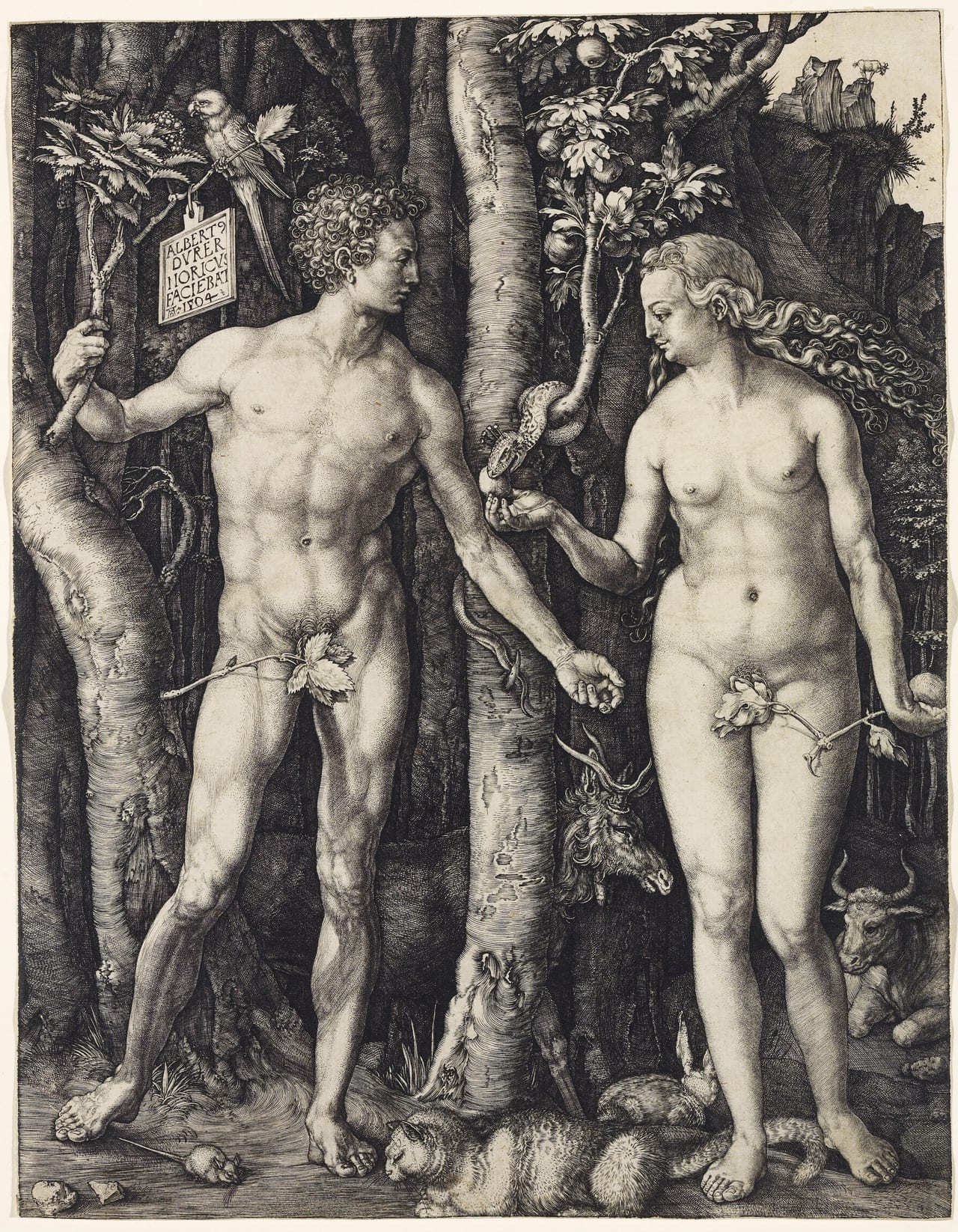
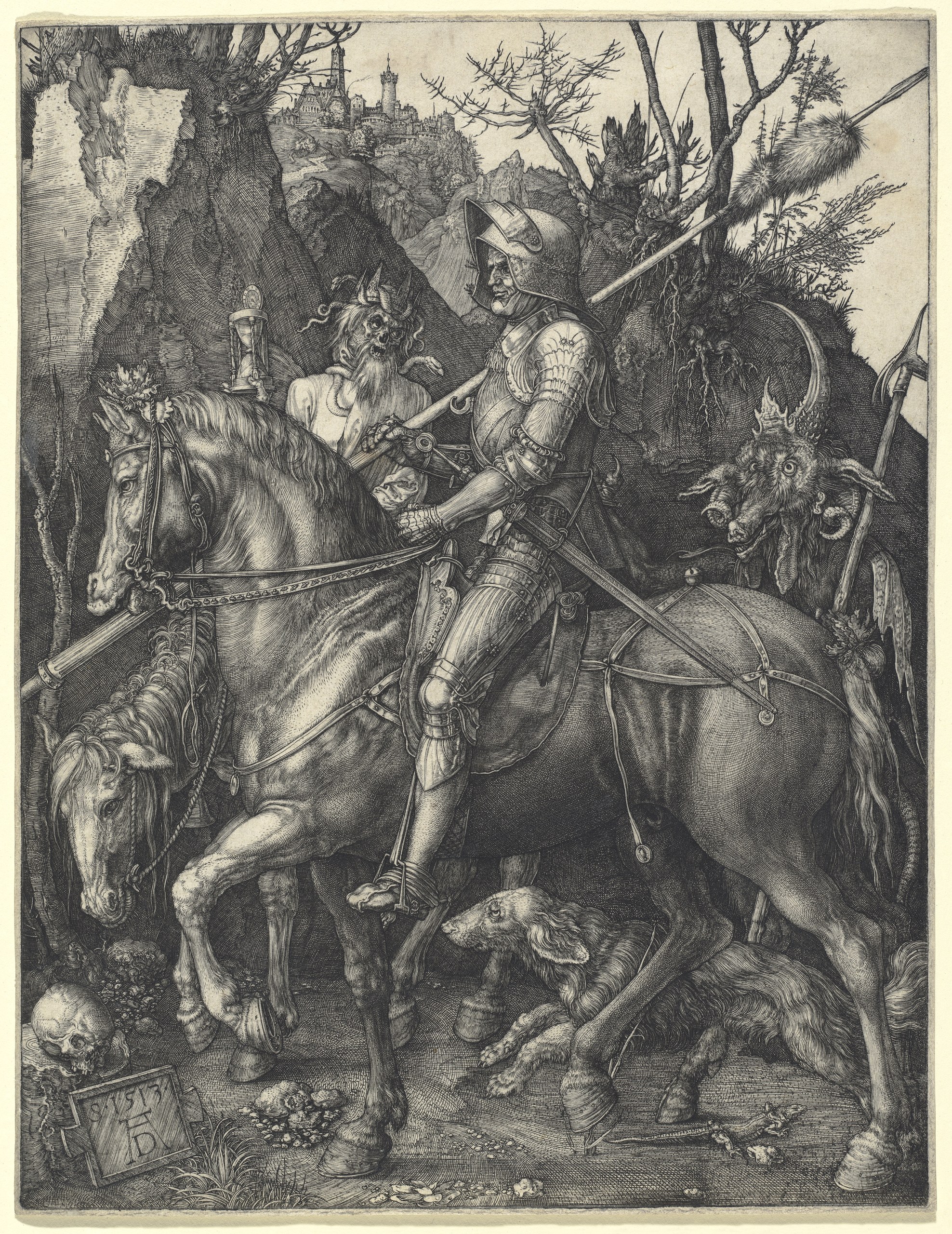
In 1513 and 1514, a period when he barely touched paint or woodcut, he made the engravings later called the master prints, of which Knight, Death and the Devil and Melencolia I are here. Their meaning has been argued over for five hundred years, and neither has given up its secret yet.
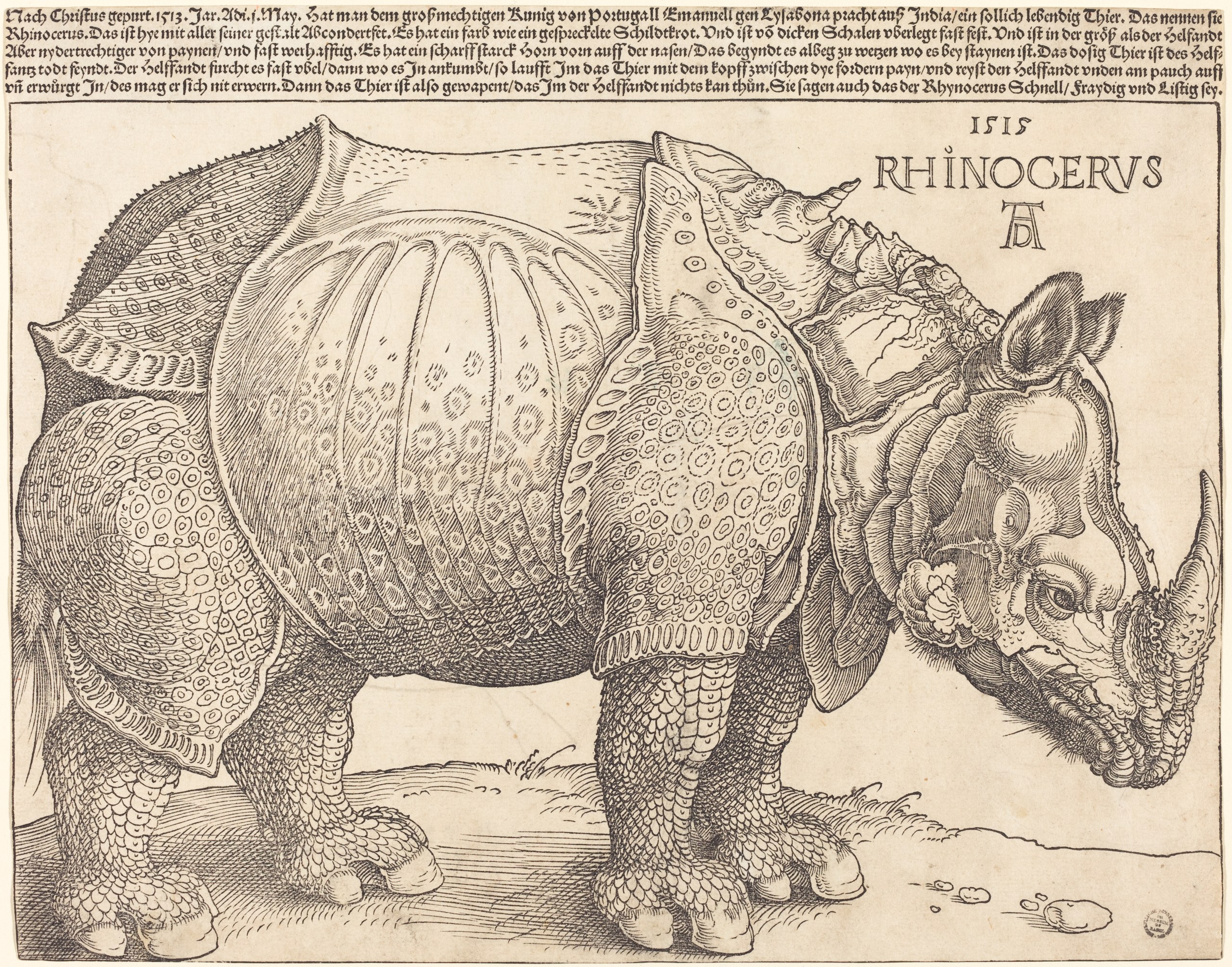
The whole body of work around them is vast: engravings above all, and then altarpieces, portraits of others and of himself, watercolour and books. In 1515, without ever setting eyes on the animal, he cut the woodblock of the rhinoceros, and his woodcut of it was copied many times over the three centuries that followed.
Known works
Knight, Death, and the Devil
Albrecht Dürer · 1513
Los Angeles County Museum of Art
A rider in full armour threads a narrow gorge on a great horse, his dog at his heel; Death on a pale mount holds up an hourglass and a goat-faced devil trots behind, but the knight looks straight ahead toward the city on the hill.
Self-Portrait
Albrecht Dürer · 1498
Museo del Prado
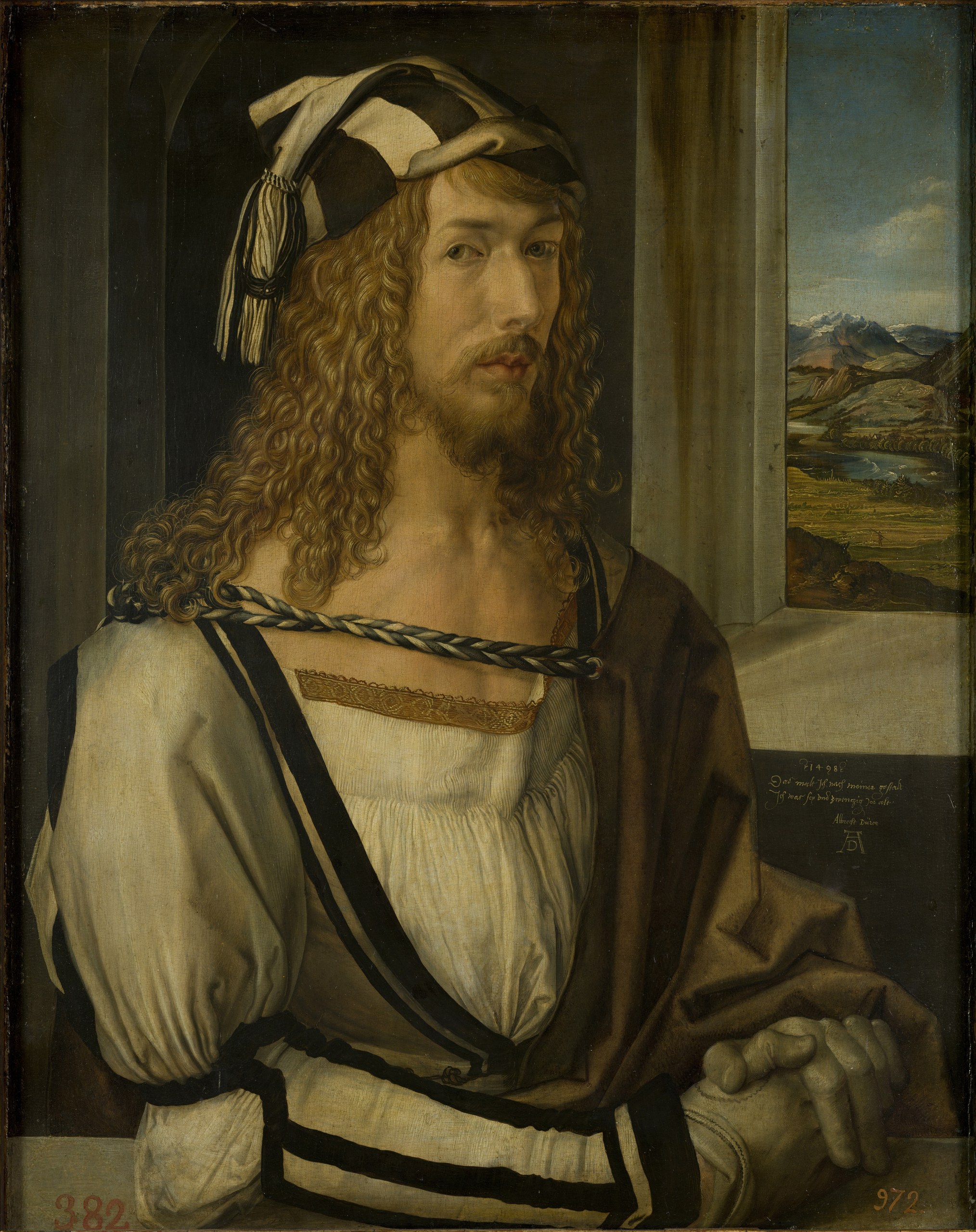
Self-Portrait. At twenty-six, after his first Italian journey, he shows himself half length under an arch, in rich gloves, hat nearly touching the top of the panel: the face of a young man certain of his rank among artists, painted like no northern face before it.
The Rhinoceros
Albrecht Dürer · 1512
British Museum
The Rhinoceros. The Indian beast in riveted plates, a small twisted horn on its back, drawn from a description and a sketch of the animal landed at Lisbon in 1515; the woodcut that stood for the species in Europe for generations, though Dürer never saw one.
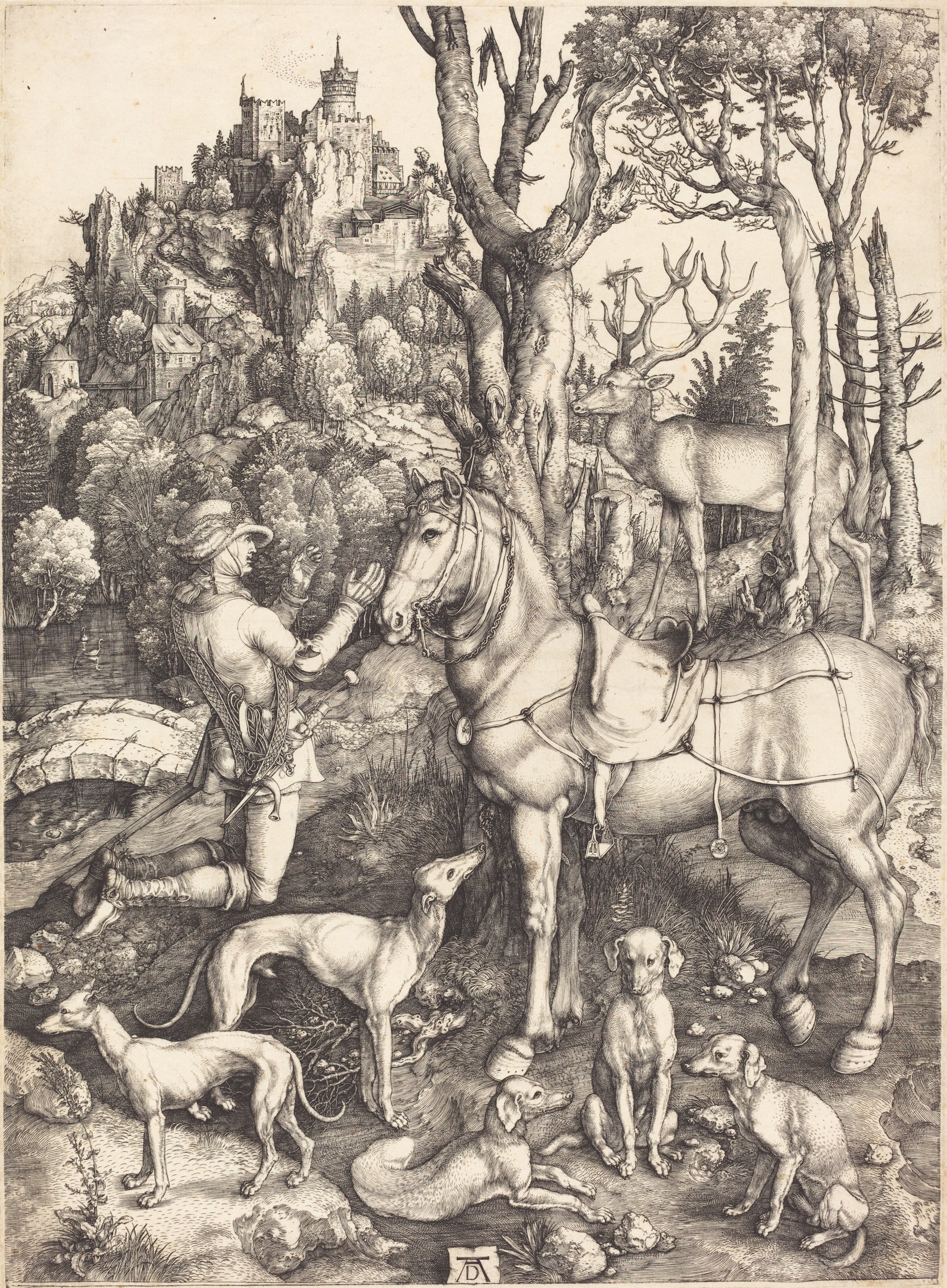
Saint Eustace
Albrecht Dürer · 1501
Museum of Fine Arts, Houston
Saint Eustace. The hunter kneels to a stag bearing a crucifix between its antlers while his horse and hounds wait; an engraving of about 1501 whose landscape and animals are cut in such detail that the whole wood reads like a world.
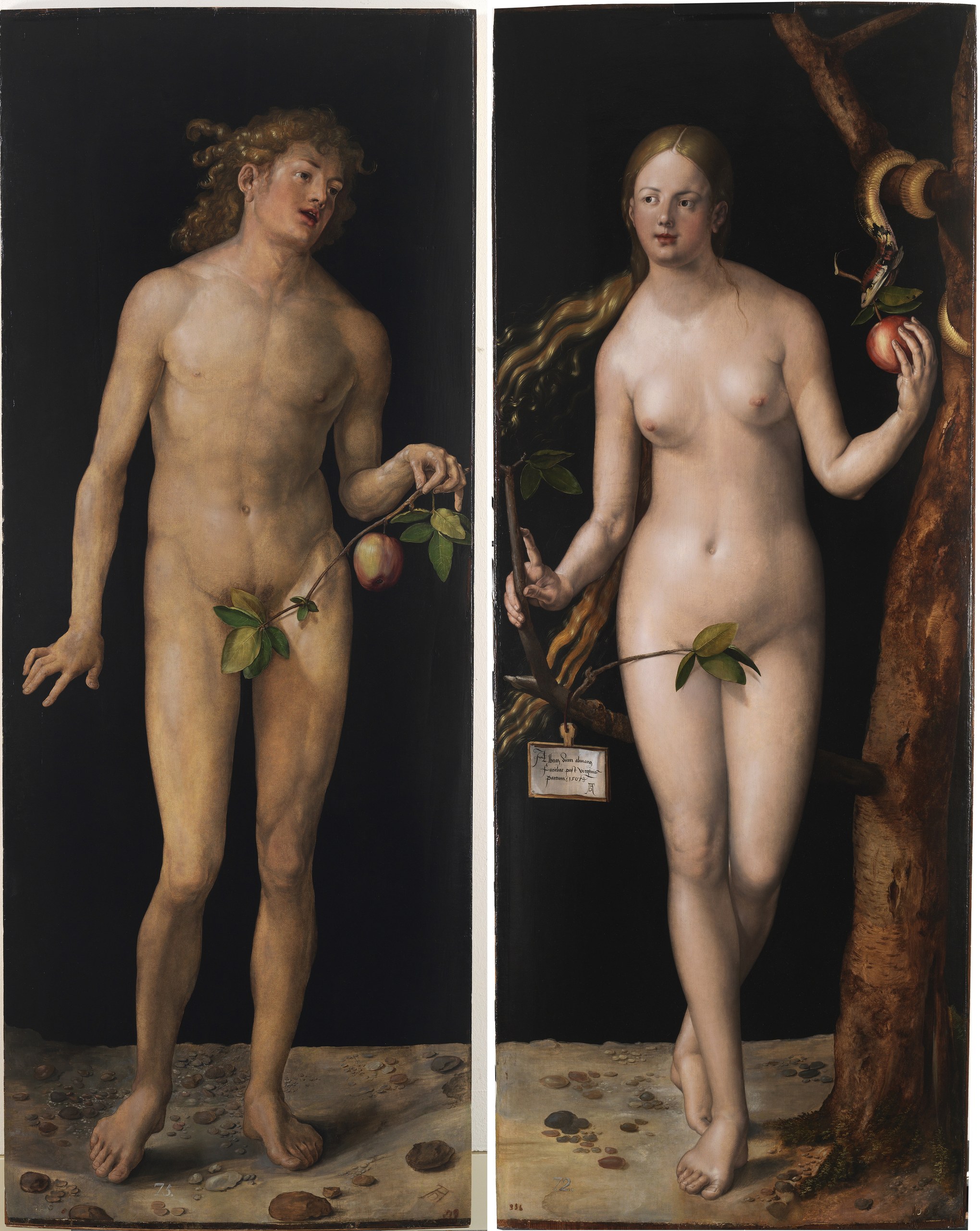
Adam and Eve
Albrecht Dürer · 1507
Museo del Prado
Adam and Eve. The pair of panels made at Nuremberg once he was back from Venice, the first nudes at full human scale in German painting; the bodies built on Italian proportion, the faces still wholly his own.
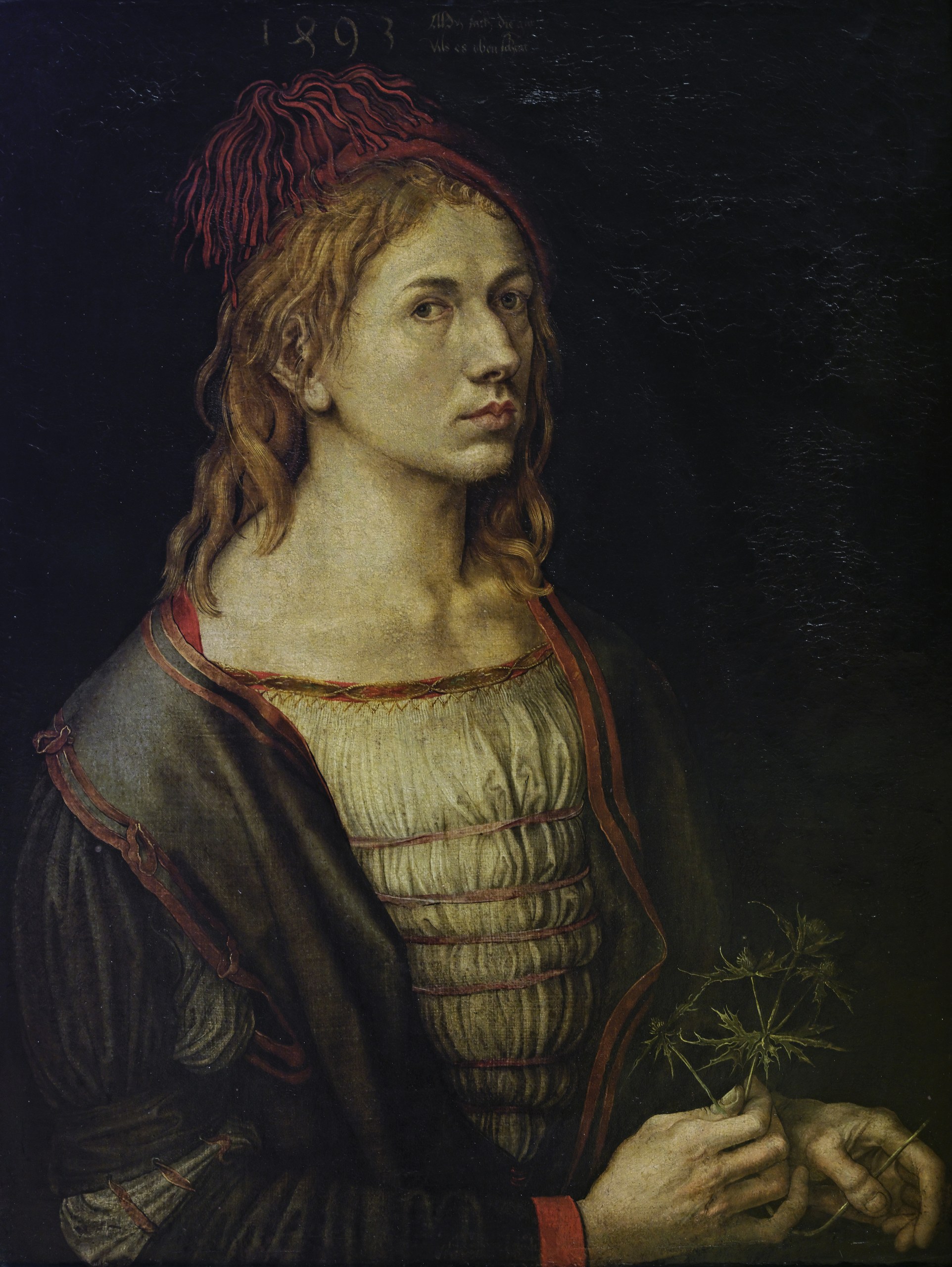
Portrait of the Artist Holding a Thistle
Albrecht Dürer · 1493
Louvre
Portrait of the Artist Holding a Thistle. The earliest of his painted self-portraits, made at twenty-two: long hair, a tight green jacket, and a sprig of thistle held up like a pledge, the flower then read as a promise of faithfulness to a bride.
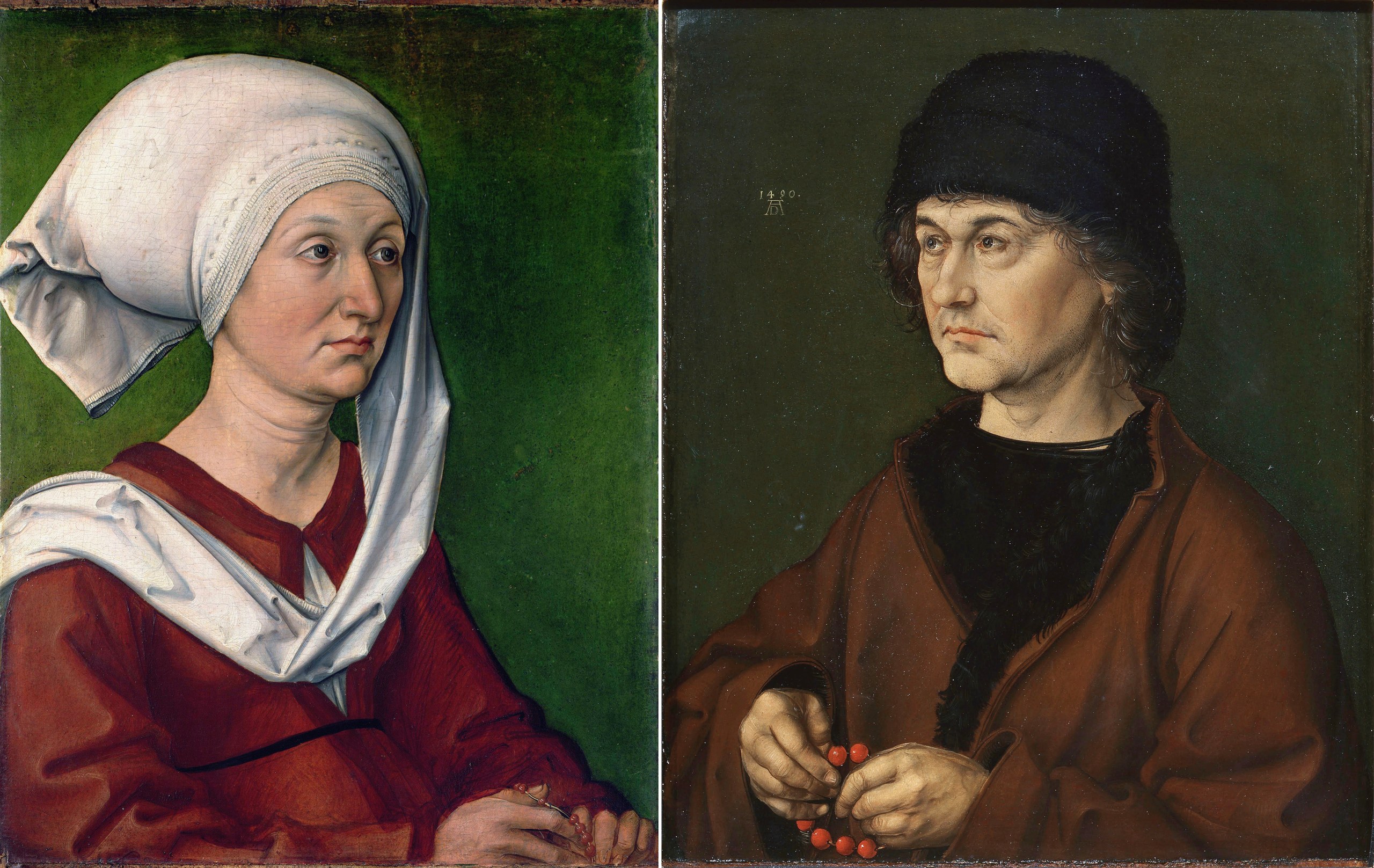
Portrait Diptych of Dürer's Parents
Albrecht Dürer · 1490
Uffizi Gallery
Portrait Diptych of Dürer's Parents. His mother near thirty-nine and his father at sixty-three, set down without one softening stroke; among the most exact and unflinching records of age a painter ever made of his own family.
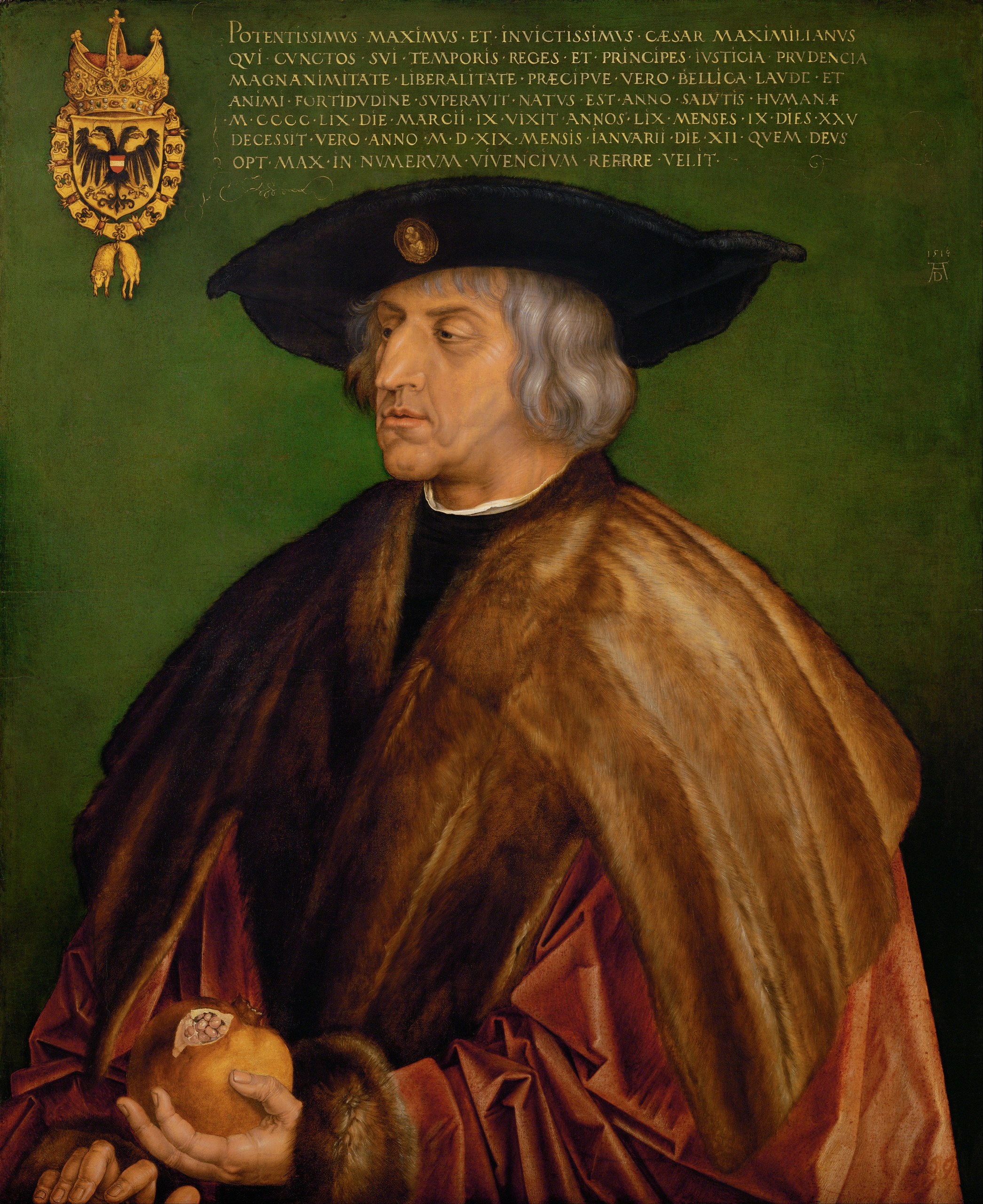
Emperor Maximilian I
Albrecht Dürer · 1519
Kunsthistorisches Museum
Emperor Maximilian I. The emperor in fur cap and heavy gold chain against a pale ground, painted after the sitting at Augsburg in 1518; the patron who kept Dürer at a pension, given the plain face of a tired, sharp man.
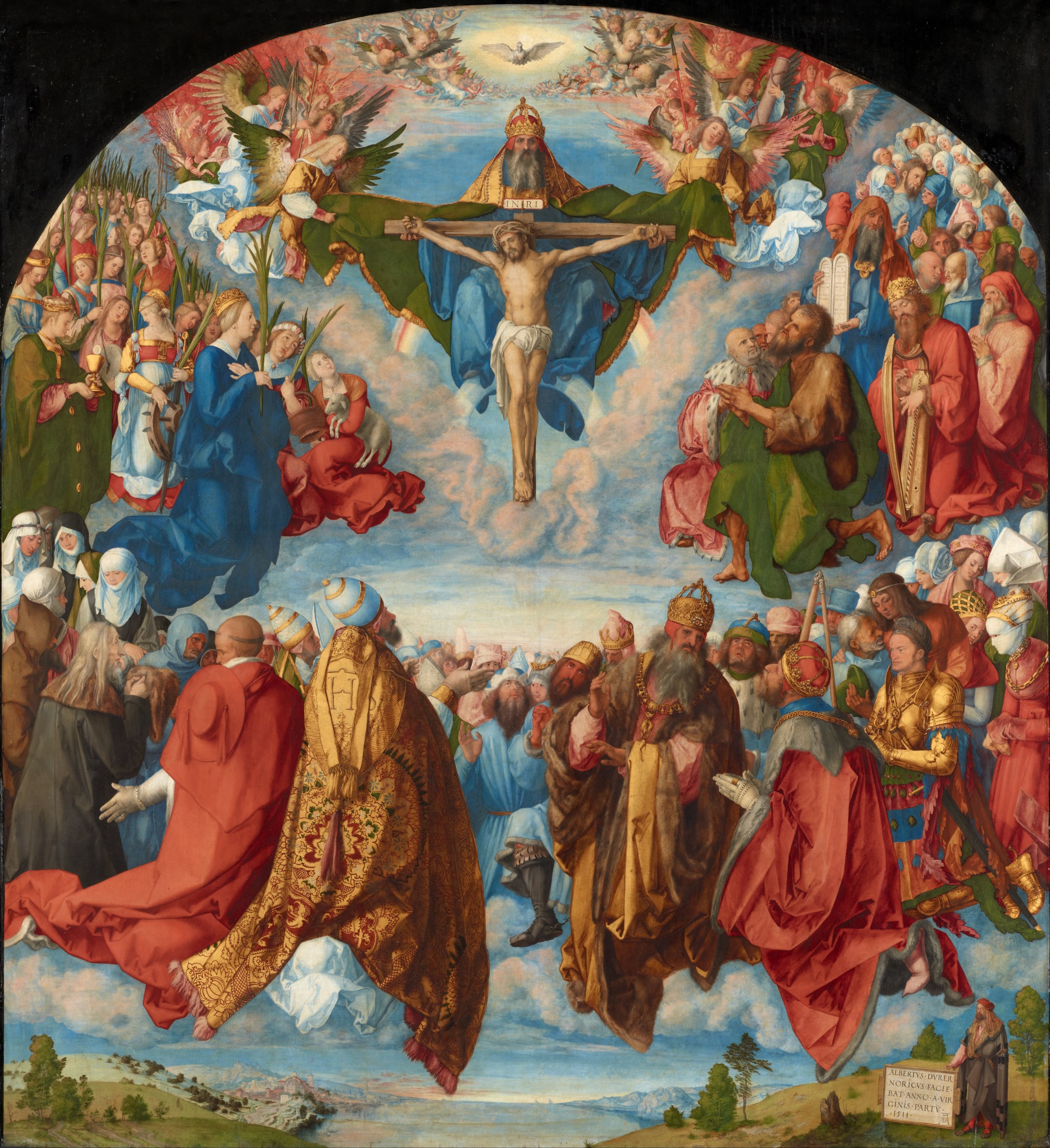
Adoration of the Trinity
Albrecht Dürer · 1511
Kunsthistorisches Museum
Adoration of the Trinity. The whole heaven in tiers above a crowded earth, painted in 1511 for a Nuremberg merchant's chapel in a house that sheltered twelve aged artisans; the sum of everything Dürer could hold on one panel.
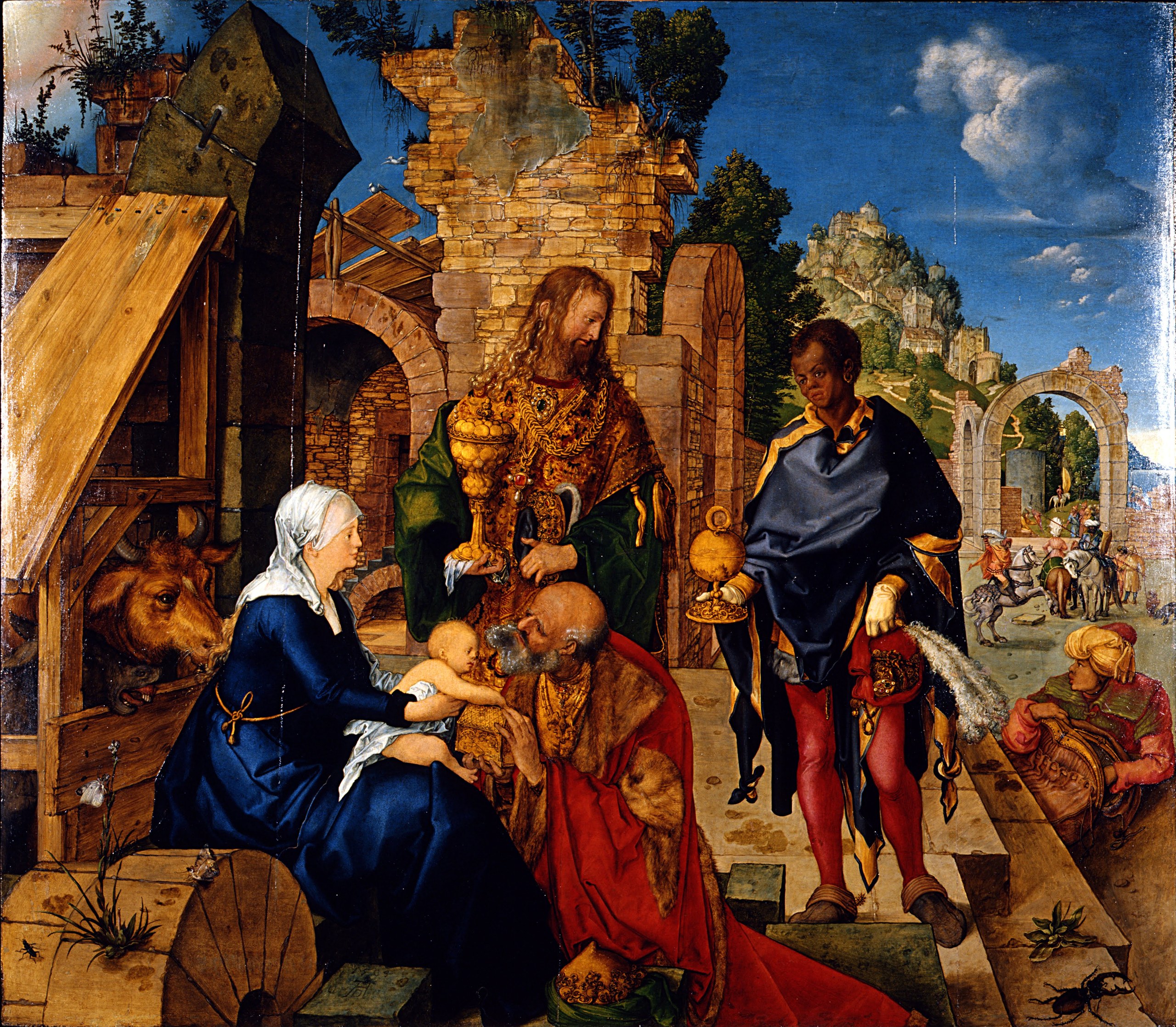
Adoration of the Magi
Albrecht Dürer · 1504
Uffizi Gallery
Adoration of the Magi. The kings and their train crowding to the Virgin under a ruin, painted for Frederick the Wise at Wittenberg; the panel where northern detail and Italian calm first sat down together, a picture Wölfflin called the first fully lucid painting in German art.
More to discover
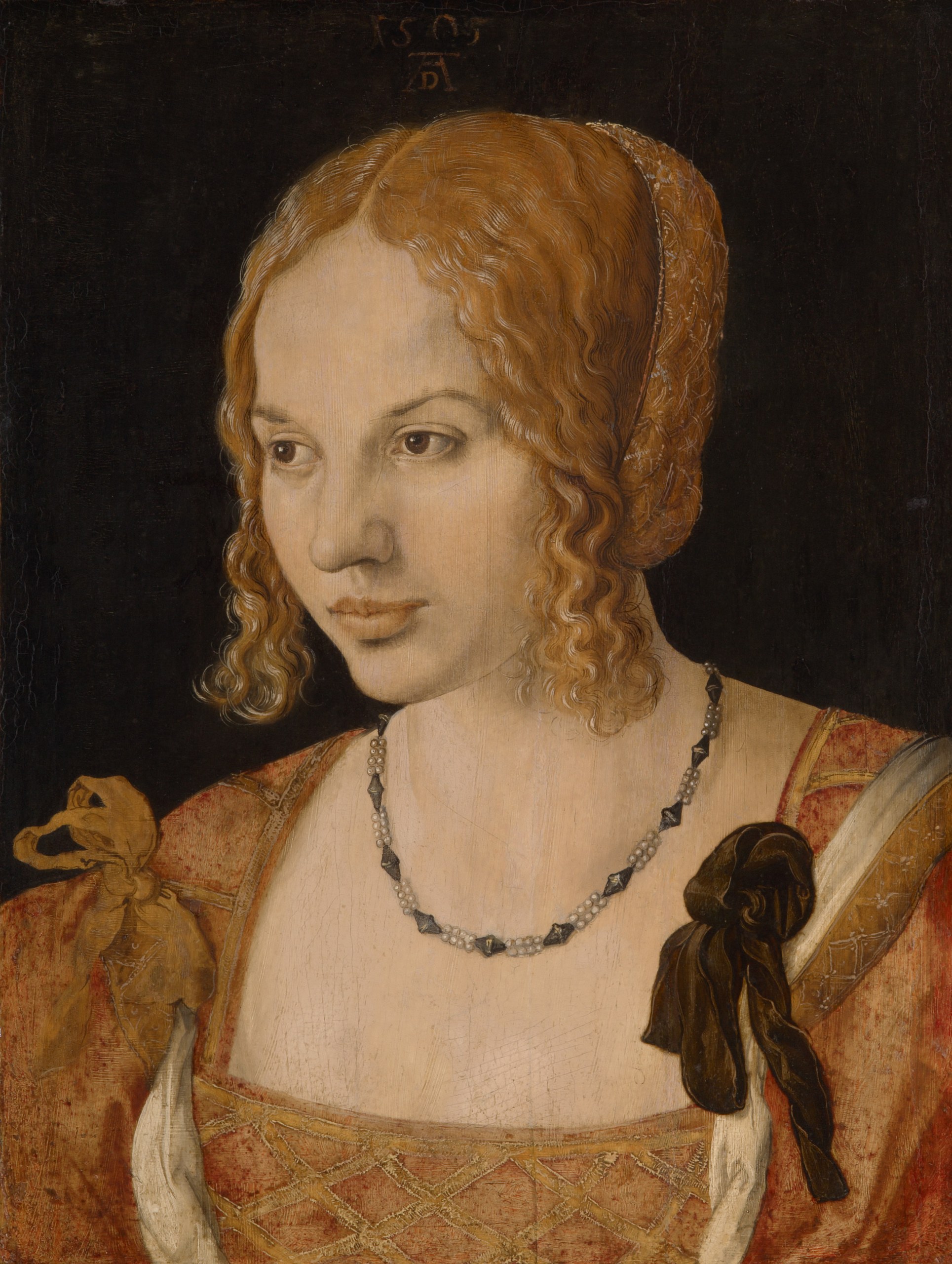
Portrait of a Venetian Woman
Albrecht Dürer · 1505
Kunsthistorisches Museum
Portrait of a Venetian Woman. A bust-length young woman against flat black, her patterned dress and pale skin set off by soft waves of reddish hair; painted on his second Italian journey in 1505, one of the society portraits that trip paid for.
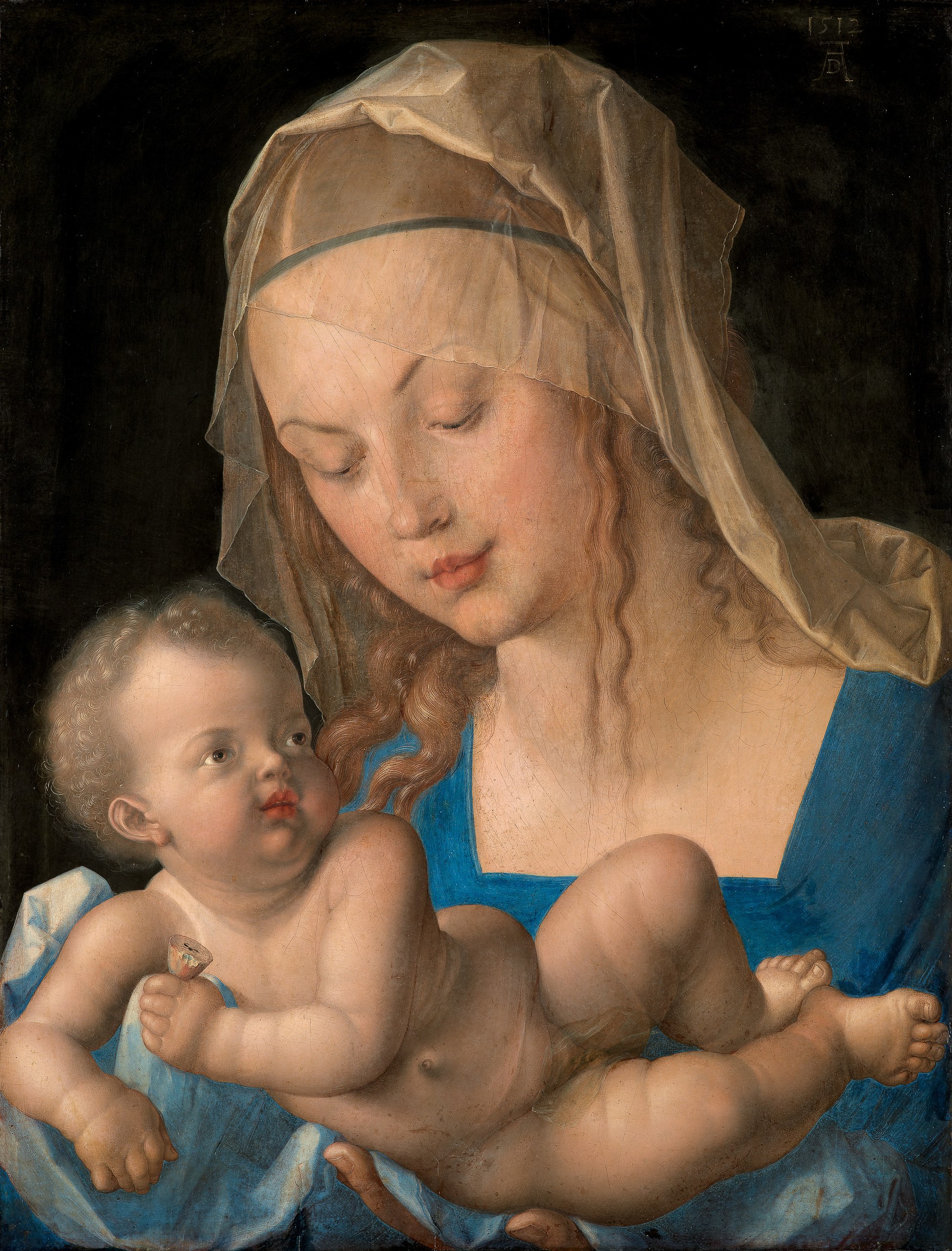
Mary and Child
Albrecht Dürer · 1512
Kunsthistorisches Museum
Mary and Child. The Virgin with the child on her arm before a plain green ground, the two faces close together, drawn in the firm, gentle line of his Nuremberg years.
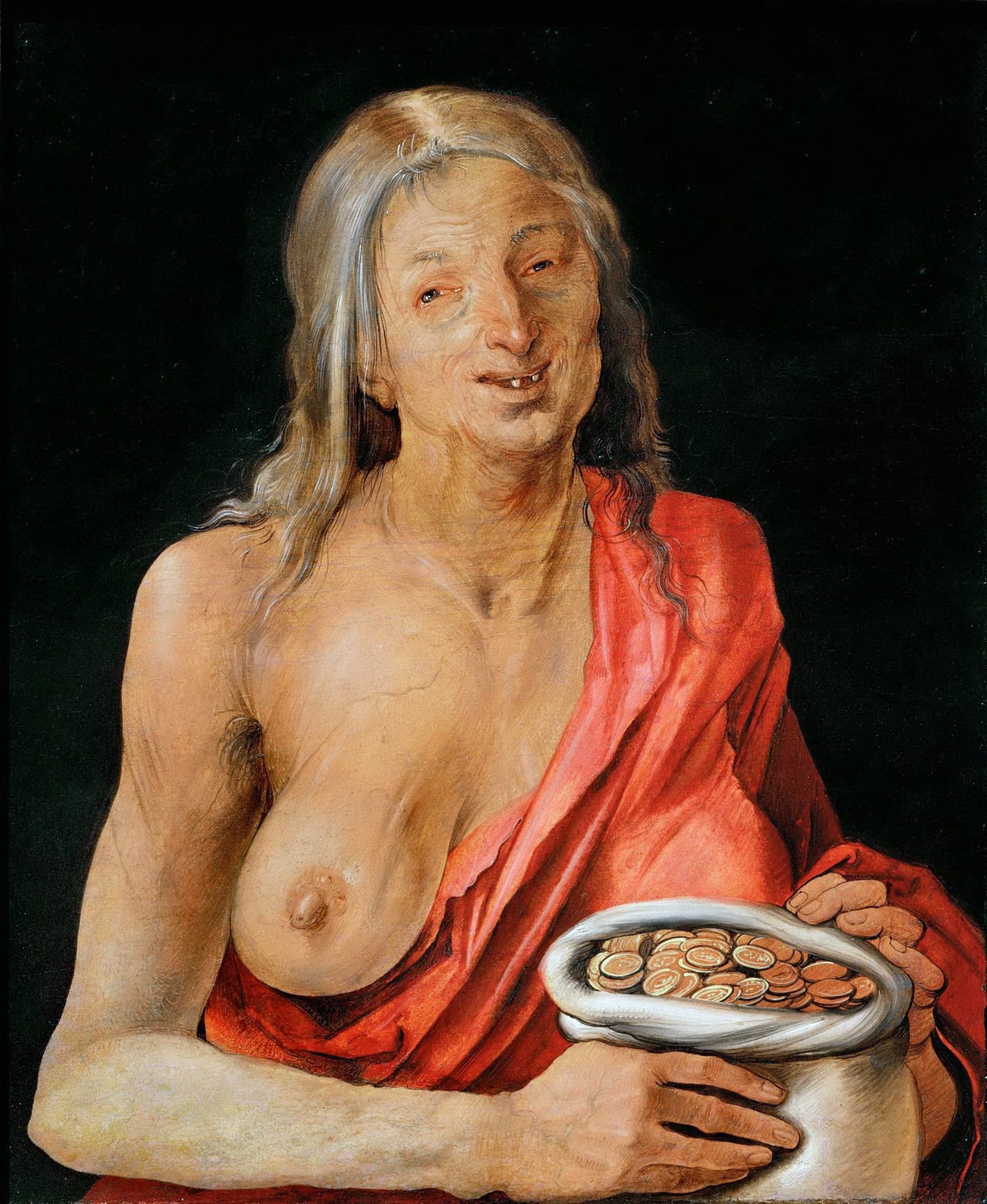
Avarice
Albrecht Dürer · 1507
Kunsthistorisches Museum
Avarice. An old woman counting coins, her blond hair and noble bone structure at war with glazed eyes and a mouth of two teeth; a small panel of 1507 on the back of a portrait, warning that youth and fortune both run out. It hangs, in the literature, beside Melencolia among his meditations on vanitas.
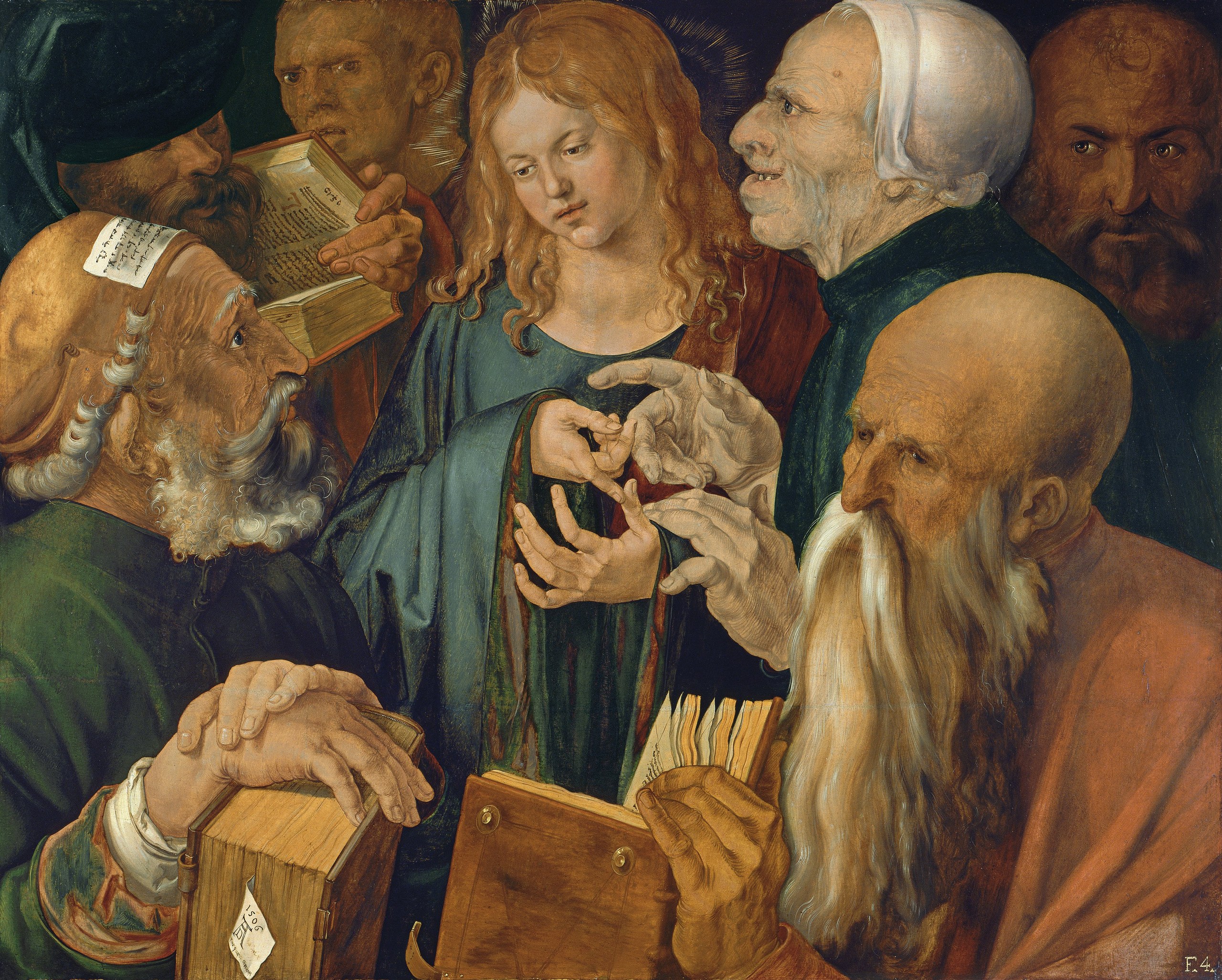
Christ Among the Doctors
Albrecht Dürer · 1506
Thyssen-Bornemisza Museum
Christ Among the Doctors. The twelve-year-old Christ boxed in by four elderly scholars, every face a separate study in suspicion or wonder; painted in Venice in 1506 and, by its own inscription, done in five days alongside the great Rosary altarpiece.
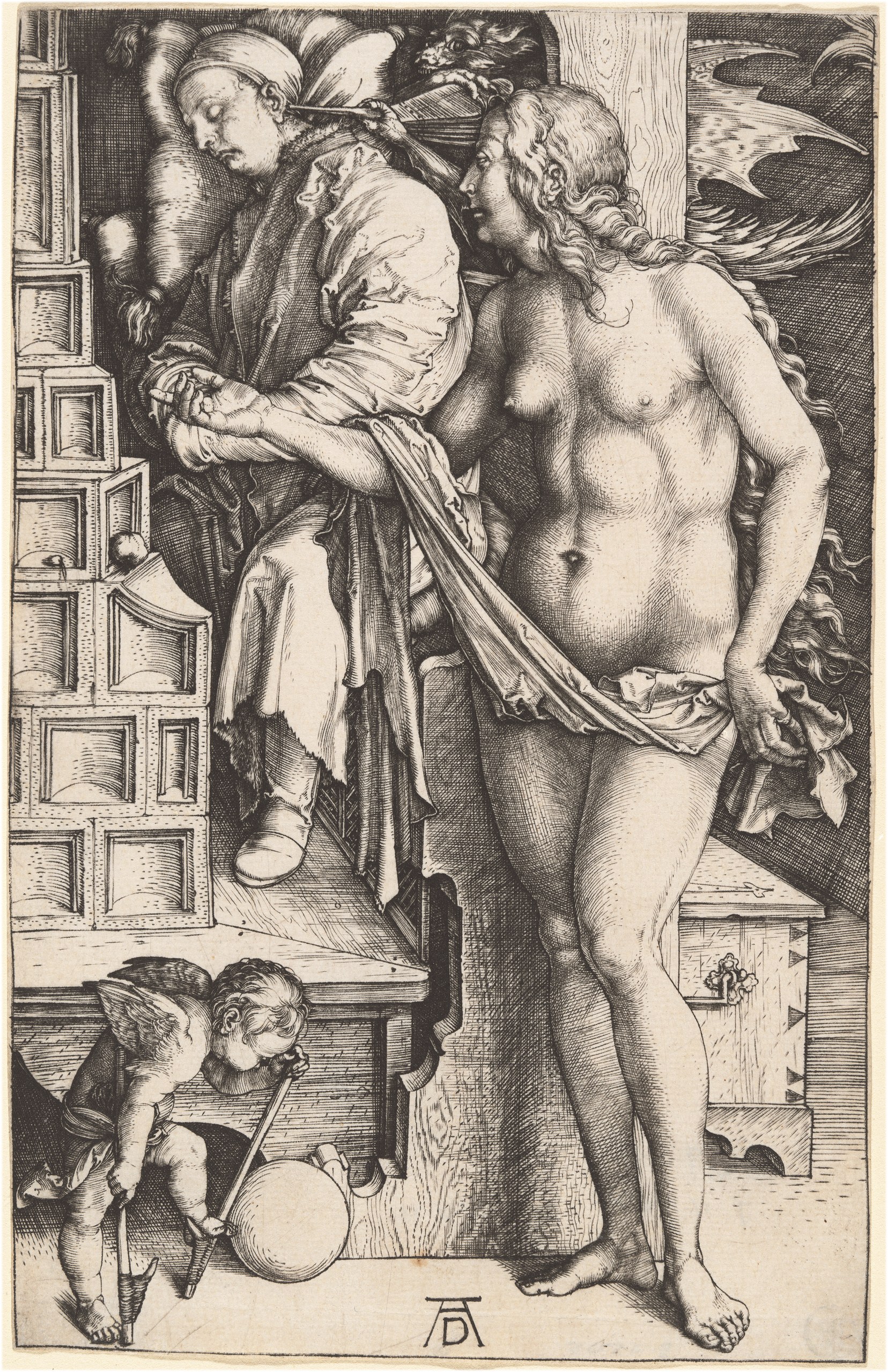
The Dream of the Doctor
Albrecht Dürer · 1498
National Museum of Art, Architecture and Design
The Dream of the Doctor. A scholar sunk in sleep while a nude woman stands over him and a small devil fans the air toward the pair; a moral riddle cut in pure line, of the kind his engravings made their own.
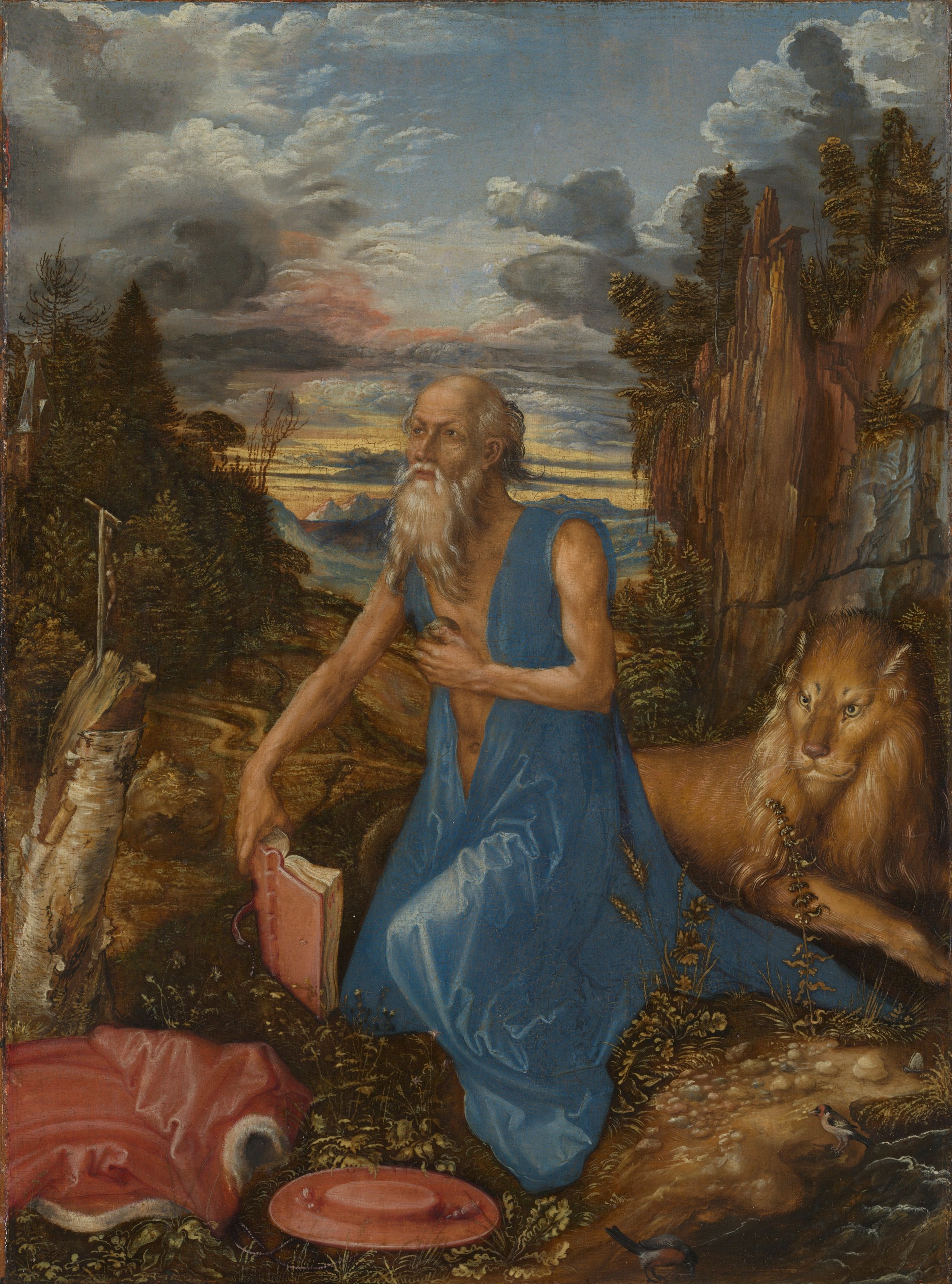
St. Jerome in the Wilderness
Albrecht Dürer · 1496
National Gallery
St Jerome in the Wilderness. A double-sided panel of about 1496: the hermit with his lion on one face, and on the reverse a strange blazing body in the sky that may be a comet or a meteorite actually observed, decades before such things were admitted as sightings.
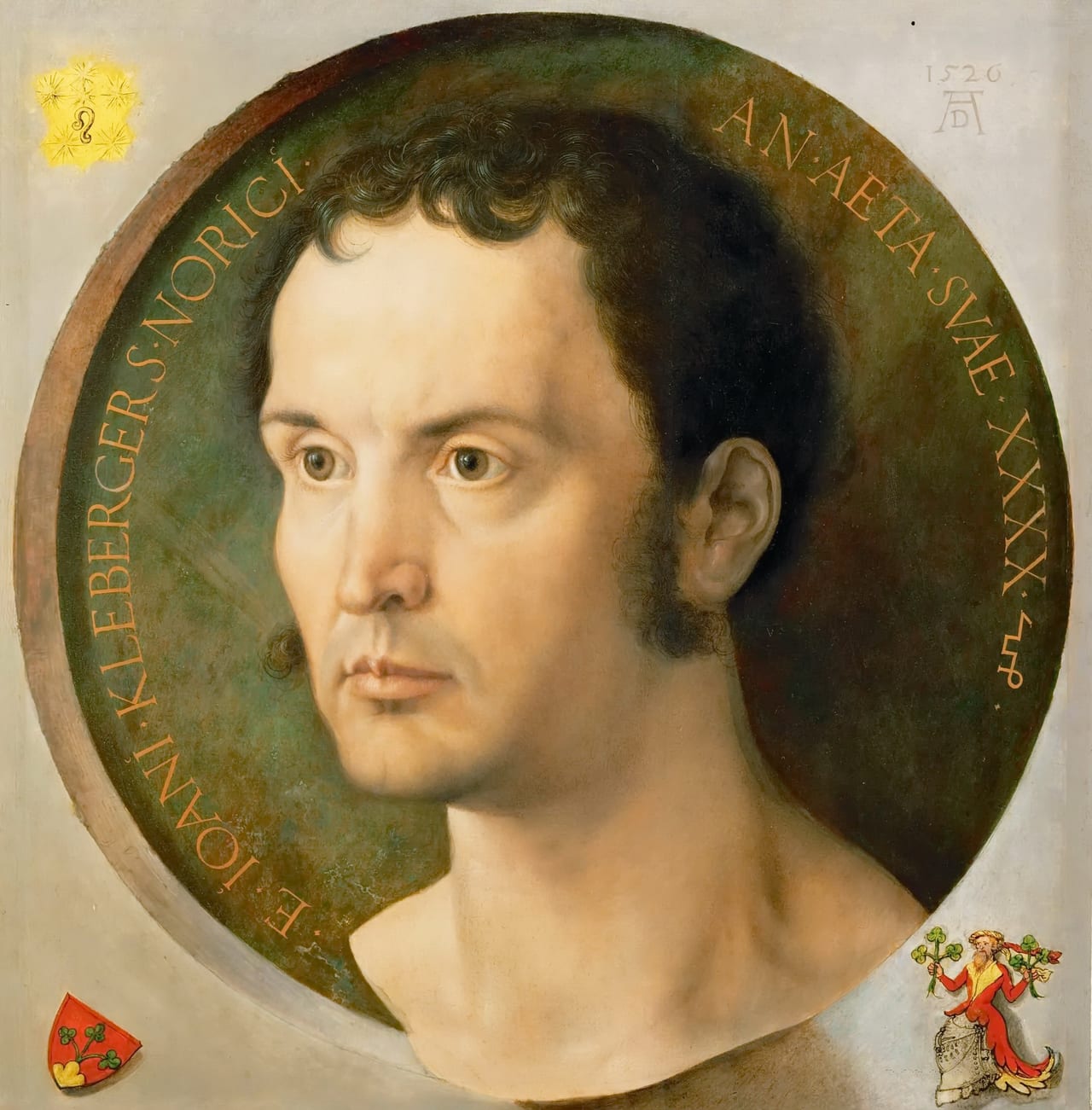
Portrait of Johann Kleberger
Albrecht Dürer · 1526
Kunsthistorisches Museum
Portrait of Johann Kleberger. A Nuremberg merchant of 1526 in three-quarter profile against a stone slab and open sky, the head carved out of the panel like a Roman medallion; one of the last portraits, ancient in air and modern in eye.
![Lot and His Daughters [reverse]](https://art.momentable.art/momentable/nga/41599_w2560.jpg)
Lot and His Daughters [reverse]
Albrecht Dürer
National Gallery of Art
Lot and His Daughters [reverse]. The old story of Lot and his daughters painted on the back of a portrait panel, the biblical scene turned away from the wall, so that a painting hides as much as it shows.
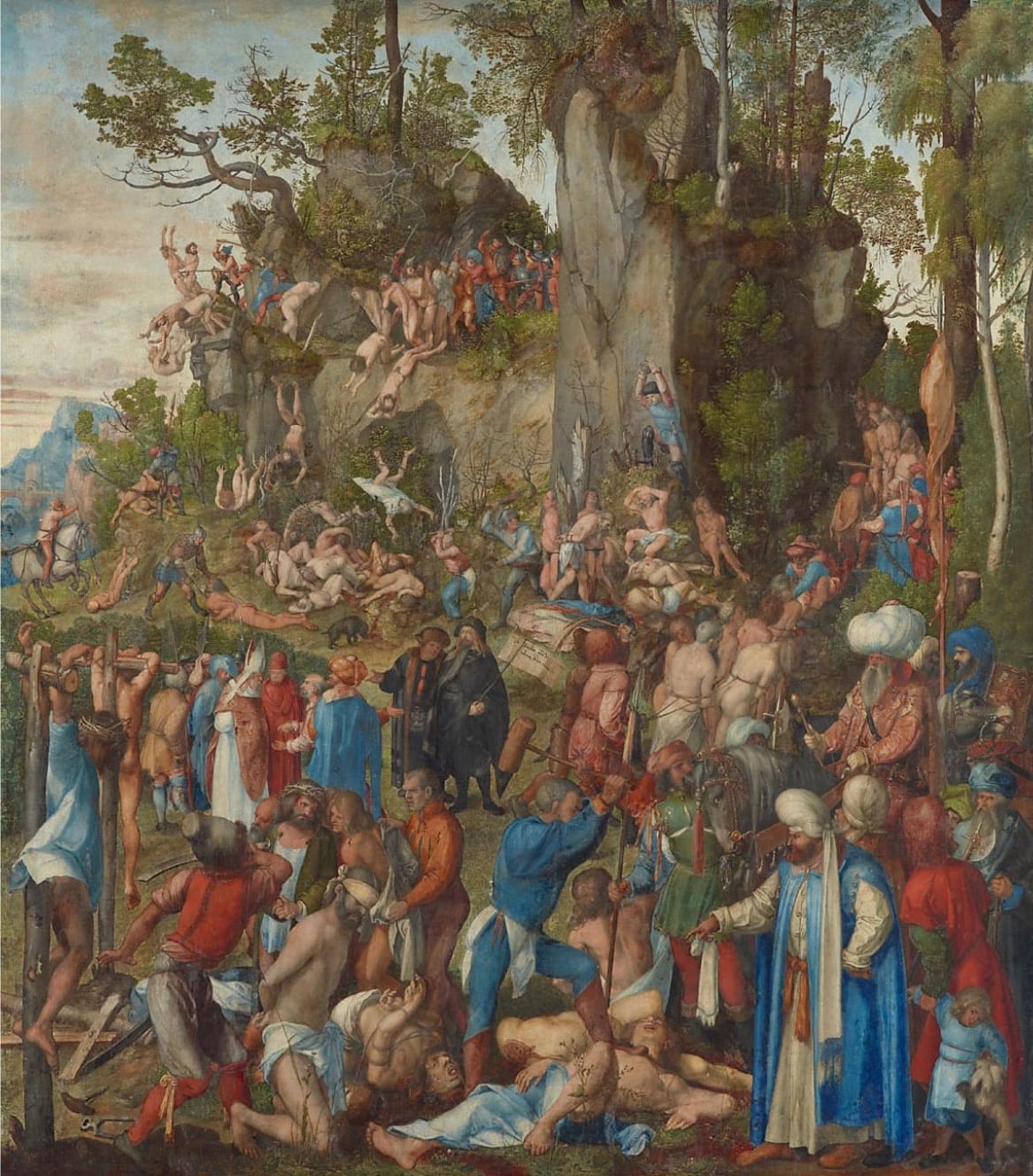
Martyrdom of the Ten Thousand
Albrecht Dürer · 1508
Kunsthistorisches Museum
Martyrdom of the Ten Thousand. A hillside of executions painted in 1508 for Frederick the Wise of Saxony, who chose the subject from relics in his own collection; the painter steps into the middle of the scene to sign it himself.
Sources
- Wikipedia, “Albrecht Dürer”
- Wikipedia, “Knight, Death and the Devil”
- Wikipedia, “Melencolia I”
- Wikipedia, “Self-Portrait (Dürer, Madrid)”
- Wikipedia, “Dürer's Rhinoceros”
- Wikipedia, “Adam and Eve (Dürer)”
- Wikipedia, “Portrait of the Artist Holding a Thistle”
- Wikipedia, “Portrait Diptych of Dürer's Parents”
- Wikipedia, “Portrait of Emperor Maximilian I”
- Wikipedia, “Adoration of the Trinity”
- Wikipedia, “Martyrdom of the Ten Thousand”
- Wikipedia, “Portrait of a Venetian Woman”
- Wikipedia, “Avarice (Dürer, Vienna)”
- Wikipedia, “Christ Among the Doctors (Dürer)”
- Wikipedia, “St. Jerome in the Wilderness (Dürer)”
- Wikipedia, “Portrait of Johann Kleberger”
- Wikipedia, “Adoration of the Magi (Dürer)”
Invite Albrecht Dürer into your living room
Play 21 works from this collection on your TV, phone or tablet with Momentable Art TV.