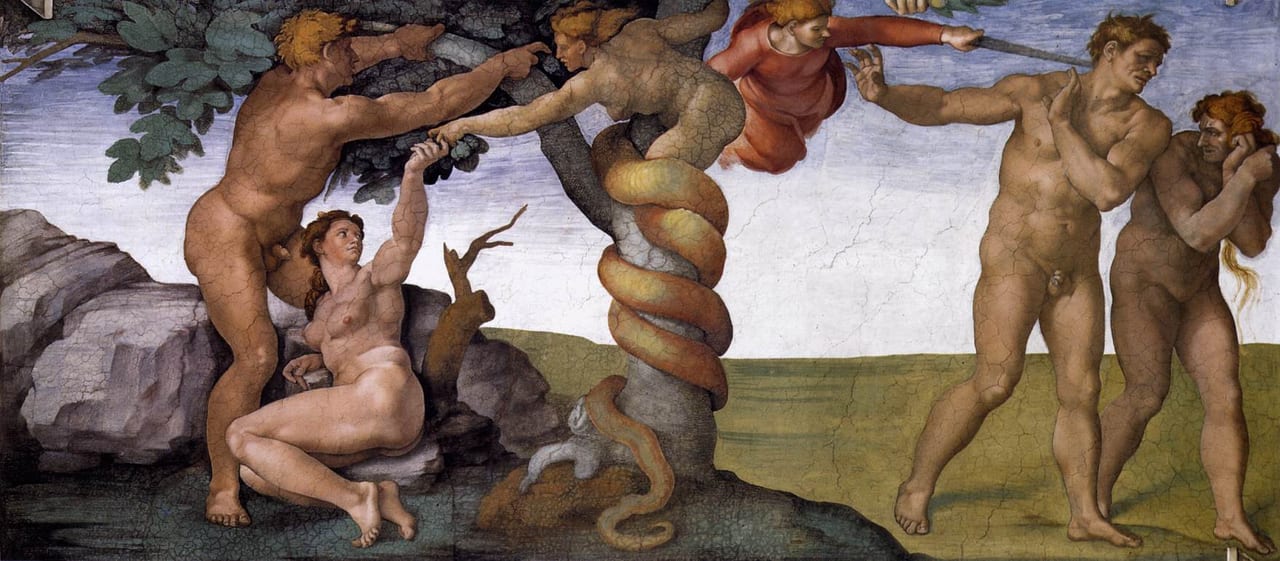
The Creation of Adam
Michelangelo · 1511

Michelangelo
Republic of Florence · 1475–1564
A Florentine who did not count himself a painter and painted, all the same, the most famous ceiling on earth.
Play 34 works from this collection on your TV, phone or tablet with Momentable Art TV.
Play CollectionThe sculptor first
Michelangelo Buonarroti, painter on panel and in fresco, carver, builder and writer of sonnets, was the first artist his own contemporaries hailed as a genius; it was said of him, while he lived, that he had outdone the ancients. Born at Caprese in 1475, he learned painting from Ghirlandaio and carving in the garden of Lorenzo de' Medici, and by 1496 he was in Rome shaping the Pietà for Saint Peter's.
Fame came absurdly early: the Pietà and the giant David were both finished before he turned thirty. Back in Florence from 1501 he opened more projects than any man could close, until in 1505 Julius II called him to Rome for the tomb that would shadow the rest of his life.
The ceiling he did not want
In 1508 the same pope set him on the vault of the Sistine Chapel, work he took on though he never counted himself a painter, and carried it, with escapes to Florence, to 1512. Down the middle run nine scenes from Genesis, the making of the world to the shame of Noah; around them sit seven prophets of Israel and five pagan sibyls, all of whom were held to have foretold Christ, with nudes, medallions and the ancestors of Jesus between.
The scheme was applauded at once, and its teeming, twisting bodies and riot of colour are the soil the Mannerist style grew out of. Michelangelo's own view of the matter stayed what it had been: a carver held hostage to a brush, whose painted figures behave like marble reliefs seen from below.
The altar wall and after
A generation later, from 1536 to 1541, he returned to the same room and covered the wall behind the altar with the Second Coming: Christ sentencing, the dead climbing and tumbling to their several ends, nearly everyone painted naked and many of them later covered by painted draperies. He was almost sixty-seven when it was done.
His last fresco, the Crucifixion of Saint Peter, went onto the wall of the pope's own chapel, the Paolina, for Paul III. And the painting that opens a window on the young man is a panel: the unfinished Entombment in London, abandoned in 1501 when Florence offered him the block of marble that became David.
Known works
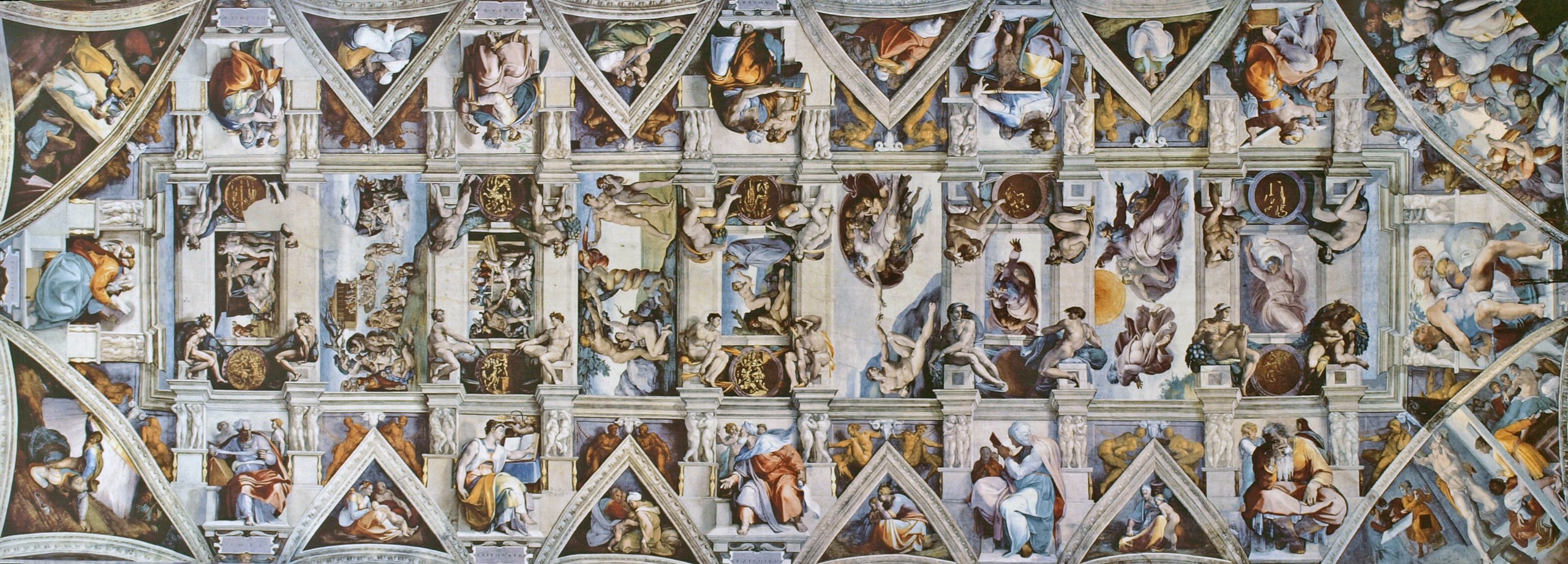
Sistine Chapel ceiling
Michelangelo · 1508
Vatican Museums
The whole vault of 1508 to 1512 for Julius II: Genesis in nine panels, prophets and sibyls enthroned at the sides, Christ's forbears waiting in the dim lunettes. Painting's highest mark, from a man who insisted he was not a painter.
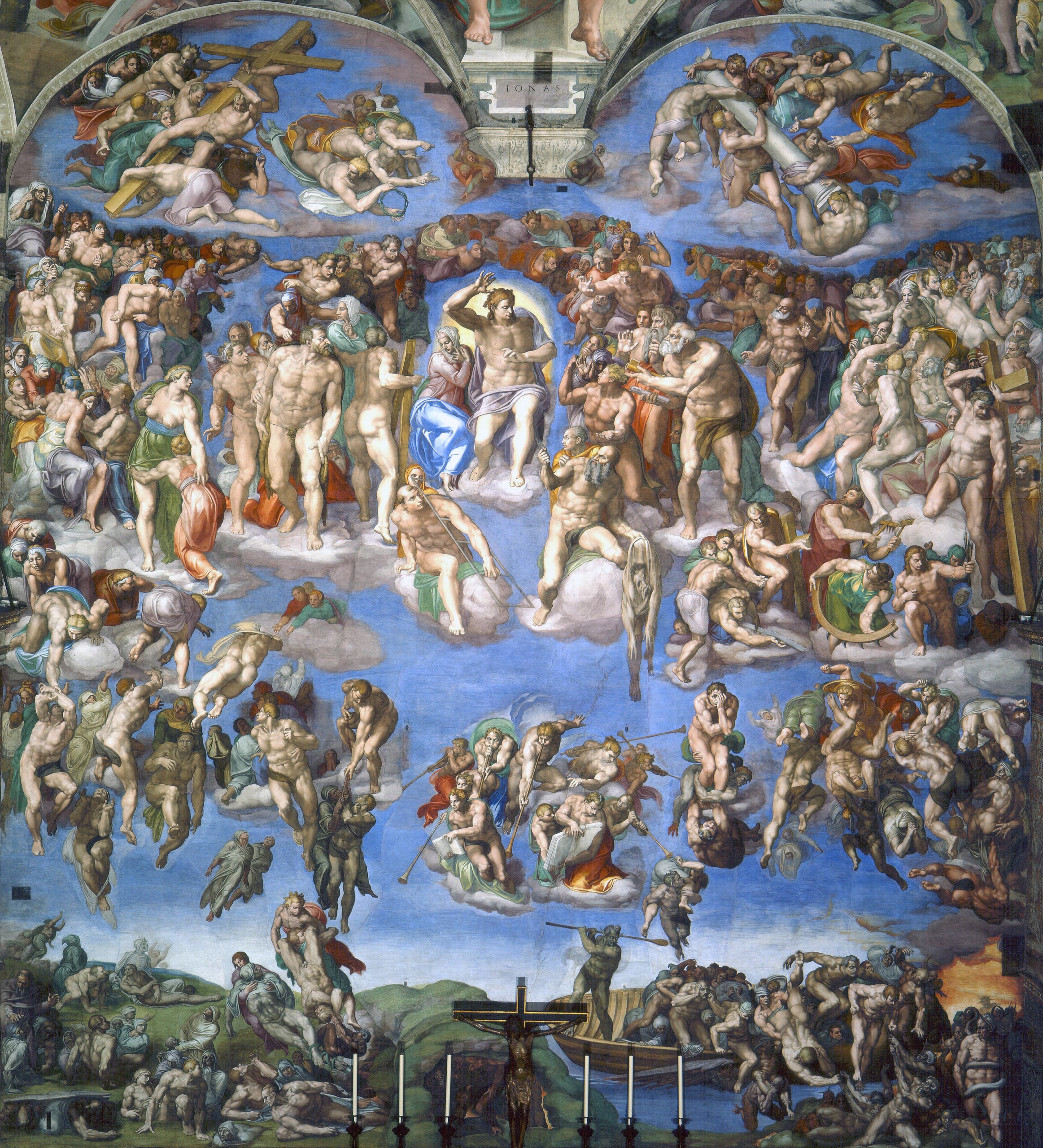
The Last Judgment
Michelangelo · 1536–1541
Vatican Museums
The chapel's altar wall, taken up twenty-five years after the ceiling: Christ the judge at the centre, saints packed around him, the raised dead swirling to heaven or down. Most of the crowd was painted nude; painted draperies were added later over many of them.
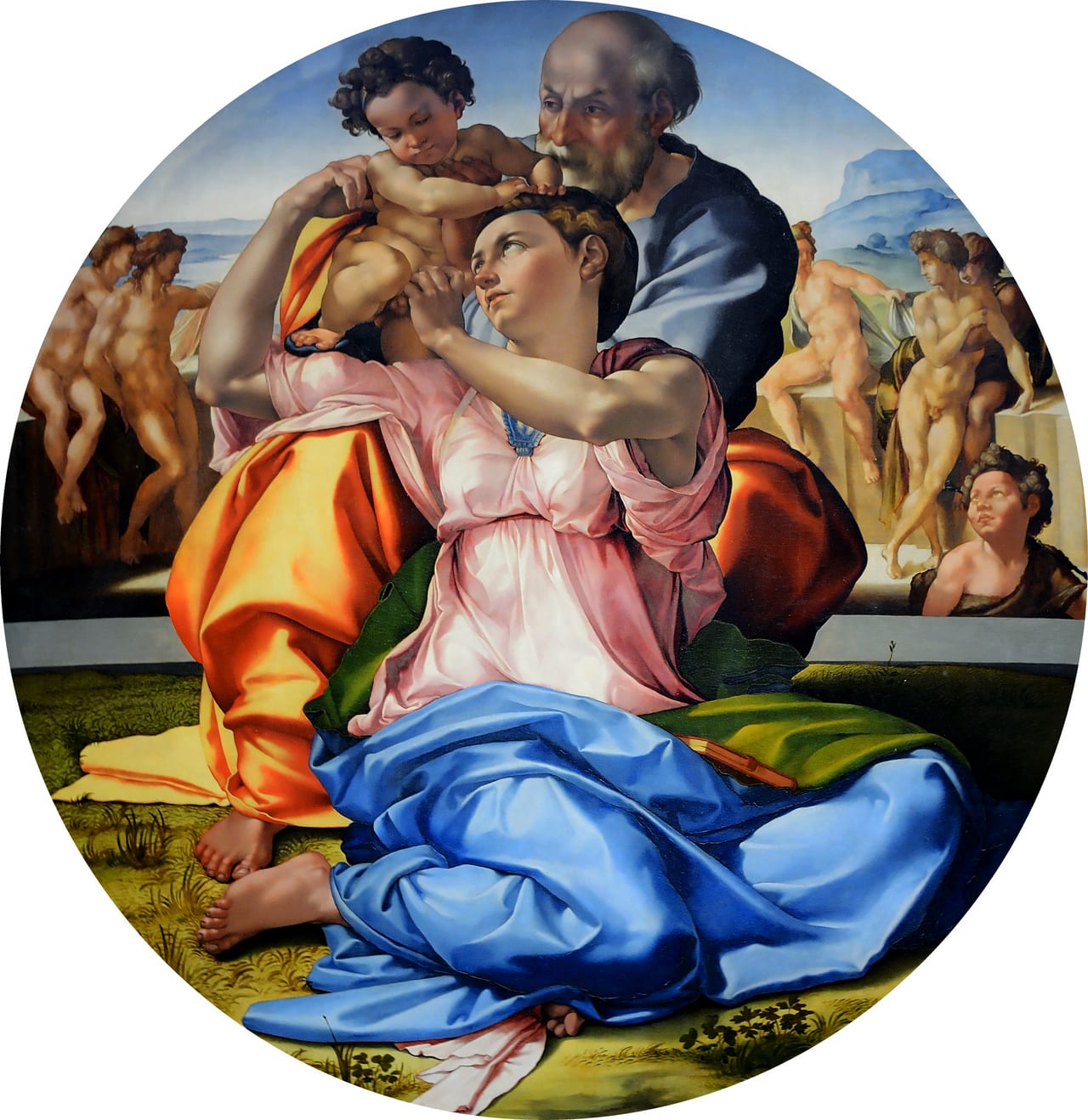
Doni Tondo
Michelangelo · 1505–1506
Uffizi Gallery
The Holy Family locked in a spiral of limbs, the little Baptist and five naked youths behind, the panel still sitting in the frame carved for it. Agnolo Doni likely ordered it for his marriage; it is the one finished movable painting of his maturity that survives.
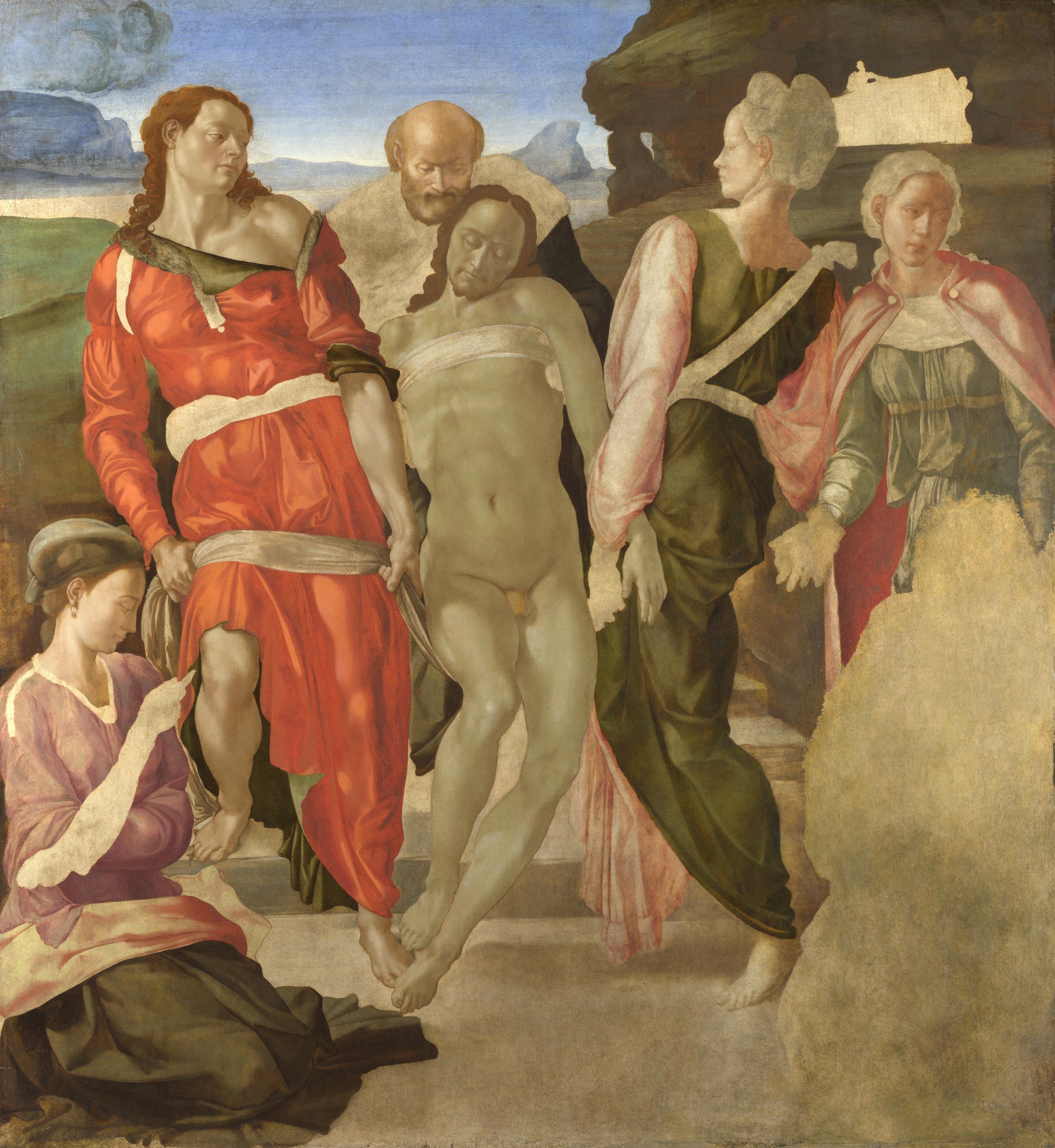
The Entombment
Michelangelo · 1500
National Gallery
Christ's body held upright toward the viewer as the bearers climb to the rock tomb, a panel left unfinished in 1501 when he walked away to Florence and the David marble. Perhaps three paintings on panel by him exist; this is one, though some scholars hand it to a pupil working from his design.
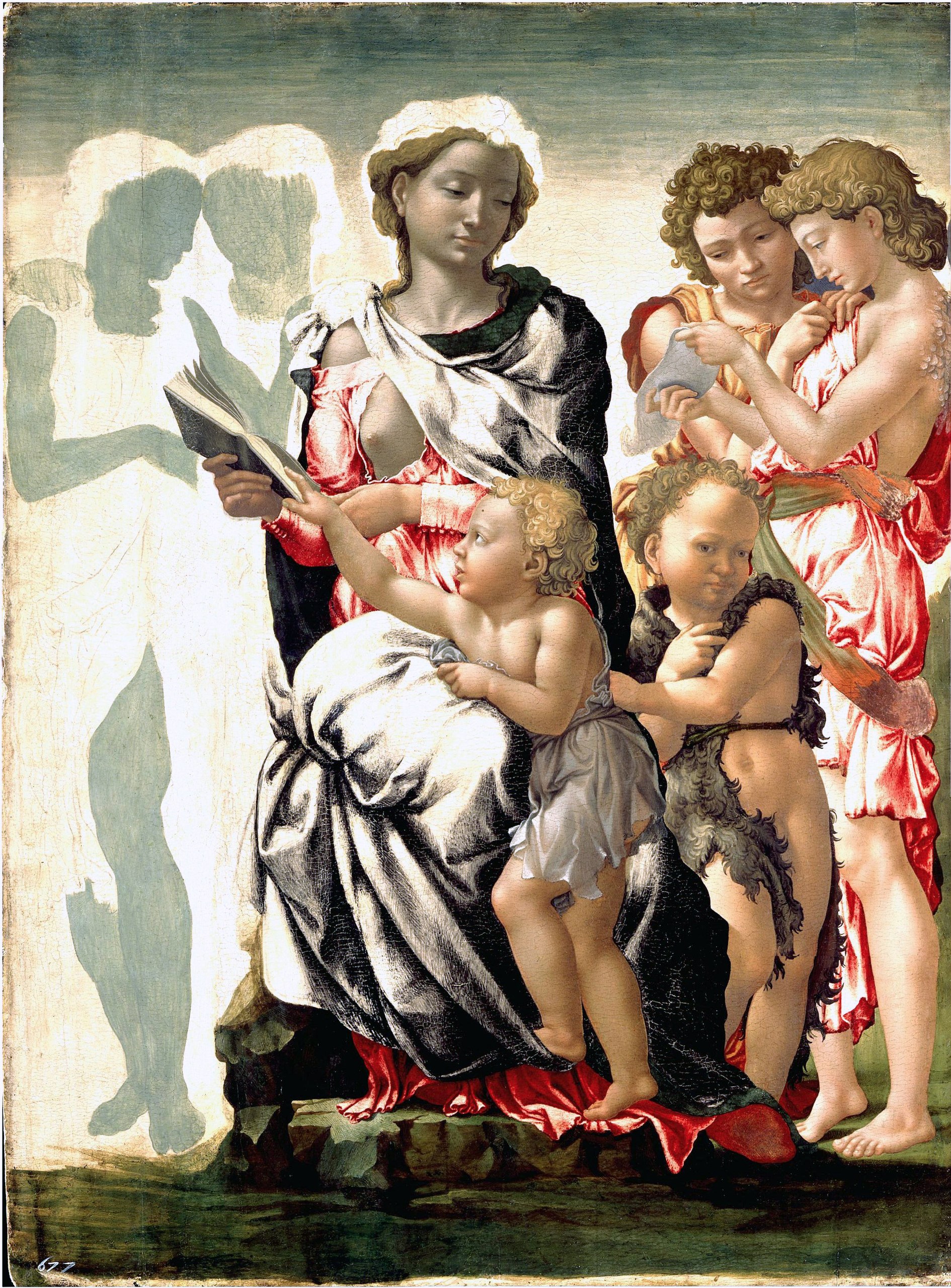
Manchester Madonna
Michelangelo · 1494
National Gallery
Probably his earliest surviving picture: Mary with a breast bared from nursing, turning to the scroll two angels read, the Christ child reaching for it. The Virgin's cloak never got its final coats of blue and the left-hand angels are ghosts; he laid each figure to completion in turn, like a tempera painter.
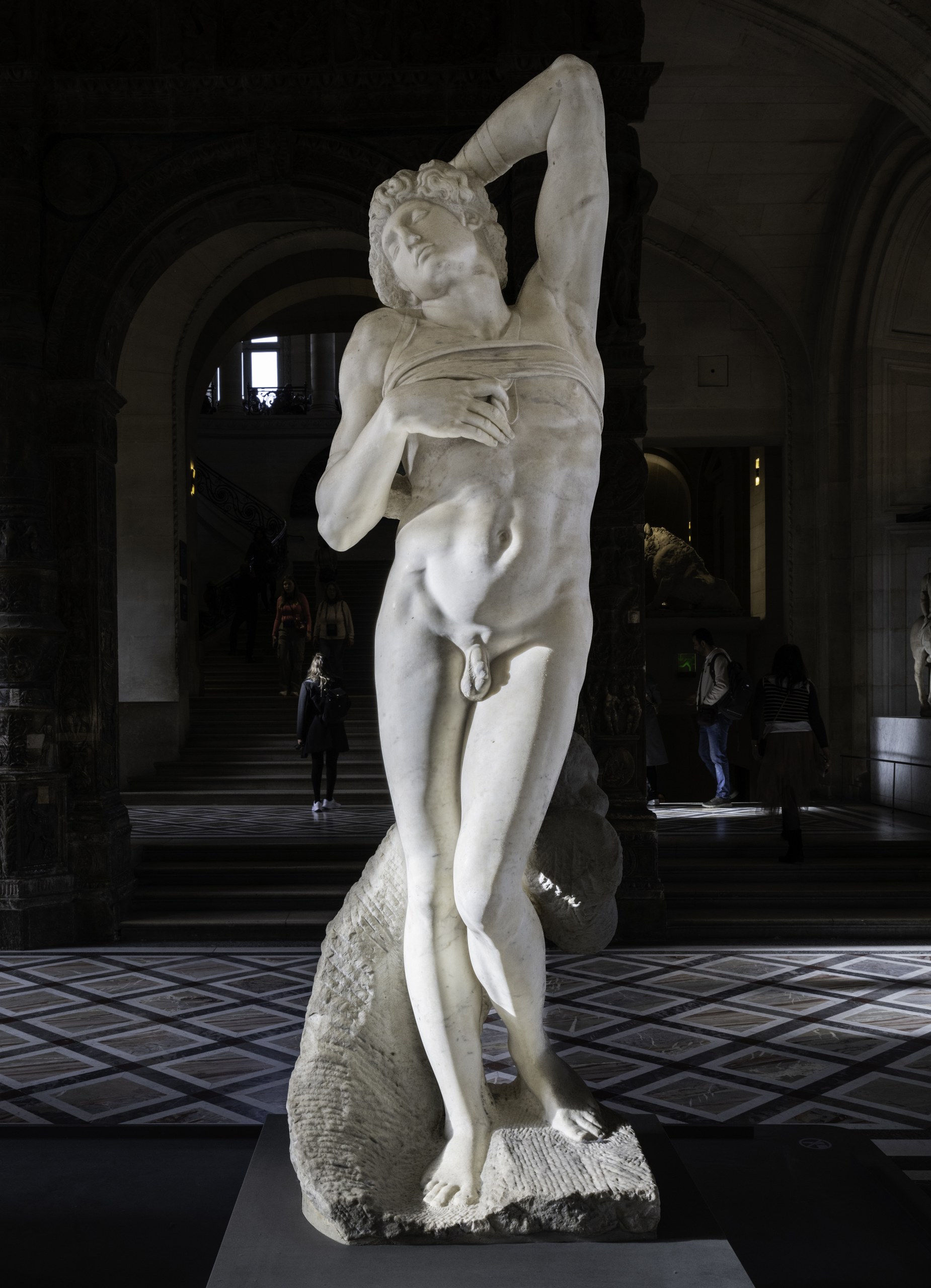
Dying Slave
Michelangelo · 1514
Louvre
A marble over two metres high, carved from 1513 to 1516 for the tomb of Julius II: a young man sinking into sleep, his shoulders rolling softly back, the stone hardly resisting at all. It stands today in the Louvre.
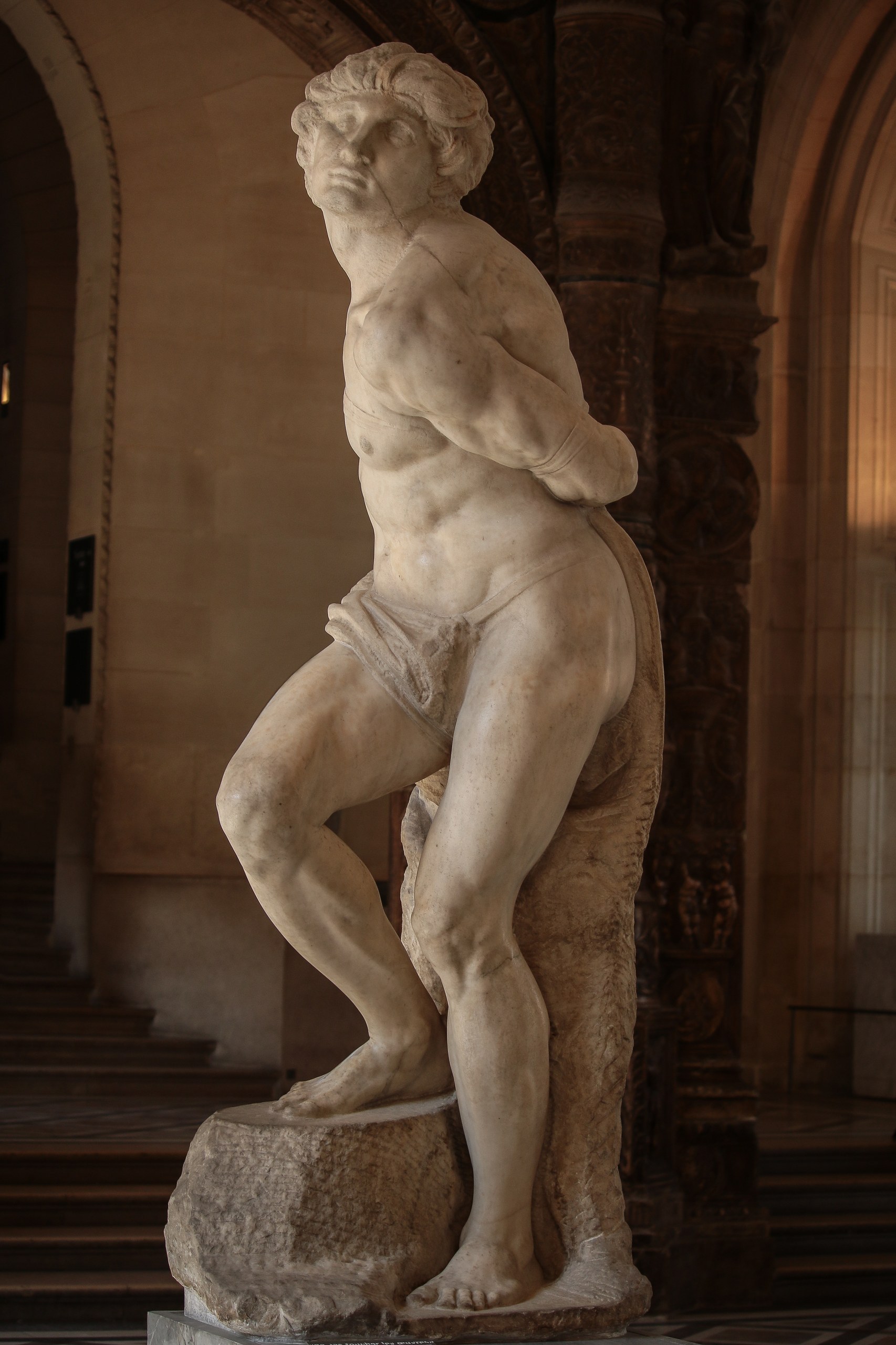
Rebellious Slave
Michelangelo · 1514
Louvre
The pendant to the Dying Slave, same tomb, same years: a figure wrenching against the band across his chest, all effort and strain. Because the pair was meant to be set into the tomb's architecture, the front was carried further than the sides.
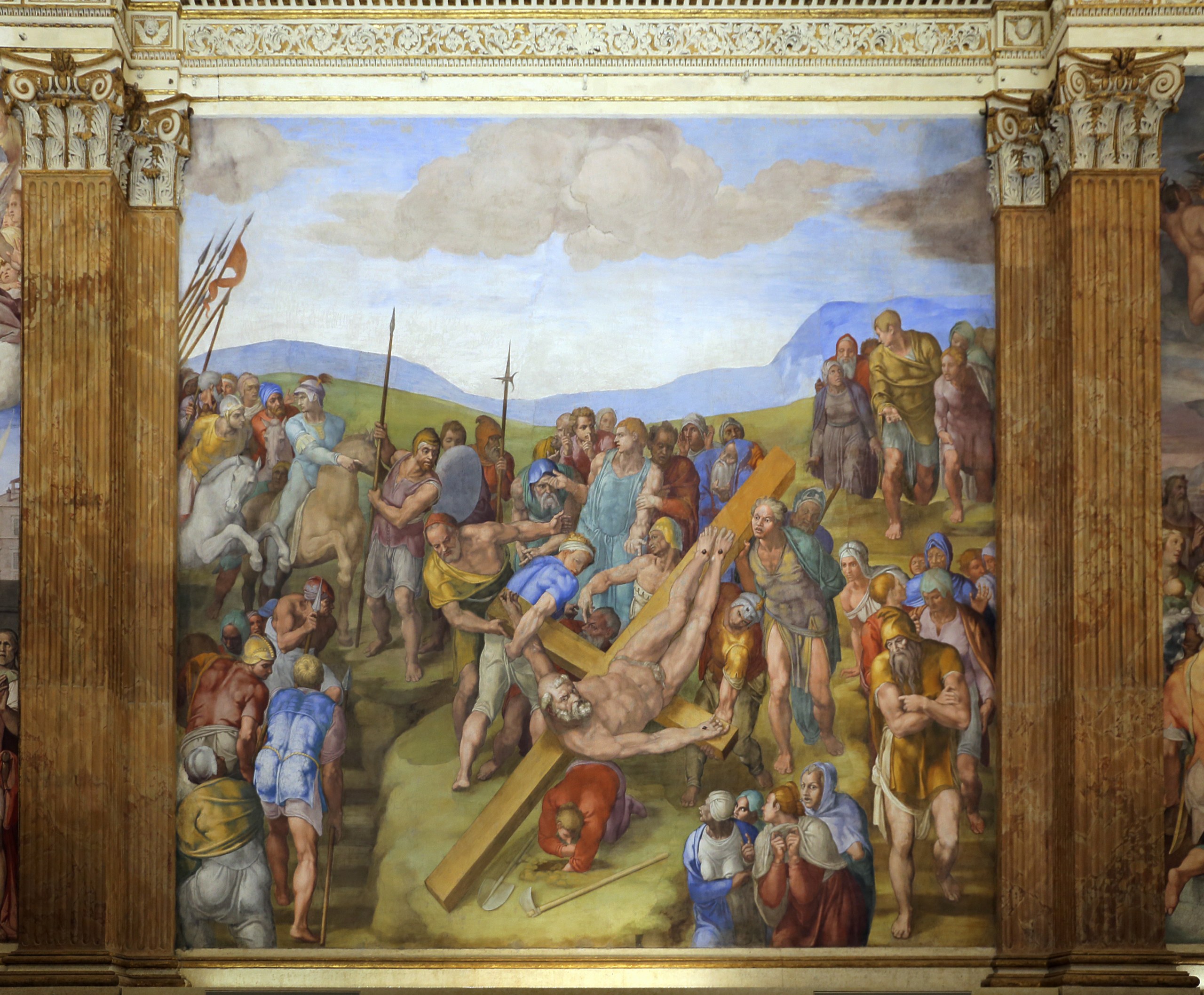
The Crucifixion of Saint Peter
Michelangelo · 1540
Vatican Museums
Peter hauled upside down on his cross by soldiers whose backs do the lifting, the onlookers' faces openly distressed; the last fresco of his life, painted for Paul III's Cappella Paolina and unveiled there in the 1540s.
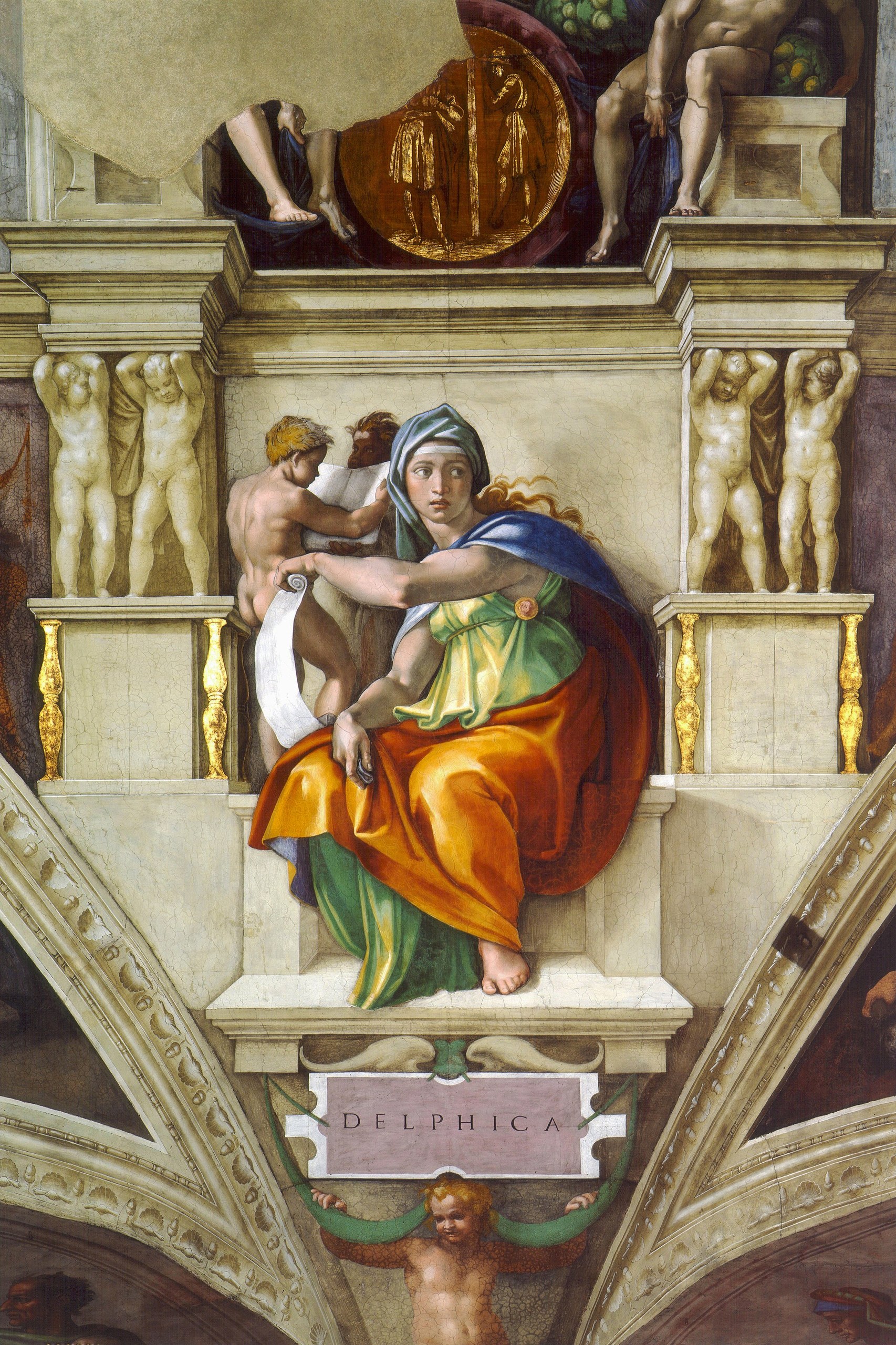
Delphic Sibyl
Michelangelo · 1508
Vatican Museums
One of the five pagan prophetesses he seated between the prophets of Israel: young, wrapped in blue and rose, an open scroll in her hand, her head turned as if someone had just spoken. The most graceful of the vault's women.
More to discover
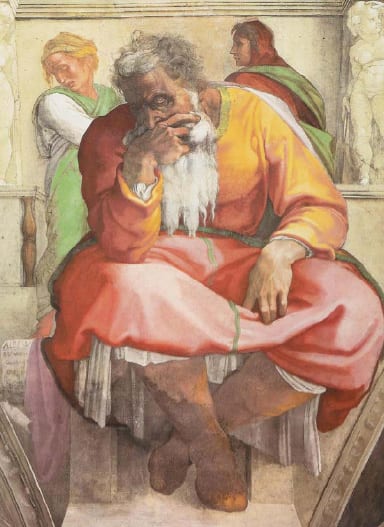
Prophet Jeremiah
Michelangelo · 1508
Vatican Museums
First throne from the altar: a heavy old man sunk in gloom, beard drawn through his fist, and long read as the painter himself, grieving through a job he never wanted.
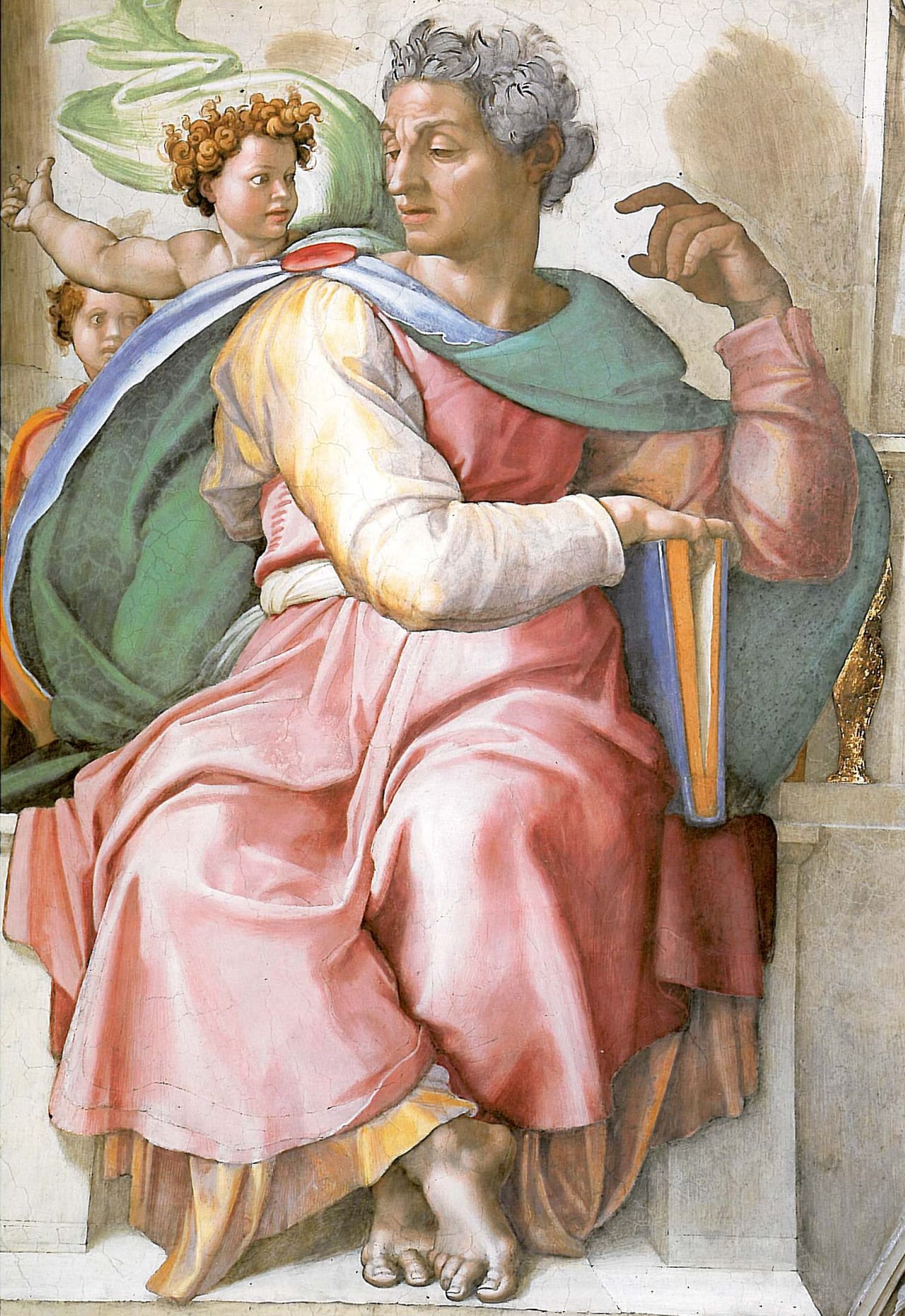
Prophet Isaiah
Michelangelo · 1508
Vatican Museums
Fourth seat from the altar, caught mid-turn with his mantle flying round him and a blue book, perhaps his own prophecy, held at his side; the fresco's spin reappears centuries later in painters from Caravaggio to Rockwell.
Prophet Daniel
Michelangelo · 1508
Vatican Museums
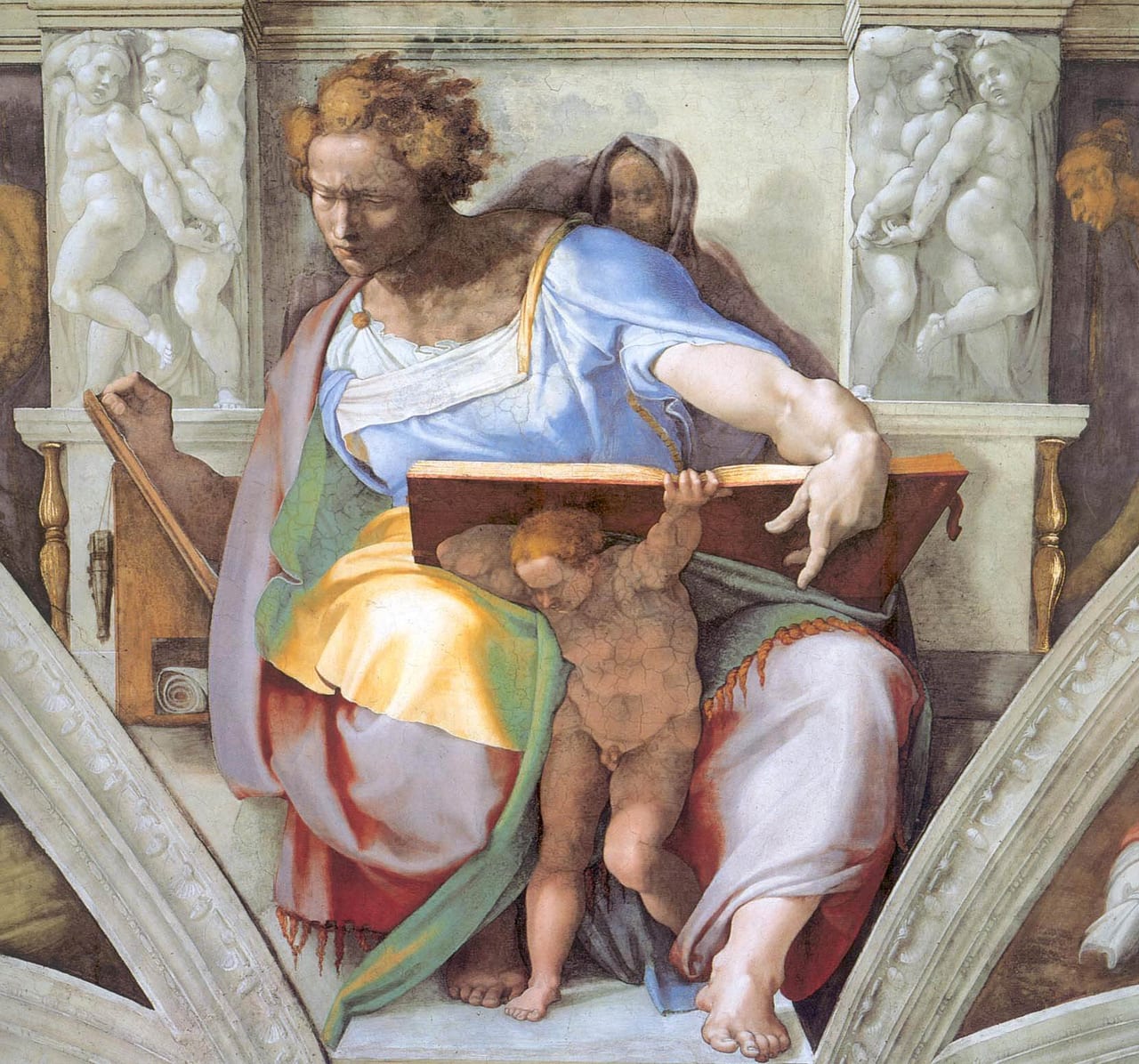
Second from the altar, absorbed in a huge volume that a small figure props up from below; alone among images of Daniel, the lions are nowhere in sight.
Prophet Jonah
Michelangelo · 1508
Vatican Museums
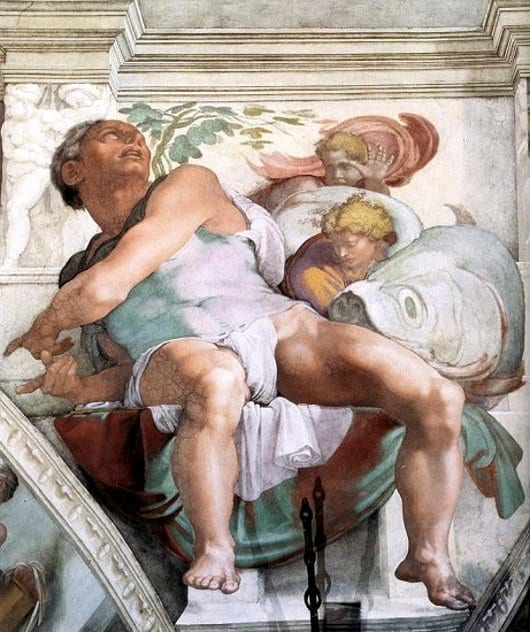
The prophet painted above the High Altar, his great frame thrown back on his fish as he stares up the vault; the most awkward seat on the ceiling, and the figure that holds it best.
Libyan Sibyl
Michelangelo · 1512
Vatican Museums
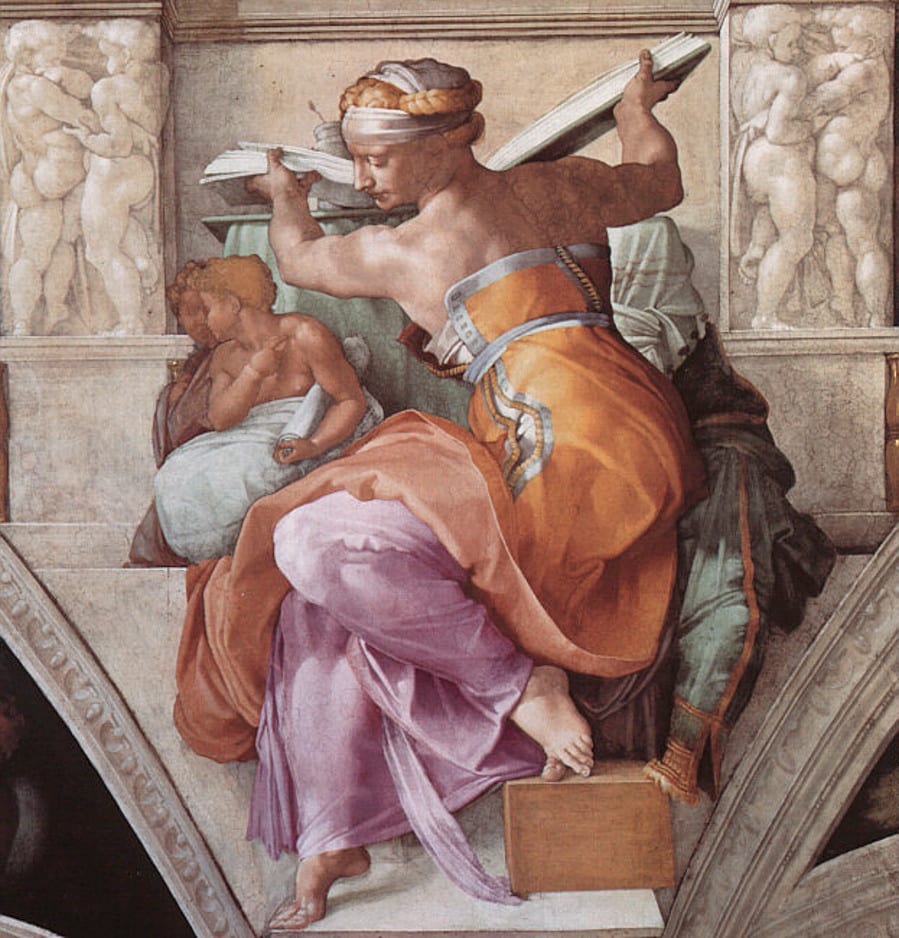
The mightiest of the five women: enormous shoulders swivelled away from us, toes clamped on the marble step, two whispering girls behind. She is setting down a book she has just closed.
Cumaean Sibyl
Michelangelo · 1511
Vatican Museums
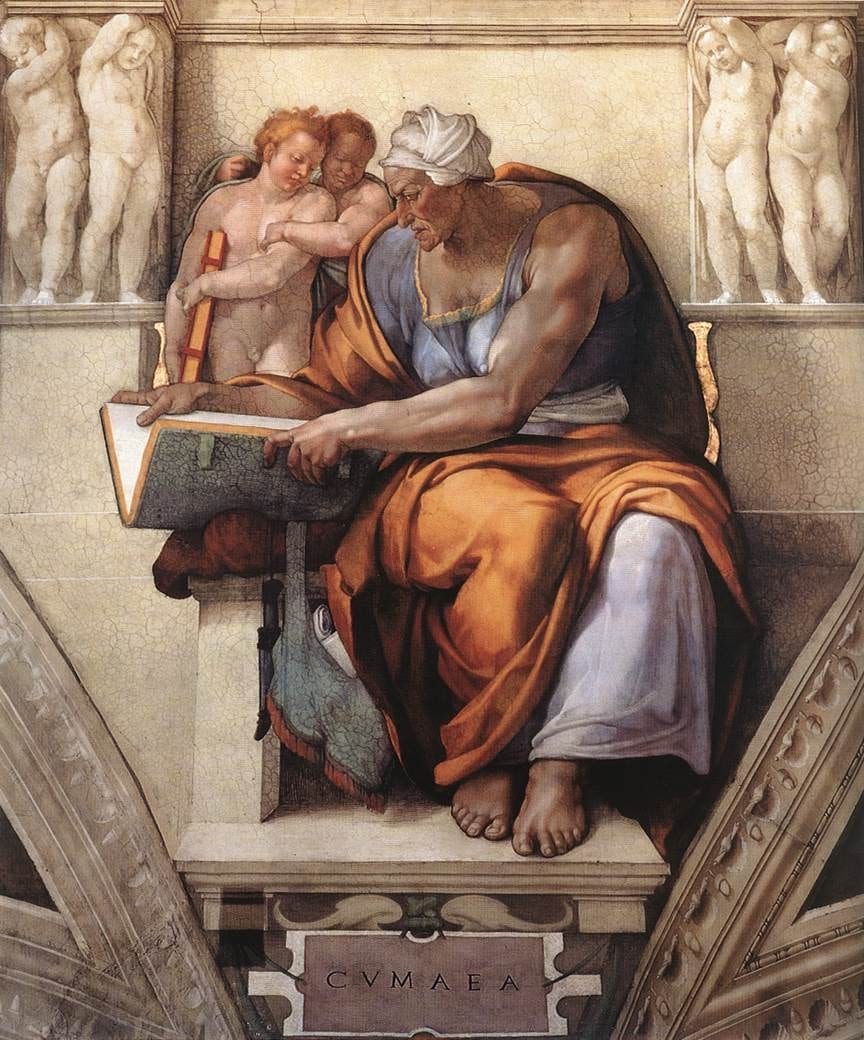
The old seer of Italy's shore, thick-bodied and bent to her page, drawn with a mass no ancient text ever asked for; painted in the middle phase of the vault, when the figures grew to their final scale.
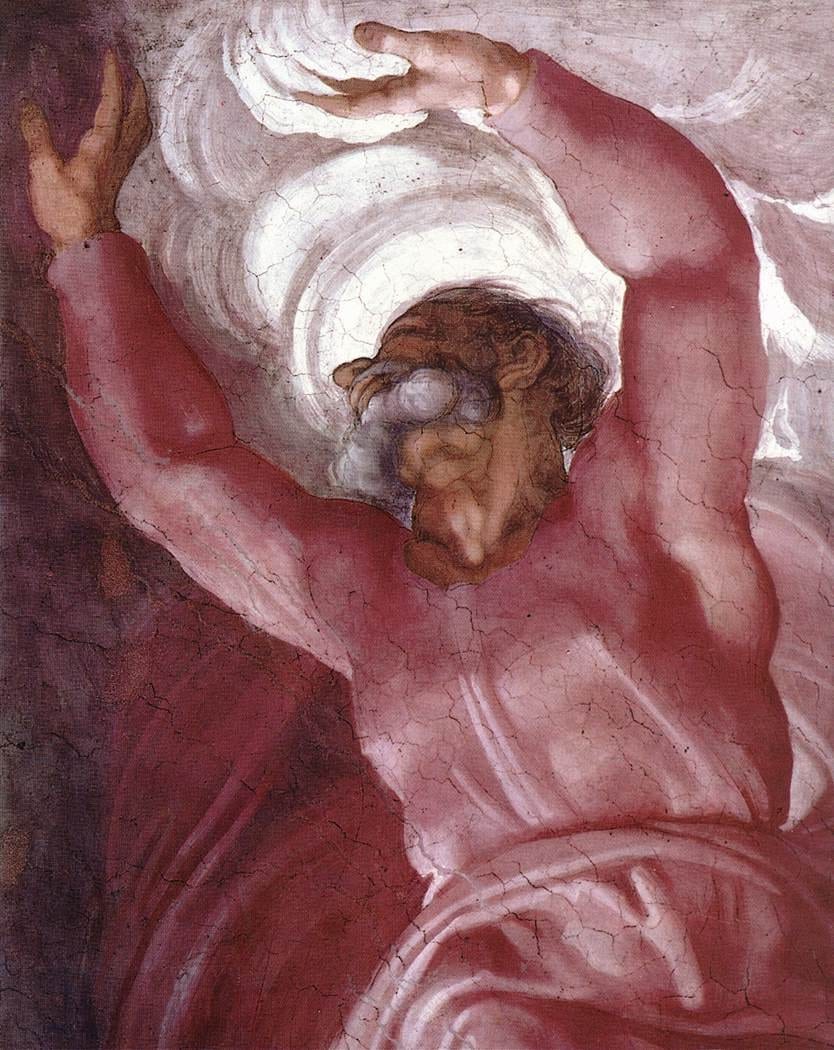
Separation of Light from Darkness
Michelangelo · 1512
Vatican Museums
God at the far east end, arms flung wide as he splits day from night, the whole figure twisted like a drill; first in the Genesis story and last on the scaffold, finished in the summer of 1512.
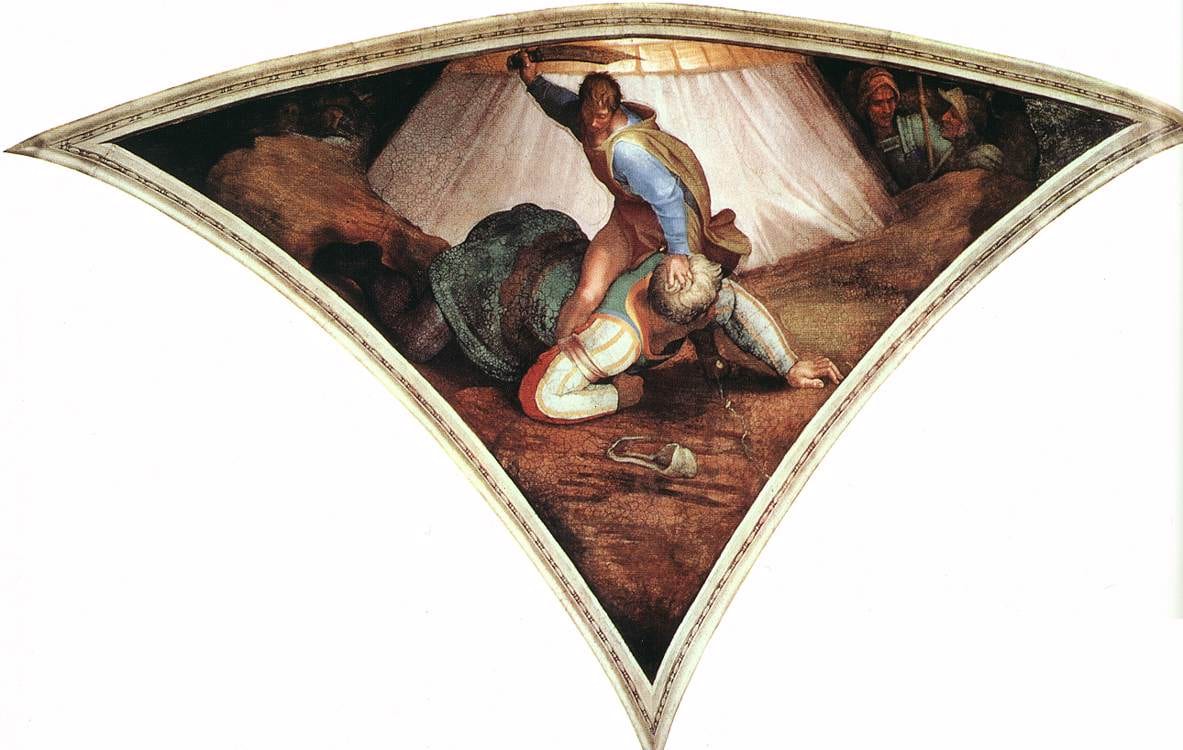
David and Goliath
Michelangelo · 1509
Vatican Museums
One of the four corner scenes of the vault, the boy and the giant wound together in a bronze-coloured spiral, told in the space of a triangle.
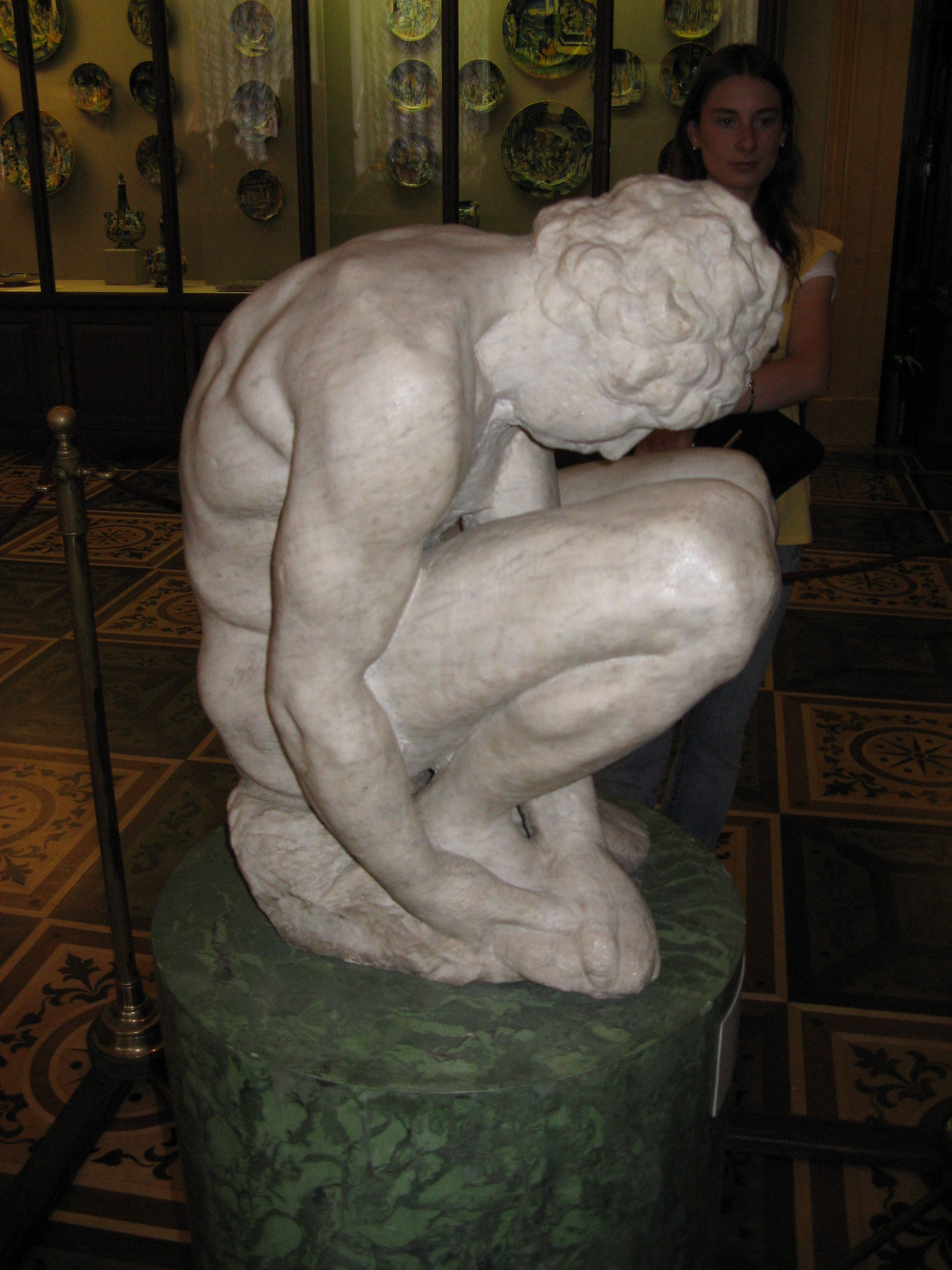
Crouching Boy
Michelangelo · 1530
State Hermitage Museum
A small unfinished marble, a naked youth folded over his own knee as if drawing a thorn from his foot, carved around 1530 to 1533 for the Medici tombs and today the one sculpture by him in the Hermitage.
Sources
- National Gallery, London, “Michelangelo”
- Wikipedia, “Michelangelo”
- Wikipedia, “Sistine Chapel ceiling”
- National Gallery, London, “The Entombment (or Christ being carried to his Tomb)”
- Wikipedia, “Doni Tondo”
- Wikipedia, “Manchester Madonna”
- Wikipedia, “Dying Slave”
- Wikipedia, “Rebellious Slave”
- Wikipedia, “The Last Judgment (Michelangelo)”
- Wikipedia, “The Crucifixion of Saint Peter (Michelangelo)”
- Wikipedia, “Prophet Jeremiah (Michelangelo)”
- Wikipedia, “Prophet Isaiah (Michelangelo)”
- Wikipedia, “Prophet Daniel (Michelangelo)”
- Wikipedia, “Prophet Jonah (Michelangelo)”
- Wikipedia, “Separation of Light from Darkness”
- Wikipedia, “Crouching Boy”
Invite Michelangelo into your living room
Play 34 works from this collection on your TV, phone or tablet with Momentable Art TV.