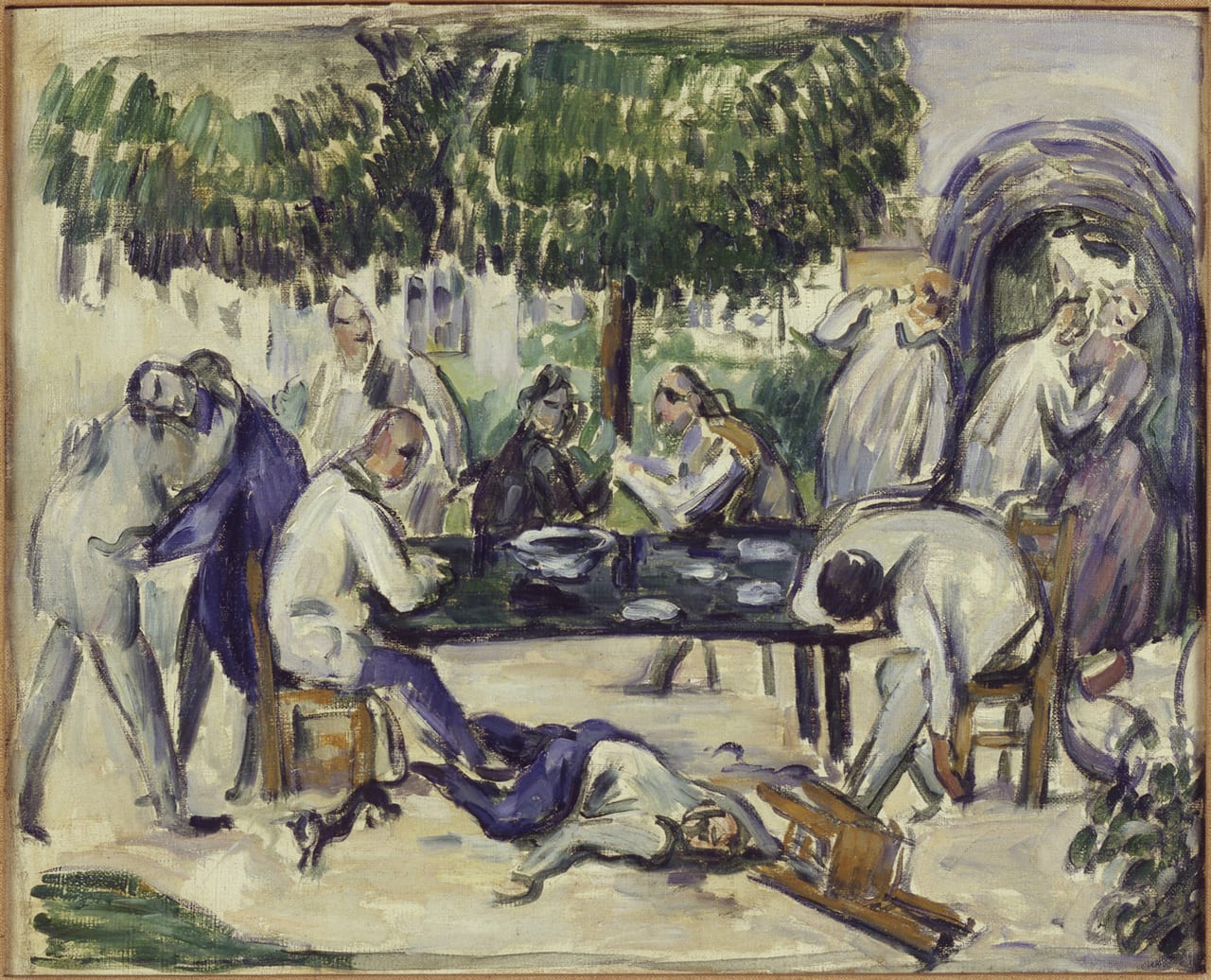
Mardi Gras
Paul Cézanne · 1888

Paul Cézanne
French · 1839–1906
The painter of Aix who rebuilt seeing out of patches of colour, and whom the painters who came after called their father.
Play 20 works from this collection on your TV, phone or tablet with Momentable Art TV.
Play CollectionAix and after
Paul Cézanne was born in Aix-en-Provence in January 1839, the son of a hatter who became a banker, and he went to school with Émile Zola. For years his pictures were laughed at; it was other painters, above all Camille Pissarro, and the dealer Ambroise Vollard who stood by him, and not until 1895 did Vollard give him a one-man show in Paris. By then the man the public ignored was quietly laying the ground on which the next century's painting would stand, a bridge from Impressionism to Cubism.
In October 1906 he collapsed outdoors, took severe pneumonia, and died within days at sixty-seven in the town he had almost never left. He is buried in Aix. Matisse and Picasso are both said to have called him "the father of us all".
Building what the eye does
His ambition, as he put it, was to "treat nature in terms of the cylinder, the sphere and the cone": an apple, a mountain and a face were all problems of volume, worked out in small patches of colour laid side by side. The work was slow to the point of legend; a single still life could cost him a hundred sittings at the easel, a portrait half as many again.
He came out of Impressionism but wanted something more durable than its passing light, and by the middle 1890s, in the great still lifes and the portraits of the people around him, the objects themselves have almost dissolved into the arrangement that holds them. The painters who followed, from the Fauves to the Cubists, took that arrangement as their starting point.
Known works
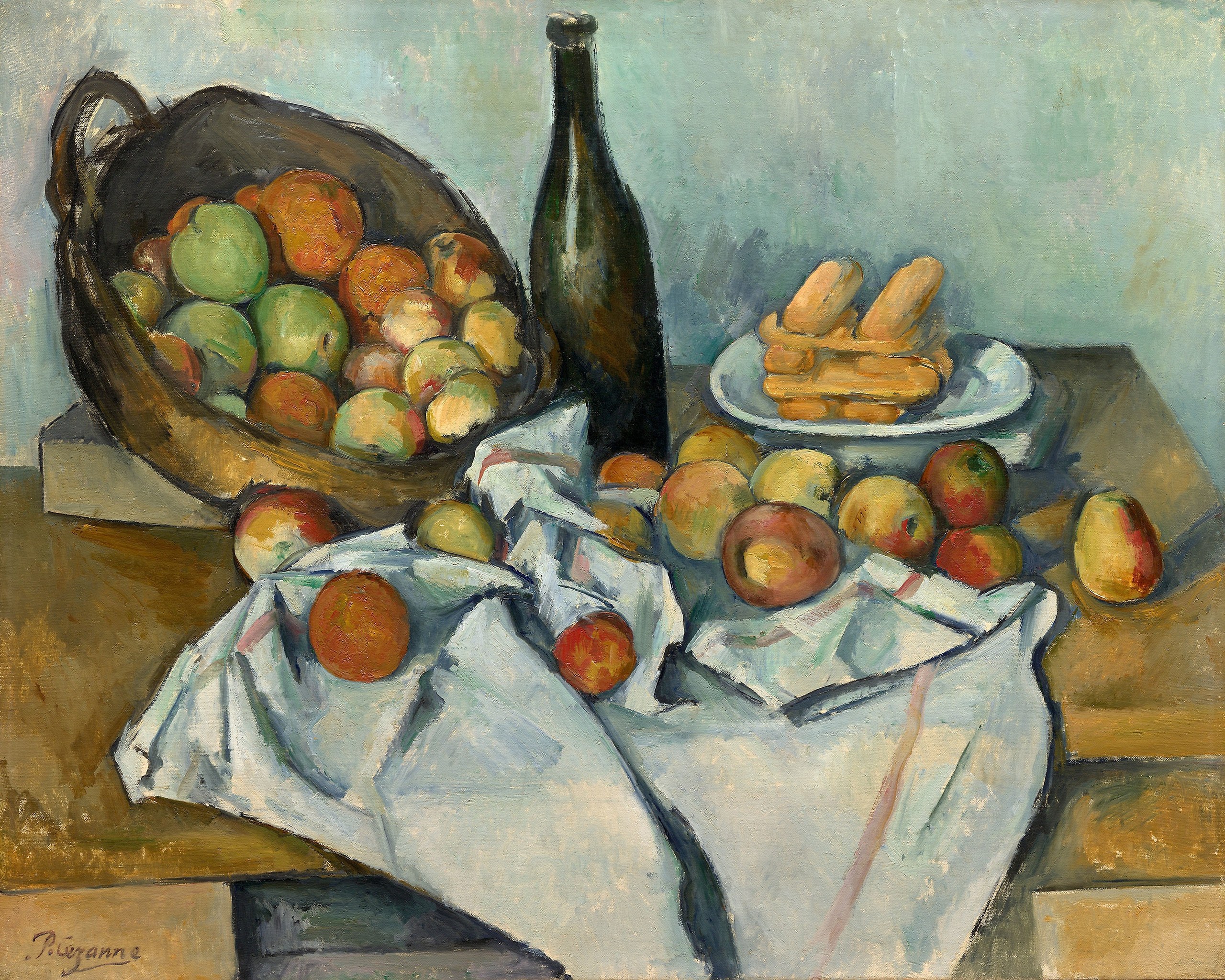
The Basket of Apples
Paul Cézanne · 1893
The Art Institute of Chicago
The Basket of Apples. Apples spill from a tilting basket, the plate sits askew, and the front of the table runs on a different level from the back: one still life that refuses to look through a single eye at once. Its distortions fed Fauvism and Cubism, and it belongs to the Art Institute of Chicago.
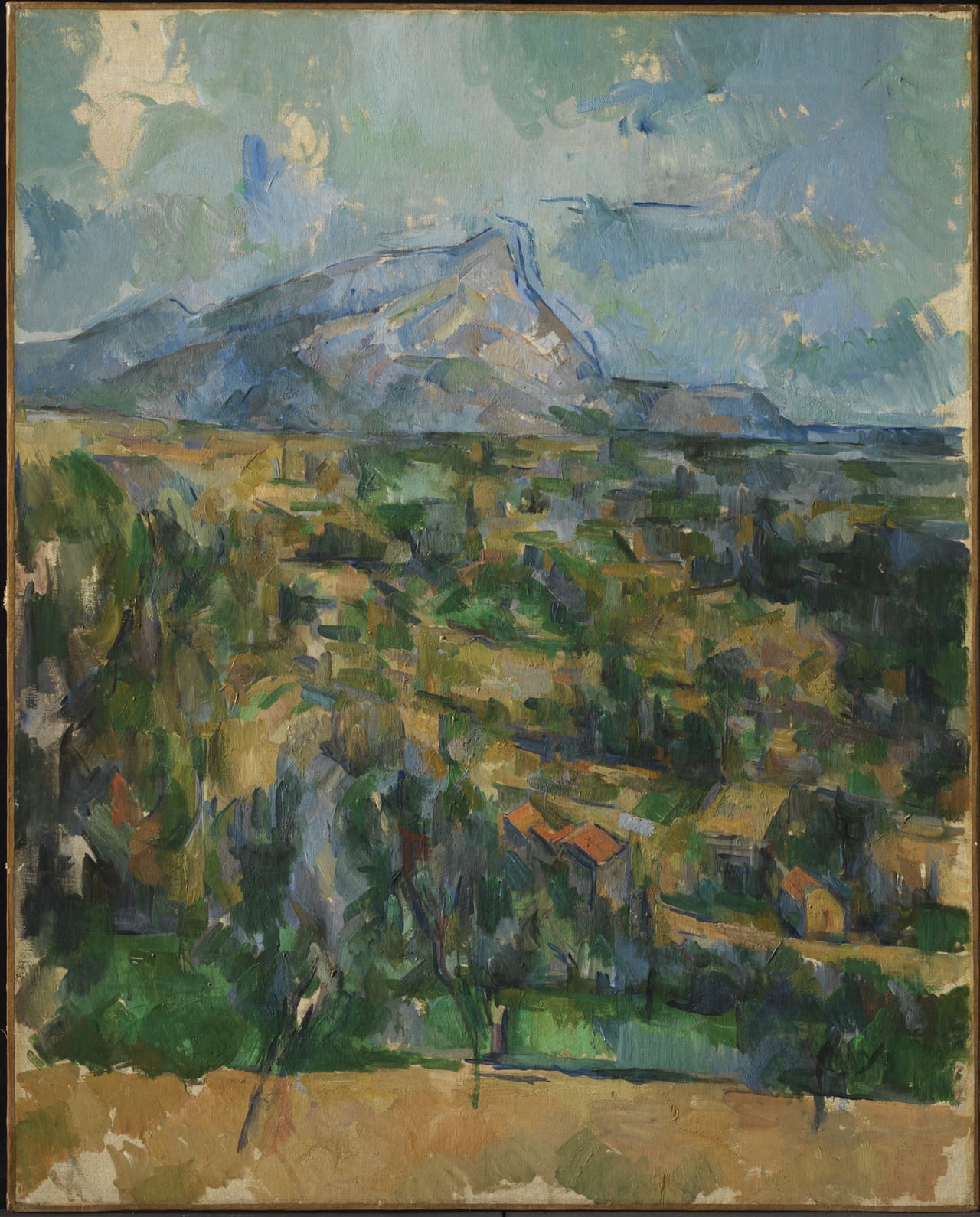
Mont Sainte-Victoire
Paul Cézanne · 1902
Mont Sainte-Victoire. The limestone mountain that stands over his home town, painted and drawn until the count ran to some eighty canvases and watercolours. Here the ridge is mass rather than silhouette, built of strokes that keep their distance and their weight, a motif worked at until it became an argument about seeing itself.
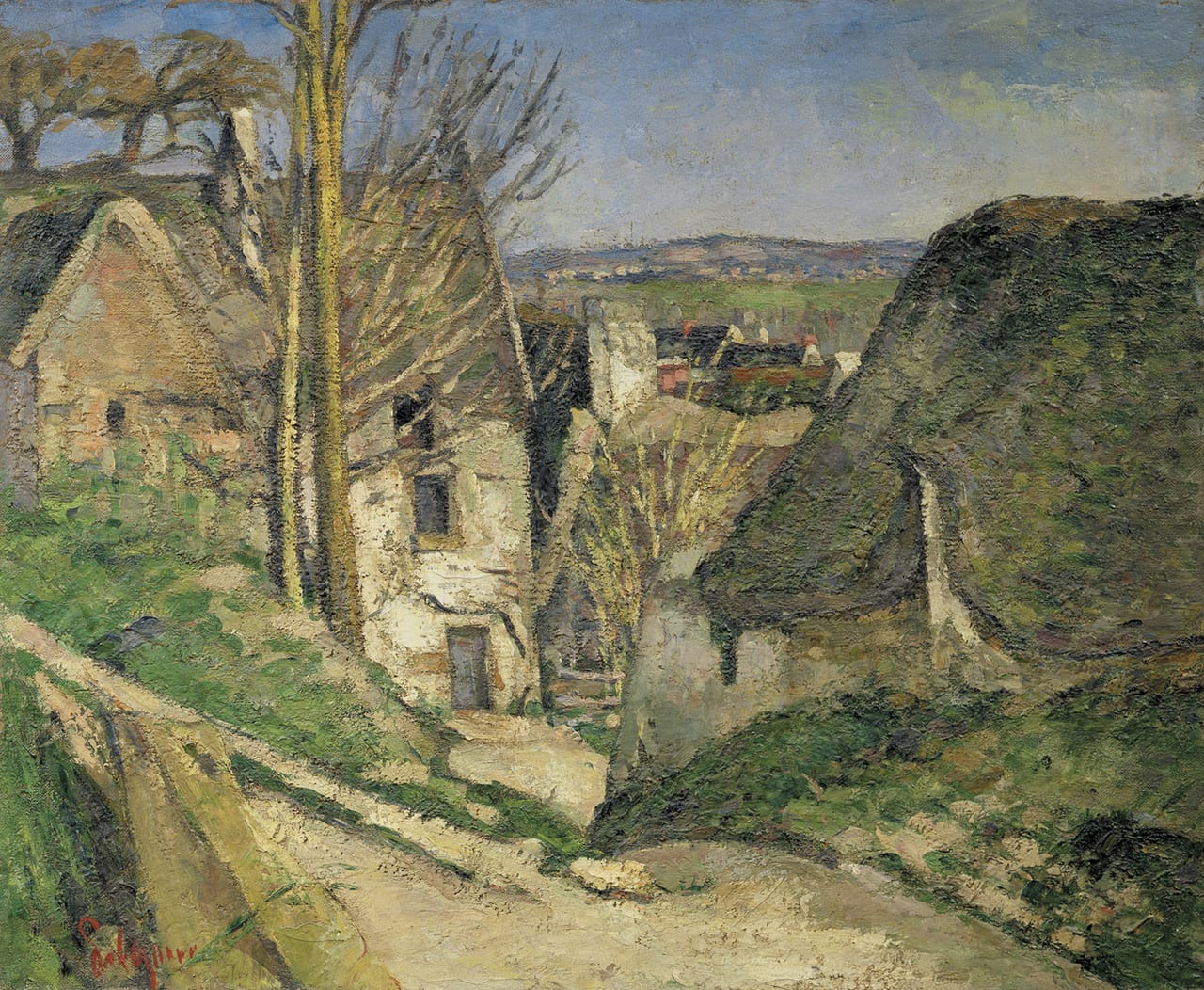
La Maison du pendu, Auvers-sur-Oise
Paul Cézanne · 1874
Musée d'Orsay
La Maison du pendu, Auvers-sur-Oise. Crooked houses stacked along a lane at Auvers, the village north of Paris where he painted beside Pissarro. Shown at the first Impressionist exhibition of 1874, it was the first picture he ever sold to a collector.
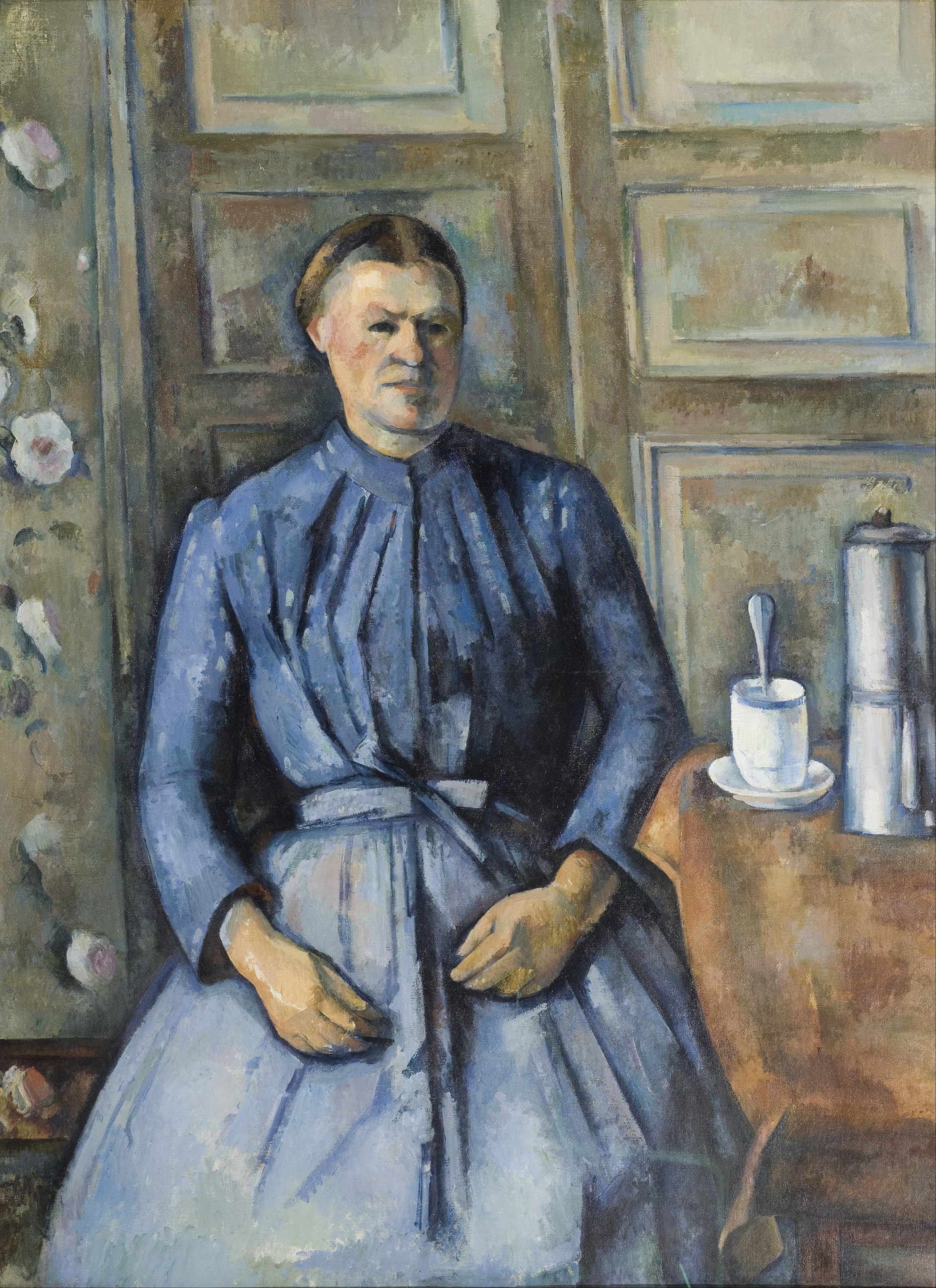
La Femme à la cafetière (Woman with a Coffeepot)
Paul Cézanne · 1895
Musée d'Orsay
La Femme à la cafetière (Woman with a Coffeepot). A woman who likely worked as a servant at the family estate of Jas de Bouffan, painted around 1895 not for her character but for her forms: body, cup and pot pared down and locked into a grid of uprights and levels, the tabletop tipped at its own angle. That plain geometry heralds Cubism.
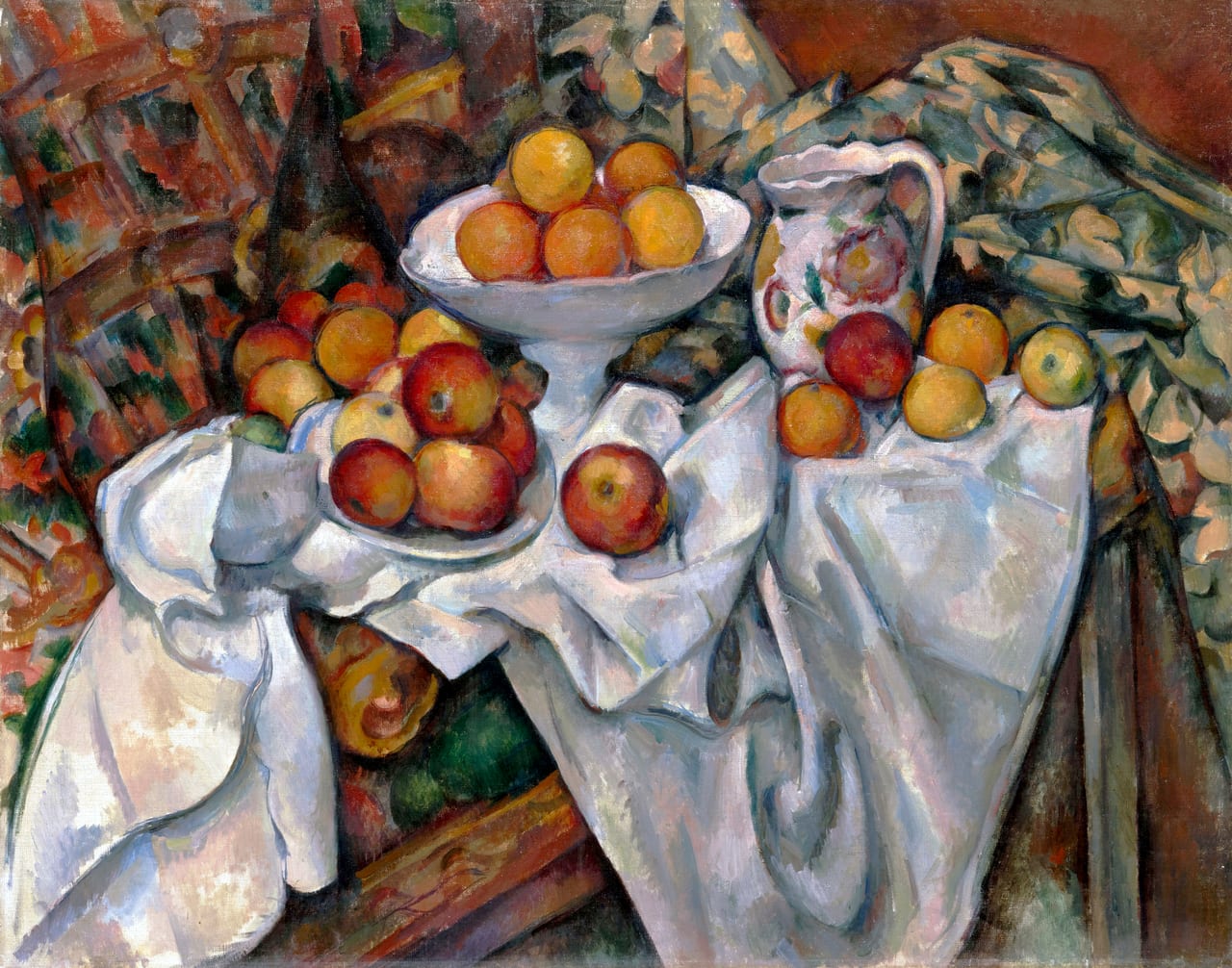
Apples and Oranges
Paul Cézanne · 1899
Musée d'Orsay
Apples and Oranges. Fruit, crockery and rumpled cloth on a table that leans toward the viewer, painted around 1899 and now at the Musée d'Orsay. It reuses the same objects as a canvas finished a few months before it, today in the Hermitage.
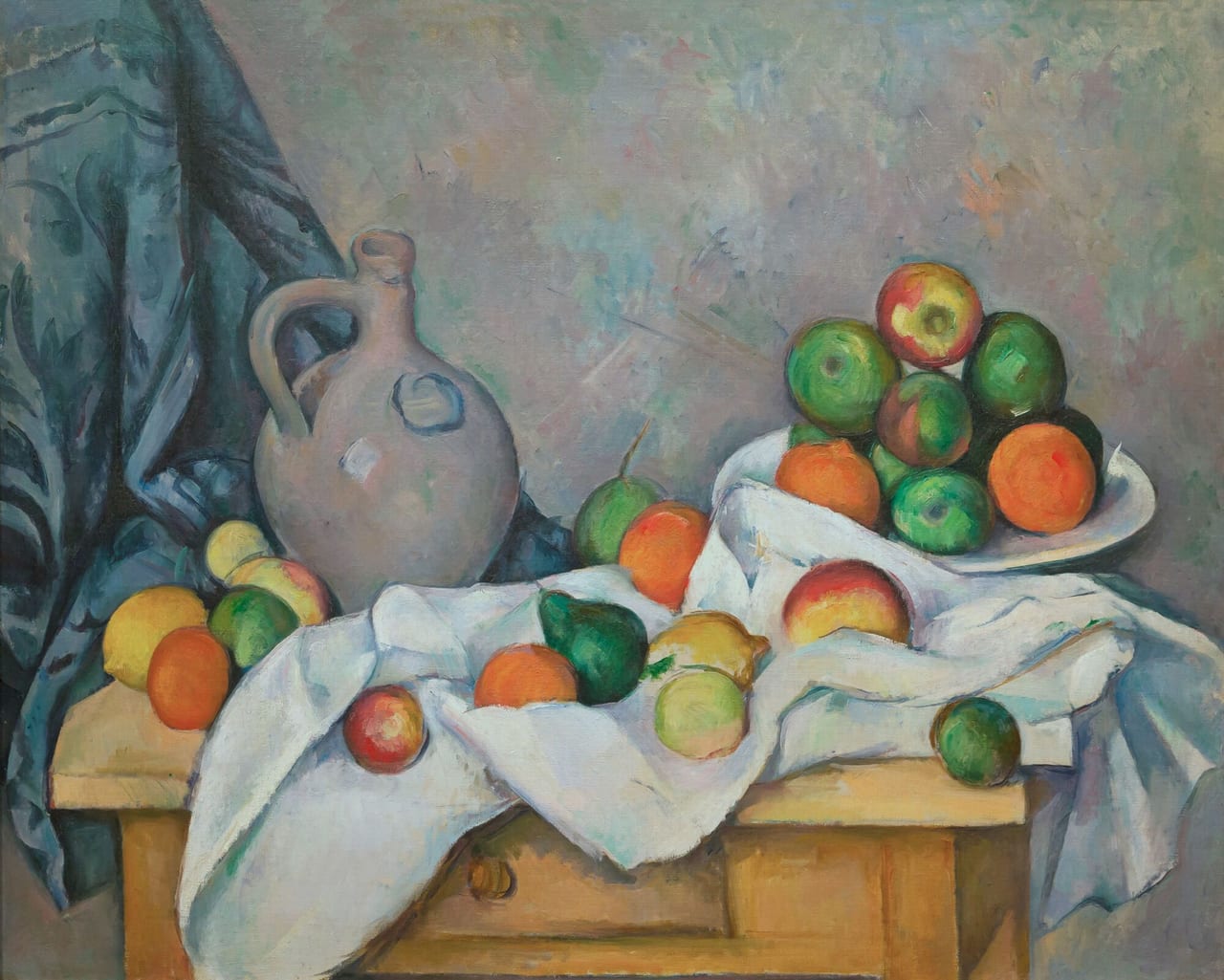
Rideau, Cruchon et Compotier
Paul Cézanne · 1893
Whitney Museum
Rideau, Cruchon et Compotier. Curtain, jug and fruit bowl in a composition of about 1893, ruled by balance and symmetry. The fruit looks thrown down by chance; nothing is, and the shifting viewpoint is the real experiment.
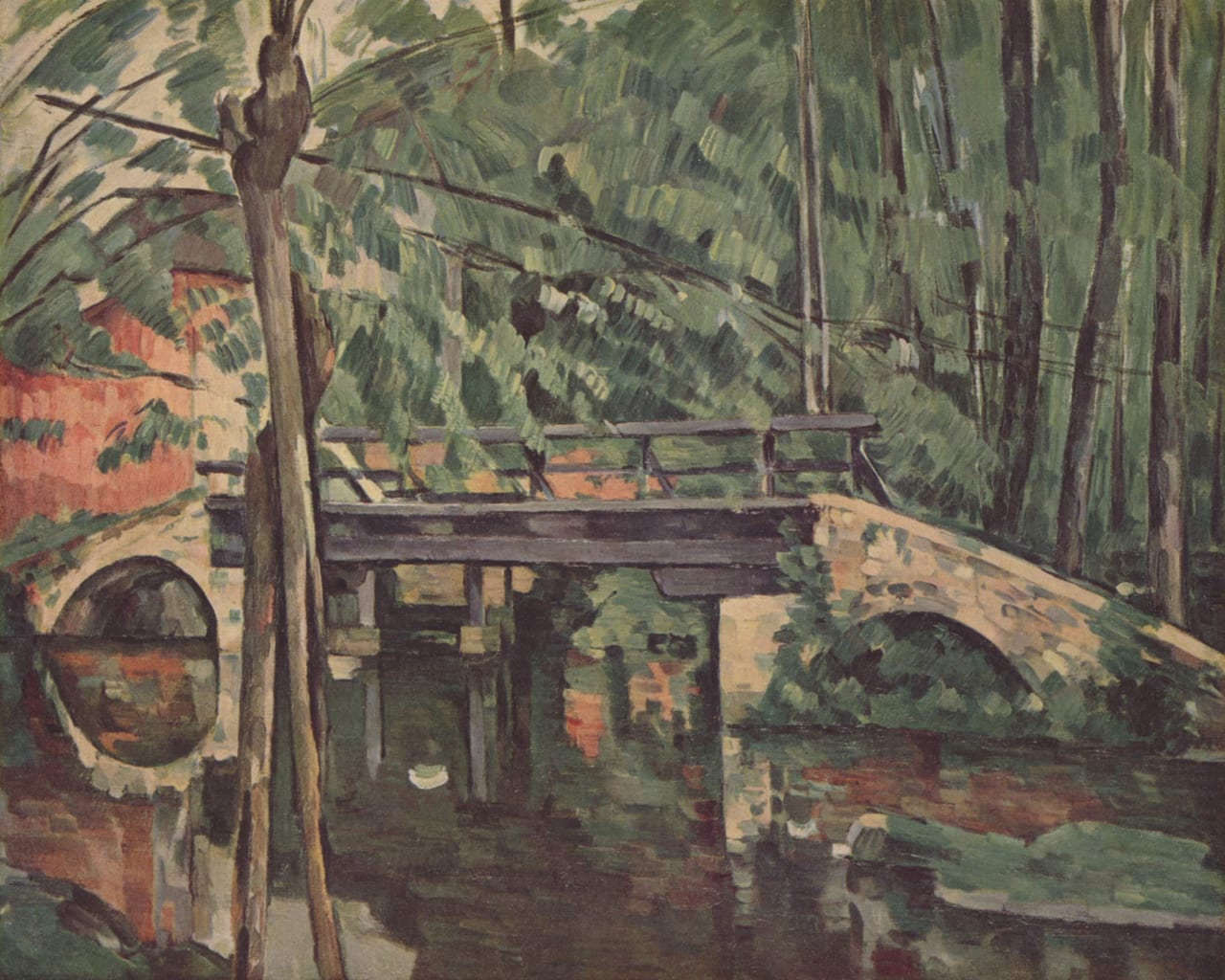
Pont de Maincy
Paul Cézanne · 1879
Musée d'Orsay
Pont de Maincy. A bridge at Maincy, near Melun where he was then living, its stone arch and its trees built stroke by stroke out of greens and greys rather than drawn. The picture hangs in the Musée d'Orsay.
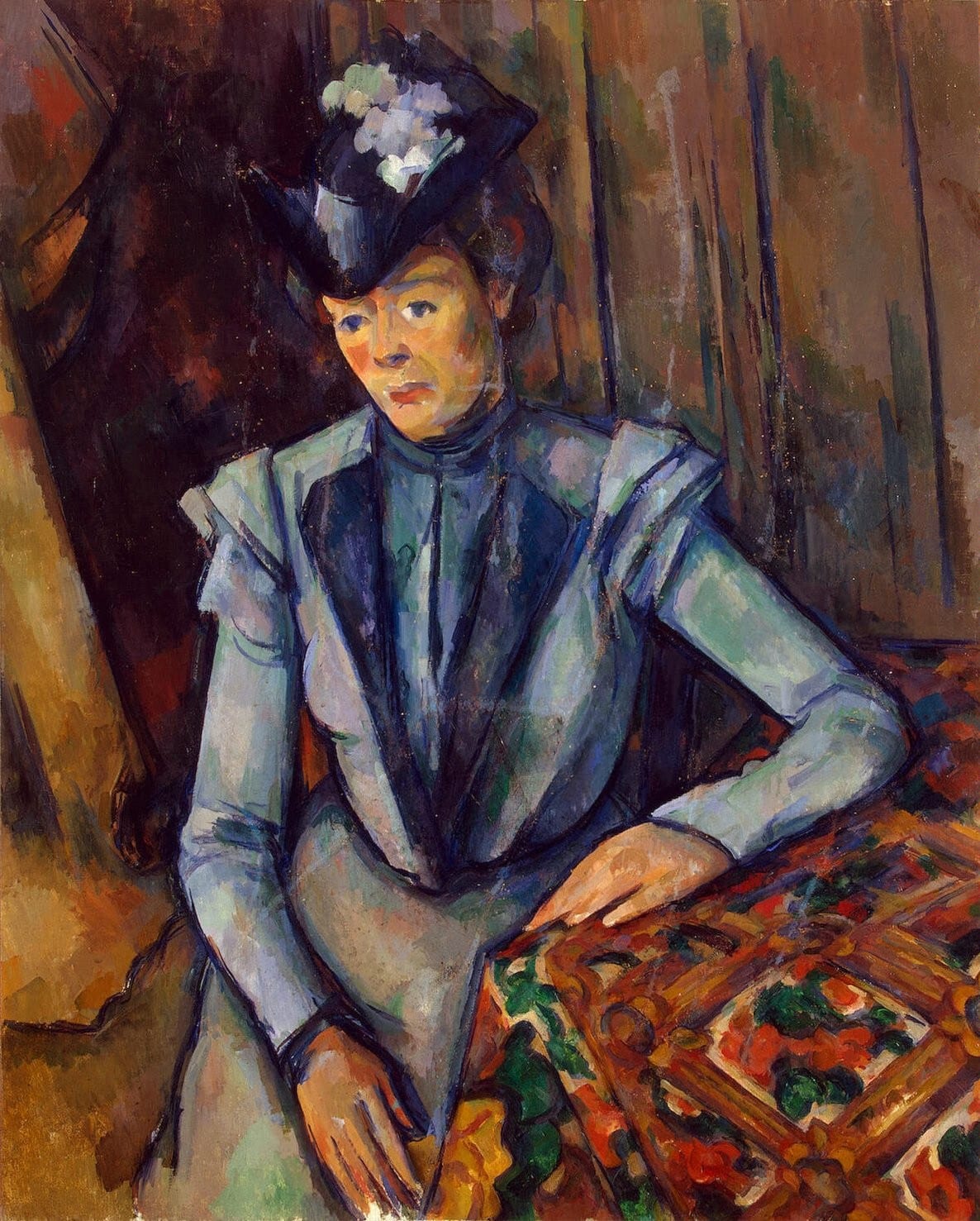
Lady in Blue
Paul Cézanne · 1904
State Hermitage Museum
Lady in Blue. His governess, Madame Brémond, seated in blue: among the last portraits of a woman he painted, made around 1900 and kept today in Saint Petersburg. Its tones and shapes lean forward into Fauvism and Cubism before either movement had begun.
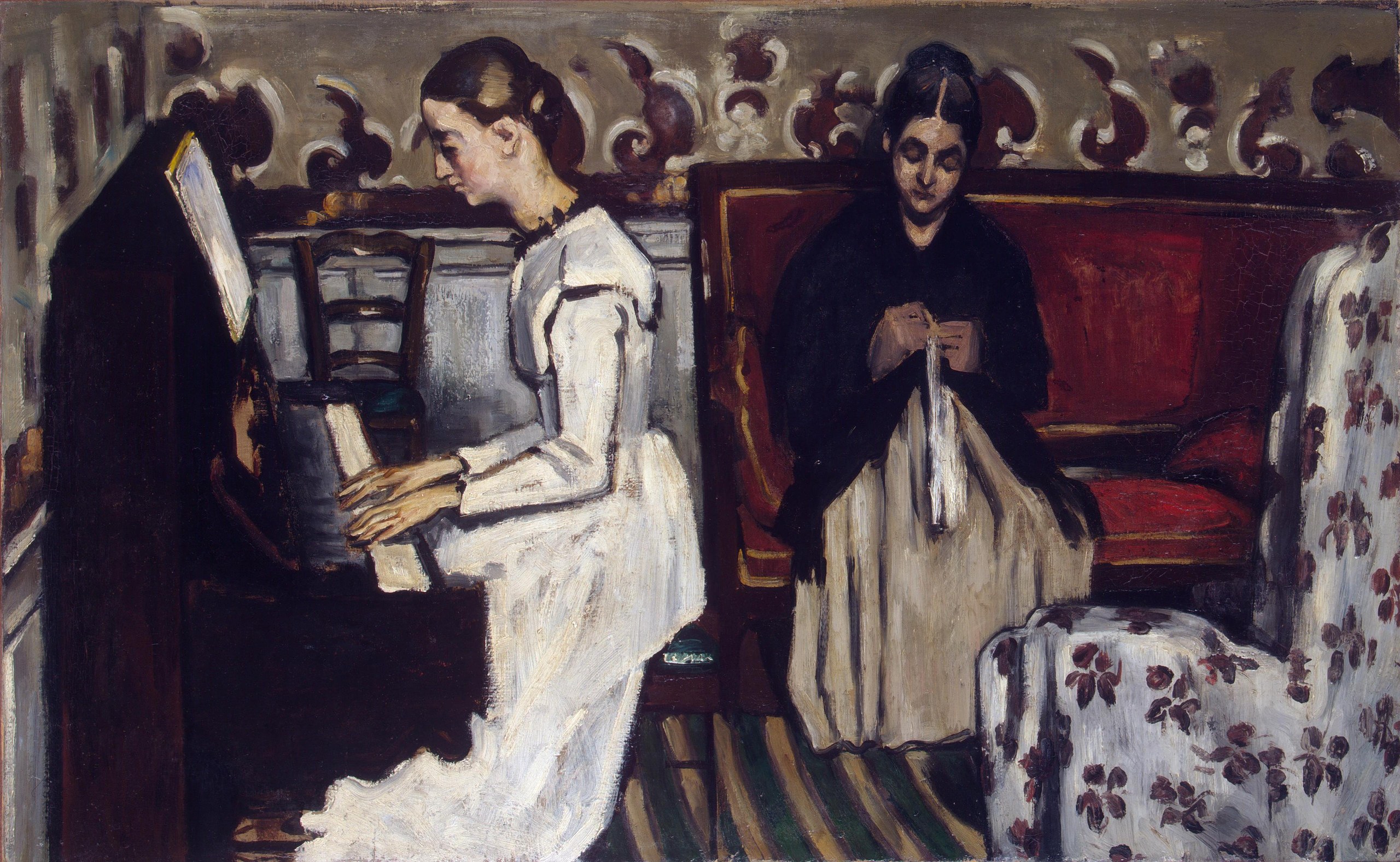
Jeune Fille au piano (Girl at the Piano - The Overture to Tannhauser)
Paul Cézanne · 1869
State Hermitage Museum
Jeune Fille au piano (Girl at the Piano - The Overture to Tannhauser). Two young women at the keyboard of the family house near Aix, usually read as his sisters, in a picture of 1869 named for the Wagner overture the pianist is playing. It reached the Hermitage from Ivan Morozov's collection in Moscow.
More to discover
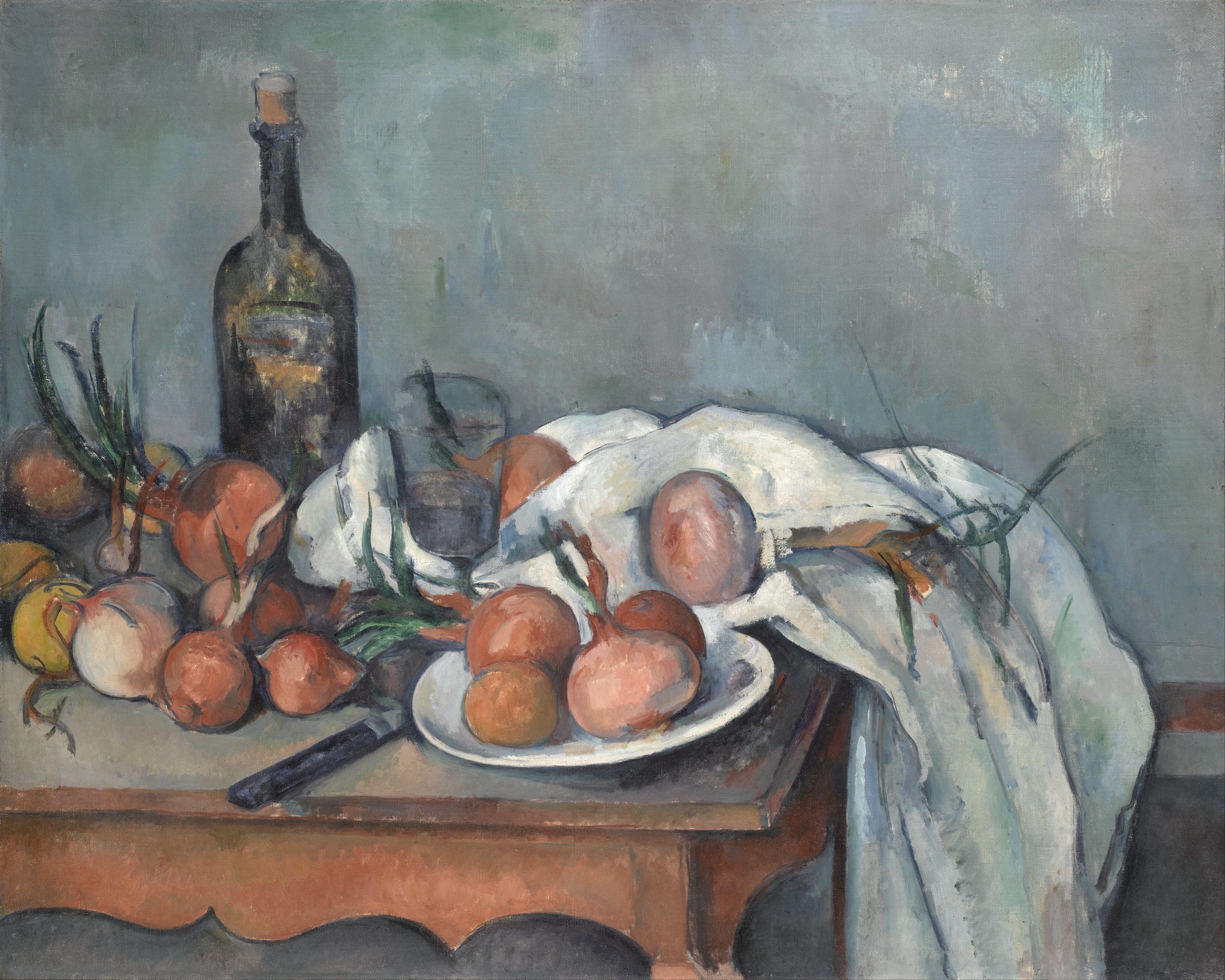
Still Life with Onions
Paul Cézanne · 1898
Musée d'Orsay
Still Life with Onions. Onions, chosen for their roundness, set with a knife laid at an angle, a bottle, a glass and a plate before a nearly bare ground. The angled knife is an old trick of depth out of Chardin, and the whole spare arrangement points the way to Cubism.
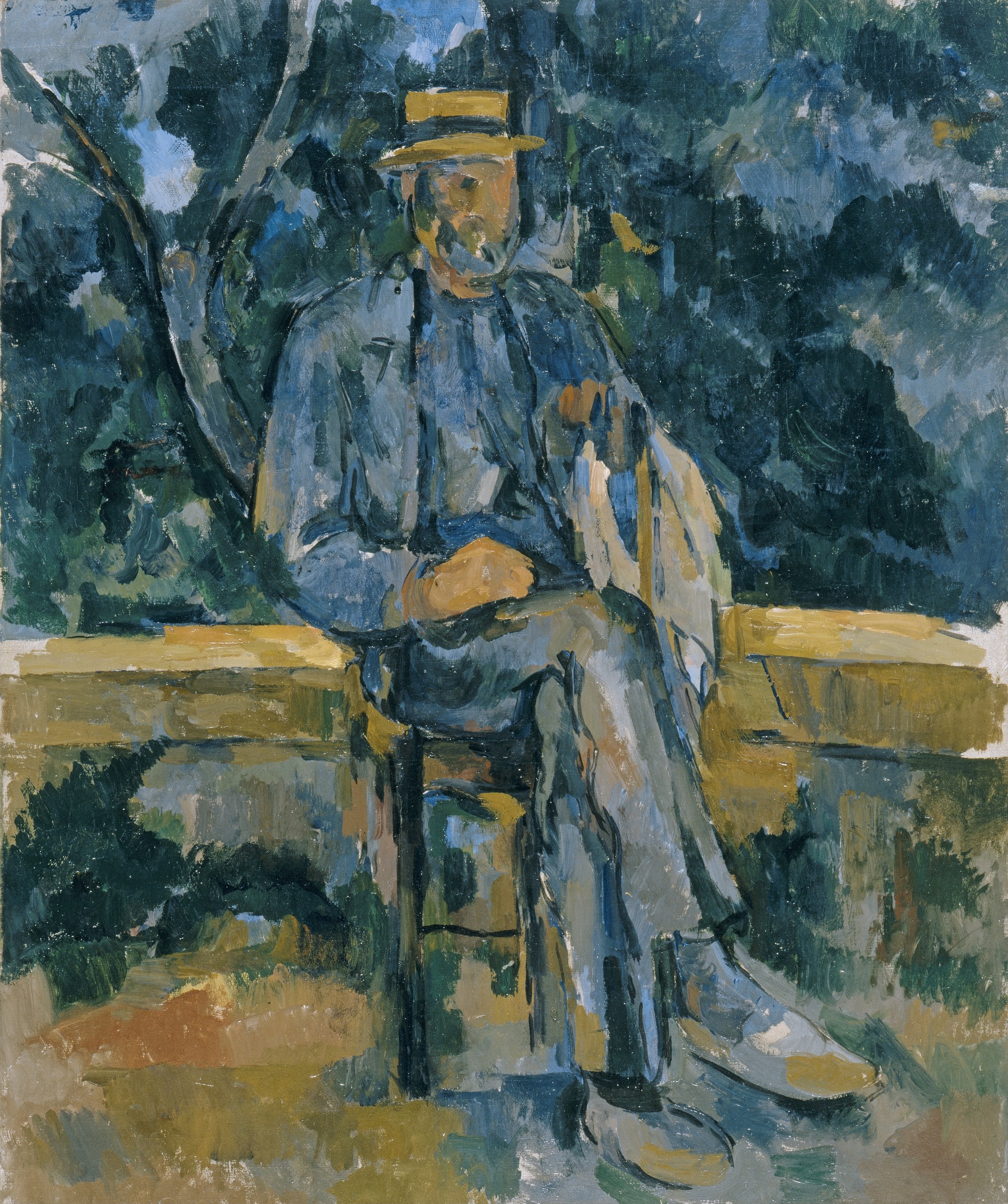
Portrait of Peasant
Paul Cézanne · 1905
Thyssen-Bornemisza Museum
Portrait of Peasant. One of the open-air portraits of Aix country people from his last years: a man in the plain blue of a Provençal peasant, seated with crossed legs and a stick by the terrace rail of his final studio, perhaps his gardener Vallier. The pose is quiet, and the figure monumental, with a dignity the old masters would have recognised.
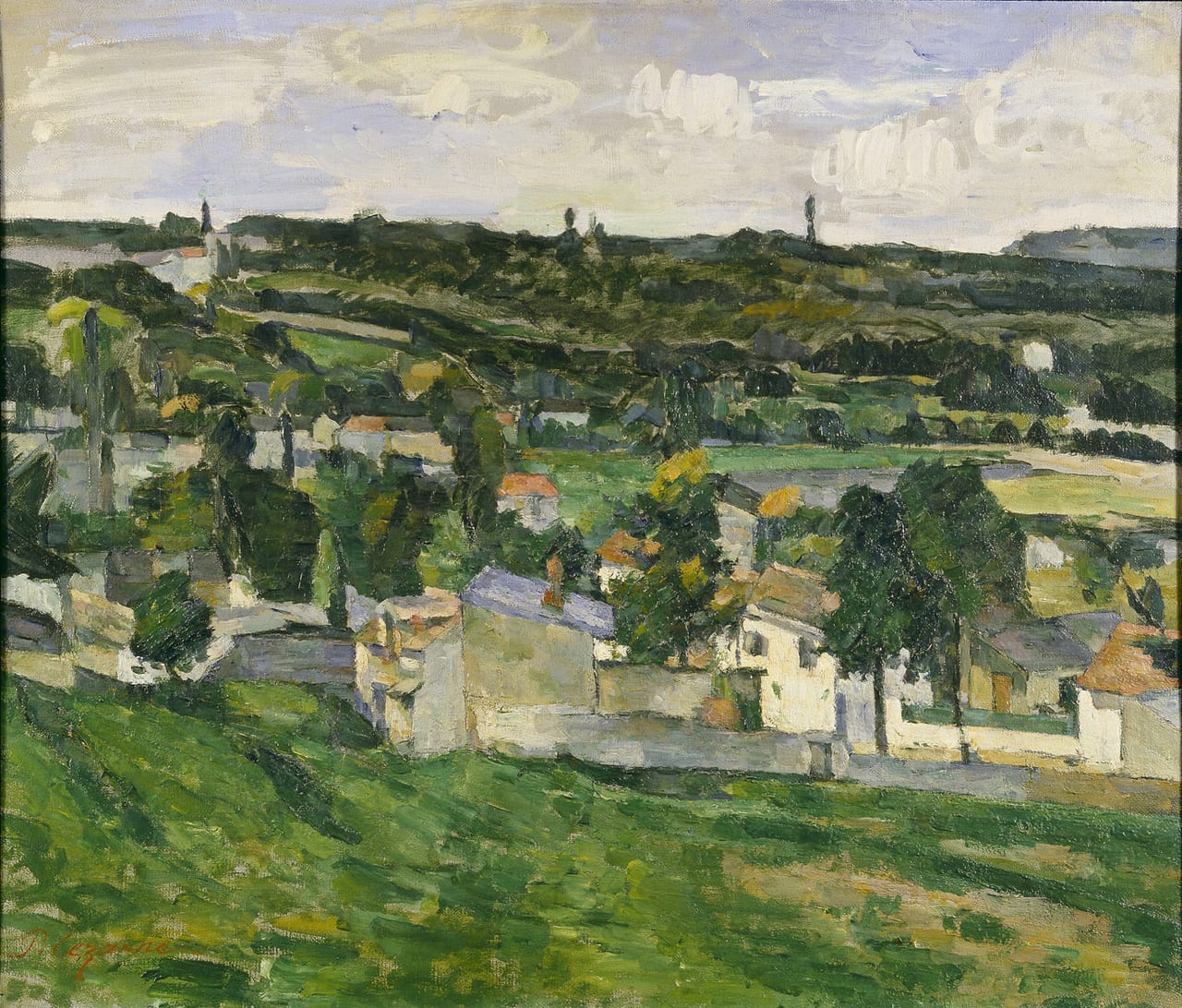
View of Auvers-sur-Oise
Paul Cézanne · 1878
Ashmolean Museum
View of Auvers-sur-Oise. A spread of northern landscape painted in 1879 and 1880, some years after he had left Auvers; the exact spot has never been pinned down. Its first owner was Victor Chocquet, the collector who backed him early, and it came to the Ashmolean in Oxford in place of inheritance tax.
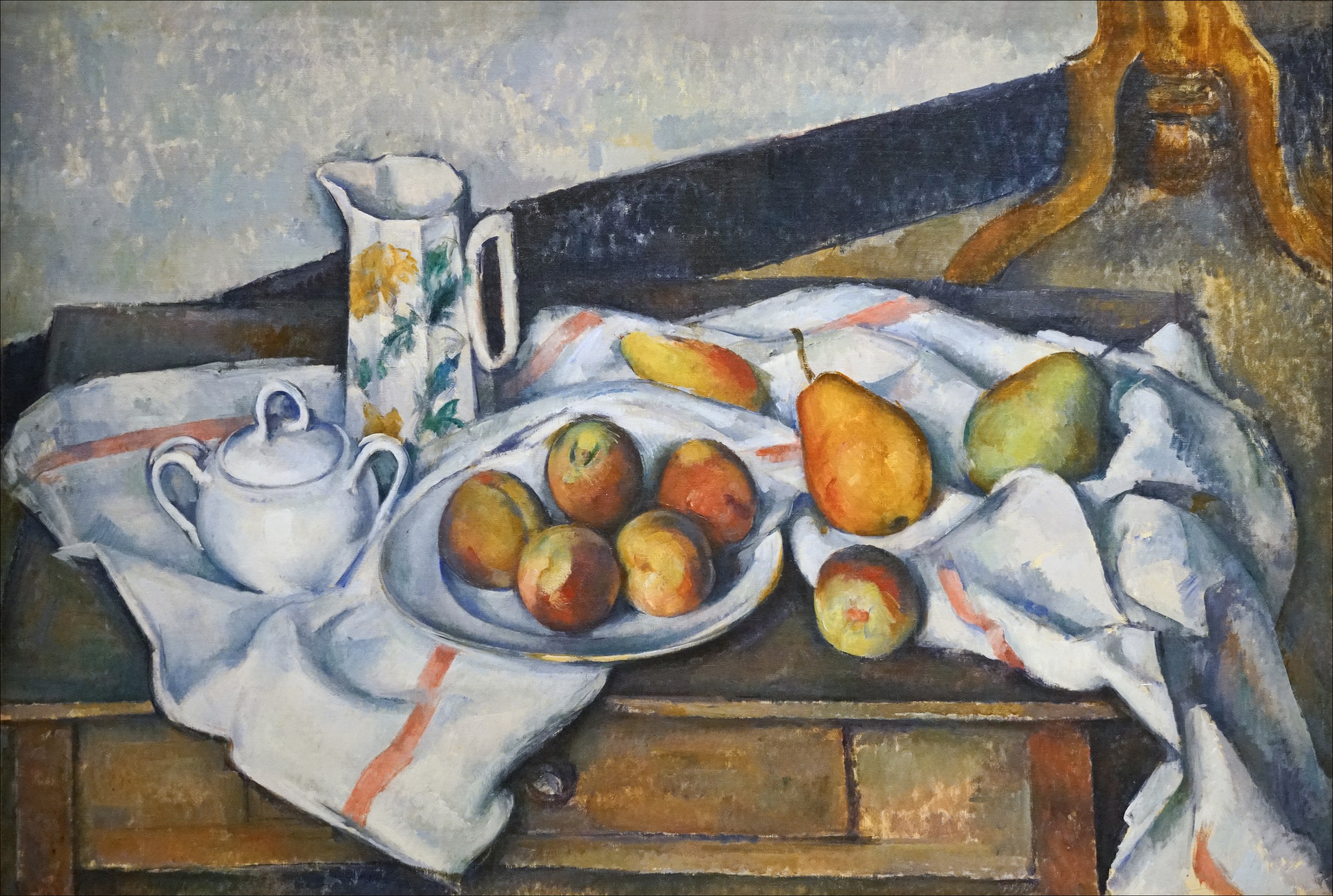
Peaches and Pears
Paul Cézanne · 1890
Pushkin Museum
Peaches and Pears. A still life of 1888 to 1890, bought from Vollard in 1912 by Ivan Morozov, nationalised with his collection in 1918 and moved to Moscow's Pushkin Museum in 1948. A closely related canvas hangs in Oslo.
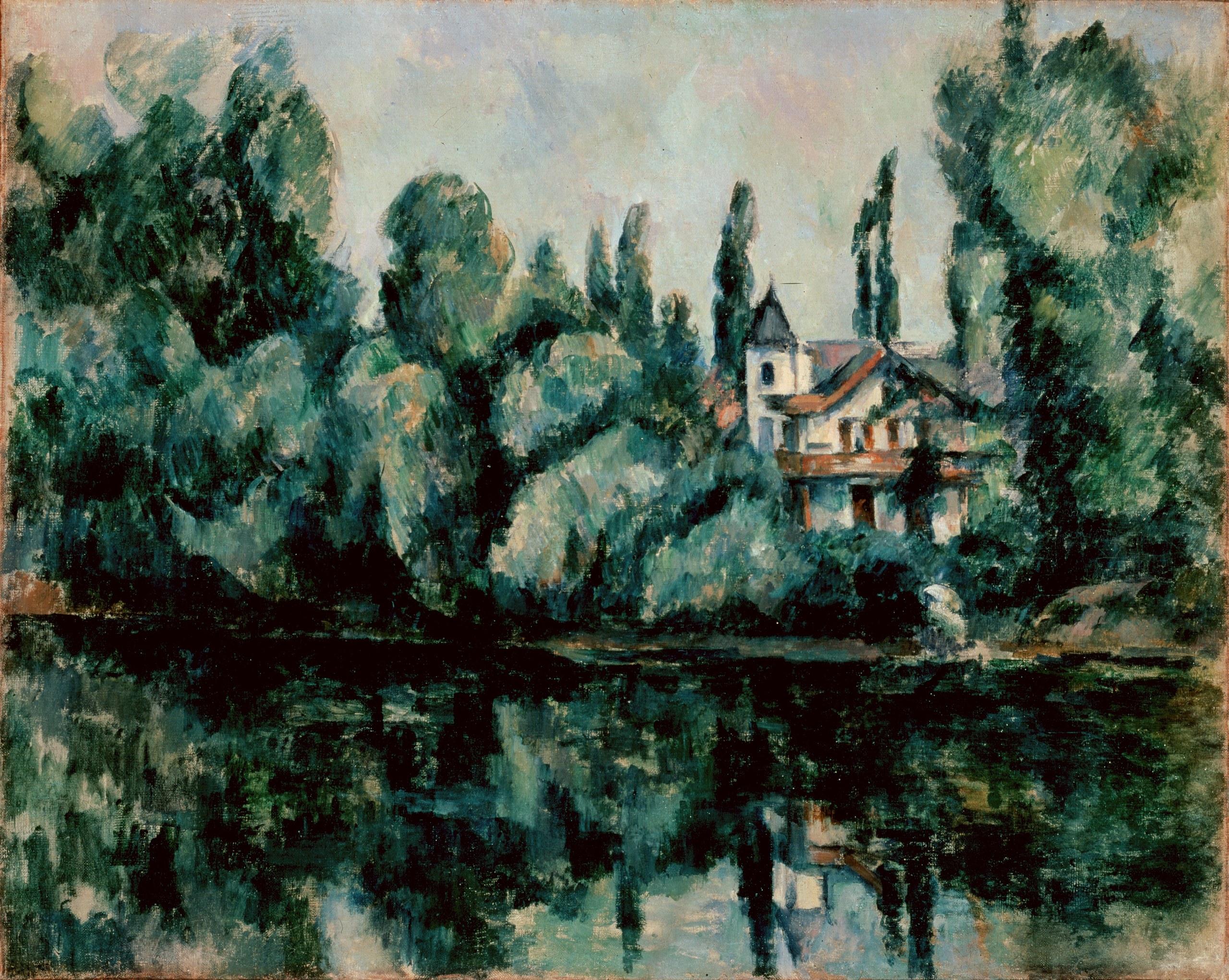
Along the Banks of the Marne
Paul Cézanne · 1888
State Hermitage Museum
Along the Banks of the Marne. River country of 1888, the far bank and the villa above it held in the same unhurried planes of colour. It came from Morozov's Moscow collection into the Hermitage.
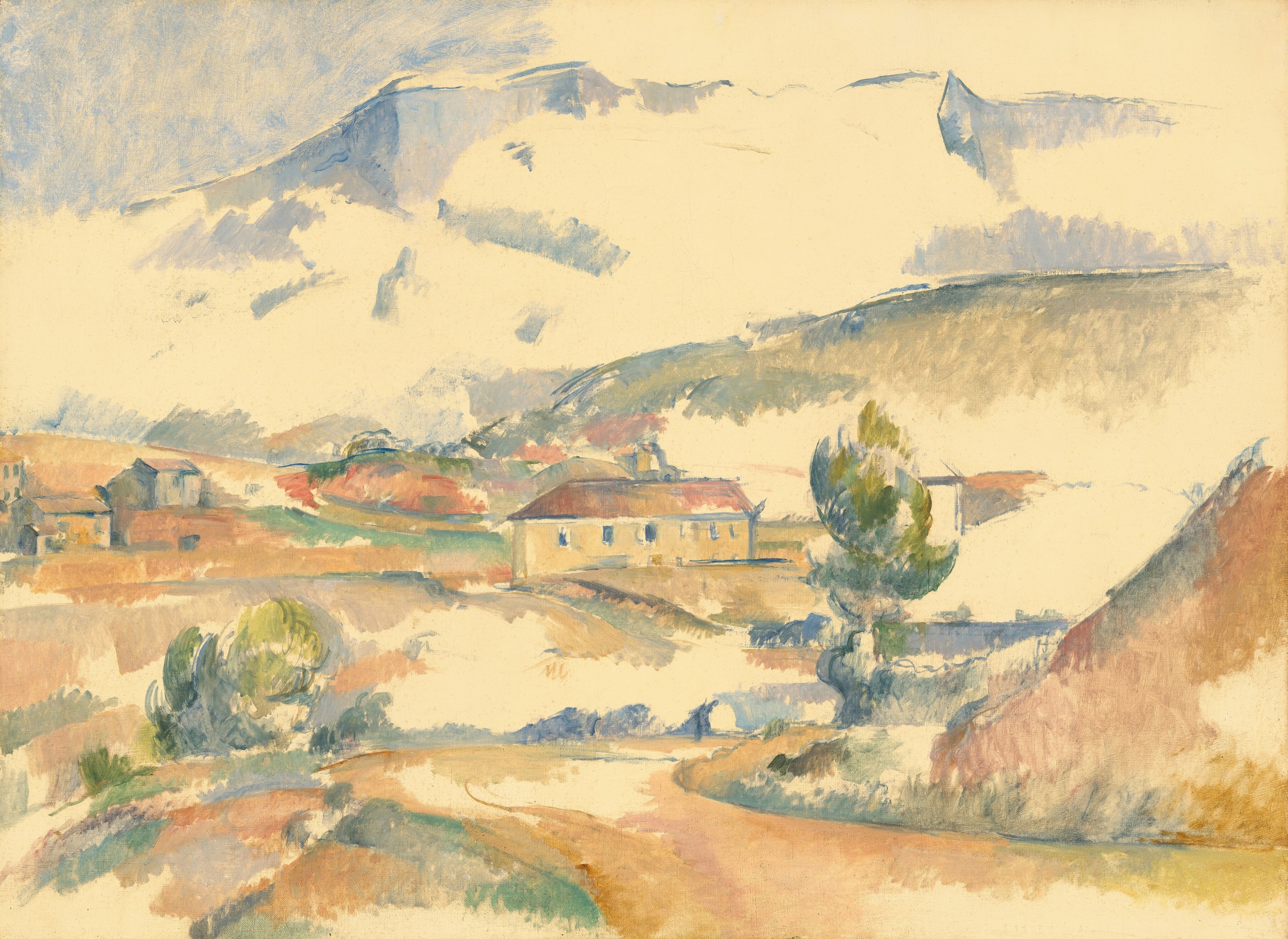
Montagne Sainte-Victoire, from near Gardanne
Paul Cézanne
National Gallery of Art
Montagne Sainte-Victoire, from near Gardanne. The mountain again, seen from the country southwest of Aix in a canvas of 1886 to 1888, the houses of the valley tucked under the ridge. It reached Washington's National Gallery of Art as the gift of the Harriman family foundation.
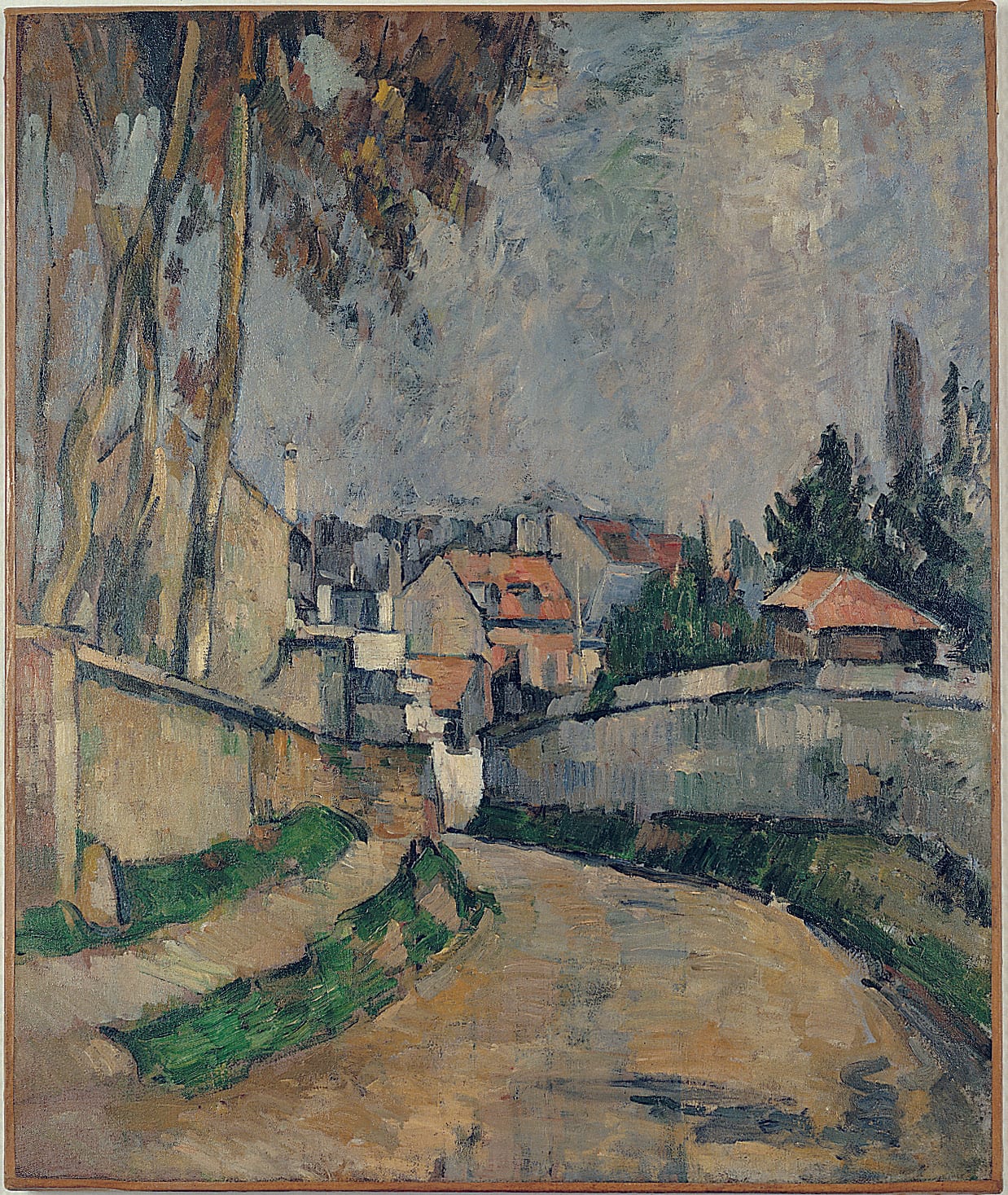
Houses by the Road II
Paul Cézanne · 1881
Tel Aviv Museum of Art
Houses by the Road II. A road bending out of the picture past houses and a wall, painted around 1881, when he was turning Impressionist colour toward something more solid. It hangs in Tel Aviv on long-term loan from the collection of Moshe and Sara Mayer.
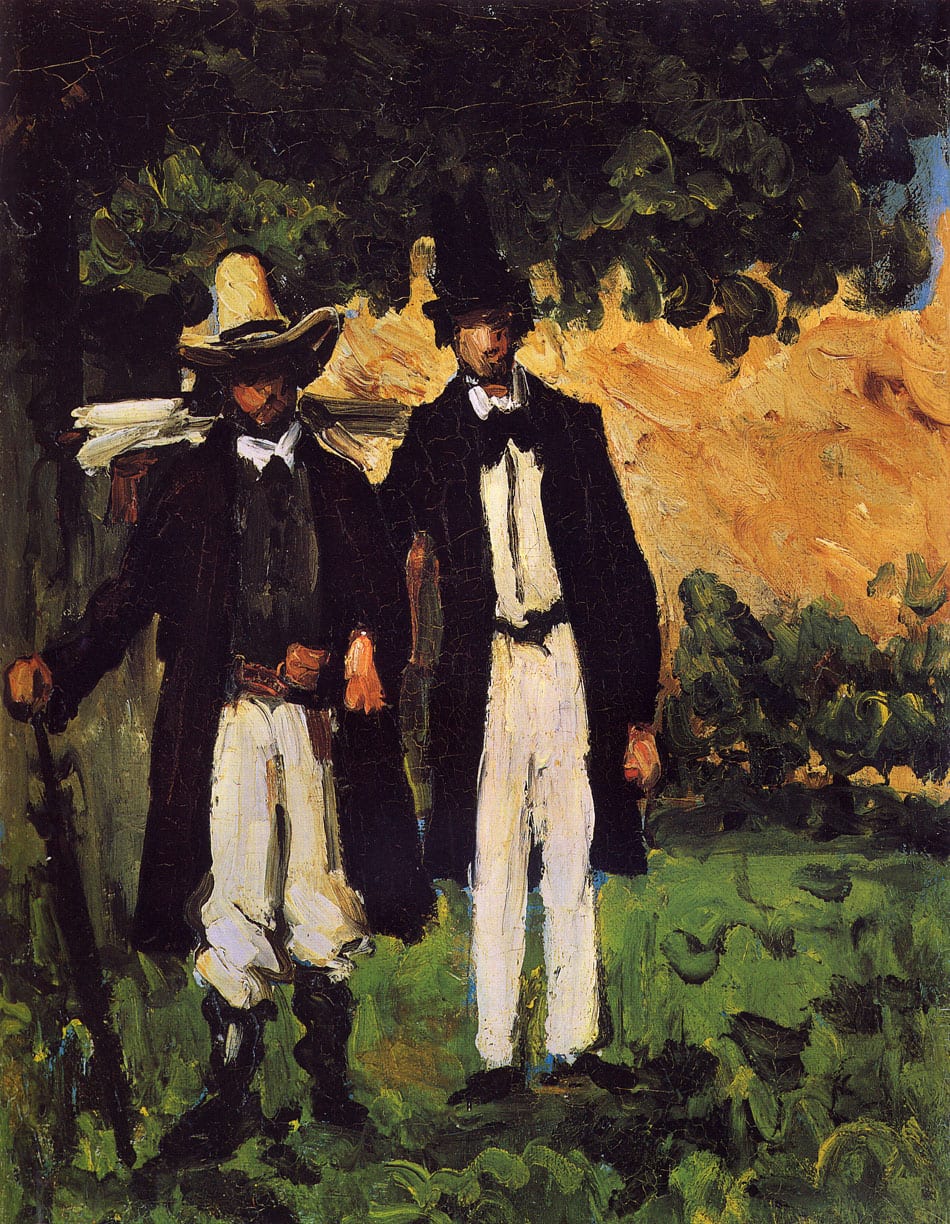
Marion et Valabrègue partant pour le motif
Paul Cézanne · 1866
Museo Soumaya
Marion et Valabrègue partant pour le motif. Two figures striding out of an autumn landscape in 1866: the painter friends of the title, Marion and Valabrègue, off to find a subject to paint. An early figure piece, small in size and blunt in its dark palette, once owned by the collector Auguste Pellerin and now in Mexico City.
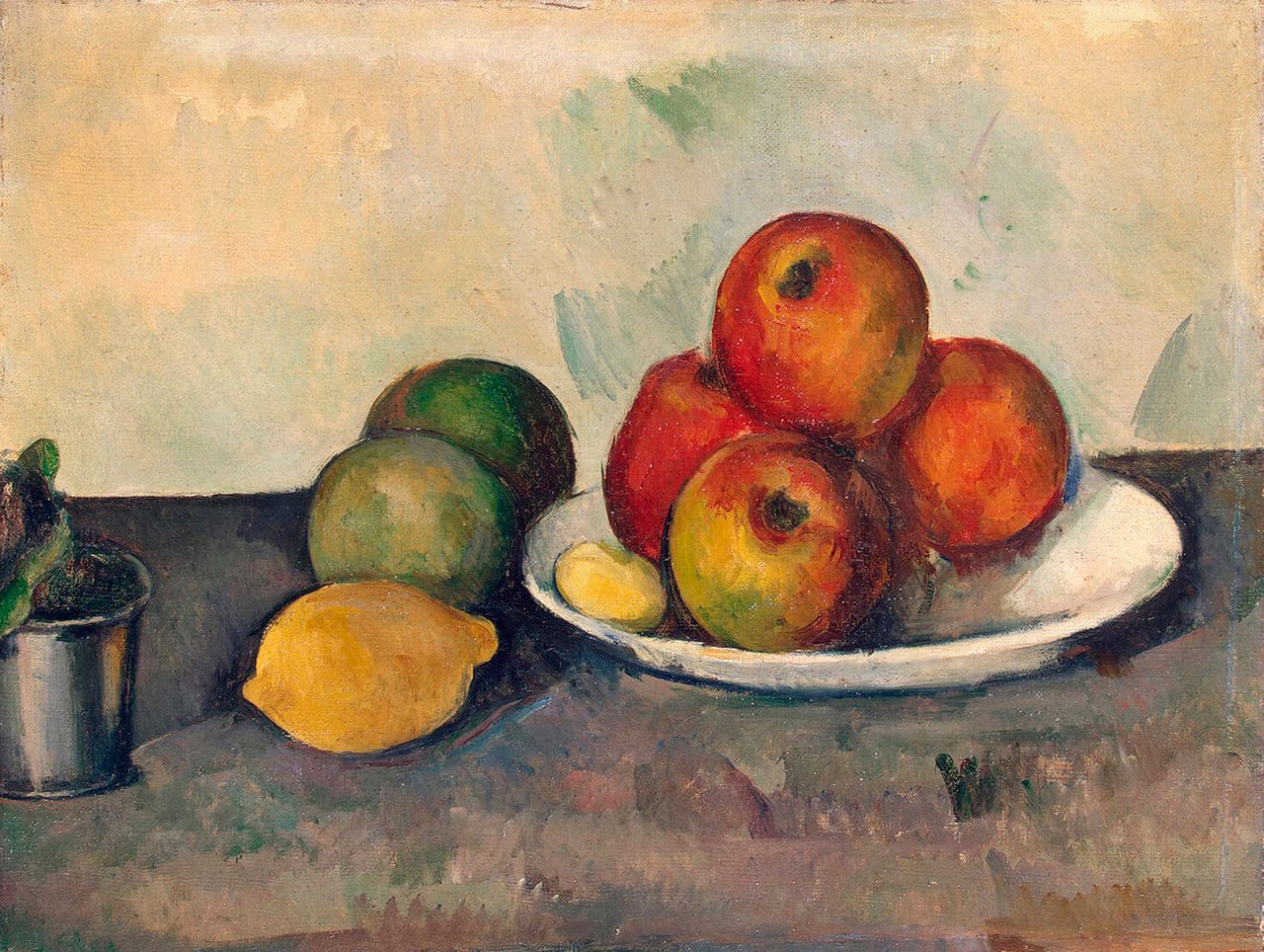
Still Life with Apples
Paul Cézanne · 1890
State Hermitage Museum
Still Life with Apples. A still life of about 1890, kept today in the Hermitage, where it came from the collection of Otto Krebs. Fruit as architecture: each apple placed and tilted until the table beneath it seems to tilt too, the ordinary subject made monumental by sheer weighing of form.
Sources
- Wikipedia, “Paul Cézanne”
- Wikipedia, “Mont Sainte-Victoire (Cézanne)”
- Musée d'Orsay, “La Femme à la cafetière”
- Musée d'Orsay, “Nature morte aux oignons”
- Museo Nacional Thyssen-Bornemisza, “Hombre sentado”
- Cézanne Catalogue Raisonné, “Marion et Valabrègue partant pour le motif”
- Cézanne Catalogue Raisonné, “Maisons au bord d'une route, II”
- Cézanne Catalogue Raisonné, “La Montagne Sainte-Victoire vue du Pont de Bayeux à Meyreuil”
- Wikidata, “Still Life with Apples”
- Wikidata, “Along the Banks of the Marne”
- Wikipedia, “The Basket of Apples”
- Wikipedia, “Rideau, Cruchon et Compotier”
- Wikipedia, “The Hanged Man's House”
- Wikipedia, “Still Life with Apples and Oranges”
- Wikipedia, “Pont de Maincy”
- Wikipedia, “Lady in Blue (Cézanne)”
- Wikipedia, “The Overture to Tannhäuser”
- Wikipedia, “Still Life with Peaches and Pears”
- Wikipedia, “View of Auvers-sur-Oise”
Invite Paul Cézanne into your living room
Play 20 works from this collection on your TV, phone or tablet with Momentable Art TV.