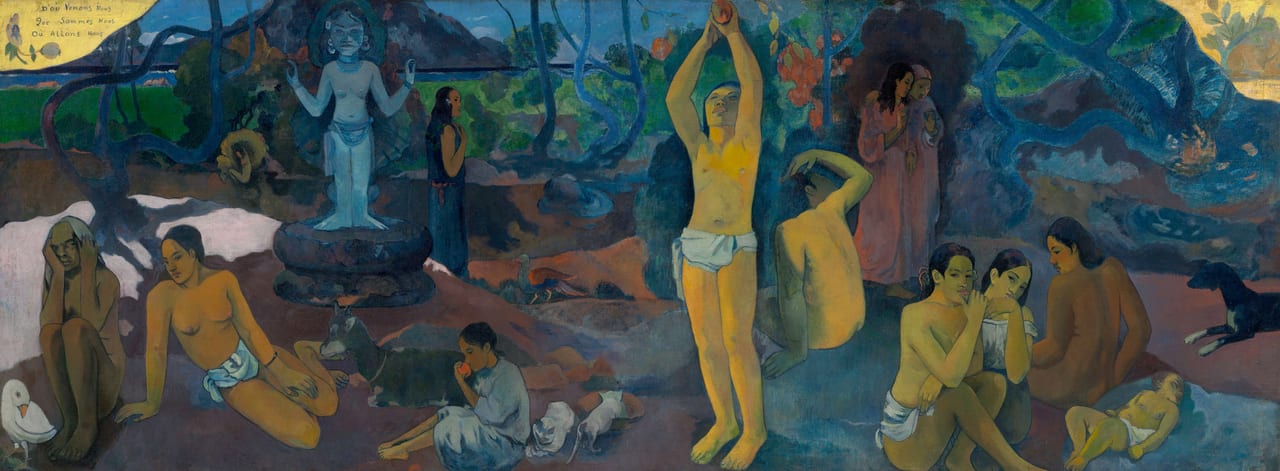
Where Do We Come From? What Are We? Where Are We Going?
Paul Gauguin · 1897

Paul Gauguin
French · 1848–1903
The Paris stockbroker who threw away the desk to paint in Brittany and then in the South Seas, letting colour say what no true scene could.
Play 24 works from this collection on your TV, phone or tablet with Momentable Art TV.
Play CollectionStockbroker to painter
Paris, 1848, the year Europe rose up: that is where and when Gauguin began. Peru took the family when he was small, and the boy's early years there were easeful enough to mark him for good. Grown up and back in France, he earned his bread on the exchange and painted on Sundays, teaching himself by looking, in galleries and shows.
The market crash of 1882 broke the day job, and he turned to the easel for a living. The bourgeois household did not outlast the decision; his Danish wife Mette took the children home to Copenhagen, and the work took all of him.
Pont-Aven and Arles
At Pont-Aven in Brittany he collected a following of younger painters around a way of working built on colour straight from the tube and subjects taken as symbols, the thing now known as the Pont-Aven School. The Yellow Christ, done there in 1889, stands with its companion as a cornerstone of Symbolism.
Then Arles, in 1888, and the house-share with Van Gogh at the Yellow House, at Theo's instigation, part financed by Theo's monthly payment of 150 francs to Gauguin. It lasted nine weeks. On the evening of 23 December, by Gauguin's own much later telling, Vincent came at him with a razor; Vincent was in hospital next day and Gauguin had left town.
Tahiti and the Marquesas
Tahiti changed everything. A French colony then, it offered what he was hunting: somewhere far from European civilisation to start again, and the 1890s belong to that turn. An auction of his paintings in Paris provided the funds for the first crossing; in 1895 Carrière found him a cheap berth for the second, and Europe never saw him again.
The islands gave him his last subjects and no ease: sickness and want pursued him to the end. He meant at last to settle in the Marquesas and did, and died there suddenly, early on 8 May 1903. What he left, those flat, bright, deliberate canvases, pushed modern painting hard, Picasso among those who took it up.
Known works
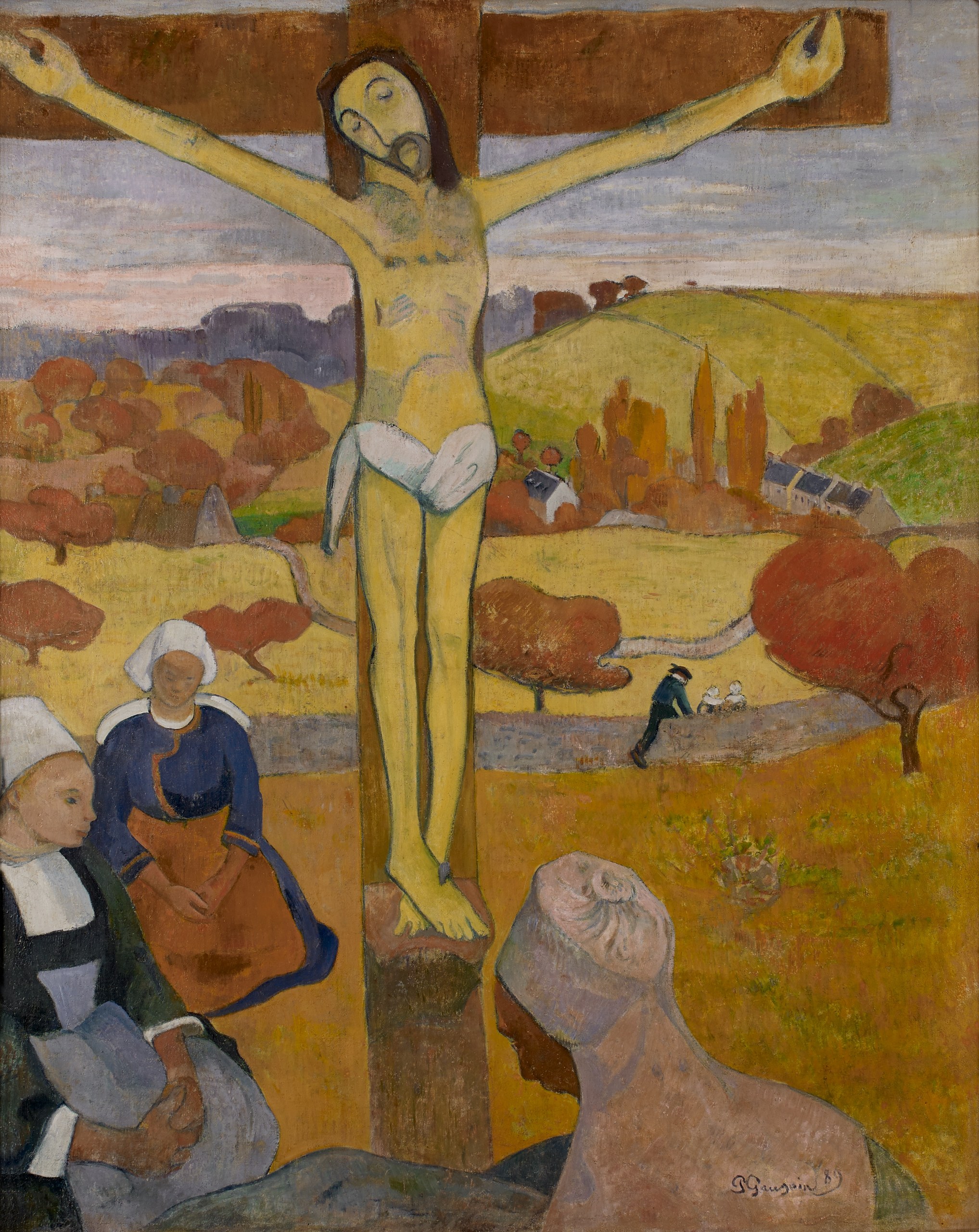
The Yellow Christ
Paul Gauguin · 1889
A crucifixion set among Breton women at the foot of the cross, the body in harvest yellow, the grass red, the whole painted in Pont-Aven in 1889; with the Green Christ it anchors Symbolist painting.
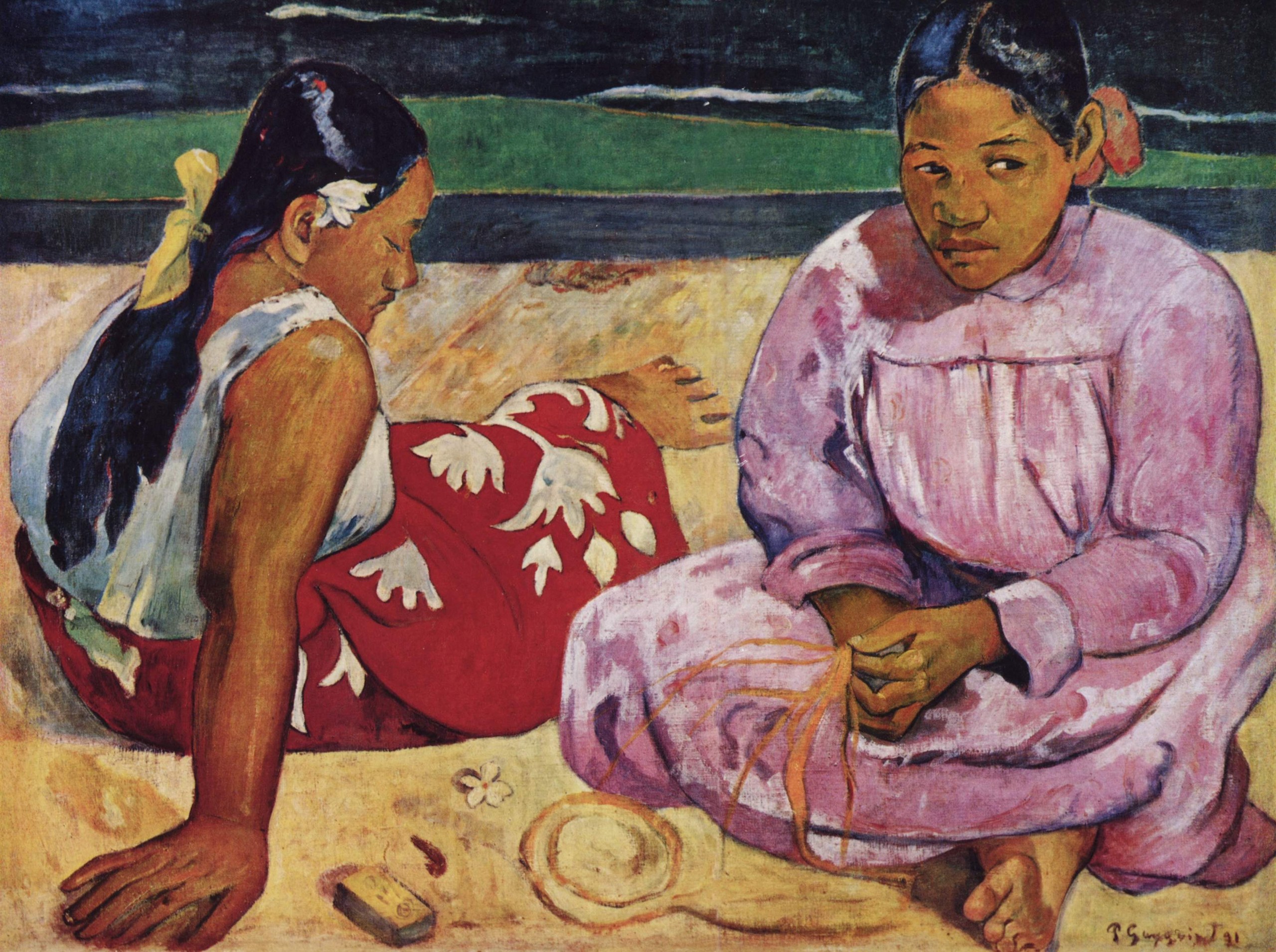
Tahitian Women on the Beach
Paul Gauguin · 1890
Musée d'Orsay
Two island women on the sand, one with her back to us, the sea flat as painted cloth behind; from the first stay in the islands, and hanging today in Paris at the Orsay.
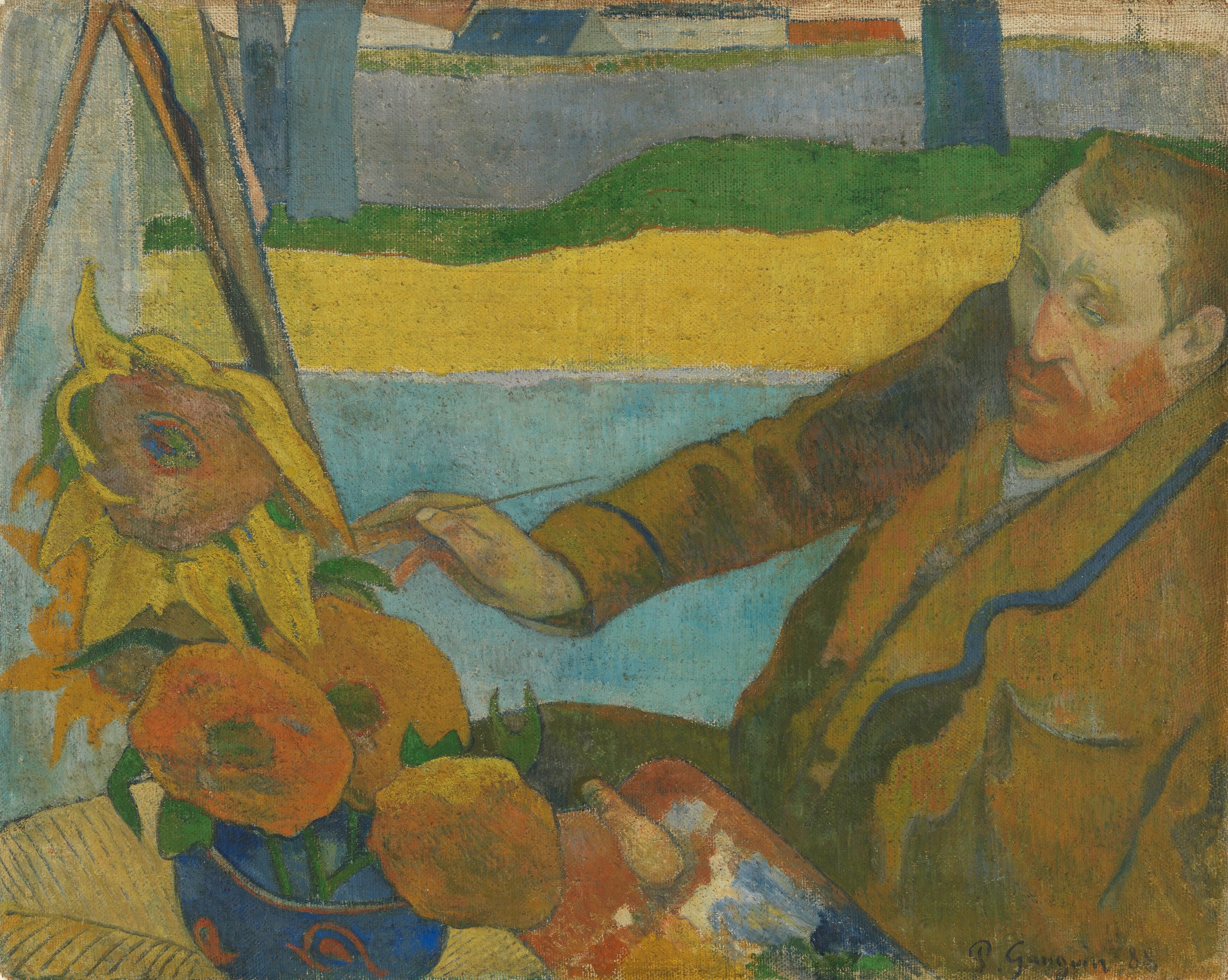
Vincent van Gogh Painting Sunflowers
Paul Gauguin · 1888
Van Gogh Museum
The Arles housemate from above and behind, at his easel with the sunflowers, the likeness taken from Gauguin's side of the room.
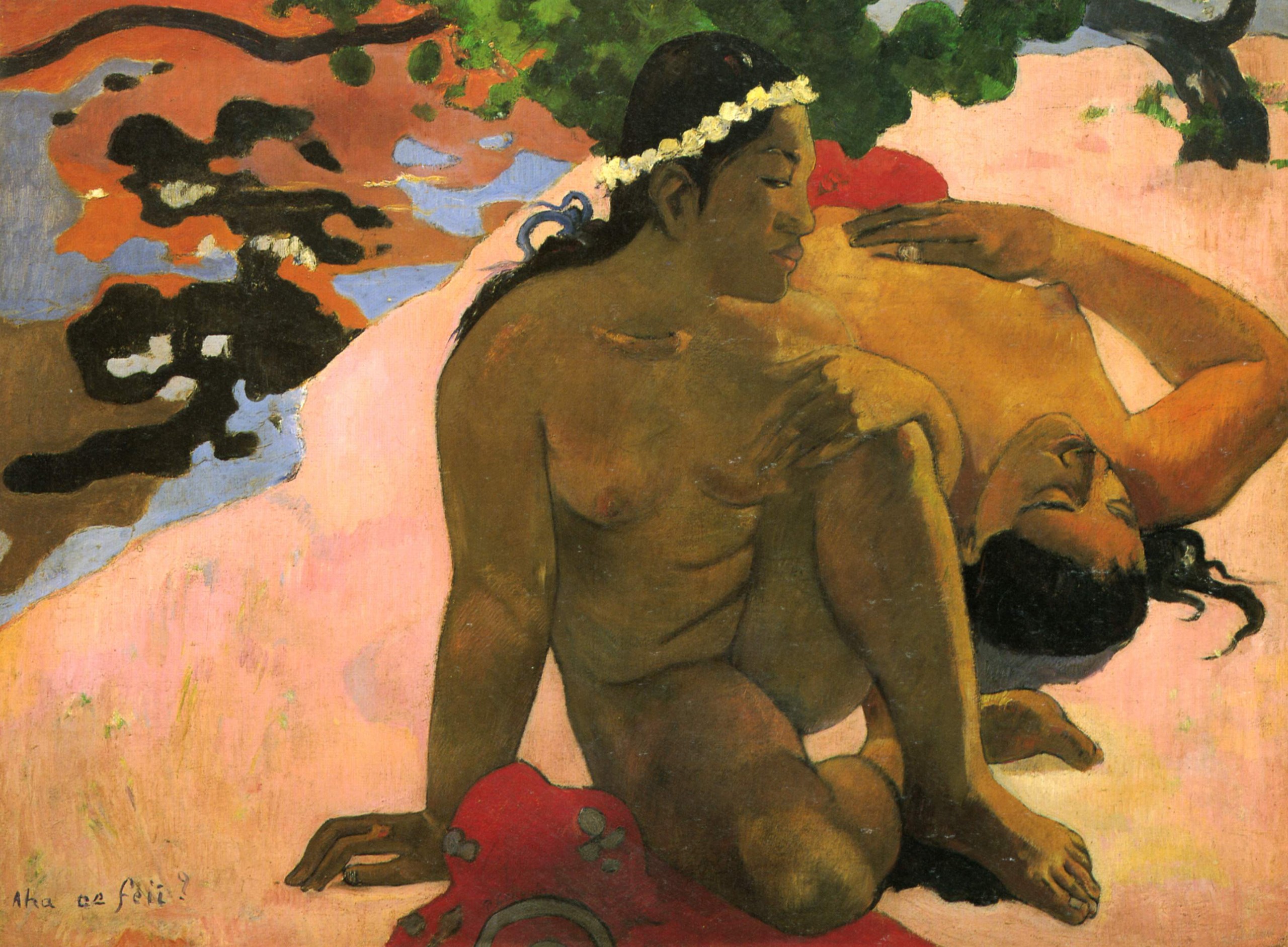
Aha Oe Feii?
Paul Gauguin · 1892
Pushkin Museum
Two sisters at rest after bathing on a red and green shore, from a real moment in his island life; he told a friend in 1892 that it was the best he had done yet.
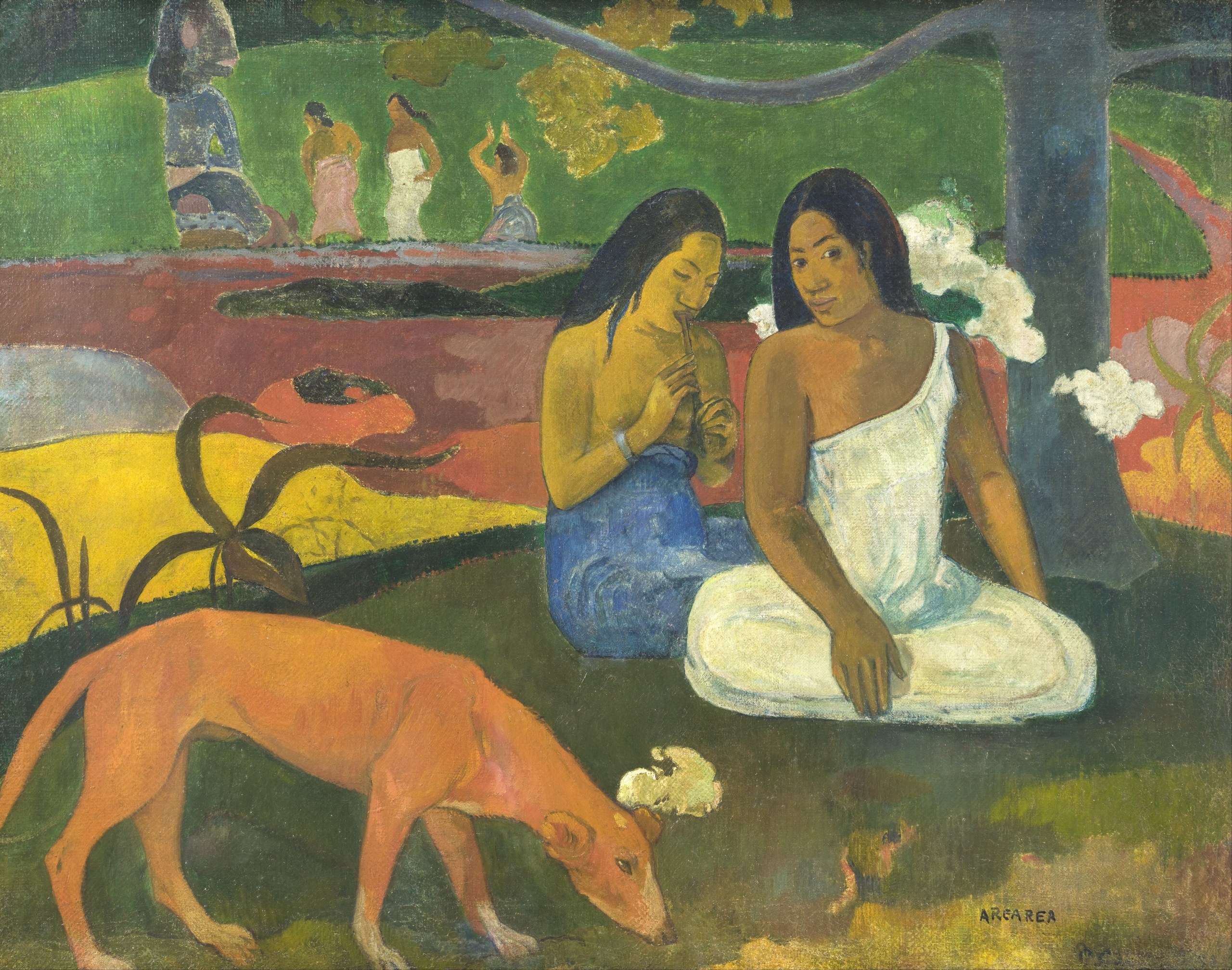
Arearea
Paul Gauguin · 1892
Musée d'Orsay
A Tahitian scene with a deliberately wrong red dog at its front; among the works he showed at Durand-Ruel's rooms in 1893, and left to the French state in 1961.
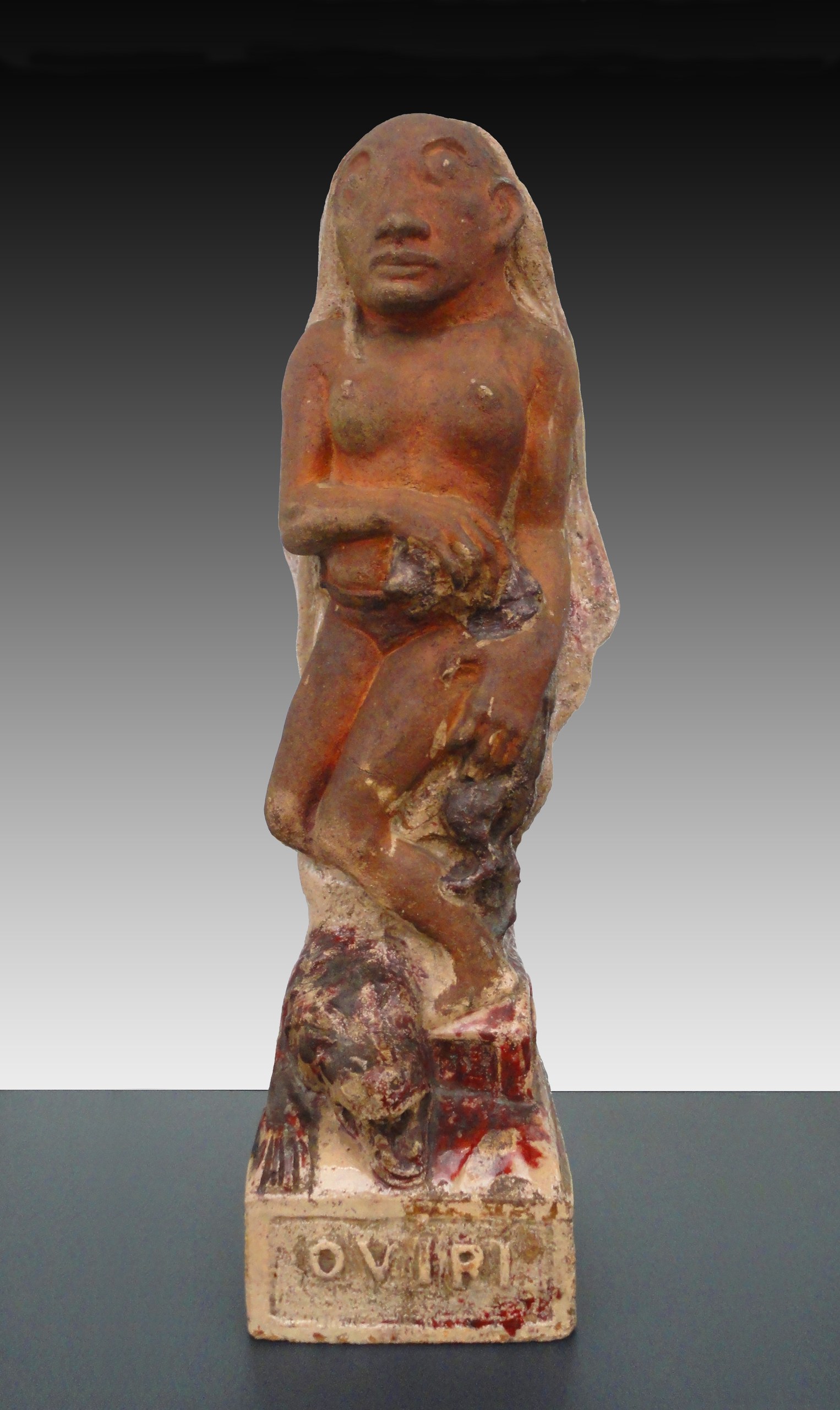
Oviri
Paul Gauguin · 1894
Musée d'Orsay
The wild one: a stoneware figure, long pale hair and wild eyes, a wolf under her foot and a cub in her arms, the Tahitian goddess of mourning; Picasso saw her and took a figure of his Demoiselles from her.
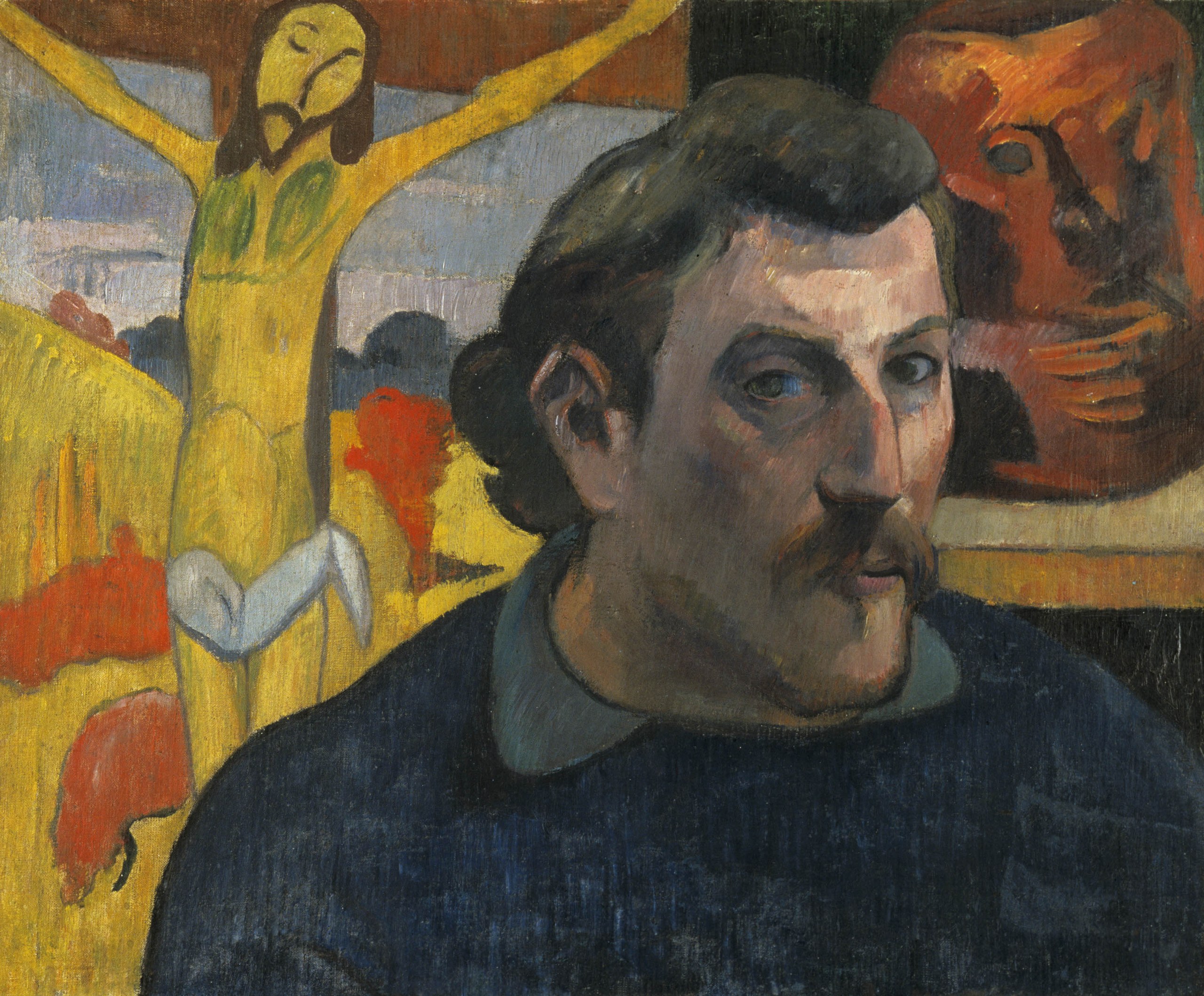
Portrait of the Artist with the Yellow Christ
Paul Gauguin · 1890
Musée d'Orsay
Himself between two of his own works, the yellow crucifix and a grotesque ceramic head of his own making, Christ standing in for the painter as he liked to do: a self-portrait three times over.
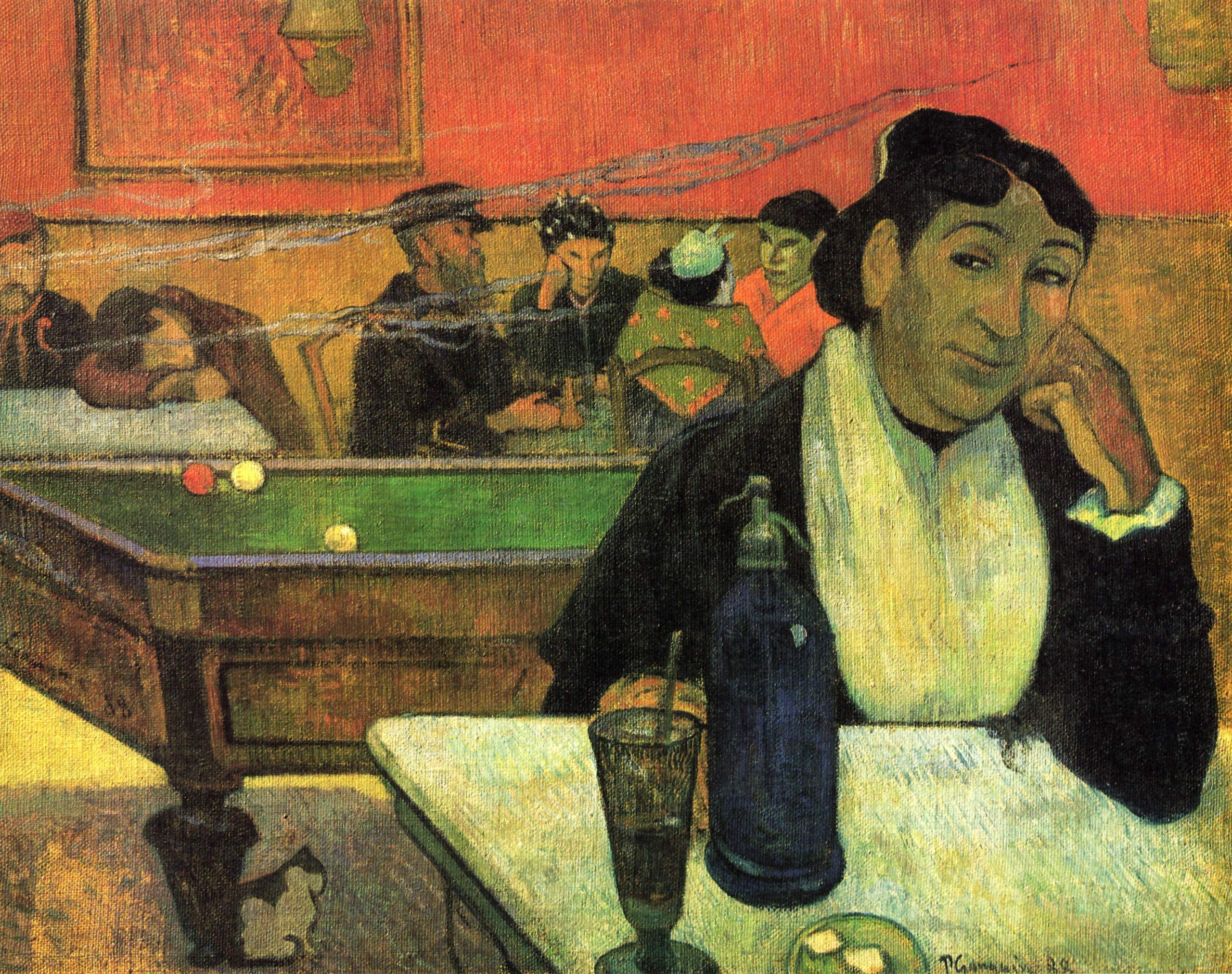
The Night Café in Arles
Paul Gauguin · 1888
Pushkin Museum
The lamp-lit café of the Van Gogh weeks, its billiard table, chairs and mirrors tilted into a pattern that has stopped pretending to be a room.
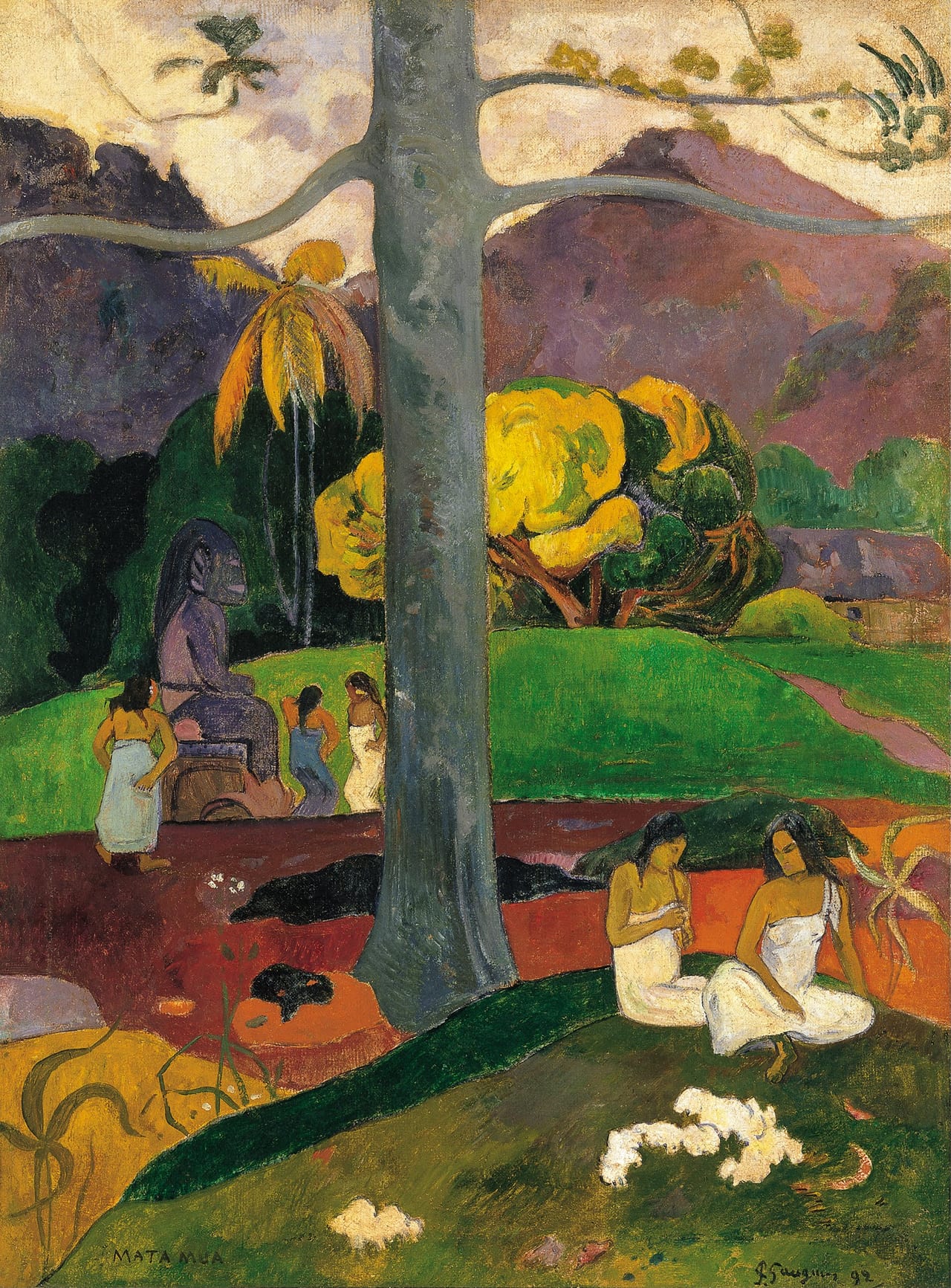
Mata Mua
Paul Gauguin · 1892
Thyssen-Bornemisza Museum
In Ancient Times: an idyll of flute-playing and idol-worship under violet mountains, the island life he wanted remembered.
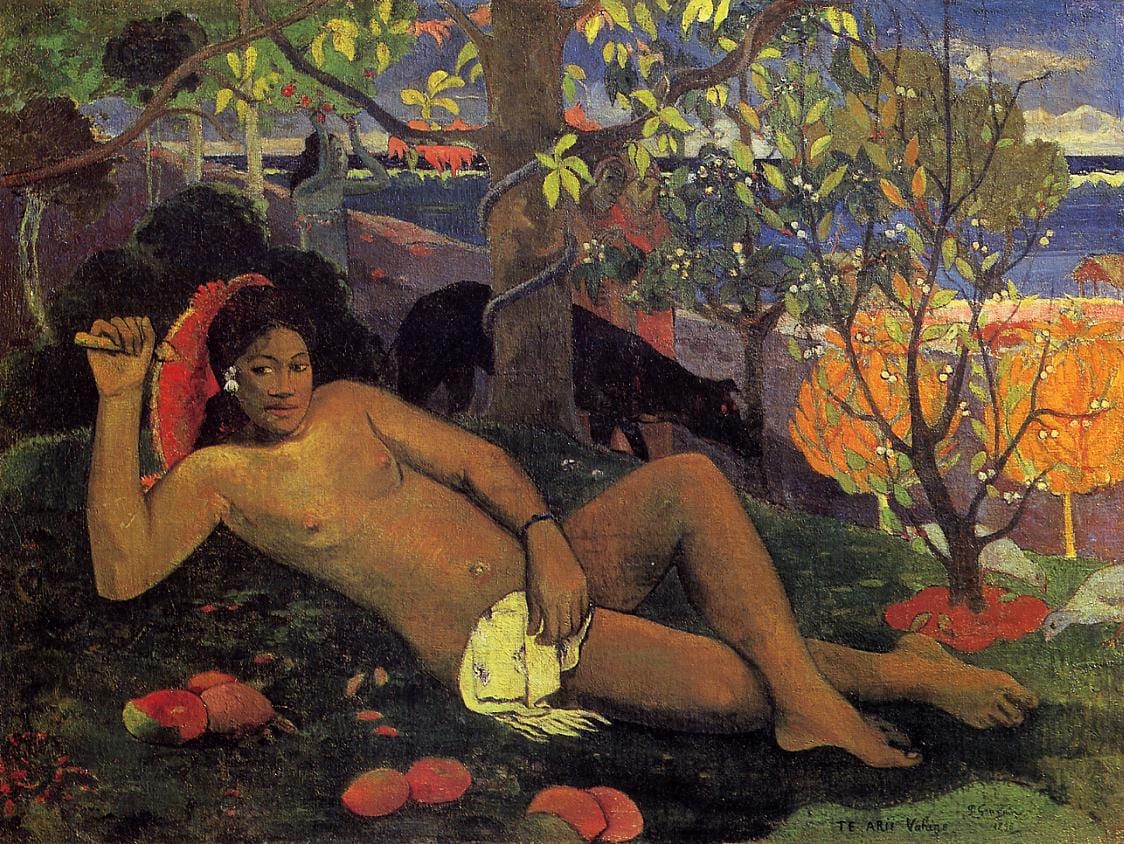
The King's Wife
Paul Gauguin · 1896
Pushkin Museum
A nude queen reclining on a green carpet while a servant picks fruit; Gauguin wrote that in colour he had never made anything of such solemn sonority.
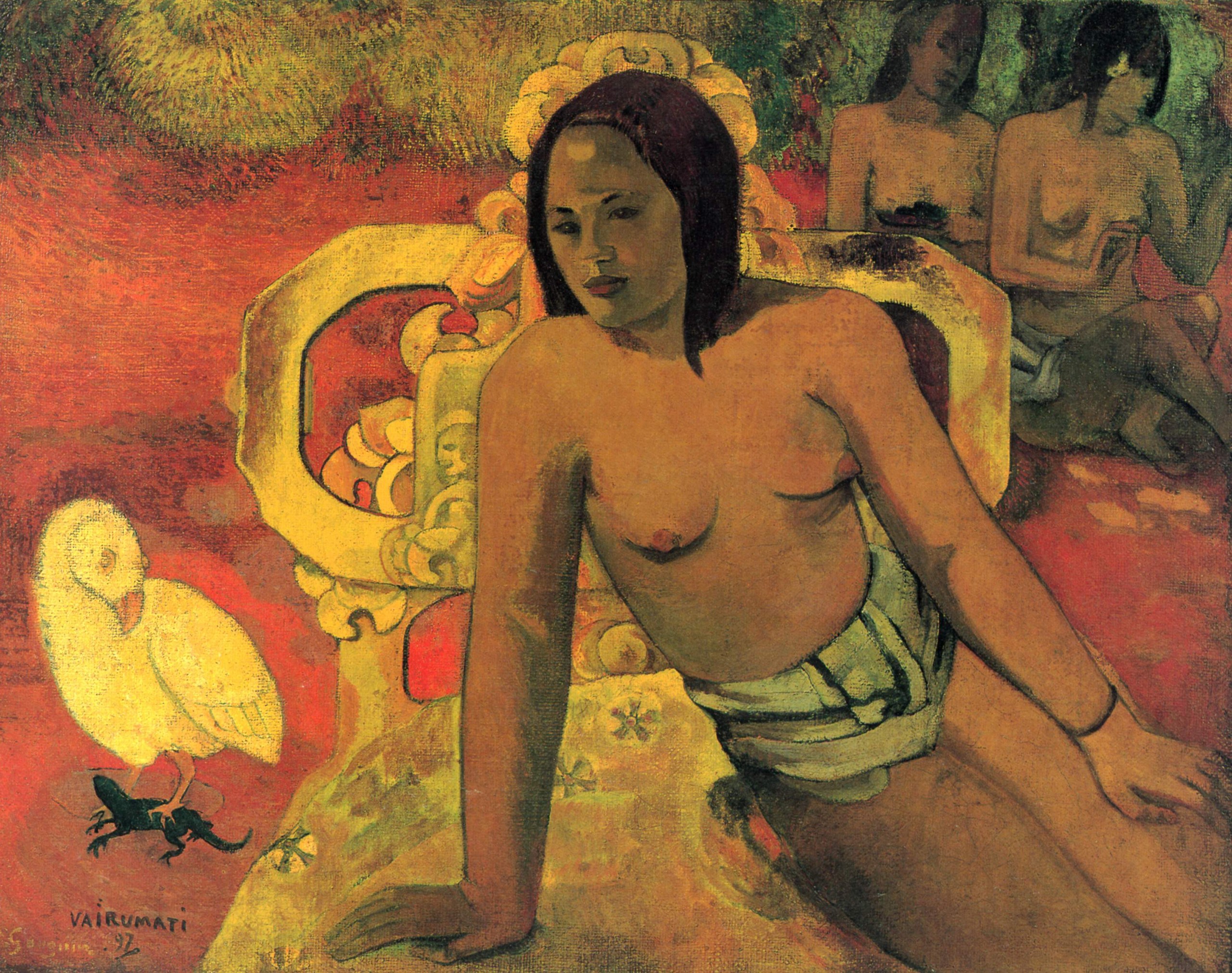
Vairumati
Paul Gauguin · 1897
Musée d'Orsay
A young woman on a bed under a carved lintel, waiting for or ignoring the painter; one of his last Tahiti subjects, painted in 1897, the year his daughter Aline died.
More to discover
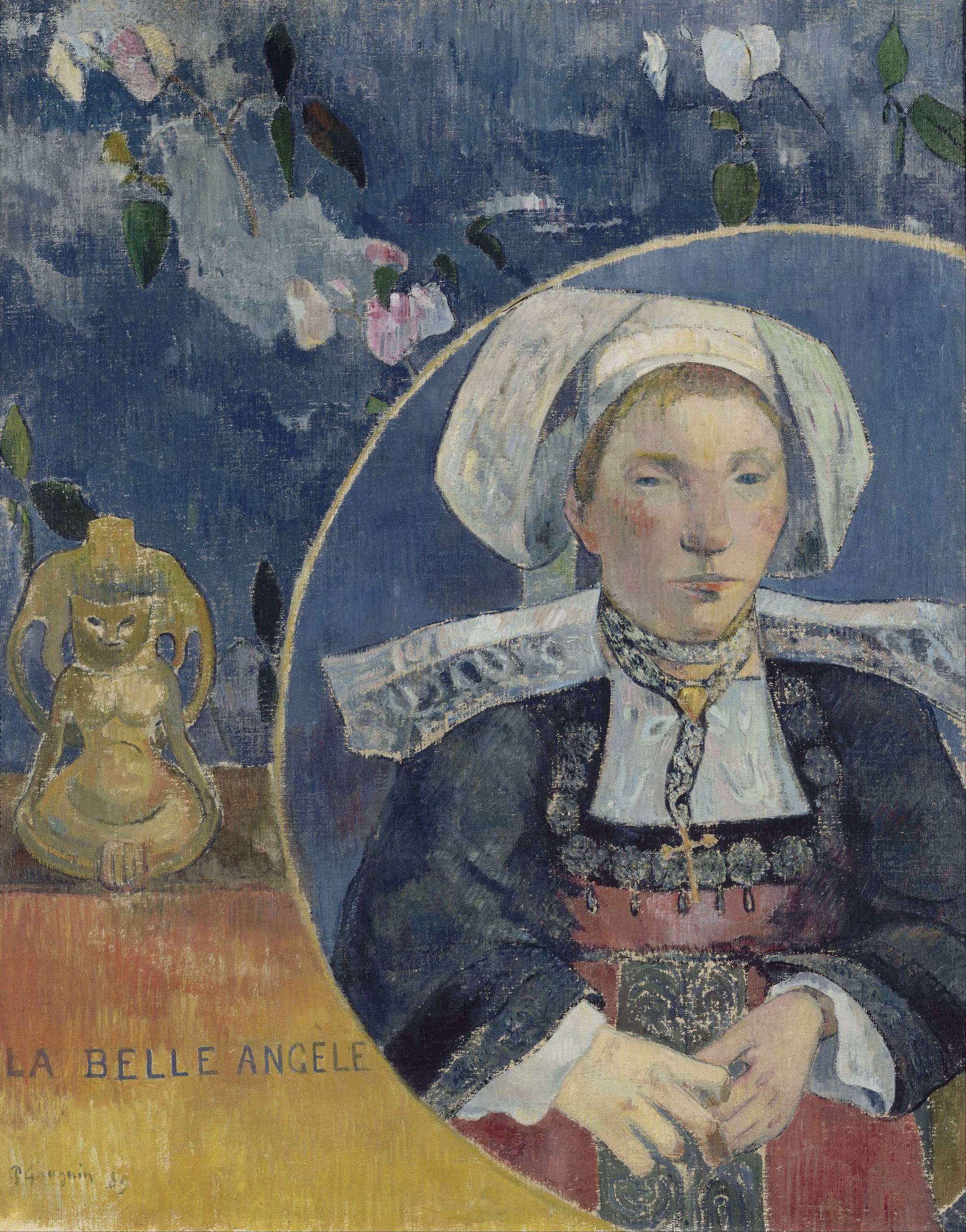
La belle Angèle
Paul Gauguin · 1889
Musée d'Orsay
An innkeeper of Pont-Aven framed like a saint on a gold ground, her ring of paint a halo; the print taste of Paris in 1889, Hokusai especially, is all over the design.
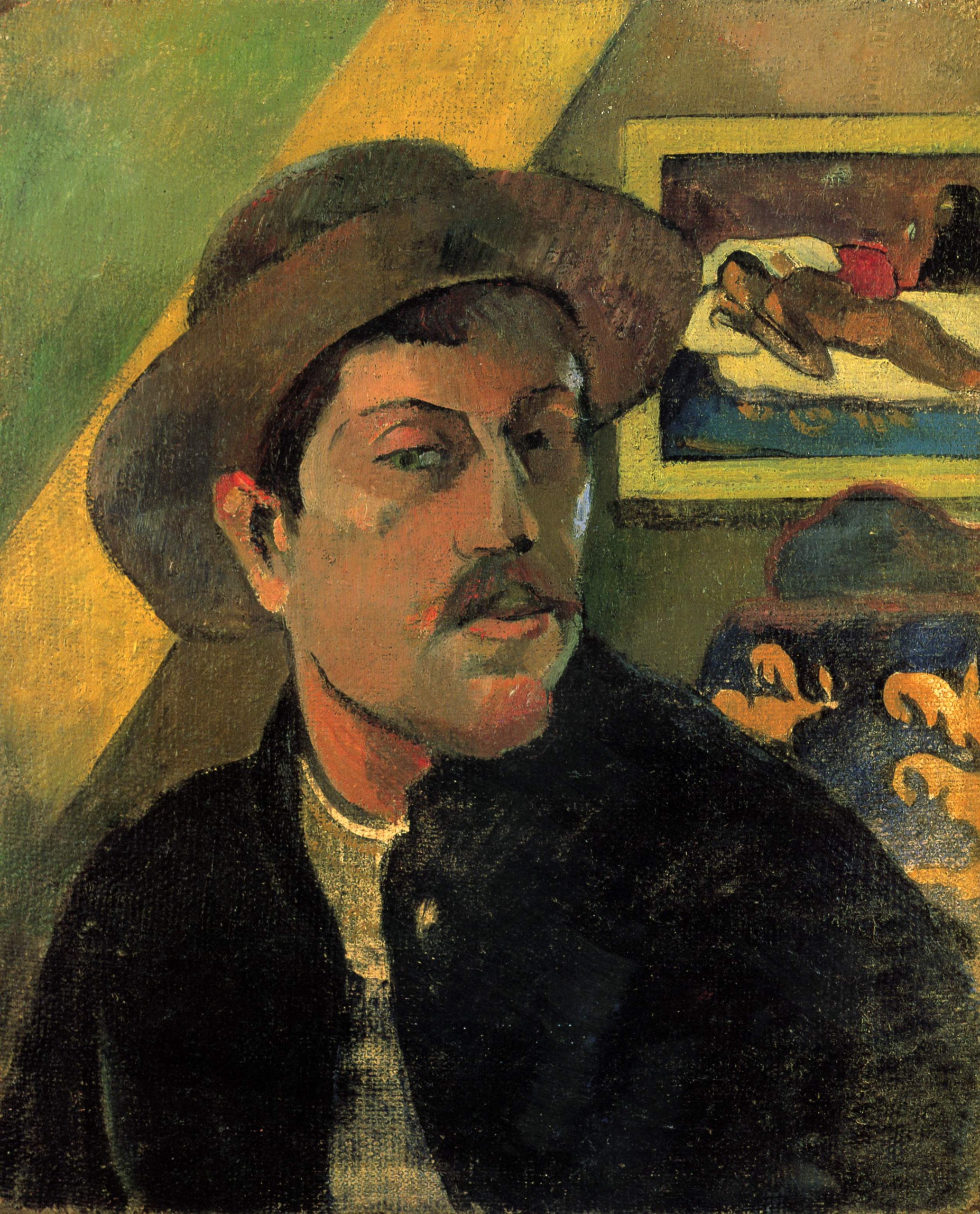
Self-portrait with hat
Paul Gauguin · 1893
Musée d'Orsay
Himself in the Paris studio after the first island voyage, his own Spirit of the Dead Watching at his back.
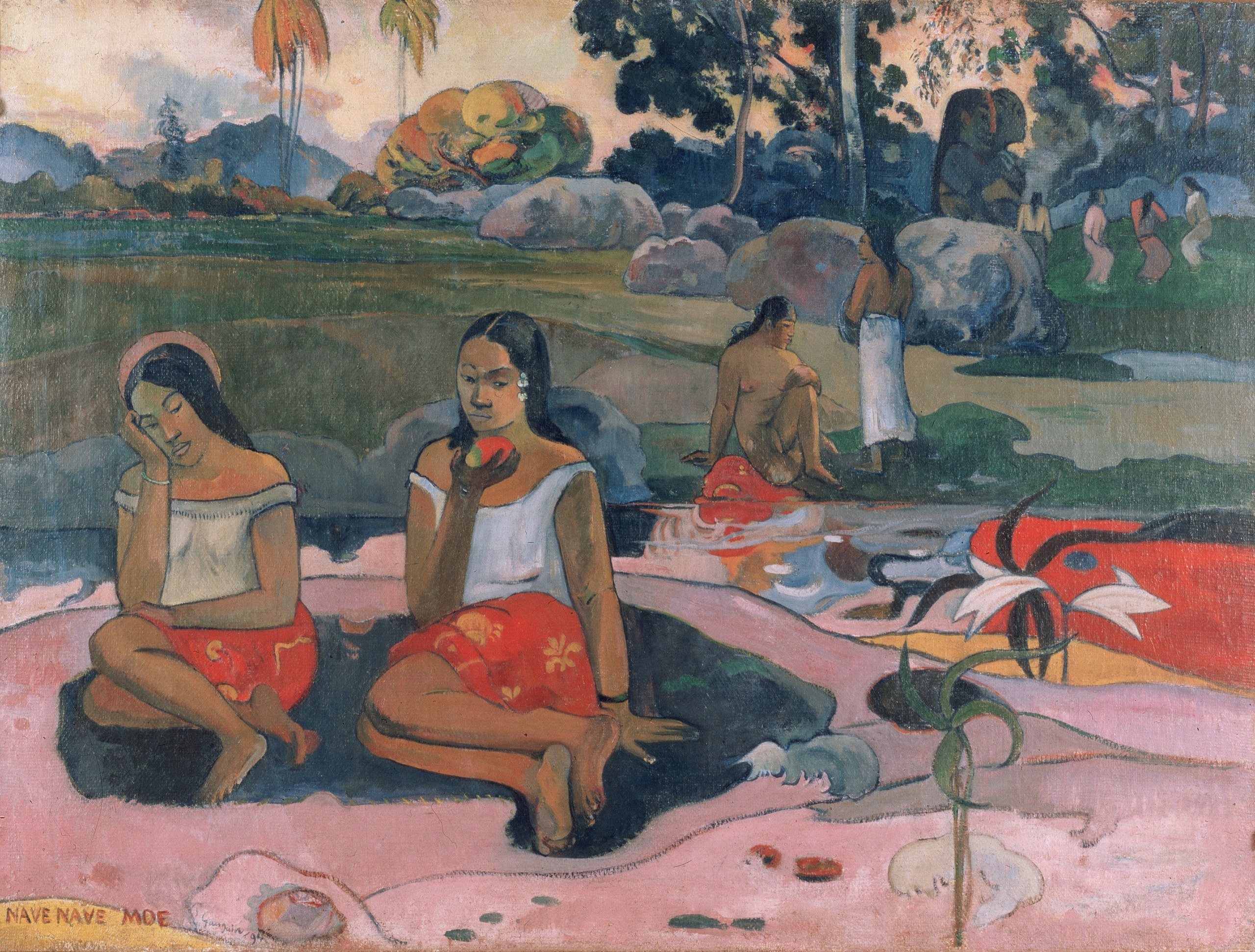
Sacred Spring: Sweet Dreams (Nave nave moe)
Paul Gauguin · 1894
State Hermitage Museum
A remembered Tahiti painted in Paris in 1894, blue pool, pink horses and all; now in the Hermitage.
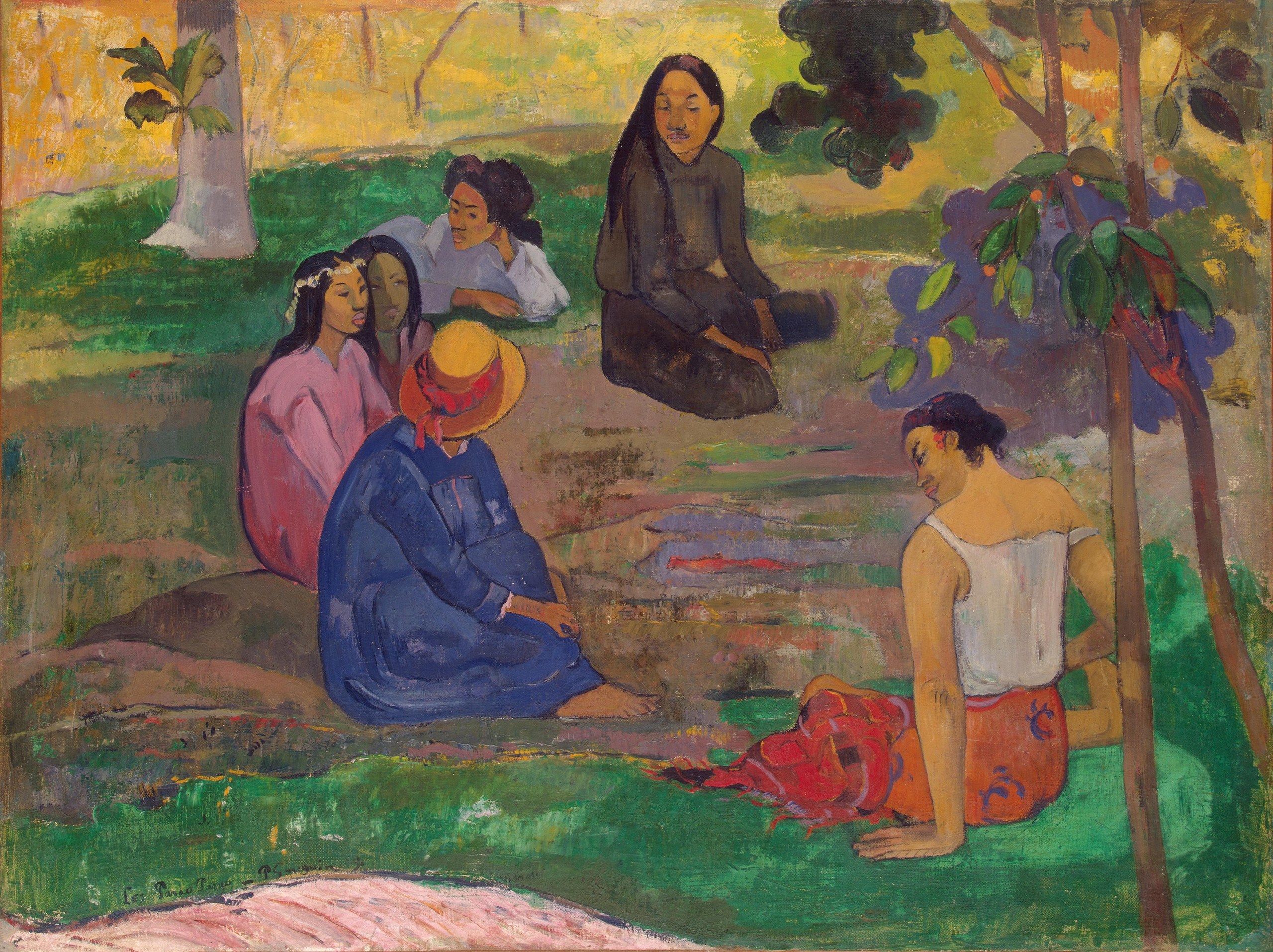
Conversation (Les Parau Parau)
Paul Gauguin · 1891
State Hermitage Museum
Tahitian women talking in pairs under trees, their talk the whole subject of the picture.
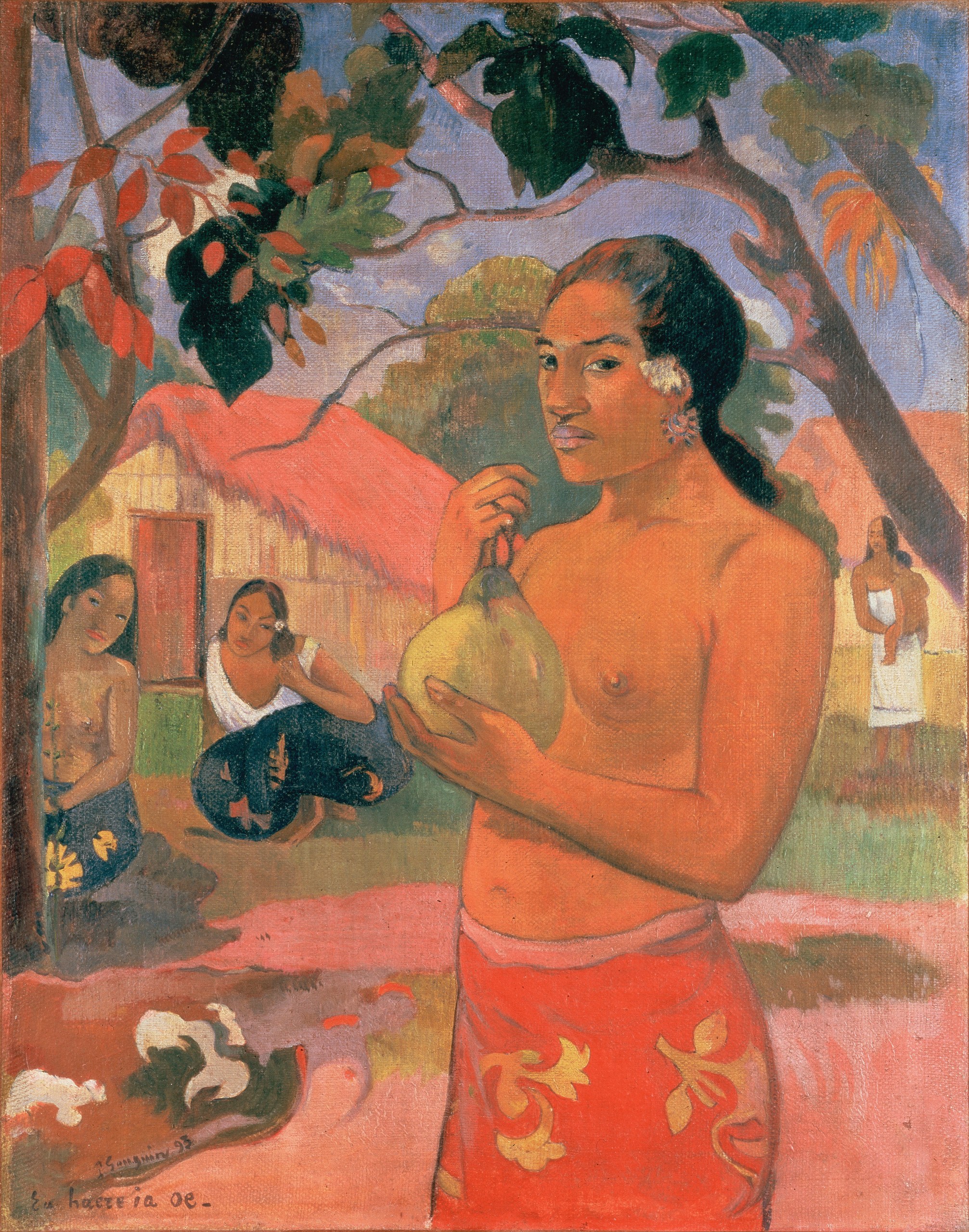
Eu haere ia oe
Paul Gauguin · 1893
State Hermitage Museum
Where are you going: a woman in blue and pink walking toward the viewer through an orchard, the question painted into the title.
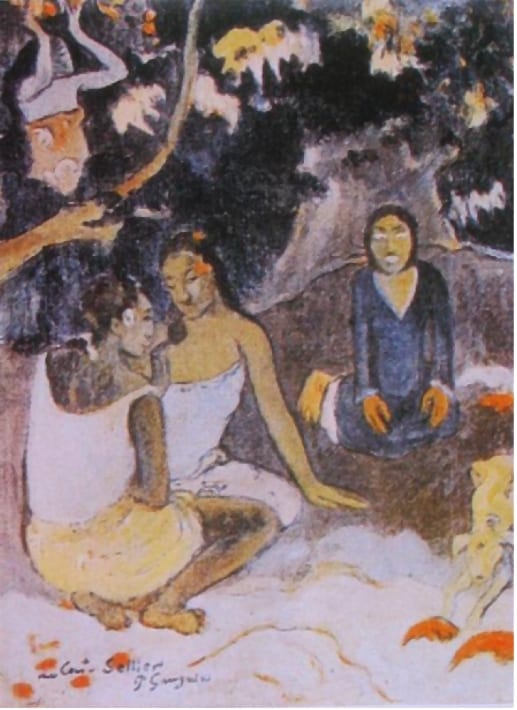
Barbarian Tales
Paul Gauguin · 1892
Tel Aviv Museum of Art
A foreground figure with a mask-like face watching a pair behind her, the story withheld on purpose.
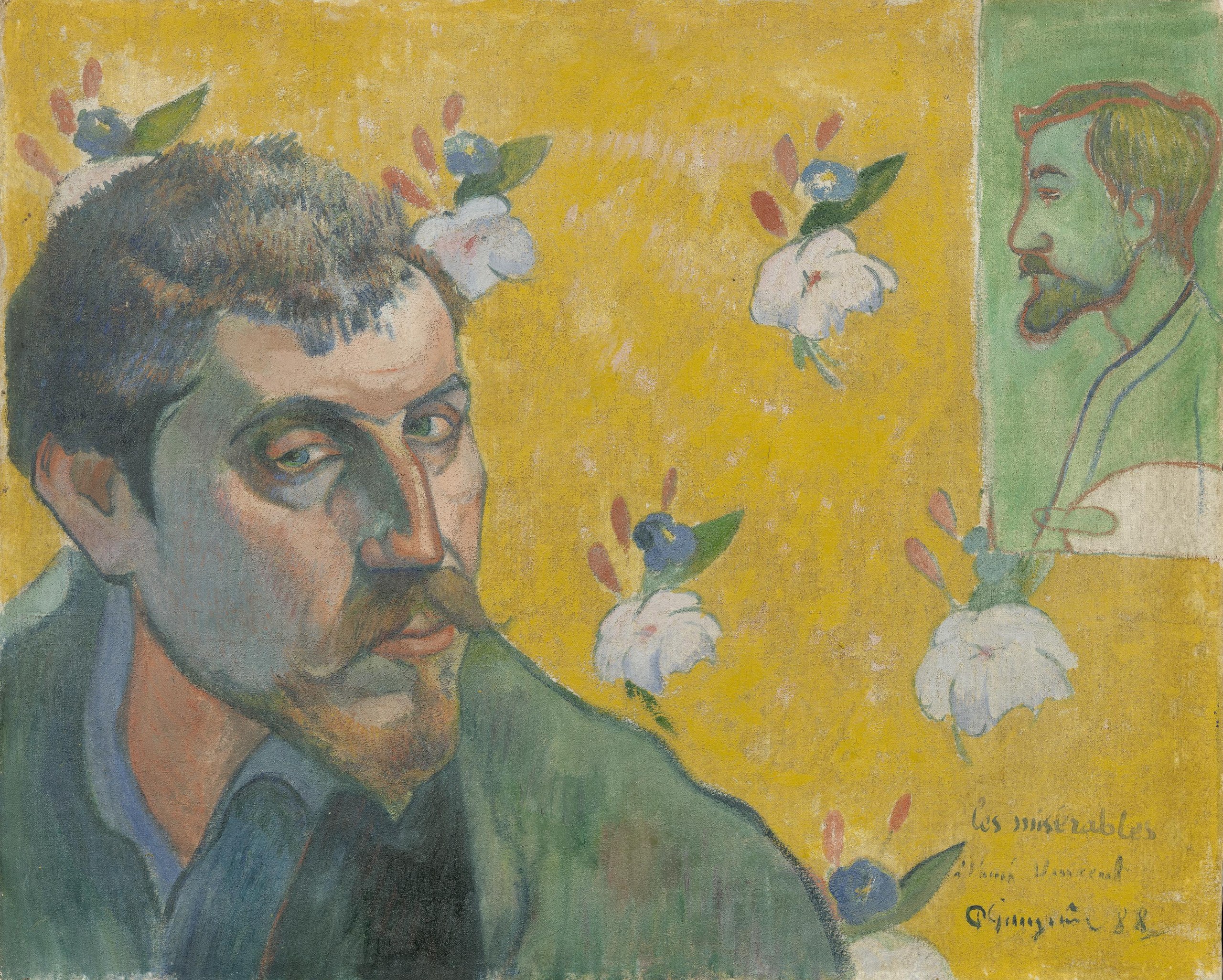
Self-portrait with Portrait of Bernard
Paul Gauguin · 1888
Van Gogh Museum
The painter at an angle, head lowered, the sketch of his friend Émile Bernard pinned in the corner like a signature.
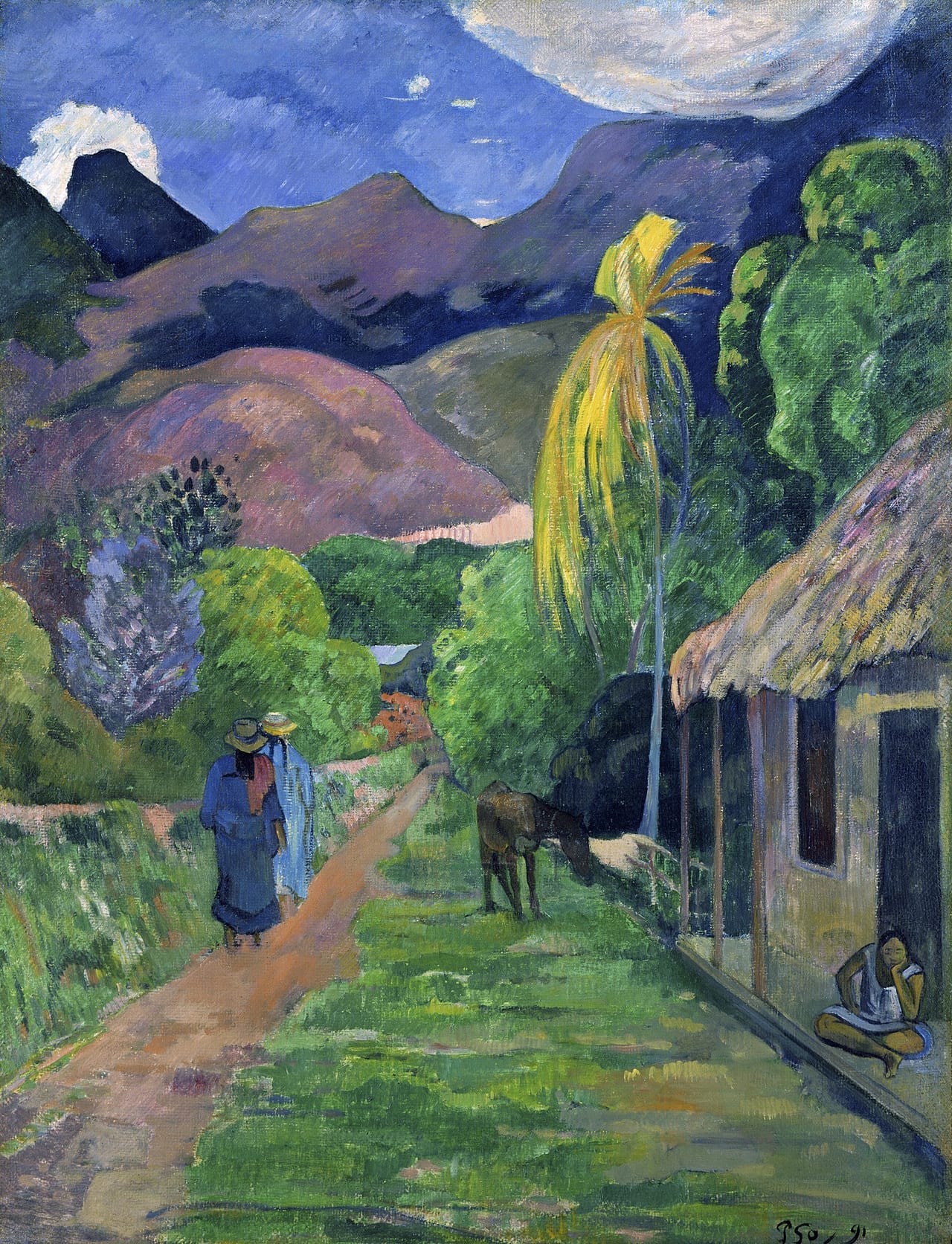
Street in Tahiti
Paul Gauguin · 1891
Toledo Museum of Art
A dirt road, a horse, low houses and a hill; the ordinary island he walked daily, held in flat planes of heat.
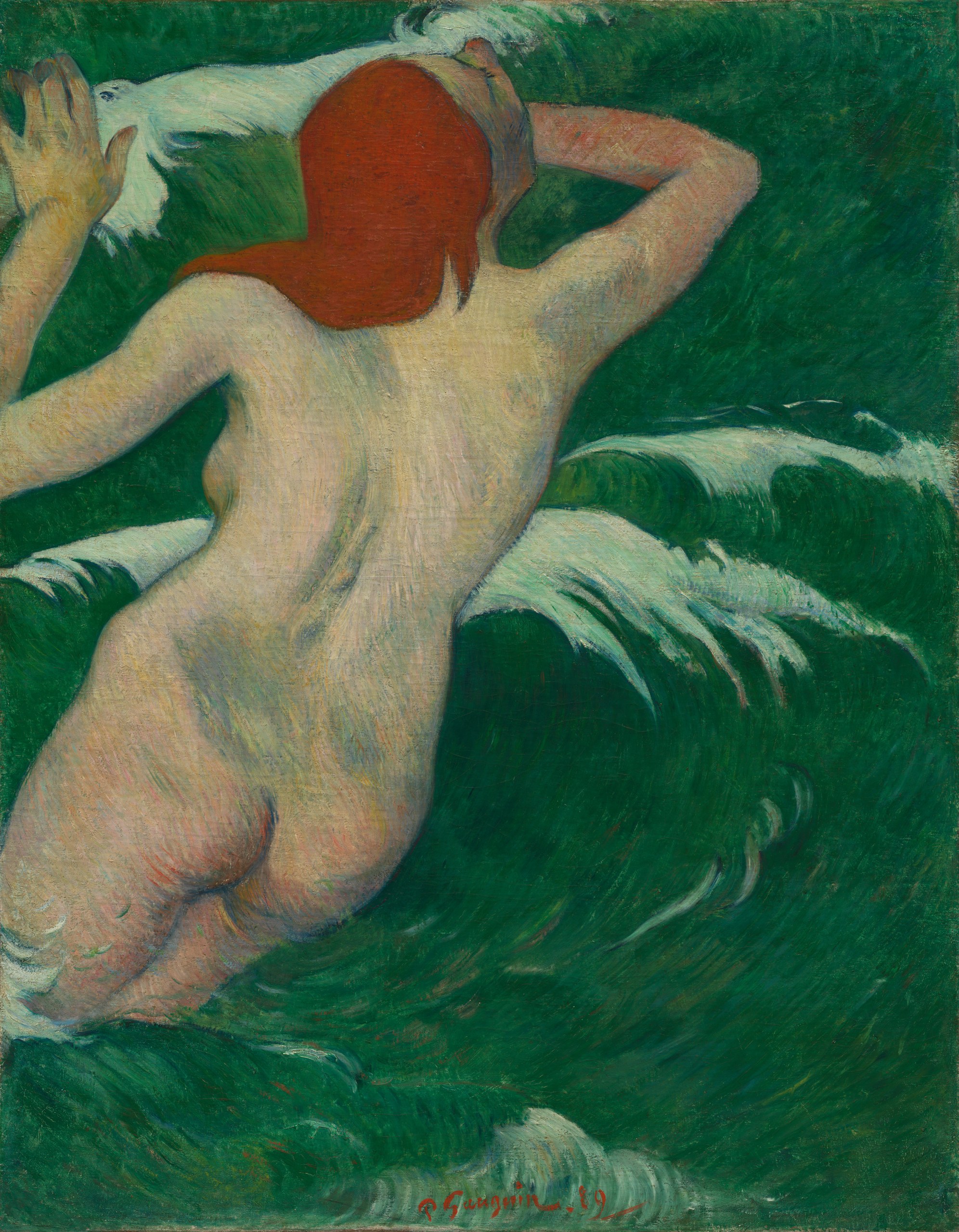
In the Waves (Dans les Vagues)
Paul Gauguin
The Cleveland Museum of Art
A bather rising out of breaking green water, the waves simplified into curves as in a print.
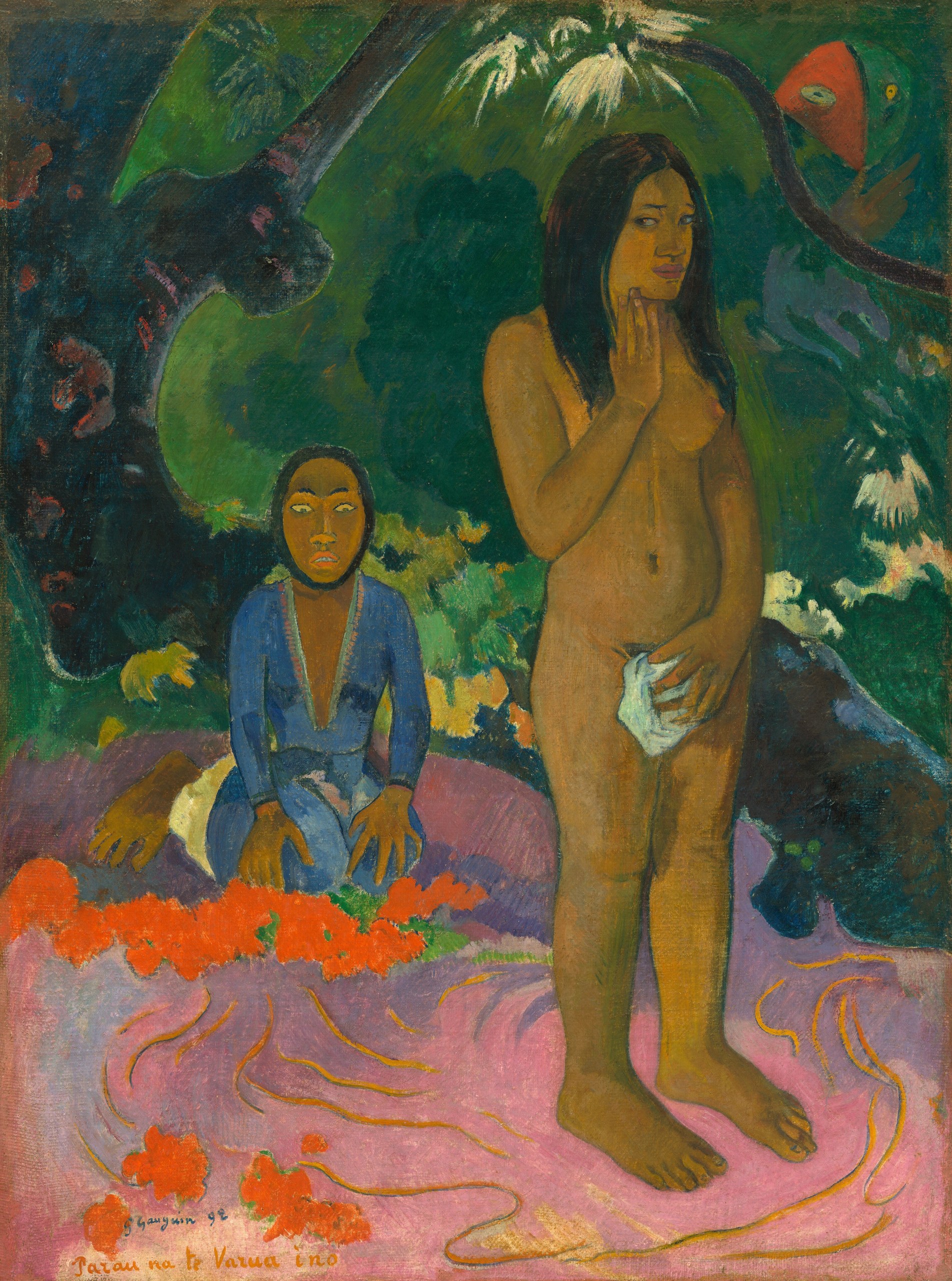
Parau na te Varua ino (Words of the Devil)
Paul Gauguin
National Gallery of Art
Two figures on a violet bank with a red horse between them, the devil's words left untranslated.
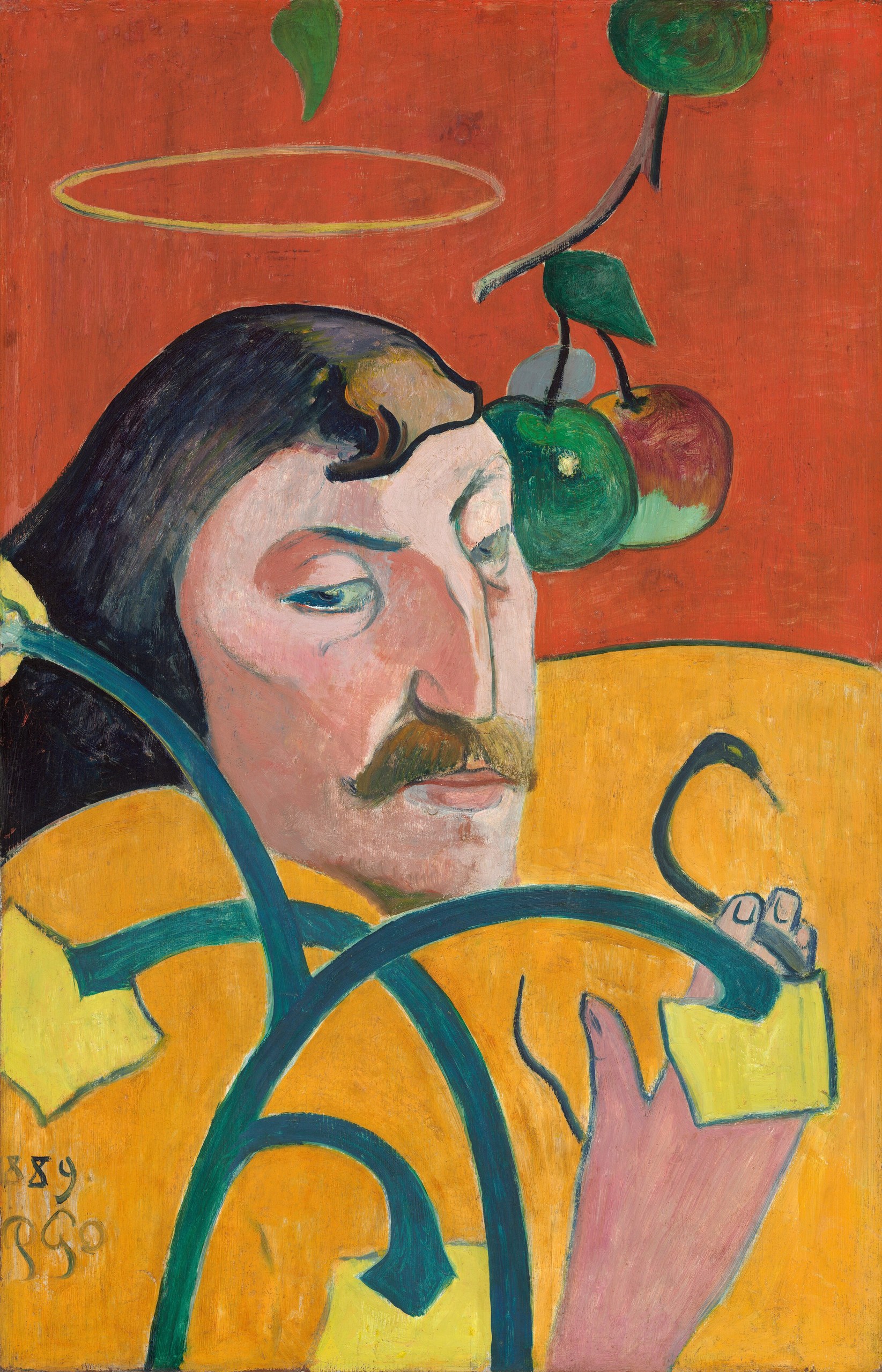
Self-Portrait
Paul Gauguin
National Gallery of Art
The face built in greens and ochres against a blue ground, the eyes doing all the talking.
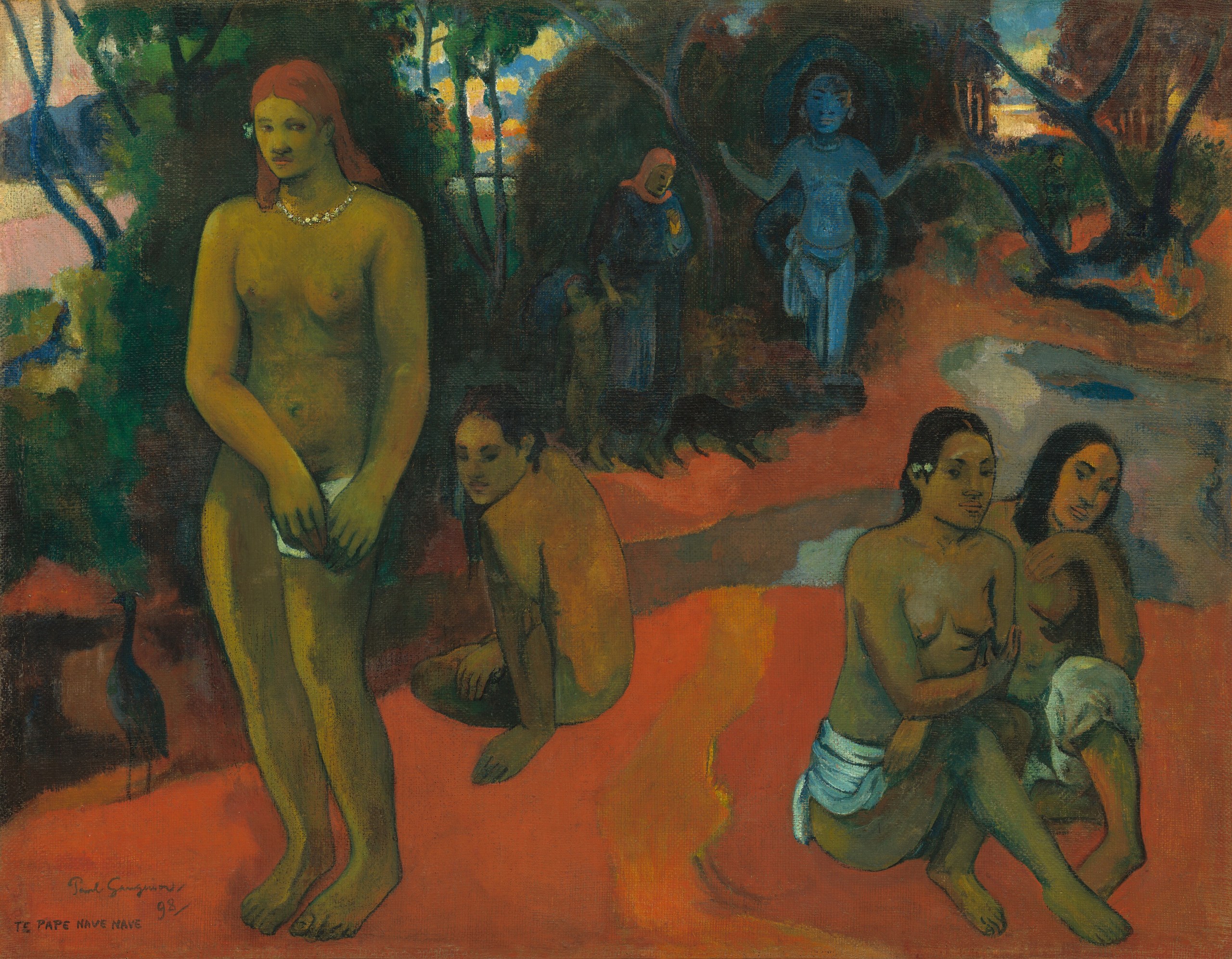
Te Pape Nave Nave (Delectable Waters)
Paul Gauguin
National Gallery of Art
Nudes at a stream under a great blue tree, the water's delectableness carried entirely by colour.
Sources
- Wikipedia, “Paul Gauguin”
- Wikipedia, “The Yellow Christ”
- Wikipedia, “Tahitian Women on the Beach”
- Wikipedia, “Vincent van Gogh Painting Sunflowers”
- Wikipedia, “Aha Oe Feii?”
- Wikipedia, “Arearea”
- Wikipedia, “Oviri”
- Wikipedia, “Self-Portrait with the Yellow Christ”
- Wikipedia, “Nave nave moe”
- Wikipedia, “The Beautiful Angel”
- Wikipedia, “Self-Portrait in a Hat”
- Wikipedia, “The King's Wife (painting)”
- Wikipedia, “Vairumati”
Invite Paul Gauguin into your living room
Play 24 works from this collection on your TV, phone or tablet with Momentable Art TV.