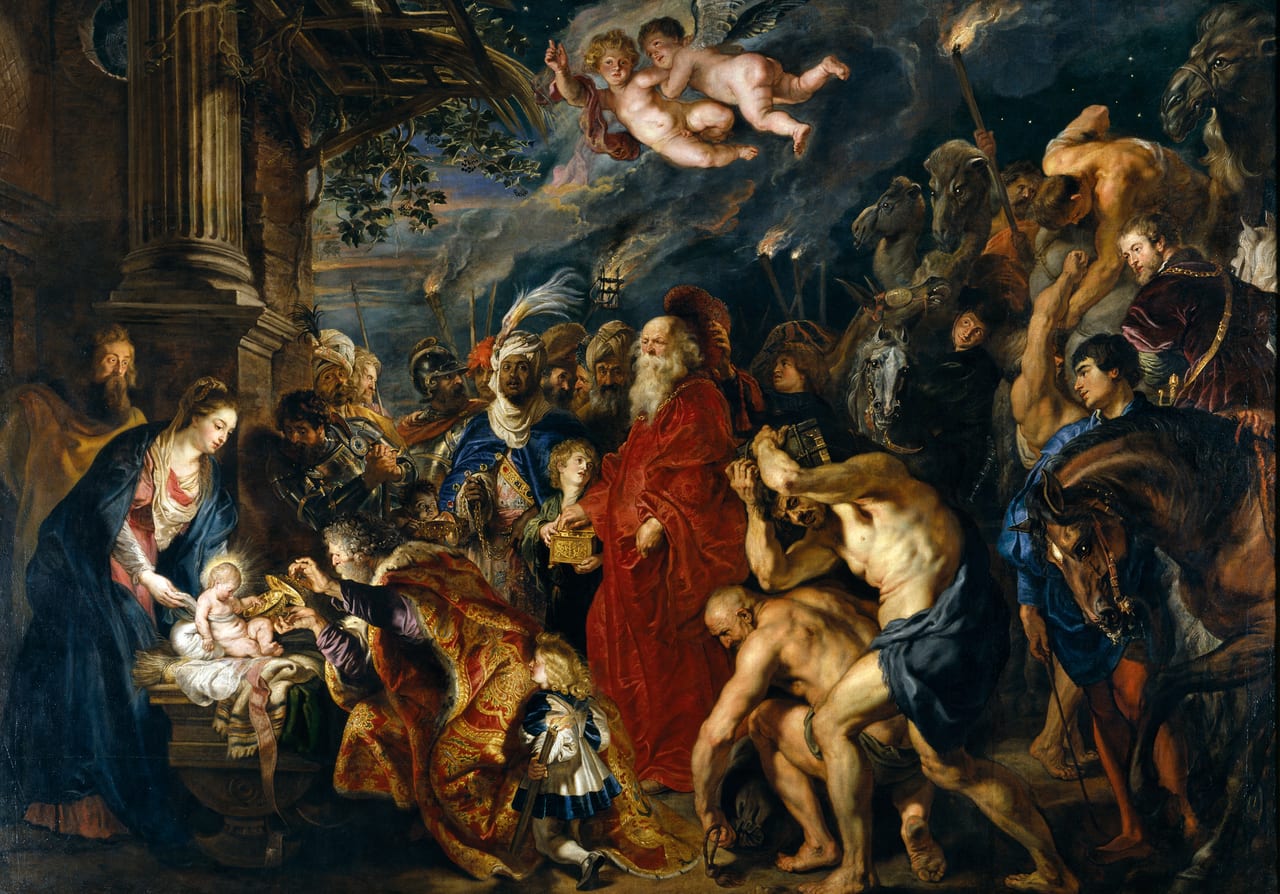
The Elevation of the Cross
Peter Paul Rubens · 1610

Peter Paul Rubens
Flemish · 1577–1640
The Flemish master whose charged, flesh-and-air canvases made him the most influential painter of the Flemish Baroque, and whose studio in Antwerp supplied the courts of Europe.
- 1,403
- Works in the catalogue of his oeuvre by Michael Jaffé
- 80+
- Paintings commissioned by Philip IV of Spain in the 1630s
- 29
- Works in the National Gallery, London
Play 40 works from this collection on your TV, phone or tablet with Momentable Art TV.
Play CollectionSiegen to Antwerp
Rubens was born in 1577 in Siegen, in the Empire, to parents who had fled Antwerp, and the family returned to that city when he was about twelve. Trained there, he left for Italy as soon as his apprenticeship ended, hungry to stand in front of the Renaissance and antique pictures he knew only from copies. He spent eight years travelling and working in the peninsula, and Venice marked him most: the colour of Veronese and Tintoretto struck him at once, and Titian shaped the mature style for good.
News of his mother's illness pulled him out of Italy in 1608; she died before he was home, and Antwerp kept him. Fame had gone ahead of him: within a year, at thirty-three, he was painter to the Archduke Albert and Isabella, rulers of the Netherlands, allowed to keep his studio in Antwerp and take other clients. The great altarpieces he then made for the city's cathedral, above all the raising of the cross of 1610, set him at the head of Flemish painting almost overnight.
The workshop and the world
The demand on him was more than one pair of hands could meet, and he built a studio of pupils and assistants to carry it, working closely with specialists: Frans Snyders painted the eagle in his Prometheus, Jan Brueghel the Elder added the flowers. Anthony van Dyck, the most gifted of the pupils, became the leading Flemish portraitist of the next generation. Rubens himself rose at four to paint, rode in the evening, and collected antiquities, gems and coins while someone read the classics aloud to him.
Because a painter could move between courts without suspicion, he was drawn into diplomacy, negotiating for the Spanish Netherlands in France and England through the late 1620s, and was knighted twice over, by the Spanish and by the English crown. The Paris commission of the 1620s, the vast cycle on the life of Marie de' Medici, survives complete in the Louvre; its unhappy second half, on Henry IV, was abandoned when the queen fell from favour.
Helena and the late landscapes
Widowed in 1625, he married again in 1630 at fifty-three, surprising everyone by choosing Helena Fourment, sixteen, of a merchant family. She became his muse and the model for the ripe figures of his last decade, appearing in picture after picture, most nakedly in the portrait of her stepping from her bath wrapped in fur. Five children came, and the country house he bought in 1635, the Steen, drew him into landscape.
The late landscapes were painted for himself rather than for sale, and they lean on the older Netherlandish tradition of Pieter Bruegel the Elder as much as on Italy. Gout had been gnawing at him for years; an attack in 1639 stopped the brush, and he died in May 1640. He lies in Saint James' Church in Antwerp, under an altarpiece of his own.
Known works
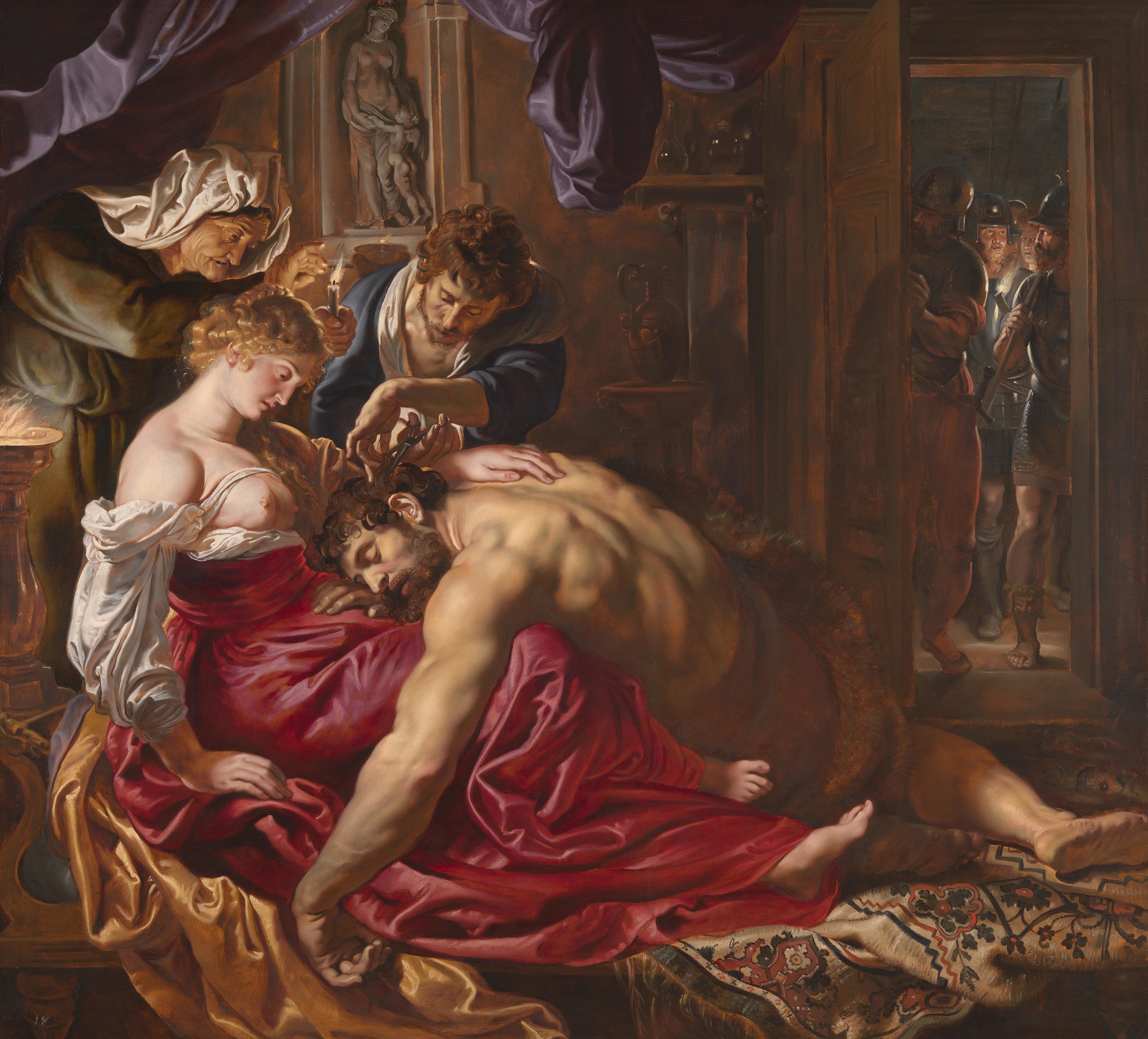
Samson and Delilah
Peter Paul Rubens · 1609
National Gallery
Samson and Delilah. The strong man lies asleep with his head in his mistress's lap while a barber crosses his hands over the lock of hair that holds his strength, a gesture read as the sign of betrayal; an old woman holds up the candle, and the Philistines wait in the doorway.
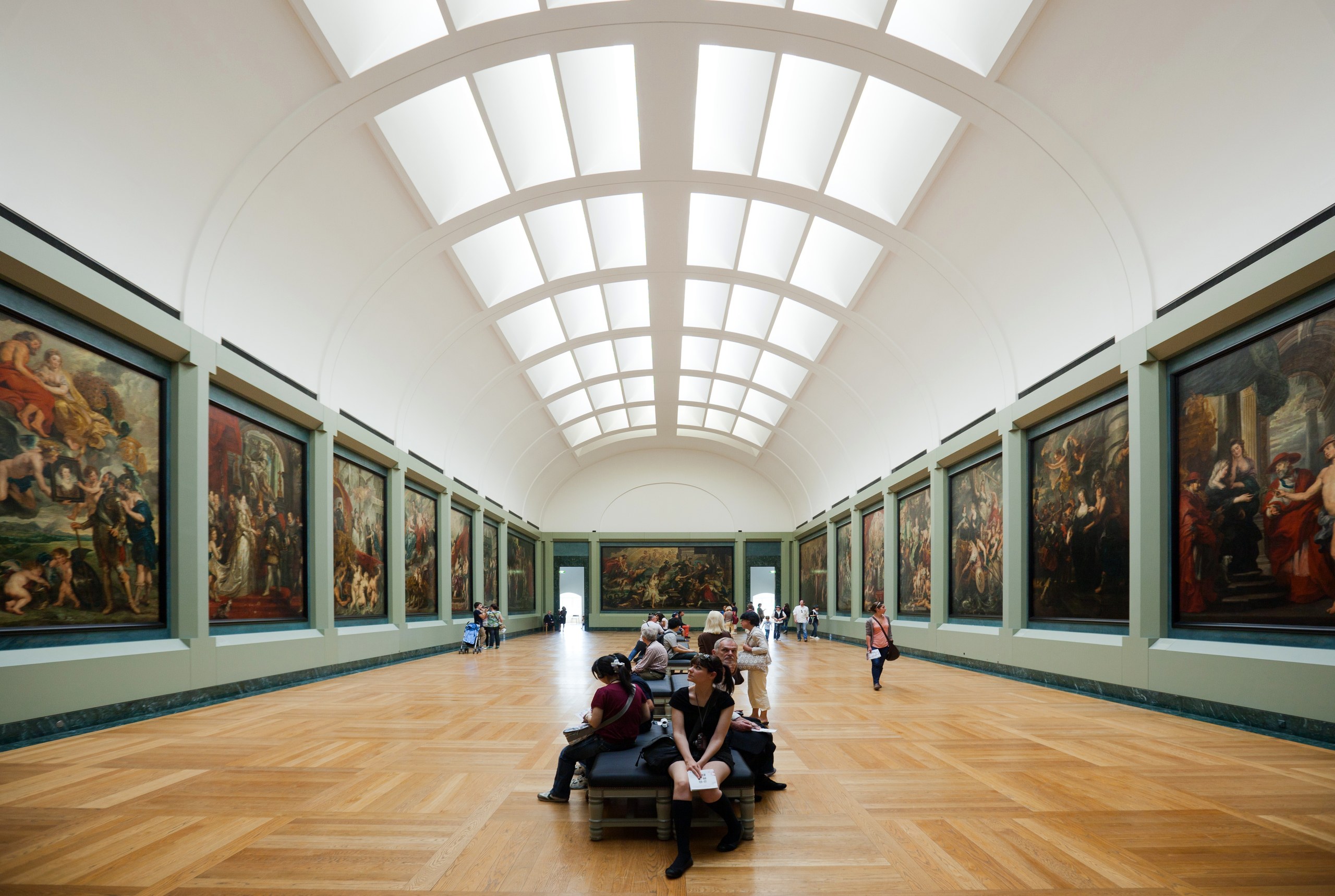
Marie de' Medici cycle
Peter Paul Rubens · 1622
Louvre
Marie de' Medici cycle. Twenty-four canvases on the life of the French queen for her palace in Paris: twenty-one scenes of her struggles and triumphs wrapped in gods and allegory, three straight portraits. Commissioned in 1621 and hung in 1625, it now fills a gallery of the Louvre.
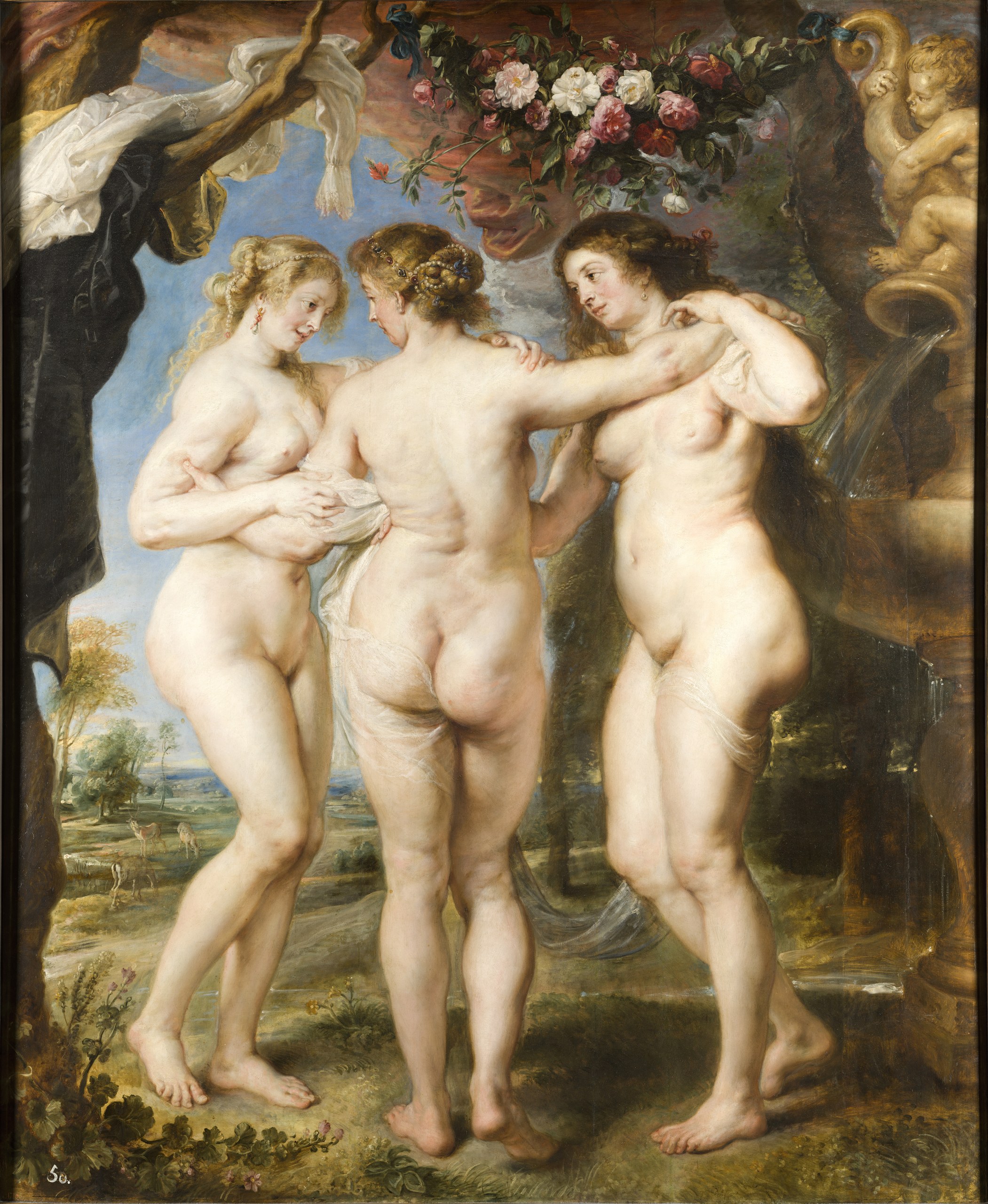
The Three Graces
Peter Paul Rubens · 1630
Museo del Prado
The Three Graces. Three women linked in a ring, one turned away, flesh lit against a dark wood; he kept the picture until his death, and Philip IV of Spain bought it for the royal collection.
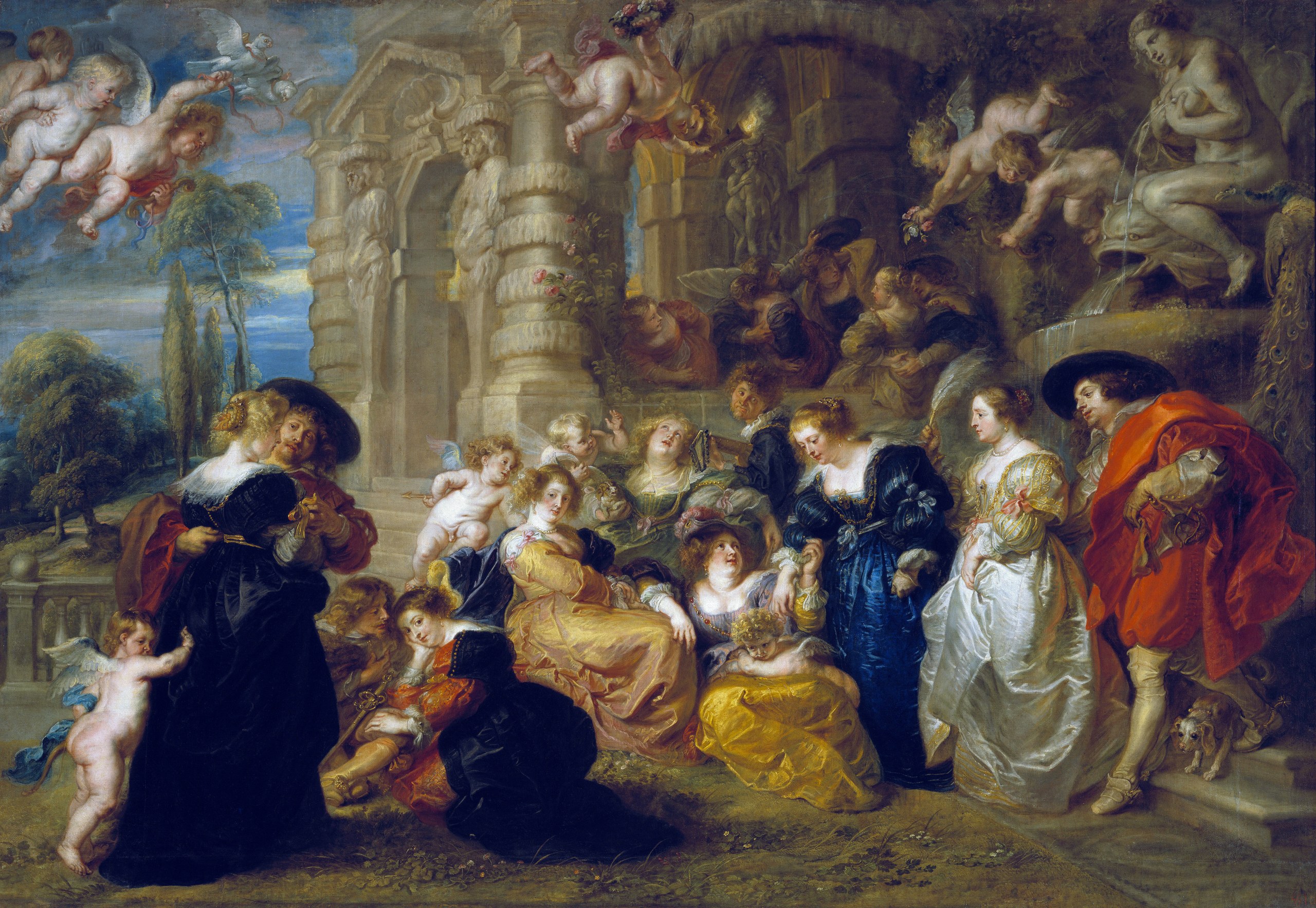
The Garden of Love
Peter Paul Rubens · 1630
Museo del Prado
The Garden of Love. A company in fashionable dress at the edge of an ideal garden, cupids fluttering among them; the courtly garden party raised to myth, and a direct ancestor of the French outdoor fête of the next century.
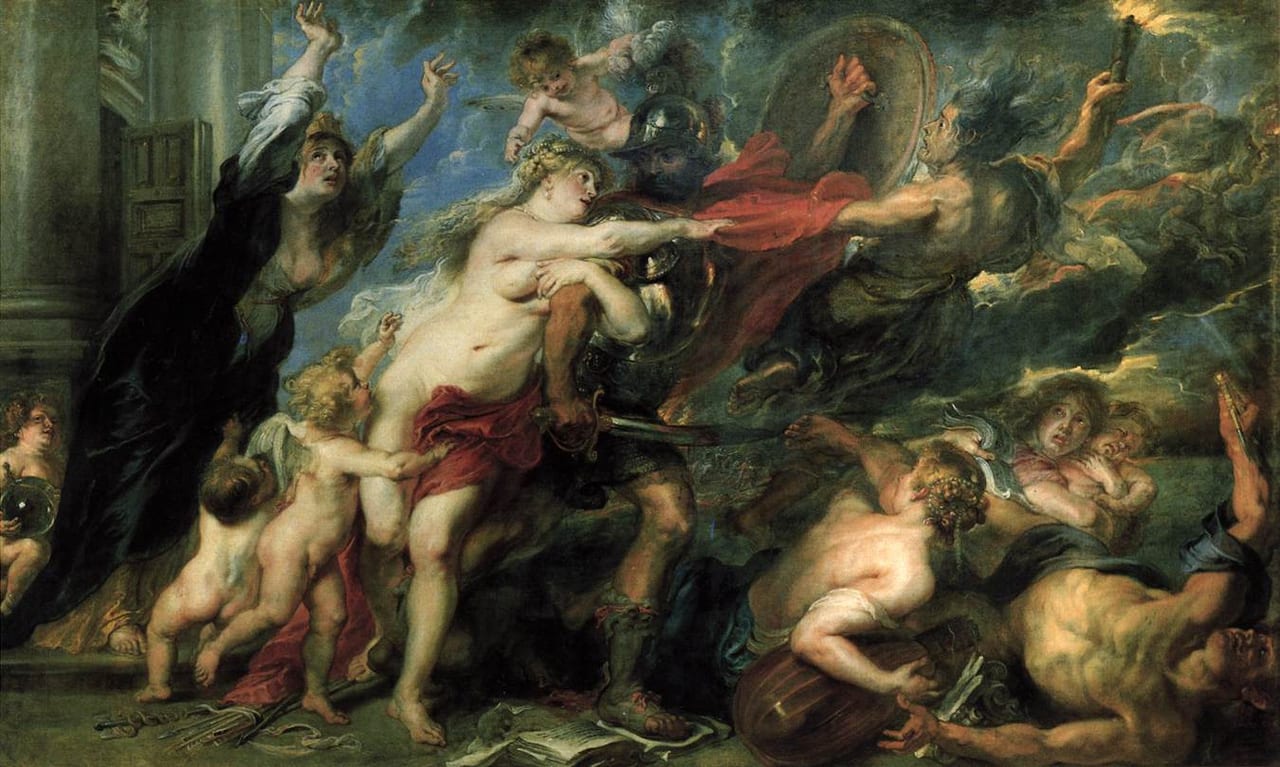
Consequences of War
Peter Paul Rubens · 1637
Palazzo Pitti
Consequences of War. Mars in red armour charges forward, Venus hanging on his arm in a vain attempt to hold him back; painted for Ferdinando II de' Medici as a lament for a continent torn apart by the Thirty Years' War.
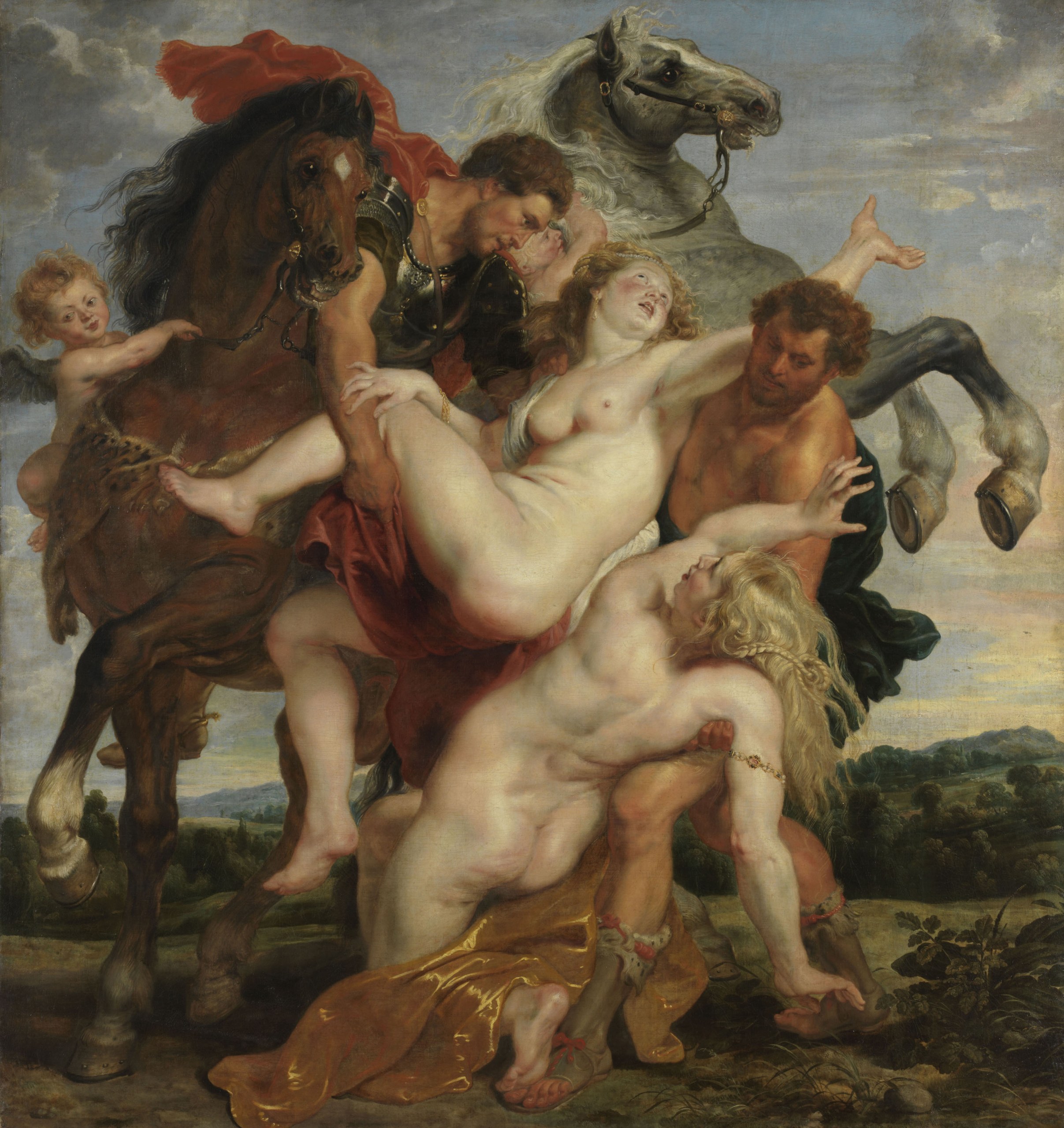
The Rape of the Daughters of Leucippus
Peter Paul Rubens · 1618
The Rape of the Daughters of Leucippus. The twins Castor and Pollux lift Phoebe and Hilaeira onto their horses, one beast steady under a putto, the other rearing; two gleaming nudes against armour and a low landscape.
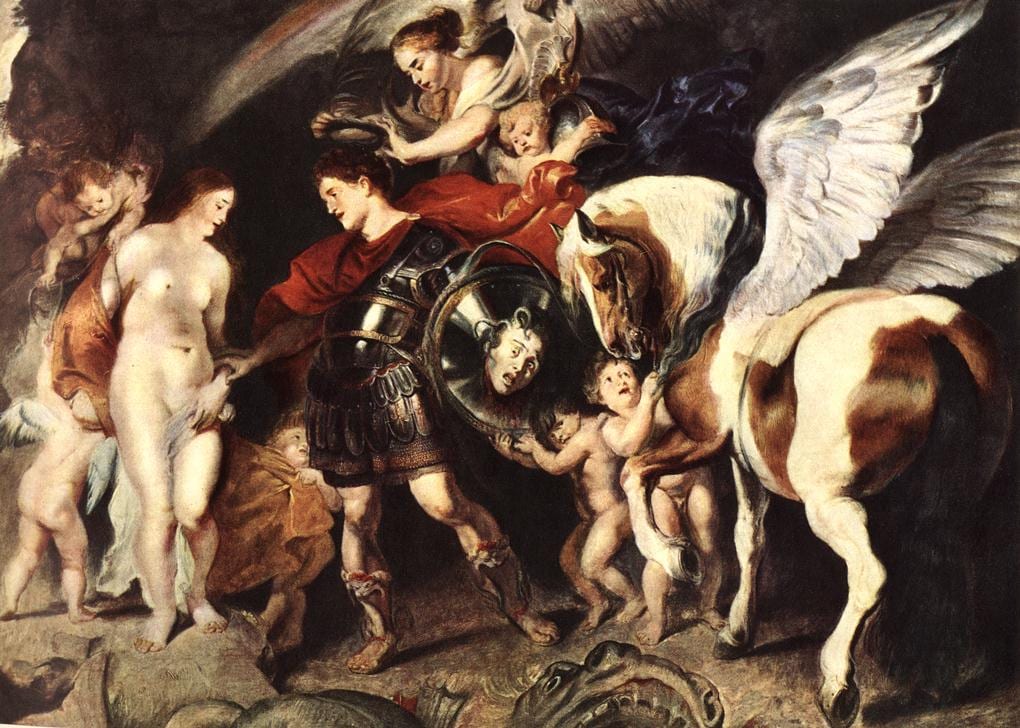
Perseus and Andromeda
Peter Paul Rubens · 1622
State Hermitage Museum
Perseus and Andromeda. The hero stands at the centre of a whirl of putti, one bearing the shield with the Gorgon's reflection, another his helmet, a third the winged Pegasus; Victory bends to crown him, and the sea monster lies dead below.
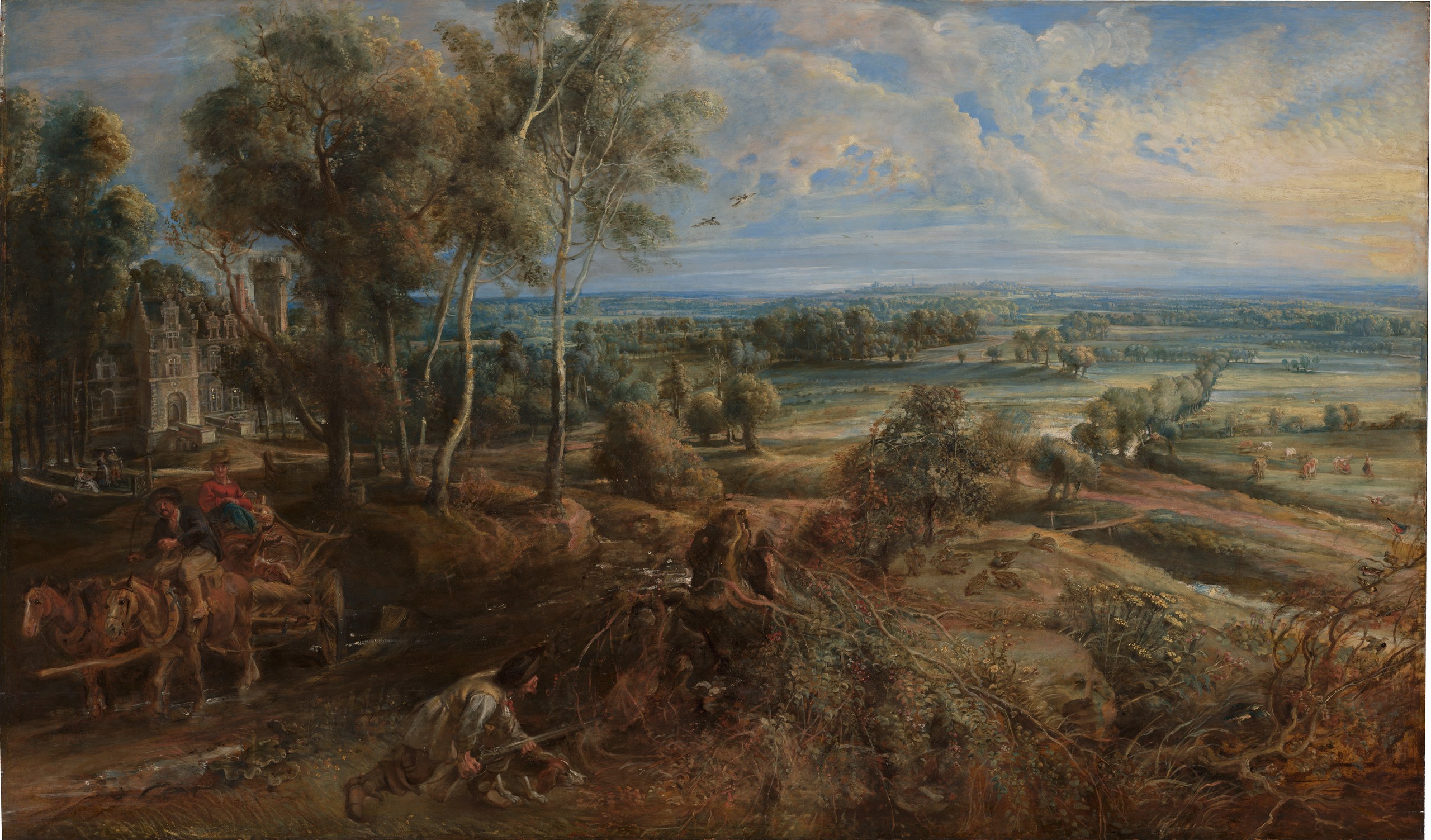
A View of Het Steen in the Early Morning
Peter Paul Rubens · 1636
National Gallery
A View of Het Steen in the Early Morning. His own estate spread wide under an autumn sunrise, a hunter and a cart on the lane; begun on three spare oak planks as a small picture of the house, it grew panel by panel into one of the great landscapes of the century. Rare for him, it was painted for no client at all.
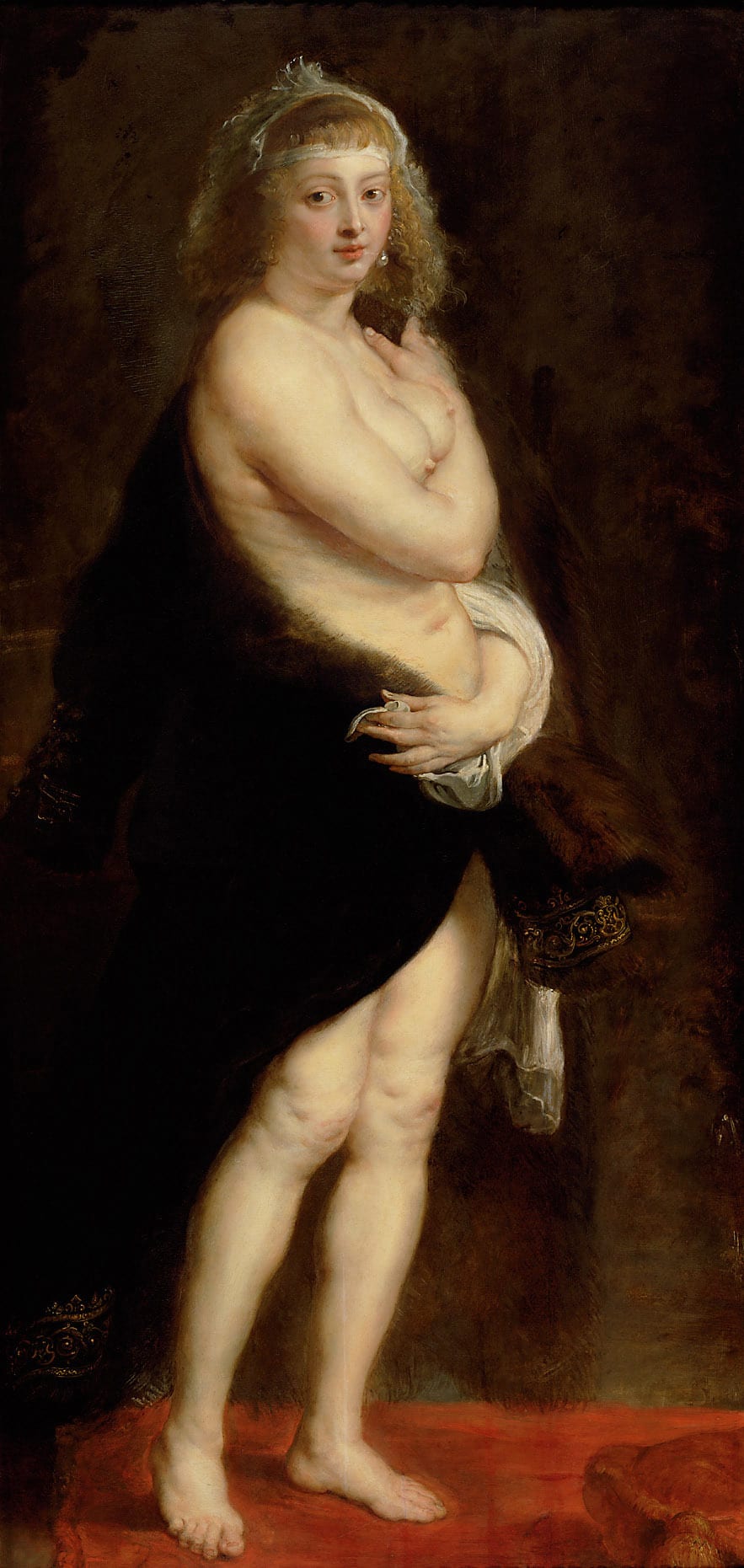
Helena Fourment in a Fur Robe
Peter Paul Rubens · 1638
Kunsthistorisches Museum
Helena Fourment in a Fur Robe. His young wife caught stepping from her bath, life-size at eighteen, holding a fold of the dark fur over her belly and looking straight out; part private portrait, part Venus, and the most personal painting of his last years.
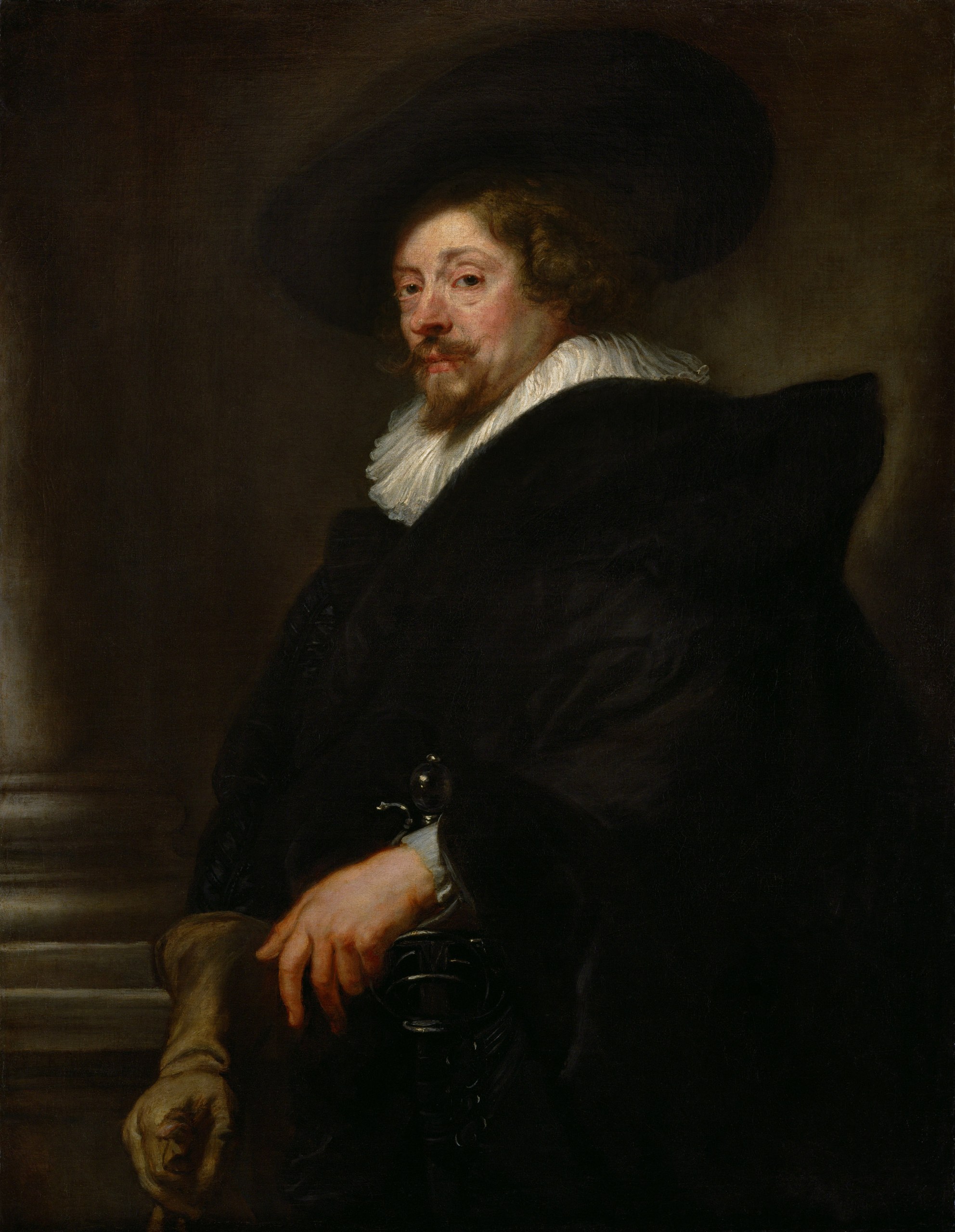
Self-portrait
Peter Paul Rubens · 1638
Kunsthistorisches Museum
Self-portrait. The painter of 1638 as a courtier, with sword, glove and the column of nobility behind him, yet the face worked more searchingly than such portraits asked; the self-image of a man who moved among kings.
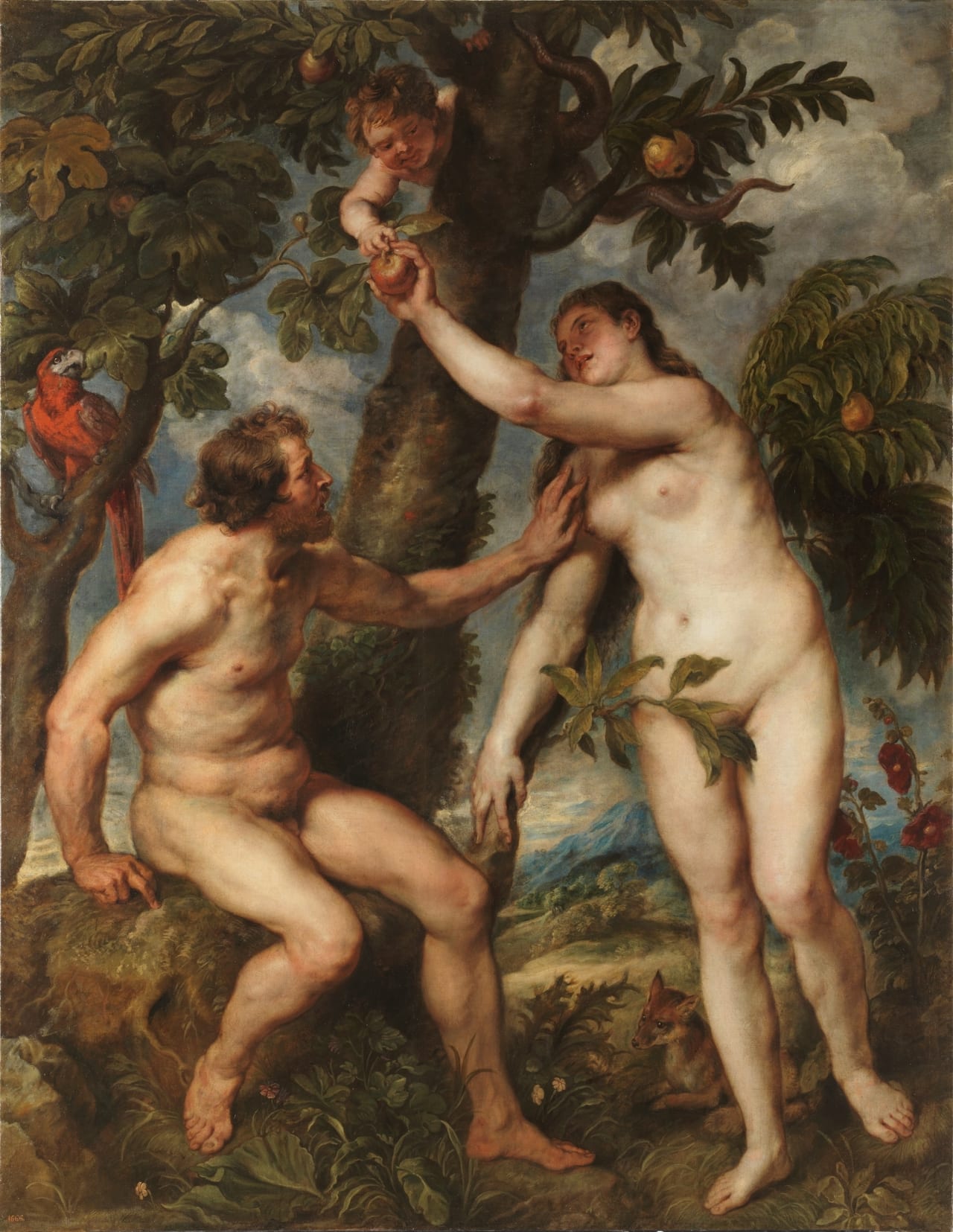
The Fall of Man
Peter Paul Rubens · 1628
Museo del Prado
The Fall of Man. Adam and Eve at the tree, the parrot Rubens added perched beside them; painted in 1628 and 1629, a free transformation of the Titian it copies, with an Adam made heavier and sadder by his own hand.
More to discover
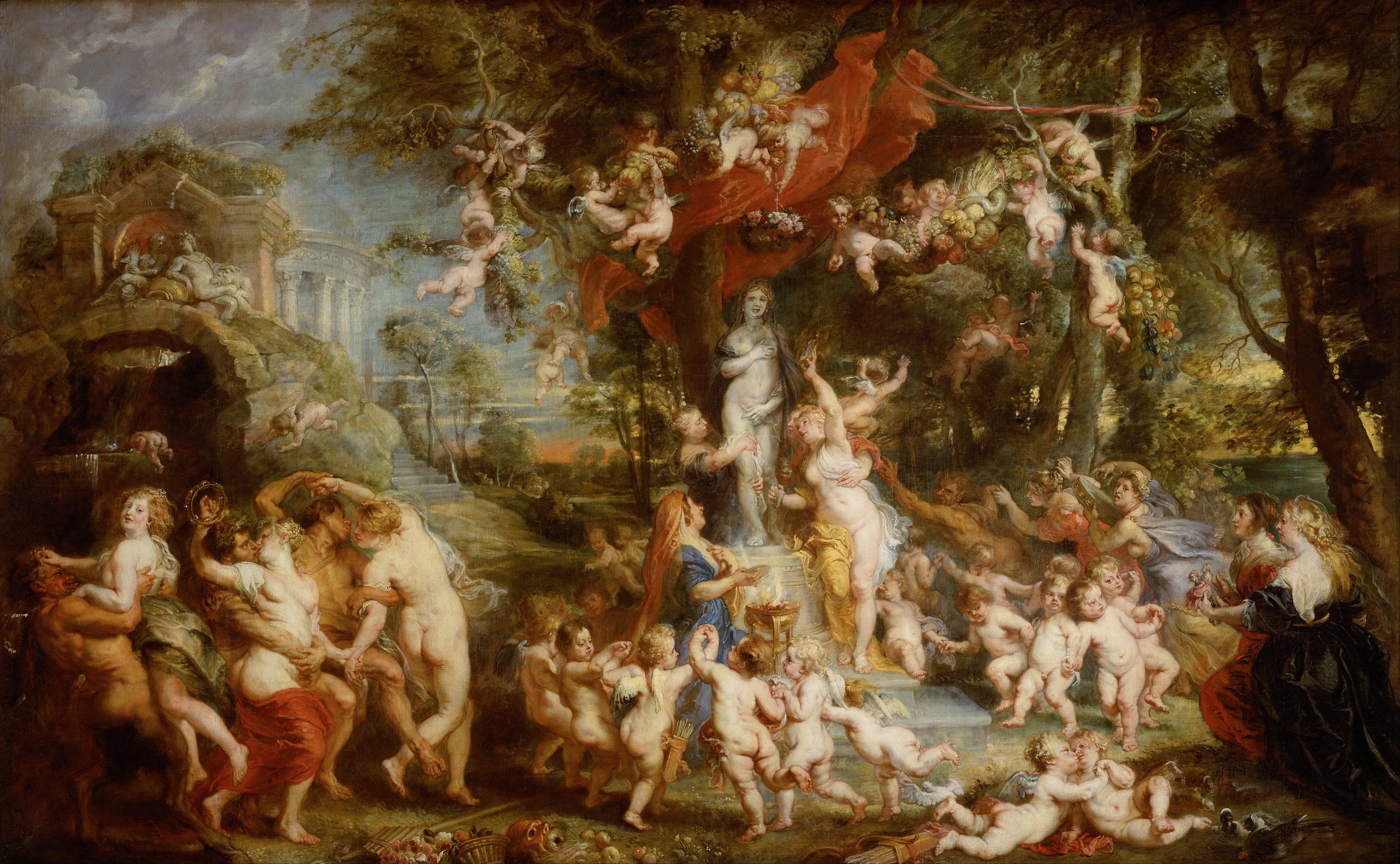
The Feast of Venus
Peter Paul Rubens · 1636
Kunsthistorisches Museum
The Feast of Venus. Nymphs and a swarm of cupids around the goddess's altar, garlands, apples and arrows everywhere; his reworking of Titian's worship of Venus, a picture he copied, owned and loved to the end.
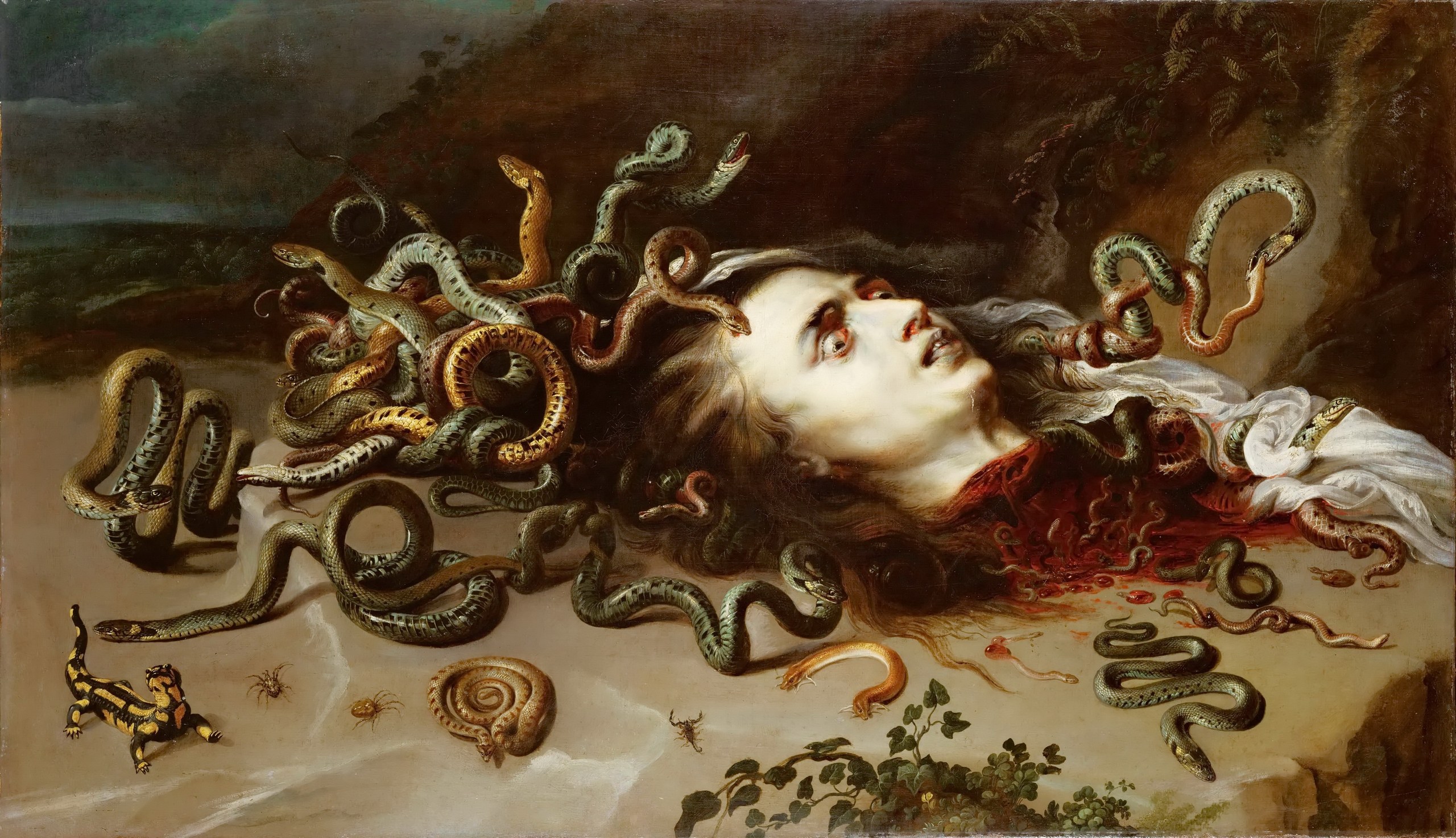
Head of Medusa
Peter Paul Rubens · 1618
Kunsthistorisches Museum
Head of Medusa. The severed head lying in its blood, alive with snakes; the reptiles are by Frans Snyders, the specialist hand Rubens trusted with animals, grass snakes and vipers together.
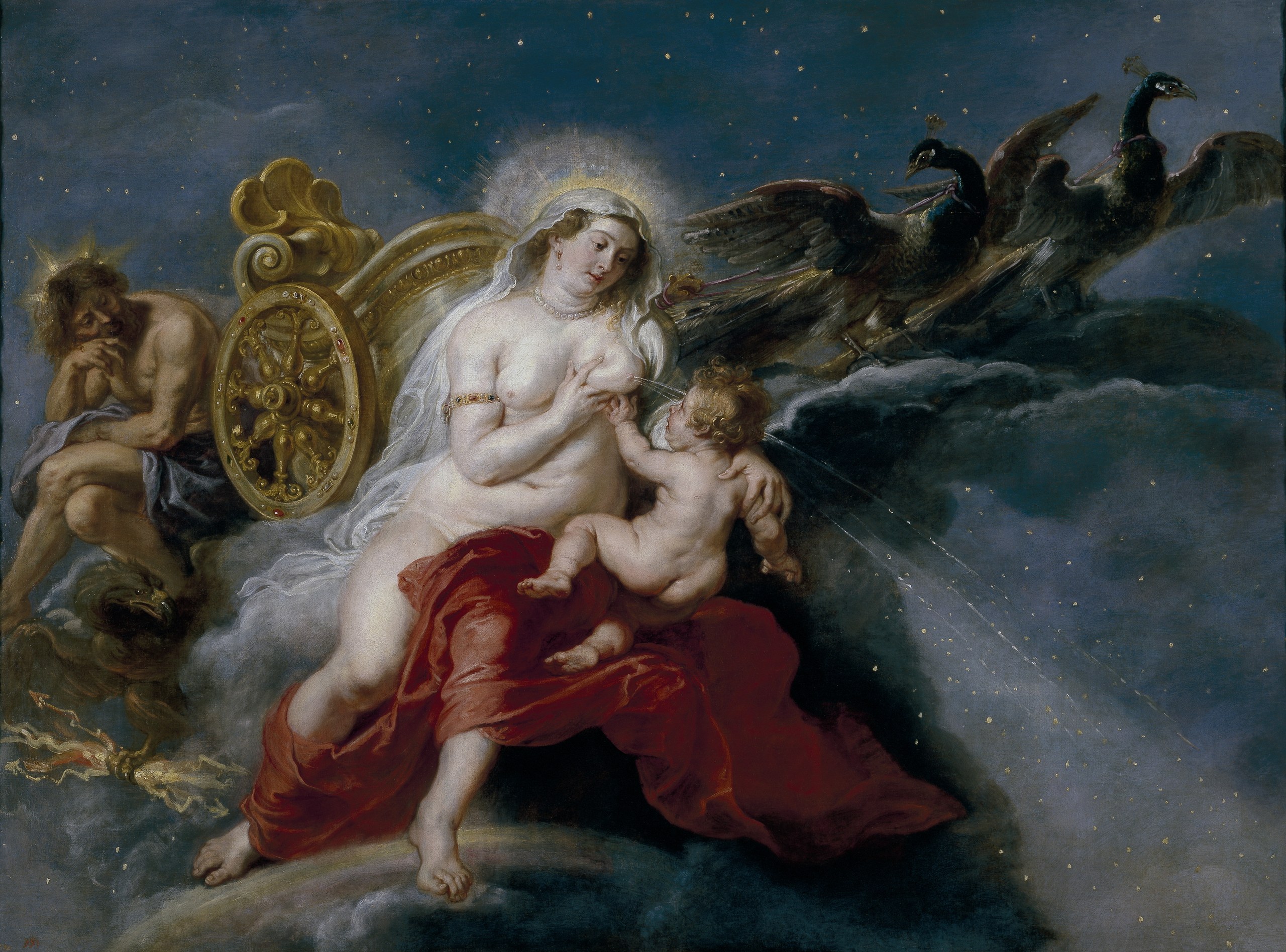
The Origin of the Milky Way
Peter Paul Rubens · 1637
Museo del Prado
The Origin of the Milky Way. Hera's milk spilling across the sky as the infant Heracles is put to her breast, Zeus behind with eagle and lightning, peacocks in harness; Hera has the face of Hélène Fourment. Painted for the Spanish crown's hunting lodge.
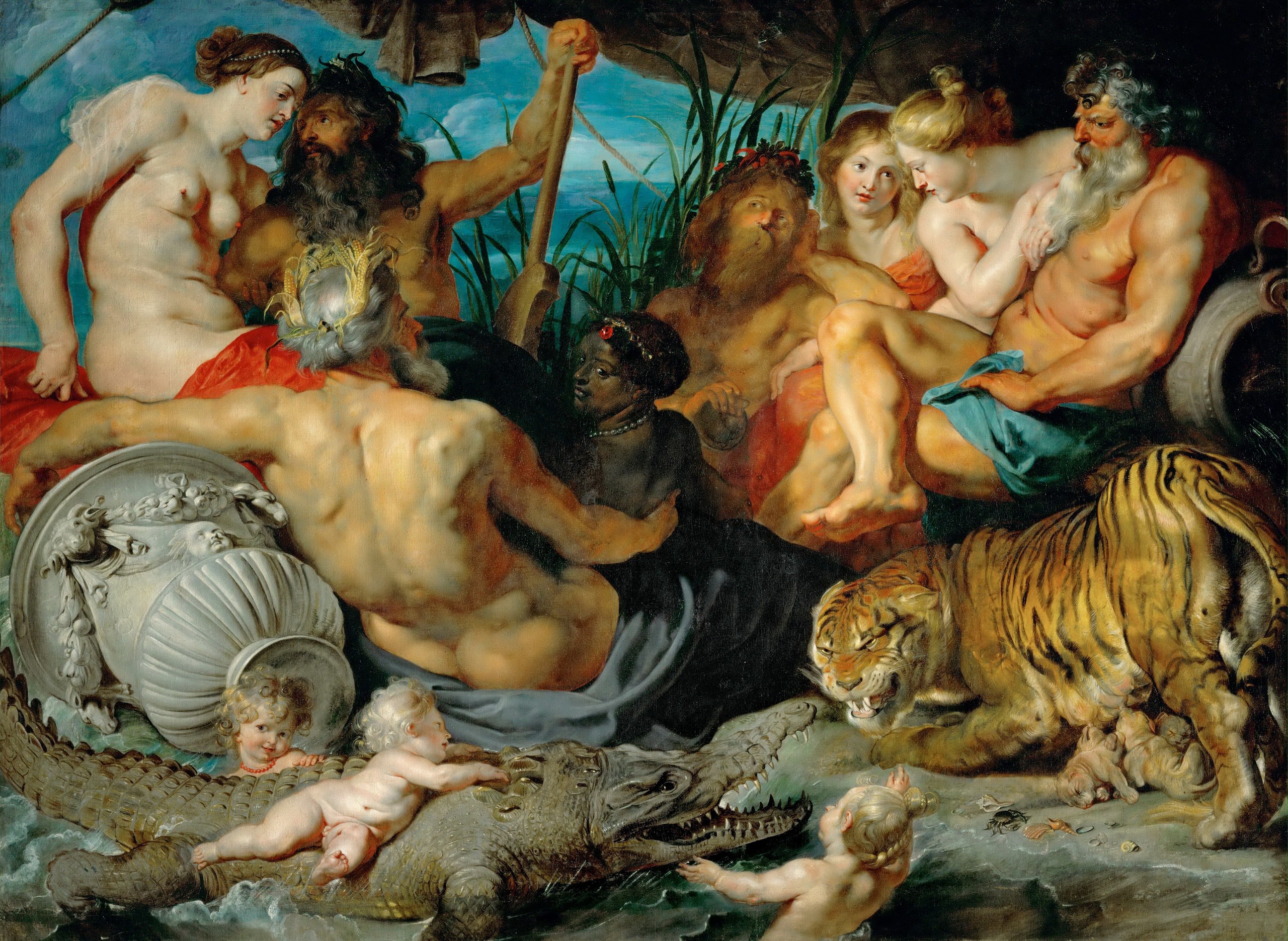
The Four Continents
Peter Paul Rubens · 1615
Kunsthistorisches Museum
The Four Continents. Four women and four river gods, resting together with a crocodile, a tigress and her cubs; painted in the breathing space of the Twelve Years' Truce.
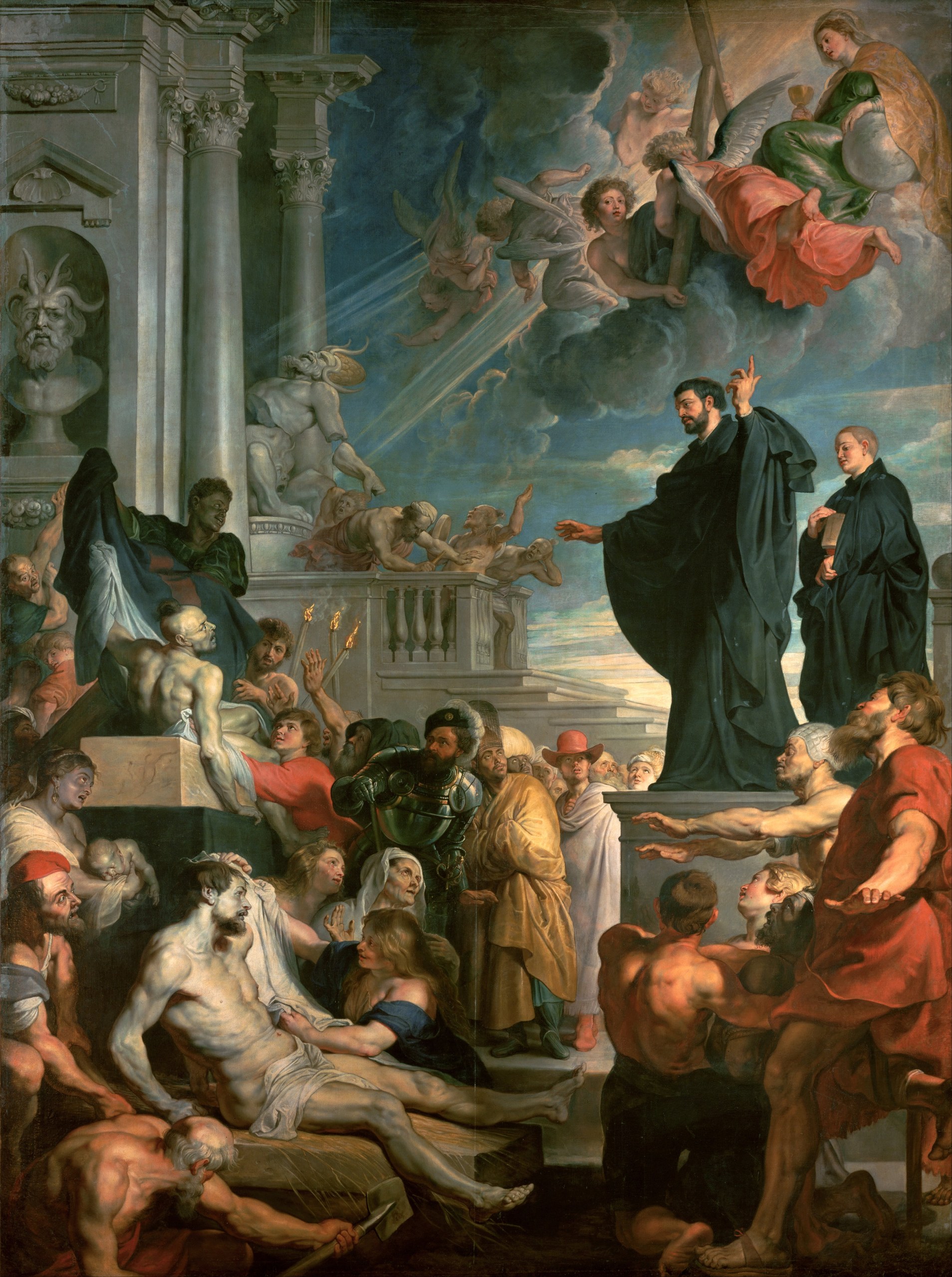
Miracles of St. Francis Xavier
Peter Paul Rubens · 1617
Kunsthistorisches Museum
Miracles of St Francis Xavier. The Jesuit missionary on a pedestal of healing, the lame rising and the possessed delivered around him, a Hindu idol crumbling in the distance; an altarpiece the Jesuits of Antwerp commissioned for their own church, with figures drawn from Asia and Africa.
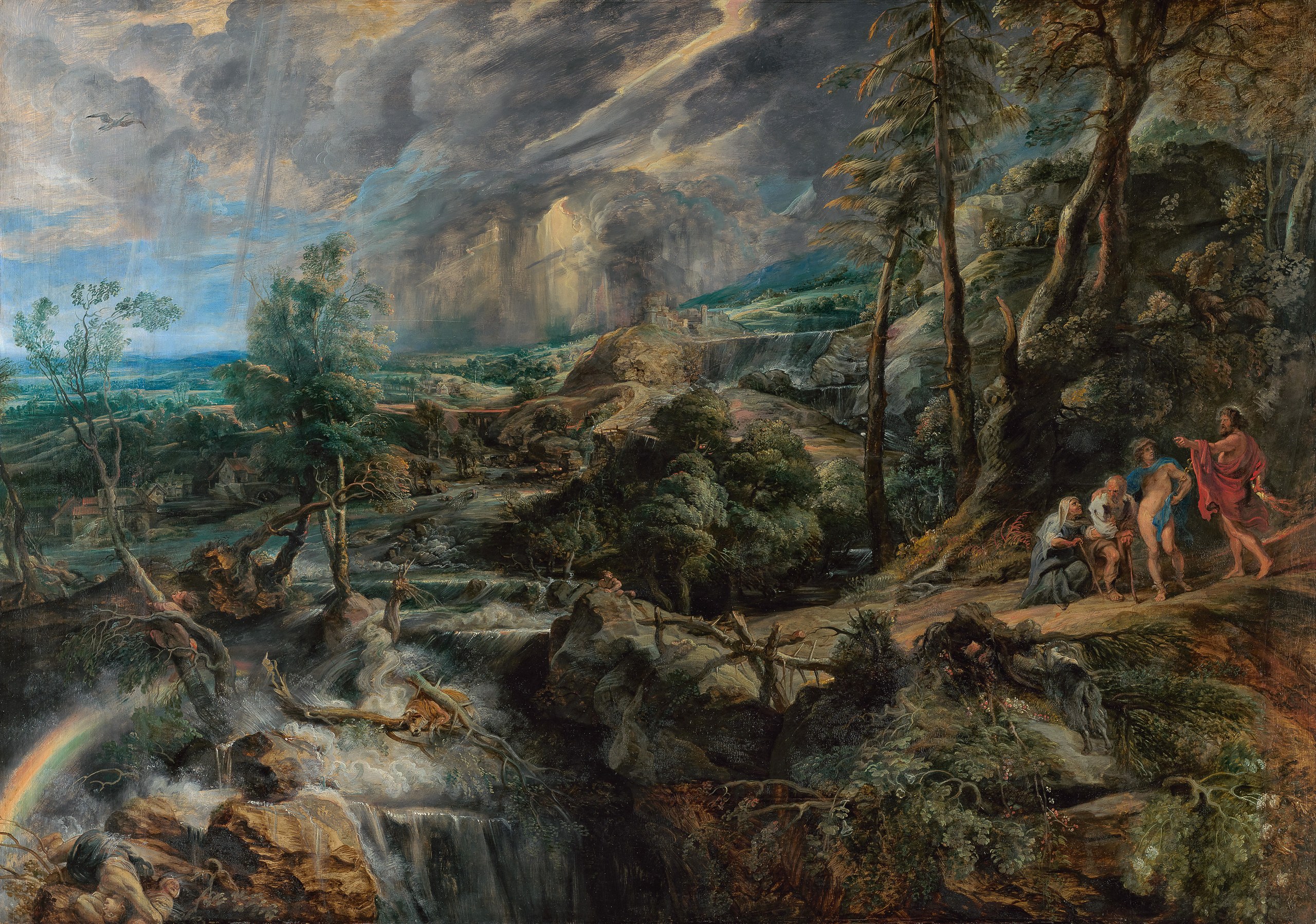
Landscape with Philemon and Baucis
Peter Paul Rubens · 1620
Kunsthistorisches Museum
Landscape with Philemon and Baucis. The old couple's cottage drowning under a flood let loose by the gods, thunder and uprooted trees filling the sky; the myth of hospitality rewarded, painted at full volume in 1620.
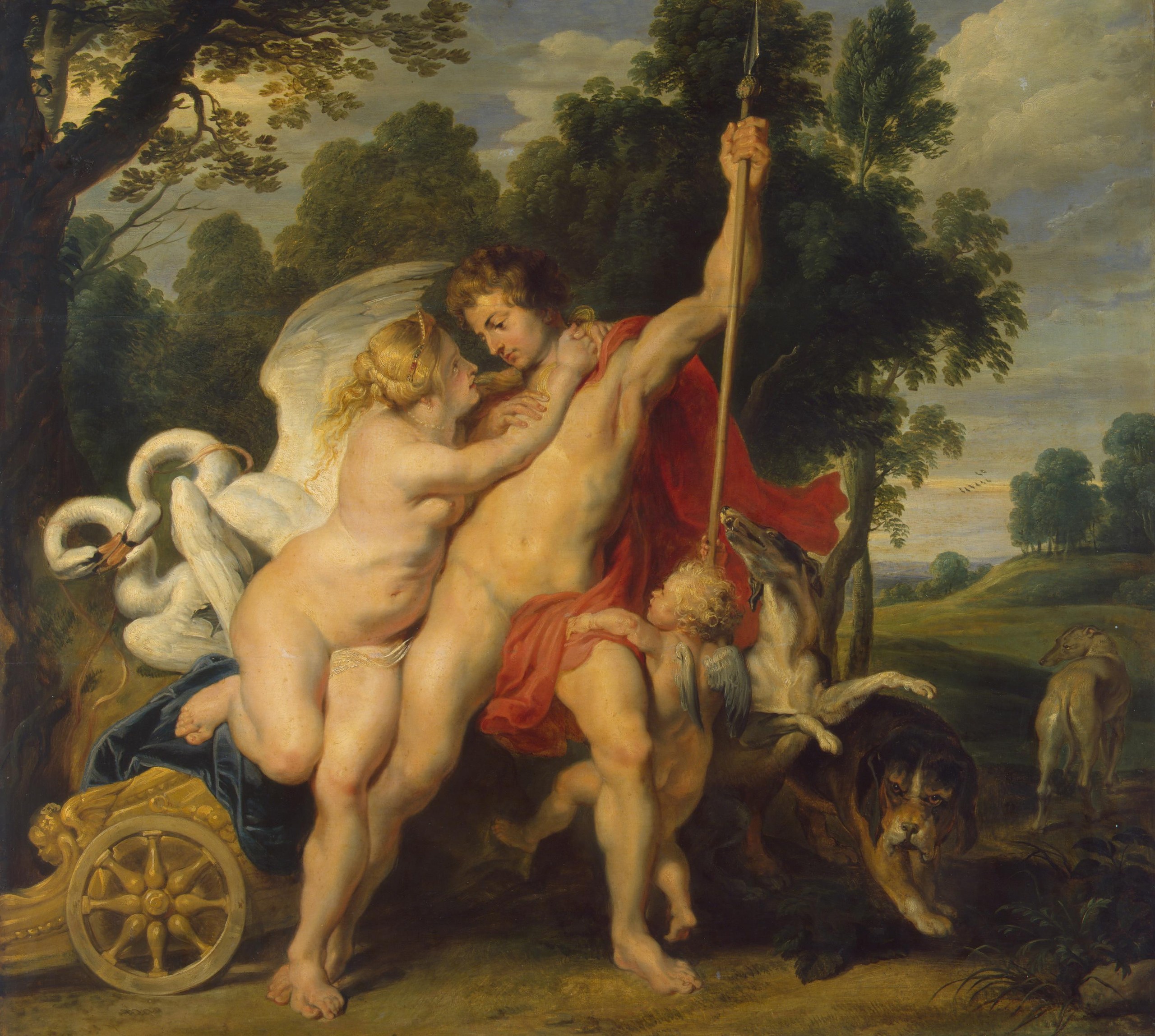
Venus and Adonis (Rubens, 1614)
Peter Paul Rubens · 1610
State Hermitage Museum
Venus and Adonis (Rubens, 1614). Venus clings to her lover as he leans away toward the hunt, hounds straining beside her; the figures are the master's own, the landscape and dogs left to studio hands.
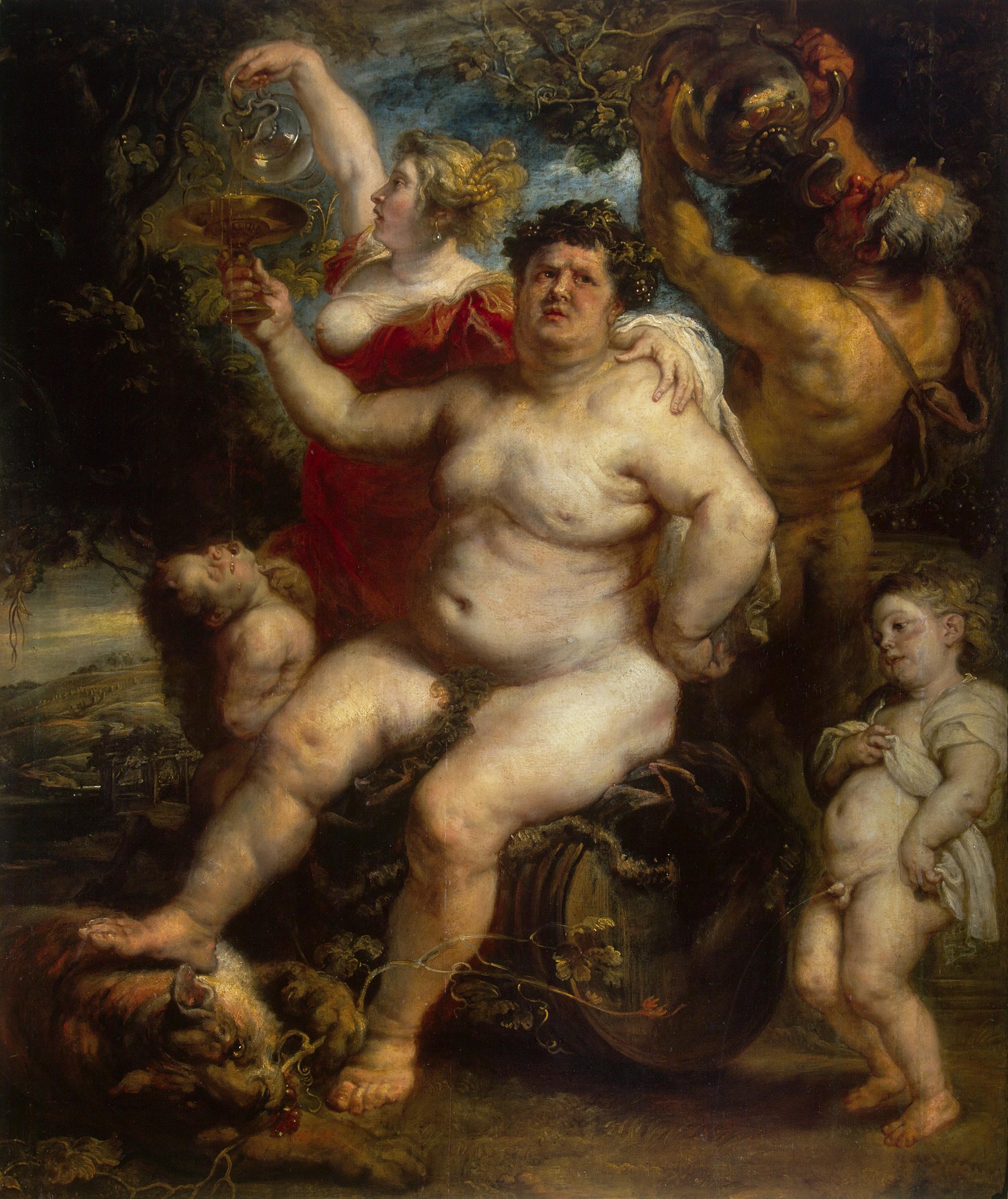
Bacchus
Peter Paul Rubens · 1630
State Hermitage Museum
Bacchus. The god as a mountain of flesh on a wine barrel, a satyr, a woman and two putti pressing round him, his head modelled on an antique bust of Vitellius; abundance pushed to the edge of comedy.
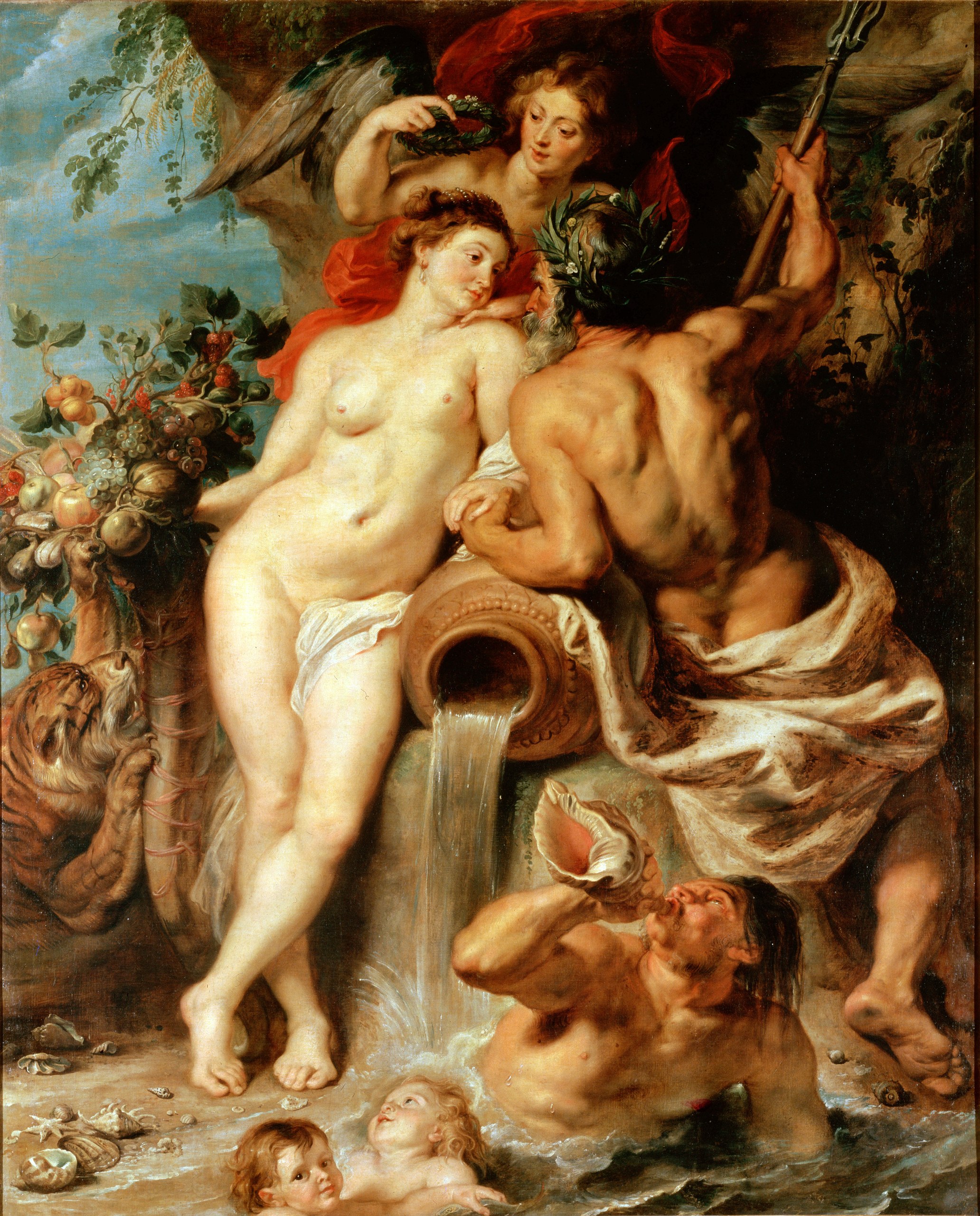
The Union of Earth and Water (Antwerp and the Scheldt)
Peter Paul Rubens · 1618
State Hermitage Museum
The Union of Earth and Water (Antwerp and the Scheldt). Cybele with her horn of plenty joined to the river god of the Scheldt, Victoria above and a triton sounding below; an allegory of Antwerp's prosperity, made while the Dutch closed the river's mouth.
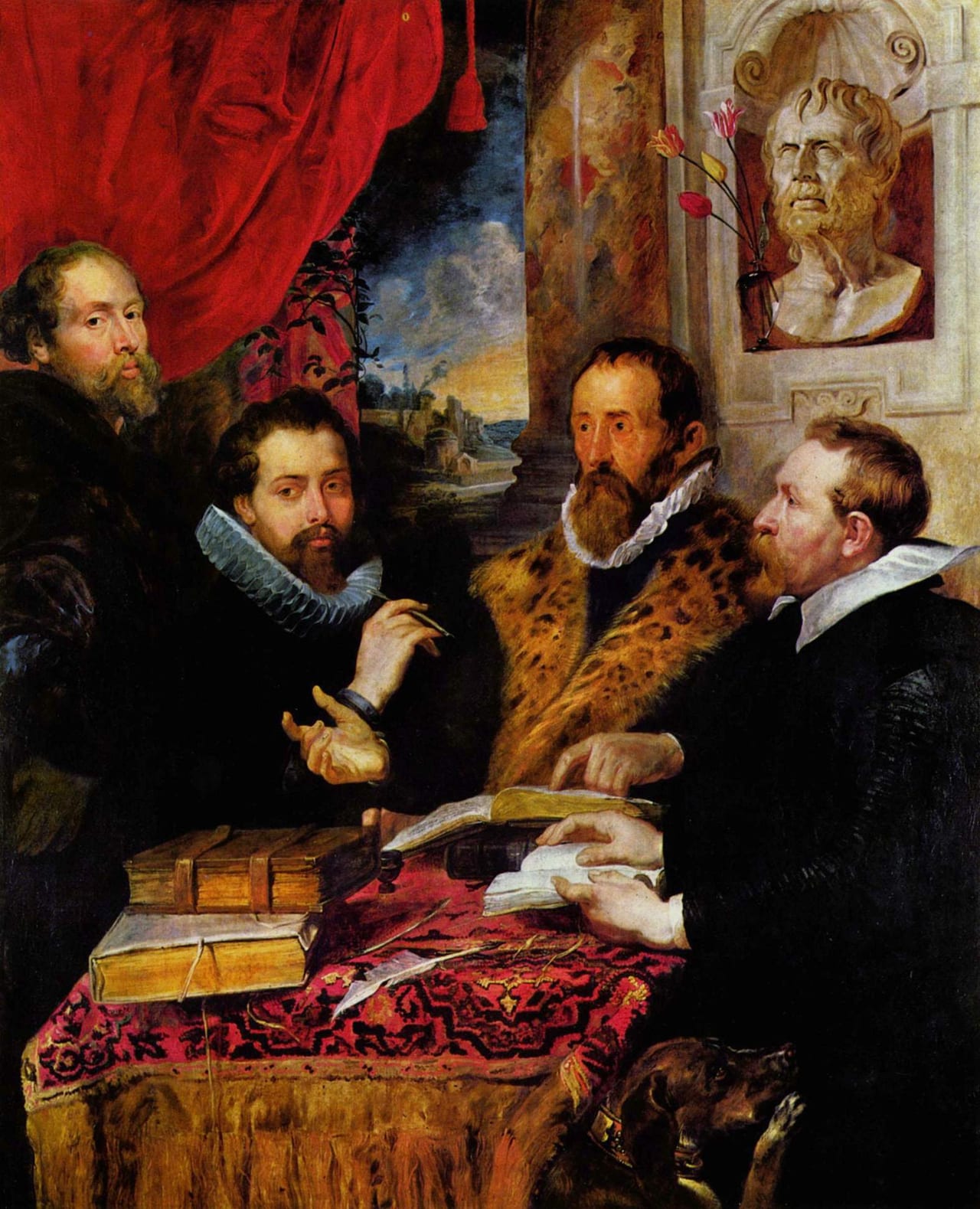
The Four Philosophers
Peter Paul Rubens · 1611
Palazzo Pitti
The Four Philosophers. The scholar Justus Lipsius with three of his followers under a red curtain, among them Rubens himself and his brother Philip, who died the year it was painted; the bust of Seneca behind them fixes the stoic creed of the group.
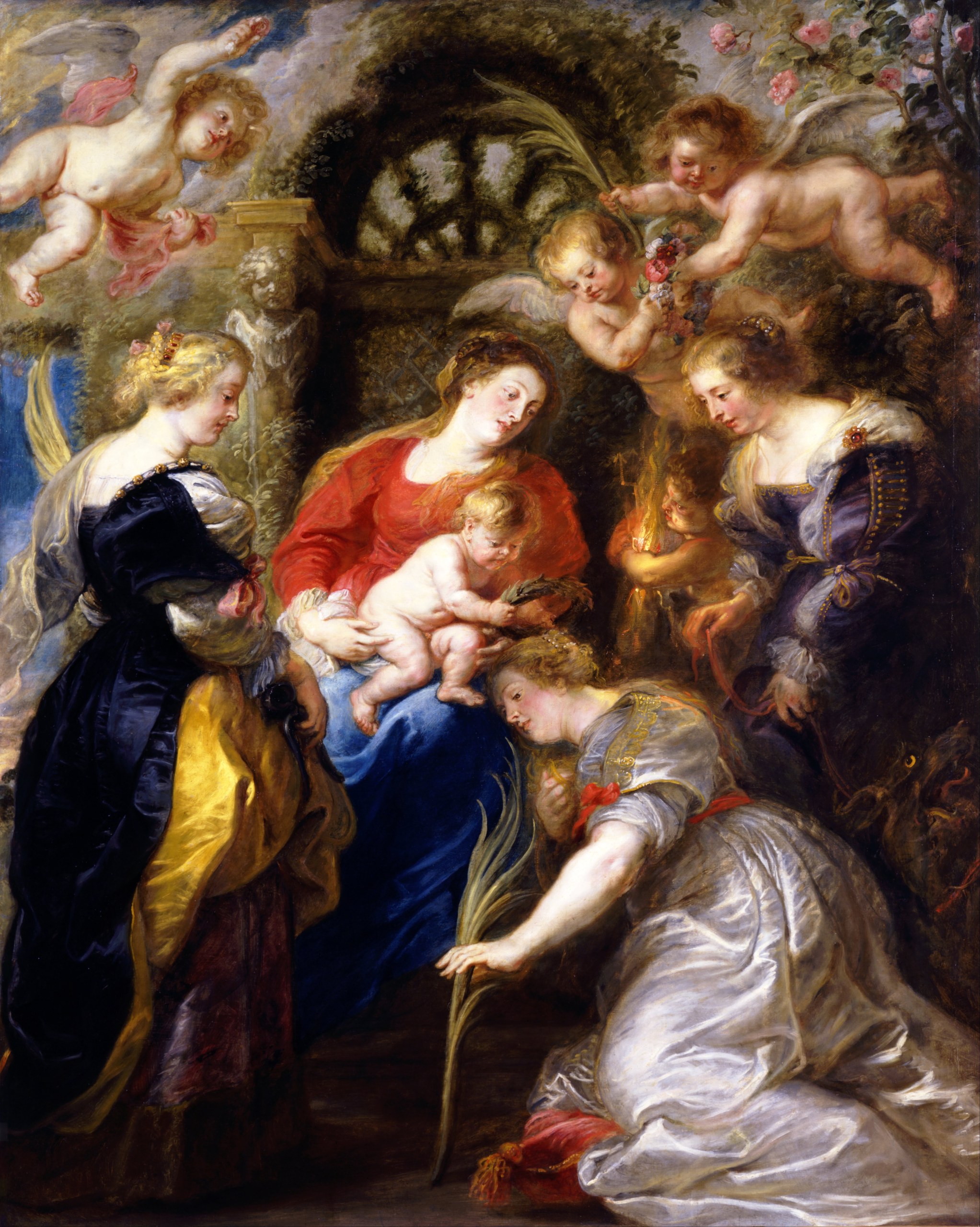
Crowning of Saint Catherine
Peter Paul Rubens · 1631
Toledo Museum of Art
Crowning of Saint Catherine. The infant Jesus, on his mother's lap, sets a crown on the martyr of Alexandria while she kneels among the instruments of her broken wheel; painted in 1631 for the Augustinian church at Mechelen.
Sources
- Wikipedia, “Peter Paul Rubens”
- National Gallery, London, “Peter Paul Rubens”
- Wikipedia, “Marie de' Medici cycle”
- Wikipedia, “Samson and Delilah (Rubens)”
- Wikipedia, “Consequences of War”
- Wikipedia, “The Rape of the Daughters of Leucippus”
- Wikipedia, “Perseus and Andromeda (Rubens)”
- Wikipedia, “The Four Philosophers”
- Wikipedia, “Medusa (Rubens)”
- Wikipedia, “The Three Graces (Rubens, Madrid)”
- Wikipedia, “The Garden of Love (Rubens)”
- Wikipedia, “A View of Het Steen in the Early Morning”
- Wikipedia, “Het Pelsken”
- Wikipedia, “The Feast of Venus (Rubens)”
- Wikipedia, “The Four Continents”
- Wikipedia, “Miracles of St. Francis Xavier (Rubens)”
- Wikipedia, “Landscape with Philemon and Baucis”
- Wikipedia, “Venus and Adonis (Rubens, 1614)”
- Wikipedia, “Bacchus (Rubens)”
- Wikipedia, “The Union of Earth and Water”
- Wikipedia, “The Fall of Man (Rubens)”
- Wikipedia, “The Birth of the Milky Way”
- Wikipedia, “The Crowning of Saint Catherine”
- Wikipedia, “Self-Portrait (Rubens, Vienna)”
Invite Peter Paul Rubens into your living room
Play 40 works from this collection on your TV, phone or tablet with Momentable Art TV.