Pollice Verso
Jean-Léon Gérôme · 1872

Academic art
Italy
For several centuries, from its origins in Italy in the mid-sixteenth century until it dissipated in the early twentieth, the art of Europe’s academies spread its influence across the Western world. The academies set out to make the teaching of art systematic, and they decided what counted as official art. Their style reached its height in the nineteenth century, after the end of the Napoleonic Wars in 1815, when the standards of the French Académie des Beaux-Arts, joining elements of Neoclassicism and Romanticism, carried great weight; William-Adolphe Bouguereau, Alexandre Cabanel and Jean-Léon Gérôme led the world of the Paris Salon. Realism and Impressionism were among the first movements to reject it, and by the First World War it had lost the favour of critics and buyers almost completely, before winning back some appreciation from the end of the twentieth century.
The academies and their school
The first academy of art was founded in Florence on 13 January 1563 by Cosimo I de’ Medici, under the influence of the architect Giorgio Vasari, and Michelangelo was among its founding members. The academies were set up to take the place of the medieval artists’ guilds. They asked students to emulate established masters and the classical tradition and gave little weight to individual creativity; in raising the professional standing of artists they moved them away from artisans and closer to intellectuals. They played a crucial part in organising the art world, controlling taste, criticism, the market and exhibitions, and, powerful through their ties to the state, they decided what was considered “official art”.
In Paris the Académie royale de peinture et de sculpture, modelled on Rome’s Accademia di San Luca, was founded in 1648 by artists under the leadership of Charles Le Brun; it later became the Académie des Beaux-Arts. King Louis XIV reorganised it in 1661, and in 1671 it came under his first minister, Jean-Baptiste Colbert, who confirmed Le Brun in post as director; between them they made it the main arm of a programme to glorify the king’s absolute monarchy. Its exhibition, the Salon, began in 1667, when Louis XIV sponsored a show of the members’ works, and took its name from the Salon d’Apollon of the Louvre, where it hung; after 1737 it became an annual event, and in 1748 a jury began to choose the works. The École des Beaux-Arts, founded by Colbert in 1671 as the Académie Royale d’Architecture, merged with the academy of painting and sculpture in 1793, and it taught drawing, painting, sculpture, architecture and engraving to students chosen by competitive examination.
Training lasted four years. In France only students who had passed an examination and carried a letter of reference from a noted professor were admitted to the academy’s school, the École des Beaux-Arts. Studies of the nude, called académies, were the basic building blocks. Students began by copying prints after classical sculpture to learn contour, light and shade, went on to draw from plaster casts of famous antique statues, and only then entered the classes where a live model posed. Painting itself was not taught at the École until after 1863: drawing was held to be the foundation, and only once proficient in it could a pupil join an academician’s studio and learn to paint. All along, competitions on a set subject and in a fixed time measured each student’s progress. The most famous, the Prix de Rome, gave its winner up to five years of study at the academy’s school in the Villa Medici in Rome. Entrants had to be French, male, single and under thirty, and in the final stage ten competitors were shut in studios for 72 days to paint a history picture; the winner was all but assured of a successful career.
Academic doctrine ranked the kinds of painting. In the hierarchy of genres, first drawn up in the seventeenth century, history painting, the “grande genre” of classical, religious, mythological, literary and allegorical subjects, stood at the top; portraits, genre scenes, landscapes and still lifes followed as minor genres. Each genre was thought to carry its own moral force, so that a moral principle could be taught with far more power and ease through a history scene than through a still life, and because the ideal human body was held to be the highest subject of art, landscapes and still lifes without people had little prestige. With a social and teaching purpose in mind, academic art favoured large works, which suited large crowds of viewers and the decoration of public spaces.
The Salon in its heyday
The nineteenth century was the academies’ heyday: their output was widely accepted by a much larger, if often less demanding, public, and academic art enjoyed a popularity comparable to that of cinema today. In the nineteenth century the most popular of many exhibitions was the Paris Salon. As much a social event as an artistic one, it might draw 50,000 people on a single Sunday and as many as 500,000 over its two-month run, and thousands of paintings hung from just below eye level up to the ceiling, in the manner now known as “Salon style”. Artists petitioned the hanging committee for a place “on the line”, at eye level, and complained if their works were “skyed”. A successful showing was a seal of approval that made a painter’s work saleable to the growing ranks of private collectors, and the summit of a career was election to membership of the Académie française, with the right to be known as an academician. Bouguereau, Cabanel and Gérôme were leading figures in this world.
The art world of the century set out to reconcile the line of Neoclassicism with the colour of Romanticism, reviving an older quarrel, and critics claimed the synthesis for one painter after another, Thomas Couture among them; Bouguereau said the trick of good painting was seeing “color and line as the same thing”. Jean-Auguste-Dominique Ingres was a key figure in forming the style. Its aim was idealism, the opposite of realism: figures were made simpler and more abstract so that they could stand for the ideals they represented, and some pictures were given a polished finish in which no brushstroke can be made out. Bouguereau is known to have said he would paint not “a war” but “War”, and many academic pictures are simple allegories of nature, with titles such as Dawn and Dusk, each idea embodied in a single nude figure.
Portraits, landscapes and still lifes were painted too, but the public and the critics valued most the large history paintings, whose stories came very often from ancient or exotic history and mythology and less often from religion; Orientalism was a major branch, and so were scenes of classical antiquity and the Middle Ages. Cabanel, Napoleon III’s preferred painter, was counted with Gérôme and Ernest Meissonier among “the three most successful artists of the Second Empire”; he won the Prix de Rome in 1845, taught at the École des Beaux-Arts from 1864 until his death, and sat on the Salon jury seventeen times between 1868 and 1888. Bouguereau entered the École in 1846, won the Prix de Rome in 1850, showed regularly at the Salon over several decades and was for a time France’s most famous painter of his day, with an influence that reached other countries, the United States above all.
Paul Delaroche, a typifying example of French history painting, became through painstakingly realistic historical subjects one of the most successful academic artists of mid-century France. He steered a course midway between the Classicists and the Romantics, gave his pictures a firm, smooth surface with an appearance of the highest finish, often worked out his compositions first in wax models, and through engraved reproductions his work became familiar in thousands of homes. In his lifetime his work won wider international acclaim than the paintings of Ingres and Eugène Delacroix, now considered the greater masters. Meissonier, who showed at the Salon from 1834 and received the highest official honours from the mid-1840s, painted mostly small pictures of military subjects or of genre in a historical setting, with a minute technique drawn largely from seventeenth-century Dutch painting and a documentary study of costume, armour and the movements of horses. Couture, trained in portraiture under Baron Antoine-Jean Gros, joined soft eighteenth-century colour to a strict nineteenth-century classicism in his most important work. He is best known for his portraits and for historical genre scenes, The Romans of the Decadence among them, a sensation at the Salon of 1847.
The French model spread. Academies inspired by it opened in Antwerp in 1663, Berlin in 1696, Vienna in 1698, Madrid in 1752 and Saint Petersburg in 1757, and in England the Royal Academy of Arts was founded in 1768. Frederic Leighton was an academic painter of immense prestige in his day. His Cimabue’s Madonna, shown at the Royal Academy in 1855 and bought by Queen Victoria, marked the arrival in England of a new cosmopolitan academic manner, in which grand scale and forms drawn from classical Greece and the High Renaissance served anecdotal and superficial subjects. He became a member of the Royal Academy in 1869 and its president in 1878, and on the day before his death he was made a baron, the first English painter to be so honoured. Lawrence Alma-Tadema, the son of a Dutch notary, trained at the Antwerp Academy and turned after a visit to Italy in 1863 almost entirely to Greek and Roman antiquity and Egyptian archaeology; he became a British subject in 1873, was elected to the Royal Academy in 1879, and excelled at recreating ancient buildings and costume and the textures of marble, bronze and silk.
Refusal, decline and return
In the second half of the century the academic values inherited from the Ancien Régime and from the Neoclassicism of Jacques-Louis David were radically remodelled by the spread of industrialisation and of the art market, the Realist wave and the Idealist and Symbolist reaction to it. Realist artists such as Gustave Courbet were the first to attack academic idealism, for its clichés and its myths and legends while the social concerns of the day were ignored, and for the smooth, slick “false surface” of its pictures, which showed no real texture. The Impressionists, who painted quickly out of doors exactly what the eye saw, rejected the finished, idealised manner, and both groups defied the low place of landscape and still life. Yet most of the early rebels had first studied in academic studios: Claude Monet, Courbet, Édouard Manet and even Henri Matisse were students of academic artists.
Several of the new painters had academic teachers. Couture’s strong tonal contrasts are thought to have influenced his pupil Manet, and Pierre Puvis de Chavannes and Henri Fantin-Latour studied with him too. Gérôme, teaching at the École des Beaux-Arts, counted Odilon Redon and the Americans Thomas Eakins and J. Alden Weir among his many pupils. Léon Bonnat, professor of painting at the École from 1888 and its director from 1905, taught Eakins, Gustave Caillebotte and Henri de Toulouse-Lautrec; his stress on overall effect, with rigorous drawing, placed him midway between the Impressionists and academic painters such as his friend Gérôme. Fernand Cormon tried to steer the pupils of his own studio towards pictures the Salon jury would accept, and failed with Toulouse-Lautrec, Émile Bernard and Vincent van Gogh.
The academy’s leaders resisted the new painting. Bouguereau, a proponent of official orthodoxy, played a major role in keeping the Impressionists and other experimental painters out of the Salon, and Gérôme, exceedingly hostile to the Impressionists, urged the government as late as 1893 to refuse a bequest of 65 of their works. In 1863 Cabanel and Bouguereau refused to let Manet and others show at the Salon, and Napoleon III, faced with the discontent of a growing number of excluded artists, set up the Salon des Refusés, now considered one of the first milestones of modernism. Courbet had shown his work alone in a Pavilion of Realism in 1855, and Manet, rejected by the Salon, did the same in 1867. The Salon had been opened to all French artists during the Revolution, though academicians still controlled most of its nineteenth-century exhibitions; after 1881, when the Société des Artistes Français took it over and independent shows of avant-garde art grew in importance, it gradually lost its influence and prestige.
As modern art gained power, academic art was further denigrated as sentimental, clichéd, conservative and bourgeois. The French called it, with derision, l’art pompier, from pompier, “fireman”, after the paintings by Jacques-Louis David in which soldiers often wear helmets like firemen’s, and its showpieces were dismissed as “grandes machines” that manufactured false emotion. In 1939 the American critic Clement Greenberg declared all academic art “kitsch”. Through the twentieth century most of the eclectic academic work of the later 1800s was turned out of private collections, fell sharply in price and was taken down from museum walls into storerooms. Postmodernism brought it back into the history books, and since the early 1990s the Classical Realist atelier movement has made academic art again, in a limited way. In museums it has enjoyed something of a critical revival, partly thanks to the Musée d’Orsay in Paris, where it hangs on more equal terms with the Impressionists and Realists; the museum’s opening in 1986 was hotly debated in France. Where academic paintings once fetched only a few hundred dollars at auction, some now fetch millions.
Artists
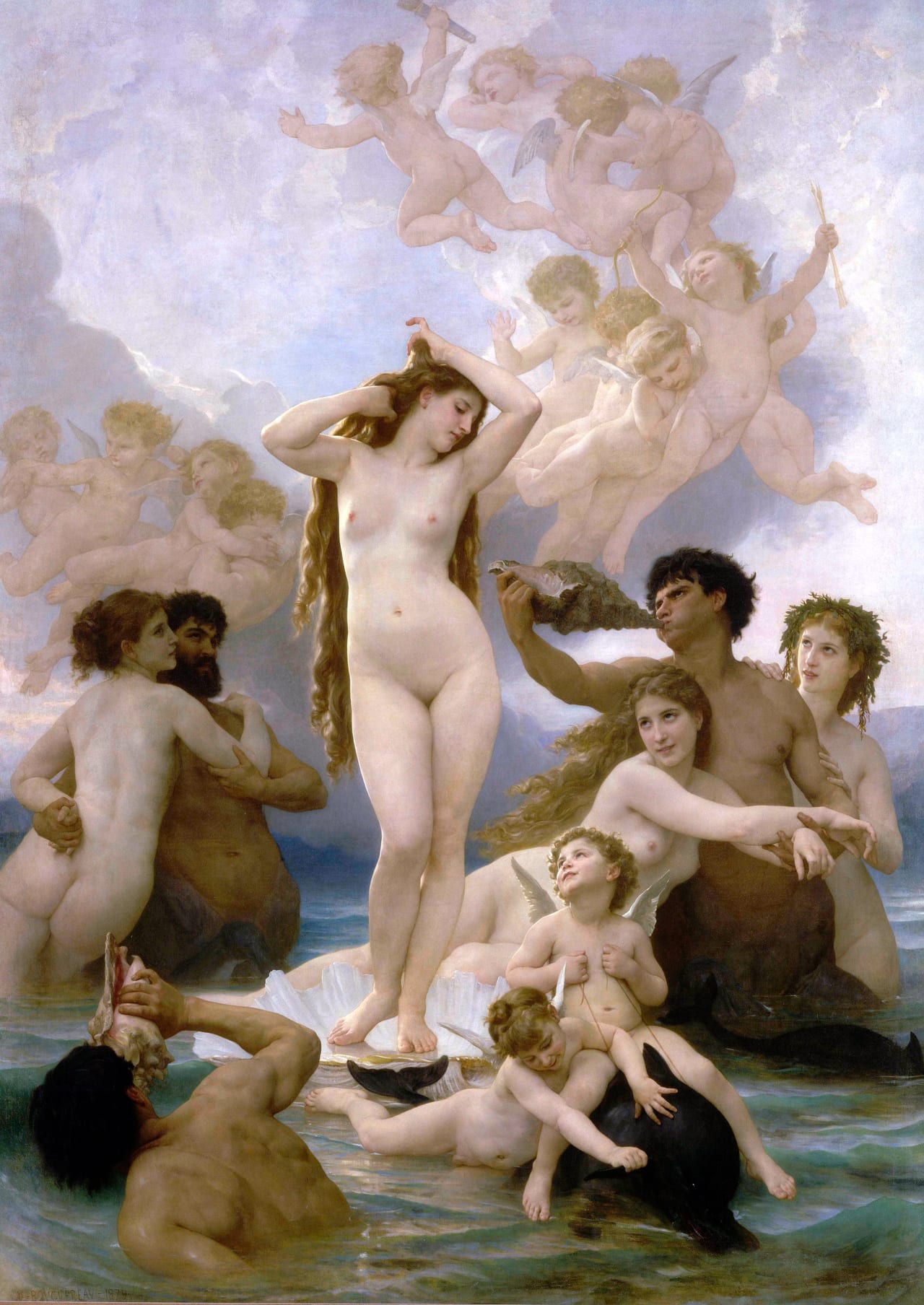
One of Bouguereau’s most famous paintings shows Venus not being born from the sea but carried in a shell, fully grown, from the sea to Paphos in Cyprus. She stands nude on a scallop shell drawn by a dolphin, raising her arms to her hair in an “S”-curve contrapposto, while fifteen putti, among them Cupid and Psyche, with nymphs and centaurs, gather to see her arrive and two centaurs sound conch and Triton shells. The canvas is just over three metres high, and its subject and composition recall Botticelli’s Birth of Venus and Raphael’s Triumph of Galatea.
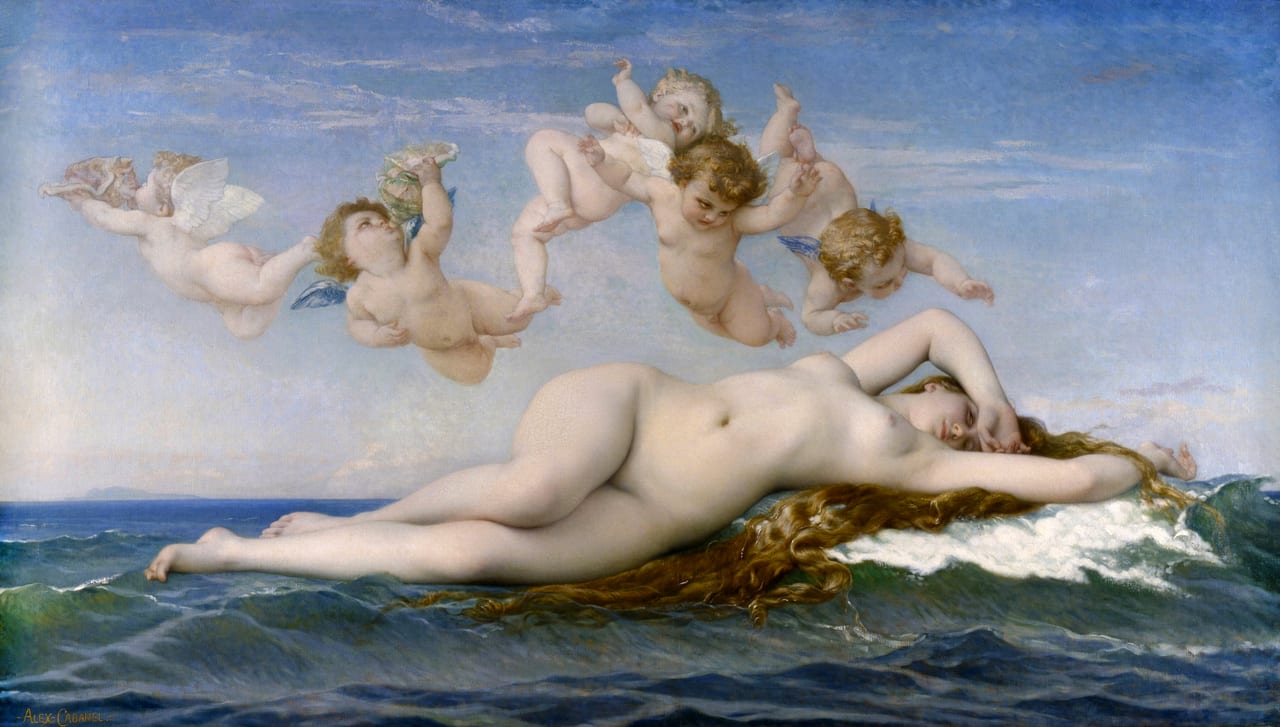
Alexandre Cabanel
One of the great successes of the Salon of 1863, where Napoleon III bought it for his private collection. Venus, born of the sea-foam, is carried ashore; for Cabanel the myth is a pretext for a nude, idealised yet lascivious in pose. Émile Zola wrote that the goddess, “drowned in a sea of milk”, looked like a courtesan made “of a sort of pink and white marzipan”. Its subject, a reclining nude, is the same as that of Édouard Manet’s Olympia, which caused a scandal; Manet’s model stares back at the viewer with a calm assurance far more provocative than the languid pose of Cabanel’s Venus.
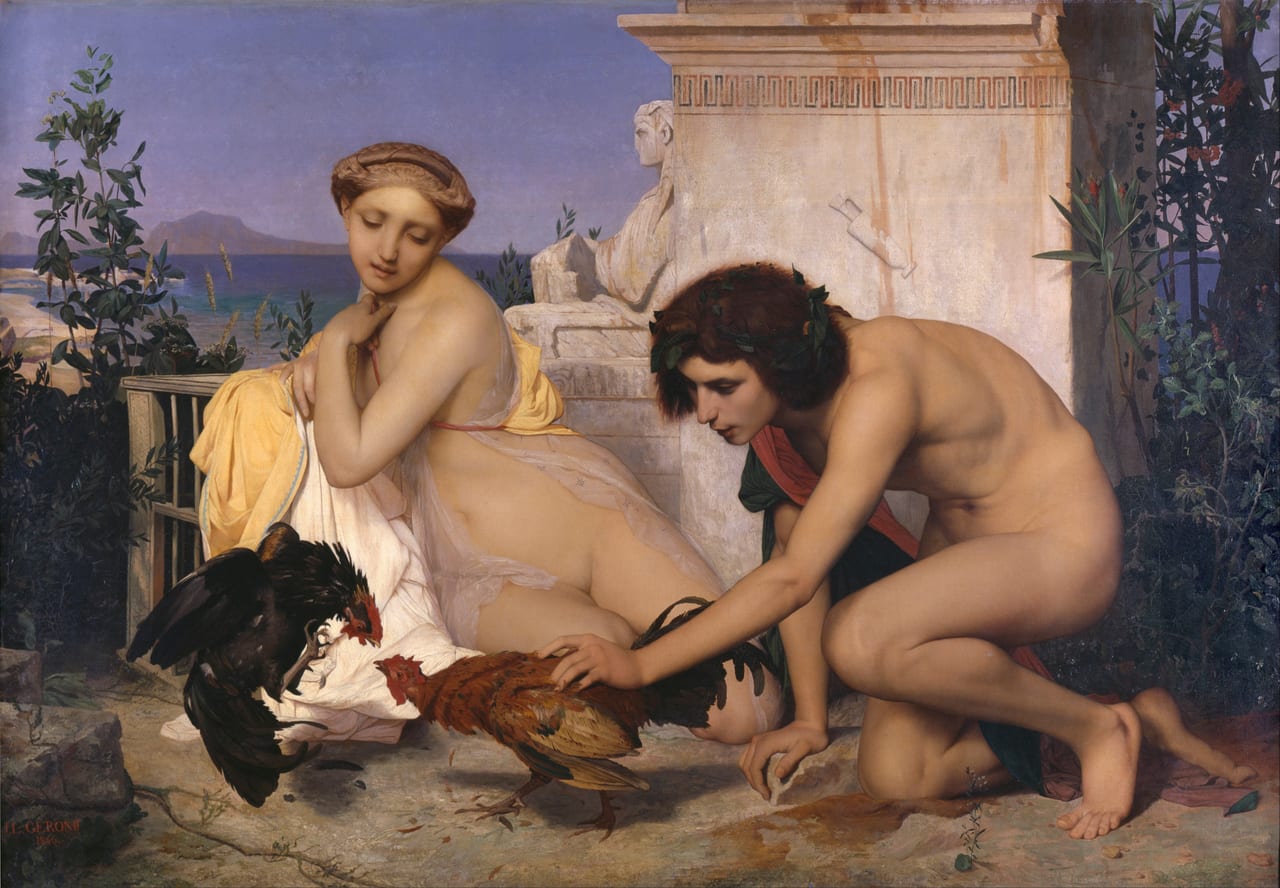
Jean-Léon Gérôme
Gérôme began this canvas in 1846, still smarting from his failure to win the Prix de Rome, and hesitated to show it; encouraged by his master Paul Delaroche, he entered it at the Salon of 1847, and it was a great success there. In the Neo-Grec manner, with meticulous finish, pale colours and smooth brushwork, he sets two near-naked adolescents at the foot of a fountain, their youth against the battered profile of the sphinx behind them, and a fight between two cocks, one doomed to die. Théophile Gautier saw in it “wonders of drawing, action and colour”, and at twenty-three Gérôme had made a brilliant entry into the art world.
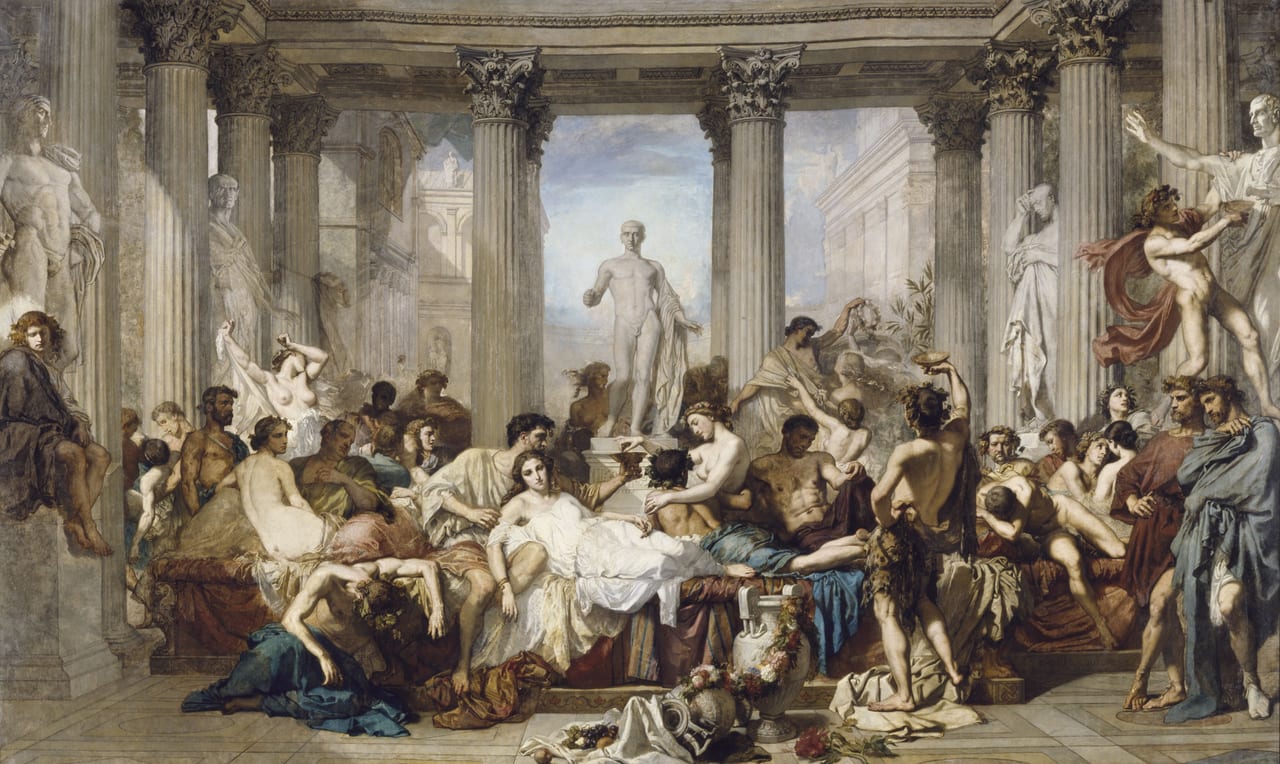
Thomas Couture
Couture took three years to finish this history painting, shown at the Salon of 1847 with two lines of Juvenal in the catalogue: “Crueller than war, vice fell upon Rome and avenged the conquered world”. Debauched revellers, exhausted or still drinking and dancing, fill the centre; three figures take no part, a melancholy boy sitting on a column at the left and two foreign visitors casting a disapproving eye at the right, and the antique statues above seem to condemn the orgy. A republican and anticlerical, Couture aimed it at the France of the July Monarchy, and the critics of 1847 soon saw in his Romans “The French of the Decadence”.
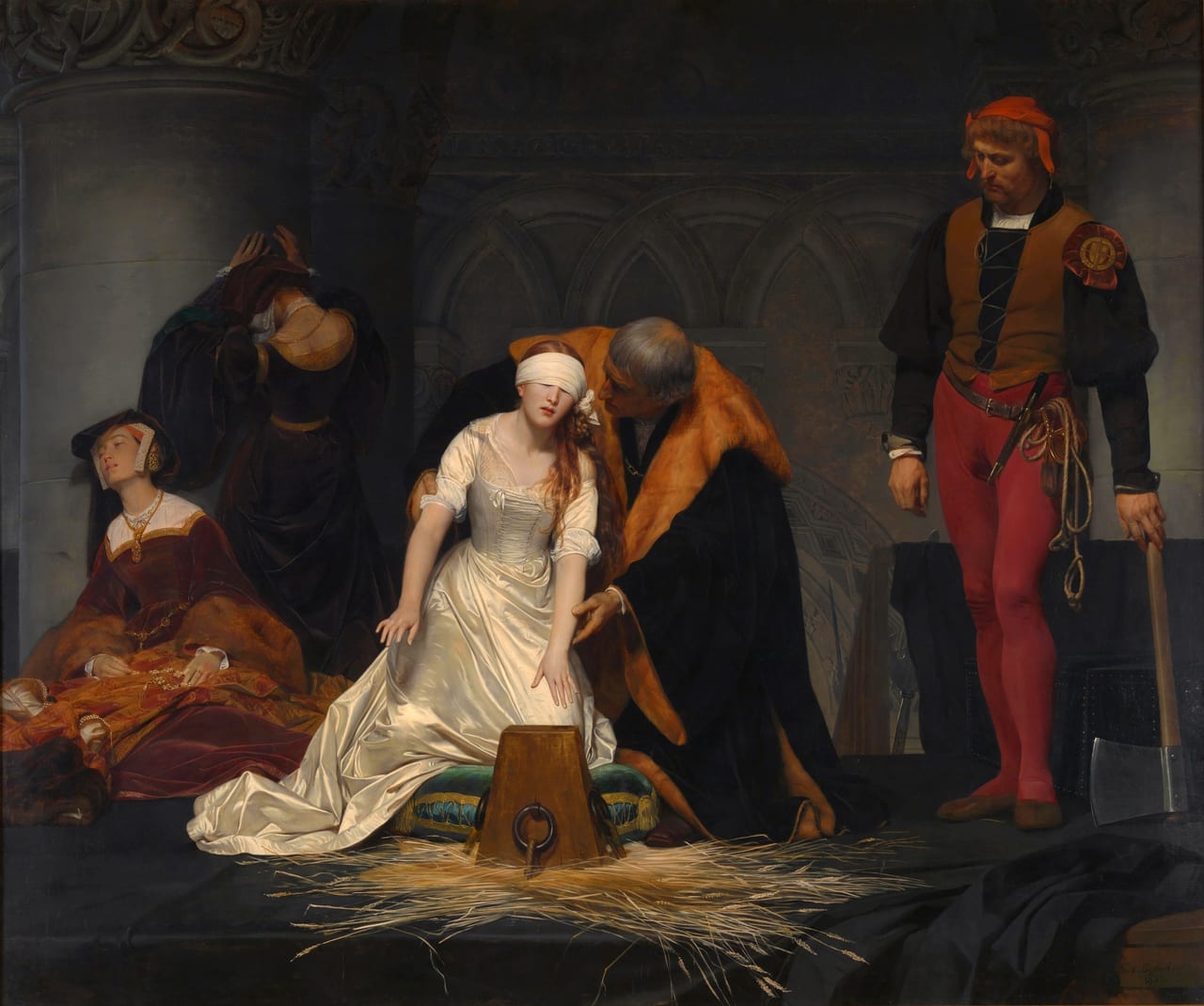
Paul Delaroche
Lady Jane Grey reigned for nine days as queen of England and was beheaded at Tower Green on 12 February 1554, at seventeen. Delaroche painted her last moments in 1833: blindfolded, she gropes for the block, guided by Sir John Brydges, Lieutenant of the Tower; one lady-in-waiting has slumped to the ground with her outer clothing in her lap, another faces the wall, and the executioner waits at the right. Shown at the Paris Salon of 1834, it was an immediate sensation, though in fact the execution took place outdoors. Long thought destroyed in the Thames flood of 1928, it was found by chance in the basement of the Tate Gallery in 1973.
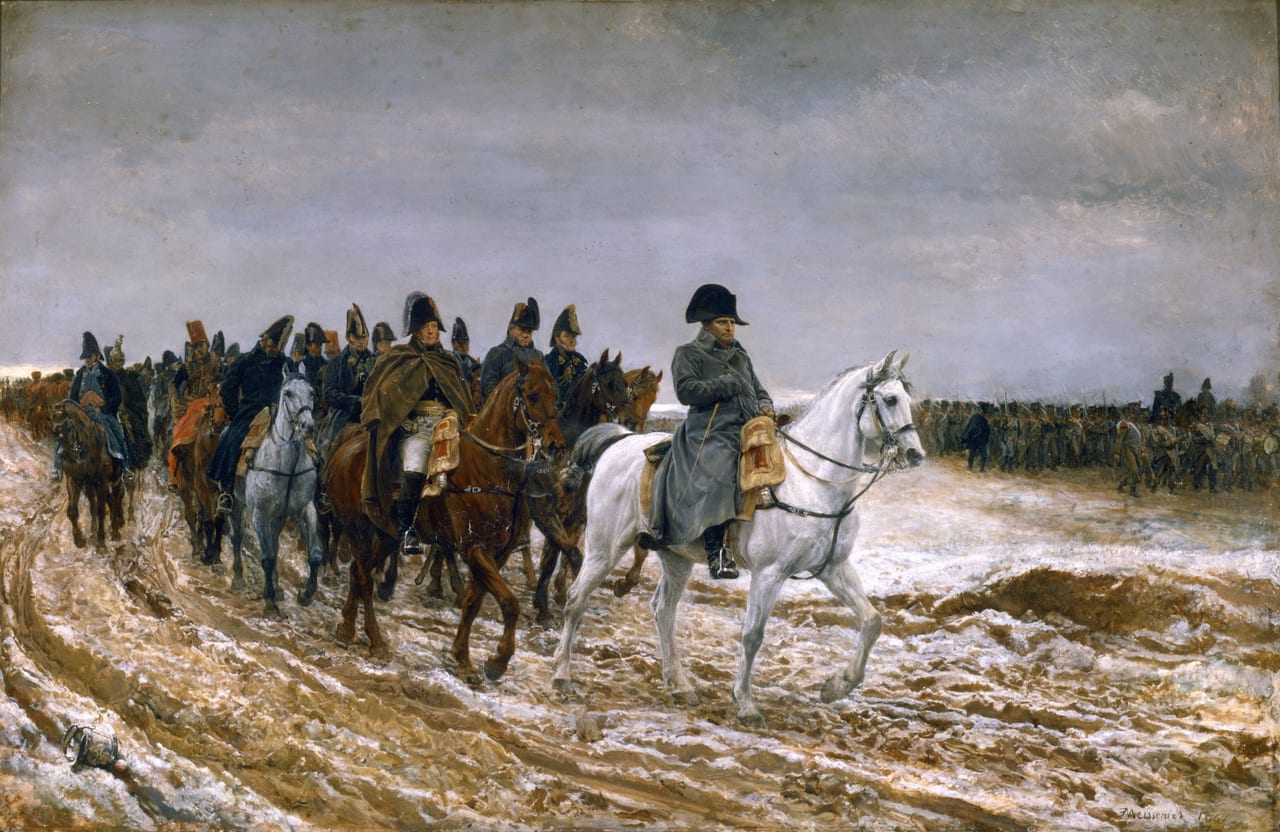
Ernest Meissonier
One of Meissonier’s best-known works and part of his cycle of Napoleonic pictures, painted in oil on wood between 1860 and 1864. Napoleon, tired and thoughtful on a white horse, leads his troops along a cold, snowy road in the grim retreat of 1814, under a dark, cloudy sky. To get every detail right, Meissonier borrowed Napoleon’s own saddle and posed before a mirror in a copy of his overcoat. Its sale in 1890 set a record price for a work by a contemporary artist. It is in the Musée d’Orsay.
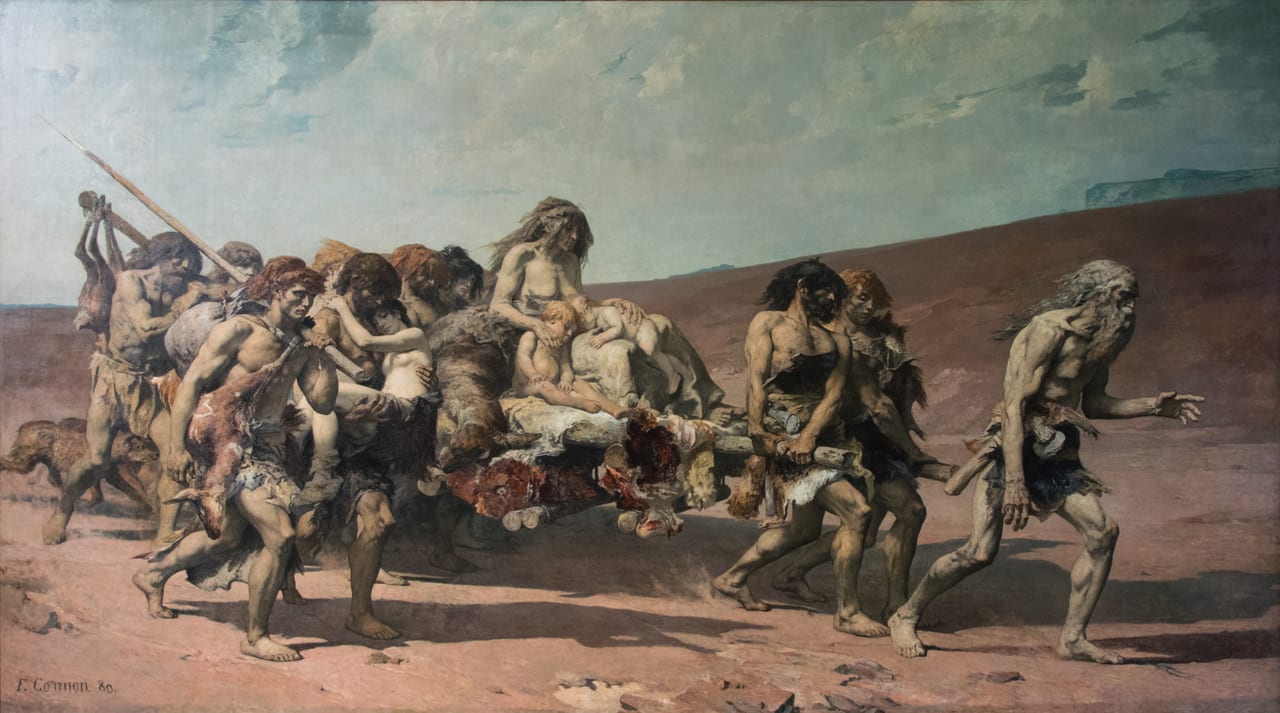
Fernand Cormon
Condemned to wander for ever after murdering his younger brother Abel, a haggard Cain leads his tribe across a bleak plain. His sons carry a wooden stretcher on which a bewildered woman sits with her dazed children, chunks of bleeding meat hang from it, and the hunters trudge alongside. Cormon used earthy colours and vigorous brushstrokes, had live models pose for every figure, and made the biblical story a reconstruction of prehistory when Palaeolithic rock paintings were only then being found; its subtitle comes from Victor Hugo’s poem Conscience.
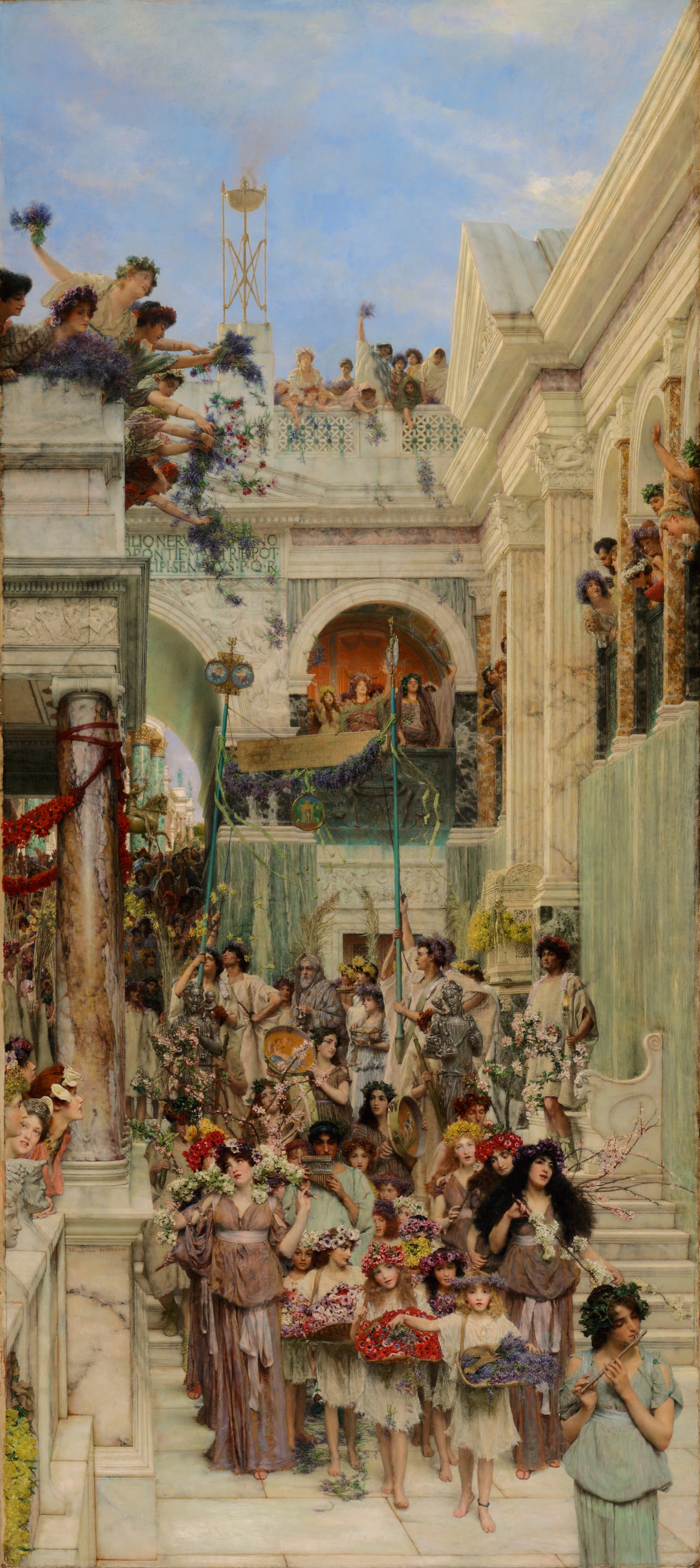
Lawrence Alma-Tadema
A procession of women and children comes along a Roman street and down marble steps, garlanded with flowers, some carrying baskets or blossom and some playing flute, pan pipes and tambourines, while spectators cheer from buildings of coloured marble. Alma-Tadema linked the Victorian May Day custom of children gathering flowers with an ancient Roman spring festival, though no single festival matches the details, and many of the figures were modelled by his friends and family. He worked on it for four years and finished it in late 1894; it has been in the J. Paul Getty Museum since 1972.
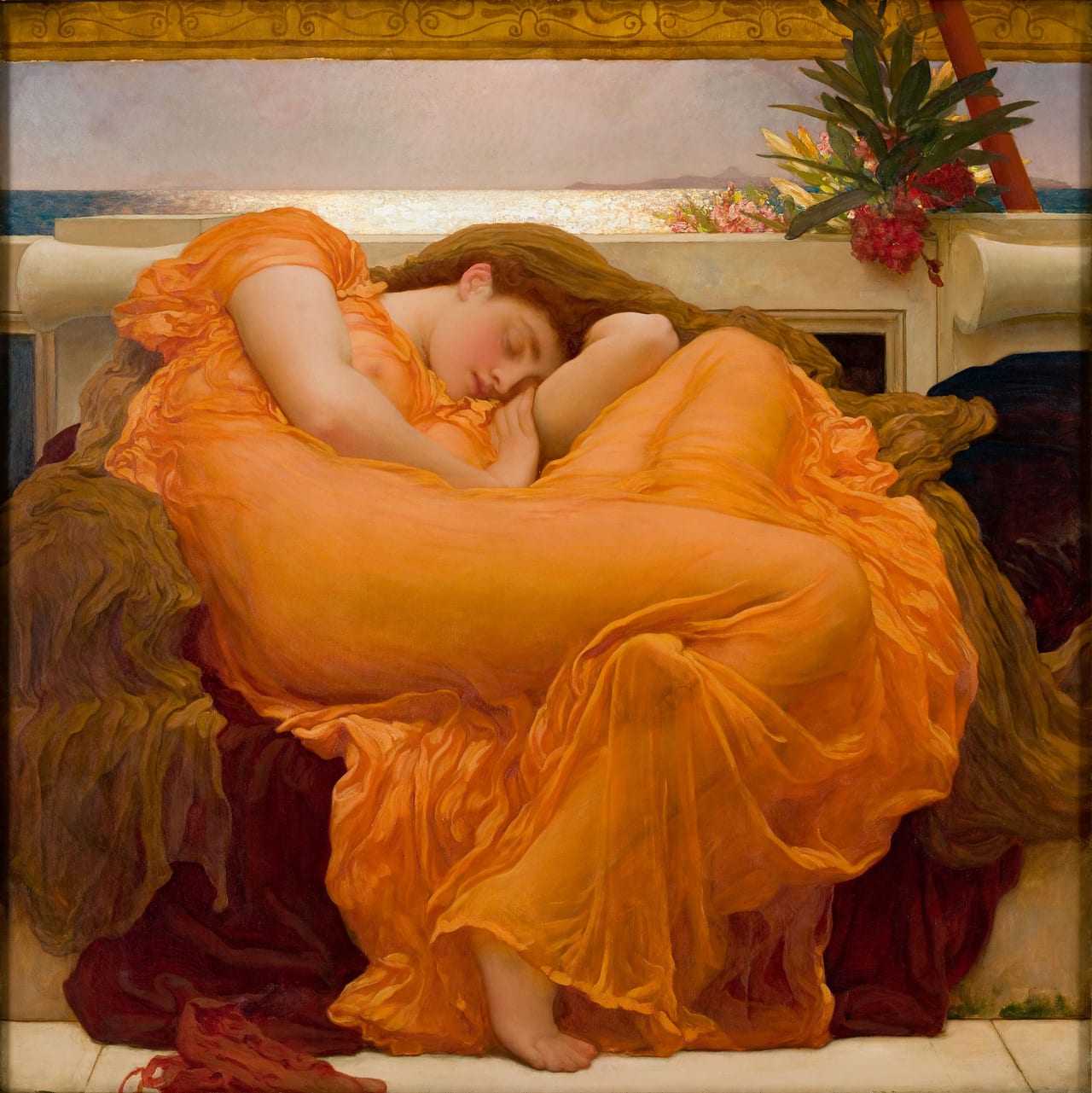
Frederic Leighton
Leighton’s most recognisable work, painted in 1895 on a square canvas: a sleeping woman in transparent drapery, in a sensuous version of his classicising academic style. In the art historian Andrew Graham-Dixon’s words, “her pose is loosely modelled on that of Michelangelo’s famous statue of Night”. It began as a motif for a marble bath in another of his pictures, Summer Slumber, and the toxic oleander at the top right possibly stands for the fragile link between sleep and death. Lost from view in the 1930s and rediscovered in the 1960s, it was bought by the Museo de Arte de Ponce in Puerto Rico.
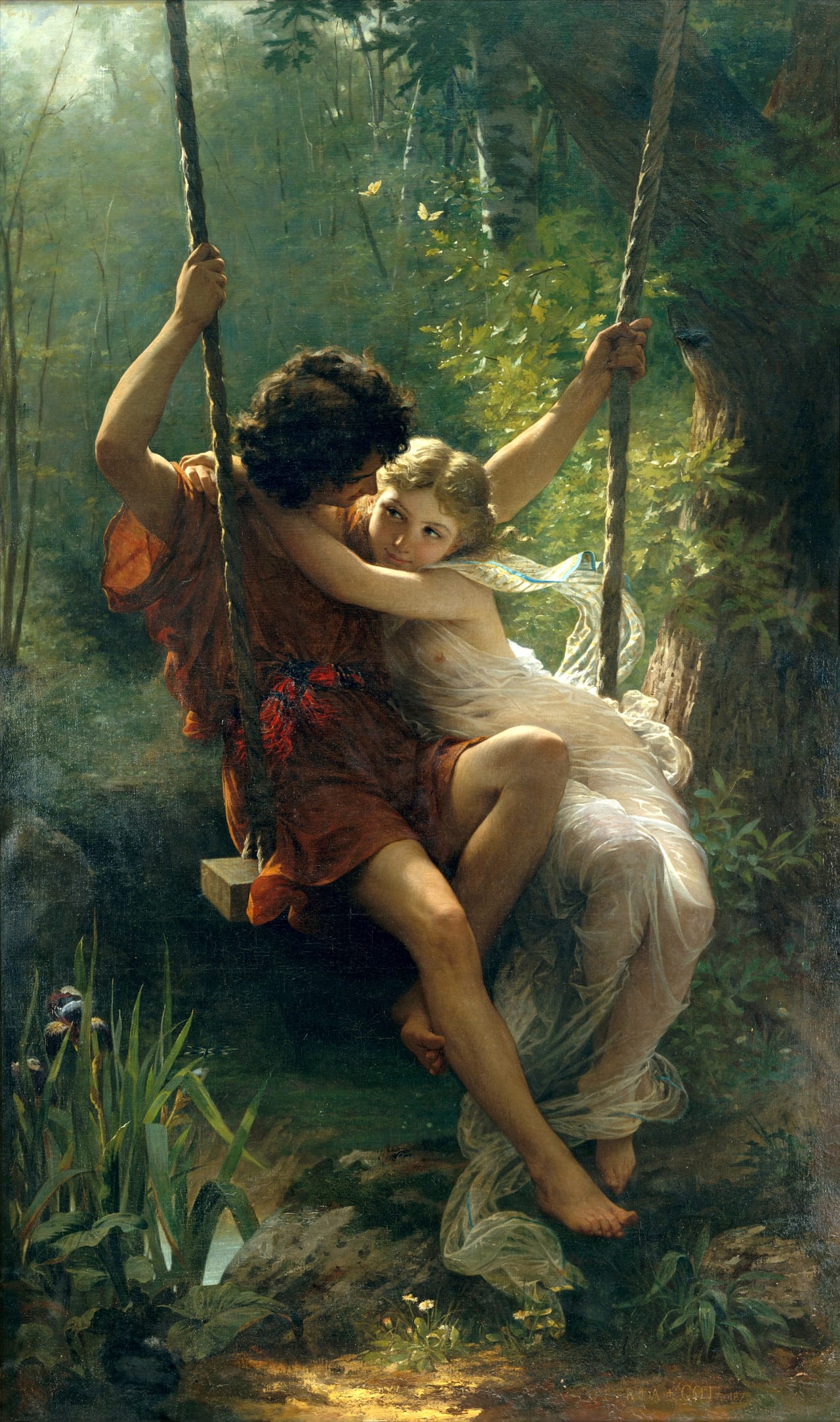
Pierre Auguste Cot
A young couple in classical dress embrace on a swing in a wood or garden, seemingly lost in each other, “drunken with first love” in one description. Cot painted it in 1873 and showed it at the Paris Salon that year, where it was well received; it became his most successful work and was often copied in other media.
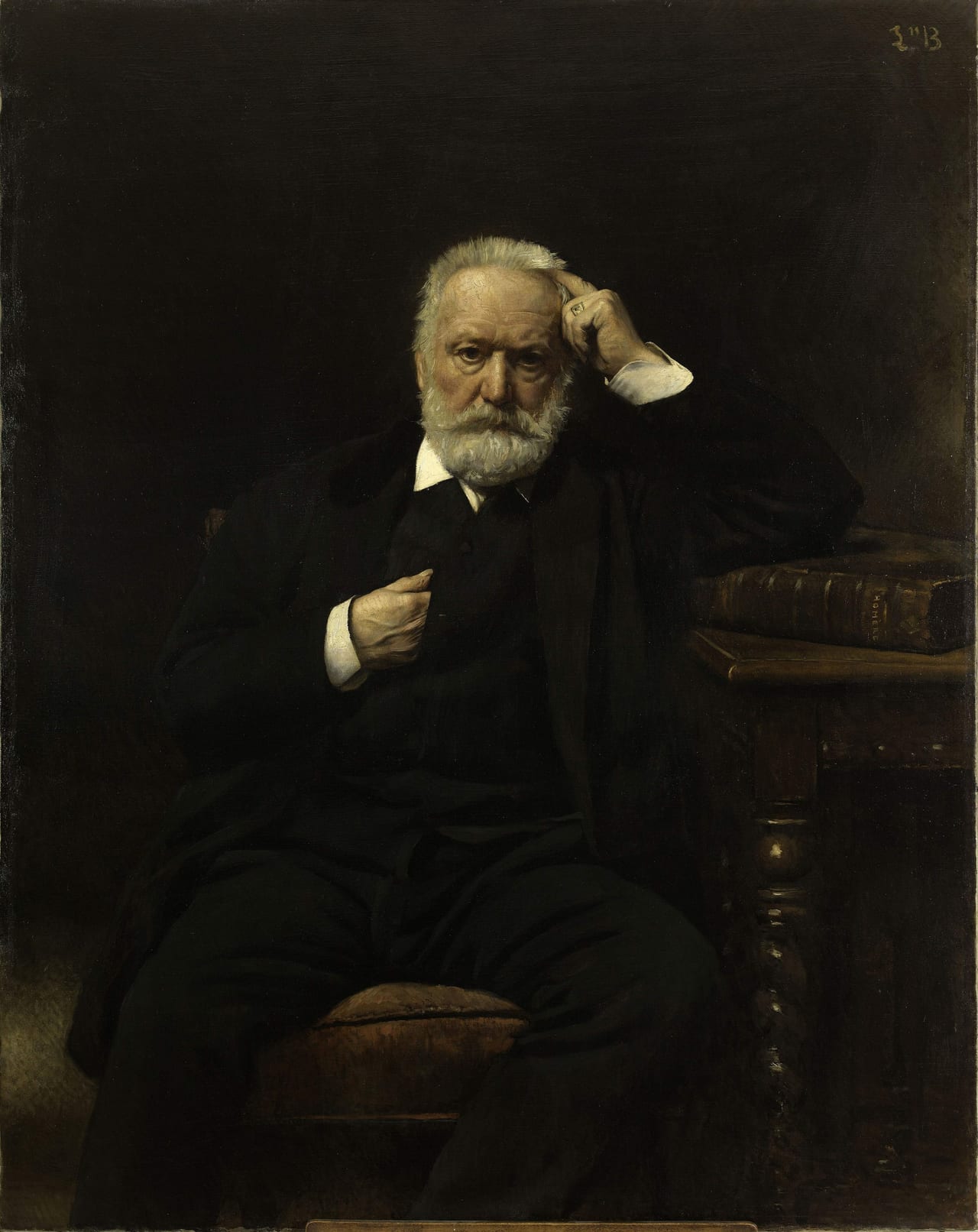
Léon Bonnat
Bonnat, known for his portraits of leading figures of French society, painted Victor Hugo in 1879, when the writer of Les Misérables, a key figure of the Romantic movement, was seventy-seven and already a legend of French literature. The portrait was shown at the Salon of 1879 in the Palace of Industry, and Hugo’s granddaughter Jeanne Hugo gave it to the French state in 1919; it is in the Palace of Versailles.
Artworks
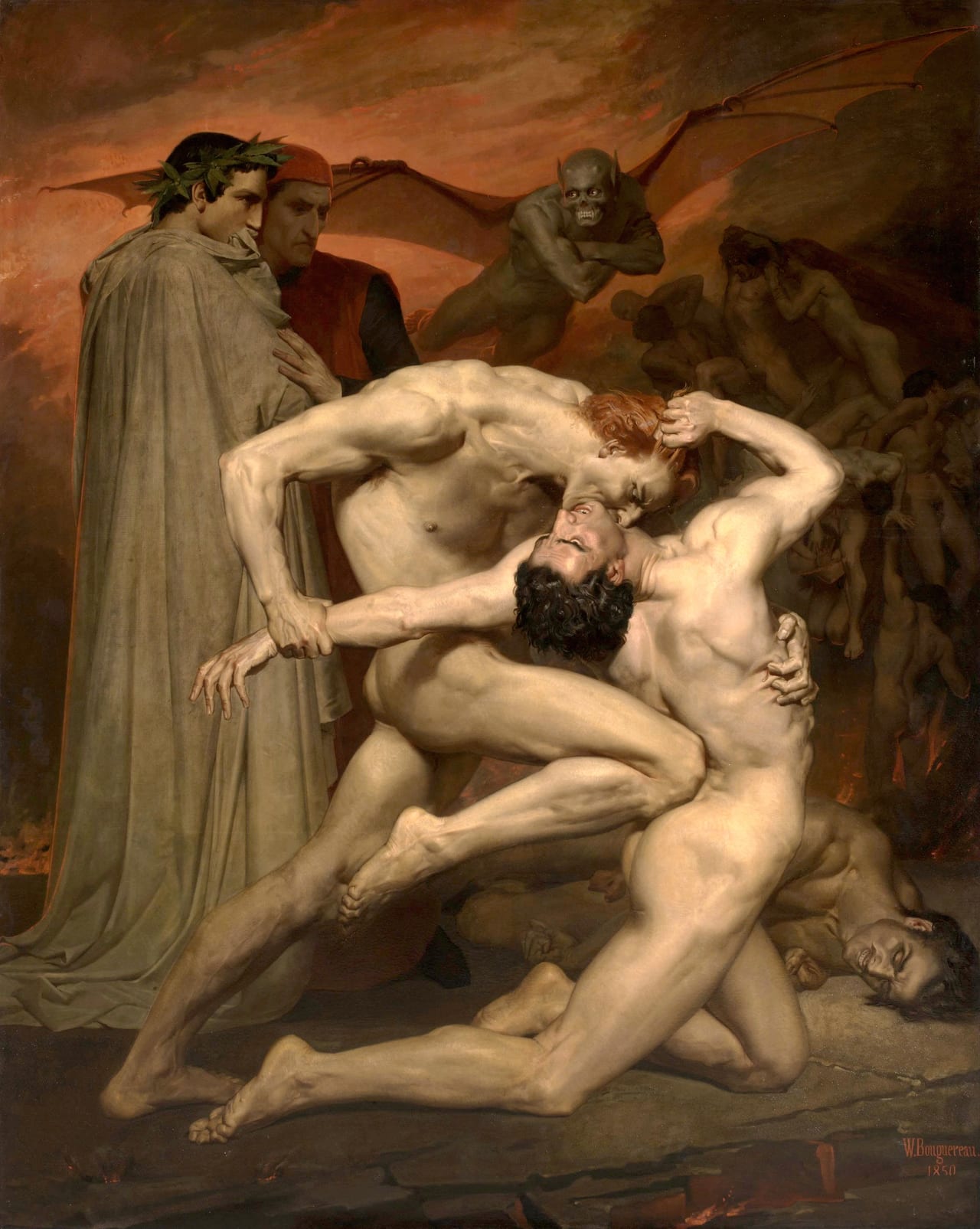
Dante and Virgil
William-Adolphe Bouguereau · 1850
Musée d'Orsay
Bouguereau painted this scene from Dante’s Divine Comedy in 1850. Dante and his guide Virgil look on as two damned souls fight for ever: the trickster Gianni Schicchi bites the neck of the alchemist and heretic Capocchio. It was shown at the Salon of 1850 and is in the Musée d’Orsay.
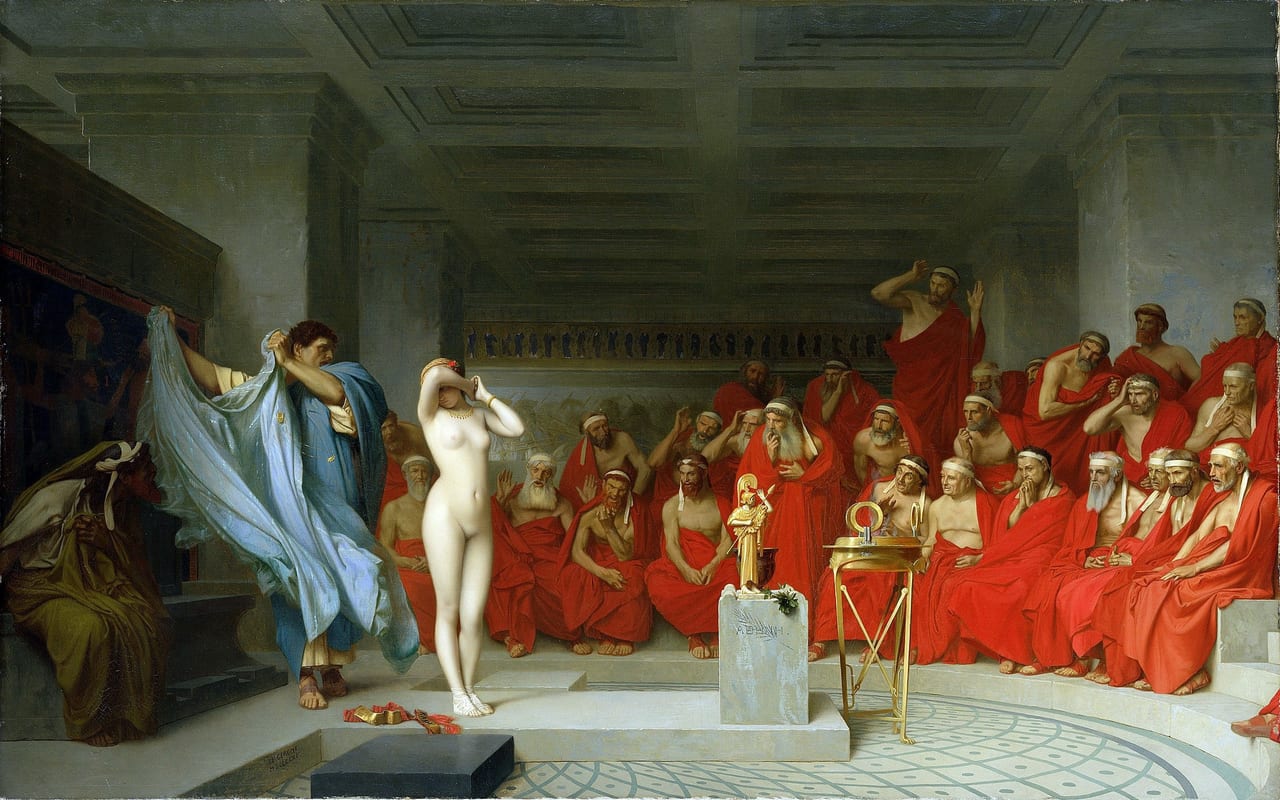
Phryne Before the Areopagus
Jean-Léon Gérôme · 1861
Hamburger Kunsthalle
Gérôme painted the trial of Phryne, the Greek courtesan charged with impiety, who was said to have been acquitted when her defender Hypereides removed her robe. She stands nude, hiding her face in her hands; Hypereides holds her robe at the left, the jurors sit at the right, and a golden statue of Athena stands at the centre. It was shown at the Salon of 1861 and is in the Kunsthalle Hamburg.
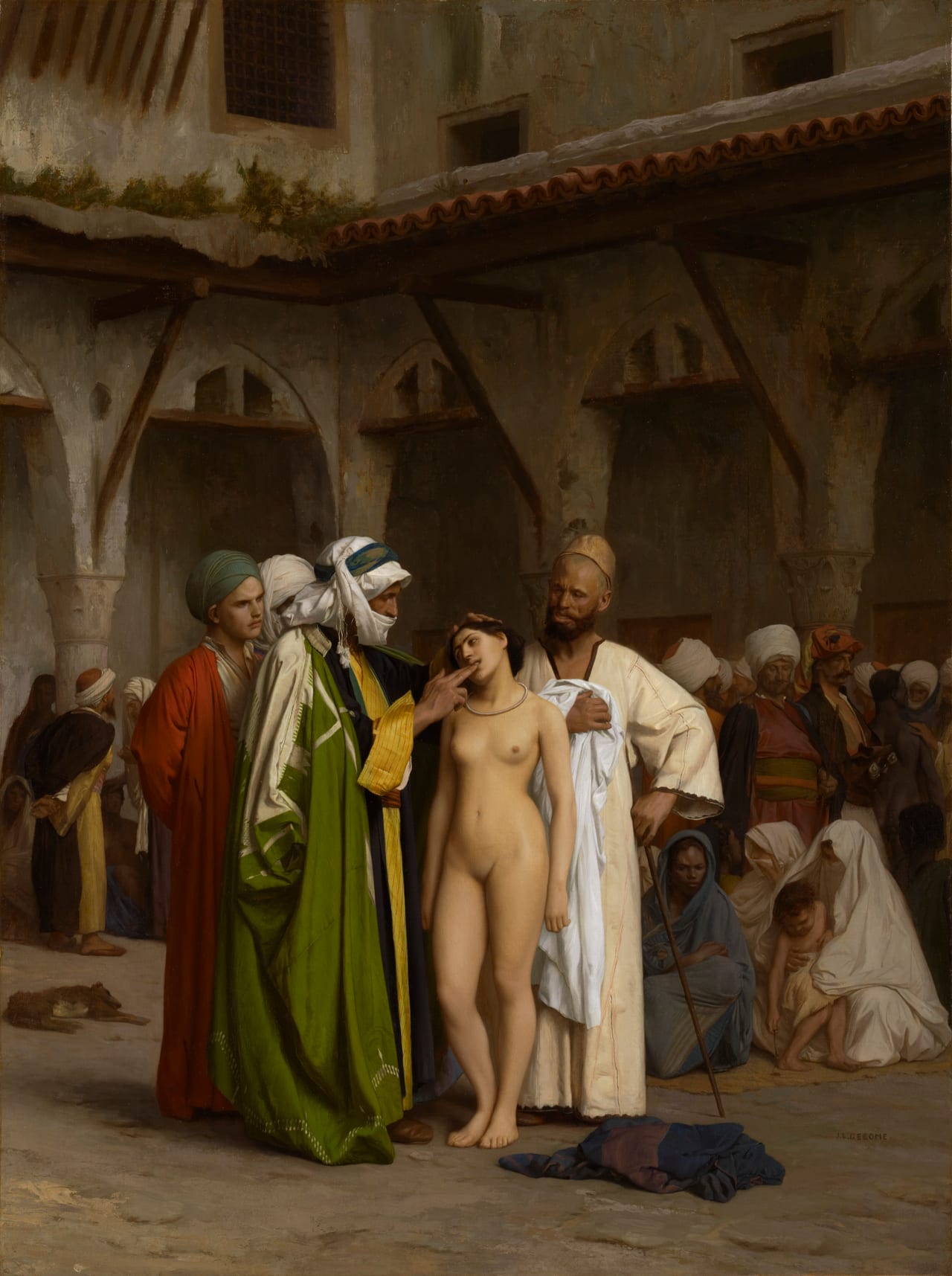
The Slave Market
Jean-Léon Gérôme · 1866
Clark Art Institute
In a West Asian or North African setting a man inspects the teeth of a nude female slave. Adolphe Goupil bought the picture in 1866 and it was shown at the Salon of 1867; with his Snake Charmer it has become an iconic example of nineteenth-century Orientalist art. It has belonged to the Clark Art Institute since 1955.
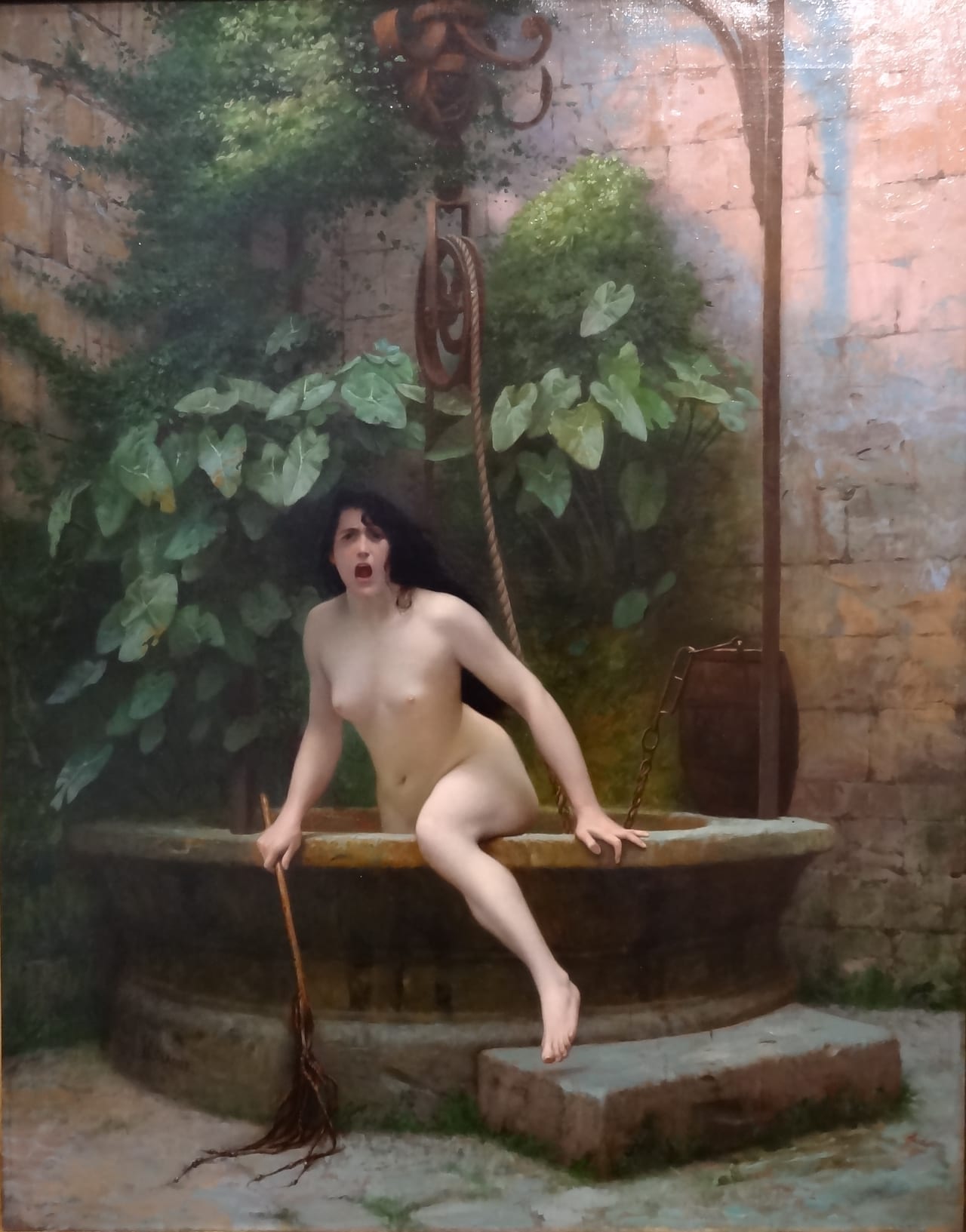
Truth Coming Out of Her Well
Jean-Léon Gérôme · 1896
Musée Anne de Beaujeu
In his final decade, from the mid-1890s, Gérôme painted at least four pictures of Truth as a nude woman thrown into, at the bottom of or rising from a well, after a saying of the philosopher Democritus that truth is in a well. In this one, shown at the Salon of 1896, she comes out armed with a whip to chastise humanity. This picture and the one he showed at the Salon of 1895 have been taken as comments on the Dreyfus affair, but the art historian Bernard Tillier argues that they belonged to Gérôme’s running attack on Impressionism.
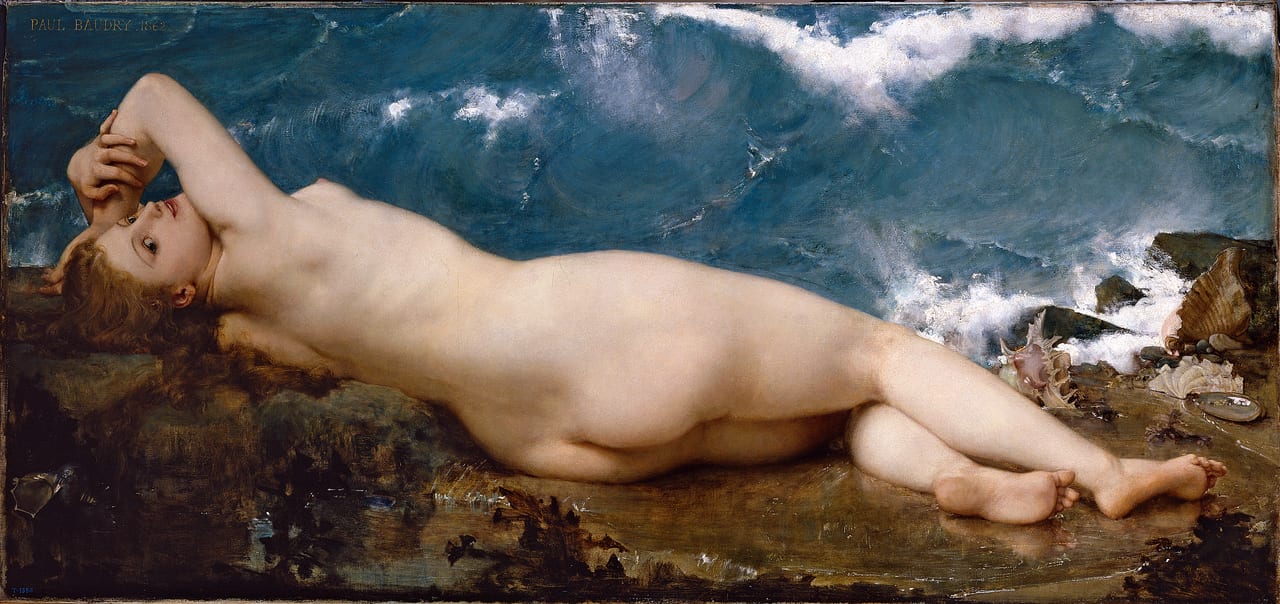
The Pearl and the Wave
Paul-Jacques-Aimé Baudry · 1862
Museo del Prado
Baudry’s nude, painted in 1862, lies at the edge of a rocky shore and looks back over her shoulder towards the viewer as waves break behind her. Critics praised its technique, and the painter Kenyon Cox called it “the most perfect painting of the nude” of the nineteenth century. Empress Eugénie bought it in 1863 for 20,000 francs; it is in the Museo del Prado.
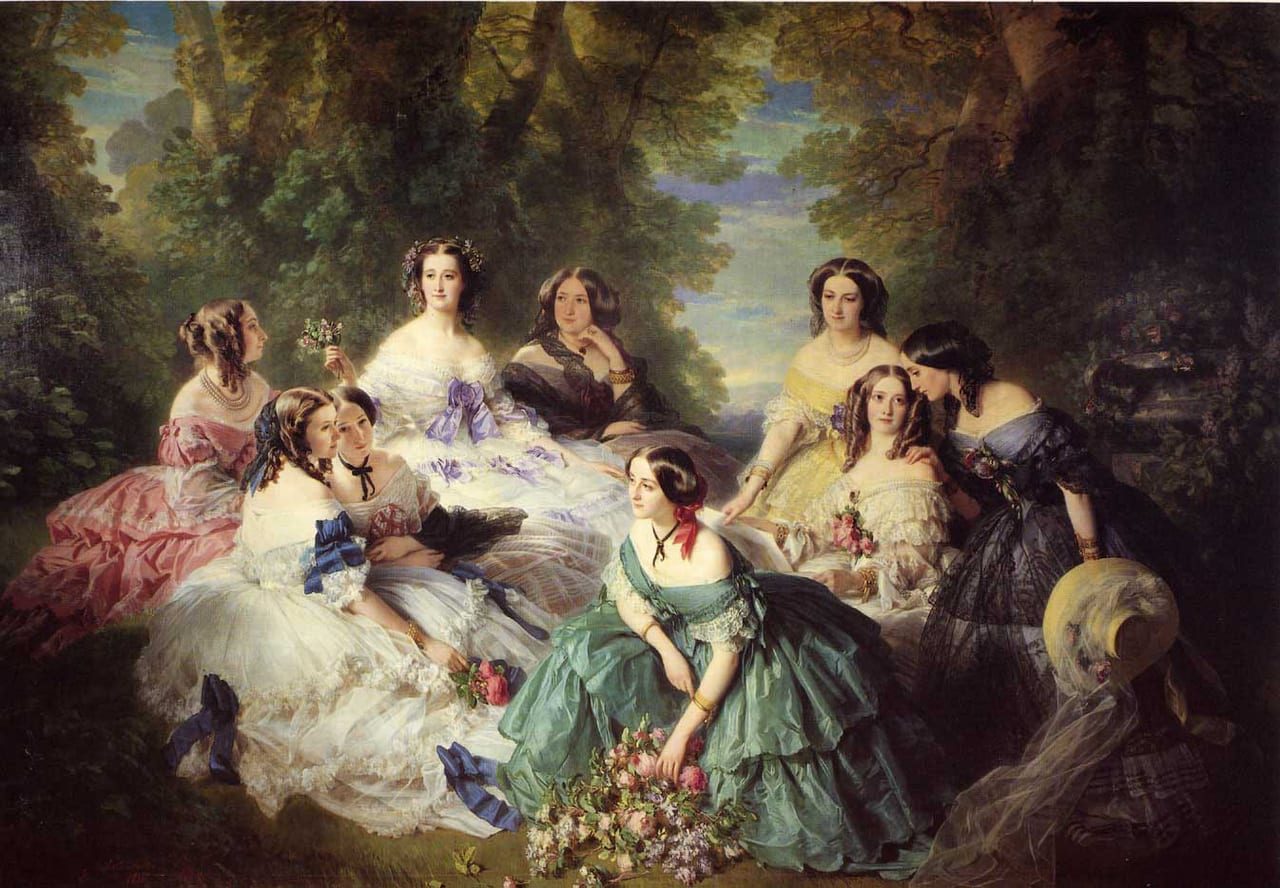
Empress Eugénie Surrounded by her Ladies in Waiting
Franz Xaver Winterhalter · 1855
Château de Compiègne
Commissioned by Empress Eugénie for the Exposition Universelle, Franz Xaver Winterhalter’s picture, completed in 1855, sets her among eight ladies-in-waiting in an imagined country landscape, crowned with honeysuckle and holding a branch of it as a sceptre. When one lady resigned he had to rethink the composition, and with his studio’s help he finished in four months. Paris critics found it careless and more interested in the dresses than the sitters, but it was a great success with the public and the imperial court, and spread as prints it became a symbol of the Second Empire. It is in the Château de Compiègne.
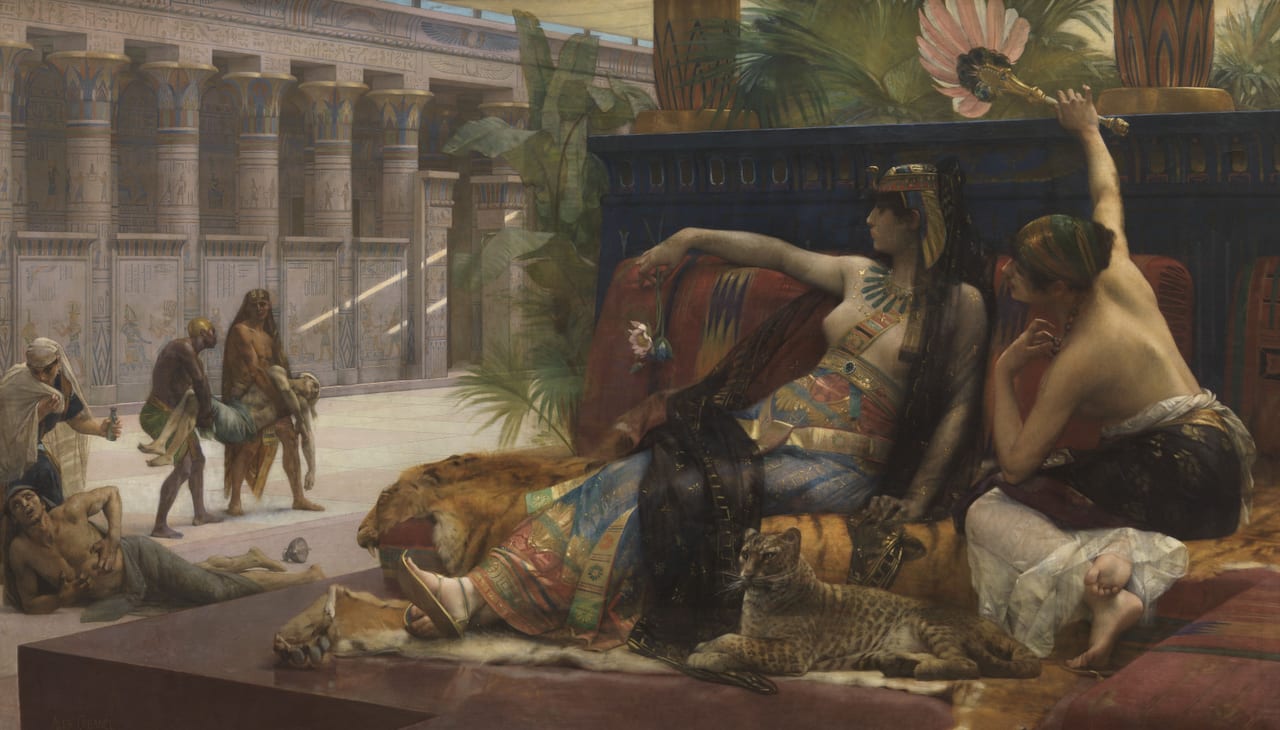
Cleopatra Testing Poisons on Condemned Prisoners
Alexandre Cabanel · 1887
Royal Museum of Fine Arts Antwerp
Cabanel’s Cleopatra reclines on a banquette spread with fabrics and a tiger skin, a leopard at her feet, and watches from afar, with a gaze described as cold, while prisoners condemned to death writhe under the poisons she is testing, as Plutarch’s life of Mark Antony describes; behind them two men carry away a corpse. Painted in 1887, it is counted a canonical work of nineteenth-century Orientalism, and it is held by the Royal Museum of Fine Arts Antwerp.
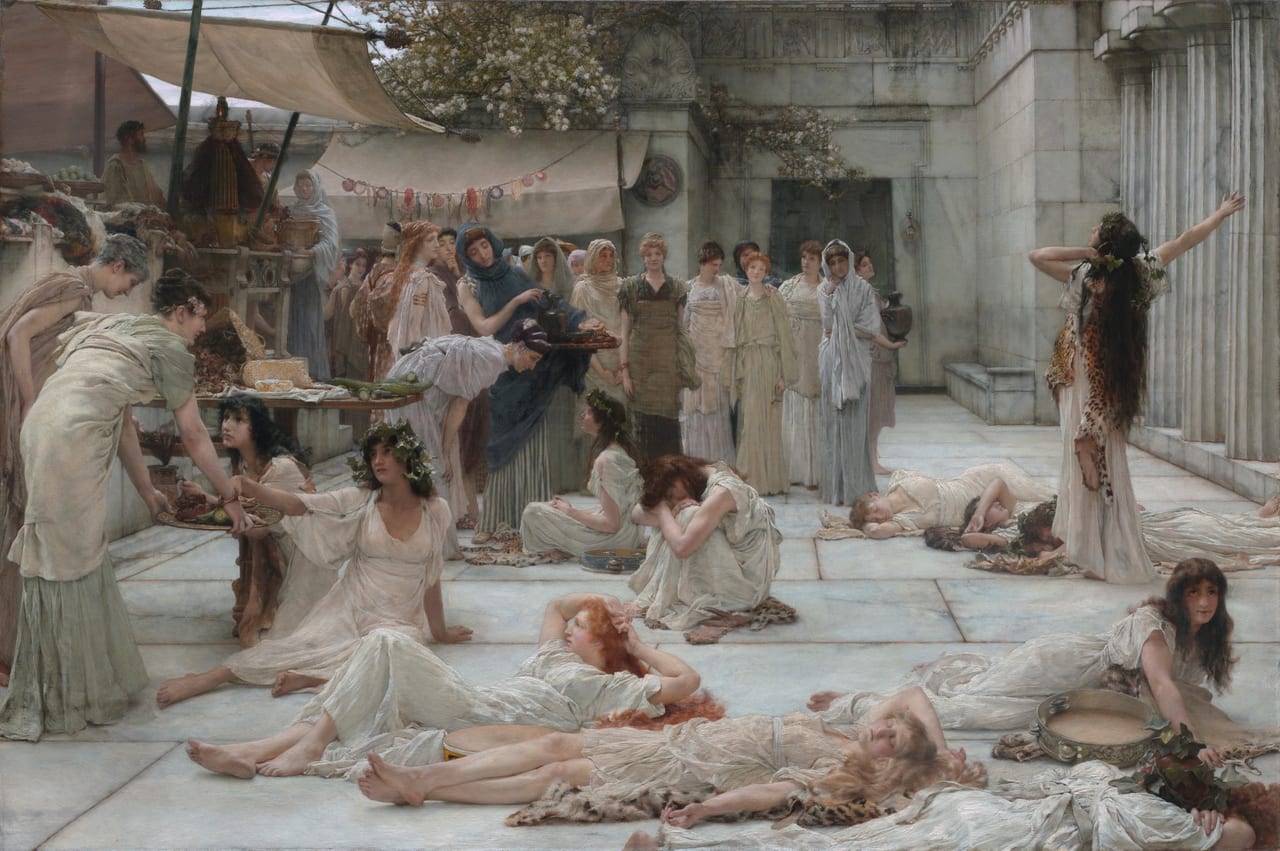
The Women of Amphissa
Lawrence Alma-Tadema · 1887
Clark Art Institute
Alma-Tadema’s maenads, women of the cult of Dionysus, wake barefoot and dishevelled in the market of Amphissa after a night of debauchery, among their scattered clothes, animal skins and tambourines. The townswomen who have come to shop, stiff and grave as ancient Greek statues, look on, some surprised, others concerned. Painted in 1887, it won the artist a medal at the Universal Exhibition in Paris in 1889; it is in the Clark Art Institute in Williamstown.
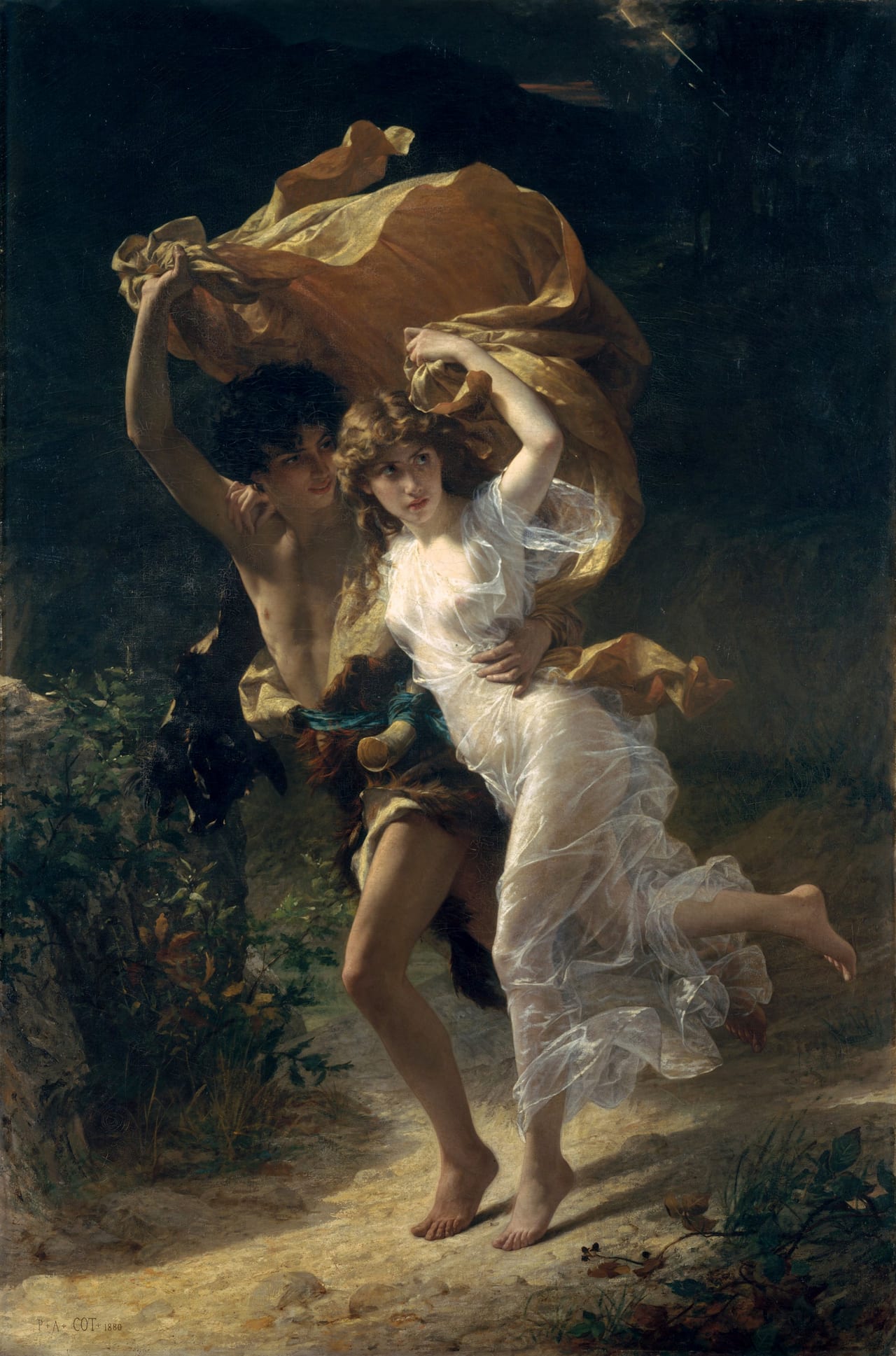
The Storm
Pierre Auguste Cot · 1880
Metropolitan Museum of Art
A young couple run from the rain under a billowing drape. Catharine Lorillard Wolfe commissioned the picture from Cot in 1880, guided by her cousin John Wolfe, one of his principal patrons. It recalls Cot’s Springtime, which John Wolfe owned and which is believed to have prompted his cousin’s purchase; of roughly the same size and both showing a young couple, the two are thought to form a pair. Some saw in it the novel Paul et Virginie, others the ancient romance Daphnis and Chloe. Completed in 1880, it is in the Metropolitan Museum of Art.
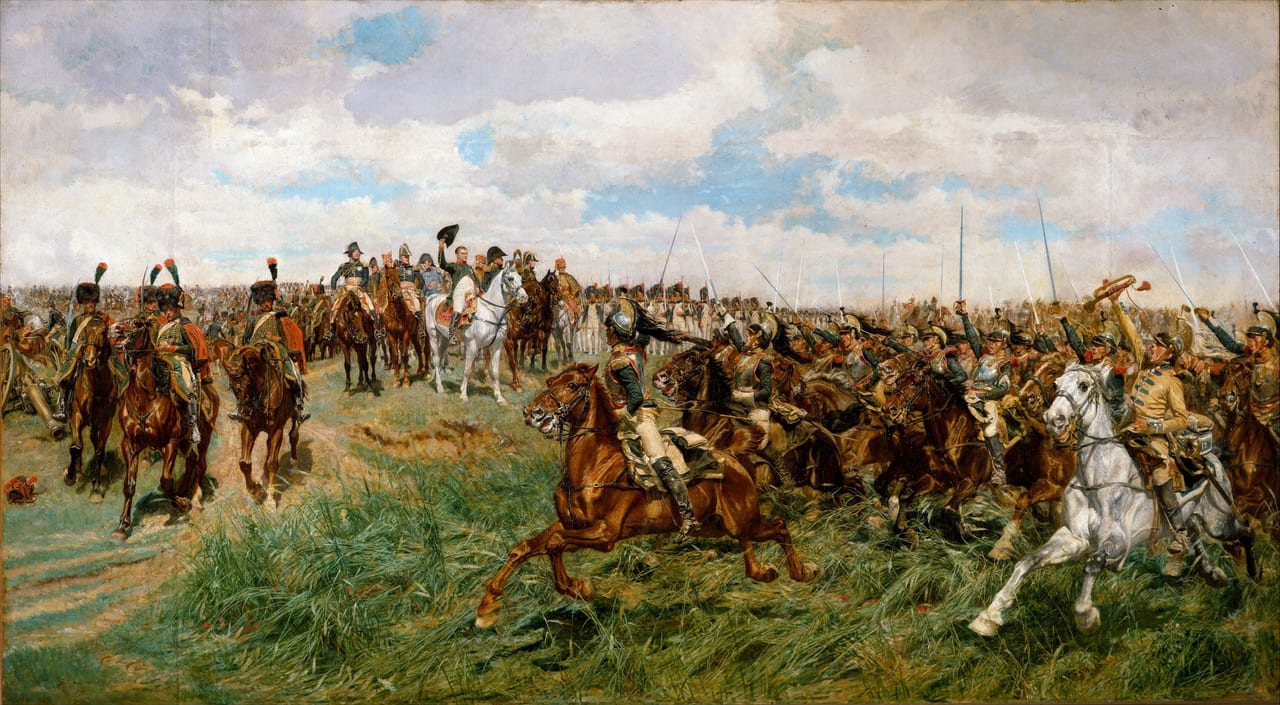
1807, Friedland
Ernest Meissonier · c. 1861–75
Metropolitan Museum of Art
Meissonier’s largest and most ambitious painting, on which he worked from 1861 to 1875. Napoleon, on a white horse and raising his bicorne, inspects his triumphant cuirassiers at Friedland, 14 June 1807, one of his greatest victories over the Russians. Meissonier began with the sky and made separate studies, some with wax models, for each horse and man. The picture caused a sensation, though Manet joked that everything in it looked made of steel “except the cuirasses”. It is in the Metropolitan Museum of Art.
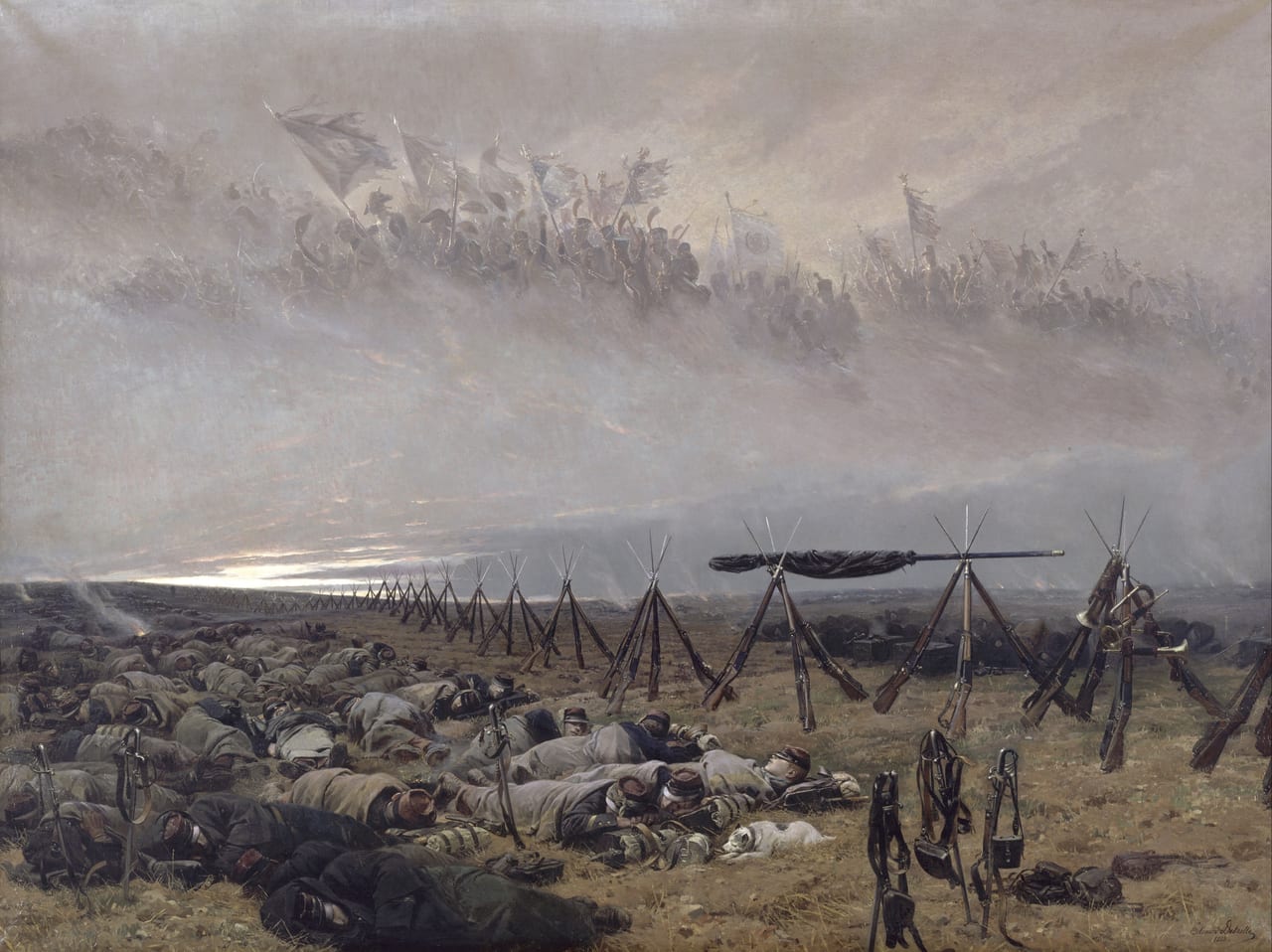
The Dream
Édouard Detaille · 1888
Musée d'Orsay
Young conscripts of the Third Republic on summer exercises sleep in a vast camp, rifles stacked in pyramids, dreaming of the glory of their forebears and of revenge for the defeat in the Franco-Prussian War; above them, deliberately indistinct in the sky, appear the soldiers of earlier battles, from the Revolution and Austerlitz to Gravelotte and Reichshoffen. Detaille’s painting won the gold medal at the Salon of 1888, and for him it meant taking “a direct political position” in support of General Georges Boulanger.
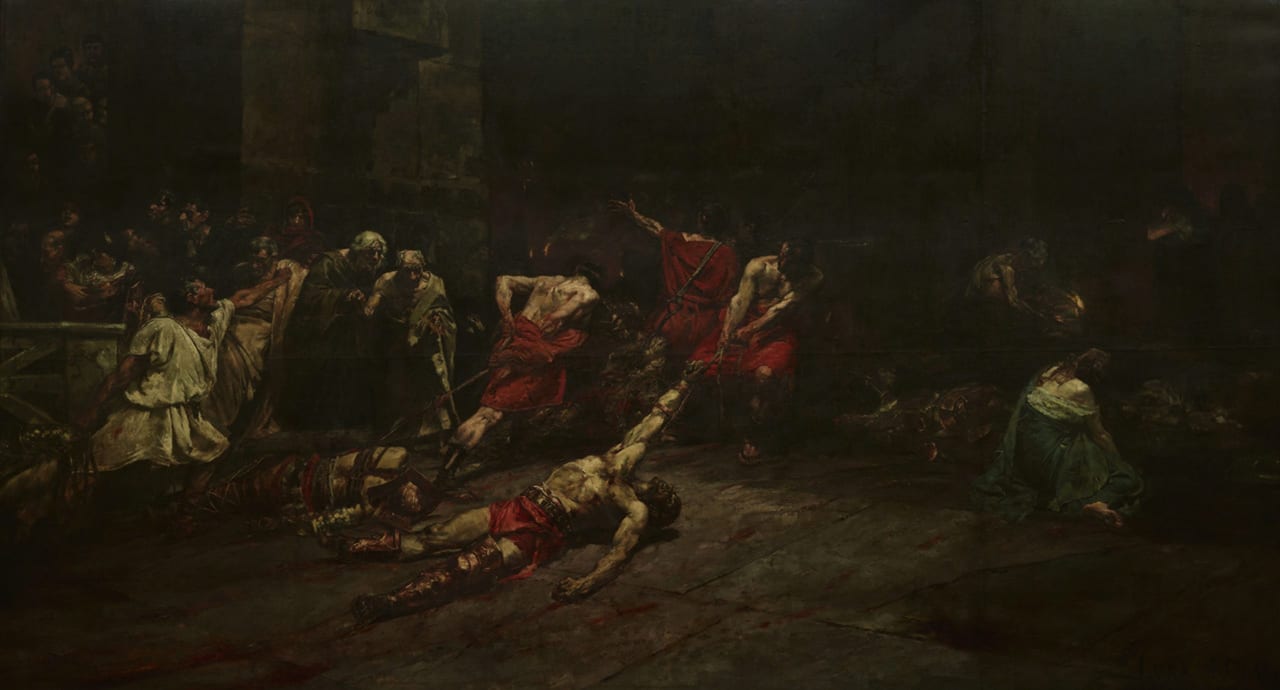
Spoliarium
Juan Luna
National Museum of Fine Arts, Manila
Juan Luna spent eight months on this canvas of a Roman circus where dead gladiators are stripped of their weapons and garments. In 1884 it won the first of three gold medals at the National Exhibition of Fine Arts in Madrid. It now greets visitors to the National Museum of Fine Arts in Manila, which counts it the largest painting in the Philippines, 4.22 by 7.675 metres.
Sources
- Wikipedia, “Academic art”
- Britannica, “Salon”
- Britannica, “École des Beaux-Arts”
- Musée d’Orsay, “Good · True · Beautiful: Masterpieces of the Paris Salon from the Musée d’Orsay”
- Britannica, “William-Adolphe Bouguereau”
- Wikipedia, “The Birth of Venus (Bouguereau)”
- Musée d’Orsay, “Naissance de Vénus” (Alexandre Cabanel)
- Wikipedia, “Alexandre Cabanel”
- Britannica, “Jean-Léon Gérôme”
- Musée d’Orsay, “Jeunes Grecs faisant battre des coqs”
- Britannica, “Thomas Couture”
- Musée d’Orsay, “Romains de la décadence”
- National Gallery, London, “Paul Delaroche”
- National Gallery, London, “The Execution of Lady Jane Grey”
- Britannica, “Paul Delaroche”
- Britannica, “Ernest Meissonier”
- Wikipedia, “French Campaign, 1814 (Meissonier)”
- Wikipedia, “Fernand Cormon”
- Musée d’Orsay, “Caïn”
- Britannica, “Lawrence Alma-Tadema”
- Wikipedia, “Spring (Alma-Tadema painting)”
- Britannica, “Frederic Leighton, Baron Leighton”
- Wikipedia, “Flaming June”
- Wikipedia, “Springtime (Pierre Auguste Cot)”
- Britannica, “Léon Bonnat”
- Wikipedia, “Léon Bonnat”
- Wikipedia, “Portrait of Victor Hugo”
- Wikipedia, “Pollice Verso (Gérôme)”
- Wikipedia, “Dante and Virgil”
- Wikipedia, “Phryne Before the Areopagus”
- Wikipedia, “The Slave Market (Gérôme painting)”
- Wikipedia, “Truth Coming Out of Her Well”
- Wikipedia, “The Pearl and the Wave”
- Wikipedia, “Empress Eugénie Surrounded by her Ladies in Waiting”
- Wikipedia, “Cleopatra Testing Poisons on Condemned Prisoners”
- Wikipedia, “The Women of Amphissa”
- Wikipedia, “The Storm (Cot)”
- Wikipedia, “1807, Friedland”
- Wikipedia, “The Dream (Detaille)”
- Wikipedia, “Spoliarium”
- Pollice Verso — Public domain via Wikimedia Commons (Public domain)
- The Birth of Venus — Public domain via Wikimedia Commons (Public domain)
- The Birth of Venus — Public domain via Wikimedia Commons (Public domain)
- Young Greeks Attending a Cock Fight — Public domain via Wikimedia Commons (Public domain)
- The Romans of the Decadence — Public domain via Wikimedia Commons (Public domain)
- The Execution of Lady Jane Grey — Public domain via Wikimedia Commons (Public domain)
- French Campaign, 1814 — Public domain via Wikimedia Commons (Public domain)
- Cain — Public domain via Wikimedia Commons (Public domain)
- Spring — Public domain via Wikimedia Commons (Public domain)
- Flaming June — Public domain via Wikimedia Commons (Public domain)
- Springtime — Public domain via Wikimedia Commons (Public domain)
- Portrait of Victor Hugo — Public domain via Wikimedia Commons (Public domain)
- Dante and Virgil — Public domain via Wikimedia Commons (Public domain)
- Phryne Before the Areopagus — Public domain via Wikimedia Commons (Public domain)
- The Slave Market — Public domain via Wikimedia Commons (Public domain)
- Truth Coming Out of Her Well — Public domain via Wikimedia Commons (Public domain)
- The Pearl and the Wave — Public domain via Wikimedia Commons (Public domain)
- Empress Eugénie Surrounded by her Ladies in Waiting — Public domain via Wikimedia Commons (Public domain)
- Cleopatra Testing Poisons on Condemned Prisoners — CC0 via Wikimedia Commons (CC0)
- The Women of Amphissa — Public domain via Wikimedia Commons (Public domain)
- The Storm — Public domain via Wikimedia Commons (Public domain)
- 1807, Friedland — Public domain via Wikimedia Commons (Public domain)
- The Dream — Public domain via Wikimedia Commons (Public domain)
- Spoliarium — Public domain via Wikimedia Commons (Public domain)
Invite Academic art into your living room