The Guitar
Juan Gris · 1913

Cubism
Paris
In Paris between 1907 and 1914, Pablo Picasso and Georges Braque, above all, created a new way of painting that became one of the most influential styles of the twentieth century. Cubist painters broke objects and figures into distinct planes so as to show several viewpoints at once, and they kept the canvas flat instead of feigning depth, a revolutionary break with the single fixed viewpoint and linear perspective that had ruled European painting since the Renaissance. Many other painters took up the new language and developed it further, and Cubism became the starting point for many later abstract styles, constructivism and neo-plasticism among them.
Picasso, Braque and the flat canvas
Paul Cézanne’s landscapes deeply inspired the early Cubists, and in his late work he can be seen painting things from slightly different points of view. Picasso also drew on African masks, highly stylised yet vividly human. It was Les Demoiselles d’Avignon, painted by Picasso in 1907, that foreshadowed the new style: in it the forms of five female nudes become fractured, angular shapes. The name came from the critic Louis Vauxcelles, who in 1908, on seeing paintings by Braque exhibited in Paris, described them as reducing everything to “geometric outlines, to cubes”.
Historians have tended to divide Cubism into two stages. In the early one, called Analytical Cubism, the subject is dissected viewpoint by viewpoint into a fragmentary image of overlapping planes. The work of Picasso and Braque grew so alike that their paintings are almost indistinguishable. They favoured right angles and straight lines and simplified their colour to a nearly monochrome scale, in which tan, brown, grey, cream, green or blue were preferred, so that nothing would distract from the structure of form itself. The object, seen from several sides, is reduced to opaque and transparent planes that seem to move out beyond the surface of the canvas rather than recede; forms are generally dense at the centre and grow larger toward the edges. Their favourite motifs were musical instruments, bottles, jugs, glasses, newspapers and the human face and figure, often combined with letters.
The later stage, generally identified as Synthetic Cubism and generally considered to date from about 1912 to 1914, combines forms rather than taking them apart. Colour plays a strong role, and shapes, still fragmented and flat, become simpler, larger and more decorative. The painters began adding textures and patterns, and pasting newspaper, patterned paper or tobacco wrappers onto the canvas beside painted areas. Smooth and rough surfaces may be contrasted, and this collage further stressed differences of texture and raised the question of what is reality and what is illusion, and putting real things straight into a work of art opened one of modern art’s most important ideas.
Salon Cubists, Gris and the Section d’Or
Before 1914 Picasso, Braque and Gris, and to a lesser extent Fernand Léger, had the support of a single committed dealer in Paris, Daniel-Henry Kahnweiler, who sold only to a small circle of connoisseurs, and his backing let them experiment in relative privacy. The Salon Cubists built their reputations instead, primarily by showing regularly at the Salon d’Automne and the Salon des Indépendants. The first organised group exhibition by Cubists was held at the Indépendants in the spring of 1911, in a room called Salle 41, with works by Jean Metzinger, Albert Gleizes, Léger, Robert Delaunay and Henri Le Fauconnier, and none by Picasso or Braque. In October 1912 the Galerie La Boétie in Paris housed the Salon de la Section d’Or, arguably the most important Cubist exhibition before the First World War, with more than 200 works, and in preparation for it Metzinger and Gleizes published Du “Cubisme” to dispel the confusion around the word.
Juan Gris, born in Madrid in 1887, moved to Paris in 1906 and settled at the Bateau-Lavoir, the artists’ building where his compatriot Picasso lived. He adopted the Cubist style in 1911. In 1912 Kahnweiler agreed to buy his entire output, and Gris, new to the Salon scene, showed his Portrait of Pablo Picasso at the Salon des Indépendants. In 1913 he arrived at his own mature version of Synthetic Cubism, compositions of rigorous geometry, their fragmented objects and sharp-edged planes laid out with the greatest clarity. A more theoretical painter than Picasso or Braque, he systematised their discoveries and so helped to spread the style; his Cubism was sterner and more classical than theirs, and less spontaneous. Between 1921 and his death in 1927 his manner grew increasingly free and lyrical.
Robert Delaunay first brought vibrant colour into Cubism. By 1910 he had made his own contribution in two series, of cathedrals and of the Eiffel Tower, joining fragmented Cubist form to dynamic movement and bright colour. The poet Guillaume Apollinaire saw in these colourful pictures a new style that gave painting the qualities of music, and named it Orphism after Orpheus, the legendary poet and singer of Greek myth; Delaunay himself called his work simultanism. Unlike the Cubists, who had removed almost all colour from their paintings, the Orphists treated colour as a powerful element in its own right. Roger de La Fresnaye, who belonged from 1912 to 1914 to the Section d’Or, a Cubist association whose meetings were held regularly in the painter Jacques Villon’s studio, used colourful prismatic shapes that recall Orphism, but his images stayed representational; his paintings did much to popularise Cubism and widen its influence just before the war.
María Blanchard, born in Santander in 1881, studied at the Académie Vitti in Paris in 1909, and there she discovered Cubist painting and came under the influence of Jacques Lipchitz and Juan Gris. From 1913 to 1922 much of her work was made in the Cubist language. Her Woman with a Fan was shown in 1915 at Los pintores íntegros (The Painters of Integrity), the first exhibition of Cubist works in Madrid, and the show’s patchy critical reception was one of the reasons she left Spain to settle in Paris for good. She became a close friend of Gris, who influenced her deeply, and joined the Section d’Or.
From Paris outward
In 1911 Piet Mondrian saw the early Cubist works of Picasso and Braque for the first time, and he was so impressed that early in 1912 he moved to Paris. His Cubist period lasted from 1912 to 1917. His compositions of trees, façades and scaffolding from these years show his urge to reduce individual forms to a general formula. He stayed somewhat within the boundaries of Cubism, keeping to the Cubists’ limited palette of ochre, brown and grey, but he avoided curves and diagonals and increasingly used only vertical and horizontal lines, and from 1913 his style began its evolution toward total abstraction.
After a trip to Paris in 1912 Kazimir Malevich came under the influence of Picasso and Cubism, and he led the Russian Cubist movement as a member of the Jack of Diamonds group. He called the works he showed at the Donkey’s Tail exhibition of 1912 and the Target exhibition of 1913 Cubo-Futurist; for him the style stood for the link between the stillness of conventional Cubism and the dynamism of Futurism. Lyubov Popova attended the Paris studios of the Cubist painters Henri Le Fauconnier and Jean Metzinger in 1912 and 1913, and painted in the Cubo-Futurist style in 1913 and 1914. In 1916 she joined Malevich’s Suprematist group.
Prague was perhaps the most important centre of Cubism outside Paris before the First World War. Members of the Czech Cubist movement, the painters Emil Filla, Bohumil Kubišta and Josef Čapek among them, grasped the epochal significance of the Cubism of Picasso and Braque and tried to draw its components into their own work. Kubišta, a founder of Osma, an Expressionist-oriented group, worked from about 1911 in a style strongly influenced by Expressionism and Cubism, and his colour and his subjects set his Cubist work apart from that of the founding Paris Cubists. Josef Čapek, first a painter of the Cubist school, later developed a playful, minimalist style of his own. In Finland, Ilmari Aalto, who had begun with Expressionism, came to know Cubism in 1914, the year the first exhibition of Cubists and Expressionists was held there.
The American painter Marsden Hartley, in Europe for the first time in 1912–13, admired the work of the Cubists, and in 1914 started a series of abstract pictures, their forms strongly outlined and their colours brilliant. August Macke, Franz Marc and Paul Klee visited the Delaunays’ studio in Paris in 1912, and the Orphist canvases of the Delaunays and František Kupka had a decisive influence on their later work; Orphism also influenced the development of Cubism in Germany.
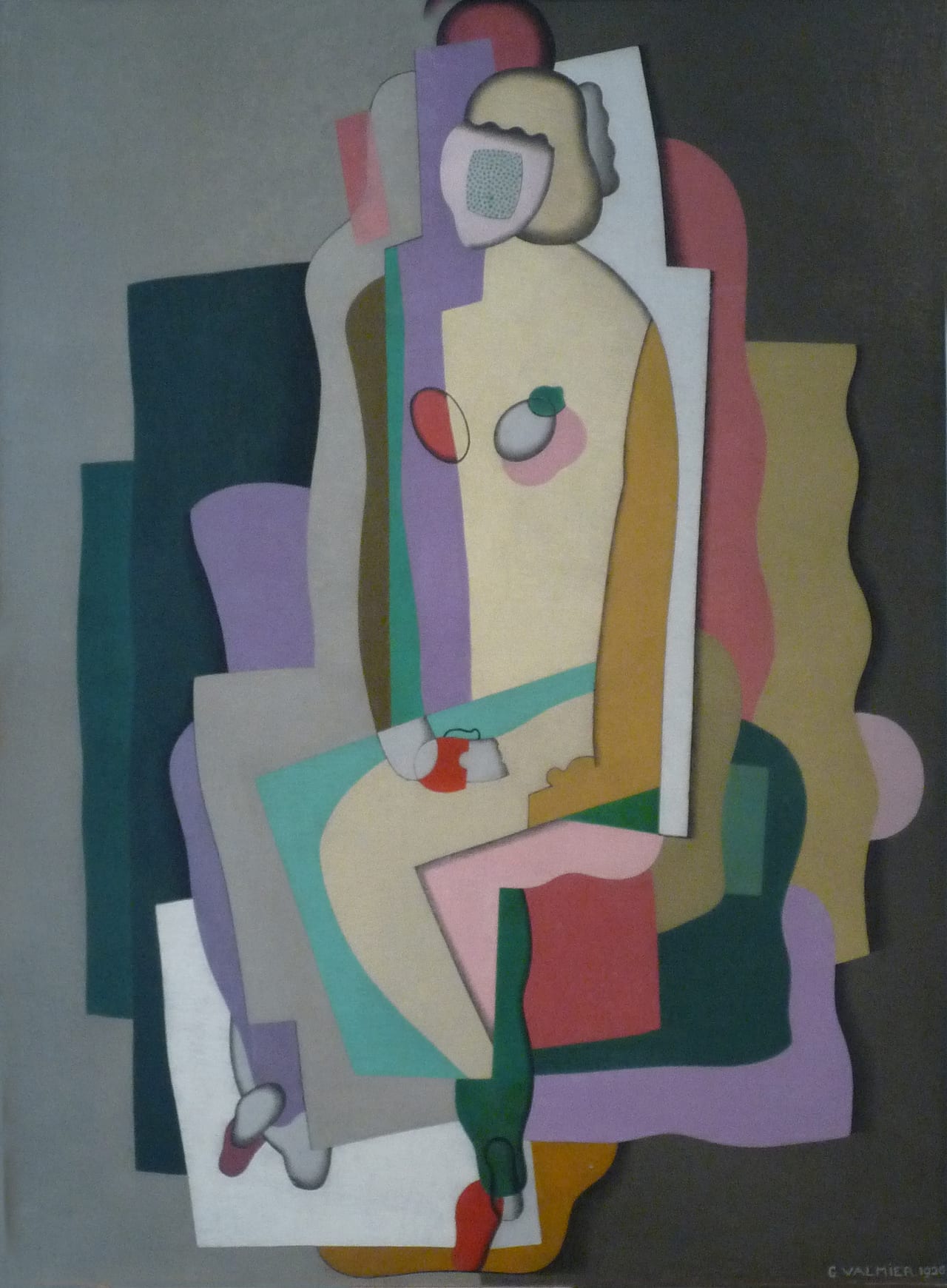
After the First World War, with the support of the dealer Léonce Rosenberg, Cubism became a central issue for artists again, until the mid-1920s, when the rise of geometric abstraction and Surrealism in Paris called its avant-garde standing into question. The tighter compositions, clarity and order of the work made between about 1917 and 1920, above all by artists under contract to Rosenberg, led the critic Maurice Raynal to speak of ‘crystal’ Cubism; Gris’s pictures from late 1916 through 1917 show a greater simplification of geometric structure. Georges Valmier, who had discovered Cubism at about 25, met Rosenberg on his return to Montmartre in 1918 and was soon under contract to him. Though primarily associated with painting, Cubism also deeply marked the sculpture and architecture of the century: Alexander Archipenko, Raymond Duchamp-Villon and Jacques Lipchitz were its major sculptors, and the houses Le Corbusier designed in the 1920s show his adoption of its aesthetic.
Artists
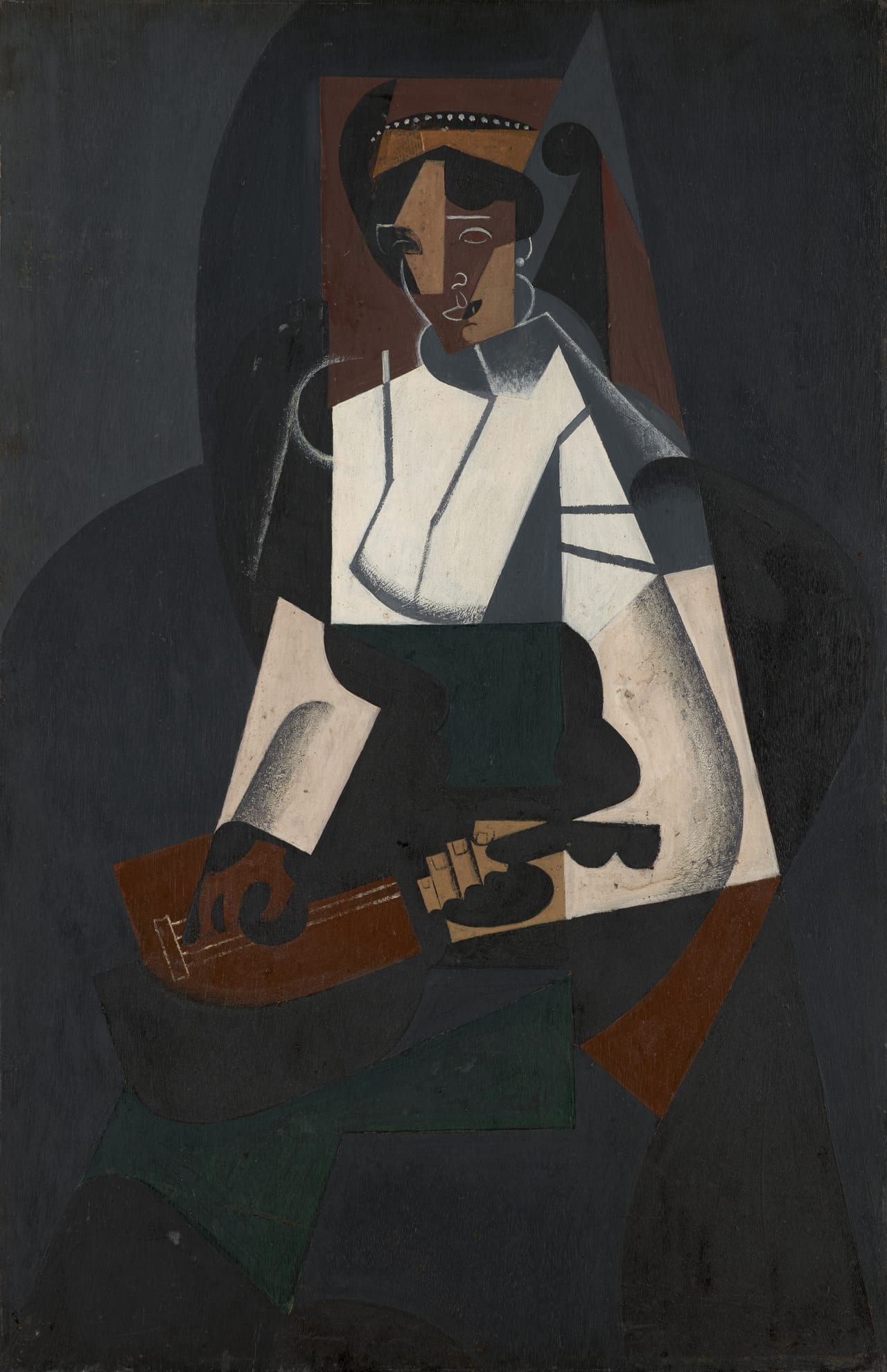
Juan Gris
Gris’s pictures from late 1916 through 1917 show a greater simplification of geometric structure and blur the distinction between objects and setting, between subject and background. Their oblique overlapping planes, tending away from balance, are seen at their clearest in this picture of September 1916 and in its epilogue, the Portrait of Josette Gris of October 1916. A clear geometric framework seems to govern the finer elements, the small planes of the face among them.
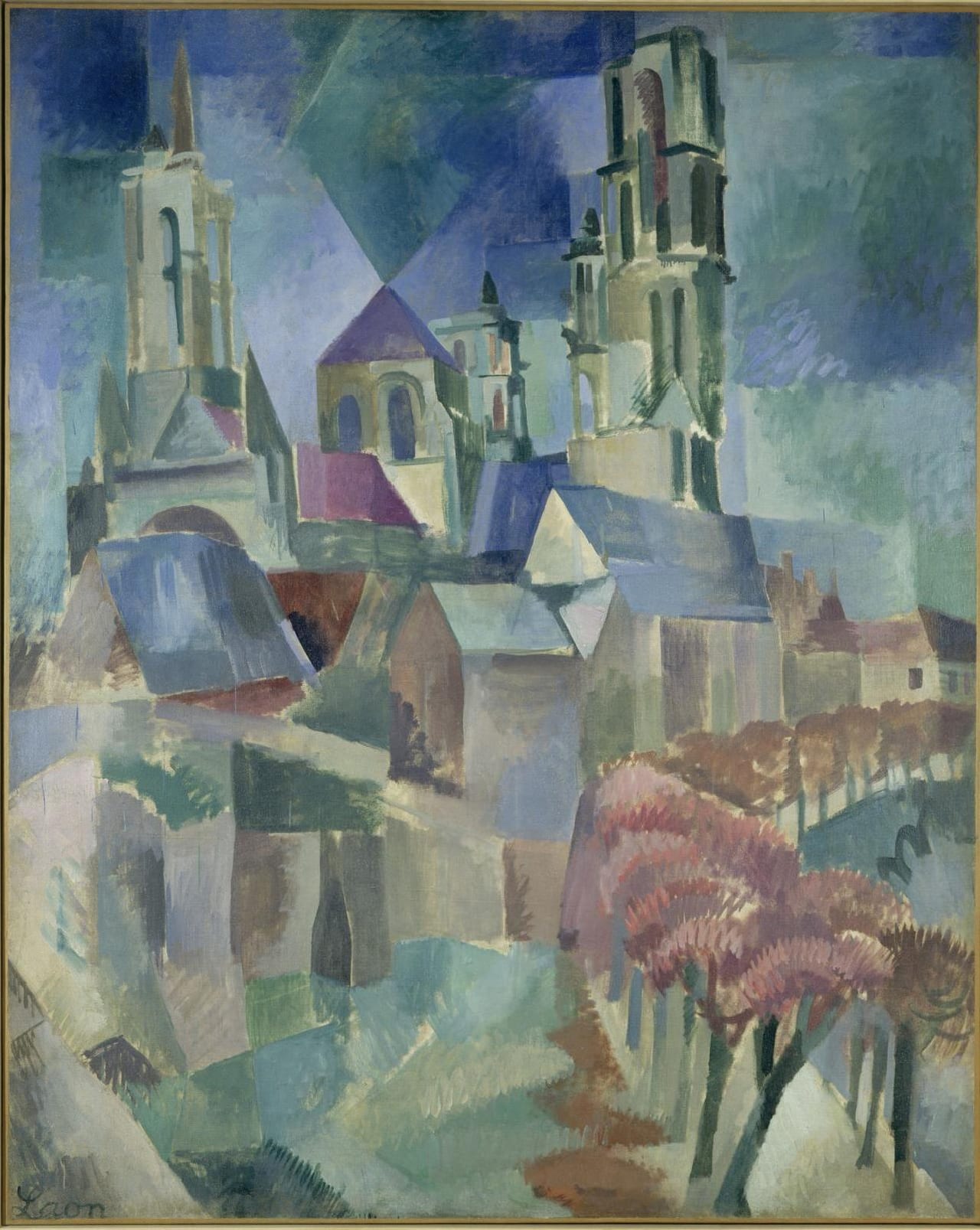
Robert Delaunay
After a considerable series on the interior of the church of Saint-Séverin in Paris in 1909, Delaunay painted the cathedral of Laon. Its Gothic architecture, well suited to Cubist treatment, breaks into geometric facets and blends gently into the landscape; the choice of subject was a way of linking Cubism to a national tradition. The French state bought it in 1935.
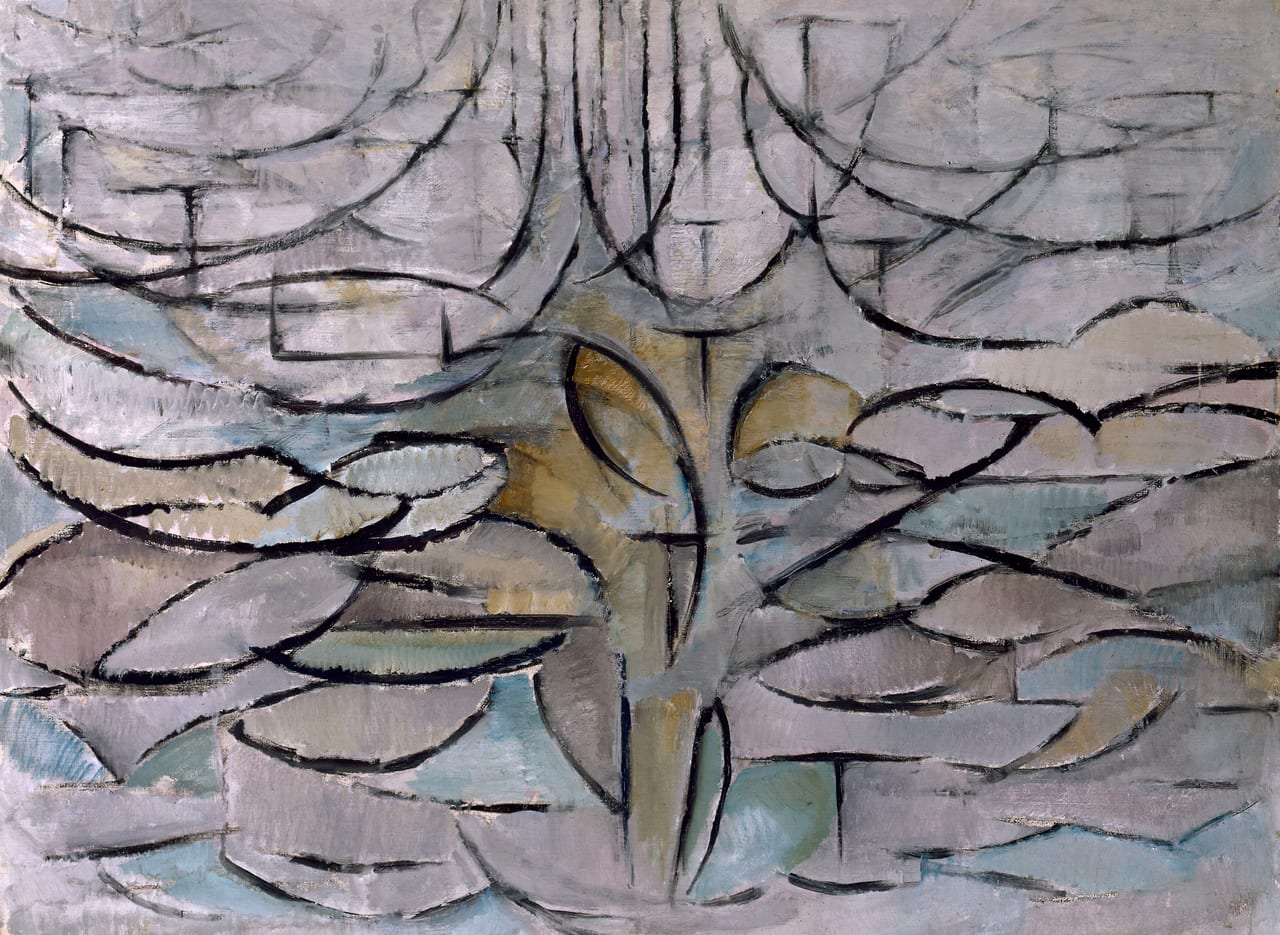
Piet Mondrian
An oil on canvas of 1912, the year Mondrian moved to Paris and the first year of his Cubist period, in which his compositions of trees, façades and scaffolding show his urge to reduce individual forms to a general formula. It is in the Kunstmuseum Den Haag.
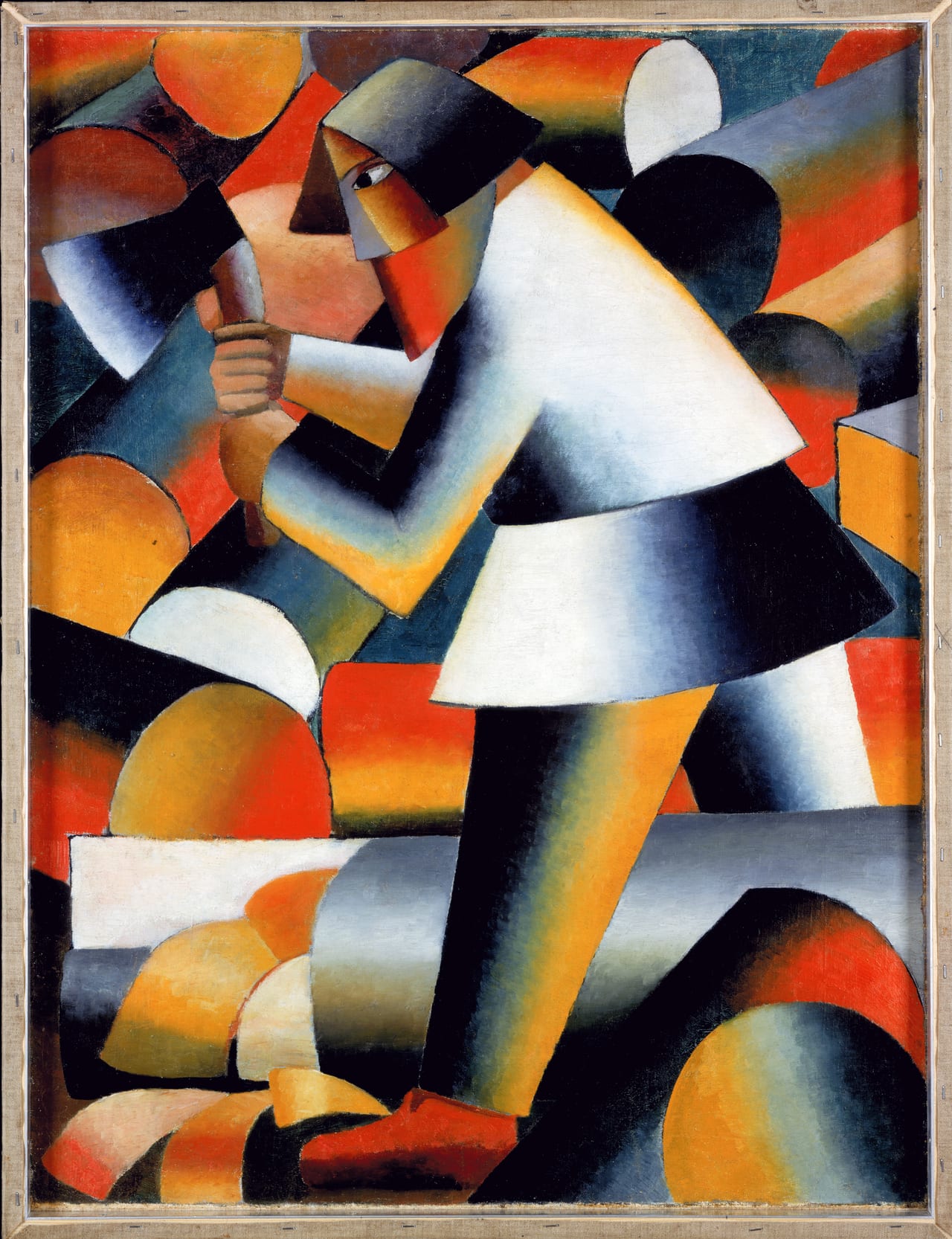
Kazimir Malevich
A mechanised figure, arms raised and ready to strike, held in tense stillness; the logs piled behind him seem to form the gears of a machine, and metallic colours strengthen the mechanical effect. Wood is the very substance of Russian peasant culture, yet the space of the picture seems machine-made, and here already are the seeds of the Russian Constructivism of the 1920s. Geometric Cézannism is joined here by a contribution from Italian Futurism, and the picture is a constructed arrangement covered in metallic paint. It was from this geometry and this Futurism that Malevich could forge the term Cubo-Futurism. It is in the Stedelijk Museum in Amsterdam.
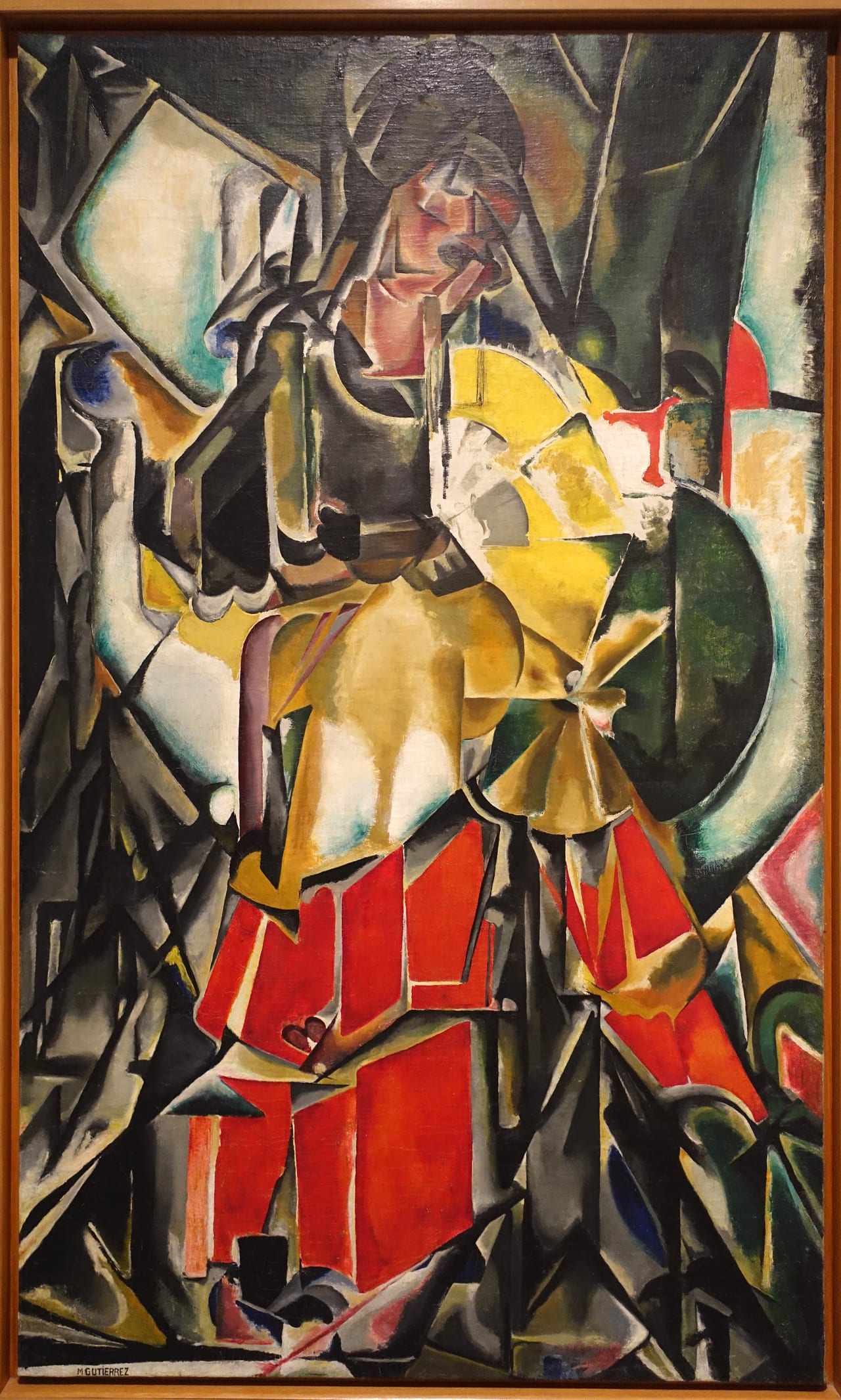
María Blanchard
One of the most ambitious paintings of Blanchard’s early years. The theme of the woman with a fan bears a relation to classical Spanish tradition, and the figure, in all likelihood a dancer, lets Blanchard play with colour and movement and arrange the composition in a series of simultaneous planes that recall, in their dynamism, the work of the Futurists or of Marcel Duchamp. It entered the Museo Reina Sofía in 1988.
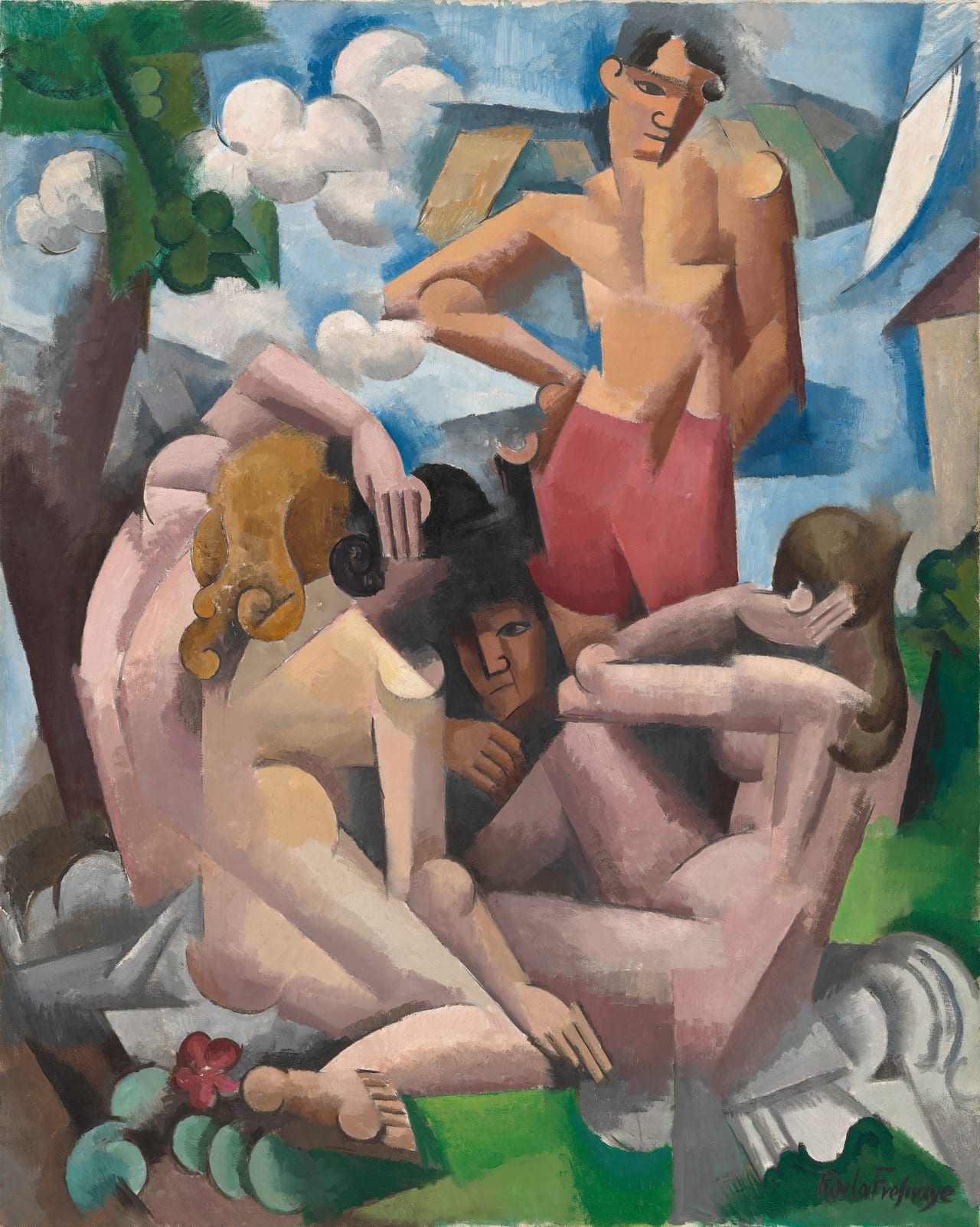
Roger de La Fresnaye
Men and women are built from angular, geometric shapes, flat planes and blocks of colour. A standing figure, apparently a bare-chested man in red shorts, rests a hand on his hip and looks to the right; at his feet appear several seated people, only partly visible. Three women seem to be facing away from us. Around them are a blue sky with abstract clouds and an angular tree. La Fresnaye showed it at the Salon d’Automne in Paris in 1912, and it came to the National Gallery of Art in 2000 as a gift of the Sara Lee Corporation.
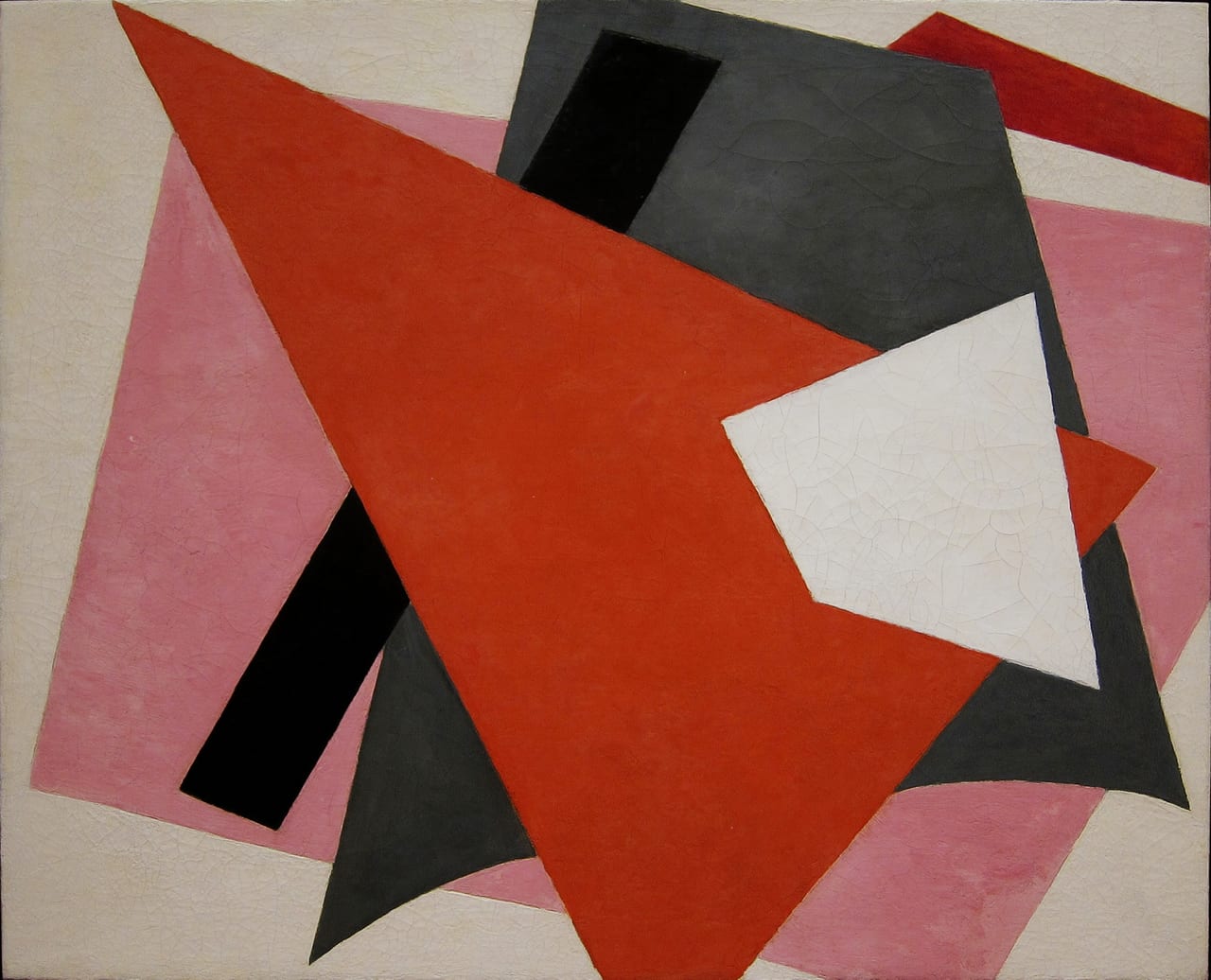
Lyubov Popova
Against the wide white grounds of Malevich’s Suprematist paintings, Popova makes what looks like a tight, shallow container whose geometric forms seem to press outward. Treating planes almost as solid things, she builds a monumental composition from how its parts relate, bringing together the coloured geometry and worked paint of Malevich and the overlapping elements of Vladimir Tatlin; she had worked in Tatlin’s studio between 1912 and 1915. It is one of a series called Painterly Architectonics, made after she joined Malevich’s Suprematist group in 1916; her Violin of 1914 already suggests the development from Cubism toward that series.
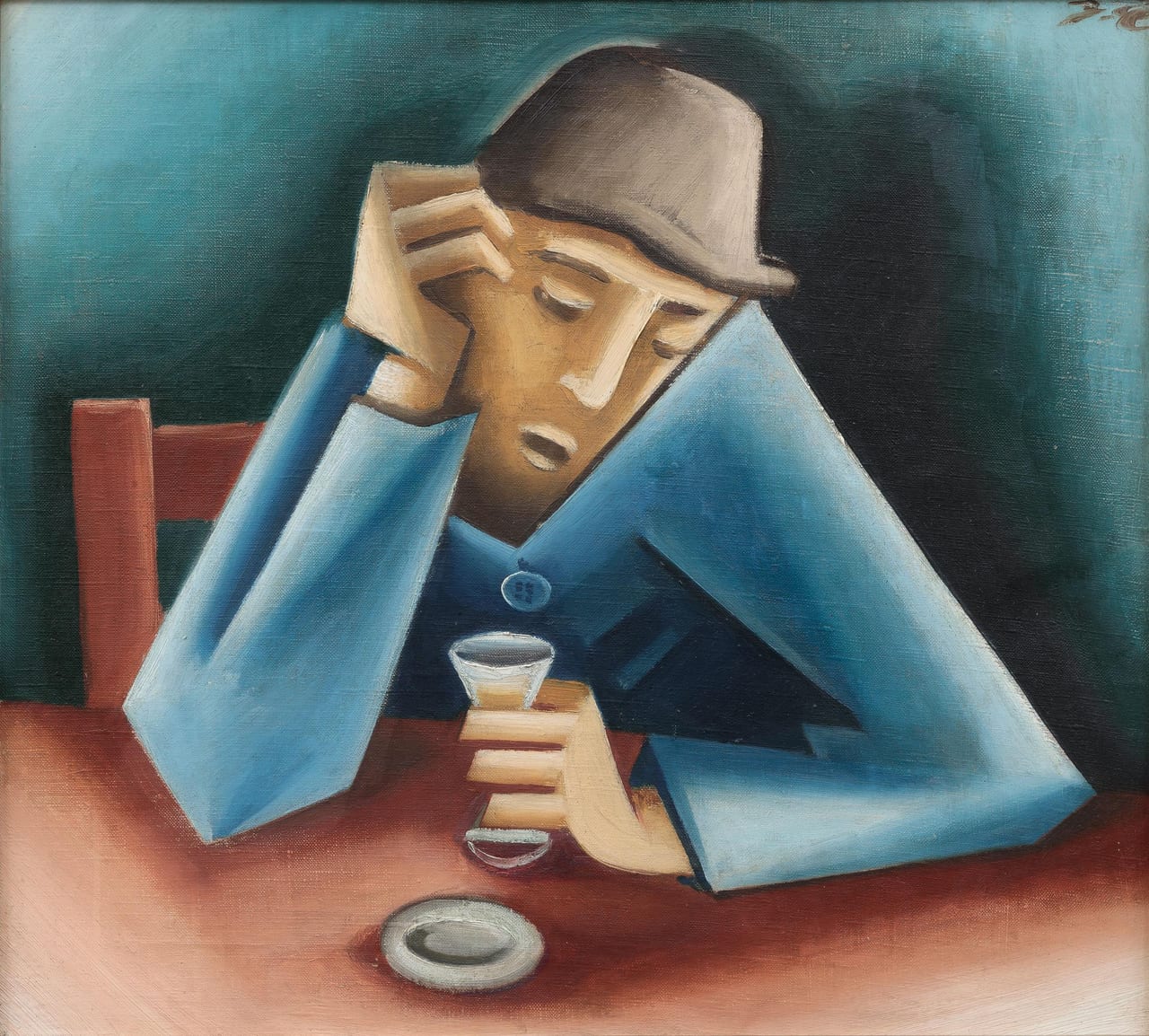
Josef Čapek
Čapek chose the drinker for its apparent banality: a hatted man at a table with a glass of wine, withdrawn into himself; as early as 1913 he called his drinker an “ordinary type”. He painted several other versions of the theme at this time in muted ochre-grey tones, but this canvas is dominated by deep blue with turquoise and pink. The figure is broken into sharply angular planes, the body bent over the table almost like a building, and the large geometric hands form the centre of the composition. It was shown in January 1920 at the second exhibition of Tvrdošíjní (The Obstinate Ones) in Prague.
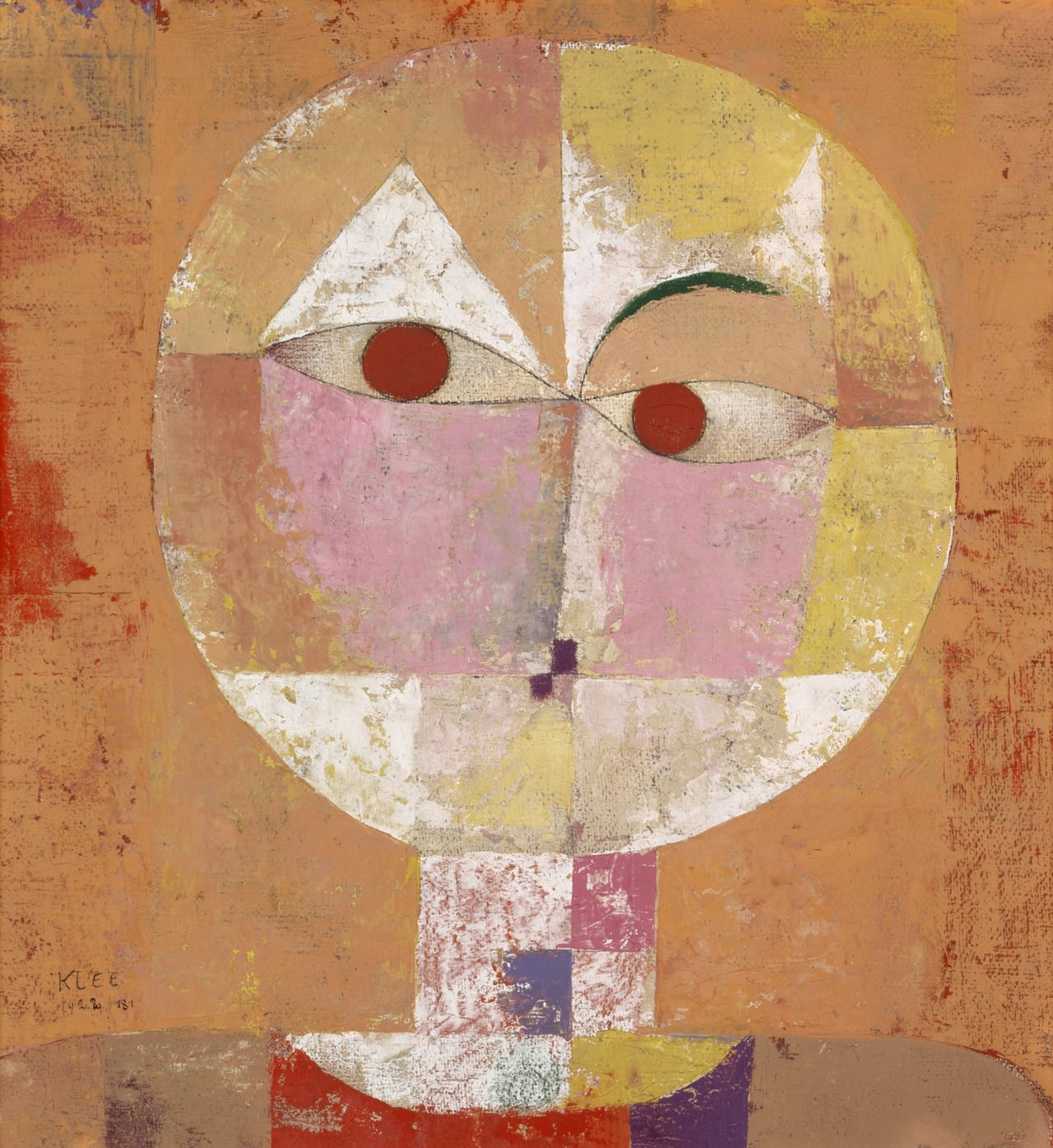
Paul Klee
Klee splits an elderly face into orange, pink, yellow and white rectangles. Inside the circle, flat squares suggest a mask or a harlequin’s patches, and a triangle above one eye and a curved line above the other give the illusion of a raised eyebrow. It is held in the Kunstmuseum Basel.
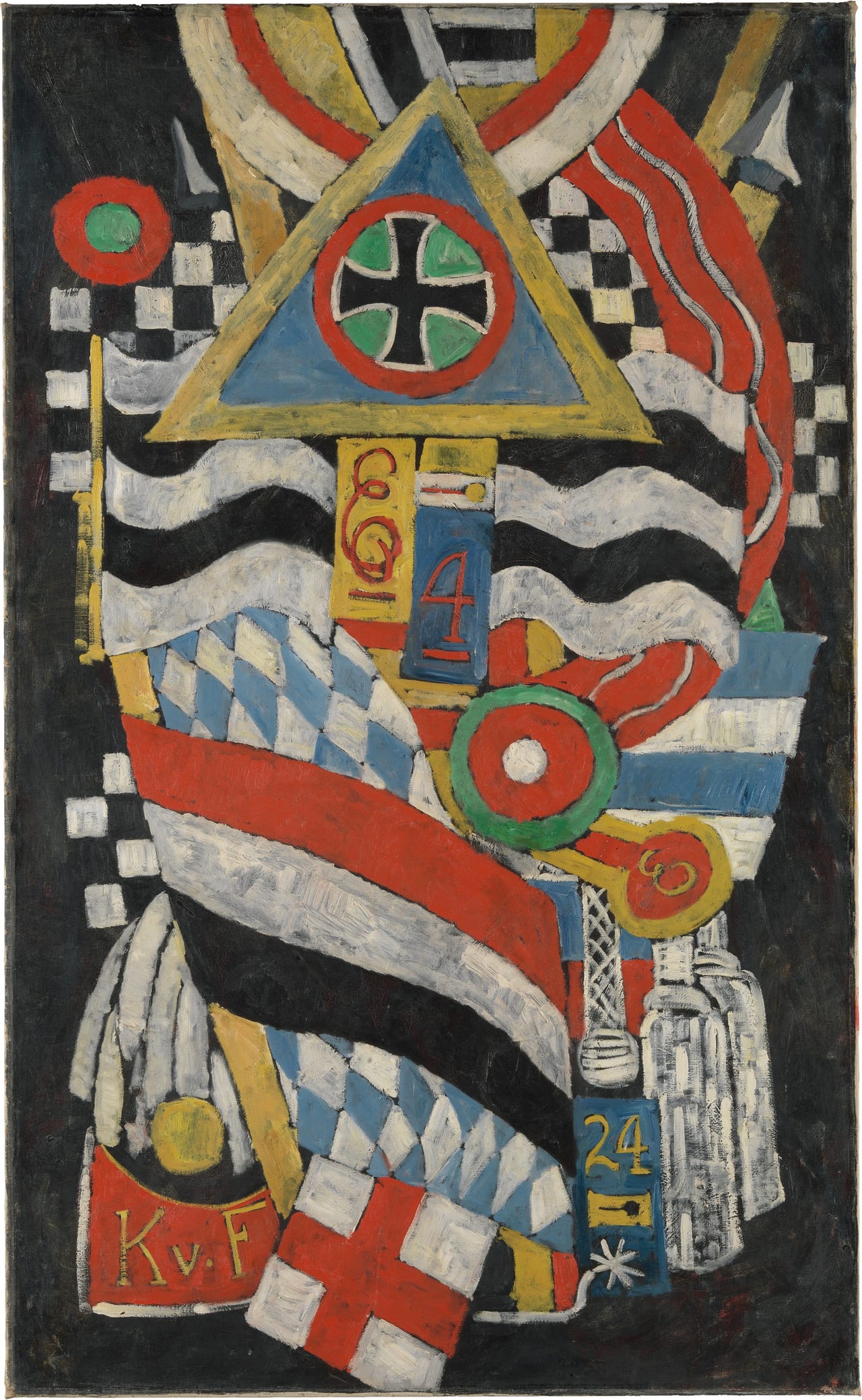
Marsden Hartley
Hartley painted it in Berlin in late 1914, and it was intended to honour Karl von Freyburg, a German lieutenant who had died in the first months of the First World War. The officer is composed entirely of military decorations: the black, white and red flag of the German Empire low in the centre, the Iron Cross Freyburg had been awarded at the top, the blue and white chequered flag of Bavaria, his home state, and personal details, among them the number 24 for his age at his death, his initials and his regimental number. Cubism and German Expressionism weigh heavily on the picture. It is in the Metropolitan Museum of Art.
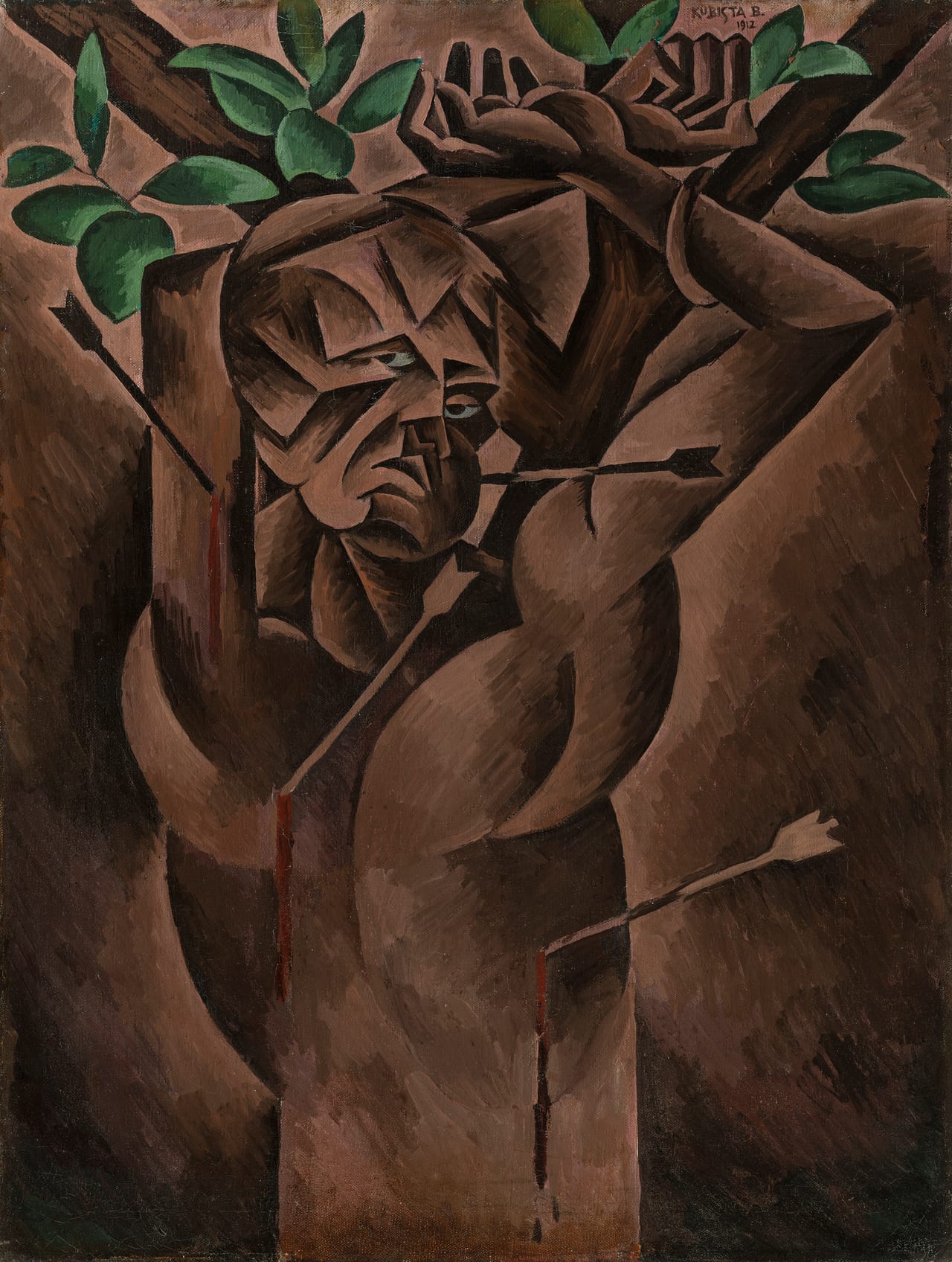
Bohumil Kubišta
The martyr is traditionally shown bound and pierced by arrows; Kubišta departs from that convention with angular, geometric forms associated with Cubism and an expressive use of colour and composition, stressing spiritual resilience rather than physical suffering. It is considered one of his most important works, and it is held in the National Gallery in Prague.
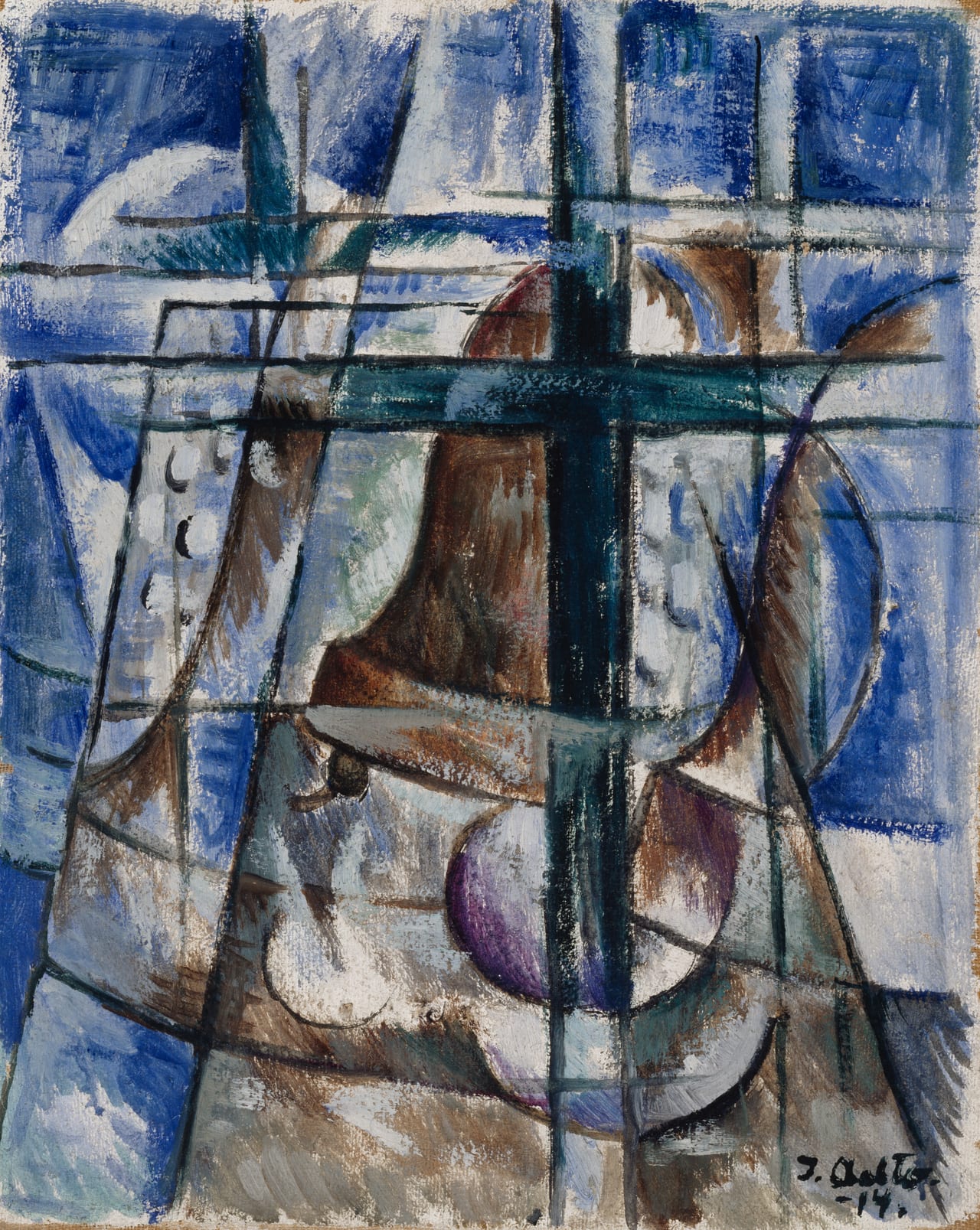
Ilmari Aalto
Aalto was drawn to Cubism from 1914 to 1916. This Cubist painting of bells and music, painted in 1914 and dominated by blue and brown, shows above all the influence of Russian Cubism. Music was a topical subject at the time: Sergei Rachmaninoff’s choral symphony The Bells had its first performance in Russia in December 1913. The Ateneum Art Museum acquired the painting in 1971.
Artworks
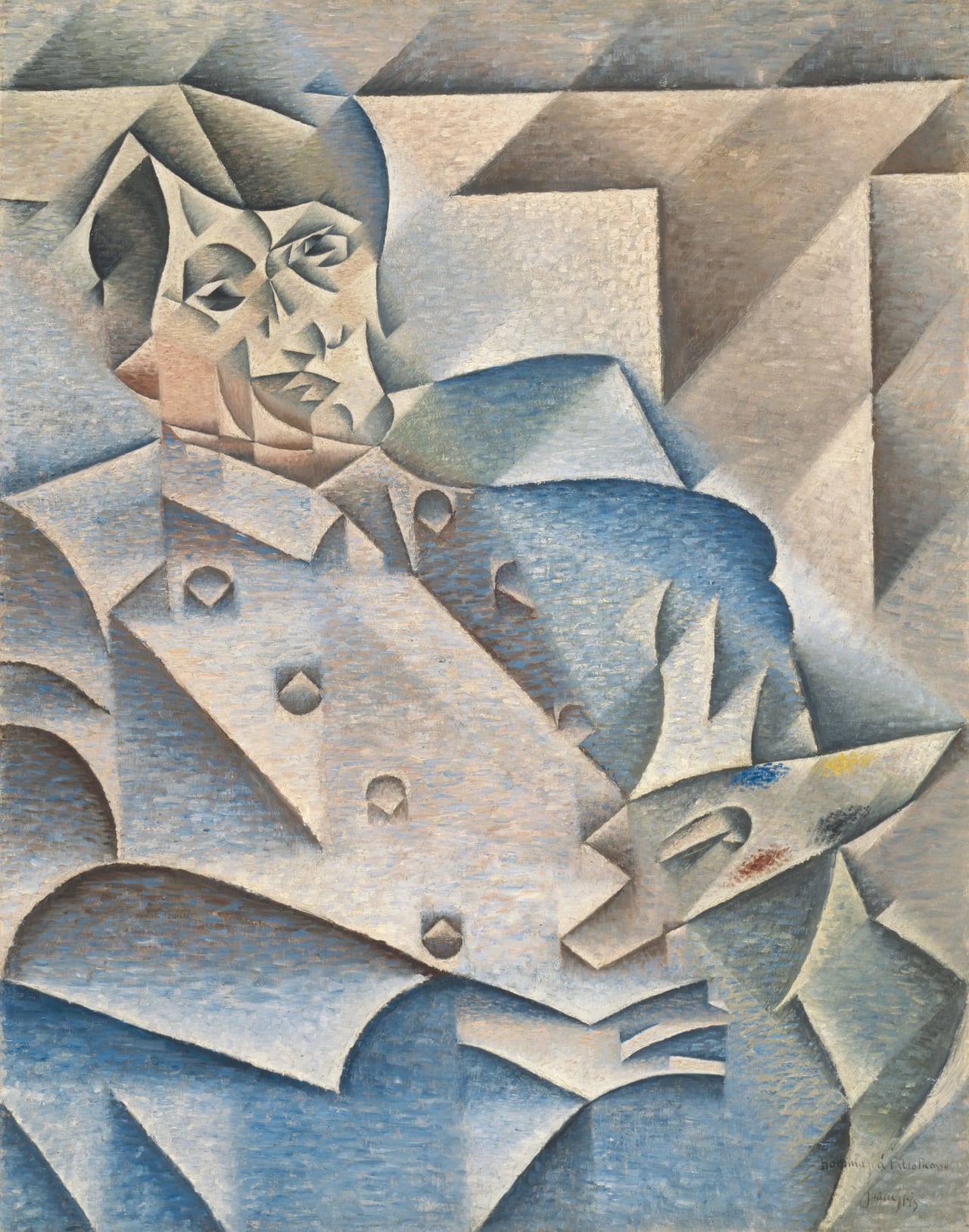
Portrait of Pablo Picasso
Juan Gris · 1912
Art Institute of Chicago
Gris painted this portrait in January–February 1912 and showed it at the Salon des Indépendants that spring. He depicts Picasso as a painter, palette in hand, and fractures Picasso’s head, neck and torso into planes and simple geometric shapes held within a regular structure of diagonals, in cool blues, browns and greys that look luminous side by side. The inscription at the lower right, “Hommage à Pablo Picasso”, shows Gris’s respect for Picasso as a leader of the Paris art world and an innovator of Cubism, and it helped Gris secure his own place in that world. It was given to the Art Institute of Chicago by Leigh B. Block.
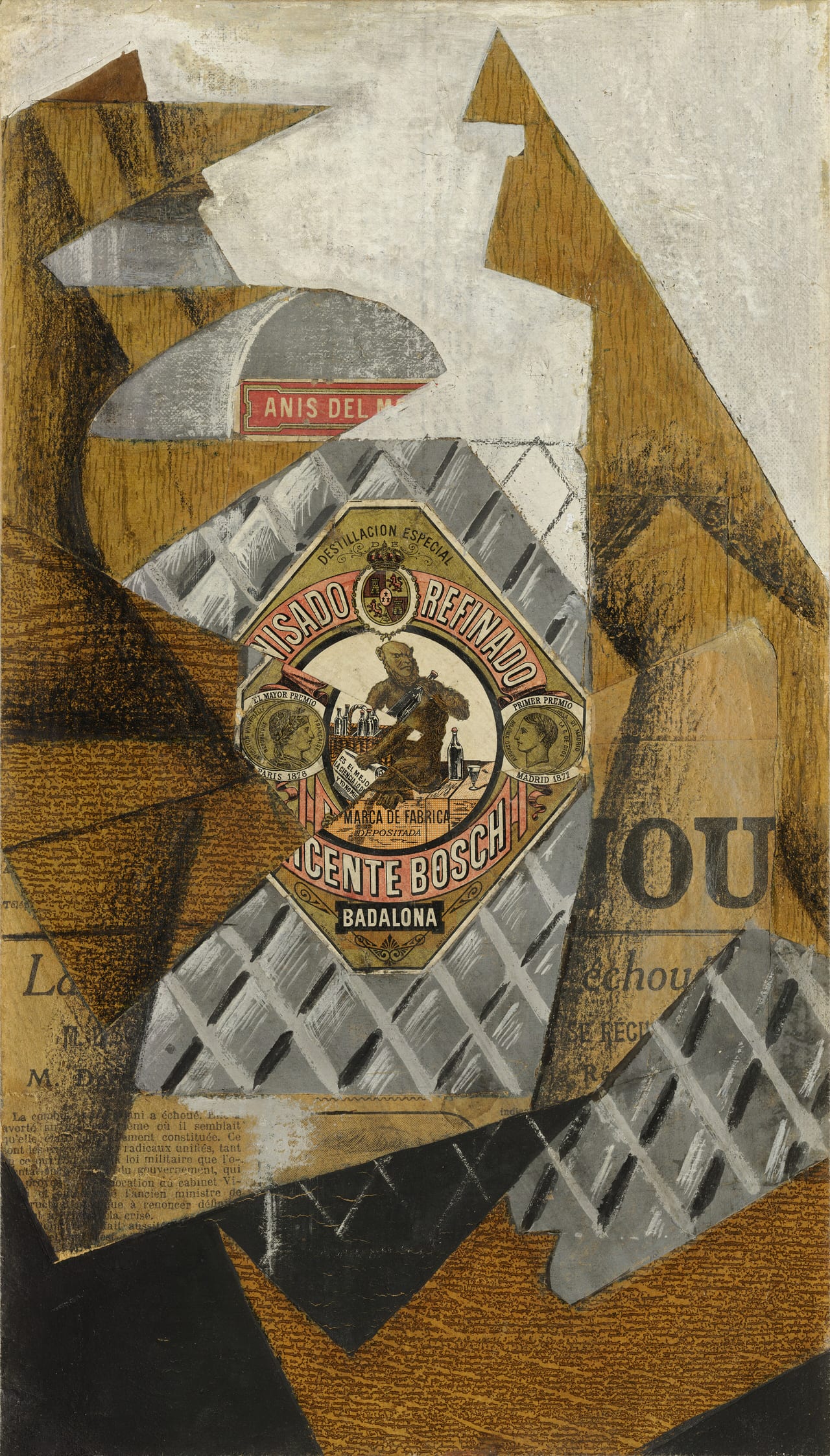
The Bottle of Anis
Juan Gris · 1914
Museo Nacional Centro de Arte Reina Sofía
Painted by Gris in June 1914 in oil, collage and graphite on canvas. At its core is the label of a bottle of Anís del Mono, a liqueur popular with Spanish artists at the turn of the century that had already appeared in the Cubism of Picasso and Diego Rivera. Its inscription Visado Refinado is perhaps a reference to Gris’s status as an exile who had fled Spain to avoid military service, and a further hidden message could lie in the three cities on the label, Paris, Madrid and Badalona, points of reference for the creators of Cubism: Paris for Braque, Badalona, so like Barcelona, for Picasso, and Madrid for Gris, who was born there. It entered the Museo Reina Sofía in 2000.
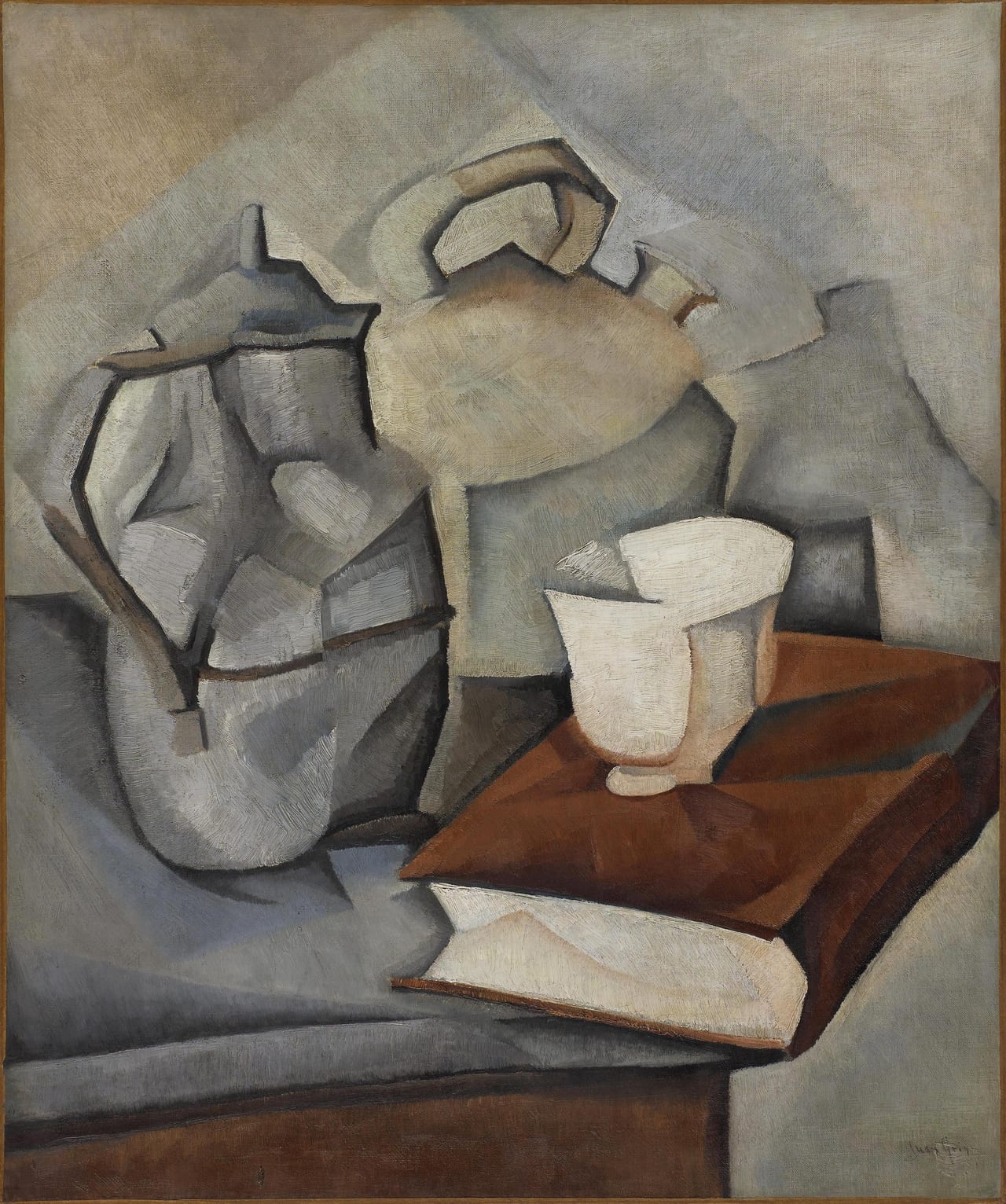
The Book
Juan Gris · 1911
Musée National d'Art Moderne
Gris painted this Cubist still life in 1911: a coffee pot, an earthenware water jug and a bowl, the bowl resting on a book. He gave it to Paul Éluard the same year; it later belonged to Louis Marcoussis and is now in the Musée National d’Art Moderne in Paris.
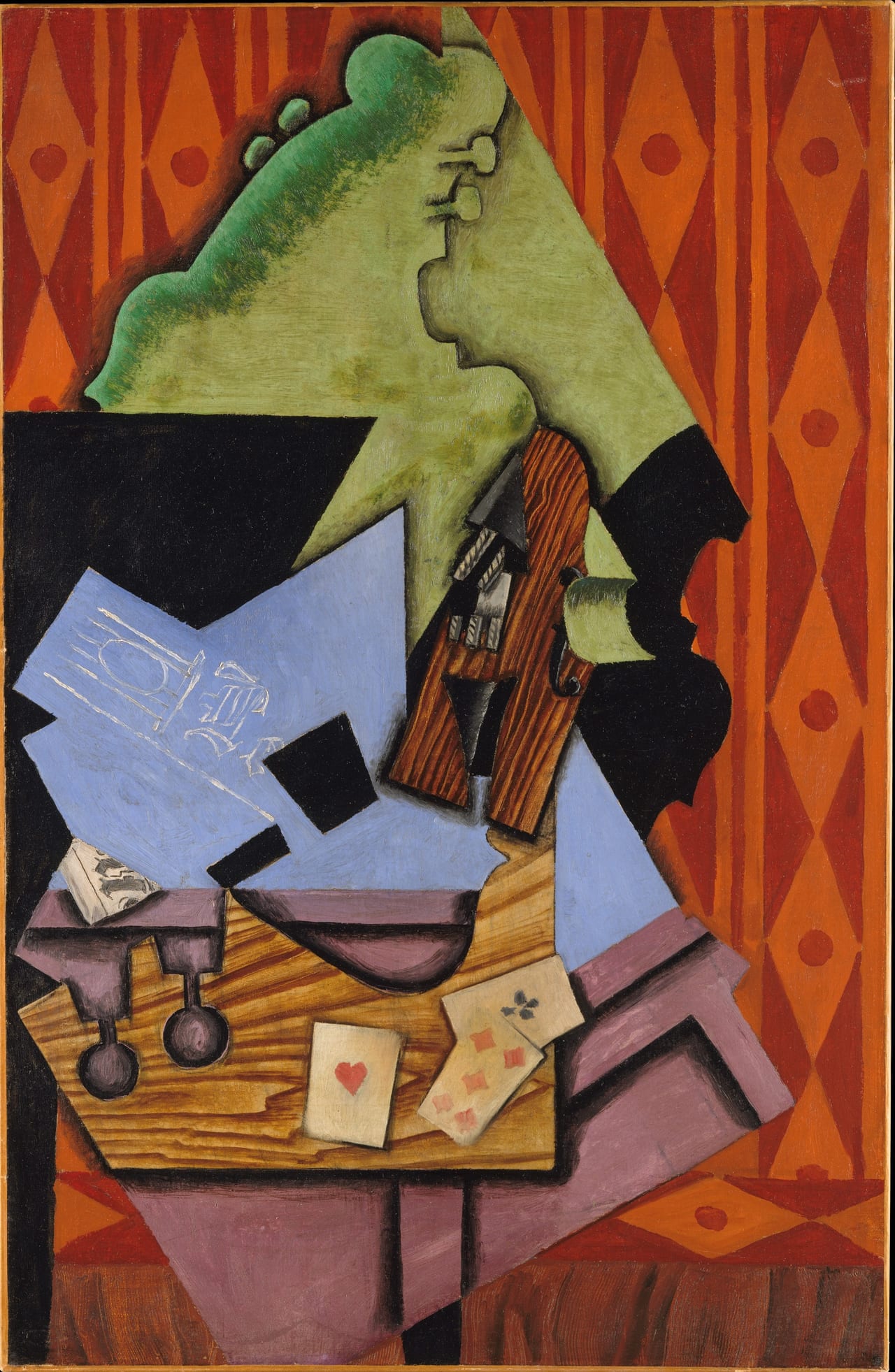
Violin and Playing Cards on a Table
Juan Gris · 1913
Metropolitan Museum of Art
An oil on canvas of 1913 by Gris. It is a still life, a typical subject for the Cubists, and the Metropolitan Museum of Art in New York holds it.
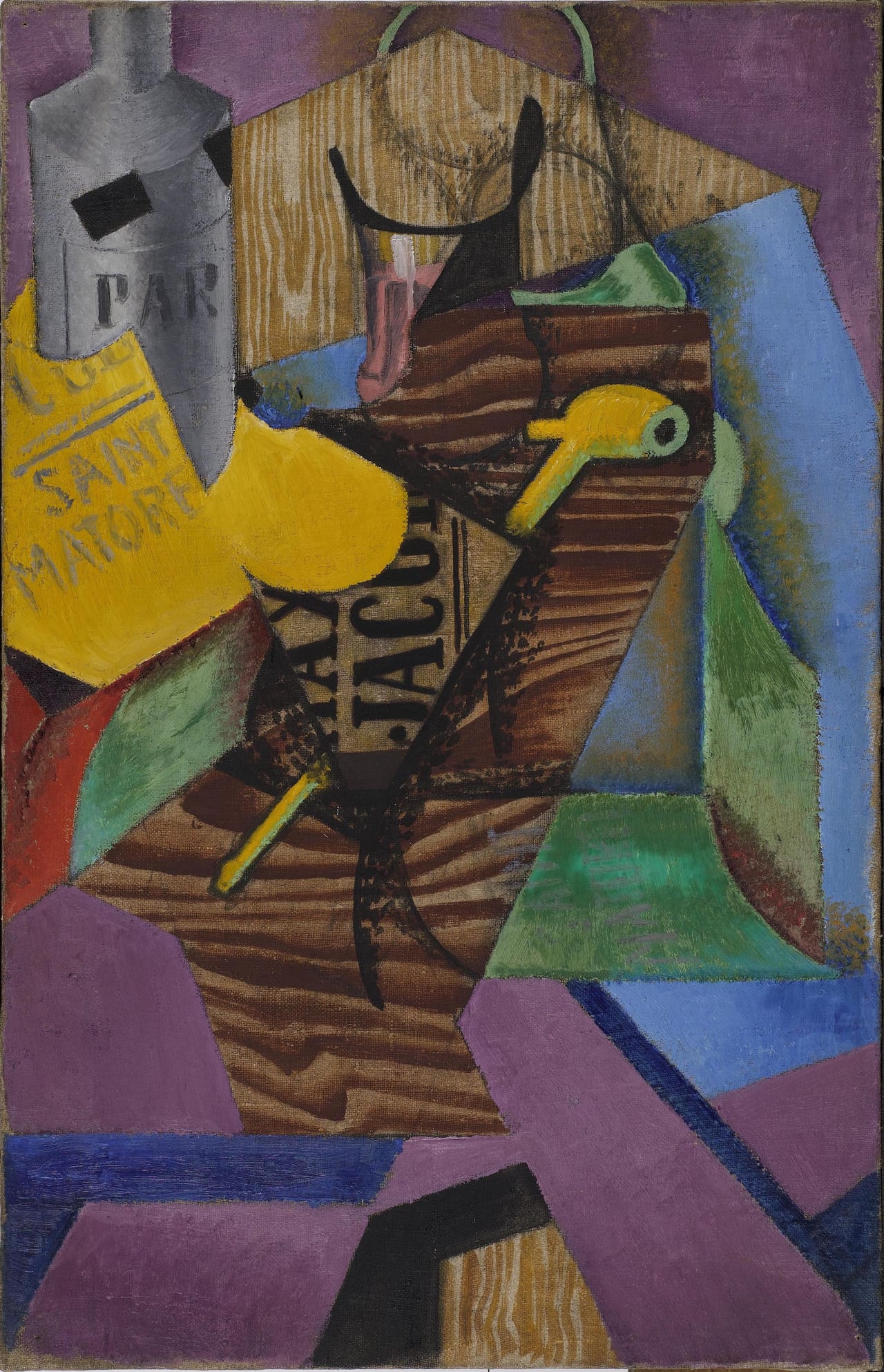
Still Life with a Book
Juan Gris · 1913
Musée National d'Art Moderne
Painted by Gris in December 1913, this Cubist still life includes, among its cut-off inscriptions, a tribute to Max Jacob. It is in the Musée National d’Art Moderne in Paris.
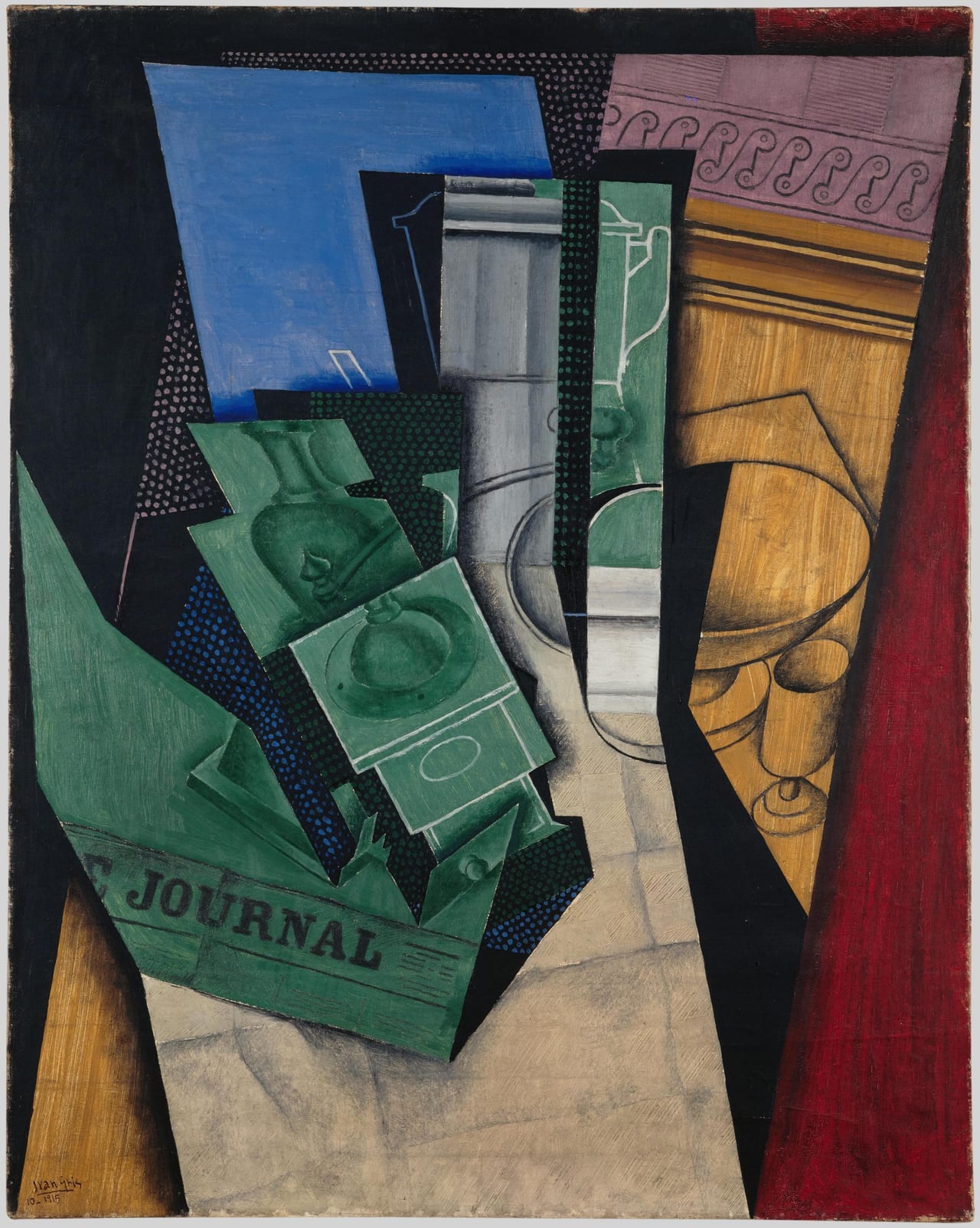
The Breakfast
Juan Gris · 1915
Musée National d'Art Moderne
Gris painted this Cubist canvas in oil and charcoal in October 1915. The still life shows, among other things, a coffee mill, a coffee pot and a fruit bowl. It is in the Musée National d’Art Moderne in Paris.
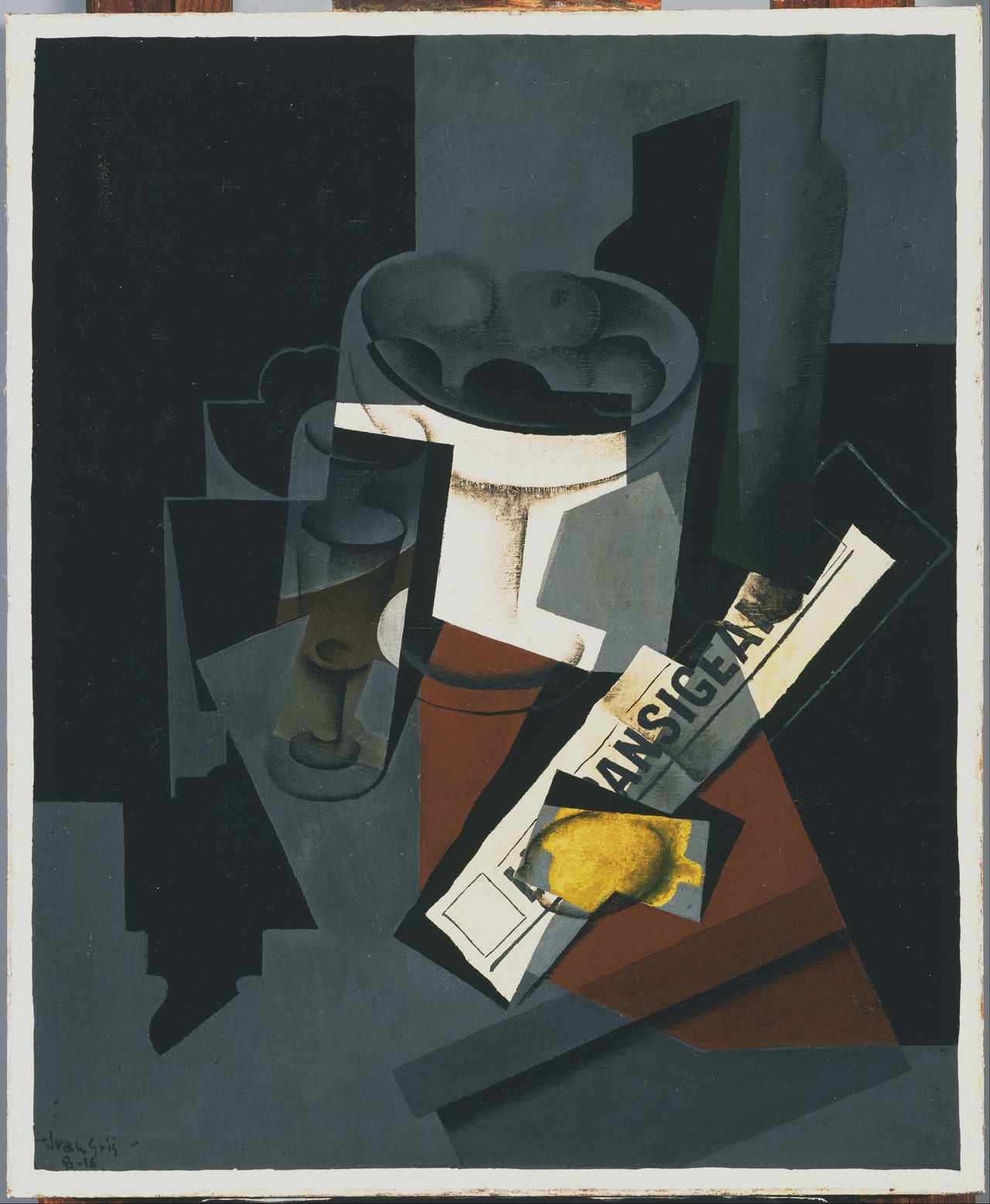
Still Life with Newspaper
Juan Gris · 1916
The Phillips Collection
Painted by Gris in 1916: a lemon resting on a copy of the newspaper L’Intransigeant, in front of a stemmed glass and a fruit bowl. The surface is immaculately smooth, and the picture draws its strength from austerity and cool restraint rather than excess; its crisply contoured shapes hold something of the stillness of the seventeenth-century painter Francisco de Zurbarán, whom Gris admired. The Phillips Collection in Washington acquired it in 1950.
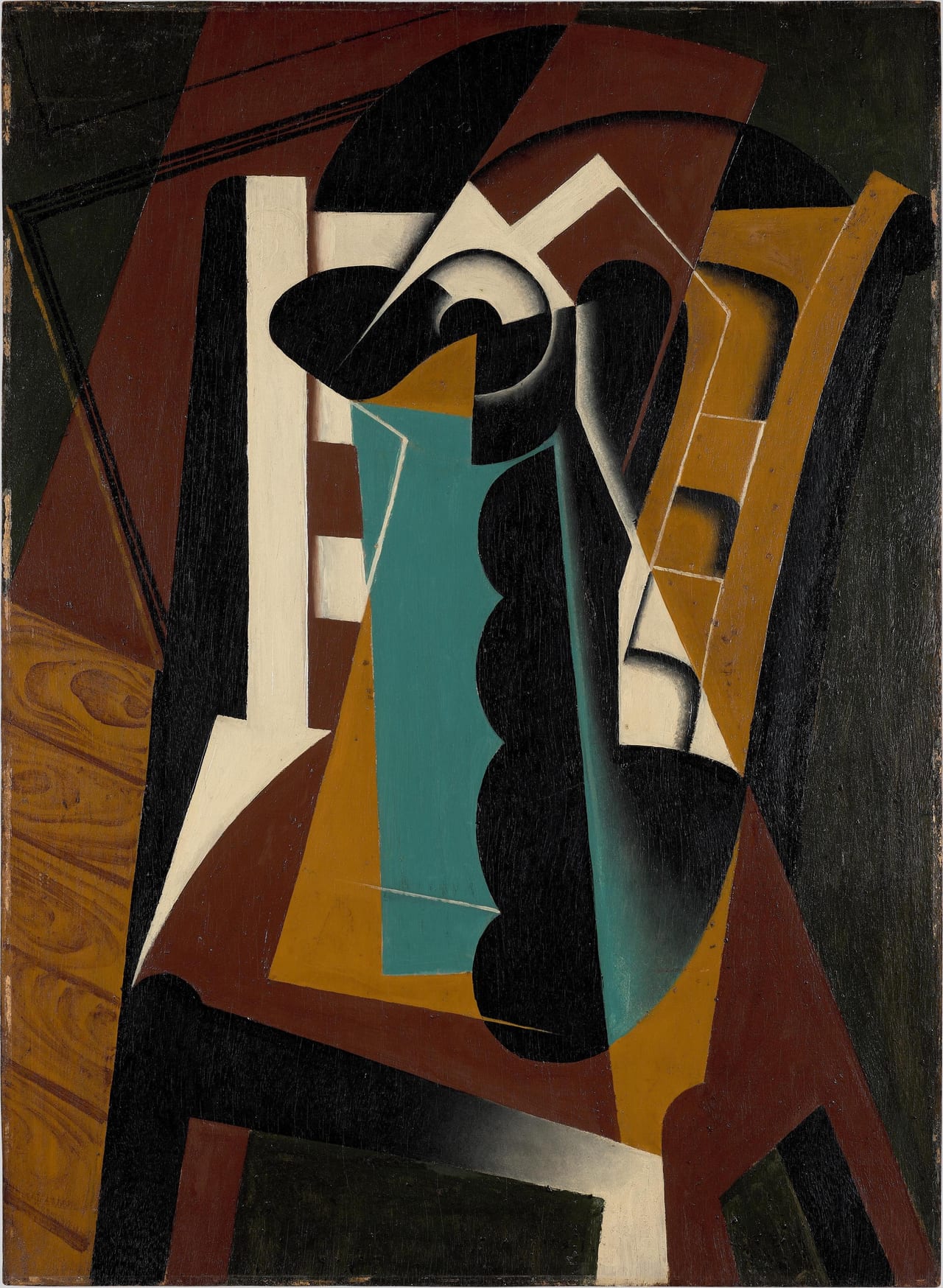
Still Life on a Chair
Juan Gris · 1917
Musée National d'Art Moderne
Gris painted this Cubist still life in oil on a wooden panel in April 1917: a jug standing on a chair. It once belonged to Raoul Albert La Roche and is now in the Musée National d’Art Moderne in Paris.
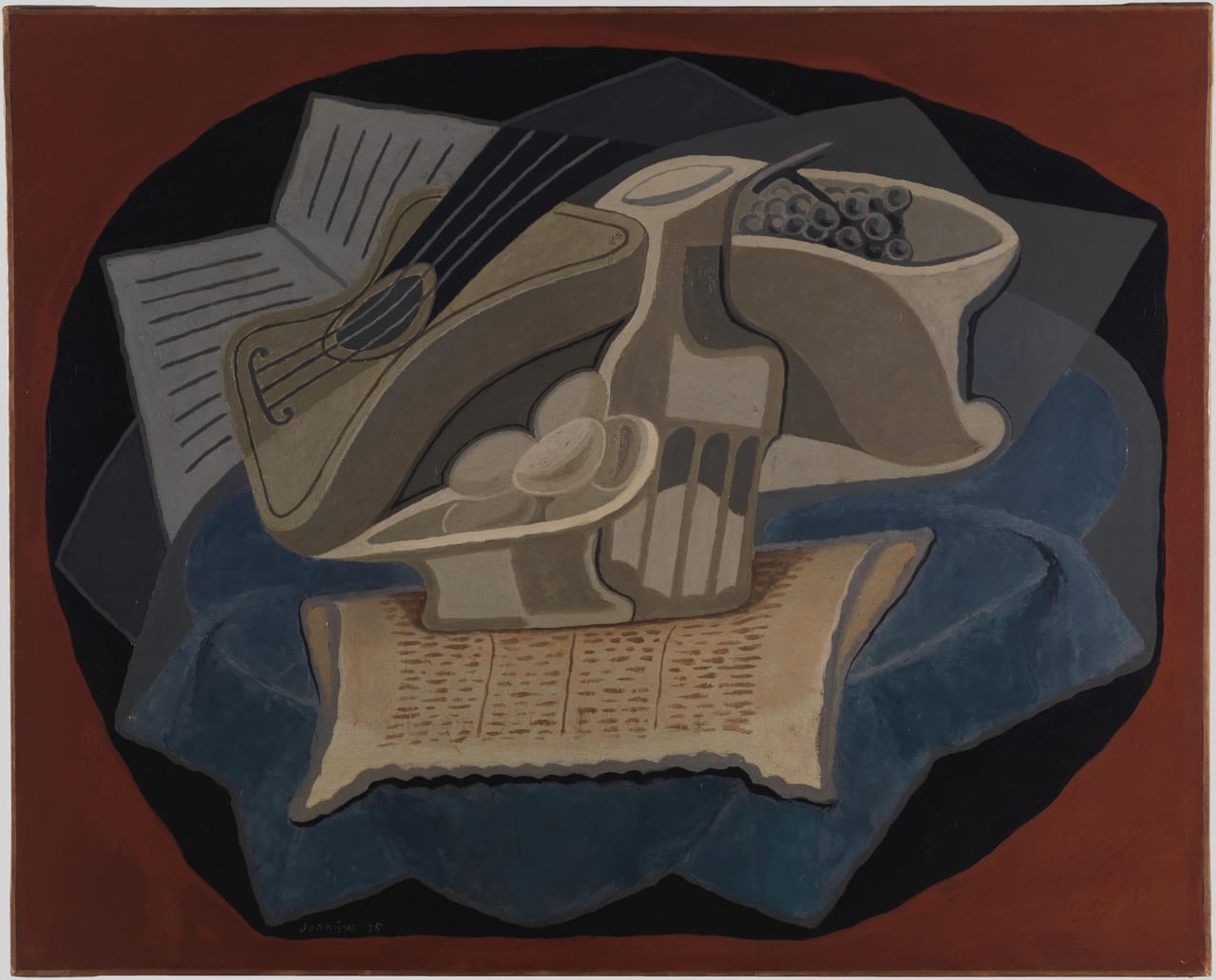
The Blue Carpet
Juan Gris · 1925
Musée National d'Art Moderne
Painted by Gris in the summer of 1925. On a blue carpet lie a guitar, a sheet of music, two bowls of fruit, a fluted bottle and a newspaper. It is in the Musée National d’Art Moderne in Paris.
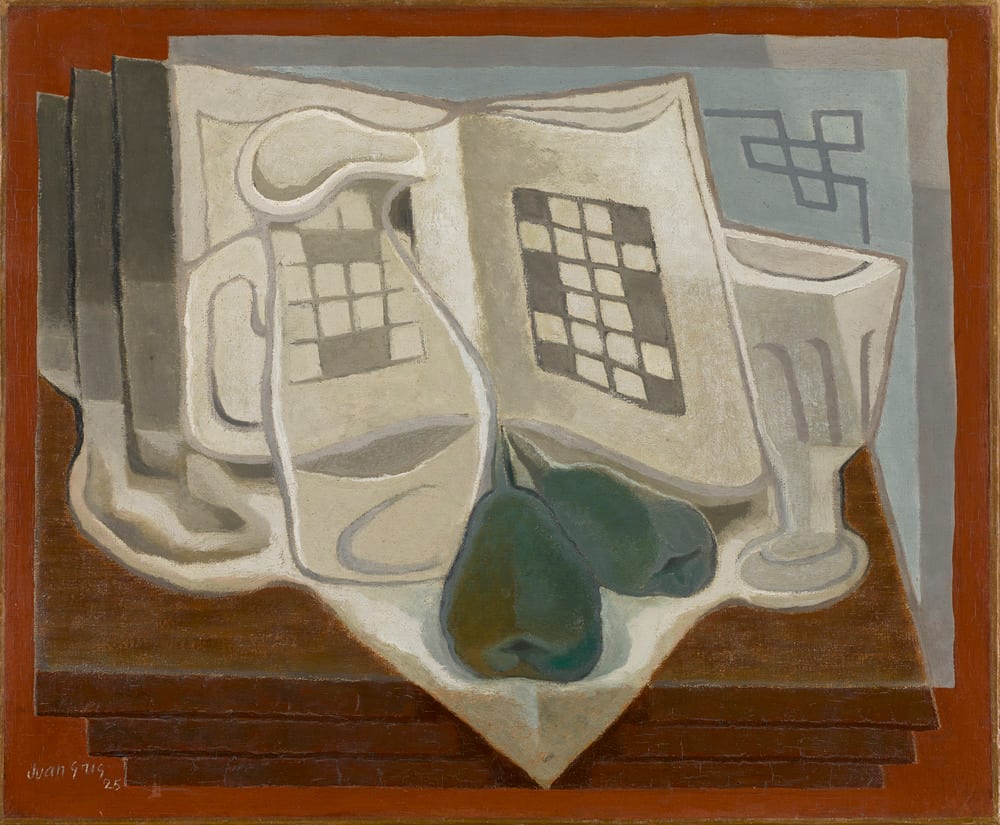
Les Mots croisés
Juan Gris · 1925
Musée d’Art Moderne de Fontevraud
Painted by Gris in 1925: two pears, a jug and a stemmed glass in front of a double page of crossword grids not yet filled in. Once part of the private collection of Martine and Léon Cligman, it has been at the Musée d’Art Moderne de Fontevraud, at Fontevraud-l’Abbaye, since the museum opened in 2021.
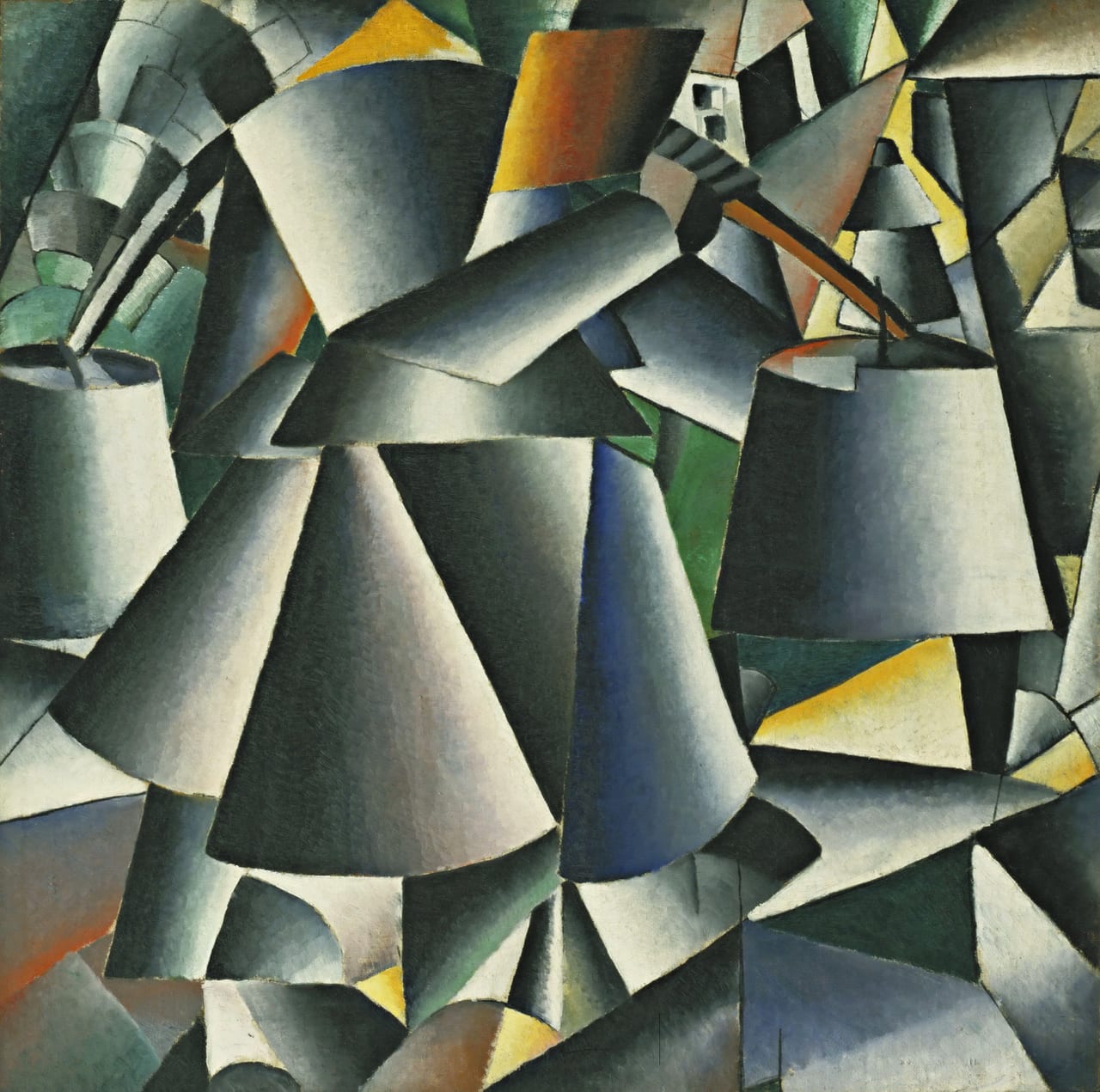
Woman with Pails: Dynamic Arrangement
Kazimir Malevich · 1912–13
Museum of Modern Art
Malevich painted this canvas in 1912–13; it is dated 1912 on the reverse, where he also described it as a dynamic decomposition of a peasant woman with pails. It is a Cubo-Futurist version of a picture by the same painter made the year before (1911), which is shown at the Stedelijk Museum in Amsterdam. From one picture to the other the elements are reversed from right to left; here cylinders and cones render the movement of the woman’s walk and the volumes of the bodies, and the faces that drew the eye in the earlier canvas shrink to upturned cones. The Museum of Modern Art acquired it in 1935, and the acquisition was confirmed in 1999 by agreement with Malevich’s estate.
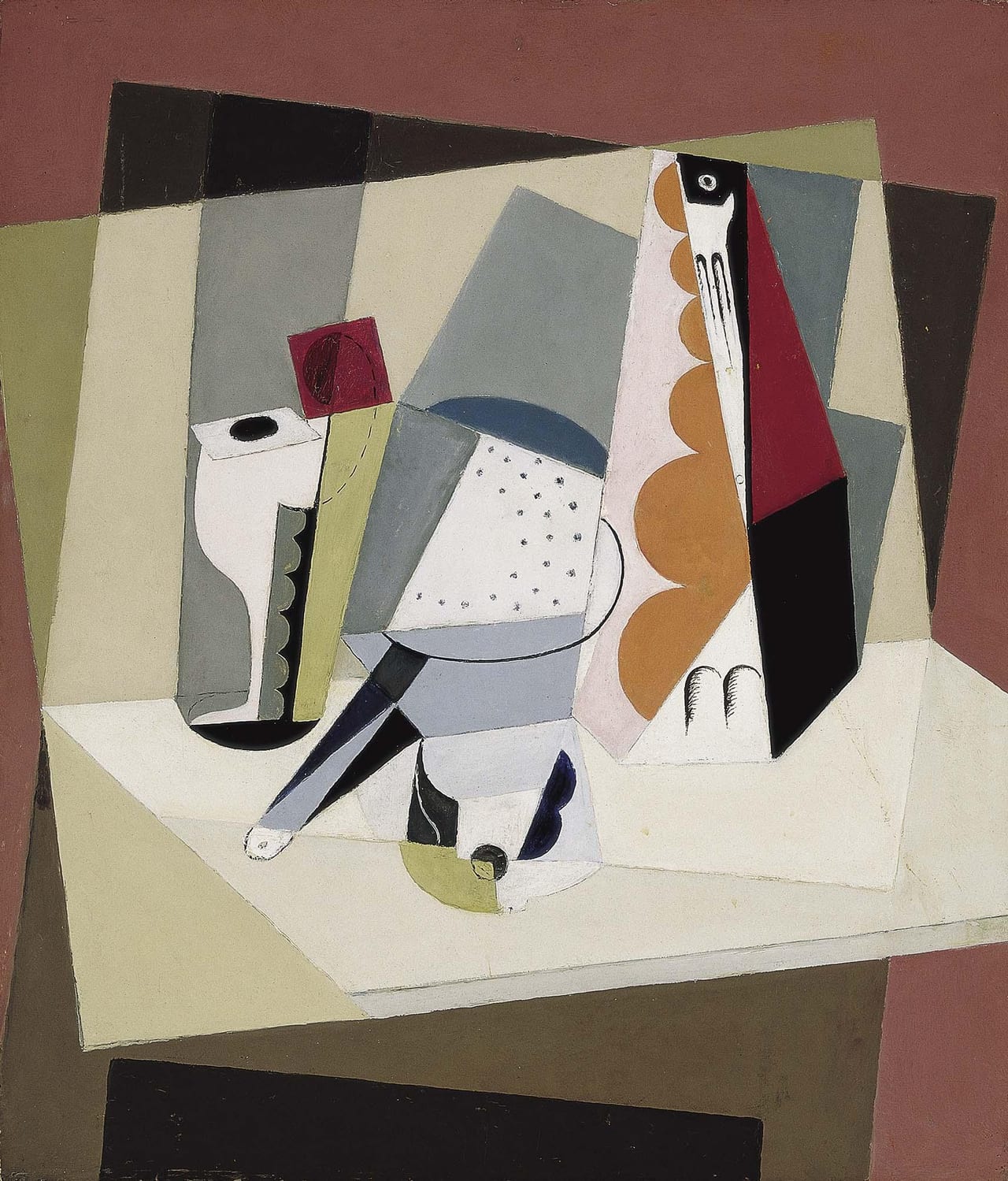
Cubist Still Life
María Blanchard · c. 1917
Museo Nacional Centro de Arte Reina Sofía
María Blanchard painted this still life around 1917, in the last stage of her Cubist period; a year later she began the figurative phase that lasted for the rest of her life. A frying pan, a goblet and a table appear in schematic form, with very fine lines bounding flat areas of colour, and the composition recalls Juan Gris’s idea of plastic rhymes. It is on long-term loan to the Museo Reina Sofía from the Telefónica Collection.
Sources
- Britannica, “Cubism”
- Tate, “Cubism”
- Tate, “Analytical cubism”
- Tate, “Synthetic cubism”
- Wikipedia, “Cubism”
- Britannica, “Juan Gris”
- Wikipedia, “Juan Gris”
- Britannica, “Orphism”
- Tate, “Orphism”
- Britannica, “Robert Delaunay”
- Britannica, “Roger de La Fresnaye”
- Wikipedia, “María Blanchard”
- Britannica, “Piet Mondrian”
- Britannica, “Kazimir Malevich”
- Wikipedia, “Cubo-Futurism”
- Wikipedia, “Lyubov Popova”
- Wikipedia, “Czech Cubism”
- Wikipedia, “Bohumil Kubišta”
- Wikipedia, “Josef Čapek”
- Wikipedia, “Ilmari Aalto”
- Britannica, “Marsden Hartley”
- Wikipedia, “Georges Valmier”
- Art Institute of Chicago, “Portrait of Pablo Picasso”
- Museo Reina Sofía, “La bouteille d’anis (The Bottle of Anis)”
- Wikipedia (French), “Le Livre (Gris)”
- Wikipedia, “Violin and Playing Cards on a Table”
- Wikipedia (French), “Nature morte au livre”
- Wikipedia (French), “Le Petit Déjeuner”
- Phillips Collection, “Still Life with Newspaper”
- Wikipedia (French), “Nature morte au journal”
- Wikipedia (French), “Nature morte sur une chaise”
- Wikipedia (French), “Le Tapis bleu”
- Wikipedia (French), “Les Mots croisés”
- Museum of Modern Art, “Woman with Pails: Dynamic Arrangement”
- Wikipedia (French), “Femme aux seaux”
- Wikipedia (Spanish), “Nature morte cubiste (María Blanchard)”
- Museo Reina Sofía, “Nature morte cubiste (Cubist Still Life)”
- Centre Pompidou, “Les Tours de Laon”
- Kunstmuseum Den Haag, “Flowering Apple Tree”
- Wikipedia (French), “Le Bûcheron”
- Museo Reina Sofía, “Mujer con abanico (Woman with a Fan)”
- National Gallery of Art, “The Bathers”
- Museum of Modern Art, “Painterly Architectonic”
- Galerie Kodl, “Josef Čapek, Drinker”
- Wikipedia, “Senecio (Klee)”
- Wikipedia, “Portrait of a German Officer”
- Wikipedia, “Saint Sebastian (Kubišta)”
- Wikipedia (Finnish), “Kellot (Ilmari Aalto)”
- Wikipedia (French), “La Guitare (Gris)”
- The Guitar — Public domain via Wikimedia Commons (Public domain)
- Woman with Mandolin, after Corot — Public domain via Wikimedia Commons (Public domain)
- The Towers of Laon — Public domain via Wikimedia Commons (Public domain)
- Flowering Apple Tree — Public domain via Wikimedia Commons (Public domain)
- The Woodcutter — Public domain via Wikimedia Commons (Public domain)
- Woman with a Fan — Public domain via Wikimedia Commons (Public domain)
- The Bathers — Public domain via Wikimedia Commons (Public domain)
- Painterly Architectonic — Public domain via Wikimedia Commons (Public domain)
- Drinker — Public domain via Wikimedia Commons (Public domain)
- Senecio — Public domain via Wikimedia Commons (Public domain)
- Portrait of a German Officer — Public domain via Wikimedia Commons (Public domain)
- Saint Sebastian — Public domain via Wikimedia Commons (Public domain)
- The Bells — Public domain via Wikimedia Commons (Public domain)
- Portrait of Pablo Picasso — Public domain via Wikimedia Commons (Public domain)
- The Bottle of Anis — Public domain via Wikimedia Commons (Public domain)
- The Book — Public domain via Wikimedia Commons (Public domain)
- Violin and Playing Cards on a Table — Public domain via Wikimedia Commons (Public domain)
- Still Life with a Book — Public domain via Wikimedia Commons (Public domain)
- The Breakfast — Public domain via Wikimedia Commons (Public domain)
- Still Life with Newspaper — Public domain via Wikimedia Commons (Public domain)
- Still Life on a Chair — Public domain via Wikimedia Commons (Public domain)
- The Blue Carpet — Public domain via Wikimedia Commons (Public domain)
- Les Mots croisés — Public domain via Wikimedia Commons (Public domain)
- Woman with Pails: Dynamic Arrangement — Public domain via Wikimedia Commons (Public domain)
- Cubist Still Life — Public domain via Wikimedia Commons (Public domain)
Invite Cubism into your living room