The Heart of the Andes
Frederic Edwin Church · 1859

Hudson River School
New York
The first school of painting native to the United States, the Hudson River School brought together landscape painters of several generations, at work between about 1825 and 1870, whose name, given afterwards, describes a shared aim rather than one place. Thomas Cole, generally acknowledged as its founder, went up the Hudson in the autumn of 1825 and hiked into the Catskills to paint the first landscapes of the area. After his death in 1848 a second generation, among them his pupil Frederic Edwin Church, made landscapes on an epic scale, and Albert Bierstadt and Thomas Moran carried the grand view west to the Rocky Mountains, the Grand Canyon and Yosemite.
Cole and the Catskills
The name of the Hudson River School was given in retrospect, and it points to what the painters meant to do rather than to one place, though many of the older ones found their subjects in the Catskills north of New York City, the picturesque country the Hudson runs through. An outgrowth of Romanticism, it was the first school of painting native to the country, and a strongly nationalistic one: proud of the beauty of the American landscape, and keen that its artists should become independent of the schools of Europe. Its centre was New York City, where many of the painters worked in the Tenth Street Studio Building in Greenwich Village.
Its pictures are realistic, detailed and sometimes idealized. They often set peaceful farmland beside the remaining wilderness, which was fast disappearing from the Hudson Valley at the very moment it was coming to be valued for its ruggedness and sublimity, and they show a country where people and nature live together peacefully. In general the painters held that the American landscape reflected God, though the depth of their faith varied, and they looked for models to Claude Lorrain, John Constable, J. M. W. Turner and other European masters.
Thomas Cole is generally acknowledged as the founder. Born in Lancashire in 1801, he came to the United States with his family in 1818. In the autumn of 1825 he took a steamboat up the Hudson, stopping at West Point and then at Catskill landing, and hiked high into the eastern Catskills to paint the first landscapes of the area. That year landscapes of his in a New York shop window came to the notice of Colonel John Trumbull and of Asher B. Durand, a painter, who bought his works and found him patrons. Settled in the village of Catskill, on the west bank of the Hudson, he travelled the Northeast, mostly on foot, making pencil studies from which he composed paintings in his studio in winter.
Cole could record a landscape directly and in minute detail, or invent grandiose and dramatic imaginary vistas with bold effects of light and chiaroscuro, and where a human figure appears it is always subordinate to the landscape. Among the early leaders, who also included Thomas Doughty and Durand, he was the most romantic, drawn to the stormy and monumental side of nature. He also painted allegories: The Course of Empire, five canvases following the same landscape from a near state of nature to the consummation of empire and then to decline and desolation, now in the New-York Historical Society; and The Voyage of Life, a symbolic journey from infancy to old age in four scenes, begun in 1839. Cole died at Catskill in February 1848.
Durand came to painting from engraving. His engraving of John Trumbull’s Declaration of Independence had established his reputation by 1823, and around 1830, with the encouragement of his patron Luman Reed, his main interest turned to oil painting. In 1837 he went sketching with Cole at Schroon Lake in the Adirondacks and soon began to concentrate on landscape. He was among the earliest Americans to work out of doors from nature, and in his “Letters on Landscape Painting” in the periodical The Crayon he set out his belief that nature was an ineffable manifestation of God. Lyrical and intimate, he made particular use of delicate light in woodland scenes. He was president of the National Academy of Design from 1845 to 1861. His Kindred Spirits of 1849, painted after Cole’s death, is an idealised memory of Cole’s discovery of the Catskills, of his friendship with the poet William Cullen Bryant and of his ideas about American nature.
Church and the second generation
A second generation emerged after Cole’s premature death. Among its members were Frederic Edwin Church, Cole’s prize pupil, with John Frederick Kensett and Sanford Robinson Gifford, and most of its finest works were painted between 1855 and 1875. Church had come to Cole at Catskill in 1844, at eighteen, and studied with him for two years; Cole wrote that the young man had “the finest eye for drawing in the world”. From the beginning Church looked for marvels of nature, Niagara Falls, volcanoes in eruption and icebergs, and he was greatly influenced by the writings of the naturalist Alexander von Humboldt.
Niagara drew crowds and won the critics’ praise. Church sketched the falls on up to five visits in 1856 and, back in his New York studio, combined his views into one across the Horseshoe Falls from the Canadian side, removing any foreground. With his gallery, Williams, Stevens & Williams, he decided to show the painting by itself; the gallery bought it with its copyright and charged 25 cents to see it. The doors opened on 1 May 1857, and over the next three weeks tens of thousands came. Shown next in London and then on a tour of the United Kingdom, it returned to New York in the autumn of 1858. One critic wrote that it was “now regarded as the finest painting ever executed by an American artist.”
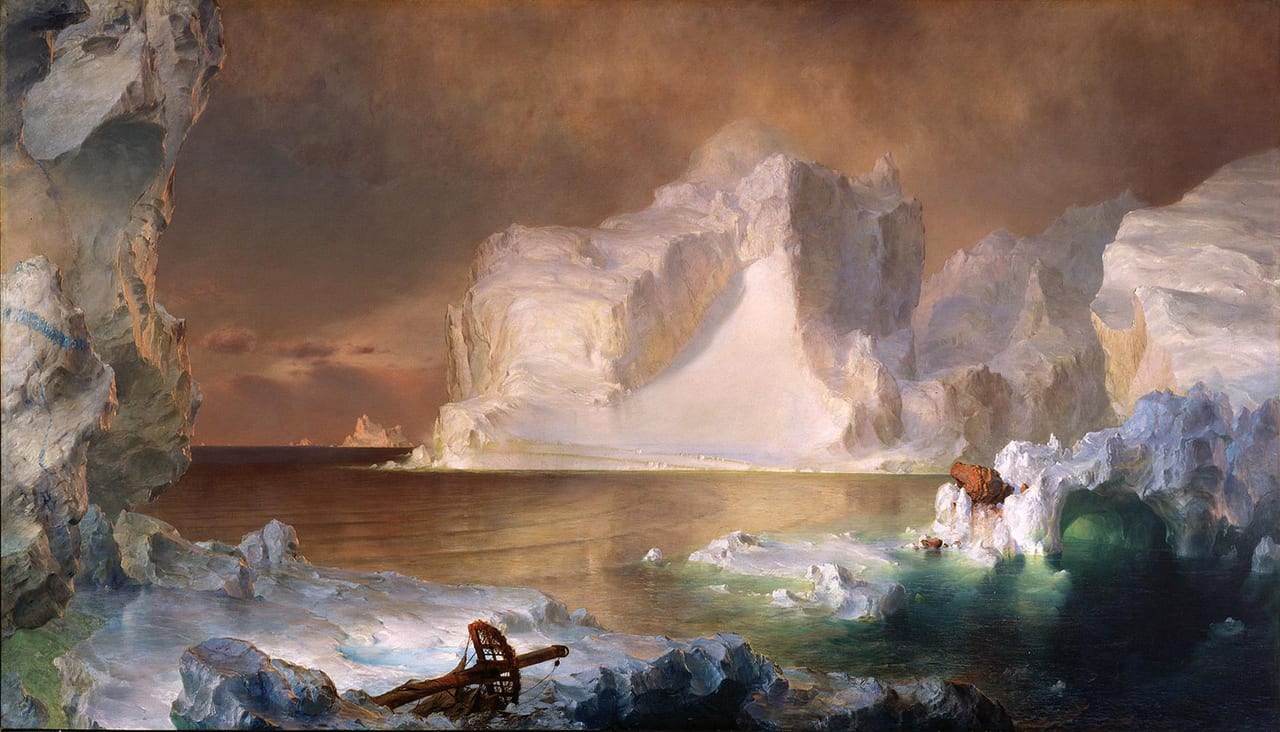
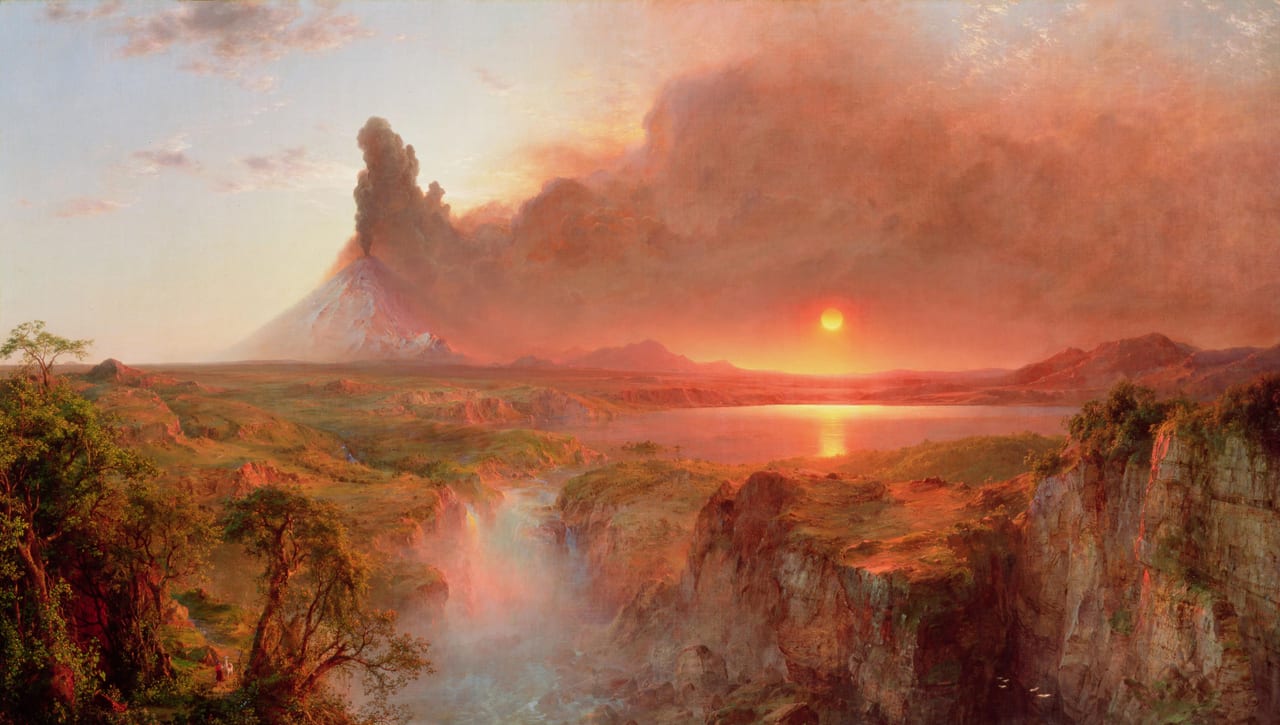
The Heart of the Andes followed in 1859, an idealized landscape almost ten feet wide that combines many Andean topographies, from Church’s travels in Ecuador and Colombia in 1853 and 1857. Its New York exhibition was a sensation and established Church as the foremost landscape painter in the United States. The Icebergs, inspired by his voyage of 1859 around Newfoundland and Labrador, was first shown in New York in 1861, again in a one-painting show for which visitors paid 25 cents. The epic size of such landscapes had no precedent in American painting. Cotopaxi, of 1862, is among his major works. Crippling rheumatism in his hands forced him to abandon painting after 1877, and he died in 1900 at Olana, his house on the Hudson, which is now a museum.
Works of the second generation are often described as luminist. The term was introduced by art historians in the mid-twentieth century: John I. H. Baur identified the style in the late 1940s and named it in an article of 1954, and the painters did not refer to their own work as luminism. Luminist landscapes attend to the effects of light, with aerial perspective and hidden brushstrokes, and favour calm, reflective water under a soft, hazy sky. Kensett, trained as an engraver and the leader of the second generation, gave most of his attention to light, rendering minute gradations of intensity in a low-key palette; Gifford, a highly regarded luminist, was noted for light and soft atmospheric effects. Kensett, Gifford and Church were among the founders of the Metropolitan Museum of Art.
Others took the school’s manner in their own directions. Jasper Francis Cropsey, trained as an architect, lived in London from 1856 to 1863, where his autumn landscapes of the American Northeast were popular, and he became known as “America’s painter of autumn.” Martin Johnson Heade turned to landscape through friendships with Hudson River painters, took a studio in the Tenth Street Studio Building and became a close friend of Church; he is best known for his New England salt marshes, and some critics and scholars question whether he belongs to the school at all. Worthington Whittredge settled in New York in 1859 after years in Düsseldorf and Rome, and his most characteristic pictures are forest scenes such as The Trout Pool, a fishing pond amid dense forest. In Cincinnati, Robert S. Duncanson, Whittredge and William Louis Sonntag, inspired by the Hudson River painters, set out together on sketching trips to bring material back to their studios.
The West, and after
For some painters the Northeast was less alluring than the wilder West. Albert Bierstadt, brought to New Bedford, Massachusetts, as a small child, studied in Düsseldorf for several years from 1853 and returned to paint New England and upstate New York. In 1859 he travelled west with the government surveyor Frederick W. Lander, and in 1863 he spent seven weeks in Yosemite Valley with the writer Fitz Hugh Ludlow; the immense canvases he made from those journeys established him as the preeminent painter of the western American landscape. He freely altered details to create an effect of awe and grandeur, and his studio pictures, immense in scale, lack the freshness of the small paintings made on the spot from which they grew.
Thomas Moran, born in England and brought to the United States as a child, was influenced by J. M. W. Turner. In 1871 he joined Ferdinand V. Hayden’s geological survey of Yellowstone as a guest artist and worked closely with the photographer William H. Jackson. His pictures of its canyons, hot springs and geysers seized the American public’s imagination and helped to bring about the designation of Yellowstone, in 1872, as the first national park, and the government bought his first enormous painting of a far-western wonder, The Grand Canyon of the Yellowstone, that same year. With Bierstadt he was among the first artists to explore the Far West, and both were enormously successful with grandiose scenes of the Rocky Mountains, the Grand Canyon and Yosemite.
Clarence Cook, art critic of the New York Tribune, or the landscape painter Homer Dodge Martin is thought to have coined the name Hudson River School. It appeared in print in 1879, and through the 1870s it was used disparagingly: the style had gone out of fashion once the plein-air Barbizon School came into vogue with American patrons and collectors. Bierstadt’s work fell further out of critical favour, attacked for its theatrical tone, and by his death in 1902 the taste for epic landscape had long since passed; he remained largely forgotten for nearly sixty years. Yet the school was the dominant school of American landscape painting through most of the nineteenth century.
Its return came in stages. Interest grew after the First World War and then fell away until the 1960s; Heade’s work, forgotten after his death, was rediscovered in the 1940s, Cropsey’s came back into fashion in the 1960s, and art historians of the late twentieth century came to count Church among the foremost American landscape painters. Several women were associated with the school, among them Susie M. Barstow, a mountain climber who painted the Catskills and the White Mountains, and Julie Hart Beers, who led sketching expeditions in the Hudson Valley. One of the largest collections of the school’s paintings is at the Wadsworth Atheneum in Hartford, Connecticut, with thirteen landscapes by Cole and eleven by Church.
Artists
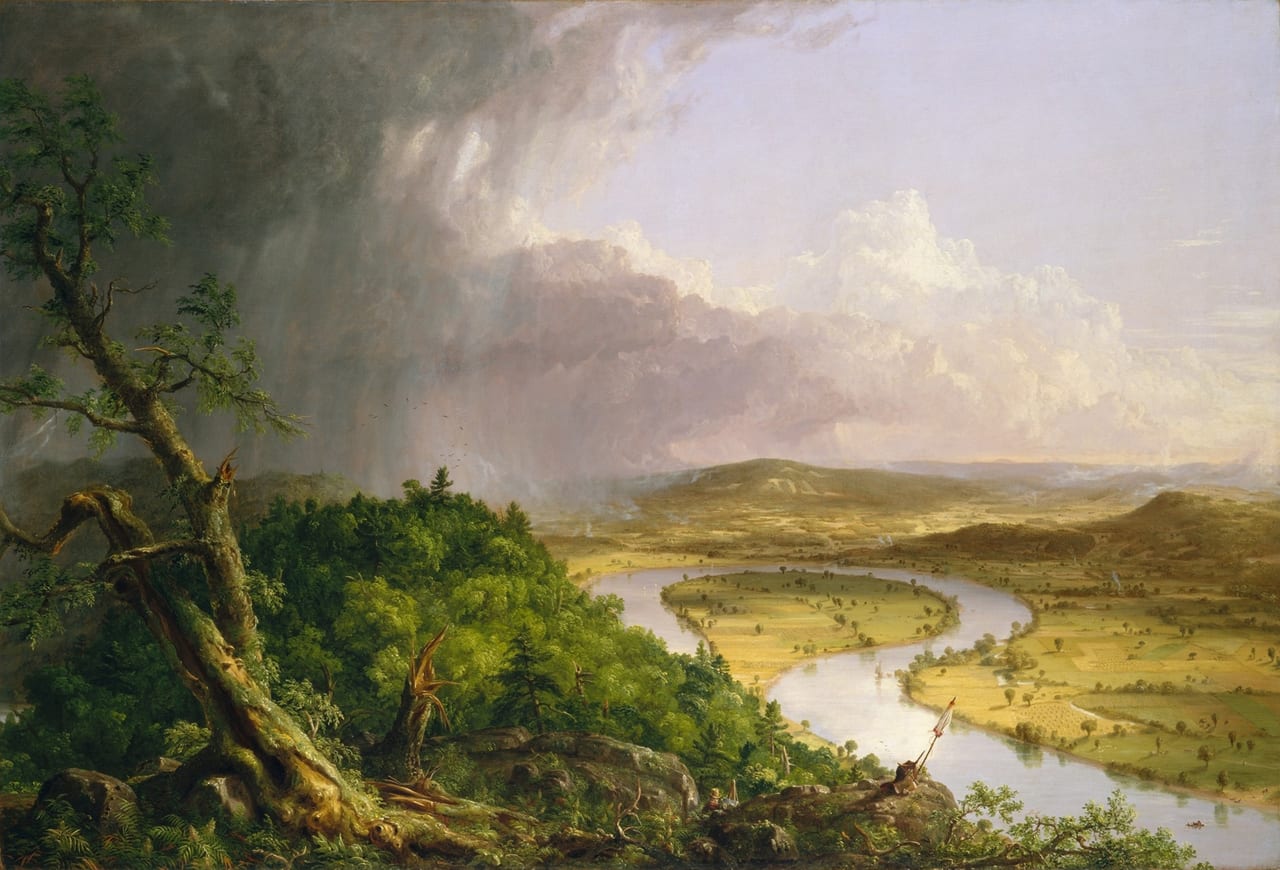
Thomas Cole
Cole painted this view from Mount Holyoke for the National Academy of Design’s exhibition of 1836. His patron Luman Reed, noticing that Cole was becoming lonely and depressed, had suggested that Cole suspend work on The Course of Empire and paint a picture more in his element. It moves from a dark wilderness of shattered trees under rain clouds on the left to the cultivated valley of the Connecticut River on the right, and it joins two views into one; Cole sits at his easel, tiny, among the foreground rocks. It has been in the Metropolitan Museum since 1908.
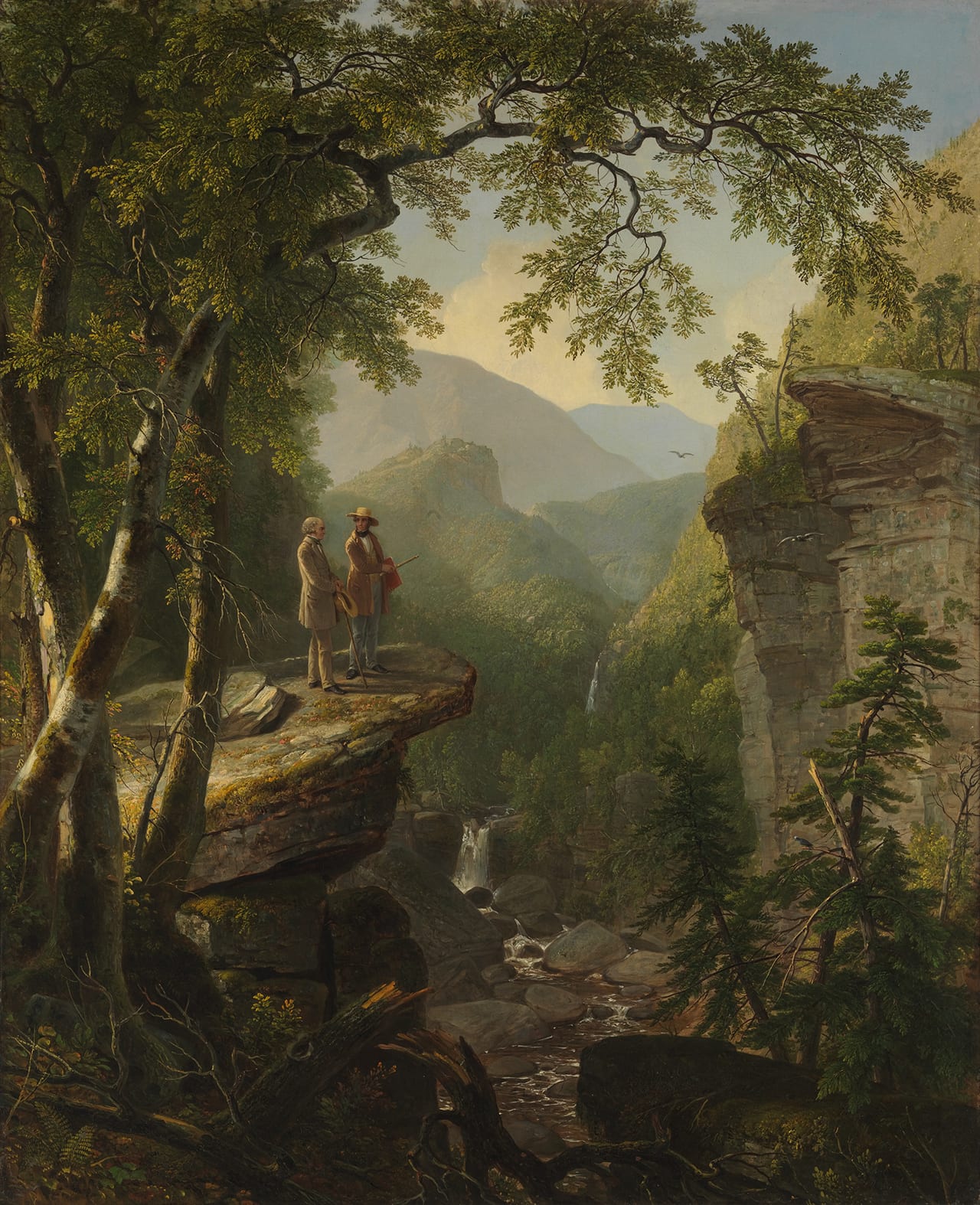
Asher B. Durand
Crystal Bridges, its home, calls it “a defining image of American art.” Durand painted it as a tribute to his late friend and mentor Thomas Cole, who stands in the landscape beside the poet William Cullen Bryant. Durand’s vision of Cole’s return to nature after death drew on Bryant’s poem Thanatopsis, above all the lines “Go forth, under the open sky, and list / To Nature’s teachings.”
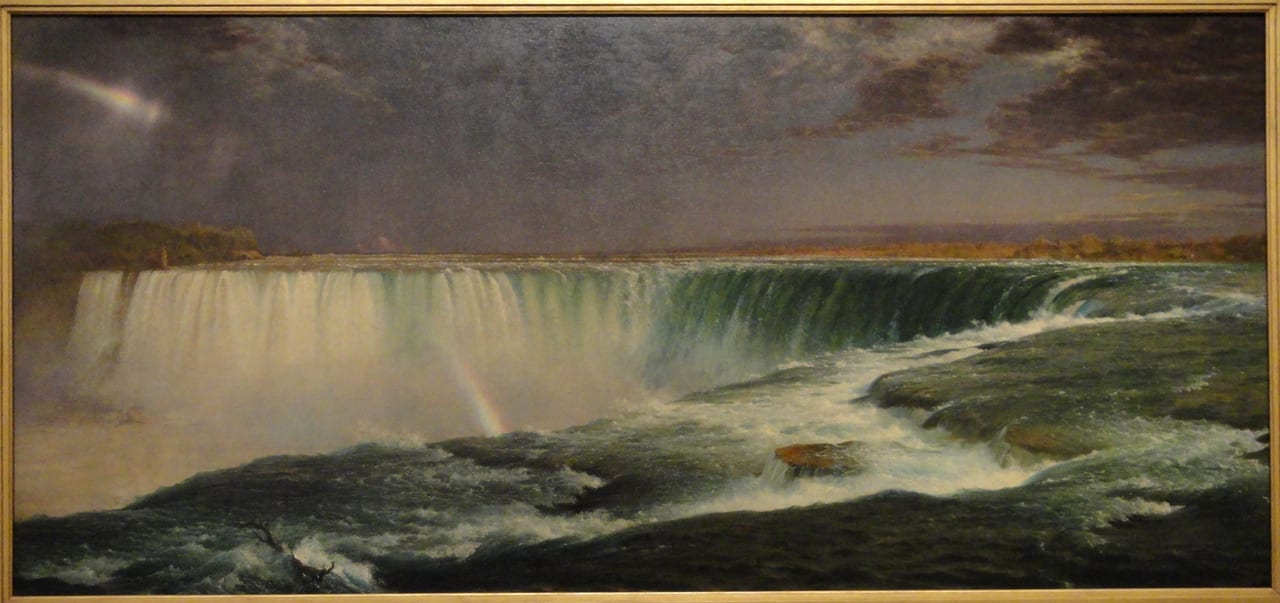
Frederic Edwin Church
Church plunges the viewer straight into the rushing water of the sweeping Horseshoe Falls, with frothing waves, water sheeting over rock and a broken rainbow in the mist. The falls, on the homeland of the Haudenosaunee, had been a popular but challenging subject for European artists since the late seventeenth century. “This is Niagara, with the roar left out!” one writer said in 1857.
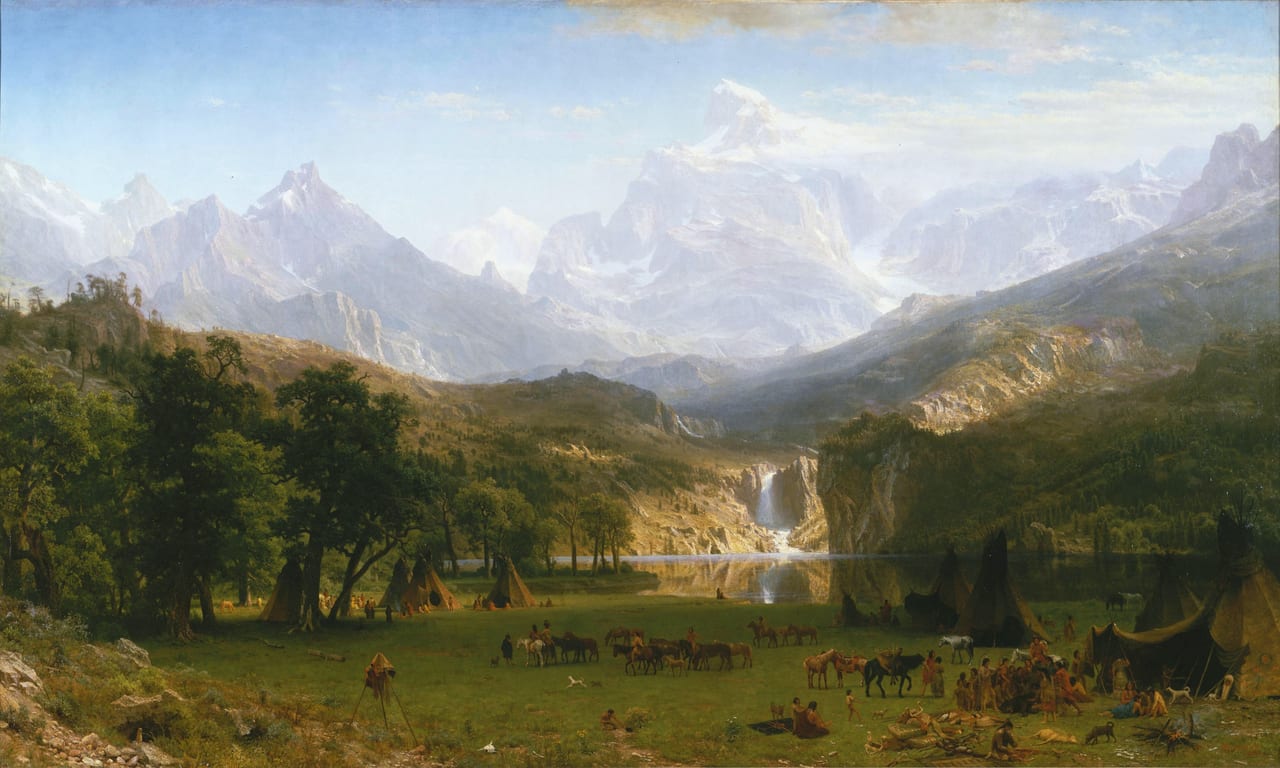
Albert Bierstadt
Based on sketches from Bierstadt’s travels with Frederick W. Lander’s survey party in 1859, it shows Lander’s Peak in the Wyoming Range above an encampment of Native Americans. Shown at the Tenth Street Studio Building in 1863, it won critics and the public at once and found a buyer in 1865 at $25,000; it has been compared and exhibited with Church’s The Heart of the Andes.
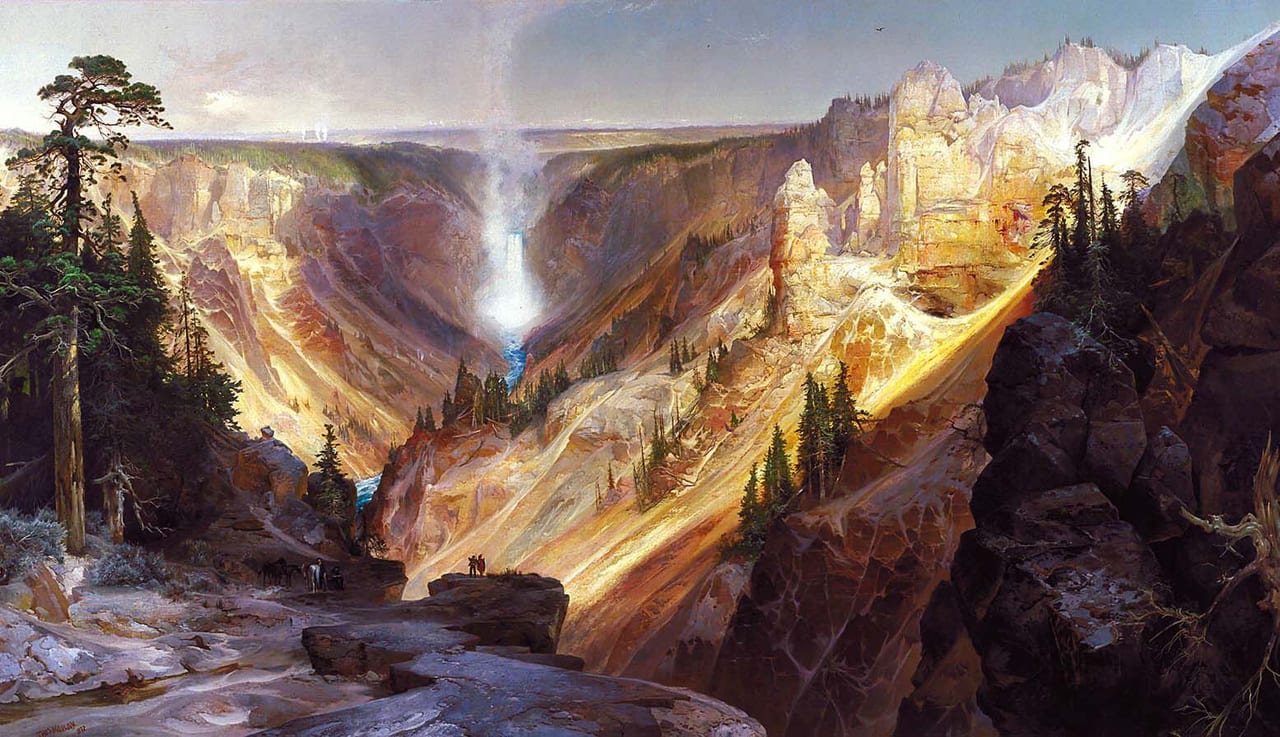
Thomas Moran
Moran sketched the canyon from several vantage points on the 1871 survey of the region led by Ferdinand V. Hayden. His idealized view draws the eye to the river in the V of the canyon, small amid ochre and brown rock, with four figures in the foreground, one of them a Native American. Congress bought it in 1872 for $10,000 and hung it in the Capitol; it is now in the U.S. Department of the Interior Museum.
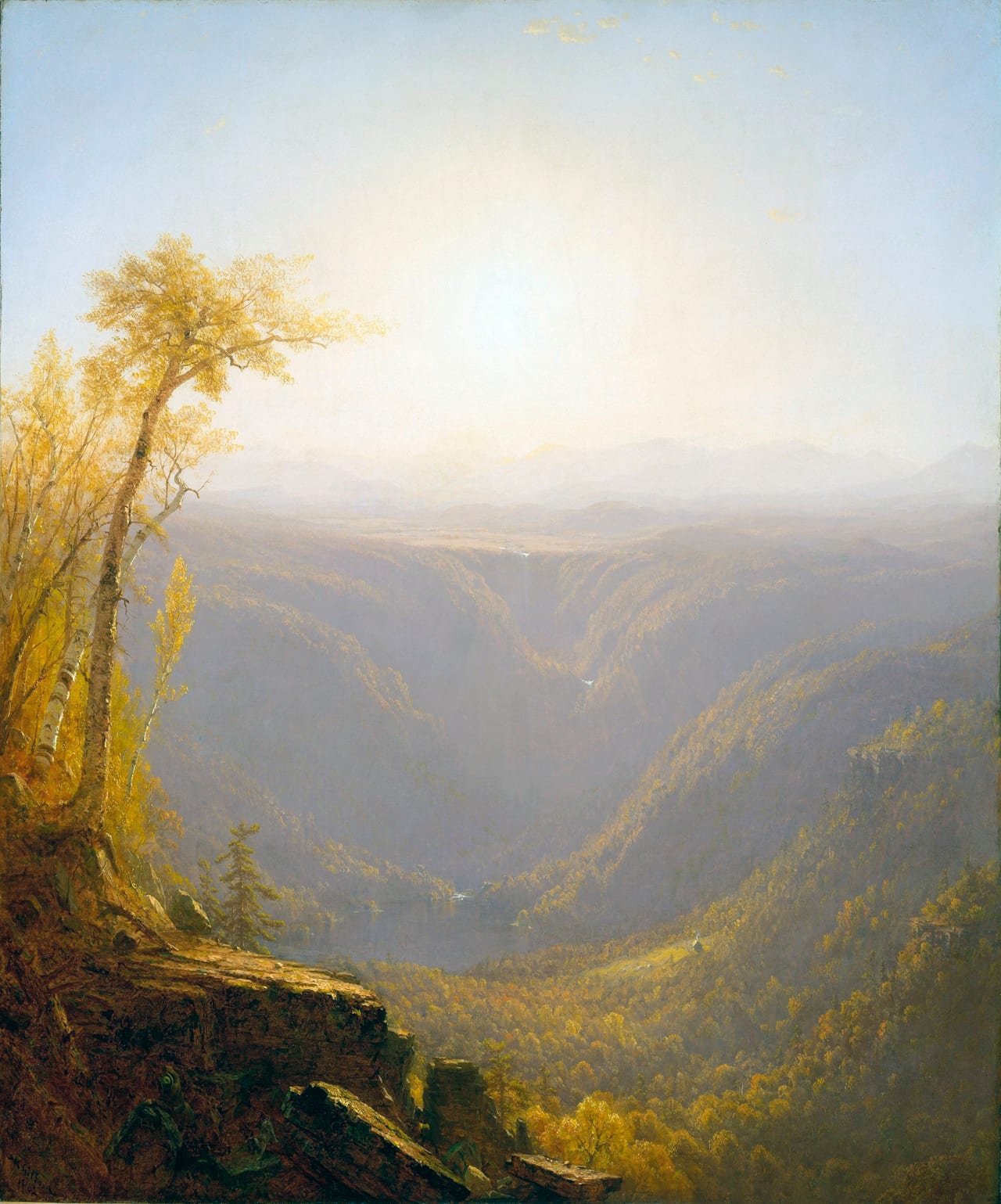
Sanford Robinson Gifford
A leading member of the second generation and a highly regarded luminist, Gifford was noted for his light and soft atmospheric effects. Trained as a portrait painter, the first work he showed at the National Academy, in 1847, was a landscape, and thereafter he devoted himself primarily to landscape. In Europe from 1855 to 1857 he met and travelled widely with Albert Bierstadt and Worthington Whittredge. This painting of 1862 is in the Metropolitan Museum.
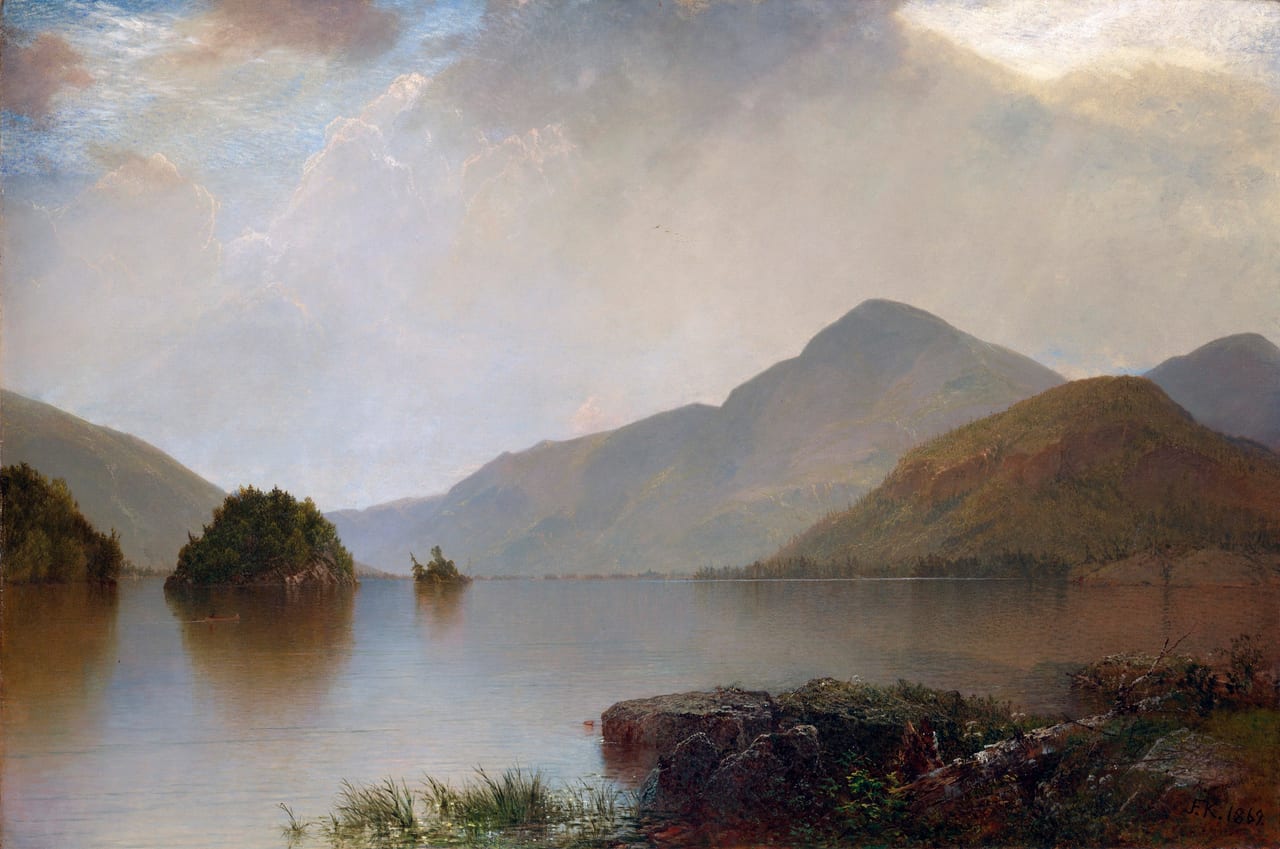
John Frederick Kensett
Kensett often visited Lake George in the Adirondacks and painted many studies there; this is his largest and most accomplished treatment of it. His viewpoint was probably Crown Island, off Bolton Landing, looking northeast across the lake toward the Narrows, and he took liberties: distances are much foreshortened, some islands are left out and others merged with the mainland.
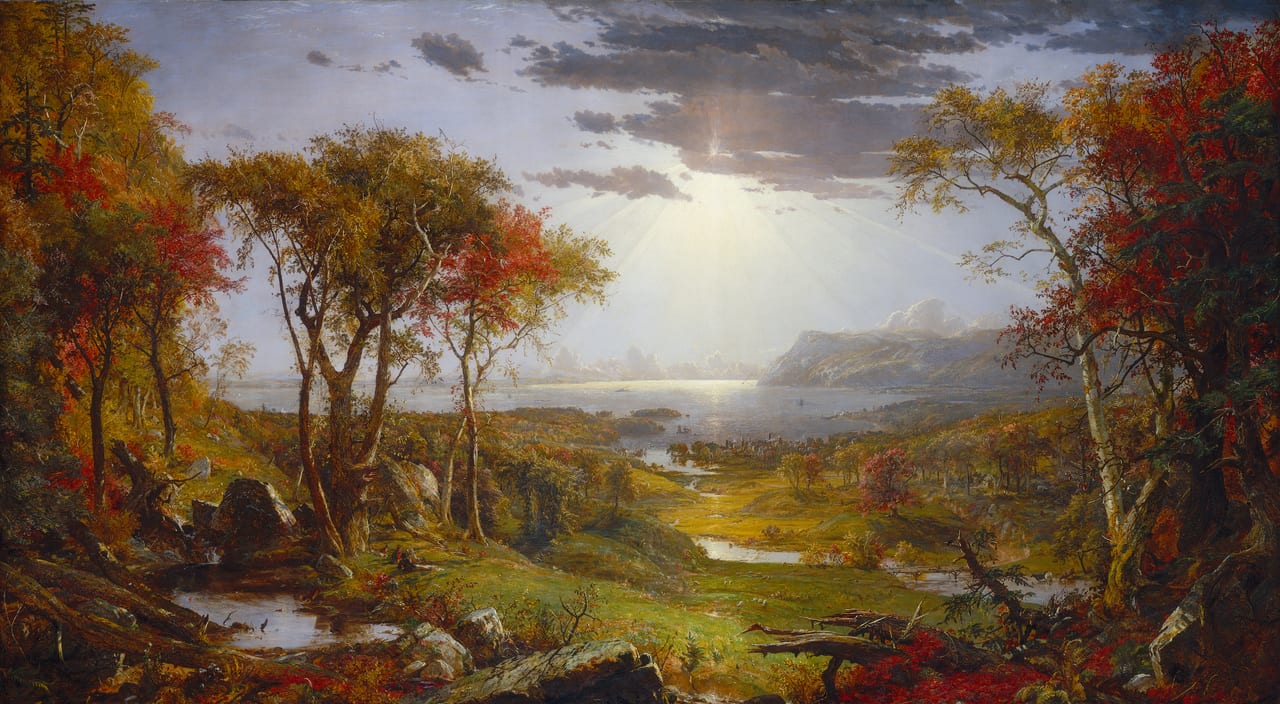
Jasper Francis Cropsey
Painted from memory in Cropsey’s London studio, the view looks southeast from high ground toward the distant Hudson and the flank of Storm King Mountain; hunters and their dogs gaze into the sunlight, and along the stream are signs of a peaceful life on the land. Many British viewers had never seen such colourful fall foliage, and Cropsey showed real North American leaves beside the painting to convince the sceptical.
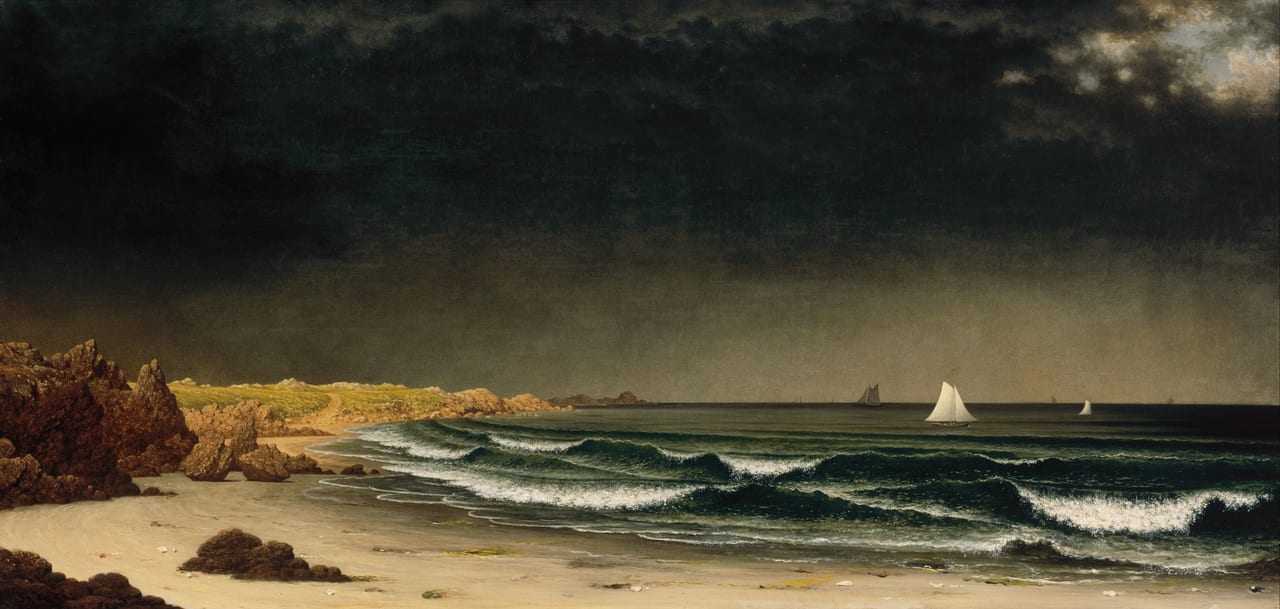
Martin Johnson Heade
Many of Heade’s coastal scenes of the late 1850s and early 1860s, this one among them, show dark waters and skies that suggest a coming storm, a theme art historians have read as his expression of the imminent Civil War. His later landscapes are less ominous, with glowing, calm skies and brilliant sunsets over salt marshes and haystacks.
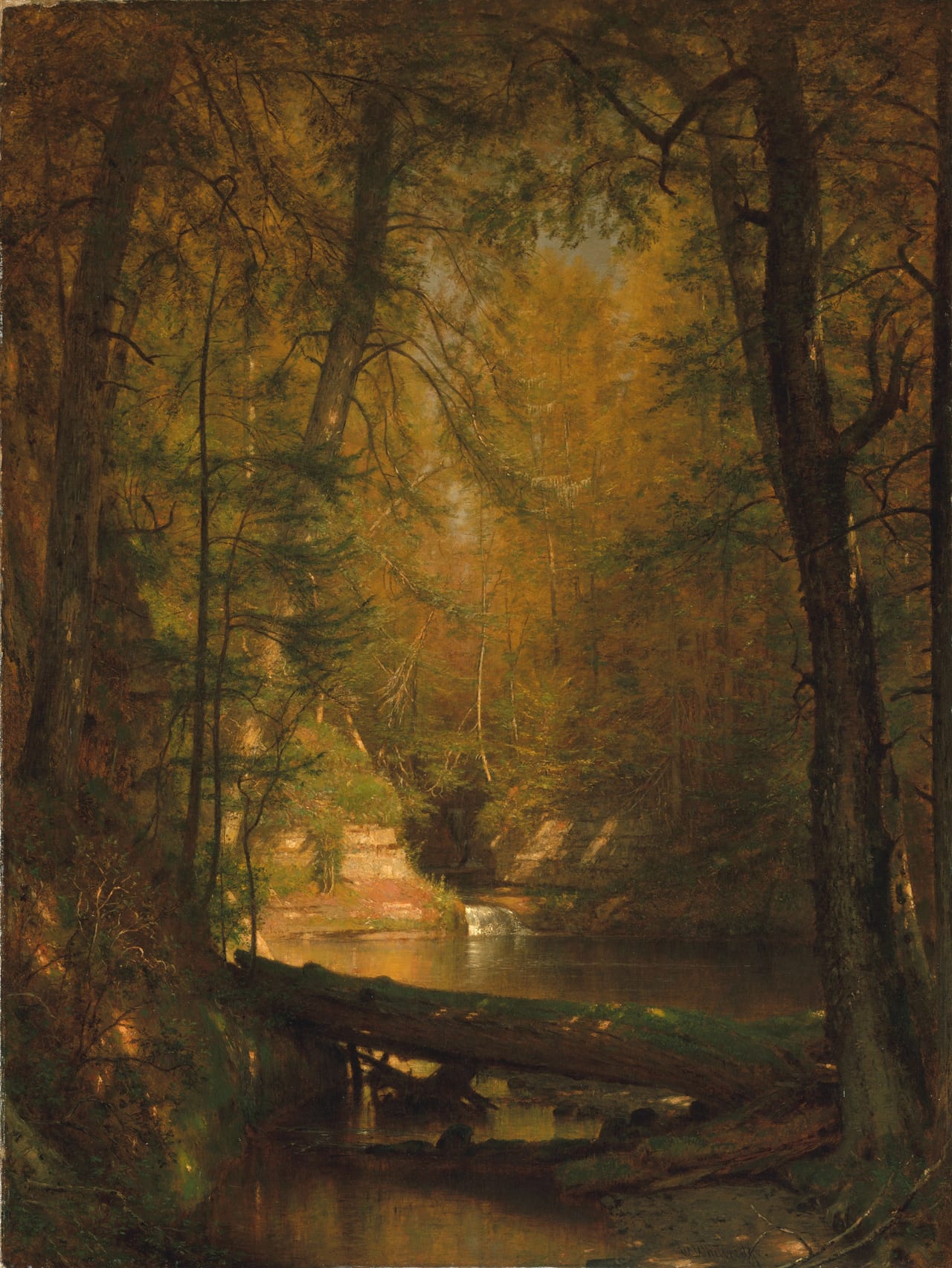
Worthington Whittredge
One of the poetic forest scenes that are Whittredge’s most characteristic works, deep in feathery fern and mossy rock and lit by light filtered through leaves. He had spent about five years in Düsseldorf, where he posed for Emanuel Leutze as George Washington in Washington Crossing the Delaware, and on his return in 1859 he took a space in the Tenth Street Studio and won almost immediate recognition.
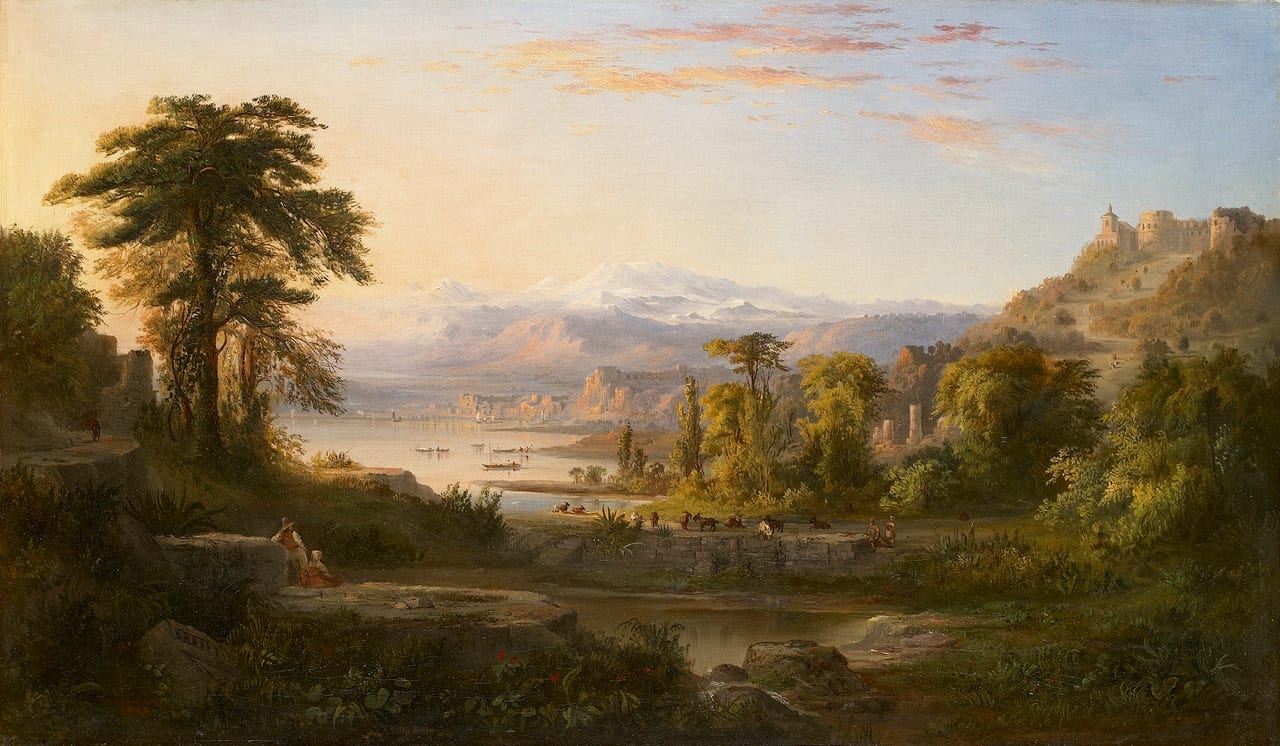
Robert S. Duncanson
Inspired by Thomas Cole and other American landscape painters, Duncanson is considered a second-generation Hudson River School artist. He spent most of his career in Cincinnati, where he helped develop the Ohio River Valley landscape tradition, and as a free Black man in antebellum America he looked to abolitionists in America and England to support his work. He is considered the first African-American artist to be internationally known.
Artworks
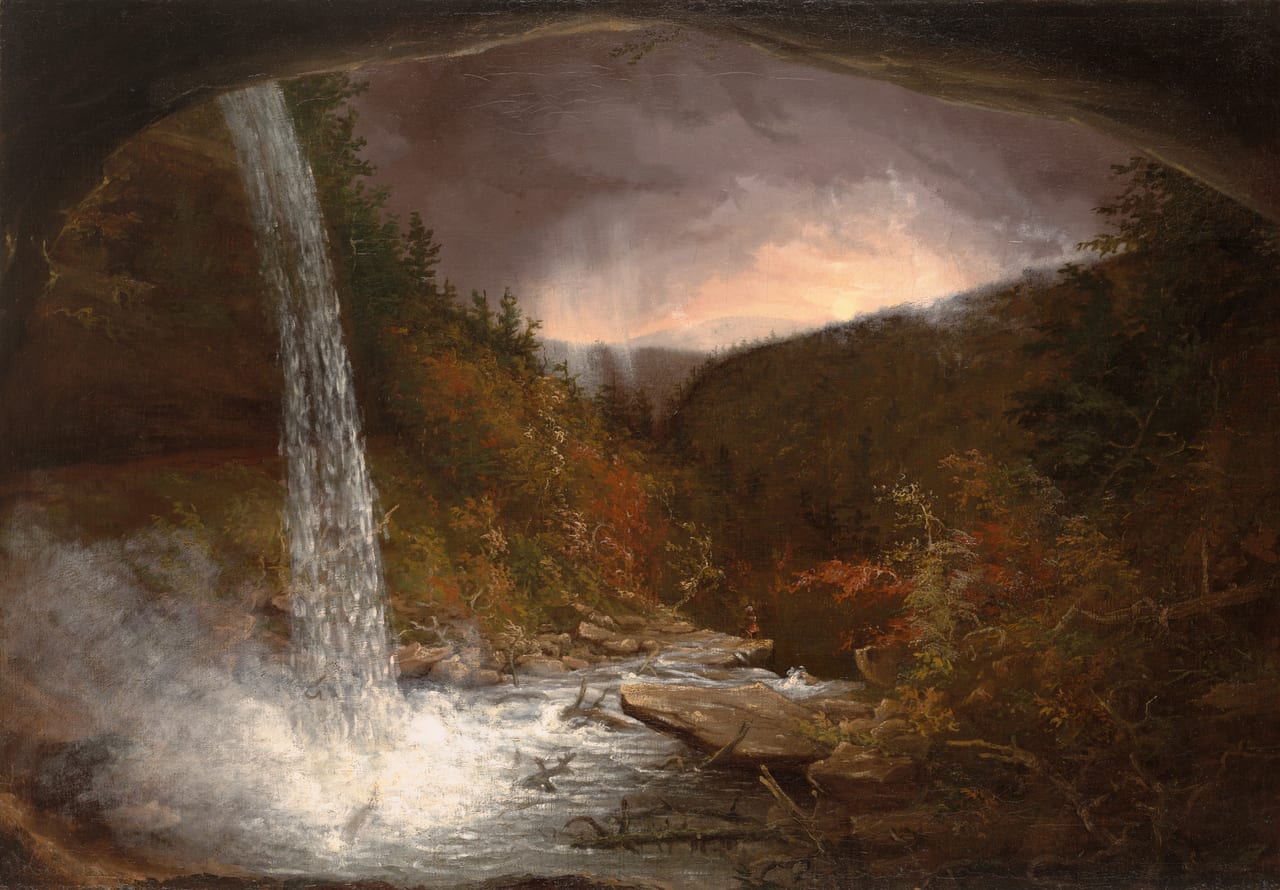
Kaaterskill Falls
Thomas Cole · 1826
Wadsworth Atheneum Museum of Art
Cole’s view of the Kaaterskill Falls in upstate New York, commissioned by Daniel Wadsworth in 1826 and bequeathed by him to the Wadsworth Atheneum in 1848, where it remains.
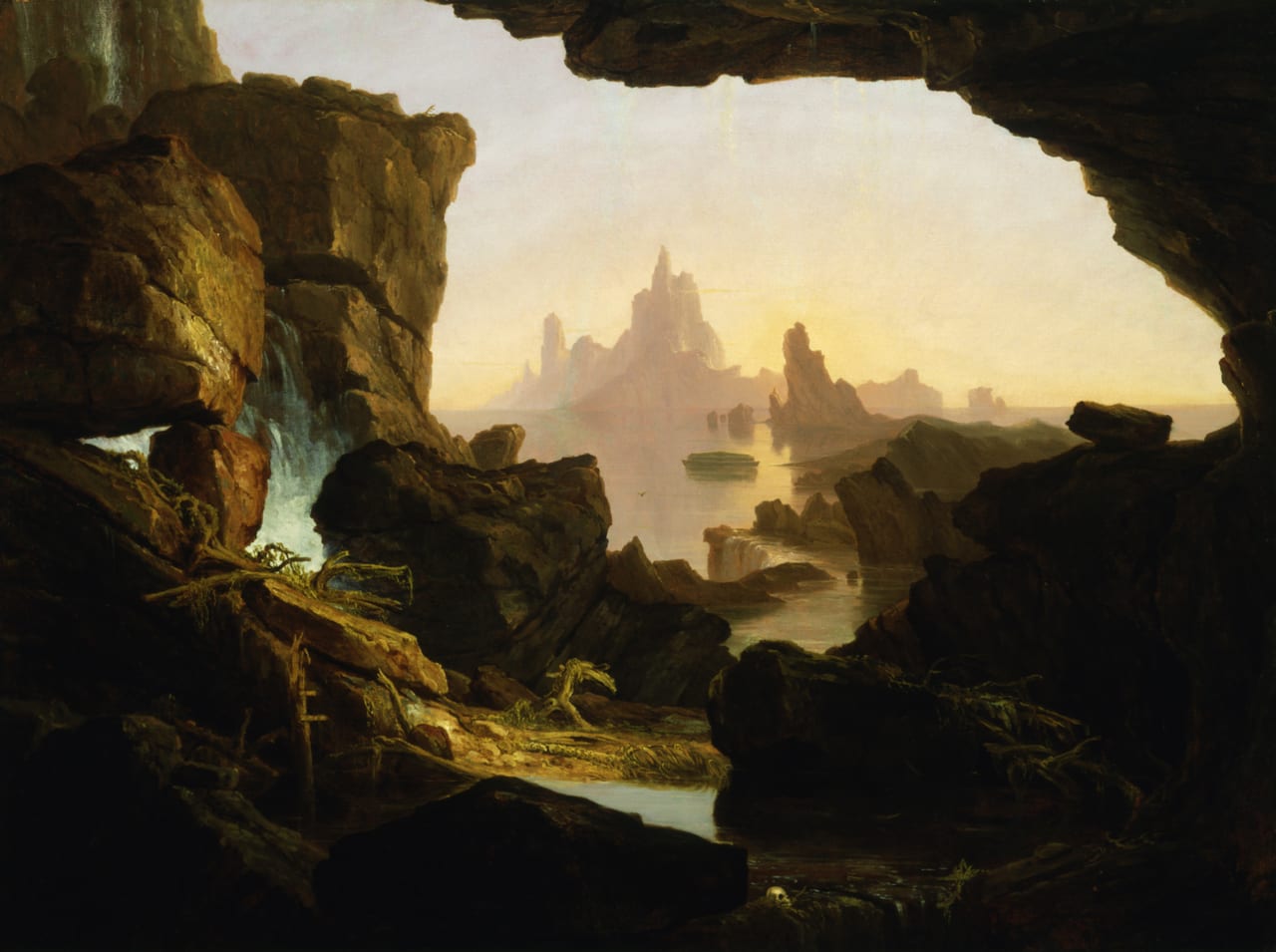
The Subsiding of the Waters of the Deluge
Thomas Cole · 1829
Smithsonian American Art Museum
The aftermath of the Flood, with a cavern framing the view of a barren, rocky coast. A waterfall made by the receding waters flows toward the sea, and debris lies on the coast: broken trees, a destroyed mast, even a skull. The land has been stripped of soil, and in the bright distance an ark floats and a dove flies. Cole gathered notes on geology and consulted scientists such as Benjamin Silliman before he painted it. Shown at the National Academy of Design in 1829 and 1831, it was then lost until 1974.
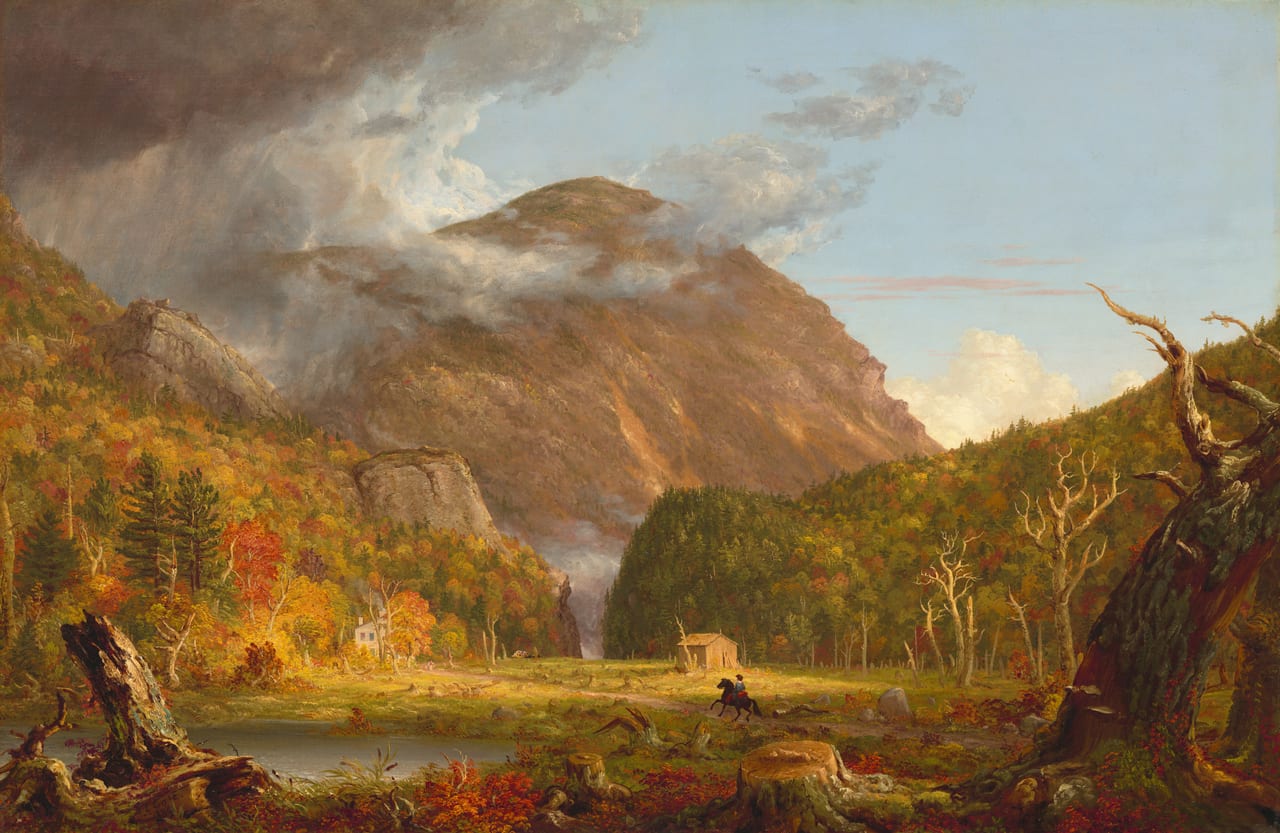
A View of the Mountain Pass Called the Notch of the White Mountains (Crawford Notch)
Thomas Cole · 1839
National Gallery of Art, Washington
Commissioned by Rufus L. Lord in 1839, Cole’s view of Crawford Notch in New Hampshire’s White Mountains glows with autumn colour. Here in 1826 a landslide drove a family from their home, and the next night they died in an avalanche; Cole set tiny figures on horseback, in a stagecoach and outside the white inn against the looming mountains, under threatening storm clouds.
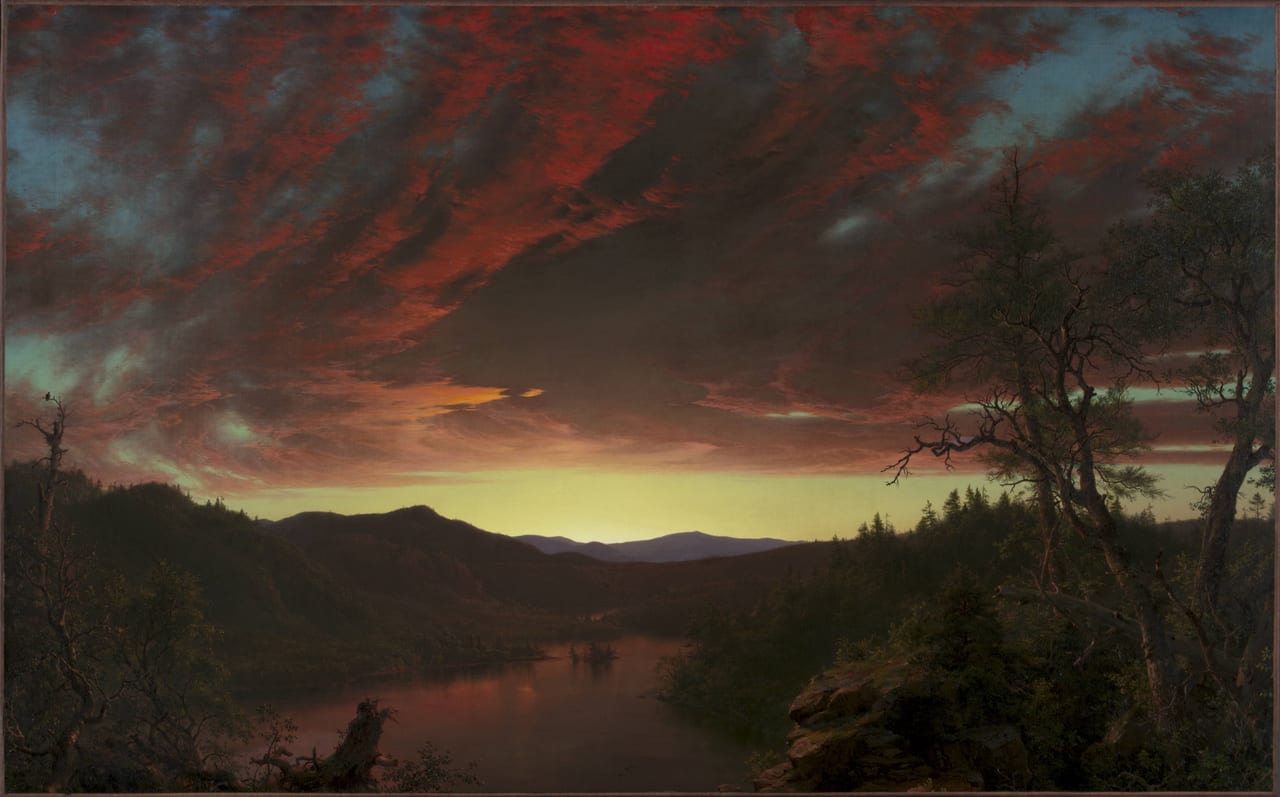
Twilight in the Wilderness
Frederic Edwin Church · 1860
Cleveland Museum of Art
A blazing sunset over the wilderness near Mount Katahdin in Maine, painted in Church’s New York studio from sketches made nearly two years before. There is no sign of human activity; the only animal is a small bird at the left. Made on the eve of the Civil War, it can be read as evoking the coming conflict. Church showed it by itself at a prestigious gallery rather than in an annual exhibition, and several hundred people came in its seven-week run.
The Icebergs
Frederic Edwin Church · 1861
Dallas Museum of Art
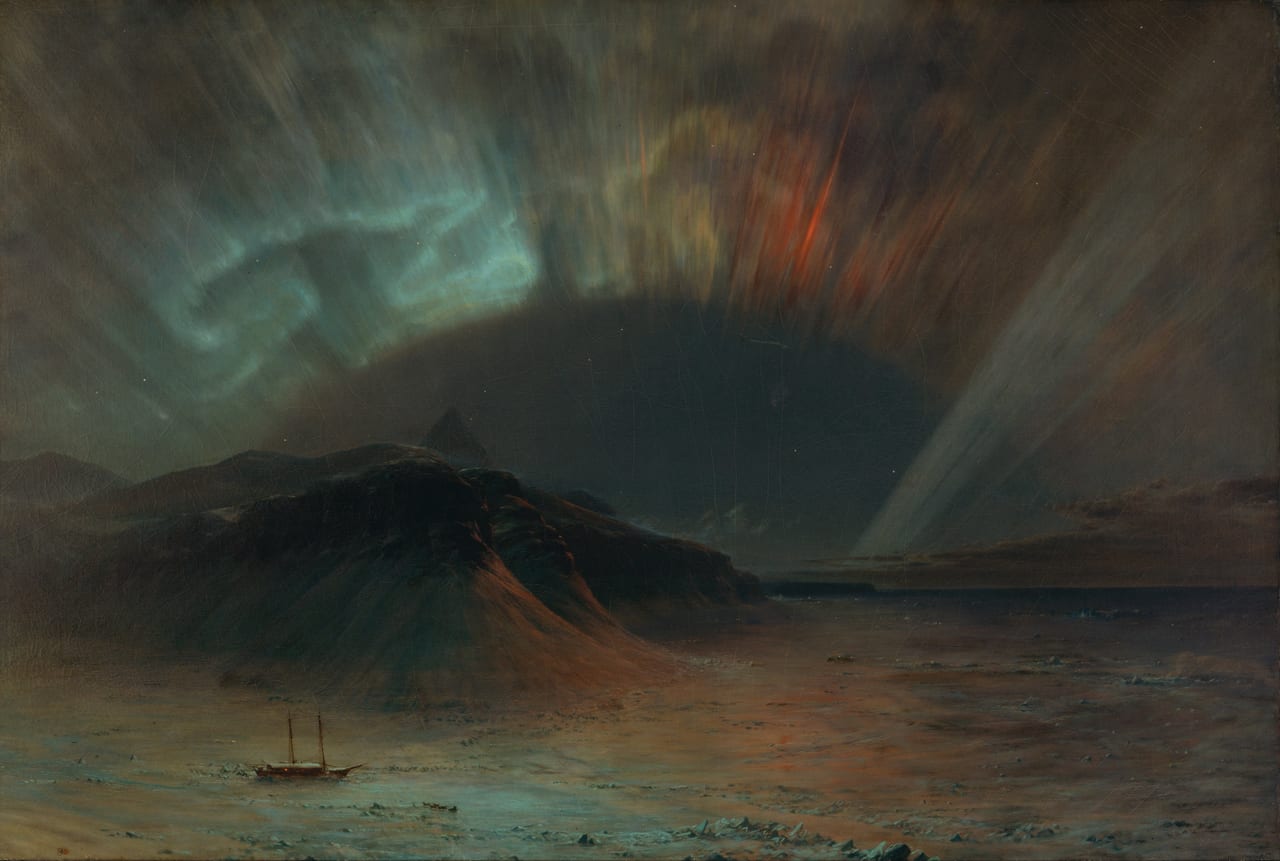
Inspired by Church’s voyage of 1859 around Newfoundland and Labrador and considered one of his “Great Pictures”, the painting shows one or more icebergs in the afternoon light of the Arctic. Between its American and English showings he added the ship’s mast and changed its title from The North. Sold in England, it dropped from view after its buyer died in 1901 and was rediscovered in a house in Manchester in 1979; it is now in the Dallas Museum of Art.
Cotopaxi
Frederic Edwin Church · 1862
Detroit Institute of Arts
The Ecuadorian volcano spews smoke and ash across a coloured sunrise. Commissioned by the collector James Lenox and first shown in New York in 1863, the painting was seen by some as a parable of the Civil War, light set against darkness. Church first painted Cotopaxi in 1853 and made at least ten paintings of it in all; some art historians have called this one the apex of the series.
Looking Down Yosemite Valley, California
Albert Bierstadt · 1865
Birmingham Museum of Art
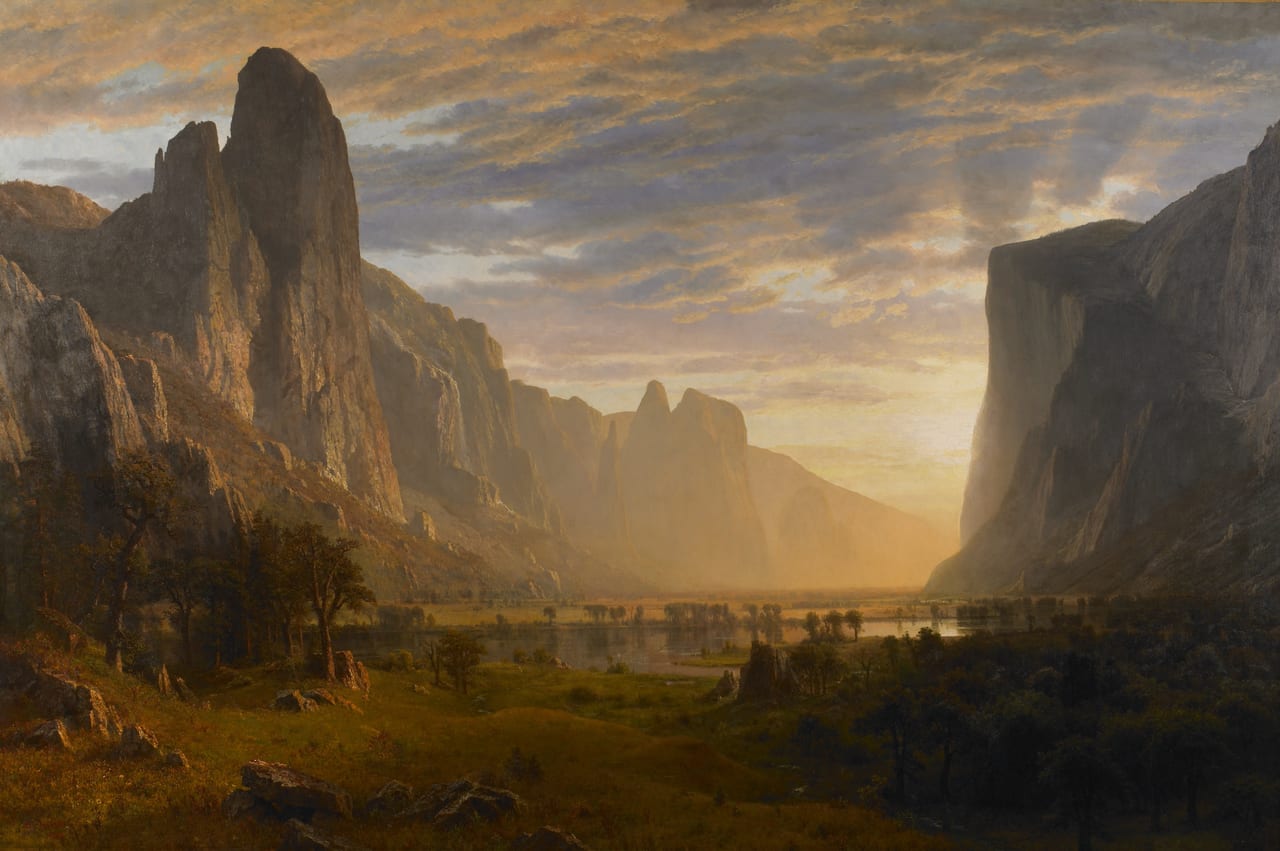
Bierstadt’s first large picture of Yosemite, the subject that would make him well known, painted from sketches of 1863. He looks due west down the valley from just above the Merced River, with El Capitan on the right, Sentinel Rock on the left and the spire of Middle Cathedral Rock in the distance.
A Storm in the Rocky Mountains, Mt. Rosalie
Albert Bierstadt · 1866
Brooklyn Museum
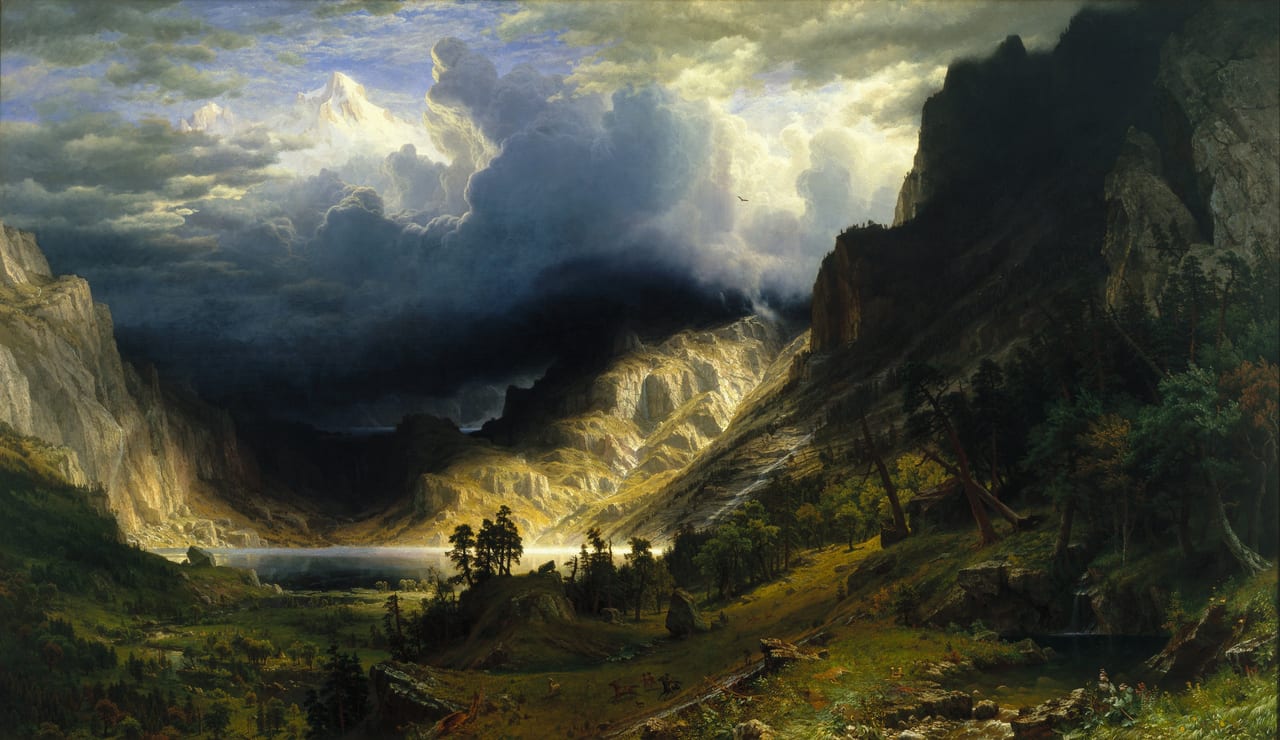
Painted from sketches of Bierstadt’s second journey west in 1863, a journey that brought him up to the Chicago Lakes, below Mount Blue Sky, in the Colorado Rockies. Its title honours Rosalie Osborne Ludlow, who was Bierstadt’s mistress and, at that time, his friend’s wife; Bierstadt had set out on the 1863 journey with her husband, his friend Fitz Hugh Ludlow. Bierstadt later married Ludlow’s wife. The canvas, 210.8 by 361.3 centimetres, has been in the Brooklyn Museum since 1976.
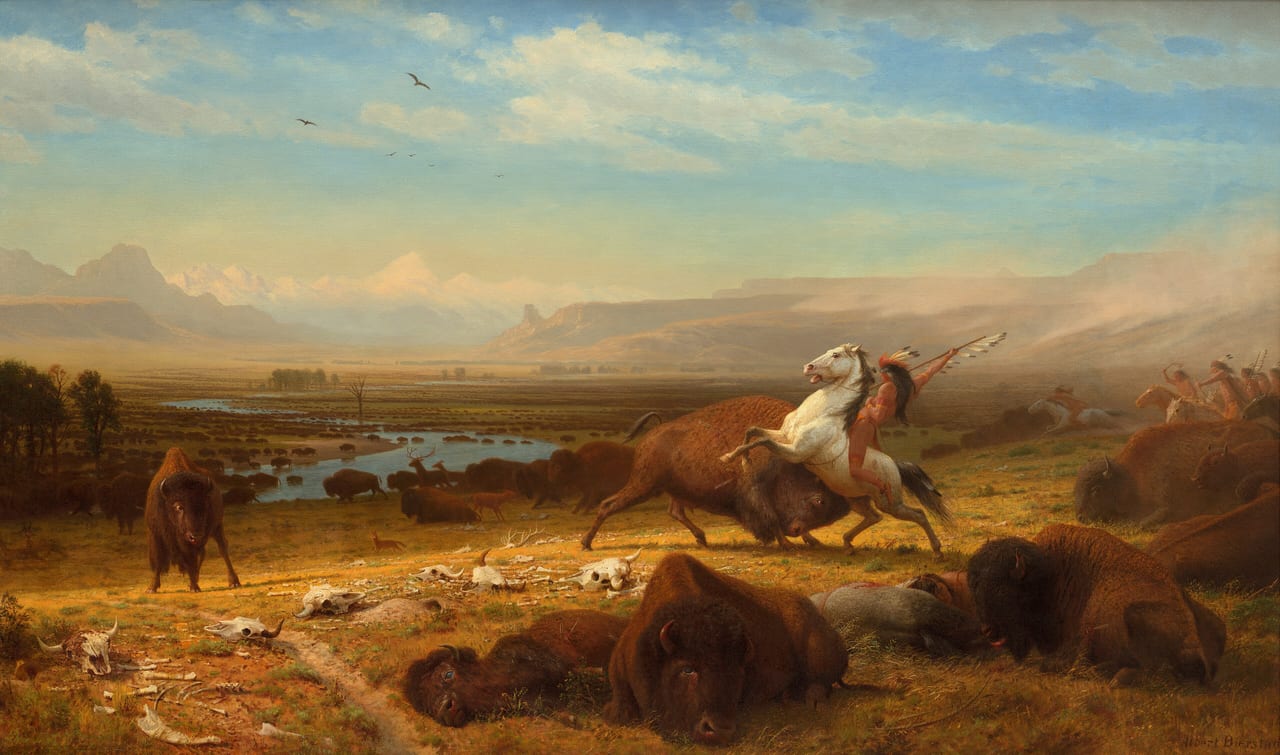
The Last of the Buffalo
Albert Bierstadt · 1888–1889
National Gallery of Art, Washington
Bierstadt’s last large canvas: Native Americans on horseback hunt buffalo before a vast plain and snow-covered peaks, a scene put together from things he had sketched on his expeditions west. It can be read as a melancholy reflection on the westward expansion of the United States, when hunting had brought the buffalo close to extinction.
Sources
- Britannica, “Hudson River school”
- Wikipedia, “Hudson River School”
- National Gallery of Art, “Hudson River School”
- Britannica, “Thomas Cole”
- Wikipedia, “Thomas Cole”
- Wikipedia, “The Oxbow”
- Wikipedia, “Kaaterskill Falls (painting)”
- Wikipedia, “The Subsiding of the Waters of the Deluge”
- National Gallery of Art, “A View of the Mountain Pass Called the Notch of the White Mountains (Crawford Notch)”
- Britannica, “Asher B. Durand”
- Wikipedia, “Asher Brown Durand”
- Crystal Bridges Museum of American Art, “Kindred Spirits”
- Wikipedia, “Kindred Spirits (painting)”
- Britannica, “Frederic Edwin Church”
- Wikipedia, “Frederic Edwin Church”
- National Gallery of Art, “Niagara”
- National Gallery of Art, “The 19th-Century Blockbuster: Frederic Edwin Church’s ‘Niagara’”
- Wikipedia, “The Heart of the Andes”
- Wikipedia, “The Icebergs”
- Cleveland Museum of Art, “Twilight in the Wilderness”
- Wikipedia, “Twilight in the Wilderness”
- Wikipedia, “Cotopaxi (painting)”
- Britannica, “John Frederick Kensett”
- Wikipedia, “John Frederick Kensett”
- Wikipedia, “Lake George (John Frederick Kensett)”
- Wikipedia, “Sanford Robinson Gifford”
- Wikipedia, “Luminism (American art style)”
- Britannica, “Jasper Francis Cropsey”
- Wikipedia, “Jasper Francis Cropsey”
- National Gallery of Art, “Autumn – On the Hudson River”
- Britannica, “Martin Johnson Heade”
- Wikipedia, “Martin Johnson Heade”
- Britannica, “Worthington Whittredge”
- Wikipedia, “Worthington Whittredge”
- Wikipedia, “The Trout Pool (Worthington Whittredge)”
- Britannica, “Albert Bierstadt”
- Wikipedia, “Albert Bierstadt”
- Wikipedia, “The Rocky Mountains, Lander’s Peak”
- Wikipedia, “A Storm in the Rocky Mountains, Mt. Rosalie”
- Wikipedia, “Looking Down Yosemite Valley, California”
- Wikipedia, “The Last of the Buffalo”
- Smithsonian American Art Museum, “Thomas Moran”
- Wikipedia, “Thomas Moran”
- Wikipedia, “The Grand Canyon of the Yellowstone (1872)”
- Wikipedia, “Robert S. Duncanson”
- The Heart of the Andes — Public domain via Wikimedia Commons (Public domain)
- The Oxbow — Public domain via Wikimedia Commons (Public domain)
- Kindred Spirits — Public domain via Wikimedia Commons (Public domain)
- Niagara — CC0 via Wikimedia Commons (CC0)
- The Rocky Mountains, Lander’s Peak — Public domain via Wikimedia Commons (Public domain)
- The Grand Canyon of the Yellowstone — Public domain via Wikimedia Commons (Public domain)
- A Gorge in the Mountains (Kauterskill Clove) — Public domain via Wikimedia Commons (Public domain)
- Lake George — Public domain via Wikimedia Commons (Public domain)
- Autumn – On the Hudson River — Public domain via Wikimedia Commons (Public domain)
- Approaching Storm: Beach near Newport — Public domain via Wikimedia Commons (Public domain)
- The Trout Pool — Public domain via Wikimedia Commons (Public domain)
- A Dream of Italy — Public domain via Wikimedia Commons (Public domain)
- Kaaterskill Falls — Public domain via Wikimedia Commons (Public domain)
- The Subsiding of the Waters of the Deluge — Public domain via Wikimedia Commons (Public domain)
- A View of the Mountain Pass Called the Notch of the White Mountains (Crawford Notch) — Public domain via Wikimedia Commons (Public domain)
- Twilight in the Wilderness — Public domain via Wikimedia Commons (Public domain)
- The Icebergs — Public domain via Wikimedia Commons (Public domain)
- Cotopaxi — Public domain via Wikimedia Commons (Public domain)
- Looking Down Yosemite Valley, California — Public domain via Wikimedia Commons (Public domain)
- A Storm in the Rocky Mountains, Mt. Rosalie — Public domain via Wikimedia Commons (Public domain)
- The Last of the Buffalo — Public domain via Wikimedia Commons (Public domain)
Invite Hudson River School into your living room