July, from the Très Riches Heures du duc de Berry
Limbourg brothers

International Gothic
Burgundy, France and northern Italy
In the late fourteenth and early fifteenth centuries illuminated manuscripts and other portable works carried ideas across Europe, and artists and their patrons came to share a taste that wore down the differences between national styles: elegance in place of monumentality, rich decorative colour, elongated figures and flowing lines. This courtly manner first arose in Burgundy, in France and in northern Italy, and spread very widely across western Europe; the French art historian Louis Courajod gave it the name International Gothic at the end of the nineteenth century. Gentile da Fabriano’s Adoration of the Magi, unveiled in Florence in 1423, has been called “the culminating work of International Gothic painting”.
Courts, Prague and Avignon
The style started as one of courtly sophistication, and somewhat sturdier versions of it later reached the art paid for by the rising merchant classes and the lesser nobility. It drew above all on northern France, Burgundy, Flanders and Brabant, the emperor’s court at Prague, and Italy. Art historians do not all use the term in the same way, some more narrowly than others, and some find it of limited help “since it tends to skate over both differences and details of transmission.”
In Prague the court of the Holy Roman Emperor Charles IV produced an important Bohemian version of the style, and for a brief time became a leading force in the development of European art. Charles had been tutored by the future Pope Clement VI, had spent seven years of his youth at the French court and had twice visited Italy, and this upbringing and family ties gave him close links with the French courts, with the papacy at Avignon and, from 1363, with the Valois Duchy of Burgundy of Philip the Bold. At first the Bohemian manner had none of the elongated figures found elsewhere, but its women had a richness and sweetness that carried great influence.
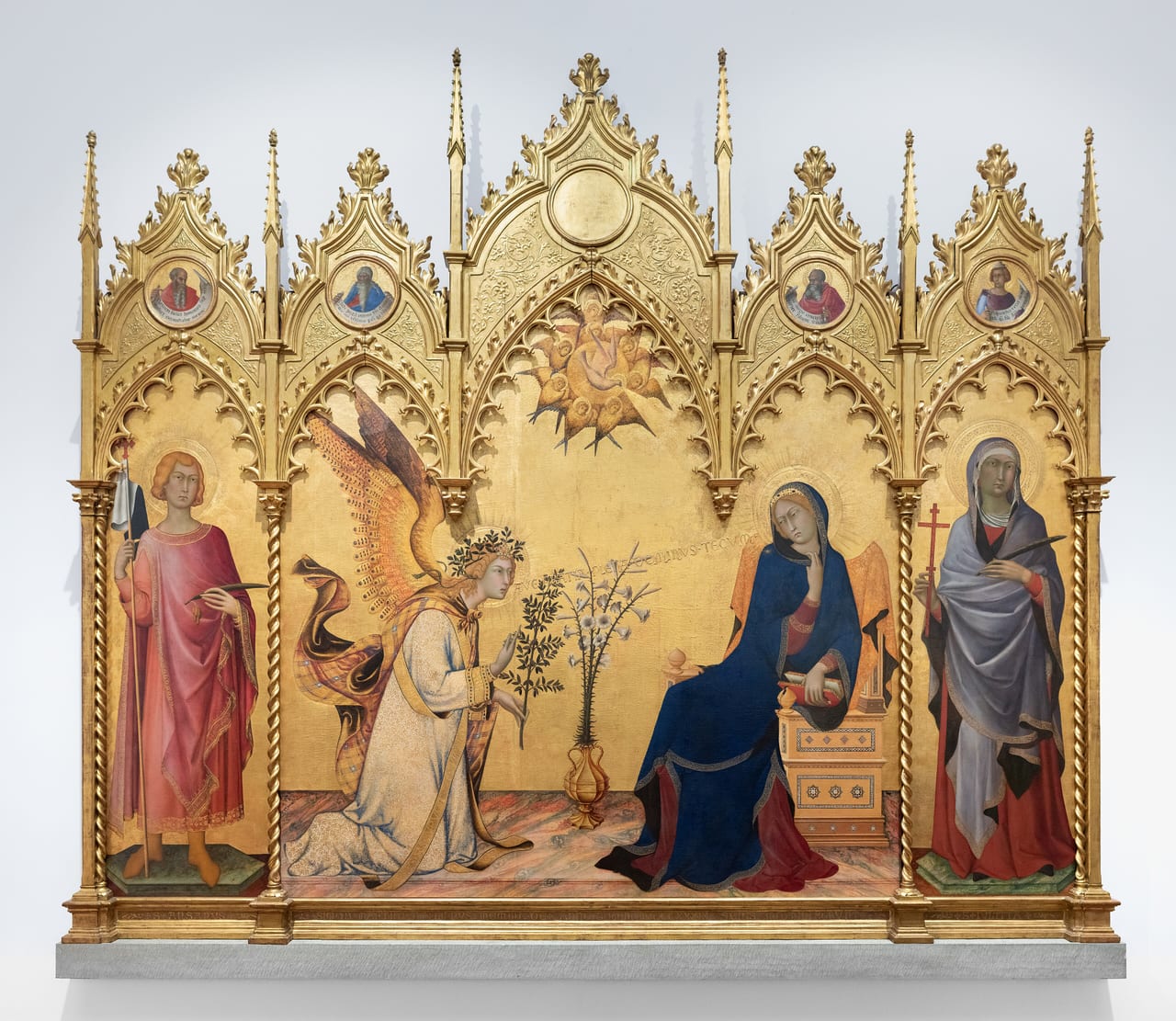
Much of the style’s growth took place in Italy. It probably reached France partly through the Italian painters attached to the papal court at Avignon, and through the works of Simone Martini displayed there in the 1330s and 1340s; the Sienese painter counts as a precursor of the style, and his manner is soft, stylised and decorative, with sinuous line and courtly elegance; his art owes much to French manuscript illumination and ivory carving, and painters in Naples, Pisa, Orvieto, Assisi and Avignon took up his art. The style did not radiate from a single centre, as Gothic art had from the Île-de-France, but grew out of a dialogue between European courts, in which the papal court, above all at Avignon, played a prominent part as a true centre of gathering and exchange for artists from all over the continent. Republican Siena kept to its own dignified Gothic manner throughout.
In Italy the most important centre of the courtly style was the flamboyant Visconti court at Milan, itself closely tied to the French royal family. Under Gian Galeazzo Visconti, in power from 1374 to 1402, Giovannino de’ Grassi decorated a prayer book, the Hours of Gian Galeazzo Visconti, with linear elegance, naturalistic accuracy and precious decoration. The next generation, Michelino da Besozzo above all, carried that legacy further, and in the Offiziolo Bodmer Michelino used a flowing line, soft colours and fresh details taken from direct observation. Votive portraits of monarchs beside a sacred figure are among the central works of the style, and the period has left the earliest surviving panel portraits of monarchs.
Berry, Burgundy and the north
The most extravagant patron of manuscripts was John, Duke of Berry, son and brother of kings of France, and the main employer of Jacquemart de Hesdin, the Master of the Brussels Initials and the Limbourg brothers. The three Limbourg brothers, born at Nijmegen in the 1380s, were nephews of Jean Malouel, court painter to the queen of France and to the duke of Burgundy, who helped them to positions at court. They were among the first illuminators to paint particular places, such as their patron’s castles, with accuracy and sensitivity. Their Très Riches Heures du duc de Berry, made between about 1412 and 1416 and left unfinished at their deaths in 1416, was completed by Jean Colombe about 1485; it is one of the landmarks of book illumination, and it did much to influence the course of Early Netherlandish art in the fifteenth century.
Burgundy had its own painters: Jean Malouel, Melchior Broederlam and Henri Bellechose, followed by Robert Campin and Jan van Eyck, who led Early Netherlandish painting towards greater illusionism. Broederlam became court painter to Louis de Mâle in 1381 and, once Louis died in 1384, served Philip the Bold, his son-in-law and successor, though he stayed based in Ypres; the duke made him valet de chambre in 1387 and court painter in 1391. He did much work, mostly decorative, at Philip’s now vanished château at Hesdin, whose elaborate mechanical devices needed painting. In sculpture Claus Sluter, the leading sculptor in Burgundy, could use the style to strongly monumental effect.
Between about 1390 and 1420 works produced far apart in Europe came especially close to one another. The Limbourg brothers’ miniatures in the Très Riches Heures, Lorenzo Monaco’s Adoration of the Magi in Italy, and sculpture and miniatures in many countries share very stylised, tall, swaying figures, older men with imposingly long beards among them. Biblical figures wear exotic clothes based loosely on those of the Middle East or the Byzantine Empire, and many seem to be there only to show the costumes off; standard religious scenes fill with people, the Magi gain large retinues, and the Crucifixion often becomes a crowd. That crowding outlived the style itself.
England’s chief contribution came in illuminated manuscripts such as the Sherborne Missal, besides John Thornton’s stained glass in York Minster and Thomas Glazier’s in Oxford. Tapestry was a further vehicle of the style, woven at Arras, Tournai and Paris, where the English occupation of 1418 to 1436 left production permanently disordered. Under the steady patronage of the Dukes of Burgundy, the tapestries’ courtly manner, with elongated figures, rich detail of dress and crowded compositions of figures set in tiers, drew on manuscript illuminators and directly on painters: Baudouin de Bailleul, a painter settled at Arras, supplied cartoons for the workshops there and at Tournai. In the fifteenth century the cities of Flanders, Bruges above all, came to outstrip Paris in both manuscript illumination and panel painting.
Florence, Cologne and Catalonia
Gentile da Fabriano was working in Venice about 1405, and in 1409 he was commissioned to paint historical frescoes in the Doge’s Palace there, which Pisanello later completed. From 1414 to 1419 he worked in Brescia for Pandolfo III Malatesta, and by August 1420 he was in Florence. In 1427 he arrived in Rome, where Pope Martin V commissioned him to decorate the nave of St John Lateran, and he died there that year, before 14 October.
Lorenzo Monaco, born Piero di Giovanni around 1372, was the last great representative of late Gothic painting in Italy. As Don Lorenzo he gave himself to religious study in a strictly cloistered Camaldolese house until 1395 or 1396, when he left to pursue a career as a painter, and he then worked in Florence for almost thirty years. He favoured elongated figures in brightly coloured garments, and in his later years his landscapes and architecture grew more fantastical; the more naturalistic approaches of his younger contemporaries failed to interest him.
Pisanello was Gentile’s assistant between 1415 and 1420, and from him took a refined, delicate and detailed manner and a taste for precious materials and beautiful fabrics. He was employed by the Doge of Venice, the Pope and the courts of Verona, Ferrara, Mantua, Milan and Rimini, and by the King of Naples, and he took the style into the Early Renaissance. In Florence the unveiling of Gentile’s Adoration of the Magi in 1423 was followed almost at once by Masolino and Masaccio’s painting of the Brancacci Chapel, from 1424 to 1426, recognised as a breakthrough to a new style. Outside Florence and the leading courts, though, International Gothic still held sway, and in northern Europe Late Gothic continuations of it, above all in decoration, could still be found until the early sixteenth century.
In Cologne, where he settled about 1430, Stefan Lochner joined naturalism to a masterly sense of colour and design. In Catalonia Lluís Borrassà, employed by the Crown of Aragon, is widely considered to have brought the International Gothic style of painting into the Principality; the workshop he set up in Barcelona in 1390 was the city’s largest until 1420. Joan Mates, at work in Catalonia between 1391 and 1431, painted within the international Catalan Gothic style that grew up around Borrassà, and Bernat Martorell, who died in Barcelona in 1452, is considered the most important artist of the International Gothic style in Catalonia.
Artists
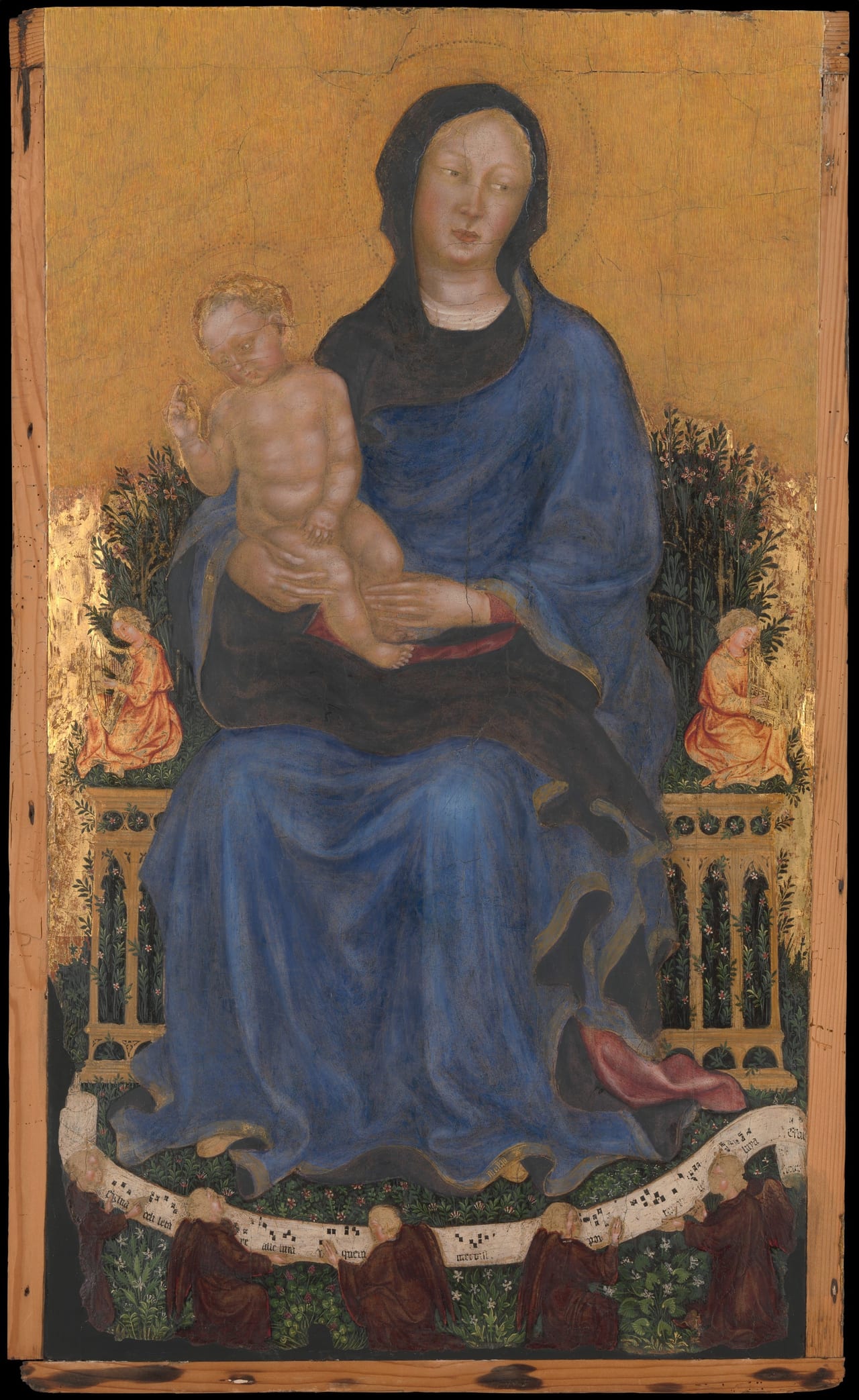
Gentile da Fabriano
The Quaratesi Polyptych of 1425, among the Madonnas of Gentile da Fabriano, has Mother and Child, in regal dress, sitting on the ground in a garden. Born around 1370 in or near Fabriano, in the Marche, Gentile stood first among the painters of central Italy as the fifteenth century began, and the few works of his that survive rank with the finest of the International Gothic style. Around 1390 he was at the court of Gian Galeazzo Visconti in Pavia. After a visit to Florence in 1419 he came into contact with humanism, and his detailed renderings of what he observed in the natural world made him highly influential on painters there.
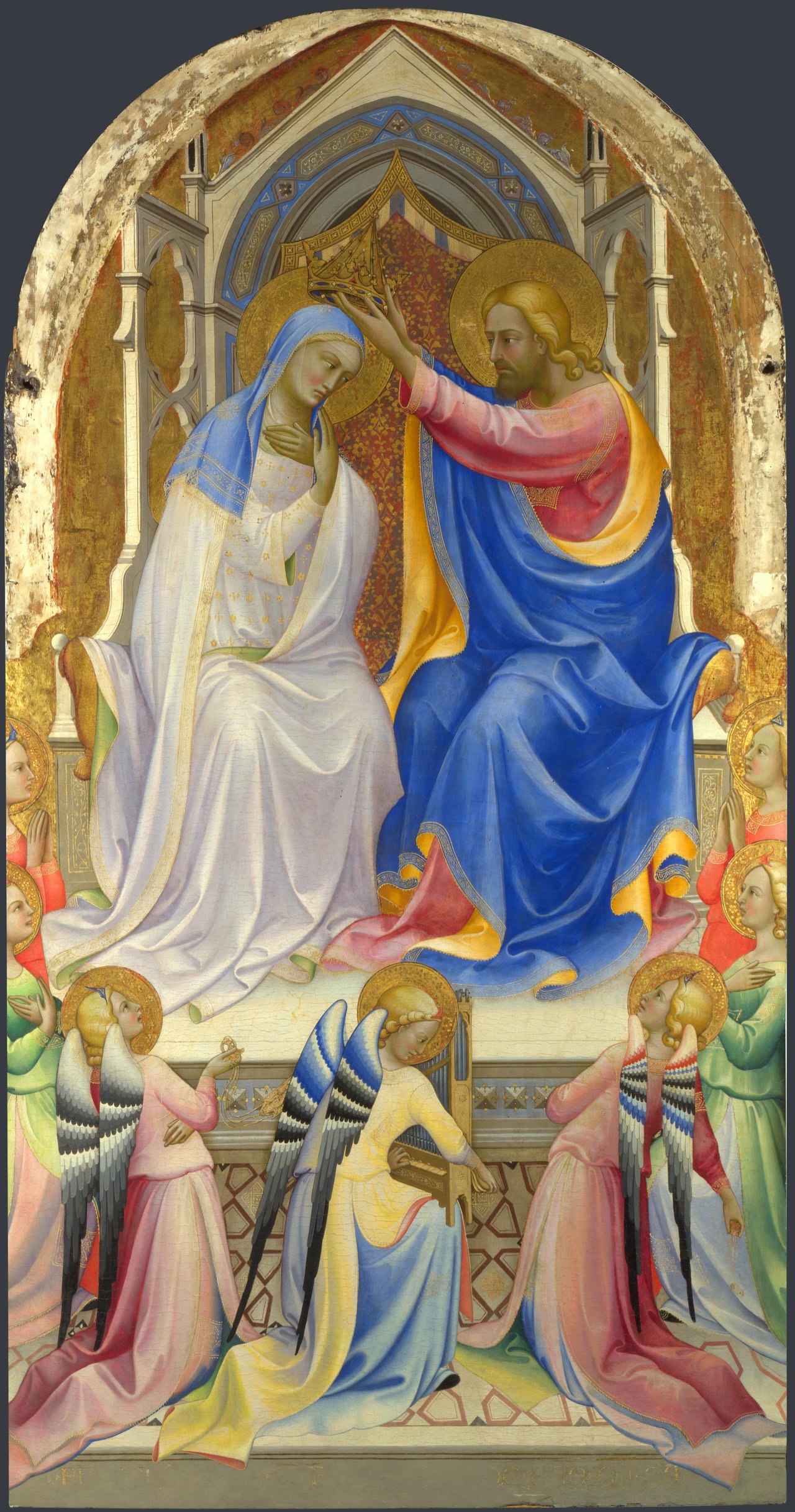
Lorenzo Monaco
Lorenzo Monaco painted this panel between 1407 and 1409 as the centre of a huge altarpiece for the high altar of San Benedetto fuori della Porta Pinti, a monastery in Florence; a Florentine citizen, Luca Pieri Rinieri Berri, commissioned it and was to pay almost the whole cost. Seated on a delicate throne, Christ places a jewelled and gilded crown on his mother’s head while angels kneel, swinging censers and making music. Christ’s blue mantle is painted with lapis lazuli, dearer than gold, and the Virgin’s robe has faded almost entirely from a deep pinkish mauve to white. The altarpiece’s main panels are in the National Gallery.
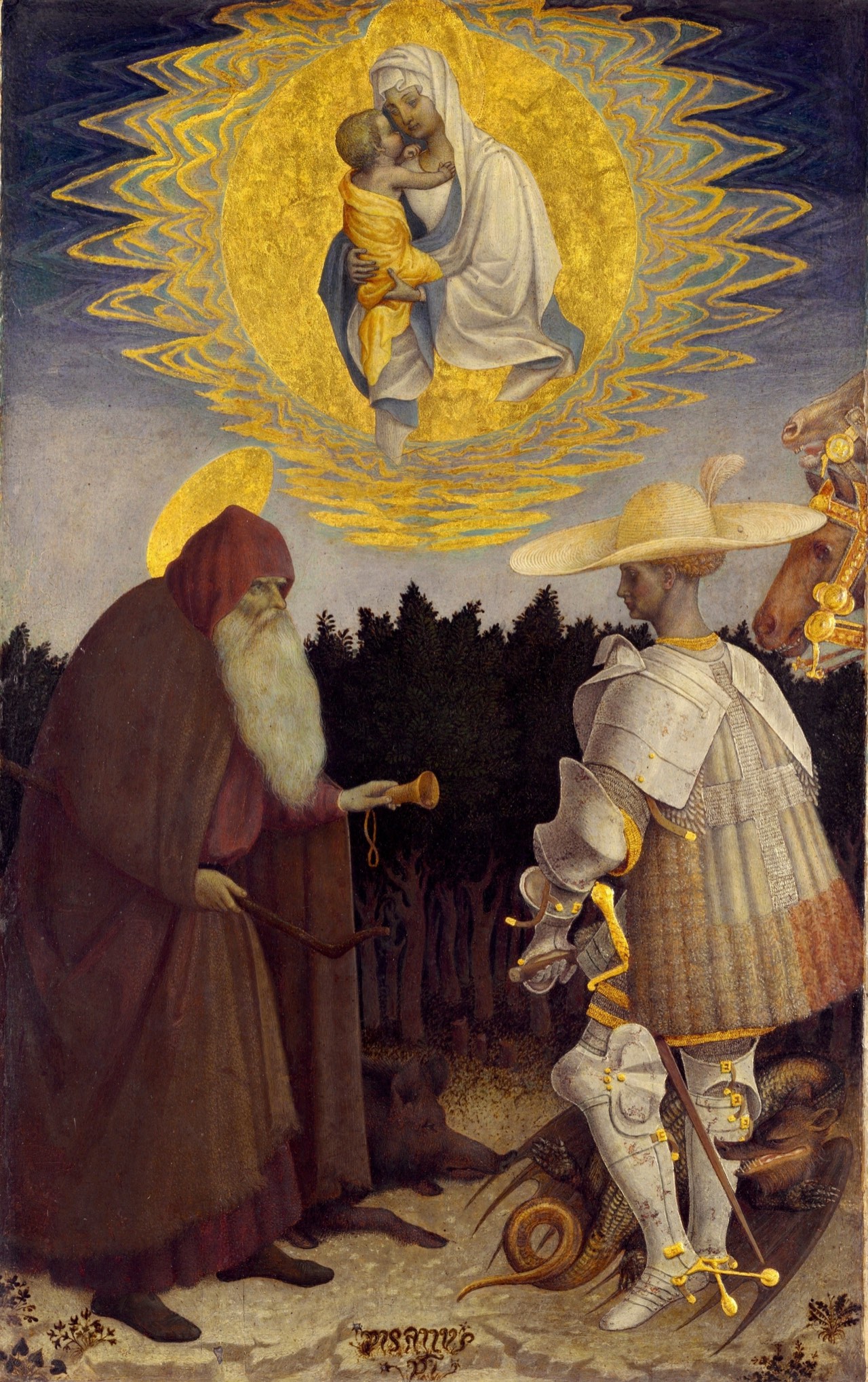
Pisanello
Pisanello’s only surviving signed work, and one of only four panel paintings certainly by him. At the top the Virgin and Child embrace within a burst of gilded sunlight; on the left, Saint Anthony Abbot rings his bell and glowers at Saint George, an elegant knight in fifteenth-century armour and a stylish straw hat in the French fashion of the day, with a dragon curled around his legs. Its small scale suggests it was meant for private enjoyment. Sir Charles Eastlake, the National Gallery’s first director, bought it in 1862, and Lady Eastlake presented it in his memory in 1867.
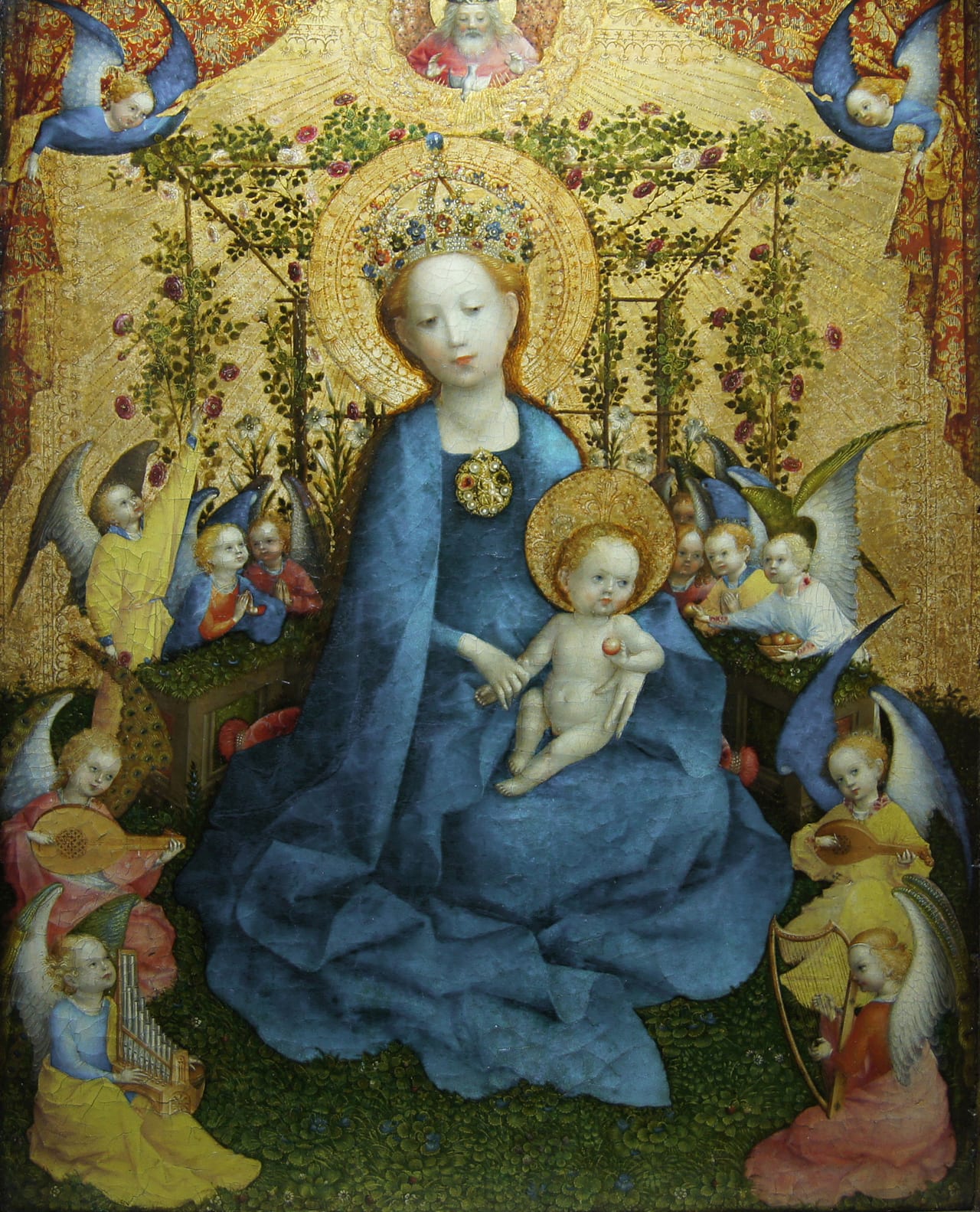
Stefan Lochner
Stefan Lochner was born about 1410 at Meersburg on Lake Constance; he is thought to have studied in the Netherlands, though little is known of his early life. His chief work is the great altarpiece for the town hall that Dürer much admired, and in 1447 he joined the town council. His harmonious colour schemes are one reason he is usually described as one of the last exponents of International Gothic. The Madonna of the Rose Bower, painted on wood, is in the Wallraf-Richartz-Museum in Cologne.
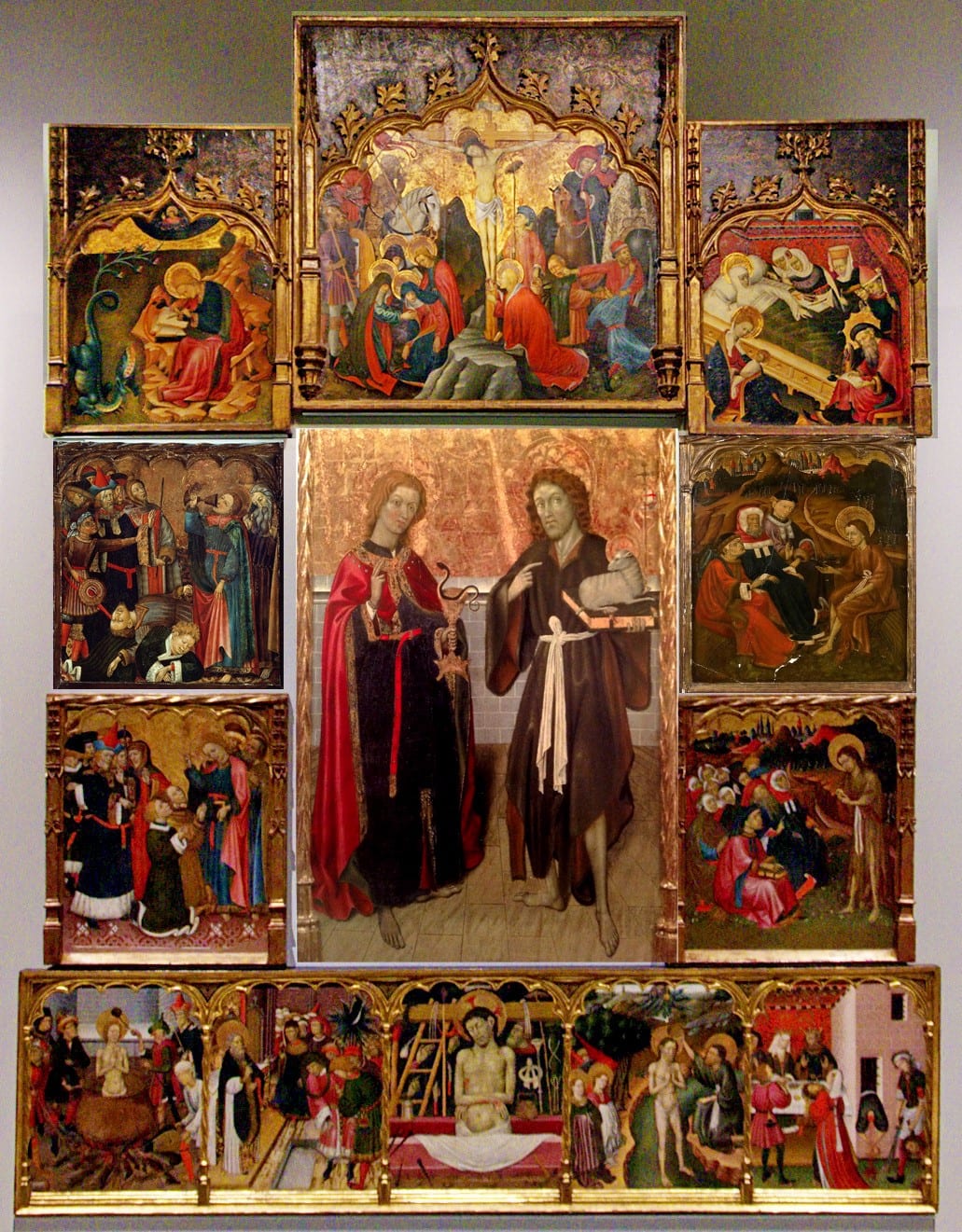
Bernat Martorell
Commissioned in 1432 from Ramon de Mur, a painter of Tarragona, this altarpiece from the parish church of Vinaixa, in the Garrigues, was in the end painted by Martorell. The two Saints John appear in scenes in its side lanes and on the predella, and its topmost panel shows the Calvary; on the predella, figures seen as negative, among them the executioner, Herod and Herodias, show old damage, above all scratches. The Museu Nacional d’Art de Catalunya holds most of its panels; the central one is in the Museu Diocesà de Tarragona and a side panel in the Musée Rolin at Autun.
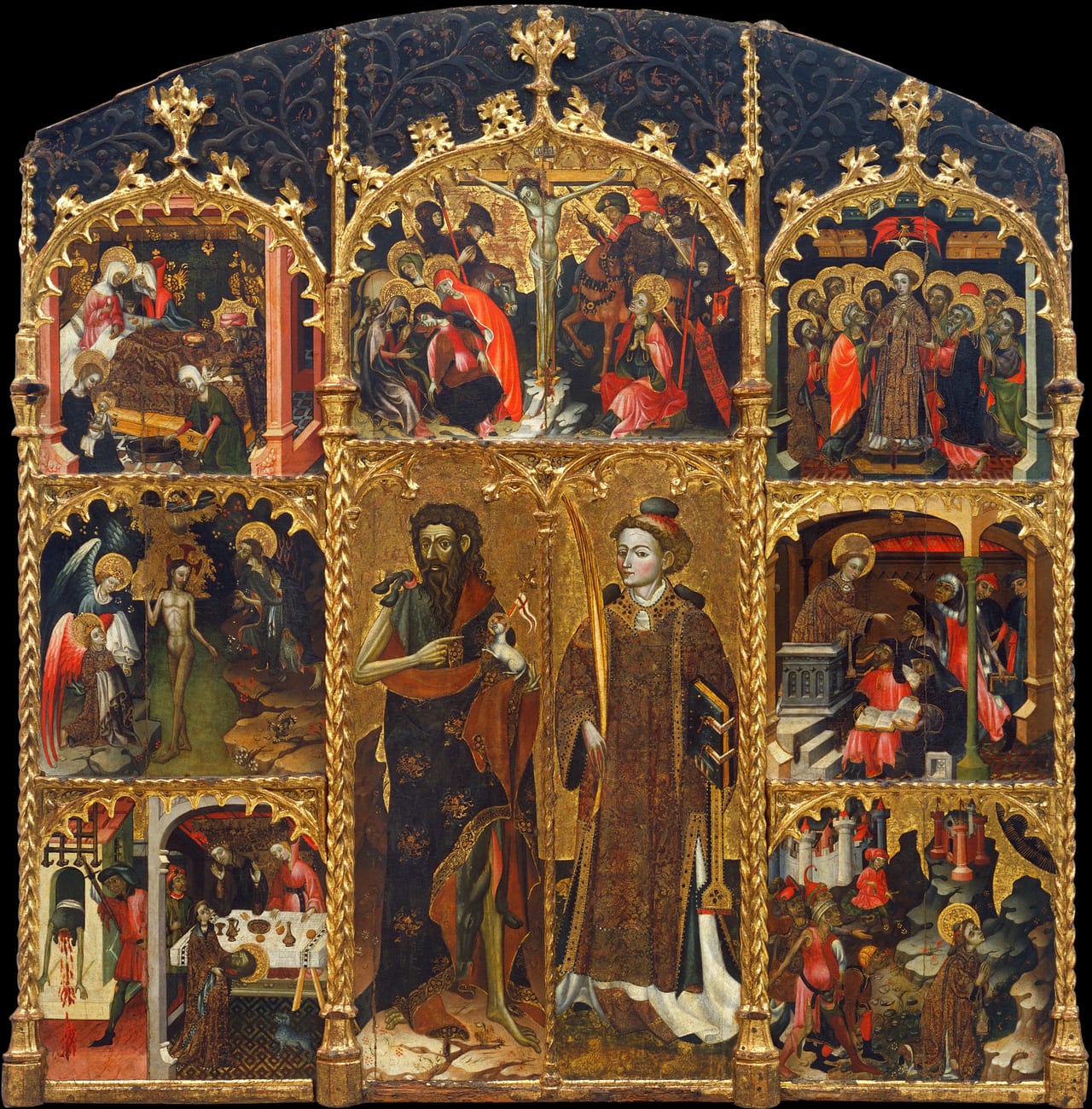
Master of Badalona
This panel, the main body of an altarpiece of Saint John the Baptist and Saint Stephen, comes from the church of Santa Maria de Badalona, in the Barcelonès, and is painted in tempera and gold leaf on wood, 198.8 by 198.5 centimetres. The Museu Nacional d’Art de Catalunya bought it in 1903. The painter known as the Master of Badalona was active in about the first third of the fifteenth century.
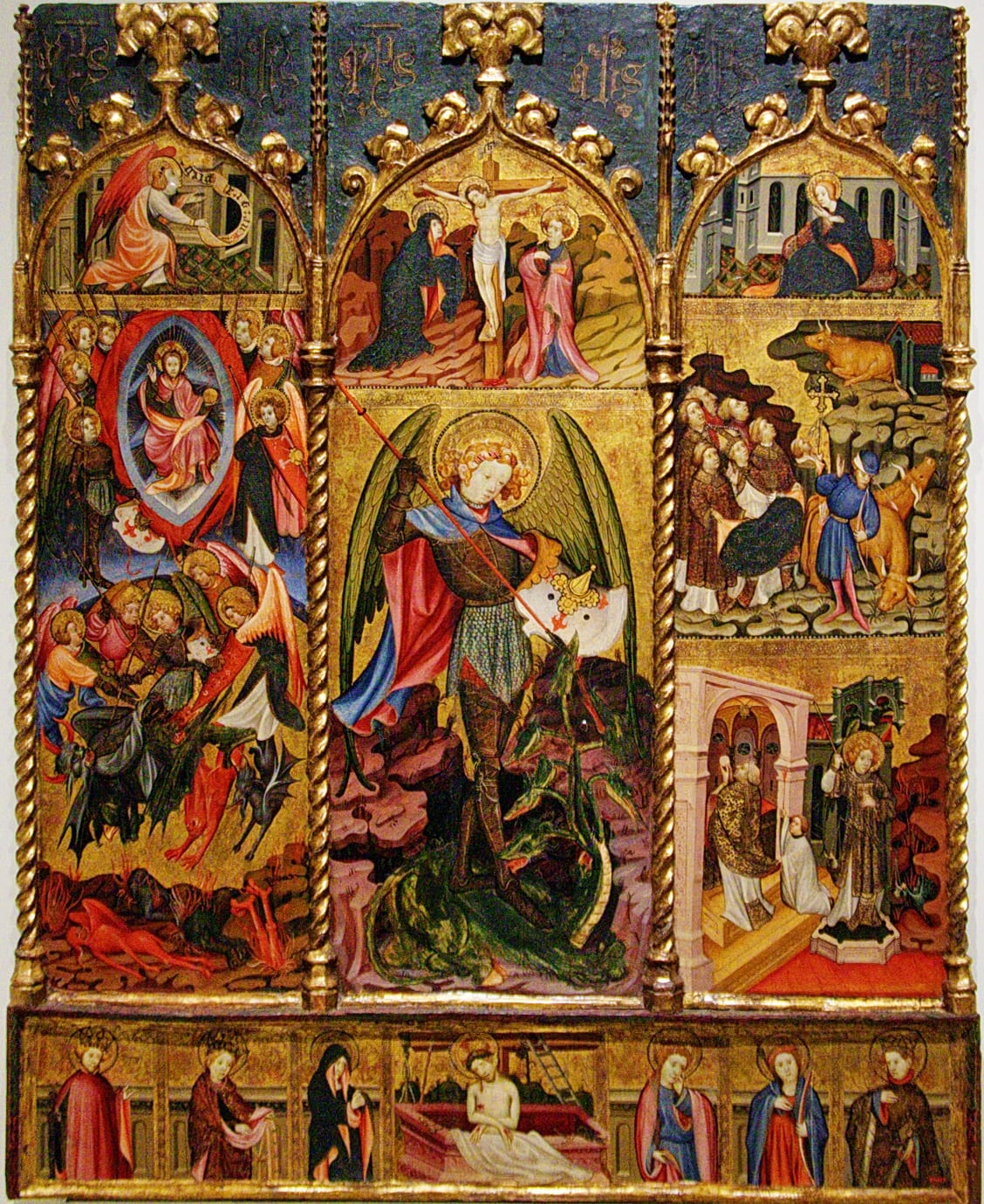
Joan Mates
Painted in tempera with gilding and silvering on wood, this altarpiece attributed to Joan Mates came from the chapel of Santa Maria de Penafel, in the Alt Penedès, and the Museu Nacional d’Art de Catalunya bought it in 2010. Mates modelled his figures with contrasting lines, and his work is notable above all for its elegance; the influence of Franco-Flemish illuminators has been seen in it. His documented works include altarpieces of Saint Martin and Saint Ambrose for Barcelona Cathedral, of 1411.
Artworks
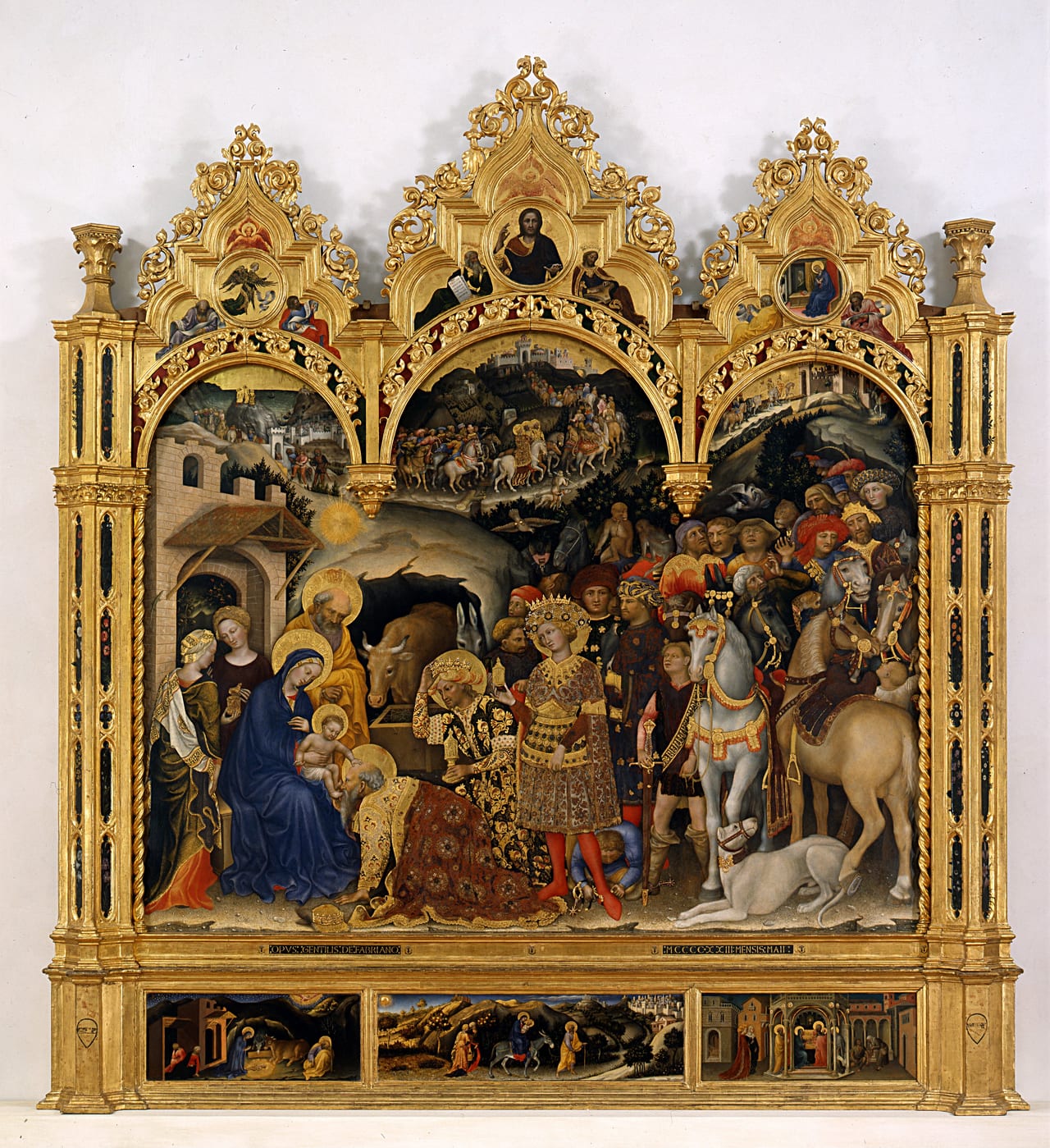
Adoration of the Magi
Gentile da Fabriano · 1423
Uffizi Gallery
The banker Palla Strozzi, a refined lover of art, ordered this altarpiece for the chapel of his family in the sacristy of the church of Santa Trinita, and paid 300 florins for it; the panel bears Gentile’s signature and the date 1423. Guided by a star, the Magi kneel before the Holy Family in rich, fashionable clothes, accompanied by a procession of many peoples with exotic animals, while three episodes of their journey unfold in the background, separated by the frame’s three arches. Metal leaf, partly raised in relief, picks out details such as a horseman’s spurs and the hilt of a sword. In the predella, with the Nativity, the Flight into Egypt and the Presentation in the Temple, blue skies take the place of medieval gold; the Presentation is a modern copy of the original, which is in the Louvre.
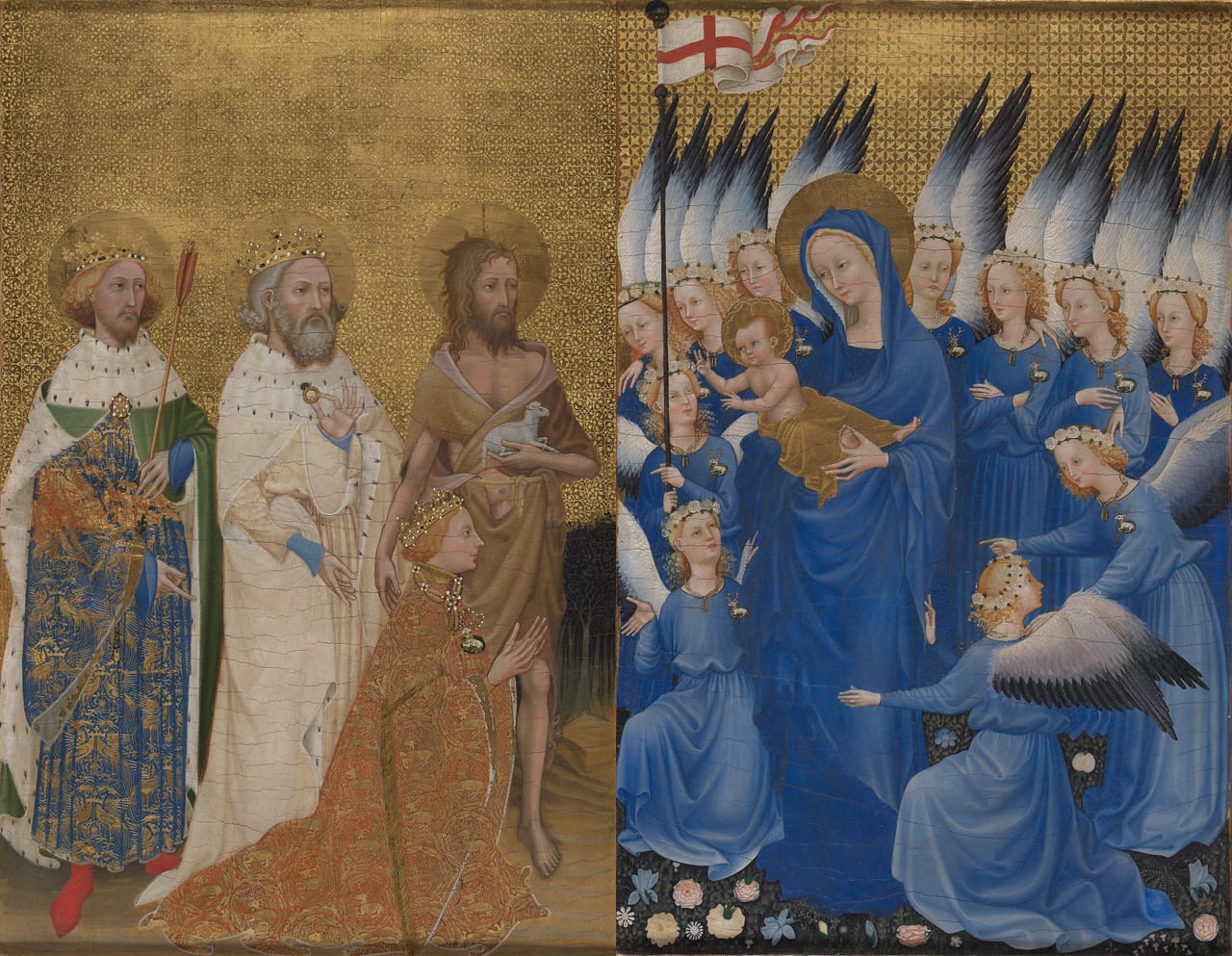
Wilton Diptych
c. 1395–1399
National Gallery
Made for the private use of Richard II, probably in the last five years of his life, this small portable diptych is among the handful of English panel paintings to survive from the Middle Ages, and its unknown artist was probably French or English. John the Baptist with the Lamb of God, Edward the Confessor with a ring and Edmund with the arrow of his martyrdom present the kneeling king to the Virgin and Child, who stand among angels in a flowery meadow. The angels wear badges of Richard’s emblem, the white hart, and one of them carries a white standard with a red cross. Richard appears as a beardless youth, though the work is generally dated to the late 1390s. It is named after Wilton House, where the Earls of Pembroke kept it until the National Gallery bought it in 1929.
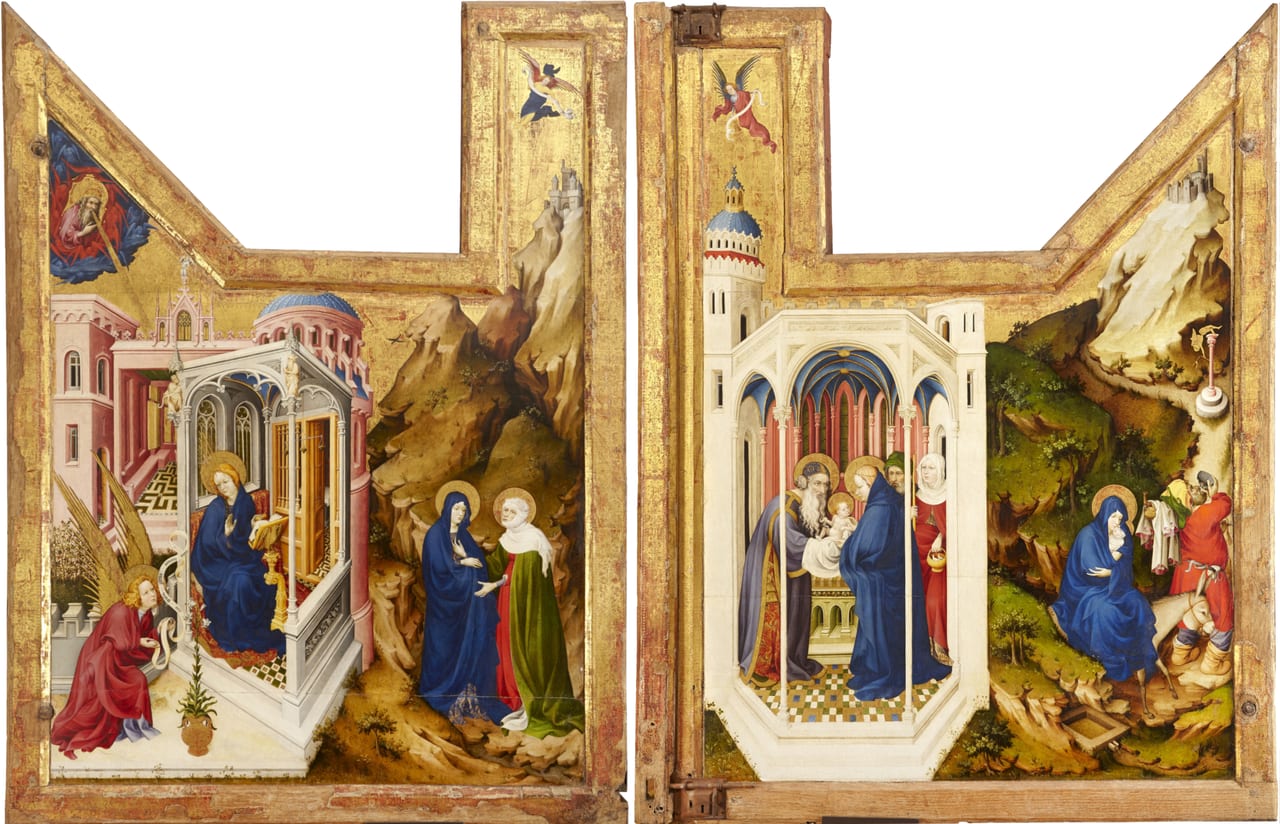
Painted wings of the Retable of the Crucifixion
Melchior Broederlam
Musée des Beaux-Arts de Dijon
Philip the Bold ordered a carved wooden altarpiece from Jacques de Baerze in 1390 for the abbey church of the Chartreuse de Champmol at Dijon, and in 1393 Melchior Broederlam of Ypres was commissioned to gild it and to paint these wings, which he completed in 1399. The altarpiece is the only work that can be given to him with confidence. Their realistic details, rendering of materials, play of light and suggestion of space look ahead to Robert Campin and Jan van Eyck; they hold much of International Gothic, and their rich textures show a Flemish attachment to surface appearances.
Sources
- Wikipedia, “International Gothic”
- Wikipedia, “International Gothic art in Italy”
- Britannica, “Limbourg brothers”
- Britannica, “Melchior Broederlam”
- Wikipedia, “Melchior Broederlam”
- CODART Canon, “Retable of the Crucifixion”
- National Gallery, “The Wilton Diptych”
- Wikipedia, “Wilton Diptych”
- Britannica, “Simone Martini”
- Wikipedia, “Simone Martini”
- Britannica, “Gentile da Fabriano”
- Wikipedia, “Gentile da Fabriano”
- Uffizi Galleries, “Adoration of the Magi”
- Wikipedia, “Adoration of the Magi (Gentile da Fabriano)”
- Britannica, “Lorenzo Monaco”
- Wikipedia, “Pisanello”
- Britannica, “Stefan Lochner”
- Wikipedia, “Stefan Lochner”
- Wikipedia, “Lluís Borrassà”
- Wikipedia, “Bernat Martorell”
- Museu Nacional d’Art de Catalunya, “Altarpiece of the Saints John”
- Museu Nacional d’Art de Catalunya, “Altarpiece of Saint John the Baptist and Saint Stephen”
- Museu Nacional d’Art de Catalunya, “Altarpiece of Saint Michael the Archangel”
- Museo Nacional Thyssen-Bornemisza, “Joan Mates”
- National Gallery, “The Coronation of the Virgin”
- National Gallery, “The Virgin and Child with Saints”
- Wikipedia, “Très Riches Heures du Duc de Berry”
- July, from the Très Riches Heures du duc de Berry — Public domain via Wikimedia Commons (Public domain)
- Madonna and Child with Angels — CC0 via Wikimedia Commons (CC0)
- The Coronation of the Virgin — Public domain via Wikimedia Commons (Public domain)
- The Virgin and Child with Saints Anthony Abbot and George — Public domain via Wikimedia Commons (Public domain)
- Madonna of the Rose Bower — Public domain via Wikimedia Commons (Public domain)
- Altarpiece of the Saints John — Public domain via Wikimedia Commons (Public domain)
- Altarpiece of Saint John the Baptist and Saint Stephen — Public domain via Wikimedia Commons (Public domain)
- Altarpiece of Saint Michael the Archangel — Public domain via Wikimedia Commons (Public domain)
- Adoration of the Magi — Public domain via Wikimedia Commons (Public domain)
- Wilton Diptych — Public domain via Wikimedia Commons (Public domain)
- Painted wings of the Retable of the Crucifixion — Public domain via Wikimedia Commons (Public domain)
Invite International Gothic into your living room