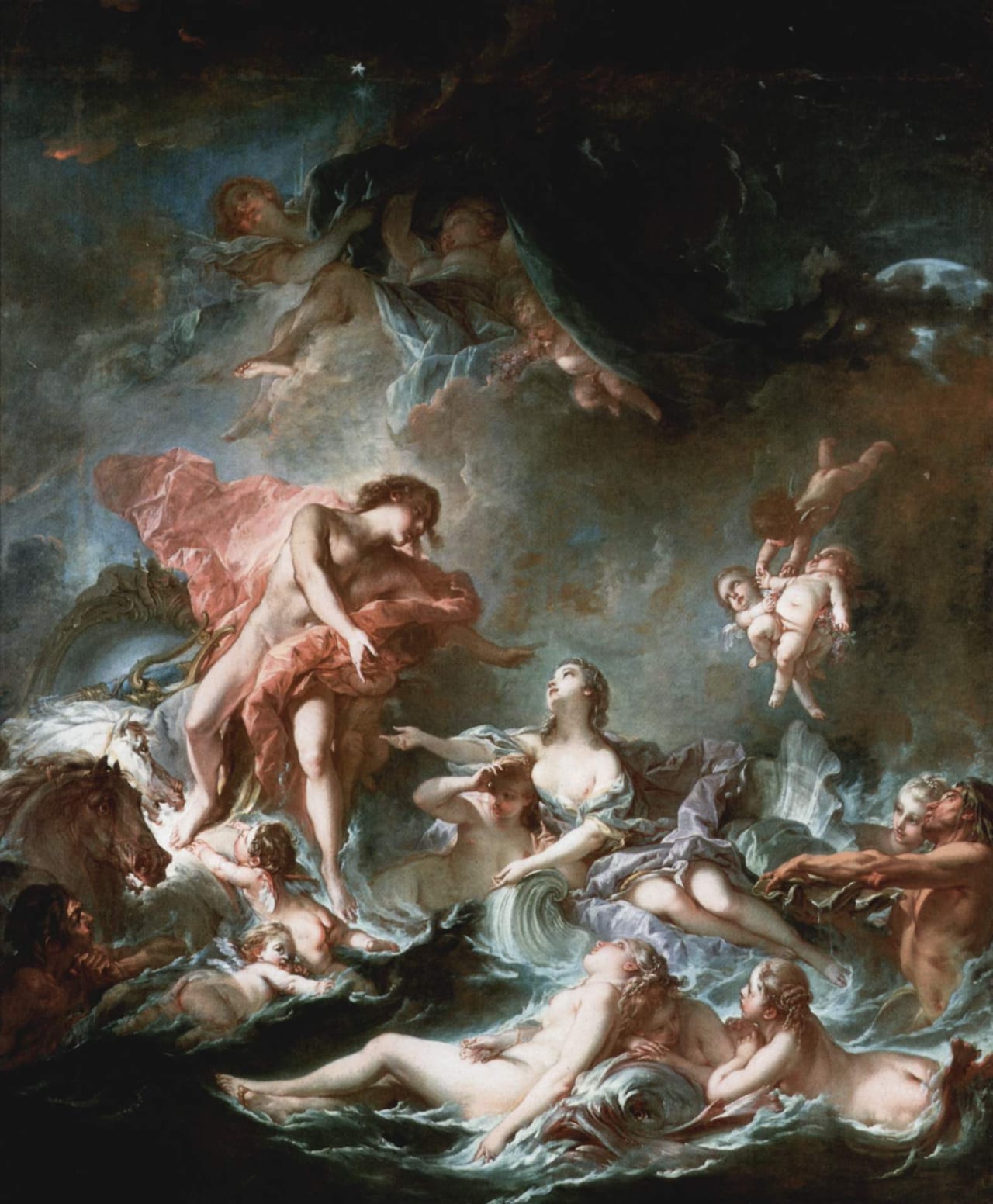
L'Indifférent
Jean-Antoine Watteau · 1717

Rococo
Paris
Rococo began in Paris in the early eighteenth century, a reaction against the heavy design of Louis XIV’s Versailles and the official Baroque of his reign. In French painting it opens with the graceful, gently melancholic pictures of Antoine Watteau, reaches its height in the playful nudes of François Boucher and closes with the freely painted genre scenes of Jean-Honoré Fragonard. In the 1730s it spread to the Catholic German-speaking lands, and in Venice the large decorative paintings of Giovanni Battista Tiepolo were its epitome; by the 1760s, in France, the more austere Neoclassicism had begun to take its place.
Paris, after Versailles
The style was born in Paris early in the eighteenth century, was soon taken up across France, and later spread abroad, above all to Germany and Austria. It grew out of a reaction against the ponderous design of Louis XIV’s Versailles and the official Baroque of his reign: a light, sensuous and intensely decorative French manner that developed after the old king’s death. The label belongs above all to the painting, interiors and architecture in fashion in France under Louis XV, who reigned from 1715 to 1774.
Its name comes from rocaille, the rock work covered with shells that decorated artificial grottoes. Neoclassicists of the late eighteenth century were the first to apply the label, and they meant it as a slight. The word rococo first appeared in print in 1825, when critics used it for decoration they thought outdated, and in 1829 Stendhal defined it, more neutrally, as “the rocaille style of the 18th century”.
Designers, painters and engravers, Nicolas Pineau, Jean Berain, Pierre Le Pautre and Juste-Aurèle Meissonier among them, worked out a lighter, more intimate decoration for the new residences of nobles in Paris. Walls, ceilings and mouldings were laced with curves and countercurves built on the letters C and S, with shells and other forms from nature. Asymmetry was the rule; light pastels, ivory white and gold were the main colours, and mirrors made rooms seem more open. Germain Boffrand’s salons at the Hôtel de Soubise in Paris, begun in 1732, are an excellent example.
Rococo art rests on the study of natural forms and is ruled by asymmetry, curves and light, bright colour. French painters treated myth and courtship in an easy, light-hearted way, with rich and delicate brushwork, a fairly light key and sensuous colour, and across the visual arts the prevailing themes were aristocratic leisure and the pastoral, set in scenes like a stage.
Watteau, Boucher, Fragonard
French Rococo painting begins with Antoine Watteau. Born at Valenciennes in 1684, he reached Paris in 1702, and at the Luxembourg he studied the cycle of paintings Rubens had dedicated to Marie de Médicis, which marked him deeply. Watteau painted many scenes from the Italian comedy, exploring its famous characters, Pierrot, Columbine and Harlequin, and he invented the fête galante: small cabinet pictures about the psychology of love, usually set in a landscape. Admitted to the Academy as a probationer in 1712, he became a full member in 1717 with his Pilgrimage to the Isle of Cythera, and the Academy created a new category, the Galante, for it. L’Indifférent, a panel of 1717, entered the Louvre with Louis La Caze’s collection in 1869. Watteau died in 1721, but his work kept its influence for the rest of the century.
Other painters took up his theme. Nicolas Lancret, a coachman’s son trained by Pierre Dulin and then by Claude Gillot, entered the Academy in 1719 and received considerable acclaim for his fêtes galantes after the deaths of Watteau and Gillot; though based in Watteau’s style, Lancret’s pictures have a more vivid palette, more varied genre themes and a lively, detailed sense of narrative. Jean-Baptiste Pater, also from Valenciennes, was briefly Watteau’s pupil in Paris, took further lessons from him in 1721, the year Watteau died, and joined the Academy in 1728; he imitated Watteau heavily, copying some of his figures directly, and used a traditional Rococo pastel palette. Lancret and Pater were among the other important painters of the fête galante.
François Boucher, born in Paris in 1703, studied Watteau’s work, and his first major commission was to engrave 125 of Watteau’s drawings. He won the Prix de Rome in 1723 and was in Italy from 1728 to 1731. His pictures are regarded as perfectly expressing French taste of the Rococo period: in the 1740s and 1750s his elegant, playful manner became the hallmark of Louis XV’s court, and from 1750 until her death in 1764 the king’s mistress, Madame de Pompadour, was his chief patron. Boucher painted in every genre and designed for the theatre, for tapestries, for book illustrations and for porcelain figures; in 1765 he became First Painter to the King and Director of the Academy.
Jean-Honoré Fragonard, born at Grasse in 1732, trained in Paris with Chardin and then with Boucher, won the Prix de Rome in 1752 and spent 1756 to 1761 at the French Academy in Rome. After 1767 he almost stopped exhibiting at the Salon and turned to landscapes, often in the manner of the Dutch painter Jacob van Ruisdael, to portraits, and to decorative, sensuous parties out of doors such as The Swing, which follow Boucher’s style but are more fluently painted. The Progress of Love, a series of 1771 for Madame du Barry, Louis XV’s last mistress, who had commissioned it, was refused in favour of classicising scenes by Marie-Joseph Vien, and from the mid-1780s Fragonard’s own style, still dynamic, grew more Neoclassical.
The finest Rococo portraitists were Jean-Marc Nattier and Jean-Baptiste Perronneau. Nattier had hoped to be a history painter, but the financial crisis of 1720 almost ruined him; he turned to portraits, revived the allegorical portrait, which shows a living sitter as a goddess or another figure of myth, and from 1745 was official portraitist to the four daughters of Louis XV. The van Loo family gave the style several more painters: Jean-Baptiste van Loo, his sons Louis-Michel and Charles-Amédée-Philippe, and his younger brother Charles-André; Louis-Michel became court painter to Philip V of Spain at Madrid. Their contemporary Jean-Baptiste-Siméon Chardin, a painter of still lifes and domestic scenes, was nearer to “the feeling of meditative quiet” in Louis Le Nain’s rustic scenes than to what has been called “the spirit of light and superficial brilliance” among many of his contemporaries. The Royal Academy took The Ray and The Buffet as his reception pieces in 1728; The Ray remains on display in the Louvre.
Venice, the German lands, and the turn of taste
In Italy the Rococo was concentrated primarily in Venice, and there the large decorative paintings of Giovanni Battista Tiepolo were its epitome. He has been called the greatest Italian Rococo painter, though his style rested on the High Renaissance’s Grand Manner and he owed most to Veronese. Tiepolo’s luminous frescoes, light in colour and airy, carry on the Baroque tradition of ceiling painting while embodying the lightness and elegance of the Rococo. In 1719 he married a sister of the painter Francesco Guardi. In 1750 he moved with his sons to Würzburg to decorate the residence of the Prince-Bishop, returning to Venice in 1753, and in 1762 he moved with them to Spain to work for the Spanish crown; he died in Madrid in 1770.
The city’s view painters felt the style too. Canaletto, born in Venice the son of a theatrical scene painter, was famed for precise, evocative views of the city, or vedute; English collectors favoured him, and he visited England repeatedly between 1746 and 1756; his feeling for atmosphere in detailed views of Venice, London and English country houses influenced later generations of landscape painters. Francesco Guardi, after Canaletto the main painter of Venetian views, worked at first on figure paintings with his brother Gian Antonio and turned to views in about 1760. He soon found a freer handling of paint and delighted in Venetian light and its dazzle on water; his sparkling, romantic impressions of the declining city stand in marked contrast to Canaletto’s limpid records of its architecture.
From France the Rococo reached the Catholic German-speaking lands in the 1730s and became there a brilliant religious architecture, French elegance joined to south German fantasy. In Munich, François de Cuvilliés built the Amalienburg (1734–39) in the park of Nymphenburg; its Hall of Mirrors, by the painter and stuccoist Johann Baptist Zimmermann, is far more elaborate than any French Rococo. Among the pilgrimage churches, Balthasar Neumann designed Vierzehnheiligen in Bavaria, and Dominikus Zimmermann built the Wieskirche near Munich, begun in 1745, which his elder brother Johann Baptist decorated. In Austria and southern Germany, Italian painting had the strongest effect on the Rococo, and the Würzburg Residence, whose ceilings Tiepolo painted, is one of the major landmarks of Bavarian Rococo.
Prussia under Frederick the Great had its own Frederician Rococo, whose most famous exponent was the architect Georg Wenzeslaus von Knobelsdorff. The Paris-born painter Antoine Pesne was Prussia’s most important artist in the century’s first half, and under Frederick II he painted mythological and allegorical ceilings and murals for the palaces of Rheinsberg, Charlottenburg, Berlin, Potsdam and Sanssouci. Philip Mercier, principal painter to the Prince and Princess of Wales, brought the Rococo to Britain; William Hogarth gave it a robust British form, and Thomas Gainsborough’s dazzling portraits of women perhaps show its influence there best.
In France the style was already in decline by the 1750s, attacked by critics as trivial and overloaded with ornament. In 1750 Madame de Pompadour sent her brother, the future Marquis of Marigny, to Italy for two years with the engraver Charles-Nicolas Cochin among others; they came back with a passion for classical art, and as director general of the King’s Buildings Marigny turned official French architecture toward Neoclassicism, while Cochin, now an important critic, denounced the petit style of Boucher. By the 1760s Neoclassicism had begun to replace the Rococo in France, and by 1785 it had passed out of fashion there, giving way to the order and seriousness of painters such as Jacques-Louis David; in some German provincial states and in Italy it held on until the Empire style swept it away.
Artists
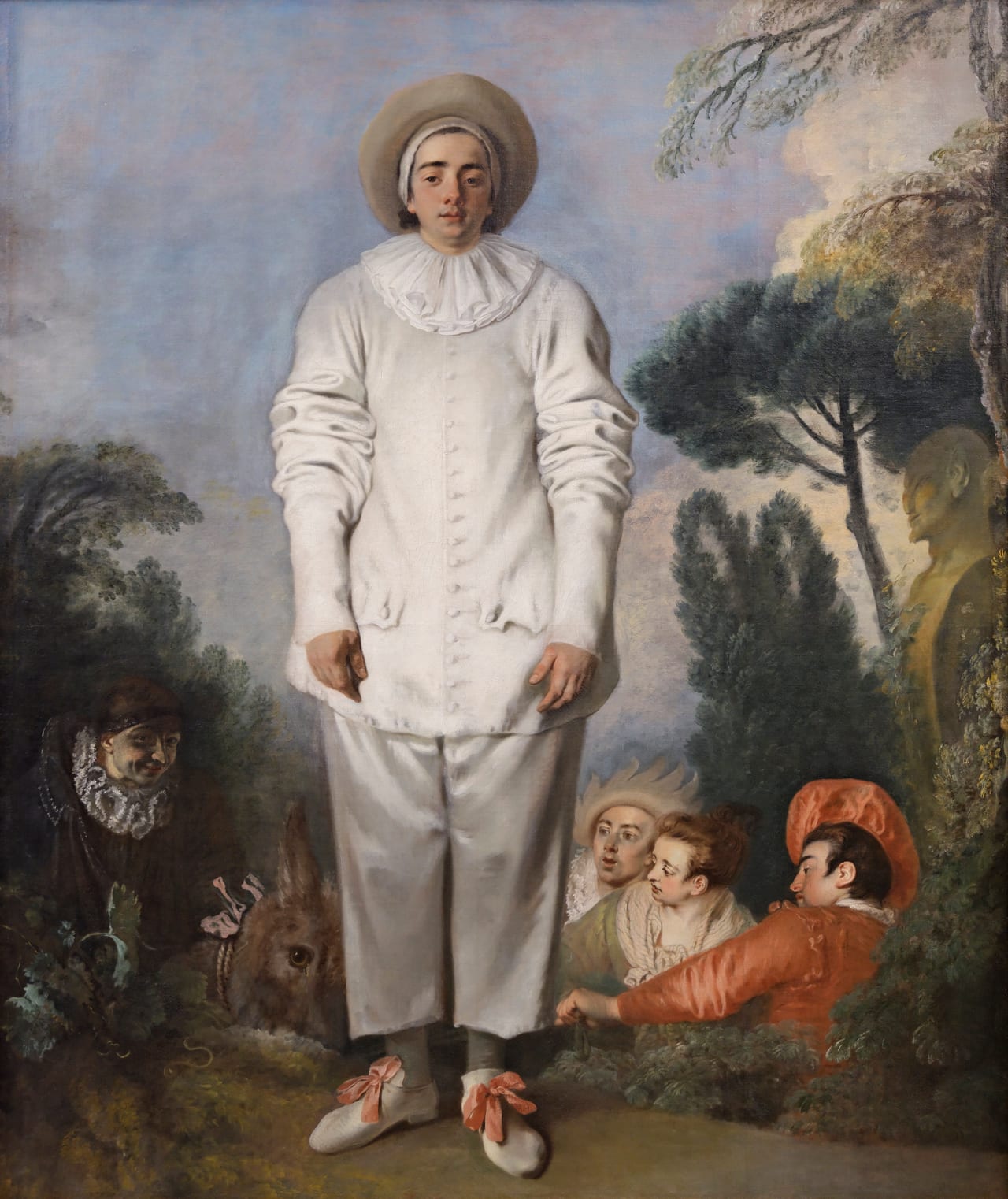
Antoine Watteau
Watteau’s only life-size figure: the commedia dell’arte character Pierrot, in white theatrical clothing, stands still and frontal among a group of actors, apart from his companions. Some scholars speculate that it began as a shop sign, possibly one of two commissioned by the retired actor Belloni, known for playing Pierrot. It has been in the Louvre since 1869.
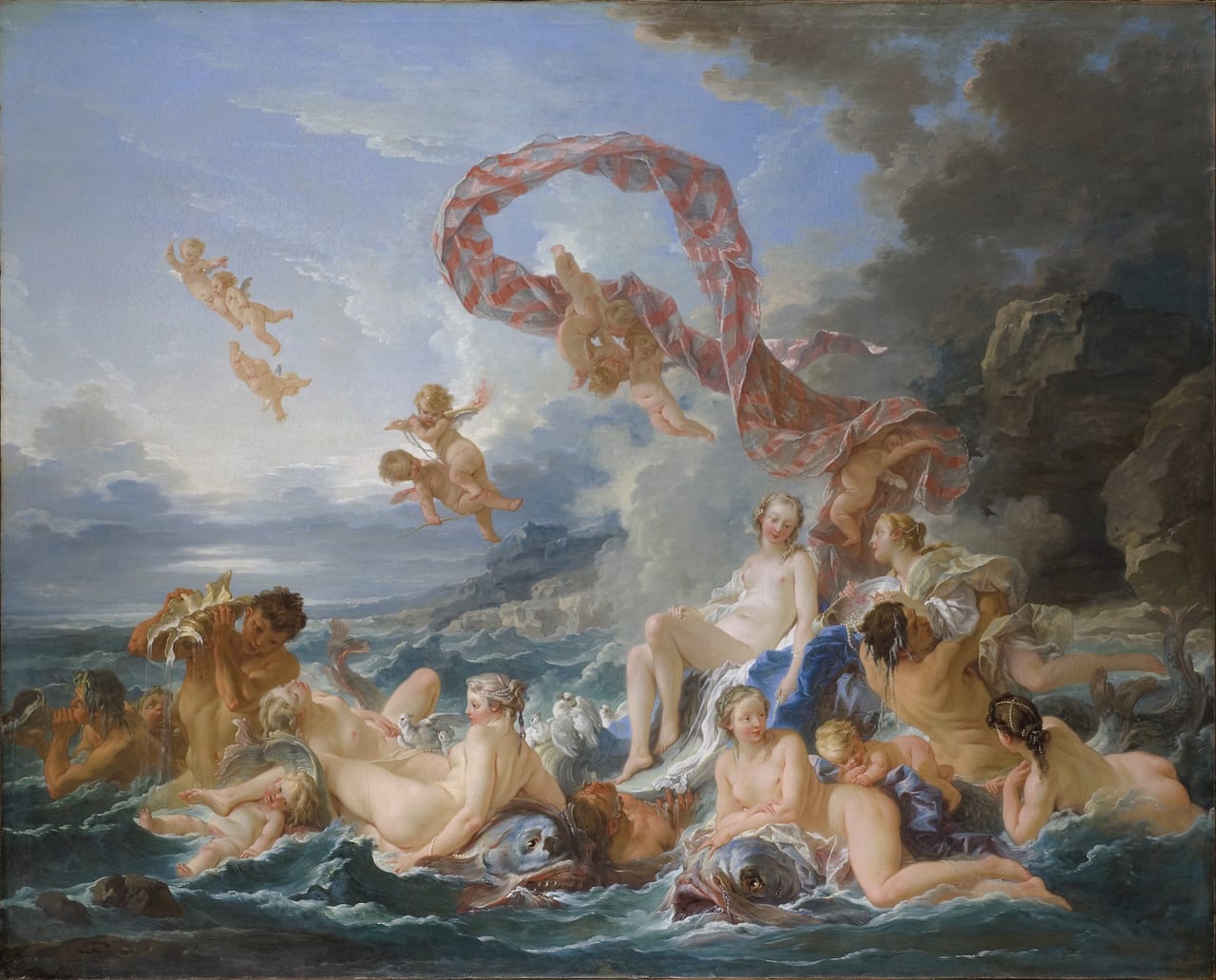
François Boucher
Boucher’s Triumph of Venus of 1740 inspired Fragonard’s Birth of Venus. Carl Gustaf Tessin acquired it among many drawings and paintings during his stay in Paris, but after money troubles in 1749 he parted with some of his collection, selling it to the Swedish king. The painting is now in the Nationalmuseum, Stockholm.
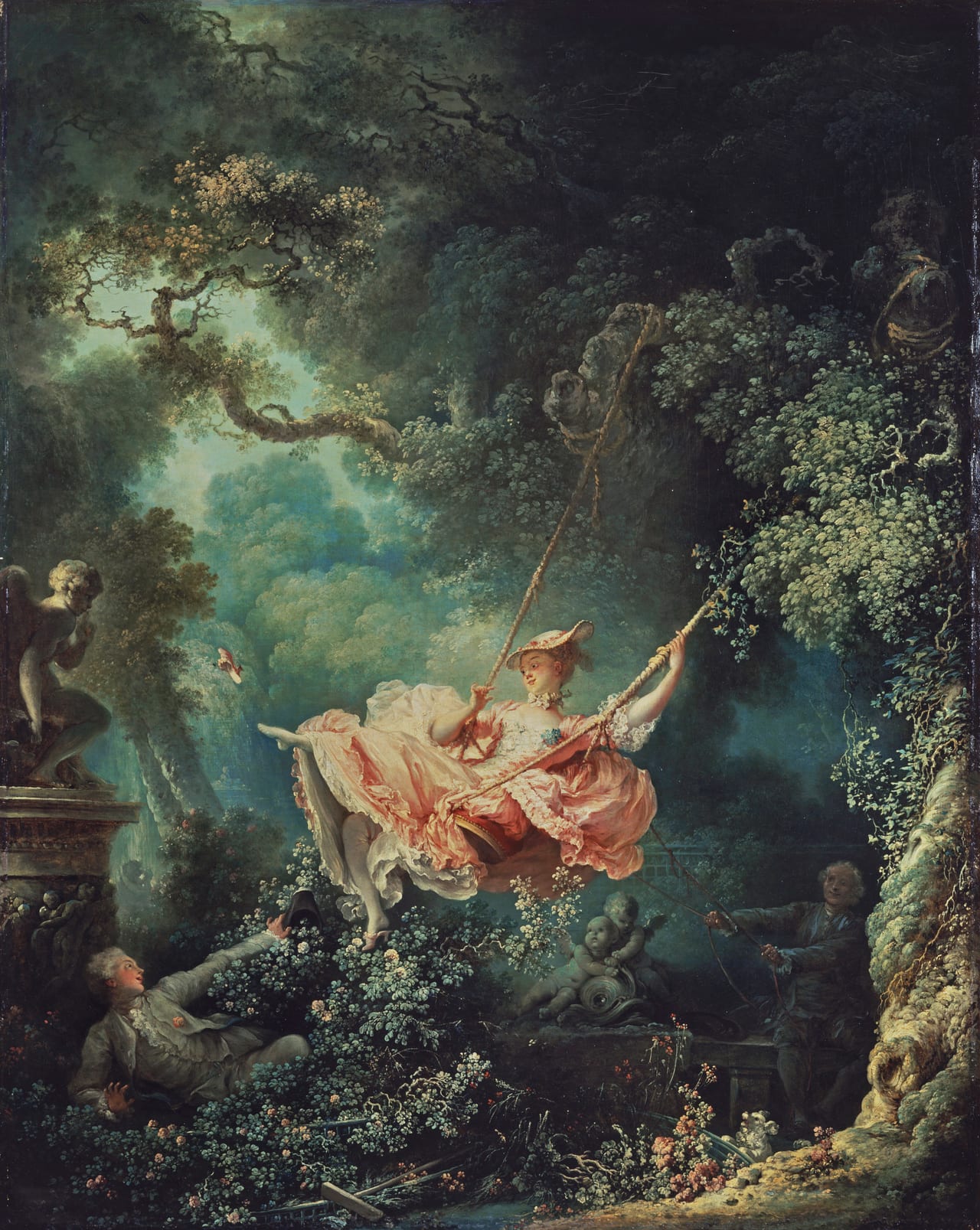
Jean-Honoré Fragonard
Fragonard’s Swing is one of the most emblematic images of French eighteenth-century art. A young woman in a pink silk dress flies on a swing, her young lover on the left and her elderly husband on the right; one of her slippers flies off, and the symbolic offer of his hat suggests her lover’s delight.
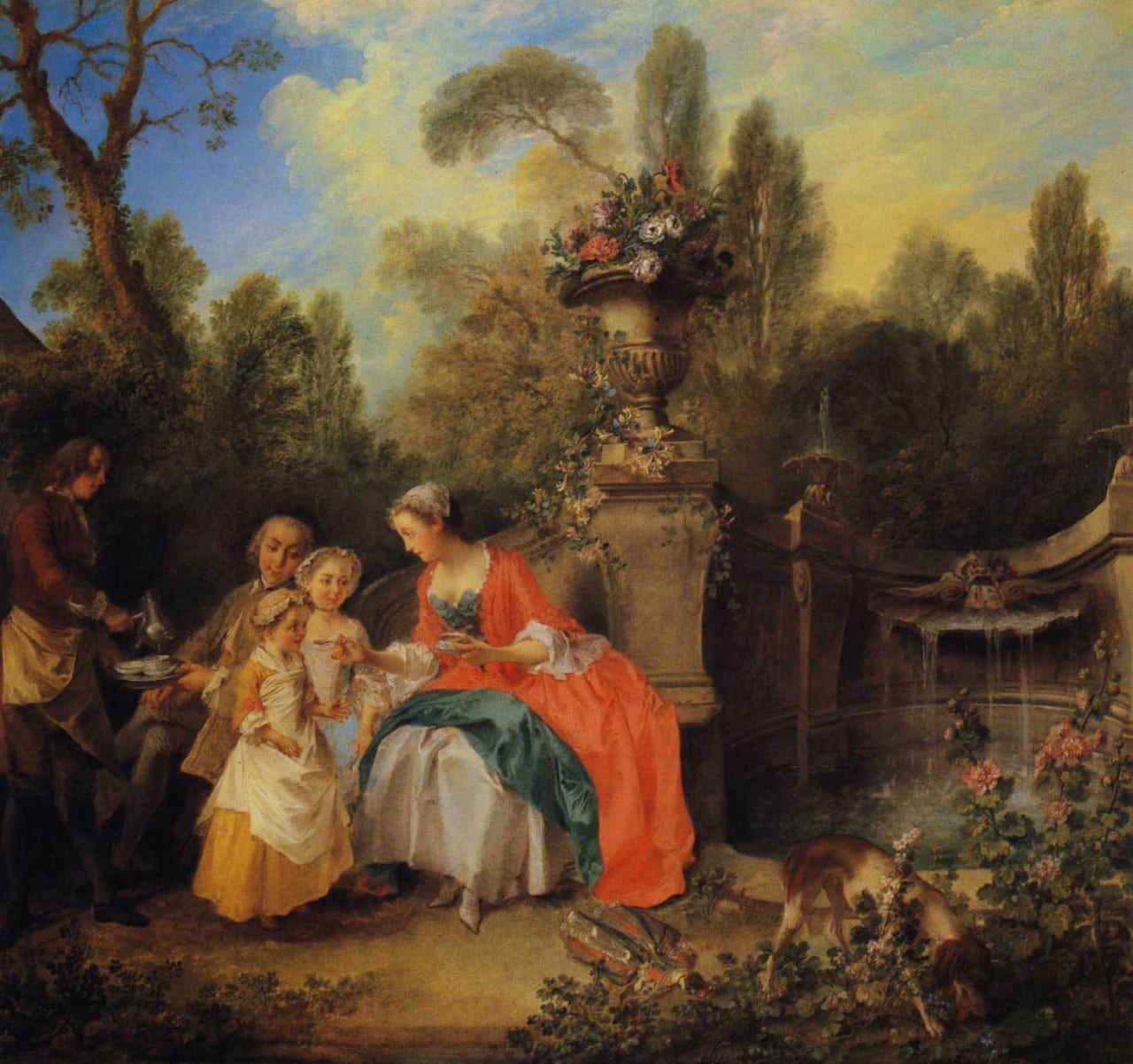
Nicolas Lancret
A wealthy family take coffee beside a fountain: the mother offers her little daughter a spoon from her cup, and the father holds the tray while a servant pours. Once known as The Cup of Chocolate, it is more likely a genre scene than a family portrait, and it is one of Lancret’s most accomplished paintings.
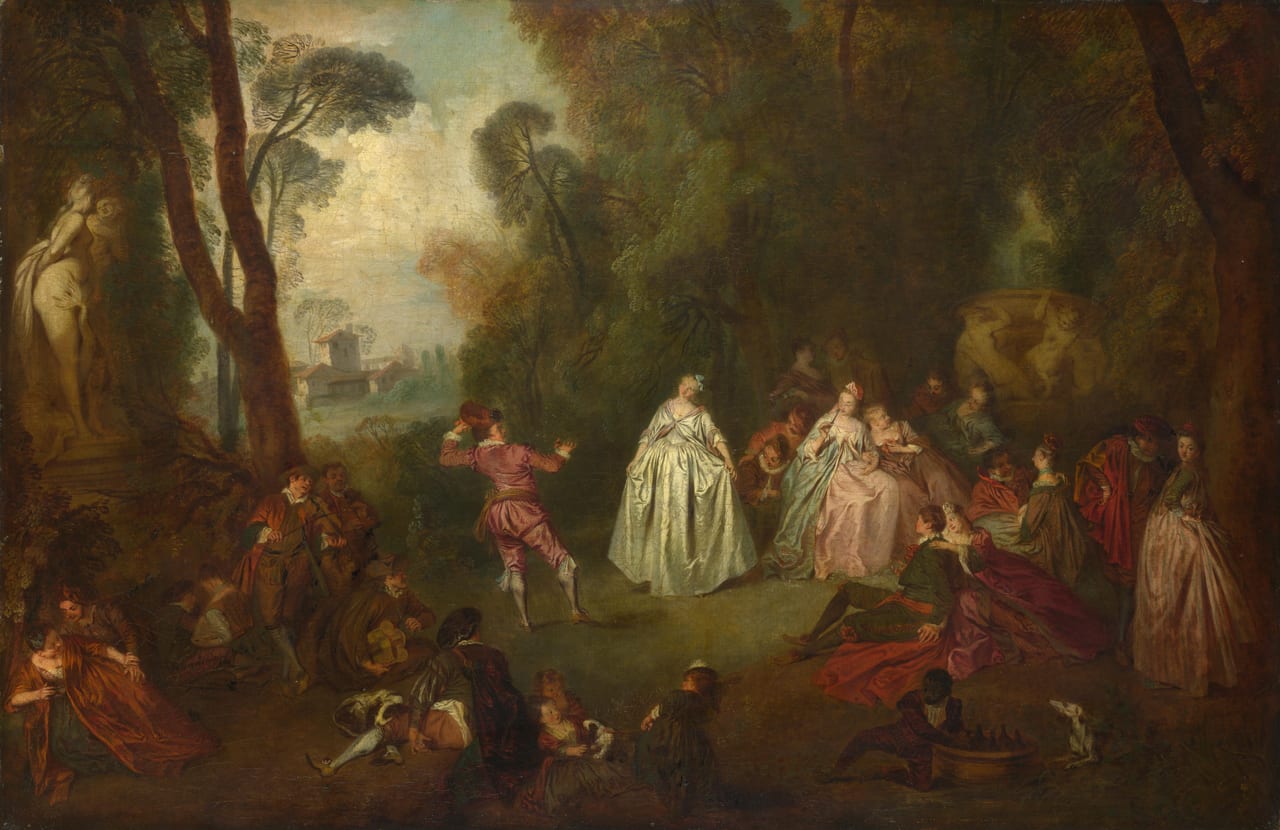
Jean-Baptiste Pater
Taught by Watteau, Pater painted large numbers of fêtes galantes inspired by his master’s work, and they found ready buyers in Paris. Here 28 figures make music, dance and court in parkland, and a number of them resemble those in paintings by or prints after Watteau; the picture probably dates from early in Pater’s career.
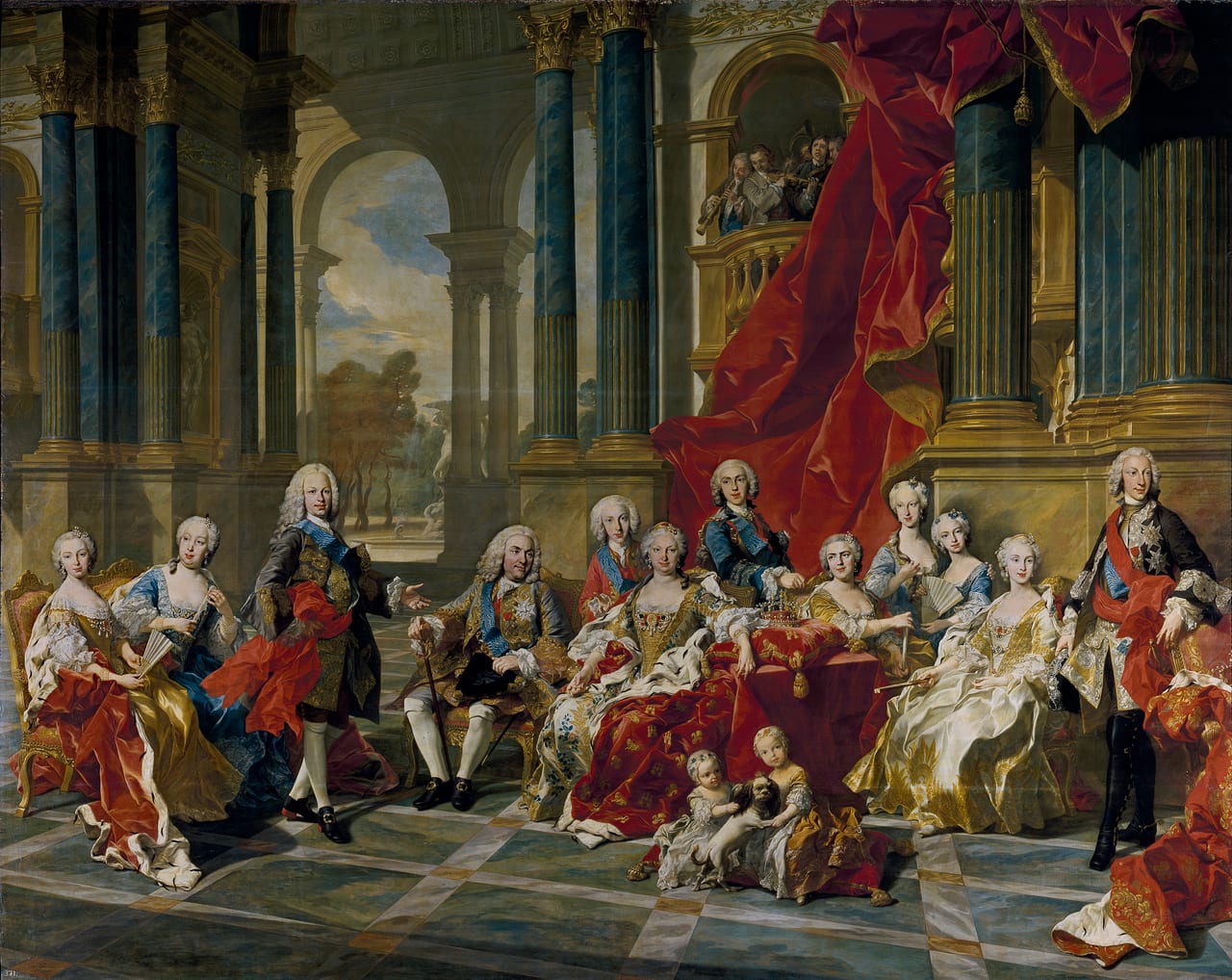
Louis-Michel van Loo
Court painter at the Spanish Bourbon court. Van Loo’s portrait of Philip V of Spain and his family, finished in 1743 and now in the Prado, shows them life-size in an imaginary room, in the manner of French Baroque and Rococo art; the king sits beside his second wife, Elisabeth Farnese.
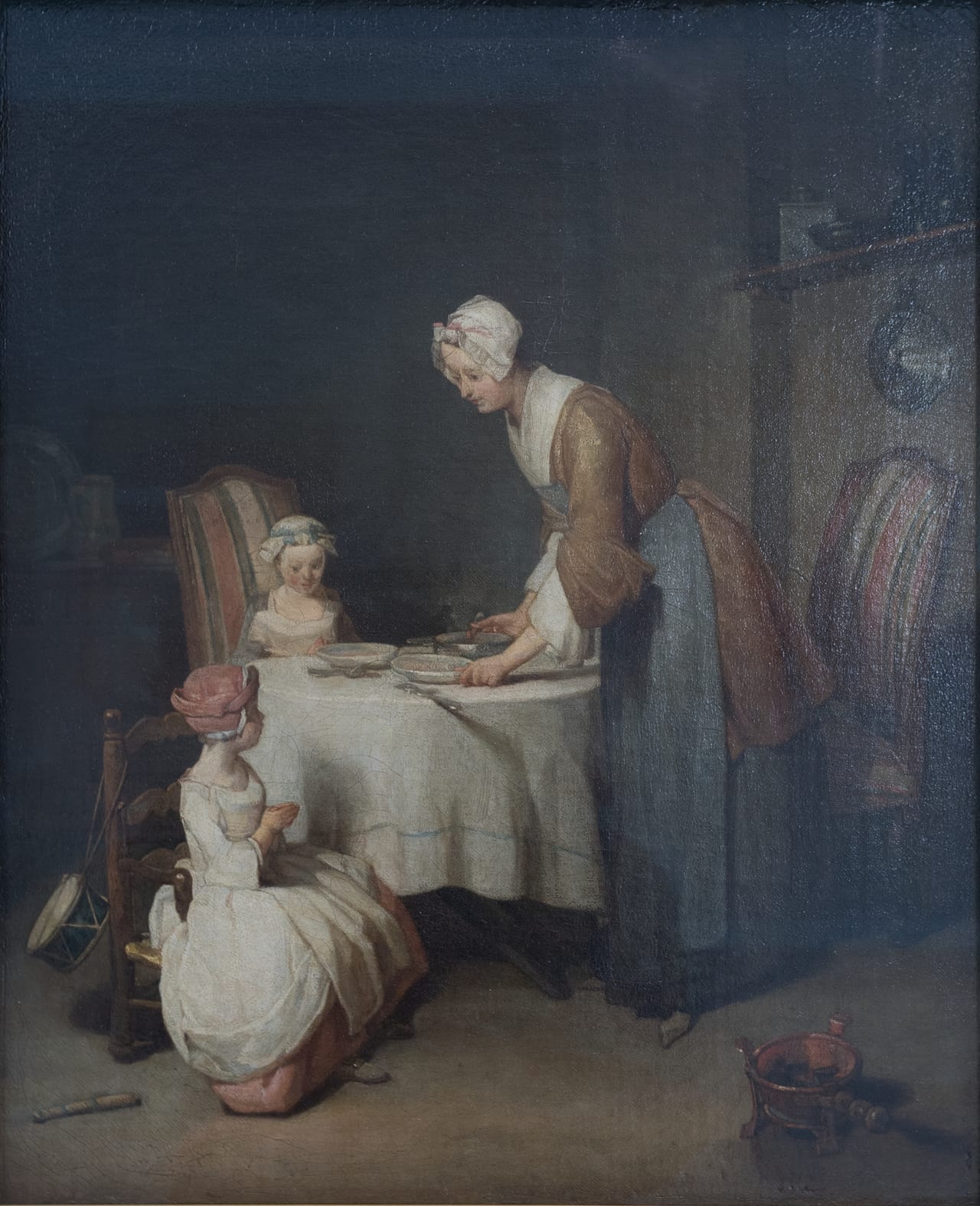
Jean-Baptiste-Siméon Chardin
A contemporary of the Rococo painters, Chardin painted still lifes and domestic scenes of intimate realism and tranquil mood, alternating pictures of “the silent life” with scenes of family life such as Saying Grace, and he was nearer to “the feeling of meditative quiet” in Louis Le Nain’s rustic scenes than to what has been called “the spirit of light and superficial brilliance” among many of his contemporaries.
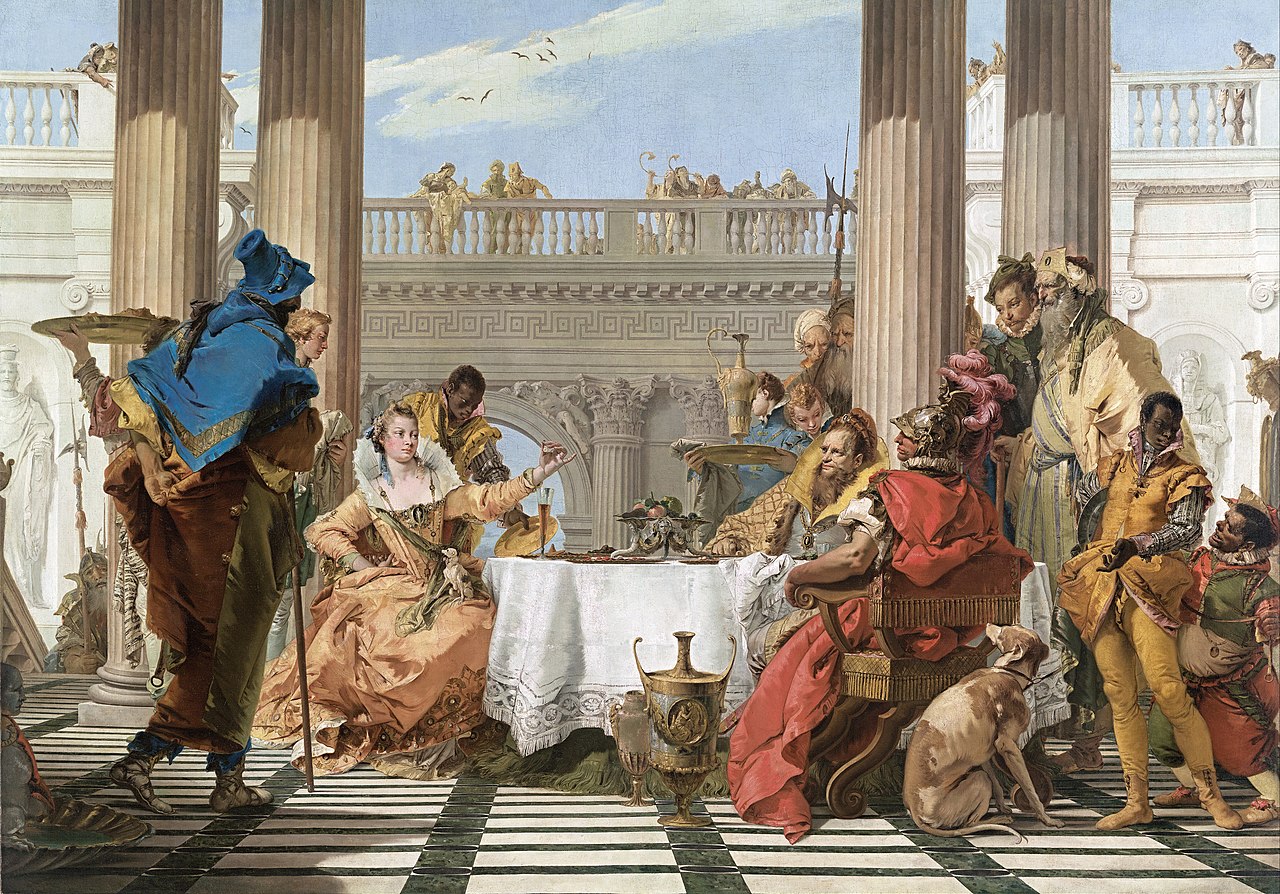
Giovanni Battista Tiepolo
Completed in 1744, the first of Tiepolo’s three large paintings of the feast Cleopatra gave for Mark Antony, at which, as Pliny and Plutarch tell it, she dissolved a costly pearl in her wine and drank it. It is in the National Gallery of Victoria, Melbourne.
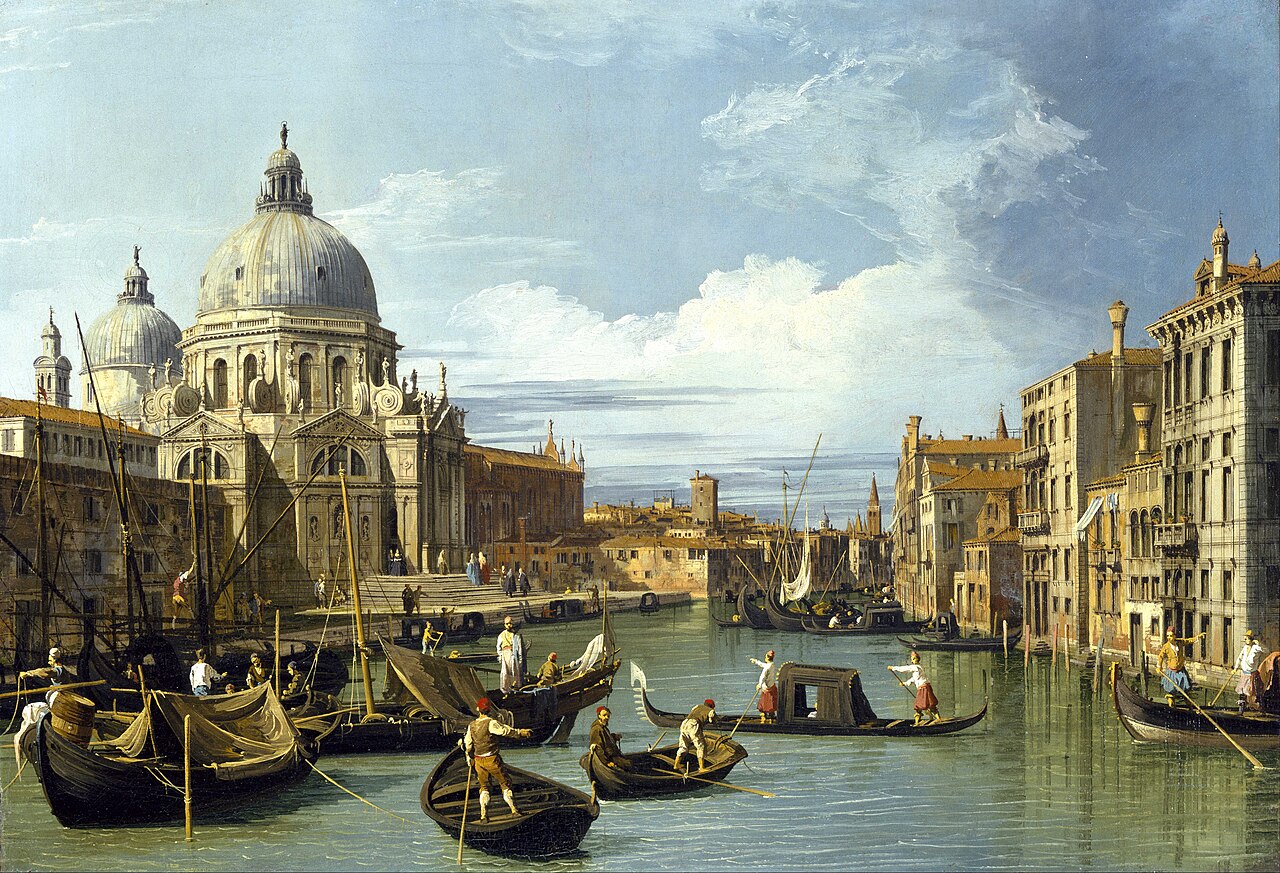
Canaletto
Canaletto’s view of about 1730, with the Basilica of Santa Maria della Salute, the large church on the left, is described as a Rococo landscape. It belongs to the Robert Lee Blaffer Memorial Collection at the Museum of Fine Arts, Houston, a gift of Sarah Campbell Blaffer.
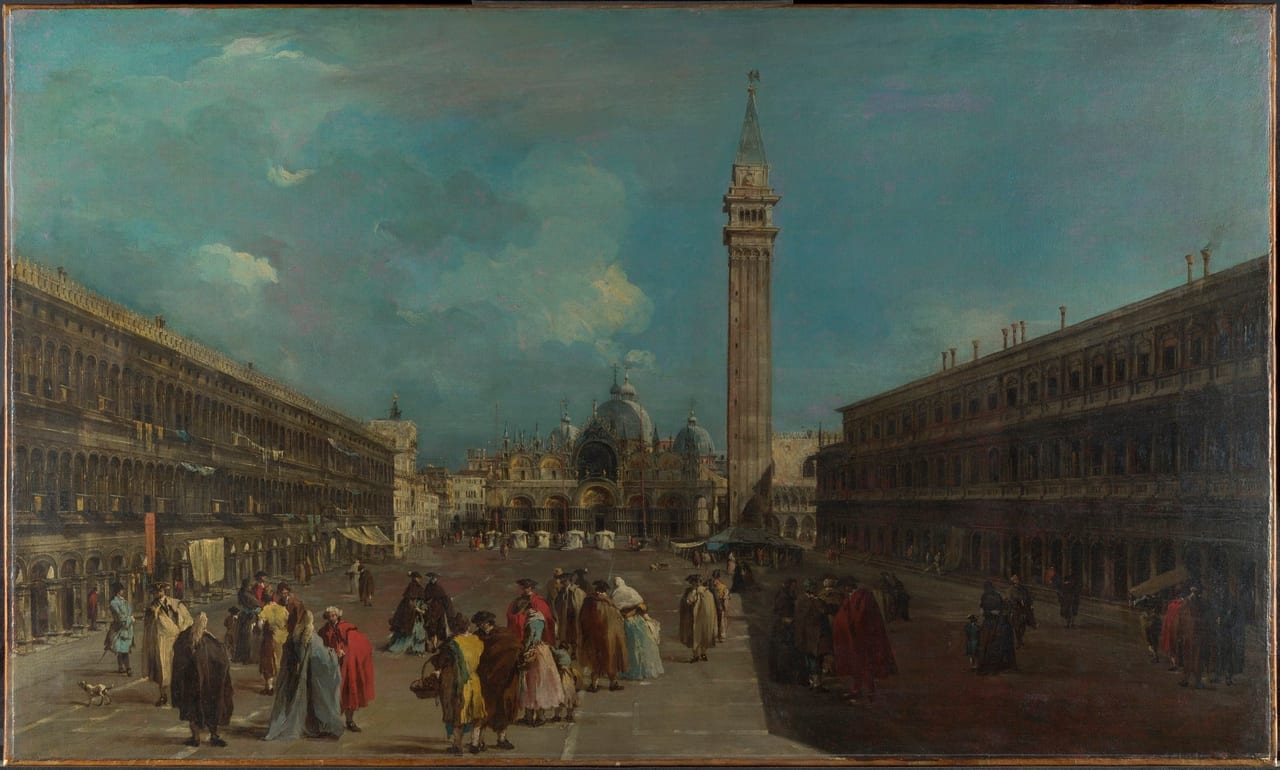
Francesco Guardi
One of Guardi’s earliest views. We look down on a crowd crossing Piazza San Marco, warm sunlight on their bright clothes and on billowing white clouds; Guardi’s brushwork, much looser than Canaletto’s, heightens the poetic mood.
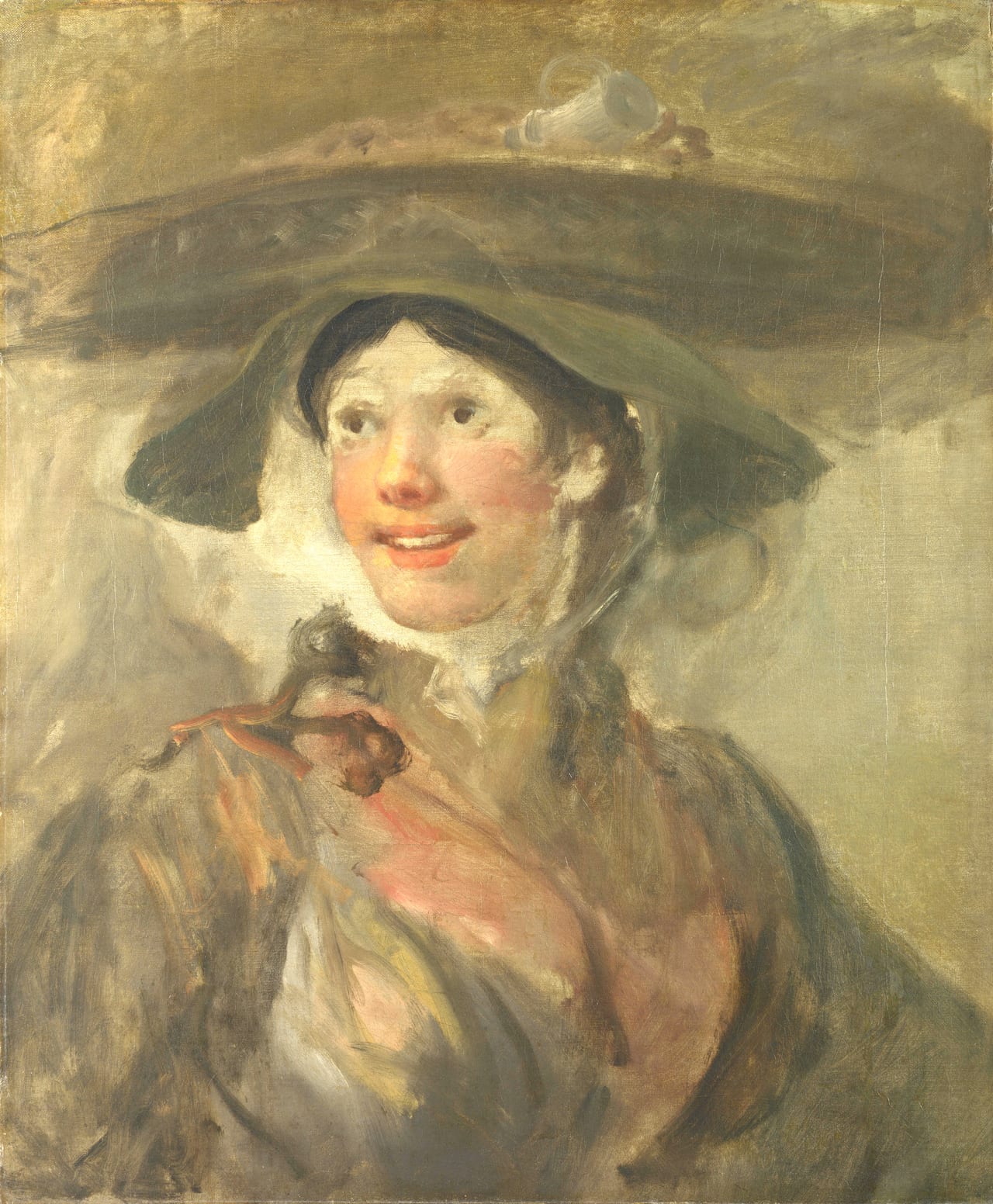
William Hogarth
Hogarth painted this sketch from life, spontaneously and for its own sake, and it seems unique among his single-figure oil sketches. The sitter, one of the women who sold shellfish in the streets of London, balances a basket on her head with a half-pint measure in it; a few darker shells suggest mussels, and perhaps cockles, as well as shrimps. Her lips spread in a smile, or perhaps she is talking, and her teeth show, which was unusual in portraits of the time.
Artworks
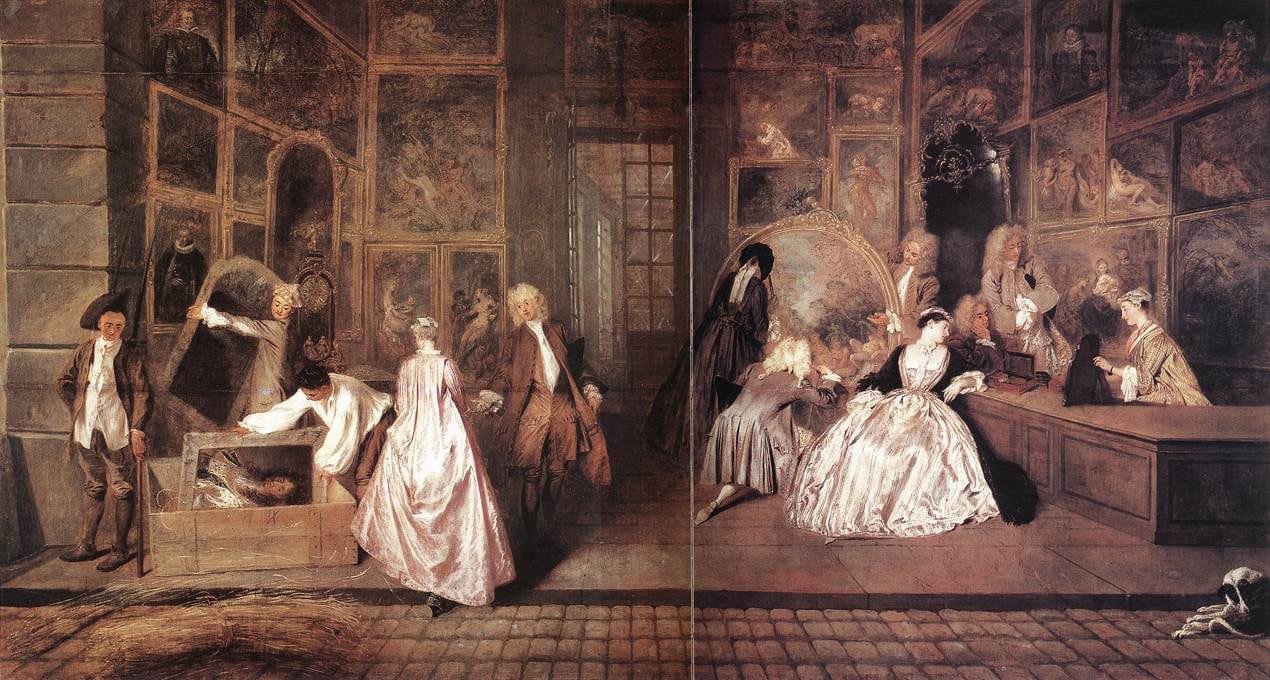
The Shop Sign of Gersaint
Jean-Antoine Watteau · 1720–21
Charlottenburg Palace
Watteau completed this sign for the shop of the Paris art dealer Edme François Gersaint, on the Pont Notre-Dame, in 1720–21; it is thought to be his last major work. On the left a worker packs away a portrait of Louis XIV, a gesture read as the end of the old regime, while customers look at pictures and a young man offers his hand to a woman stepping into the shop. It spent only fifteen days there, and an unknown painter later added the upper parts to turn the arched picture into a rectangle. It is in Charlottenburg Palace, Berlin.
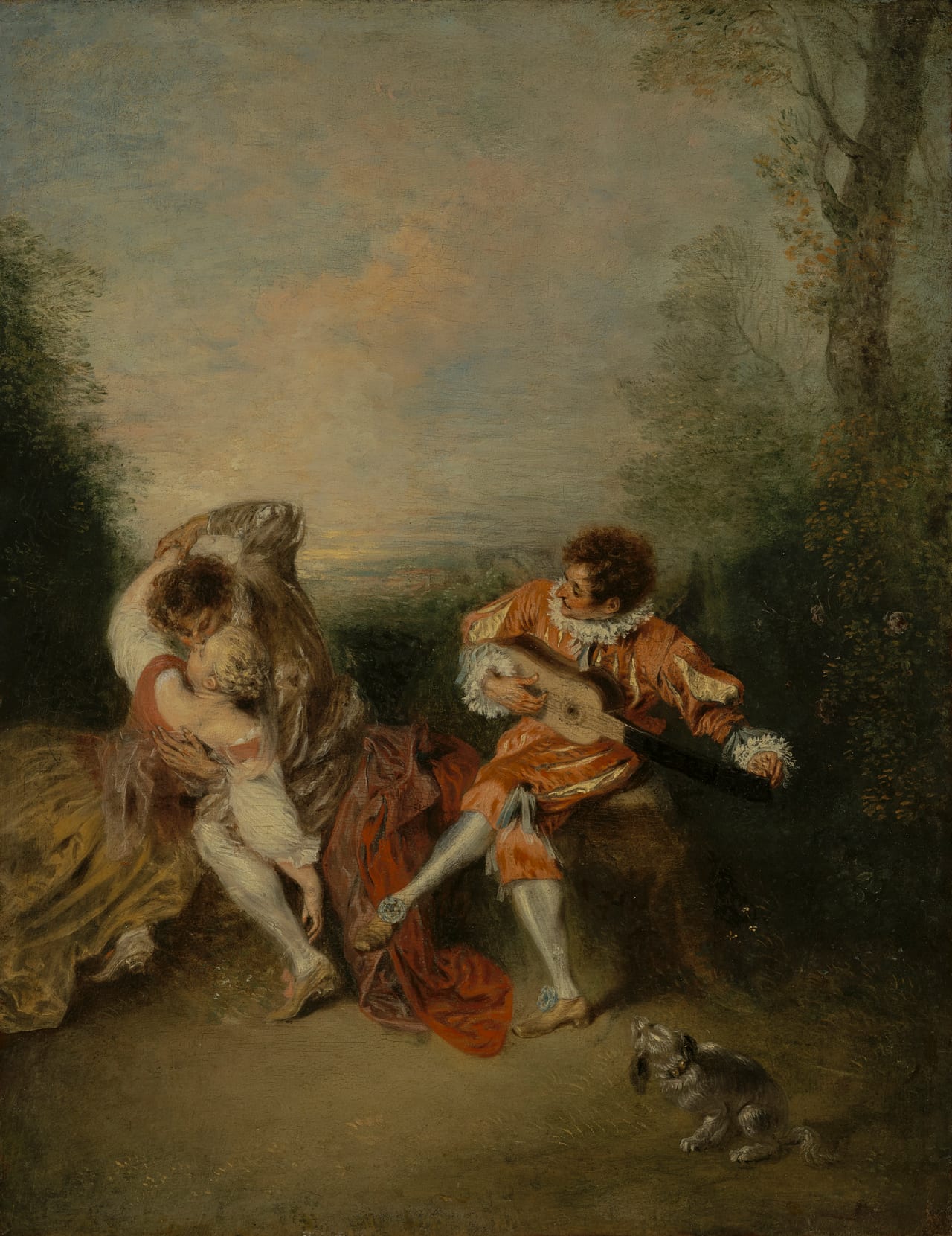
The Surprise
Jean-Antoine Watteau · c. 1718
J. Paul Getty Museum
Painted by Watteau around 1718, on panel. A guitarist dressed as Mezzetino watches a couple embrace, and a small dog watches the whole scene; Watteau’s habit of reusing figures shows here, and so does what he took from Flemish Baroque painting. Its pendant, Perfect Harmony, is in the Los Angeles County Museum of Art. Twice lost, it was found again in 2008 in a British country house, and it is now in the J. Paul Getty Museum.
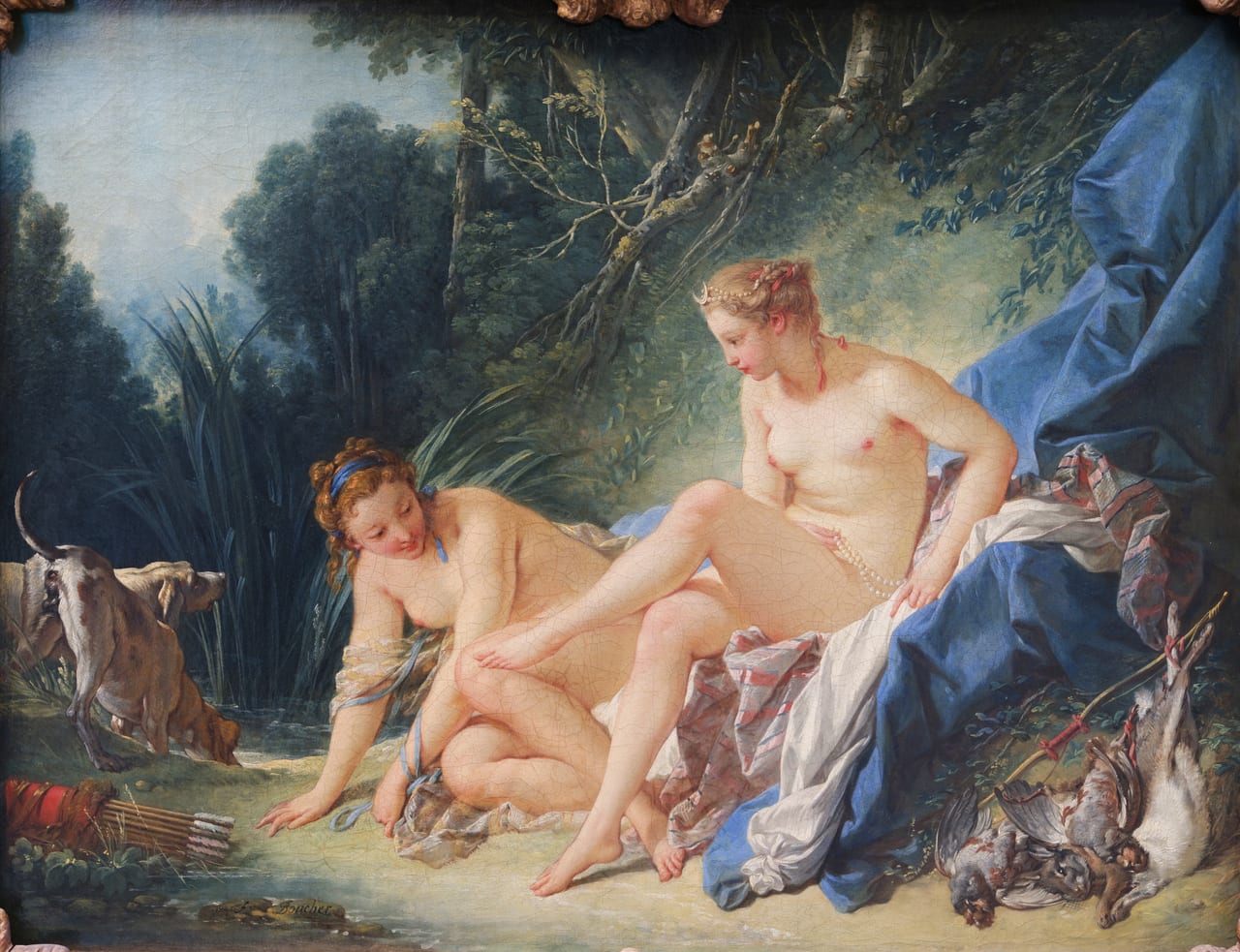
Diana Leaving Her Bath
François Boucher · 1742
Musée du Louvre
Boucher painted Diana in 1742, just out of her bath. The goddess, known by the crescent jewel in her crown of pearls, sits naked on silks with a nymph kneeling at her feet; her quiver and arrows, two hunting dogs and her game identify the huntress. The Louvre acquired the picture in 1852.
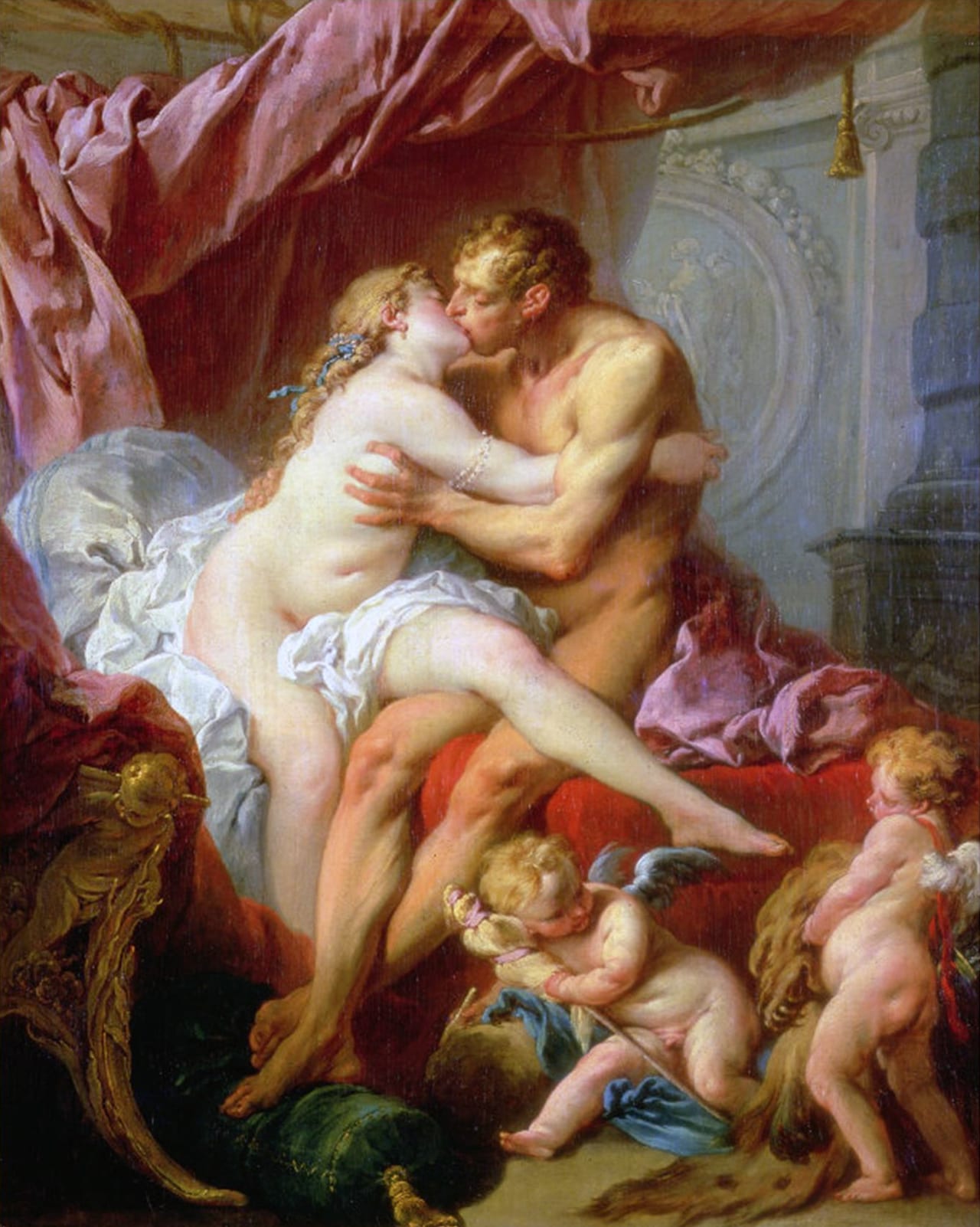
Hercules and Omphale
François Boucher · probably 1731–34
Pushkin Museum of Fine Arts
An important early work by Boucher, probably finished between 1731 and 1734, soon after his studies with François Lemoyne. The Greek hero and the queen of Lydia embrace on a bed beneath a red velvet canopy in a richly furnished room. Earlier pictures stressed Hercules’ humiliation in Omphale’s service; Boucher instead paints a youthful hero with a barely grown beard, and shared desire. It is in the Pushkin Museum in Moscow.
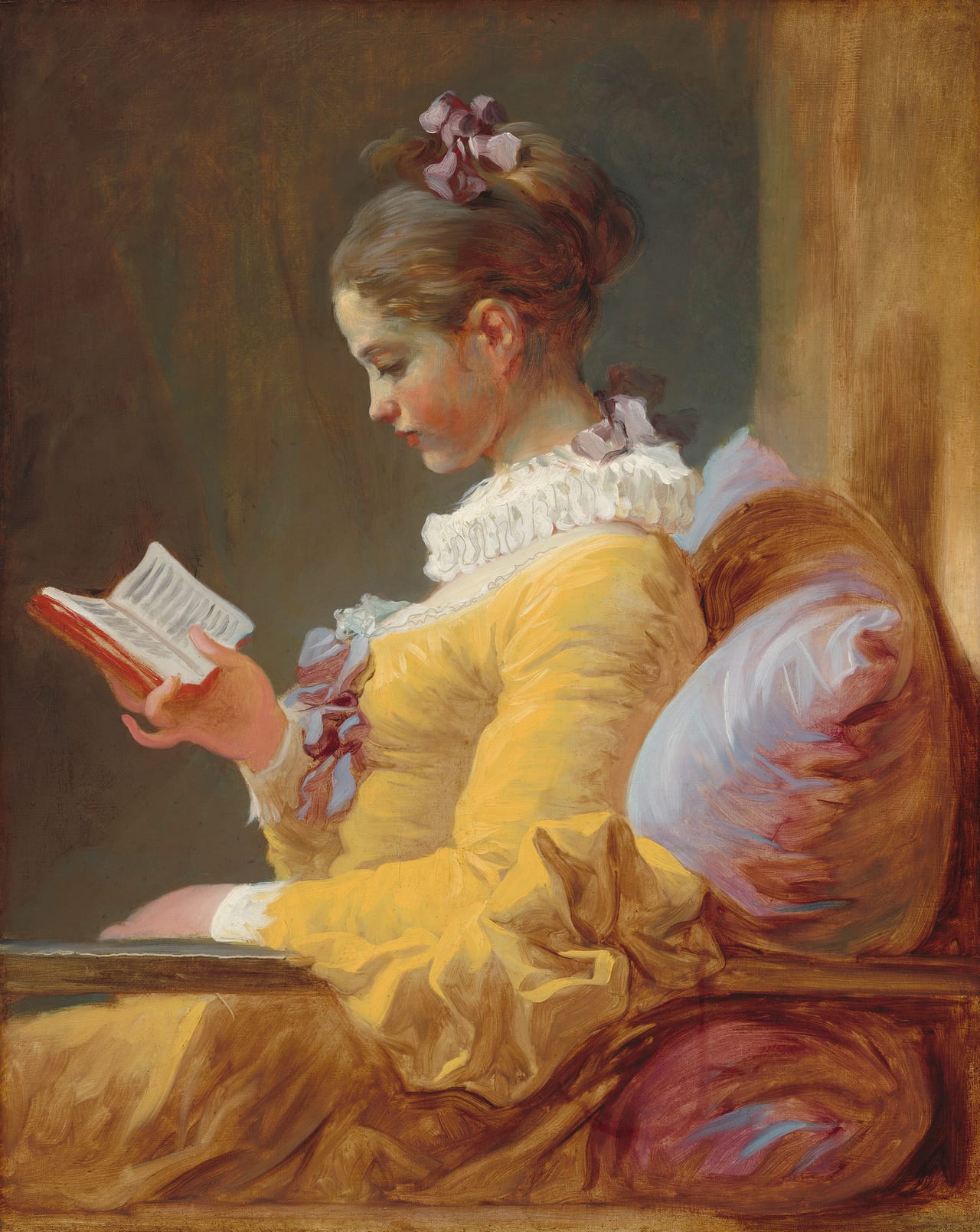
A Young Girl Reading
Jean-Honoré Fragonard
National Gallery of Art
An unidentified girl sits in profile in a lemon-yellow dress with a white ruff and purple ribbons, reading from a small book held in her right hand. Fragonard made it more a genre scene than a portrait, one of a series of quickly painted pictures of young girls called figures de fantaisie, and X-rays show that he painted over an earlier head turned toward the viewer. The National Gallery of Art in Washington bought it in 1961.
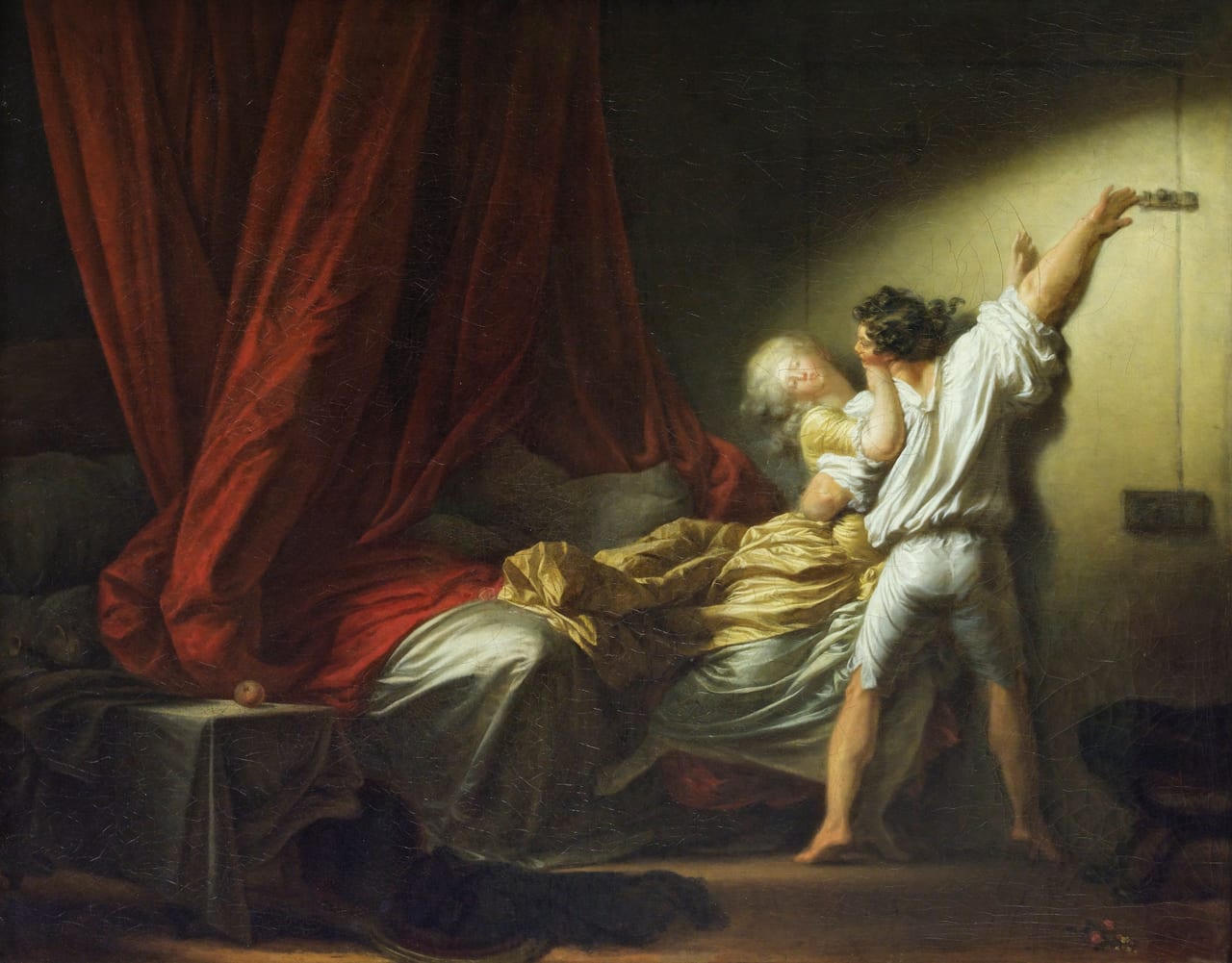
The Bolt
Jean-Honoré Fragonard · 1777
Musée du Louvre
Commissioned by the Marquis de Véri in 1773 and painted by Fragonard in 1777. In a bedroom in disarray, with the bed unmade and a chair overturned, a man holds a woman in a golden satin gown and reaches for the bolt on the door. One reading sees two lovers; another sees a rape, the woman trying to break free. It is in the Louvre.
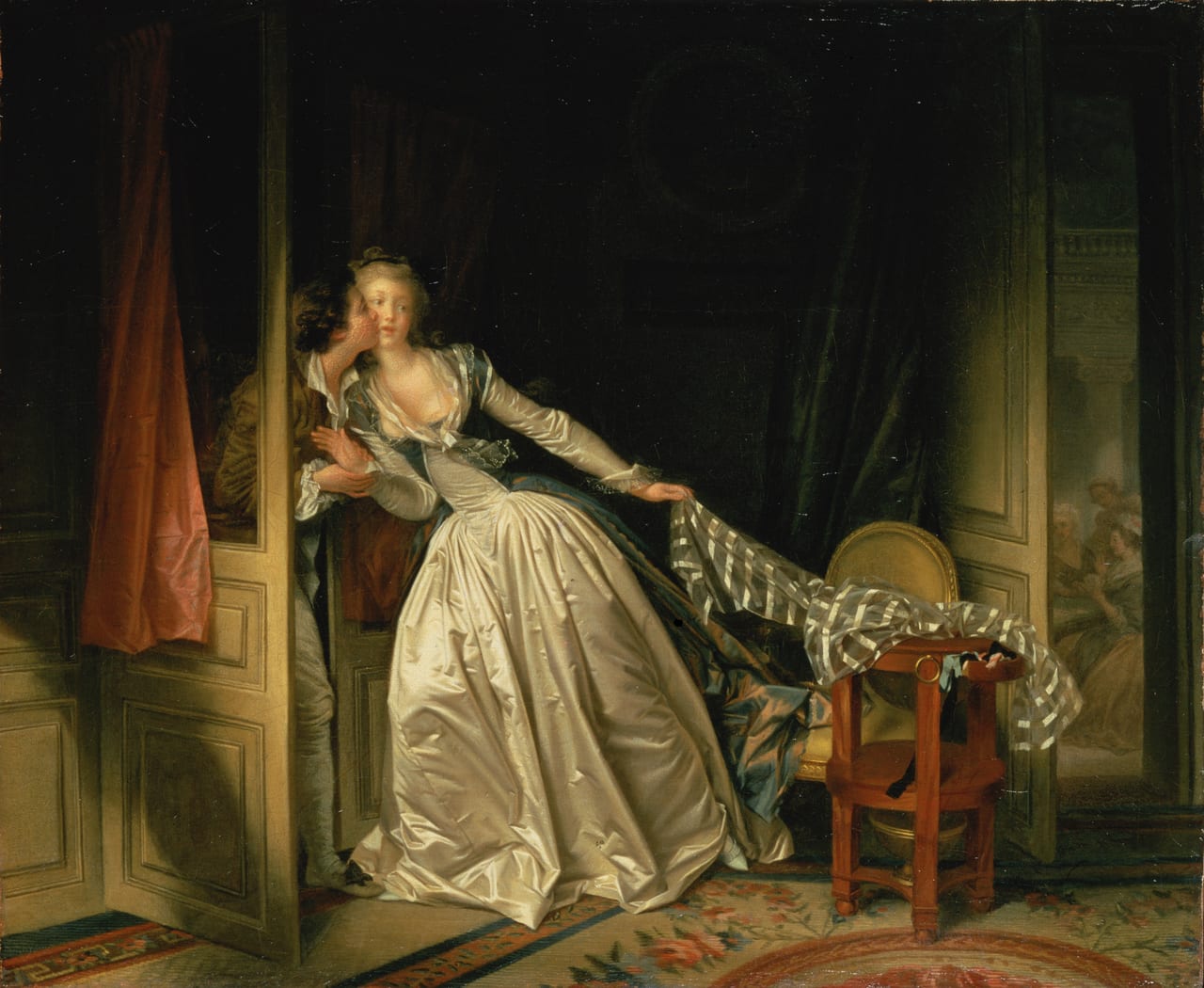
The Stolen Kiss
Jean-Honoré Fragonard, Marguerite Gérard · 1787
Hermitage Museum
A young couple in a secret romance, in a picture of 1787, long attributed to Fragonard because an etching published in 1788 named him as its author. Its style, though close to Fragonard’s Bolt, is more typical of his sister-in-law and apprentice Marguerite Gérard, and some scholars hold it to be their joint work or hers alone. It was once owned by Stanisław August Poniatowski, last monarch of the Polish–Lithuanian Commonwealth, and went to the Hermitage in 1895.
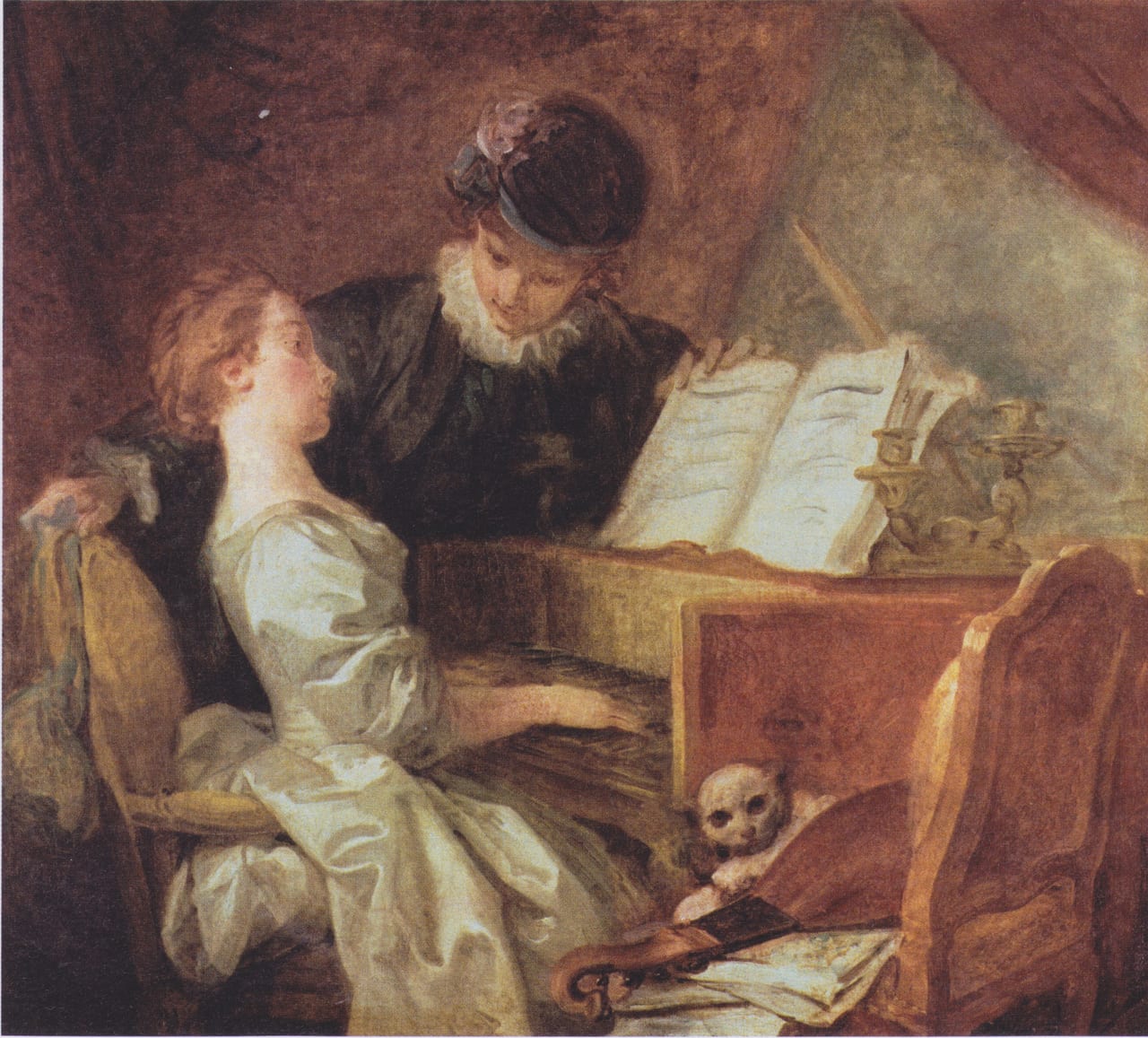
The Music Lesson
Jean-Honoré Fragonard · c. 1770
Musée du Louvre
Painted by Fragonard around 1770. The music lesson was a frequent subject in the Dutch Golden Age, and Fragonard turns it into a fête galante of dreamy love, the young teacher courting his pupil. Hippolyte Walferdin gave it to the Louvre in 1849.
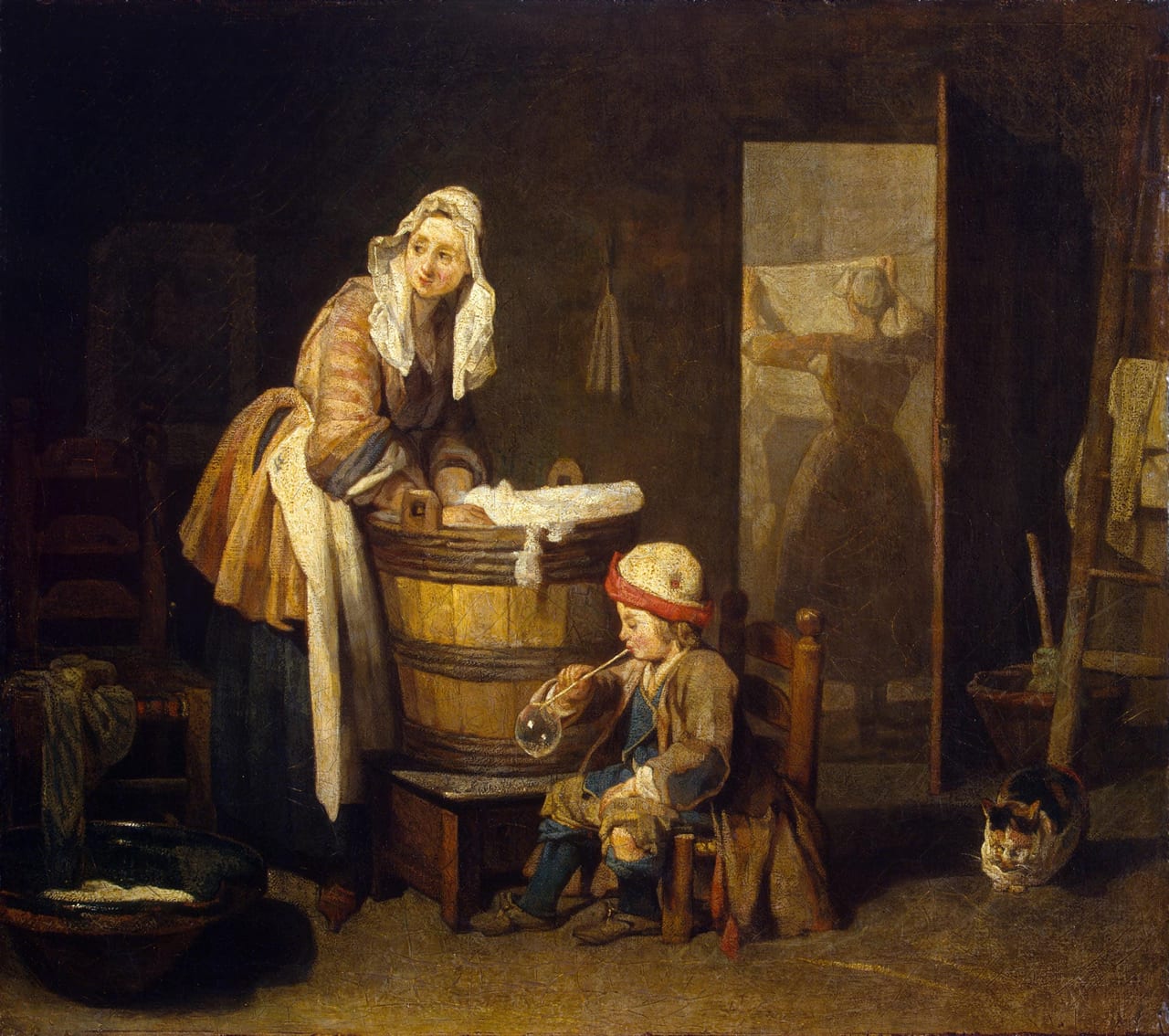
The Laundress
Jean-Baptiste-Siméon Chardin · 1733–40
Hermitage Museum
Chardin painted The Laundress three times. This is the prime version, signed at the upper left and dated between 1733 and 1740. It was in the Crozat collection, most of which Catherine II of Russia bought in 1772 on Denis Diderot’s advice, and so it came to the Hermitage.
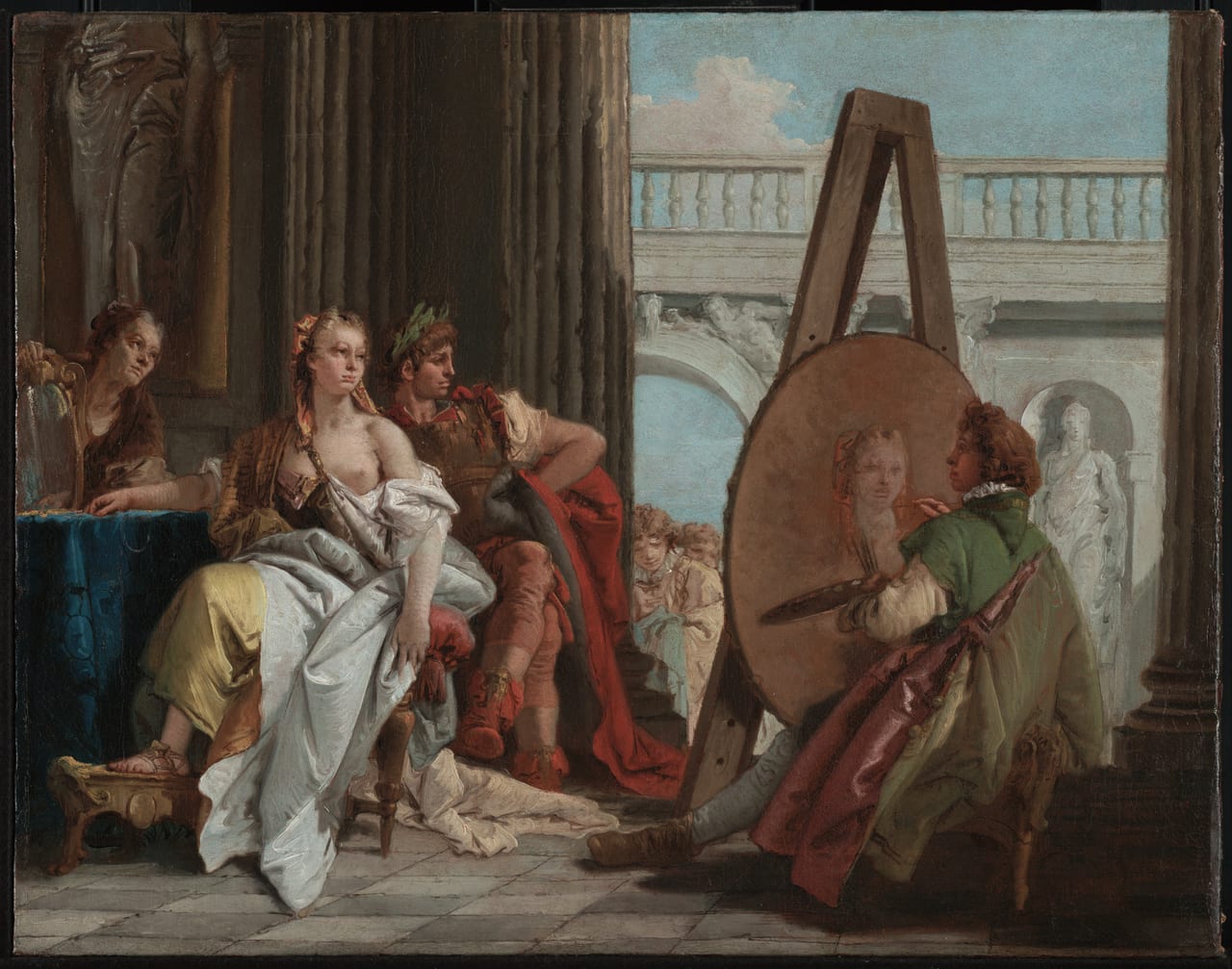
Alexander the Great and Campaspe in the Studio of Apelles
Giovanni Battista Tiepolo · c. 1740
J. Paul Getty Museum
Painted by Tiepolo around 1740, after a story told by Pliny the Elder. Alexander the Great has commissioned the court painter Apelles to portray his lover Campaspe; seeing that the artist loves her, Alexander gives her up to him. It is one of three pictures Tiepolo drew from the legend, and is in the Getty Museum; an earlier one is in Montreal.
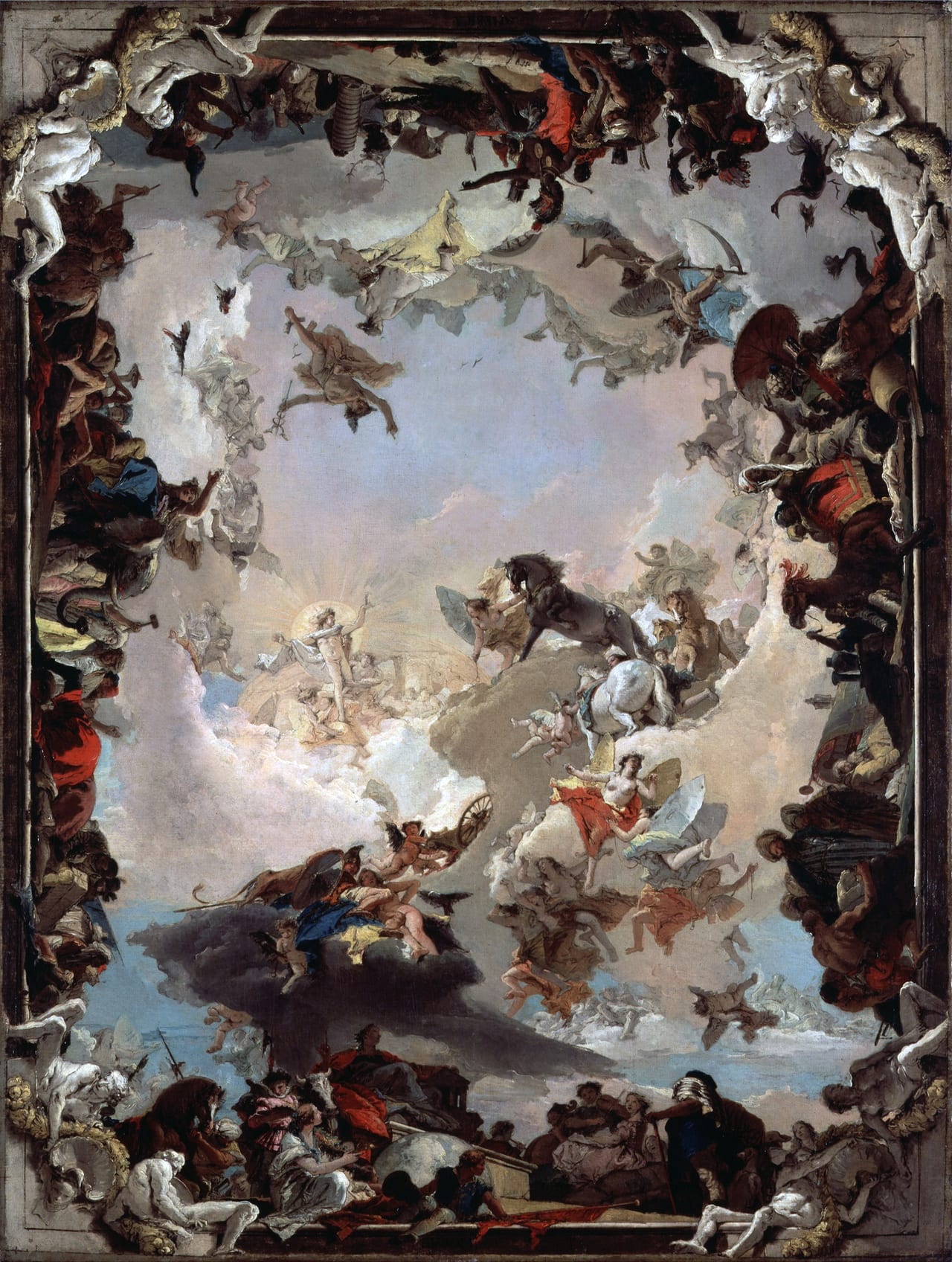
Allegory of the Planets and Continents
Giovanni Battista Tiepolo · 1752
Metropolitan Museum of Art
An elaborate oil sketch of 1752, for a larger version of the scene as a fresco. Tiepolo was commissioned between December 1750 and November 1753 to decorate the newly built palace of the Prince-Bishop of Würzburg, and over its staircase he painted a fresco of more than 600 square metres. Figures circle Apollo, the sun god, as the planets circle the sun, and the cornice stands for Europe, America, Africa and Asia. Critics differ over whether it came before or after the fresco, and whether it is by Giovanni Battista Tiepolo or his son Domenico. It was identified in 1954 in the ceiling of a corridor at the Hendon Hall Hotel in London.
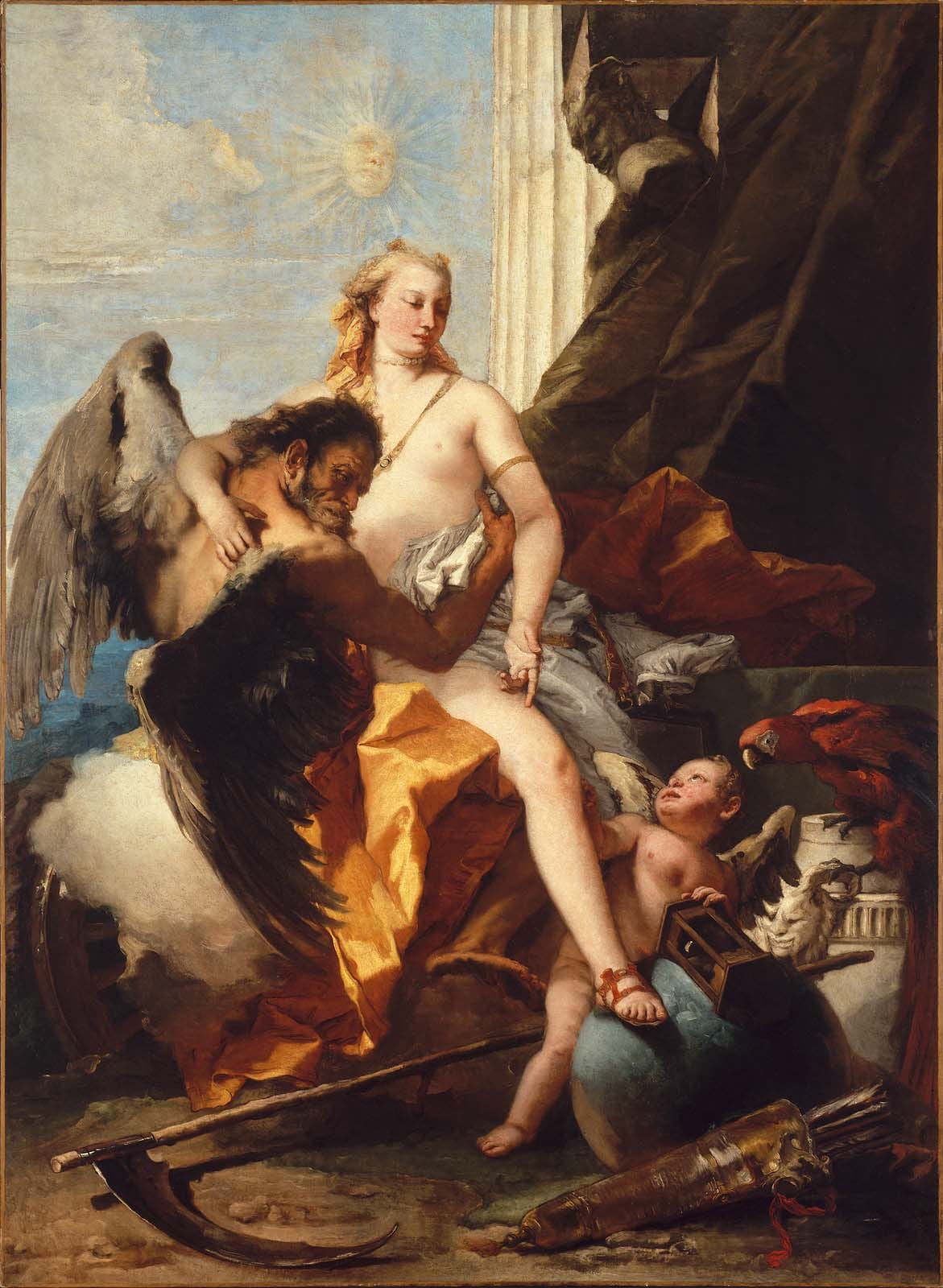
Time Unveiling Truth
Giovanni Battista Tiepolo · c. 1745–50
Museum of Fine Arts, Boston
Painted by Tiepolo around 1745 to 1750. Father Time, on a chariot and holding a scythe, uncovers the body of Truth. The picture stayed in Verona until the nineteenth century, changed hands several times in Paris, and has been in the Museum of Fine Arts, Boston, since 1961.
Sources
- Britannica, “Rococo”
- National Gallery, London, “Rococo”
- Tate, “Rococo”
- Wikipedia, “Rococo”
- National Gallery, London, “Jean-Antoine Watteau”
- Britannica, “Antoine Watteau”
- National Gallery, London, “Nicolas Lancret”
- Britannica, “Nicolas Lancret”
- National Gallery, London, “A Lady in a Garden having Coffee with Children”
- National Gallery, London, “Jean-Baptiste Pater”
- Wikipedia, “Jean-Baptiste Pater”
- National Gallery, London, “Fête Galante”
- National Gallery, London, “François Boucher”
- Britannica, “François Boucher”
- National Gallery, London, “Jean-Honoré Fragonard”
- Britannica, “Jean-Honoré Fragonard”
- Wallace Collection, “The Swing”
- Britannica, “Jean-Marc Nattier”
- Wikipedia, “The Family of Philip V (1743)”
- Wikipedia, “Louis-Michel van Loo”
- Britannica, “Jean-Baptiste-Siméon Chardin”
- National Gallery, London, “Giovanni Battista Tiepolo”
- Britannica, “Giovanni Battista Tiepolo”
- Wikipedia, “The Banquet of Cleopatra (Tiepolo)”
- Britannica, “Canaletto”
- National Gallery, London, “Canaletto”
- Wikipedia, “The Entrance to the Grand Canal, Venice”
- Britannica, “Francesco Guardi”
- National Gallery, London, “Francesco Guardi”
- National Gallery, London, “Venice: Piazza San Marco”
- Britannica, “Antoine Pesne”
- National Gallery, London, “The Shrimp Girl”
- Wikipedia, “Pierrot (Watteau)”
- Wikipedia, “L’Enseigne de Gersaint”
- Wikipedia, “The Surprise (Watteau)”
- Wikipedia, “Diana Bathing (Boucher)”
- Wikipedia, “Hercules and Omphale (Boucher)”
- Wikipedia, “The Triumph of Venus”
- Wikipedia, “A Young Girl Reading”
- Wikipedia, “The Bolt (Fragonard)”
- Wikipedia, “The Stolen Kiss (painting)”
- Wikipedia, “The Music Lesson (Fragonard)”
- Wikipedia, “The Laundress (Chardin)”
- Wikipedia, “Alexander the Great and Campaspe in the Studio of Apelles”
- Wikipedia, “Allegory of the Planets and Continents”
- Wikipedia, “Time Unveiling Truth (Tiepolo)”
- Wikipedia, “L’Indifférent”
- Wikipedia, “The Ray (Chardin)”
- L'Indifférent — Public domain via Wikimedia Commons (Public domain)
- Pierrot — Public domain via Wikimedia Commons (Public domain)
- The Triumph of Venus — Public domain via Wikimedia Commons (Public domain)
- The Swing — Public domain via Wikimedia Commons (Public domain)
- A Lady in a Garden having Coffee with Children — Public domain via Wikimedia Commons (Public domain)
- Fête Galante — Public domain via Wikimedia Commons (Public domain)
- The Family of Philip V — Public domain via Wikimedia Commons (Public domain)
- Saying Grace — Public domain via Wikimedia Commons (Public domain)
- Venice: Piazza San Marco — Public domain via Wikimedia Commons (Public domain)
- The Shrimp Girl — Public domain via Wikimedia Commons (Public domain)
- The Shop Sign of Gersaint — Public domain via Wikimedia Commons (Public domain)
- The Surprise — Public domain via Wikimedia Commons (Public domain)
- Diana Leaving Her Bath — Public domain via Wikimedia Commons (Public domain)
- Hercules and Omphale — Public domain via Wikimedia Commons (Public domain)
- A Young Girl Reading — Public domain via Wikimedia Commons (Public domain)
- The Bolt — Public domain via Wikimedia Commons (Public domain)
- The Stolen Kiss — Public domain via Wikimedia Commons (Public domain)
- The Music Lesson — Public domain via Wikimedia Commons (Public domain)
- The Laundress — Public domain via Wikimedia Commons (Public domain)
- Alexander the Great and Campaspe in the Studio of Apelles — Public domain via Wikimedia Commons (Public domain)
- Allegory of the Planets and Continents — Public domain via Wikimedia Commons (Public domain)
- Time Unveiling Truth — Public domain via Wikimedia Commons (Public domain)
Invite Rococo into your living room