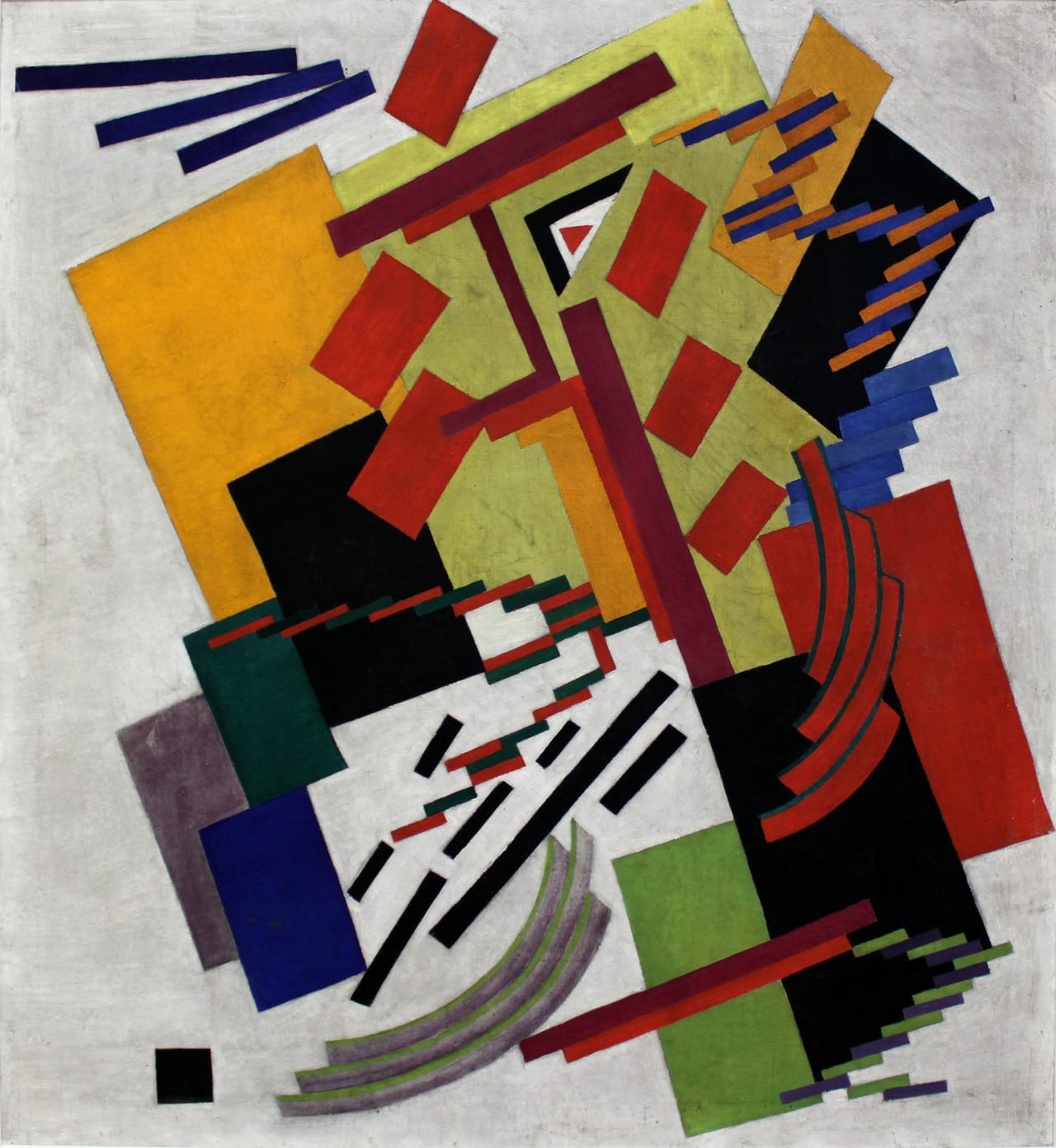
Suprematist Composition
Kazimir Malevich · 1916

Suprematism
Russia
Squares, circles, crosses and rectangles, painted in a limited range of colours: these are the pictures of Suprematism, which Kazimir Malevich began in Russia in about 1913, the first movement of pure geometrical abstraction in painting. Its name expressed his idea that colour, line and shape should rule over subject matter or narrative. Malevich introduced the new paintings at 0.10: The Last Futurist Exhibition in Petrograd in 1915. At a one-man exhibition in 1919 he announced the end of the movement, but by way of Wassily Kandinsky and El Lissitzky its geometrical style reached Germany, and the Bauhaus in particular, in the early 1920s.
From Cubo-Futurism to the square
Kazimir Malevich was born near Kyiv in 1878, to parents of Polish origin, and studied drawing in Kyiv before attending the Stroganov School and the Moscow School of Painting, Sculpture, and Architecture. His early pictures followed Impressionism, Symbolism and Fauvism; a journey to Paris in 1912 brought him under the influence of Pablo Picasso and Cubism, and in the Jack of Diamonds group he led Russian Cubism. In 1913 Malevich drafted a manifesto for the First Futurist Congress with the composer Mikhail Matiushin and the writer Alexei Kruchenykh, and designed the sets and costumes for their opera Victory over the Sun. That year, too, Malevich began to make abstract geometric patterns in a manner he called Suprematism.
Malevich’s first Suprematist work, a black square drawn in pencil on a white field, did away with every element of objective representation that had marked his earlier Cubo-Futurist style, itself a distinctly Russian offshoot blending Cubism and Futurism. In his book The Non-Objective World, published in 1927, one of the most important theoretical documents of abstract art, Malevich wrote: “In the year 1913, trying desperately to free art from the dead weight of the real world, I took refuge in the form of the square.” The right means of representation, as he put it, “is always the one which gives fullest possible expression to feeling as such and which ignores the familiar appearance of objects”, and he linked the black square with feeling and its white surround with “the void beyond this feeling.”
Malevich’s early Suprematist compositions most likely date from 1913, but they were first shown only in 1915, when Malevich edited the Suprematist manifesto, From Cubism and Futurism to Suprematism: New Painterly Realism, published in 1916, with the help of several writers, most notably the poet Vladimir Mayakovsky. The first actual exhibition of Suprematist paintings was in St Petersburg, in December 1915, at an exhibition called 0.10. The exhibition included Malevich’s abstract paintings, among them the famous black square on a white ground, now in the State Tretyakov Gallery in Moscow, which headed the list of Malevich’s works in the catalogue. Some visitors found it especially scandalous because it hung in the top corner of the room, where Russian Orthodox households place their icons. Vladimir Tatlin’s Corner Counter Reliefs and Olga Rozanova’s Metronome were among the exhibition’s other highlights.
Colour in space
Malevich made his first Suprematist works of simple forms, squares, circles and crosses, and held their palette to black, white, red, green and blue. Out of what he called the ‘suprematist square’ he developed a whole range of forms, rectangles, triangles and circles among them, often in intense colours, floated against a ground that is usually white; the feeling of colour in space is a crucial aspect of Suprematist painting. By 1916–17 Malevich was presenting more complex shapes, fragments of circles and tiny triangles, adding brown, pink and mauve to his colours, making the spatial relationships more complex and bringing the illusion of three dimensions into his painting.
To support the movement Malevich established a journal, Supremus, first titled Nul, or Nothing, to which artists and philosophers contributed; among the essays written for its first issue was Olga Rozanova’s Cubism, Futurism, Suprematism. The publication never took off, and its first issue was never distributed because of the Russian Revolution. Suprematism had a few adherents among lesser-known artists, Ivan Klyun, Ivan Puni and Rozanova among them.
Rozanova had developed from the influences of Cubism and Futurism into pure abstraction, where the visual weight and relationship of colours organise the composition; from 1917 to 1918 she made a series of non-objective paintings that she called tsv’etopis’. She died of diphtheria in Moscow in 1918, at the age of 32. Lyubov Popova began to paint completely abstract Suprematist compositions in 1916, but Painterly Architectonics, the title she gave many of these pictures, suggests that, Suprematist as she was, she cared more for painting as a projection of material reality than as a personal expression of metaphysical reality.
Malevich’s experiments reached their end point in the White on White paintings of 1917–18, from which colour was removed, leaving a faintly outlined square that barely rises from its ground; White on White takes his Suprematist theories to their logical conclusion. From 1919 he tried Suprematism in three dimensions, in architectural models, and he began teaching at the Vitebsk Popular Art School, which he soon directed; there he and his students formed the Suprematist group Unovis. At a one-man exhibition of his work in 1919, Malevich announced the end of the Suprematist movement.
After Suprematism
El Lissitzky met Malevich in 1919 and fell strongly under the influence of Suprematism; so did the Hungarian-born László Moholy-Nagy. Wassily Kandinsky, though not affiliated with the movement, showed its influence in the geometrisation of his forms after 1920. By way of Kandinsky and Lissitzky, the geometric manner, along with other abstract currents in Russian art, travelled to Germany, particularly to the Bauhaus, in the early 1920s. On a visit to the Bauhaus at Dessau in 1927, Malevich met Kandinsky and published his theory as Die gegenstandslose Welt (The Non-Objective World). Later, when Soviet politicians turned against modern art, Malevich and his work fell out of favour.
From 1921 to 1924 Popova was entirely involved in Constructivist projects, sometimes working with Varvara Stepanova, the architect Alexander Vesnin and Alexander Rodchenko. Widely known for her abstract paintings, she was also an influential educator and theoretician who declared painting obsolete and gave herself to the applied arts, which became basic to building a new Soviet society after the October Revolution.
With Stalin’s rise from 1924 and the imposition of socialist realism, Malevich’s career languished. His ties with German artists led to his arrest in 1930, and many of his manuscripts were destroyed. In his last years he painted figurative pictures: a self-portrait of 1933 shows him in a traditional manner, the only one Stalinist cultural policy allowed, but signed it with a tiny black-over-white square. Malevich died in Leningrad in 1935, of cancer, in poverty and oblivion. Suprematism was one of the key movements of modernist art.
Artists
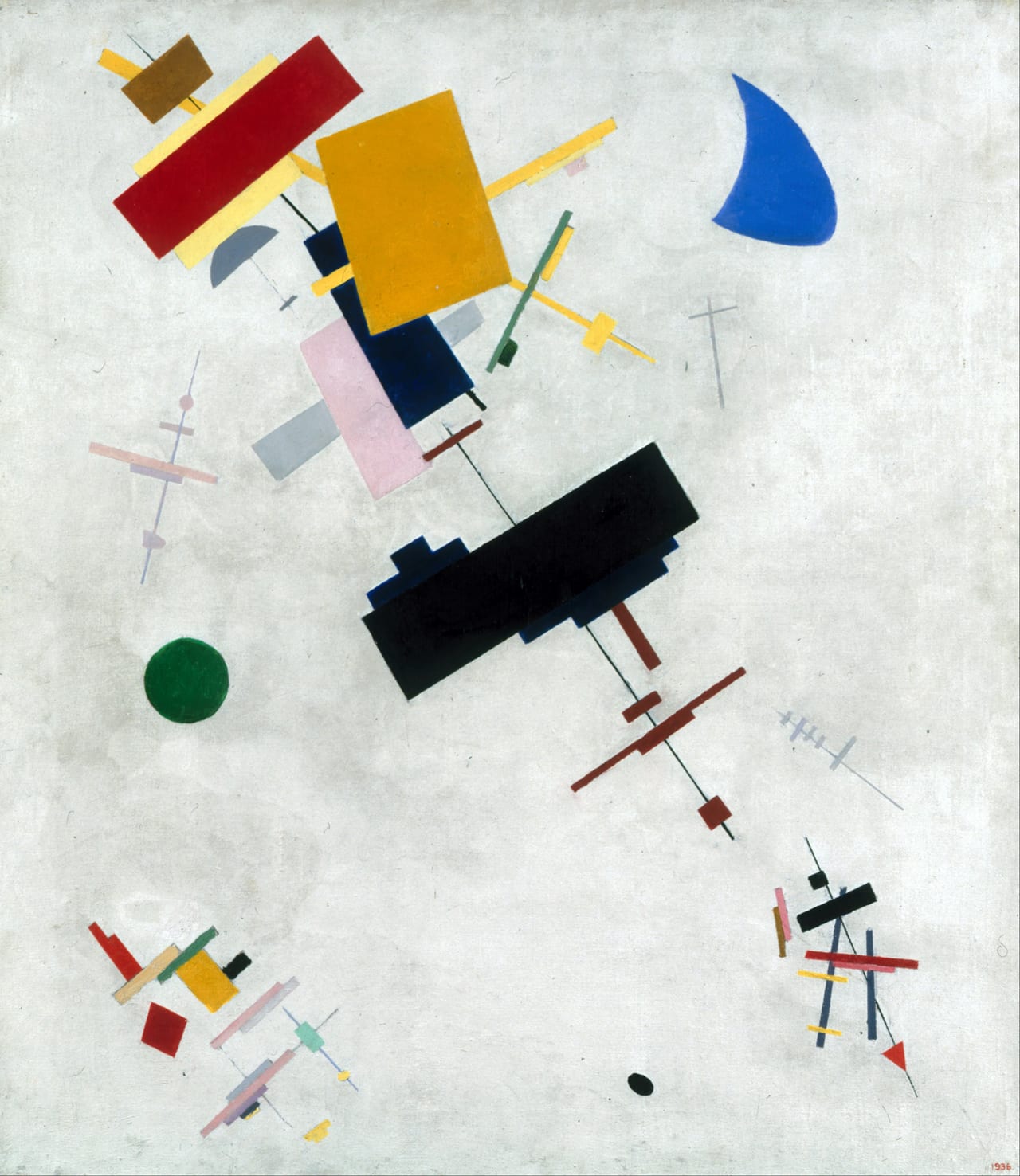
Kazimir Malevich
Malevich painted this picture in 1915–16, and it entered the Russian Museum in 1920. He joins coloured geometric figures, a rectangle, a square, a circle and a cross, in dynamic links; intersecting and in harmony with one another, they are the “letters” of the universal language he invented and named Suprematism. Hovering in the white space of the background, these “constructions” personify Malevich’s idea of an infinite universe, and the picture has no top or bottom.
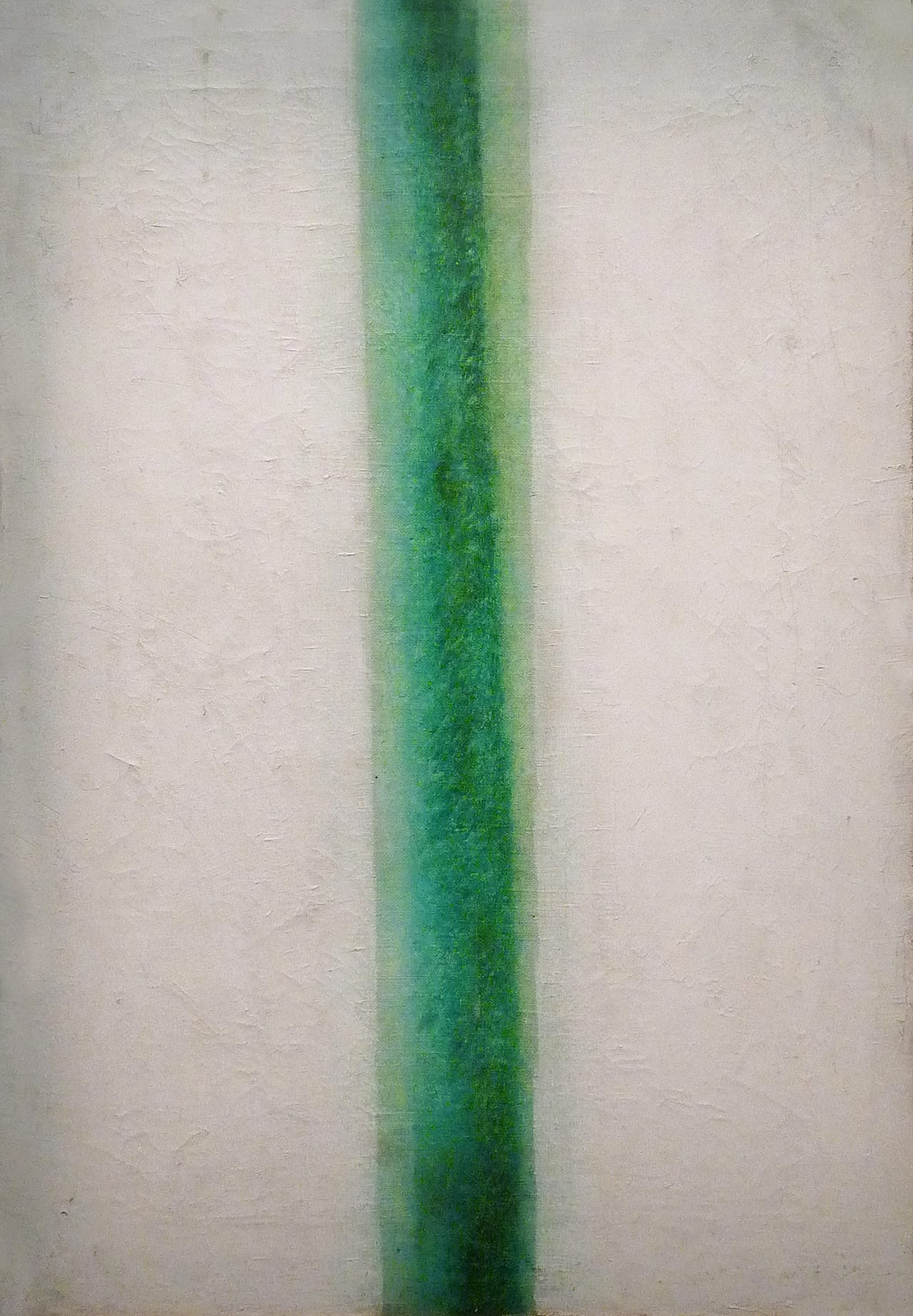
Olga Rozanova
Rozanova painted Green Stripe in 1917–18, shortly before her early and sudden death, as she moved from Suprematism towards a new kind of geometric abstraction based on dispersing forms with light. Its only motif is a stream of green light, unfolding and pulsing in space, and the stripe itself is a fragment of a stripe running on into infinity. It is among the best-known canvases of the Russian avant-garde and is often compared, for its originality, with Malevich’s Black Square, yet until the 1970s the painting, like its author, was almost forgotten. It has been in the Rostov Kremlin museum-reserve since the early 1920s.
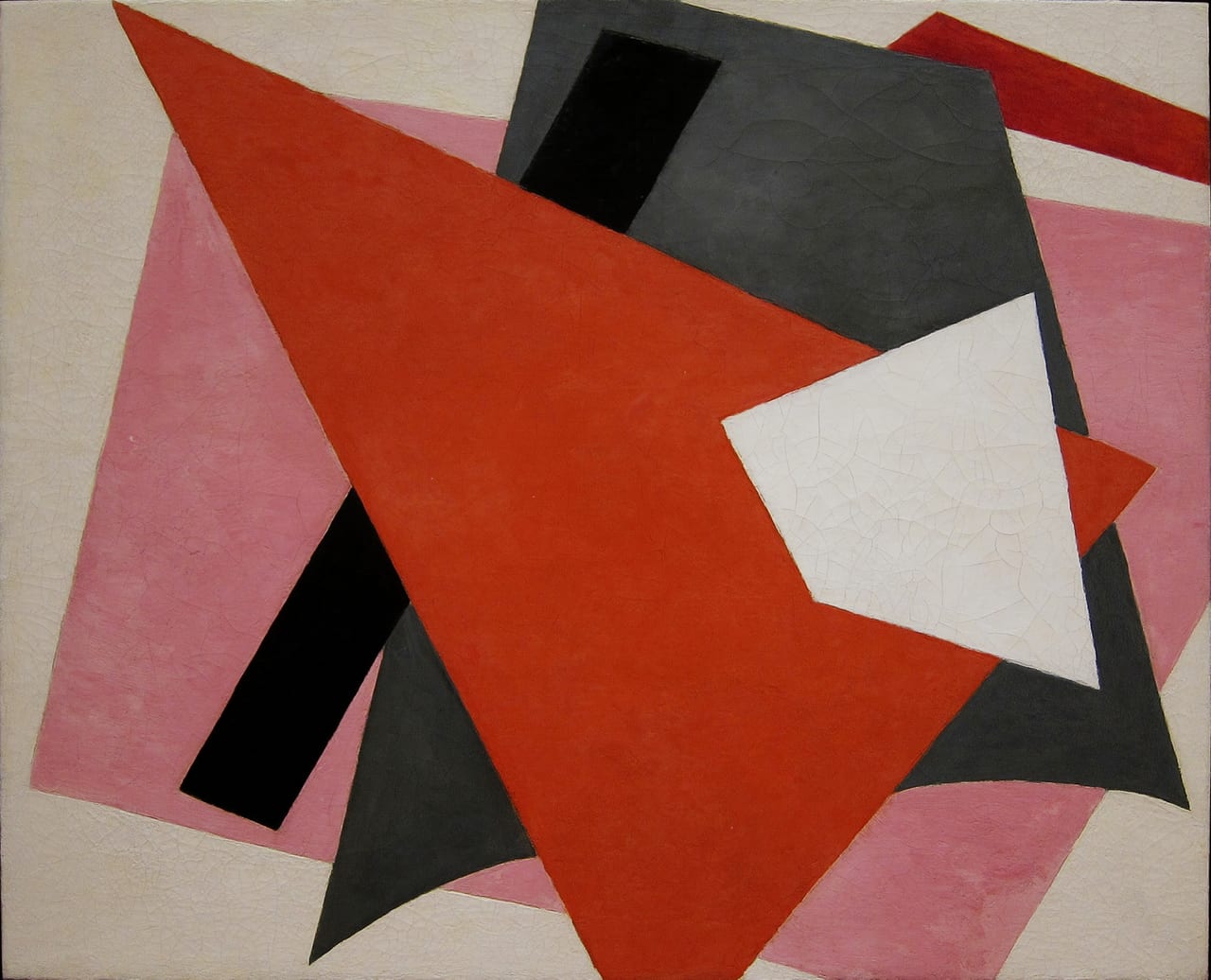
Lyubov Popova
Against the wide white grounds of Malevich’s Suprematist paintings, Popova builds what looks like a tight, shallow box whose geometric forms seem to press outward against it. Treating planes almost as solid material things, she builds a monumental composition about the relations between its parts, joining Malevich’s coloured geometric forms and worked paint surface to the overlapping, relief-like elements of Vladimir Tatlin, in whose studio she had worked between 1912 and 1915. Popova joined Malevich’s Suprematist group in 1916 and over the next two years made a series of works, this one among them, called Painterly Architectonics.
Artworks
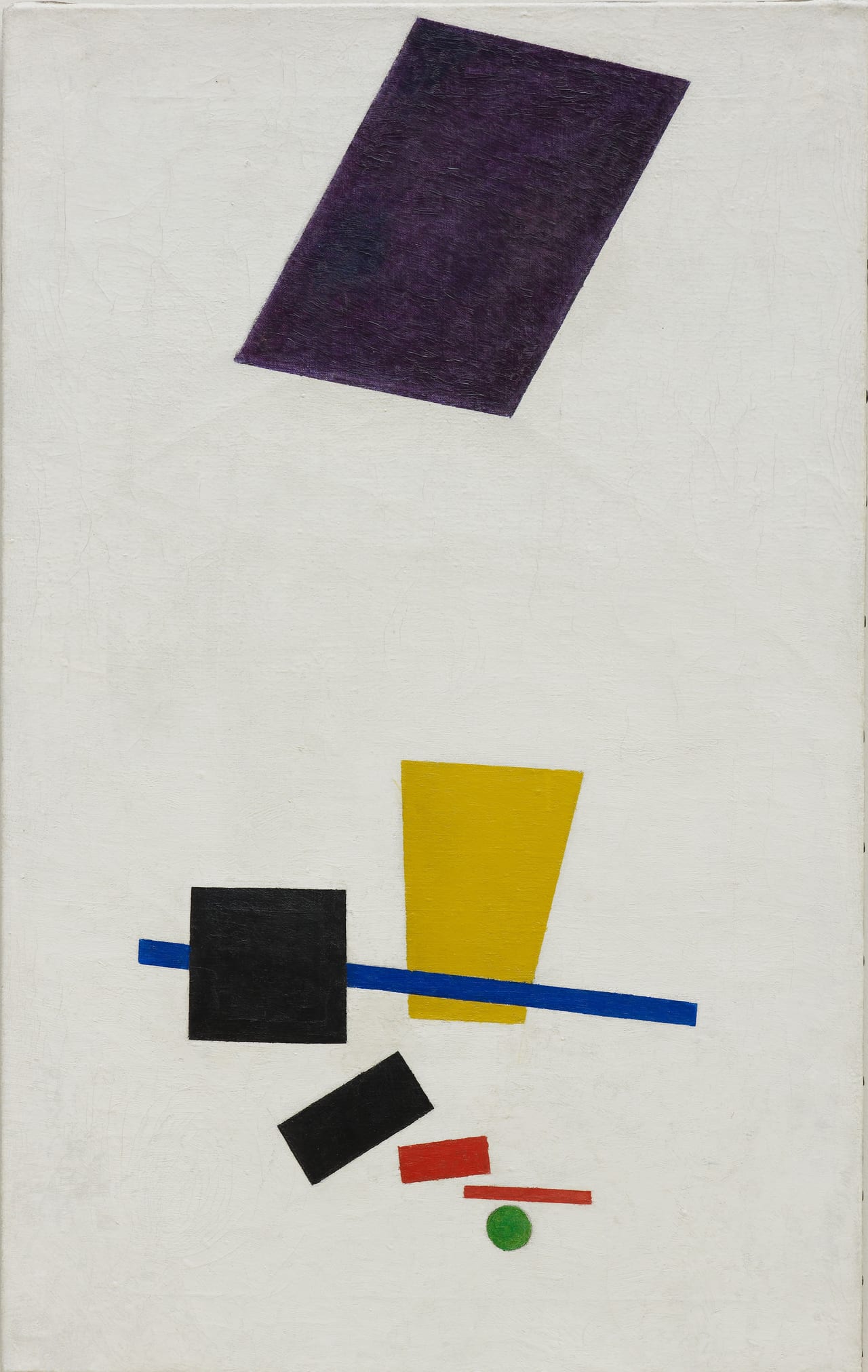
Painterly Realism of a Football Player—Color Masses in the 4th Dimension
Kazimir Malevich · 1915
Art Institute of Chicago
Malevich painted this picture in the summer or autumn of 1915. Breaking from observed reality, he set coloured geometric forms against a textured white ground and asked viewers to imagine a new kind of realism in painting, which he invoked through the metaphor of a spatial fourth dimension, named in the title, and by showing such works without frames and refusing to give them a precise orientation. In 1921 he explained: “In reality, the globe has no bottom, no top, no perspective, no weight—it does not have that most important thing upon which our knowledge of the world is based: relativity.”
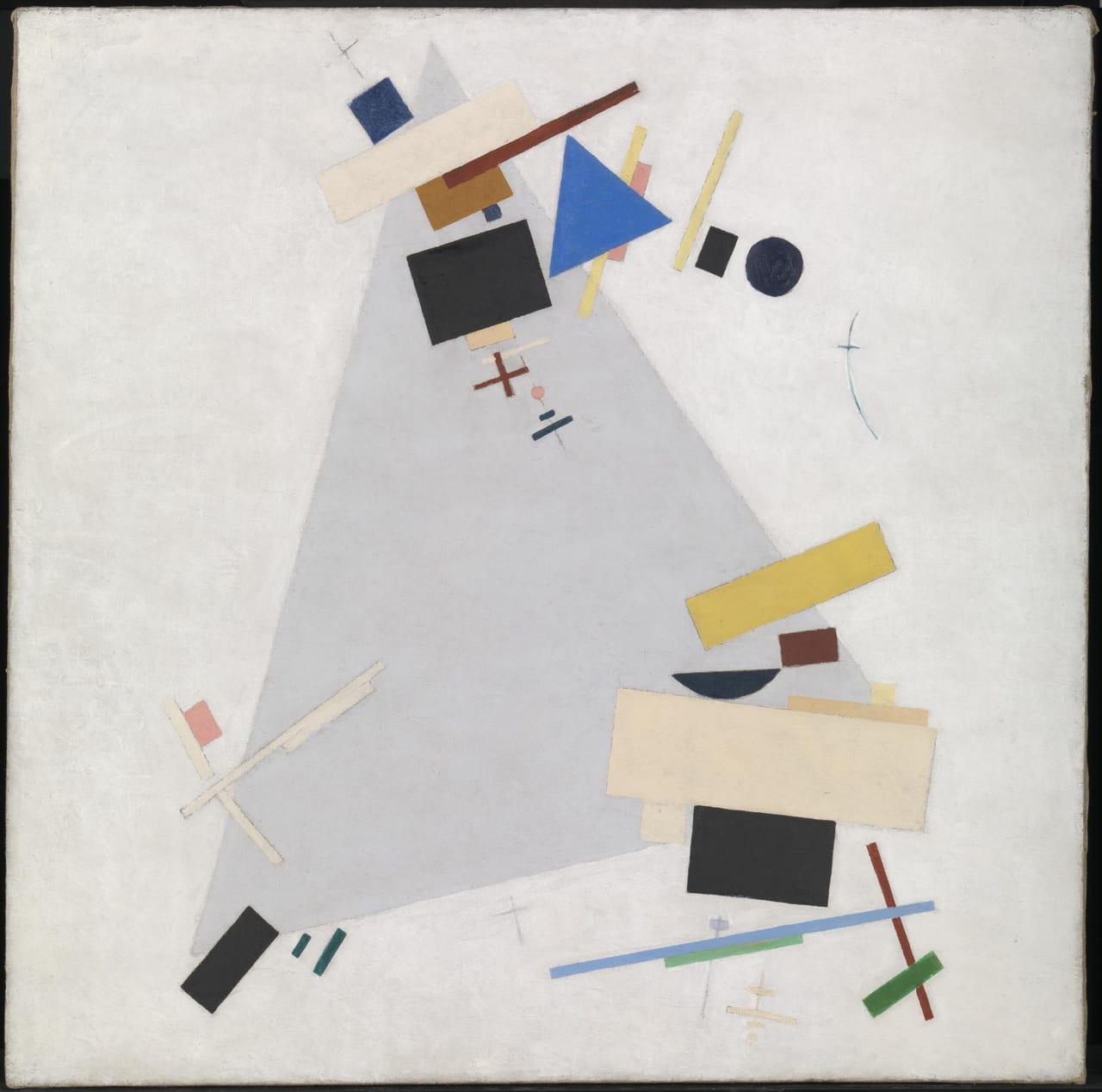
Dynamic Suprematism
Kazimir Malevich · 1915 or 1916
Tate
Malevich painted Dynamic Suprematism in 1915 or 1916. The Museum of Painterly Culture bought it from him, and when that museum was dissolved the painting passed to the Tretyakov Gallery, in 1929 or 1930. On 16 December 1975 the Tretyakov released it on an order of the USSR Ministry of Culture; to whom, and in exchange for what, is still unknown. In 1978 it was bought for the collection of the Tate Gallery in London.
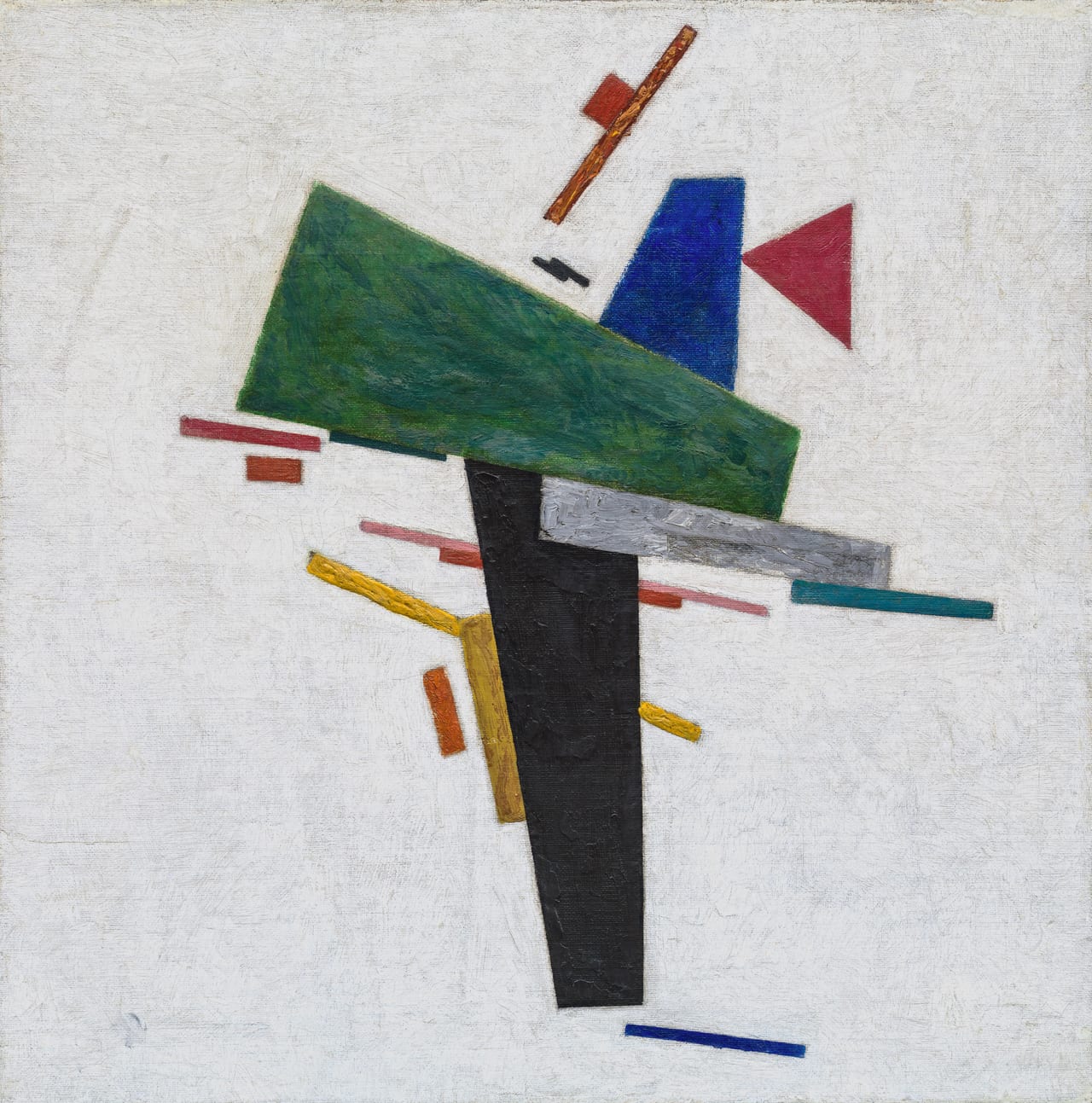
Untitled
Kazimir Malevich · c. 1916
Peggy Guggenheim Collection
Malevich’s Untitled, of about 1916, is in the Peggy Guggenheim Collection.
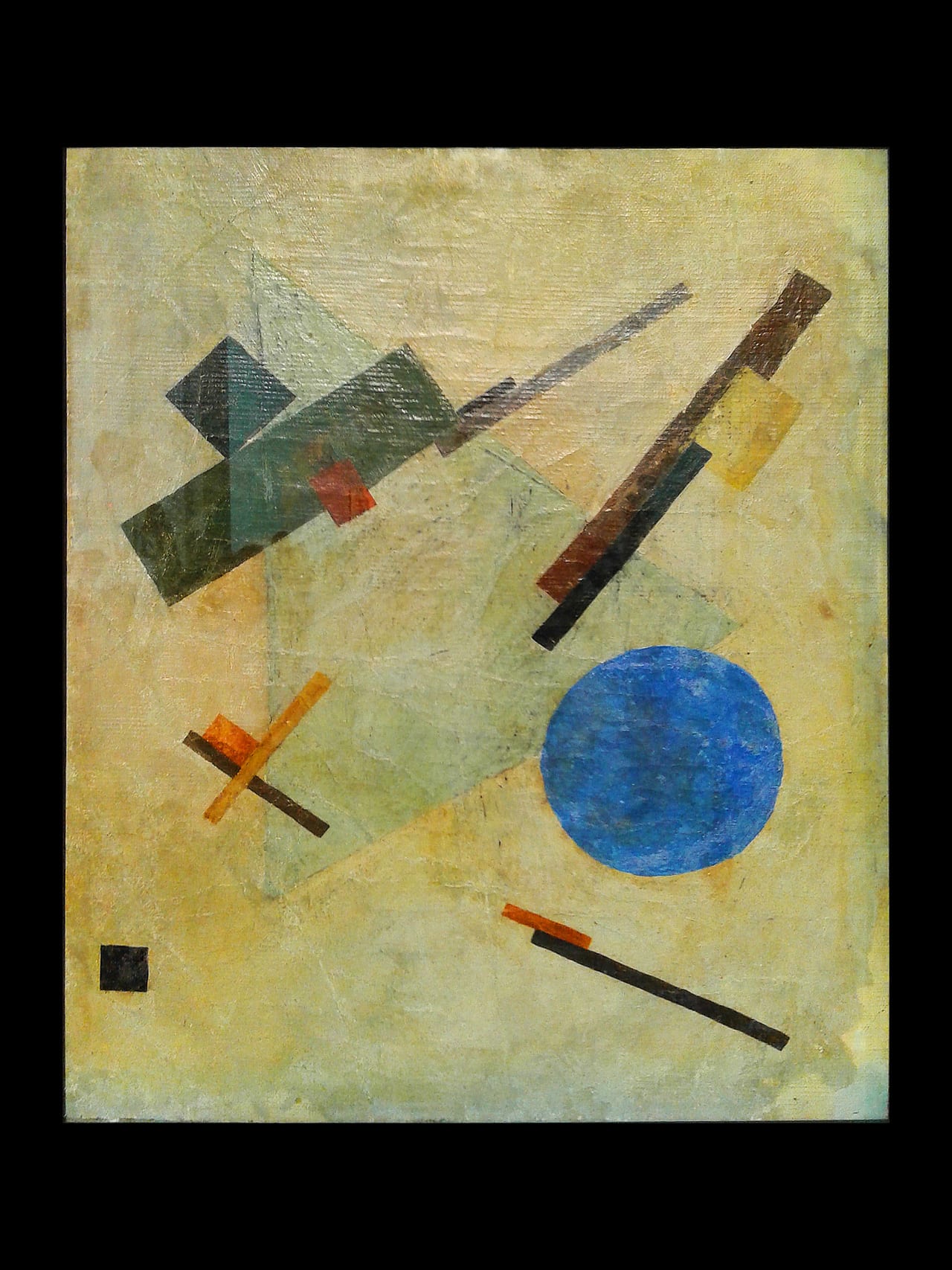
Suprematist Composition 1
Kazimir Malevich · 1916
Mystetskyi Arsenal
Malevich painted Suprematist Composition 1 in 1916, and for several decades it lay outside the view of art historians and collectors. According to Dmitry Gorbachev, the collector and art historian Igor Dichenko bought it as presumably the work of one of Malevich’s pupils, from a grandson of the sculptor Iosif Chaikov; within a year Dichenko attributed it to Malevich himself, and a number of other experts on the Russian avant-garde agreed. On 12 October 2015 Dichenko’s widow, Valeria Virskaya, gave his whole collection to Ukraine, and the collection then passed to the Mystetskyi Arsenal. The painting is one of two works by Malevich in Ukraine’s state collections.
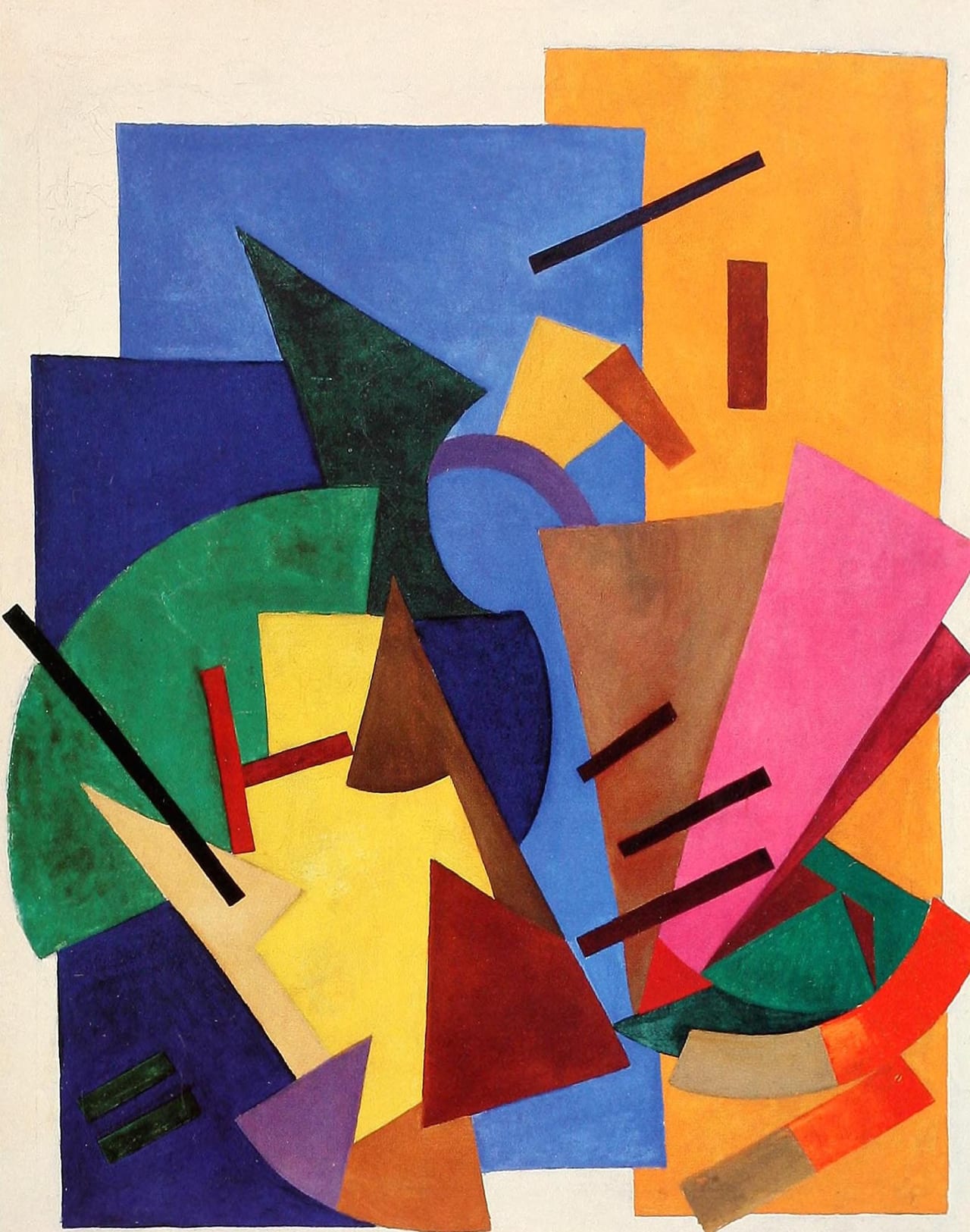
Flight of an Aeroplane
Olga Rozanova · 1916
Samara Art Museum
Olga Rozanova painted Flight of an Aeroplane, a Suprematist composition, in 1916, working with rectangular, triangular and segment-shaped forms. Here, as in her other Suprematist works of the time, those forms have lost their earlier transparency and gained density and saturated colour, and the work as a whole a remarkable harmony.
Sources
- Britannica, “Suprematism”
- Britannica, “Kazimir Malevich”
- Tate, “Suprematism”
- Museum of Modern Art, Lyubov Popova, “Painterly Architectonic”
- Art Institute of Chicago, Kazimir Malevich, “Painterly Realism of a Football Player—Color Masses in the 4th Dimension”
- Russian Museum, Kazimir Malevich, “Suprematism (Supremus No. 56)”
- Peggy Guggenheim Collection, “Kazimir Malevich”
- Samara Art Museum, Olga Rozanova, “Полёт аэроплана”
- Wikipedia, “Suprematism”
- Wikipedia, “0,10 Exhibition”
- Wikipedia, “Olga Rozanova”
- Wikipedia, “Lyubov Popova”
- Wikipedia, “Suprematist Composition”
- Wikipedia (Russian), “Динамический супрематизм № 57”
- Wikipedia (Russian), “Зелёная полоса (картина Розановой)”
- Wikipedia (Russian), “Супрематическая композиция 1”
- Suprematist Composition — Public domain via Wikimedia Commons (Public domain)
- Suprematism (Supremus No. 56) — Public domain via Wikimedia Commons (Public domain)
- Green Stripe — Public domain via Wikimedia Commons (Public domain)
- Painterly Architectonic — Public domain via Wikimedia Commons (Public domain)
- Painterly Realism of a Football Player—Color Masses in the 4th Dimension — Public domain via Wikimedia Commons (Public domain)
- Dynamic Suprematism — Public domain via Wikimedia Commons (Public domain)
- Untitled — Public domain via Wikimedia Commons (Public domain)
- Suprematist Composition 1 — Public domain via Wikimedia Commons (Public domain)
- Flight of an Aeroplane — Public domain via Wikimedia Commons (Public domain)
Invite Suprematism into your living room