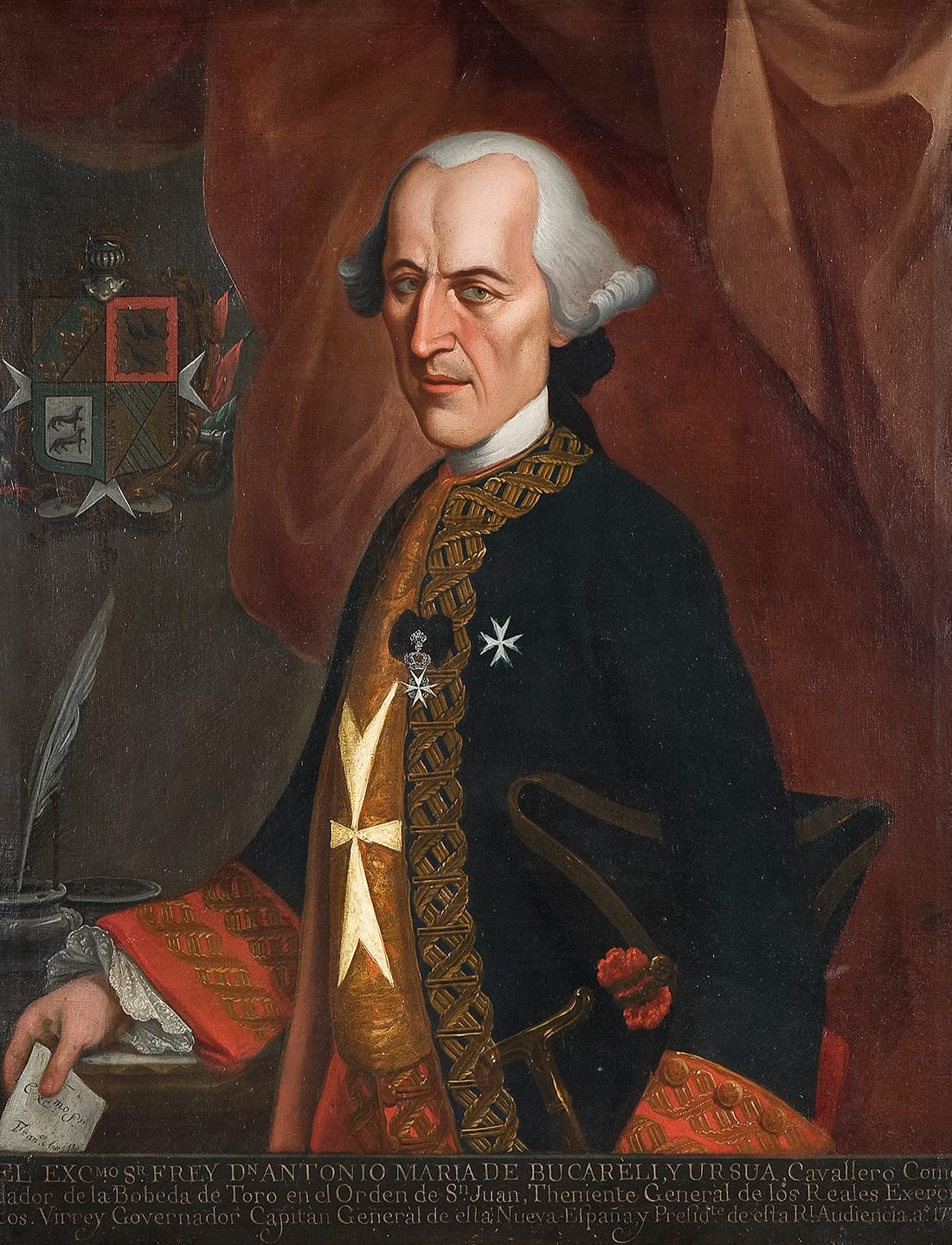
Portrait of Sor María Ignacia de la Sangre de Cristo
José de Alcíbar · 1777

Museo Nacional de Historia, Castillo de Chapultepec
Mexico City
The Museo Nacional de Historia keeps the memory of Mexico’s history, from the conquest of Tenochtitlan to the Mexican Revolution, in the Castillo de Chapultepec, whose construction began in 1785 under Bernardo de Gálvez, viceroy of New Spain. Built as a house of rest, the castle served over time as a military college, as the imperial residence of Maximilian and Carlota from 1864 to 1867 and as a presidential residence; since 1939 it has been the museum’s seat, and the museum opened its doors on 27 September 1944.
- of permanent exhibition, presenting the country’s history from the Conquest to the Mexican Revolution
- 12 rooms
- in the area known as the Alcázar, recreating the rooms of Maximilian and Carlota and of President Porfirio Díaz, with one more recalling the assault on the castle
- 22 rooms
- in the collection by the museum’s own count after six decades, during which it also gave objects to other museums
- Nearly 100,000 pieces
A palace on the hill of the grasshopper
The woods of Chapultepec have a history reaching back three thousand years, and their name is Nahuatl: the hill of the grasshopper, from chapulin, grasshopper, and tepetl, hill or mountain. Pottery and burials of the Preclassic period bear witness to the first people who settled on the shores of Lake Texcoco, and after the founding of Mexico-Tenochtitlan in 1325 Chapultepec was held to be a sacred place and a strategic one, for the springs that supplied the capital of the empire with drinking water. In 1530 a royal decree of the Emperor Charles V made the woods of Chapultepec the property of Mexico City, and the first viceroys came there to rest, to walk and to hunt deer, hares and rabbits.
A viceregal pleasure palace on the lower slopes of the hill was destroyed in 1784 by a gunpowder explosion, and a year later the viceroy Bernardo de Gálvez began another palace on the summit, today’s Castillo de Chapultepec. The work was directed first by the engineer Francisco Bambitelli and then by Manuel Agustín Mascaró, and it was never finished, because of the viceroy’s death; the Spanish Crown ordered it halted and put up for auction, no one showed any interest, and in 1806 the city council of Mexico City acquired it. In 1833 the abandoned palace was chosen as the seat of the Military College, and in the rebuilding begun in 1841 a tower raised on the highest part of the hill, the Caballero Alto, gave the building the look of a fortress: it was then that people began to call it a castle.
The castle was the scene of the final battle of the war between Mexico and the United States: the fighting culminated in the assault on the Castillo de Chapultepec on 13 September 1847, and a year later the Treaty of Guadalupe Hidalgo ceded the lands north of the Río Bravo. Cadets of the military academy were among the hill’s defenders, and several were killed; Mexican history remembers them as Los Niños Héroes, and by tradition one of them leapt from the walls with the flag so that the enemy would not take it. Gabriel Flores’s mural of 1970 in the dome over the main entrance shows one of them, Juan Escutia, falling with the flag of Mexico.
Emperors and presidents
The Alcázar took its present form when the Austrian archduke Maximilian of Habsburg and his wife, the Belgian princess Carlota, lived in the castle from 1864 to 1867, during the Second French Intervention. Maximilian, younger brother of the Emperor Francis Joseph, had been crowned emperor of Mexico on 10 June 1864; he was executed on a hill outside Querétaro on 19 June 1867. The Mexican architect Ramón Rodríguez Arangoity, a former student of the Military College, fitted it out as a palace, the Austrian botanist Wilhelm Knechtel redesigned the gardens, and furniture, pianos, porcelain and silver services, oil portraits of the imperial couple, tapestries, clocks, table linen and glassware arrived from Europe. The couple chose ground-floor rooms facing east, towards Mexico City, Lake Texcoco and the volcanoes Iztaccíhuatl and Popocatépetl, and had a panoramic terrace built in front of them. Maximilian had built a castle he called Miramar at Trieste; when he came to know Chapultepec, he named his new palace Miravalle.
In 1878 the first National Astronomical Observatory was set up in the castle, its main telescope in the Caballero Alto, crowned for it with a dome. In 1883 the observatory moved to Tacubaya so that the castle could become the Military College once more, and the summer residence of Porfirio Díaz. Díaz meant the building to be a showcase of Mexico’s artistic and technological progress: he installed a great stained-glass window, which survives, on the east terrace of the Alcázar’s upper floor; lifts, among them one that carried people up from the foot of the hill; and a bowling alley, in whose room the first film screening in Mexico took place in 1896. In 1939 President Lázaro Cárdenas moved his official home to Los Pinos and handed the castle to the people of Mexico for the Museo Nacional de Historia; restored and adapted between 1941 and 1944, the building was inaugurated as the museum on 27 September 1944.
Gathering the nation’s history
The museum’s beginnings go back to 1825, when Guadalupe Victoria, the first president of Mexico, ordered the formation of the first National Museum. On 4 December 1865 Maximilian decreed a Public Museum of Natural History, Archaeology and History, housed in the old Casa de Moneda, and by 1890 its history section had five rooms, given to the Franciscans, the viceroys, Cortés, the Conquest and Independence. Before the end of the nineteenth century that museum held the series of paintings of the viceroys, the sculpted portrait of Miguel Hidalgo y Costilla, the military coat of Vicente Guerrero, the baton of command of Agustín de Iturbide and Maximilian’s Christofle silver service. The celebrations of the first centenary of independence brought, among other pieces, the portrait of José María Morelos y Pavón; the keys of Mexico City, objects returned by Spain and France; and the font in which Hidalgo was baptised, brought from Cuitzeo de los Naranjos.
Most of what the Museo Nacional de Arqueología, Historia y Etnografía kept in its department of colonial and modern ethnography came from two great lots: that of the military man Martín Espino Barros, 60,369 pieces ranging from coins, medals and reliquaries to fans, spurs and inkwells, and that of the mining entrepreneur Ramón Alcázar, which arrived in 1917 with more than 7,233 pieces of the viceregal period and the nineteenth century. In February 1939 President Lázaro Cárdenas decreed that the castle become the seat of the Museo Nacional de Historia, and the collections of the departments of history and of colonial and modern ethnography became part of the exhibition in the castle. Among its holdings were a battle standard that the conquistador Hernán Cortés used and an eighteenth-century sculpture, Virgin with Child, attributed to Luisa Roldán, royal sculptor to Charles II of Spain. For study, the collections in store are organised in six curatorial areas: painting, sculpture, drawing, engraving and prints; numismatics; historical documents and flags; technology and arms; dress and accessories; and furniture and household goods.
Among the paintings, José de Alcíbar, one of the founding members of the Real Academia de Bellas Artes de San Carlos in 1784, is represented by his portrait of Sor María Ignacia de la Sangre de Cristo, painted in 1777, and Francisco Antonio Vallejo, a late Baroque painter of New Spain who died in 1785, signed the museum’s portrait of Antonio María Bucareli y Ursúa.
The museum’s seventeenth-century portrait of Fray Bernardino de Sahagún shows him full length in three-quarter profile, in a blue habit with its hood drawn back, girded by a long cord with four knots ending in a tassel, and a black cap. His left hand holds an open book on a lectern, in which he seems to be writing, and his right a pen in its inkwell; behind him a chair stands beneath a bookcase with an image of the Virgin. The inscription calls him one of the first to teach theology in the college, where he lived more than forty years. The Franciscan arrived in Mexico in 1529, learned Nahuatl and gave his life to the Historia general de las cosas de Nueva España, which covers nearly every aspect of Aztec culture.
Rooms, murals and the Alcázar
The history rooms, in the buildings of the old Military College, tell the story of Mexico from the Conquest in 1521 to the twentieth century: two continents apart before 1521, the kingdom of New Spain across four rooms, the War of Independence, the young nation, the road to modernity and the twentieth century, seen through the many faces of the Revolution. The Salón de Malaquitas shows jewels and luxuries of the colonial centuries and the nineteenth, and the Salón de Virreyes is devoted to the viceroyalty of New Spain, where the viceroy stood directly for the monarch. Juan O’Gorman’s Retablo de la Independencia, a fresco of 1960–1961 in Room 6, is an allegory of a story that begins in 1795 and ends in 1813, told in four acts, with Hidalgo, its main figure, shown twice. José Clemente Orozco’s La Reforma y la caída del Imperio, of 1948, in Room 8, sets at its centre a monumental portrait of Benito Juárez that recalls the great Olmec sculptures, with Maximilian as a shrouded corpse resting on the heads of those who offered him the throne; David Alfaro Siqueiros worked on Del porfirismo a la Revolución from 1957 to 1960 and again in 1966.
The Alcázar recreates the rooms of Maximilian and Carlota and of President Porfirio Díaz. In the Salón de Gobelinos, the portraits of Maximilian and Carlota that Albert Graefle, a German painter of history, genre and portraits, painted in 1865 hang with those of Napoleon III and his wife, Eugenia de Montijo. Napoleon III’s gift to Maximilian, a Louis XV suite in hazel wood whose Aubusson tapestry upholstery shows scenes from Jean de La Fontaine’s fables, stands with two pianos, one French and one English, that belonged to Maximilian and Carlota. The tapestries of the games room, with figures playing with tops, cup-and-ball, badminton and skittles, were made in France and given to Maximilian by Napoleon III for his birthday. In the Galería de Emplomados, stained-glass windows made in Paris to Díaz’s order around 1900 show five goddesses: Pomona, Flora, Hebe, Diana and Ceres. The carriage room keeps the calash Benito Juárez used on his journeys through several states during the French intervention, and the gala carriage of Maximilian and Carlota.
What to see
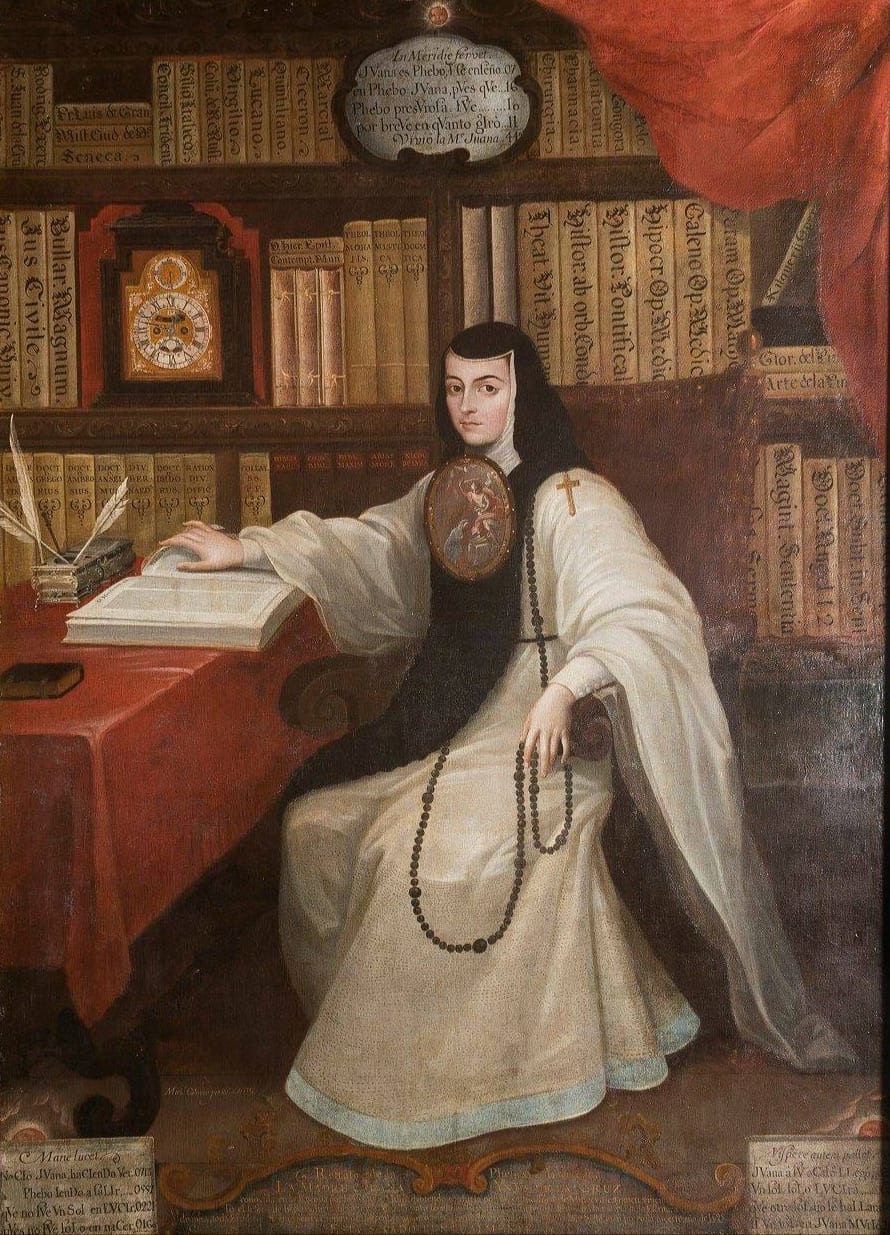
Portrait of Sor Juana Inés de la Cruz
Miguel Cabrera · c. 1750
Miguel Cabrera painted the seventeenth-century poet Sor Juana Inés de la Cruz after her death, reinterpreting the portrait of her by Juan de Miranda and stressing the symbols of her learning and her spirituality. Cabrera is counted among the greatest exponents of viceregal painting in Mexico, and is also known for this posthumous portrait.
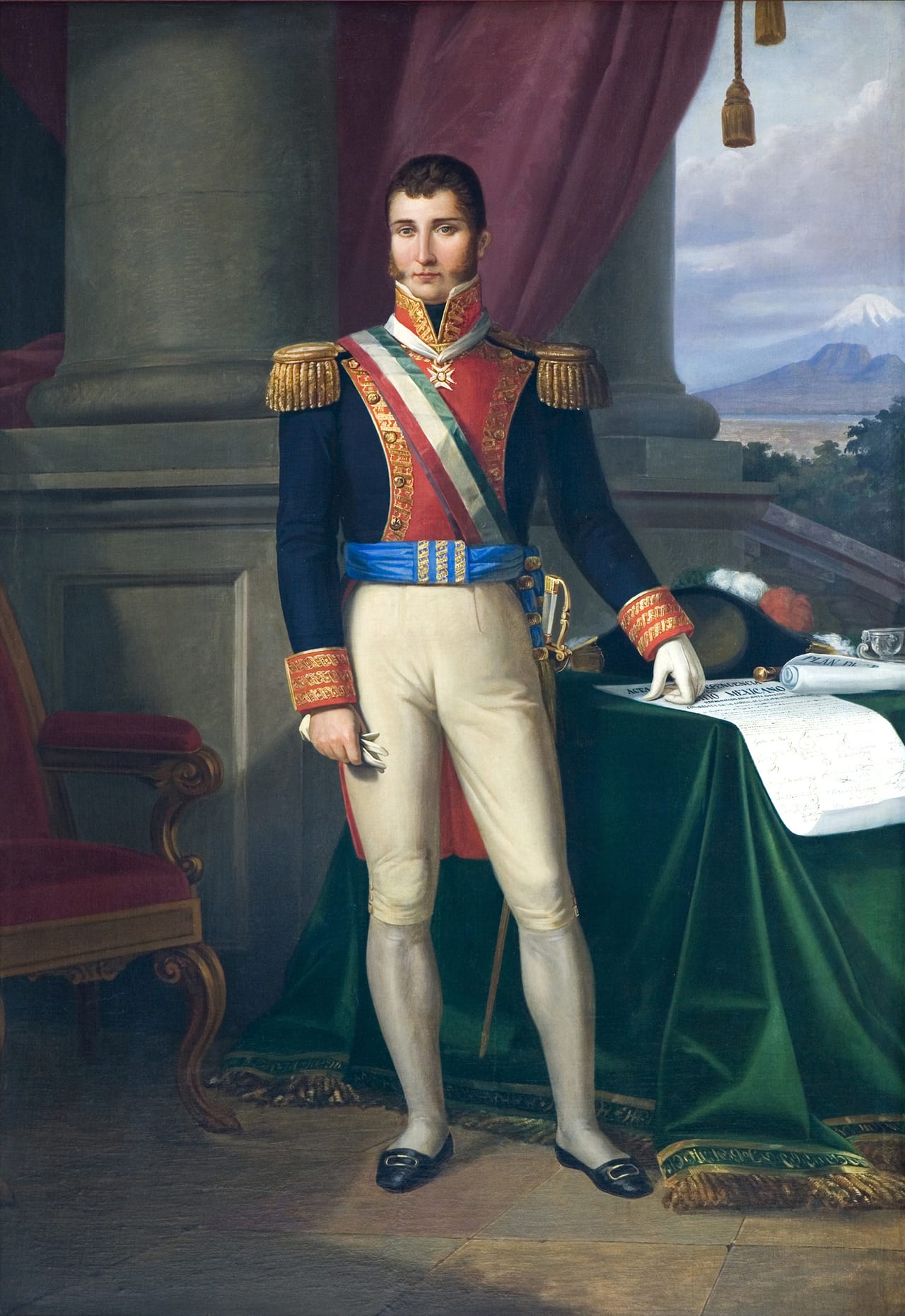
Agustín de Iturbide
Primitivo Miranda · 1865
Primitivo Miranda, who lived from 1822 to 1897, painted Iturbide full length in 1865, in a blue gala uniform with a red front, gold buttons and gold embroidery, epaulettes, a cross-shaped decoration at his neck on white silk and a tricolour sash. On the table beside him, under a green cloth embroidered in gold, lie the Act of Independence of the Mexican Empire, signed by Iturbide, the rolled Plan of Iguala and a plumed bicorne hat in the colours of the Three Guarantees; behind him lies the Valley of Mexico and its mountains. Iturbide’s Plan of Iguala, published on 24 February 1821, proclaimed immediate independence from Spain, and on 19 May 1822 he placed the crown on his own head as Agustín I.
Artworks
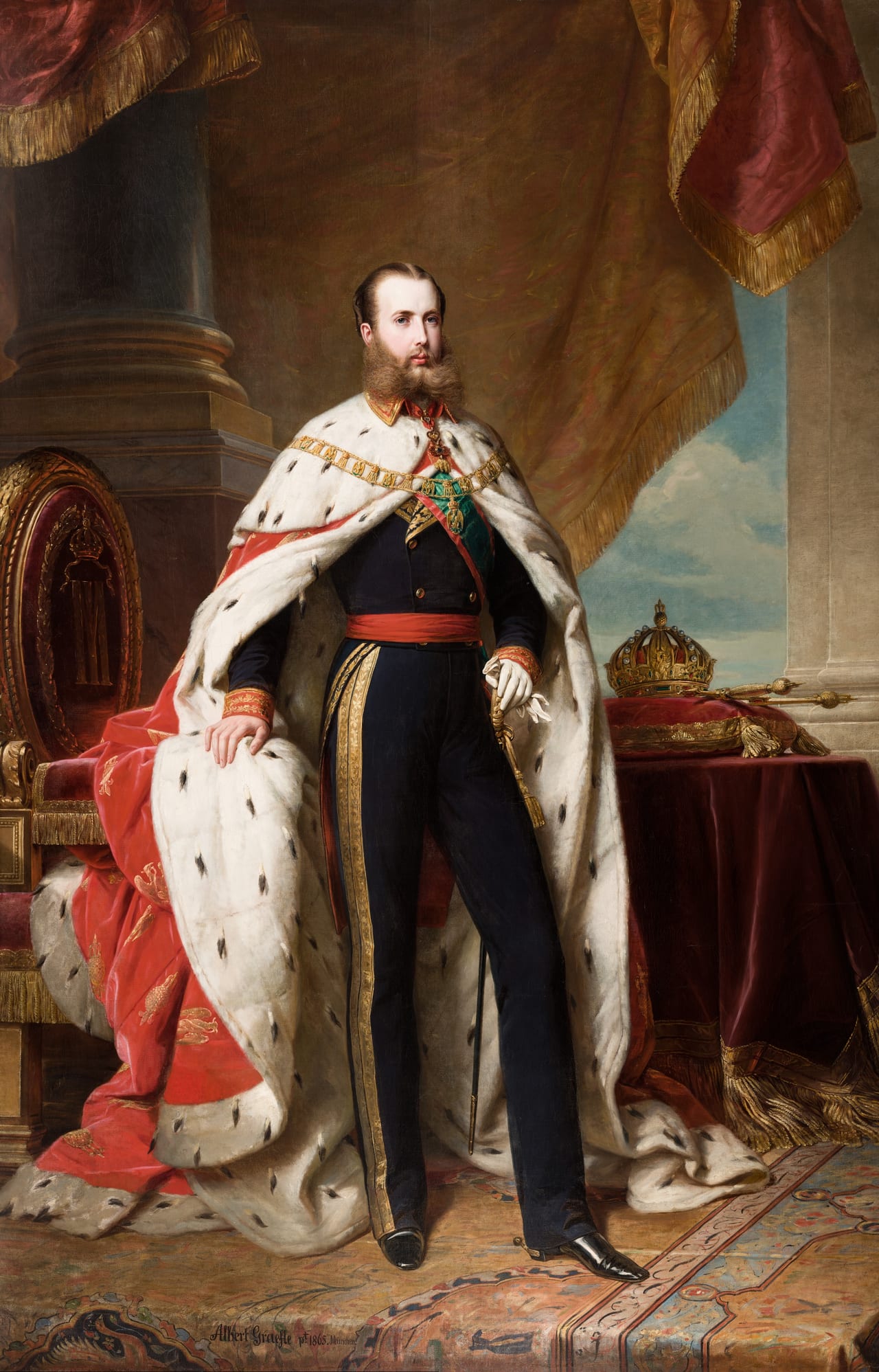
Portrait of Maximilian I of Mexico
Albert Graefle · 1865
Sources
- Museo Nacional de Historia, “Quiénes somos”
- Museo Nacional de Historia, “Arquitectura”
- Museo Nacional de Historia, “Historia de Chapultepec”
- Museo Nacional de Historia, “Historia del Museo”
- Museo Nacional de Historia, “Curadurías”
- Museo Nacional de Historia, “Salas de historia”
- Museo Nacional de Historia, “Salas del Alcázar”
- Museo Nacional de Historia, “Murales”
- Museo Nacional de Historia, virtual tour, “Sor Juana Inés de la Cruz” (archived)
- Museo Nacional de Historia, virtual tour, “Agustín de Iturbide” (archived)
- Museo Nacional de Historia, virtual tour, “Don Antonio María Bucareli y Ursúa” (archived)
- Mediateca INAH, “Agustín de Iturbide”
- Mediateca INAH, “Fray Bernardino de Sahagún”
- Britannica, “National Museum of History”
- Britannica, “Chapultepec”
- Britannica, “Maximilian”
- Britannica, “Agustín de Iturbide”
- Britannica, “Bernardino de Sahagún”
- Wikipedia (es), “Miguel Cabrera (pintor)”
- Wikipedia, “Miguel Cabrera (painter)”
- Wikipedia, “Albert Gräfle”
- Wikipedia (es), “José de Alcíbar”
- Wikipedia (es), “Francisco Antonio Vallejo”
- Wikimedia Commons, “Emperador Maximiliano I de Mexico.jpg”
- Wikimedia Commons, “Agustin I of Mexico.jpg”
- Museo Nacional de Historia, virtual tour, “Sor María Ignacia de la Sangre de Cristo” (archived)
- Portrait of Sor María Ignacia de la Sangre de Cristo — Luis Alvaz, CC BY-SA 4.0, via Wikimedia Commons (CC BY-SA 4.0)
- Portrait of Sor Juana Inés de la Cruz — Public domain via Wikimedia Commons (Public domain)
- Agustín de Iturbide — Public domain via Wikimedia Commons (Public domain)
- Portrait of Maximilian I of Mexico — Public domain via Wikimedia Commons (Public domain)
Invite the Museo Nacional de Historia into your living room