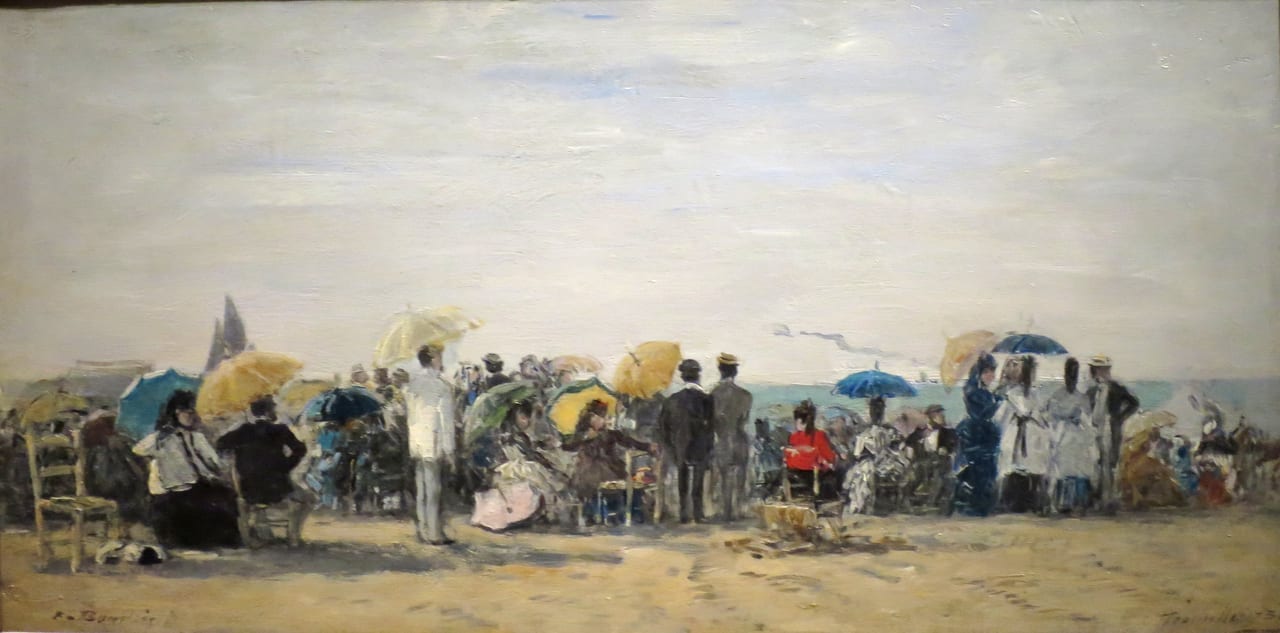
Boulevard des Fossés, Pontoise
Camille Pissarro · 1872

Norton Simon Museum
Pasadena
The Norton Simon Museum in Pasadena, California, shows the art that the industrialist Norton Simon collected, from gold-ground panel paintings to Van Gogh, Degas and Picasso, together with sculpture, art from South and Southeast Asia, and the contemporary holdings of the Pasadena Art Museum, whose building he took over in 1974.
- on view at any one time
- 800 or 900 works
- glazed in shades of brown by the ceramicist Edith Heath, facing the curving façade
- 115,000 tiles
- by Edgar Degas alone
- Over 100 works
Before Norton Simon
The museum began as the Pasadena Art Institute. Galka Scheyer, a German dealer who from 1924 represented the Blue Four, Lyonel Feininger, Wassily Kandinsky, Paul Klee and Alexej von Jawlensky, in the United States, had left her collection to UCLA at her death in 1945, on condition that the university met the terms set in 1944 for her friend Walter Arensberg’s gift of his modern art; when UCLA failed to meet them, a committee entrusted her collection of works by the four and other modern artists, with a cache of 800 documents, to the institute in 1953. Renamed the Pasadena Art Museum in 1954, the institute was then California’s only museum of modern art between San Francisco and La Jolla, and Walter Hopps, its curator from 1962, mounted a Marcel Duchamp retrospective there in 1963.
A new building, designed by the Pasadena architects Thornton Ladd and John Kelsey, was completed in 1969. Its curving front wears 115,000 glazed tiles in rich browns, made by Edith Heath. The museum stands on the route of the Rose Parade, and its brown tile exterior can be seen in the background of the television broadcasts.
By the early 1970s an ambitious exhibition programme and the new building project had brought the museum to serious financial trouble. Norton Simon, an industrialist who in the 1960s had become one of the leading art collectors in the world, wanted a lasting home for a collection of more than 4,000 objects. Under the agreement they reached in 1974, Simon assumed an $850,000 loan on the building and other obligations, among them a $1 million accumulated operating deficit, and in return took 75 per cent of the galleries for his collection; the rest showed the Pasadena museum’s contemporary holdings, and the museum was renamed after him; it counts its establishment from 1 March 1975. Many locals criticised the change, which closed the only contemporary art museum between San Francisco and La Jolla, and it led indirectly to the Museum of Contemporary Art, Los Angeles, founded in 1979 largely through the efforts of Simon’s sister Marcia Weisman.
Norton Simon, collector
Simon enjoyed early success, and in 1927 he put $7,000 into an insolvent orange-juice bottling plant in Fullerton; he sold that business to Hunt’s Foods for a controlling stake in the merged company. In the 1960s he paid $6 million to the Duveen Gallery, a Manhattan dealer in old masters, for just under 800 objects and a building on East 79th Street. The scholars who studied those purchases for him found many misattributions, and he sold much of that purchase, keeping some 130 objects, chiefly paintings.
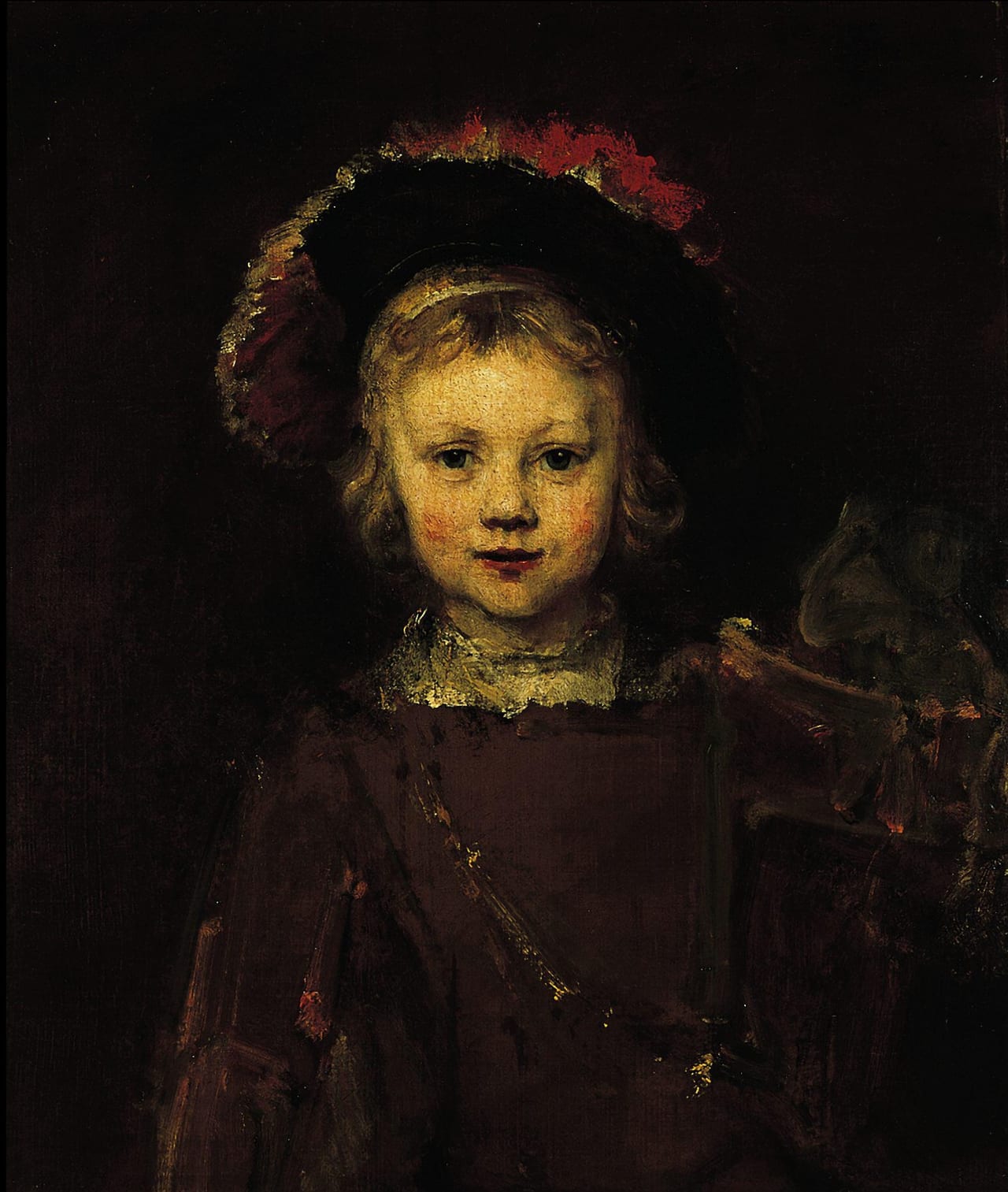
In 1965 Simon bought Rembrandt’s Titus at Christie’s in London. The auctioneer had already knocked the picture down to an English buyer, but Simon had the bidding reopened by producing a letter which proved that his agreed bidding signal had been missed. He lent the portrait to the National Gallery of Art in Washington for six months, where more than 300,000 visitors saw it; that June he and the painting were on the cover of Time, and in December Titus flew to Southern California wrapped as a Christmas present, its tag reading “To Mother”.
In 1972 Simon paid $900,000 for a tenth-century South Indian bronze Nataraja, Shiva dancing, which, India’s government declared, had been taken illegally from a Tamil Nadu temple and smuggled out of the country. In 1976 he and India settled: he would return the bronze, and India allowed him first to keep and show it in his museum for nine years.
Most of what the museum shows belongs to two foundations, the Norton Simon Foundation and the Norton Simon Art Foundation, each owning its own group of works and lending it to the museum long term; their public filings in 2014 put the art’s combined fair-market value near $5 billion. No more than 800 or 900 pieces are on view at any one time, and the museum still receives gifts, though it does relatively little to enlarge what its founder gathered.
Jennifer Jones and the galleries remade
Simon died in 1993, and his widow, the actress Jennifer Jones, who chaired the board, took corrective and conciliatory steps that repositioned the museum and both its collections. In 1995 the museum started a $5 million renovation with Frank Gehry, for many years one of its trustees. It gave the museum a sequence of medium-sized, more intimate galleries with raised ceilings and better lighting, more space for changing exhibitions, a whole floor of Asian art and restored access to the gardens, which Power and Associates replanned on the old Carmelita property as a setting for the twentieth-century sculpture.
From its founding in 1975, for more than three decades, the museum kept to a no-loans policy. In 2007 its board agreed to send chosen works to other museums, the National Gallery of Art in Washington among them, wishing the museum to be better known, and in 2009 it entered a reciprocal loan agreement with the Frick Collection in New York.
The South and Southeast Asian collection shows works from India, Pakistan, Nepal, Tibet, Cambodia and Thailand, with selections from Afghanistan, Myanmar, Bangladesh, China, Indonesia, Sri Lanka, Vietnam and Japan. It is especially rich in art of the Indian subcontinent: monumental Kushana and Gupta stone sculpture and a remarkable group of southern Indian Chola bronzes, beside Rajput paintings from India and thangkas, Buddhist religious paintings, from Tibet and Nepal. Among its Japanese woodblock prints are some that Frank Lloyd Wright once owned.
Claims on the collection
In 2012 the government of Cambodia asked the United States for help in recovering a tenth-century Khmer statue in sandstone from the museum, saying it had been looted from a temple complex during the political upheavals of the 1970s. Owned by the Norton Simon Art Foundation, it had been on display since 1980; in the spring of 2014 the museum returned it to Cambodia.
Ownership of Lucas Cranach the Elder’s Adam and Eve, a pair of paintings of about 1530, is disputed because of their history as Nazi loot. Jacques Goudstikker, a prominent Dutch Jewish dealer, bought them at auction in 1931; he died on board a ship while he and his family tried to flee the Netherlands. After the war the Monuments Men recovered the pictures and returned them not to Goudstikker but to the Dutch government, which in 1966 transferred them, in exchange for a payment and the withdrawal of claims, to the US Navy commander George Stroganoff-Scherbatoff; he sold them to the Norton Simon Foundation in 1970 and 1971.
On 1 May 2007 Goudstikker’s daughter-in-law, Marei von Saher, sued for the paintings’ return. The museum fought her claim, despite ethical concerns raised by many, Norton Simon’s grandson among them, and rested its defence on a legal sale by the Dutch government after Goudstikker’s widow had declined a settlement in 1966; in 2017 the court decided against von Saher by three votes to none. In 2026, after Congress passed the new HEAR act banning technical defences in restitution cases with links to the Holocaust, the Jewish Federation-Council of Greater Los Angeles, acting as her assignee, filed a new lawsuit, and the museum countersued in October 2026.
What to see
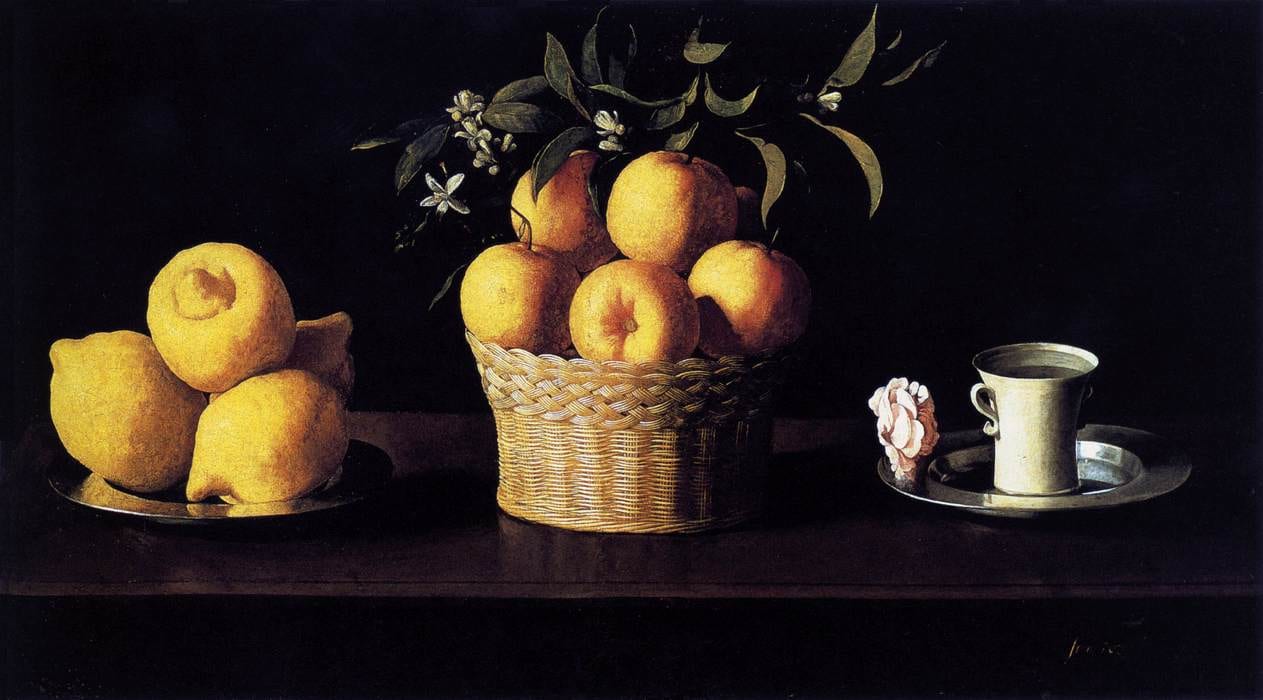
Still Life with Lemons, Oranges and a Rose
Francisco de Zurbarán · 1633
On a table before a dark ground Zurbarán sets three groups at equal intervals, a saucer holding four citrons, a basket of oranges, and a saucer holding a cup of water and a rose, balanced in a pyramidal order. It is the only still life he signed and dated, and the objects are often read as symbols, alluding to the Holy Trinity or honouring the Virgin Mary. Morten Lauridsen has called it a major inspiration behind O magnum mysterium, his choral setting of 1994.
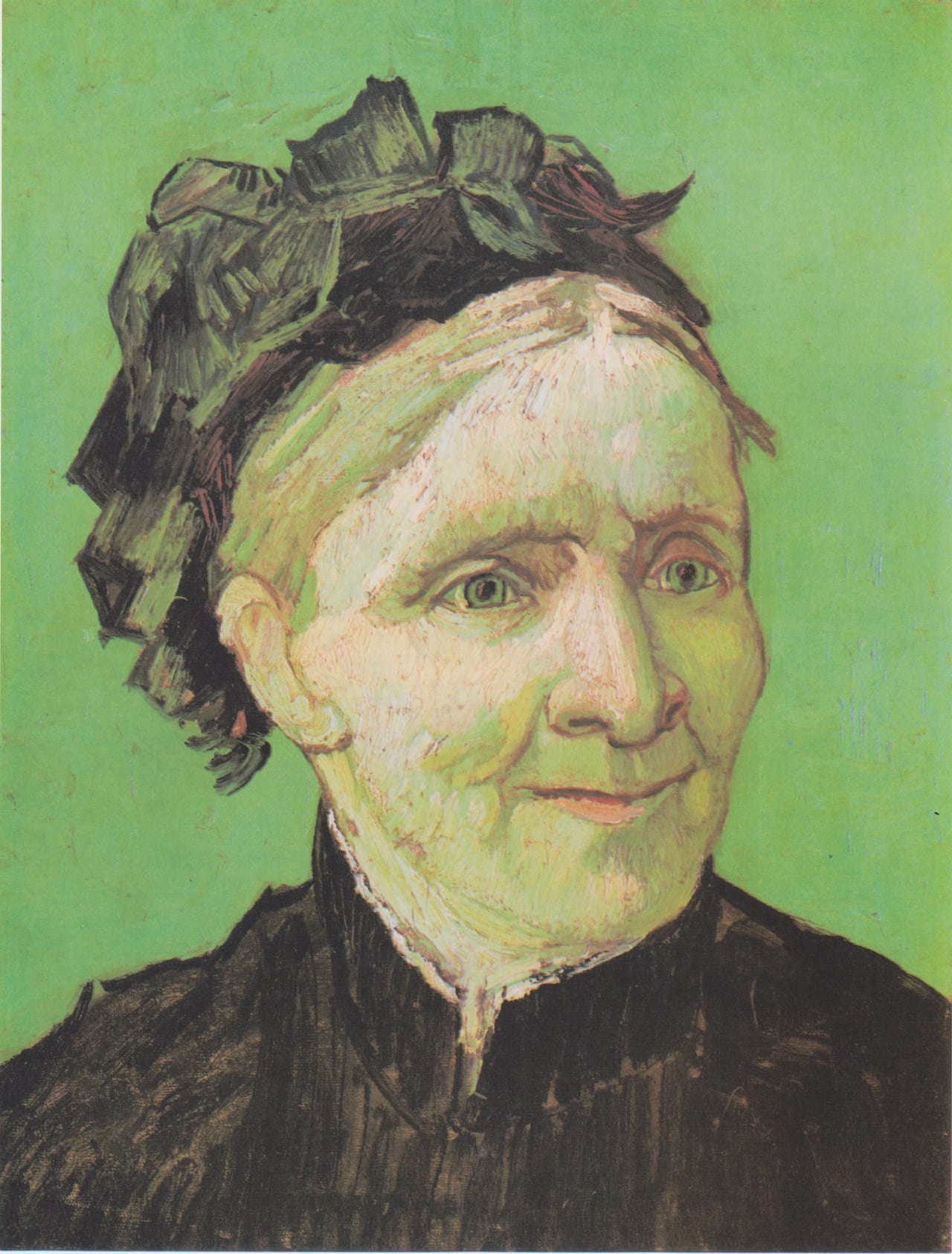
Portrait of the Artist’s Mother
Vincent van Gogh · 1888
Van Gogh painted his mother, Anna Carbentus van Gogh, an amateur artist and the person who introduced him to art, from a black-and-white photograph, and she appears attentive and proud against a green background. He wrote to his brother Theo: “I cannot stand the colorless photograph, and I am trying to do one in a harmony of color, as I see her in my memory.”
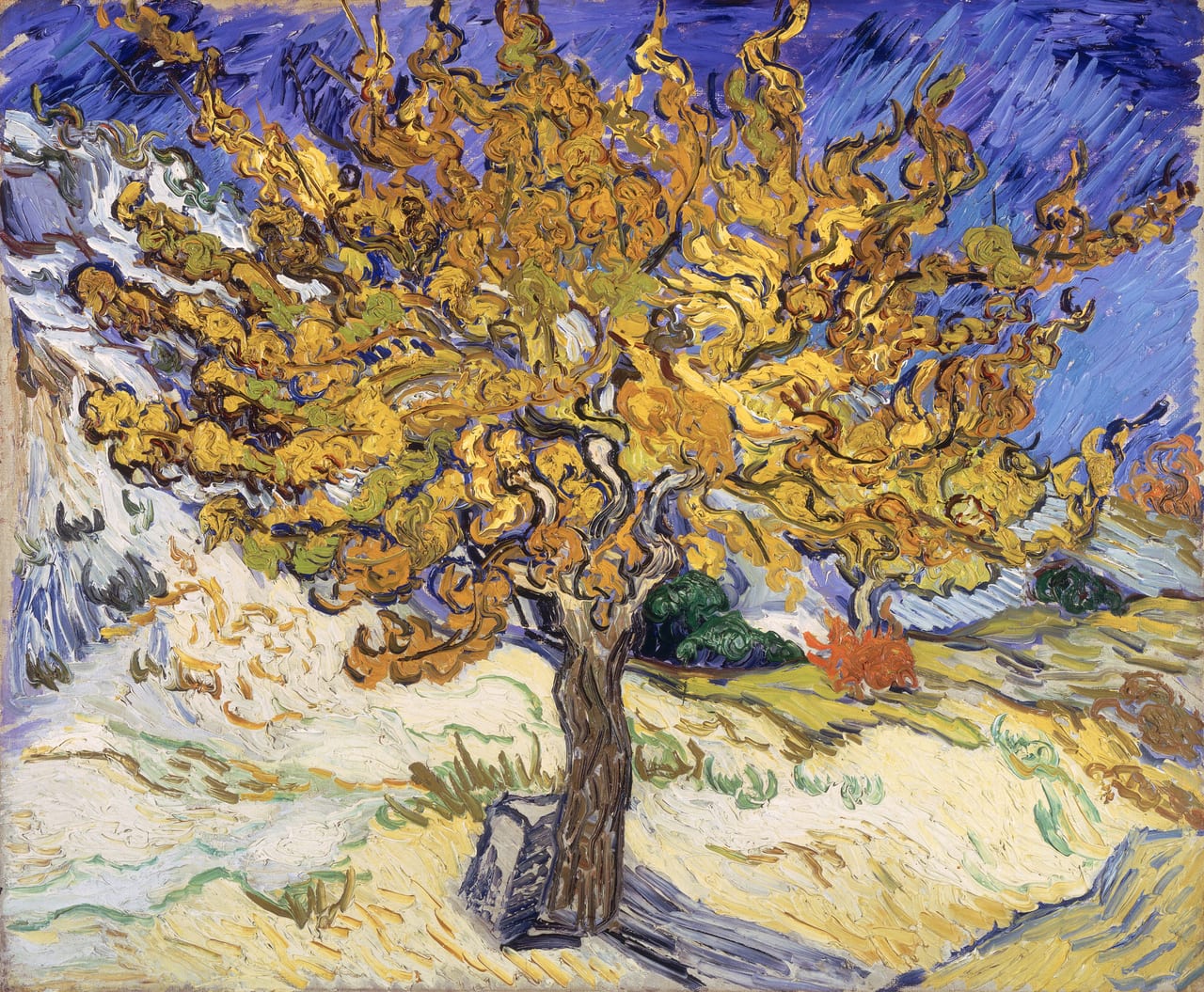
The Mulberry Tree
Vincent van Gogh · 1889
Van Gogh painted it in October 1889 while living in the asylum of Saint Paul-de-Mausole at Saint-Rémy-de-Provence: a lone mulberry in autumn growing out of a bare, rocky slope, its swirling yellow and orange leaves against a blue sky, the paint laid on so heavily that the picture looks almost three-dimensional. Sending a batch of autumn studies to Theo in December, he wrote that he thought the best one was “the yellow mulberry tree against a very blue sky”.
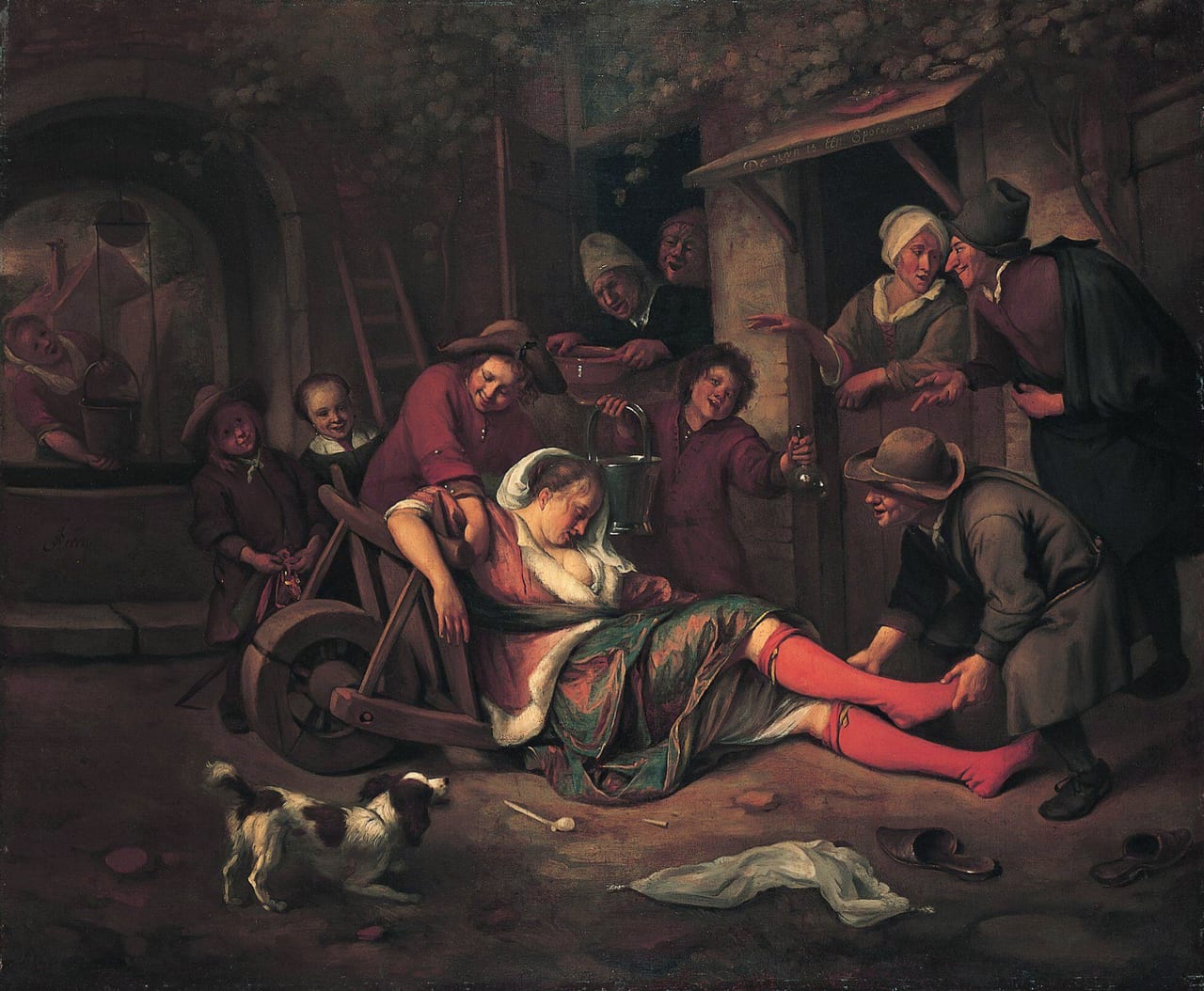
Wine is a Mocker
Jan Steen
In front of an inn, a well-dressed woman who has drunk too much is about to be taken home in a wheelbarrow. The title comes from a biblical proverb, and the proverb, written over the inn door, reads “Wine is a mocker, strong drink a brawler”. The painting makes the point that nobody, whatever their rank, is safe from what strong drink does; Steen himself ran a tavern.
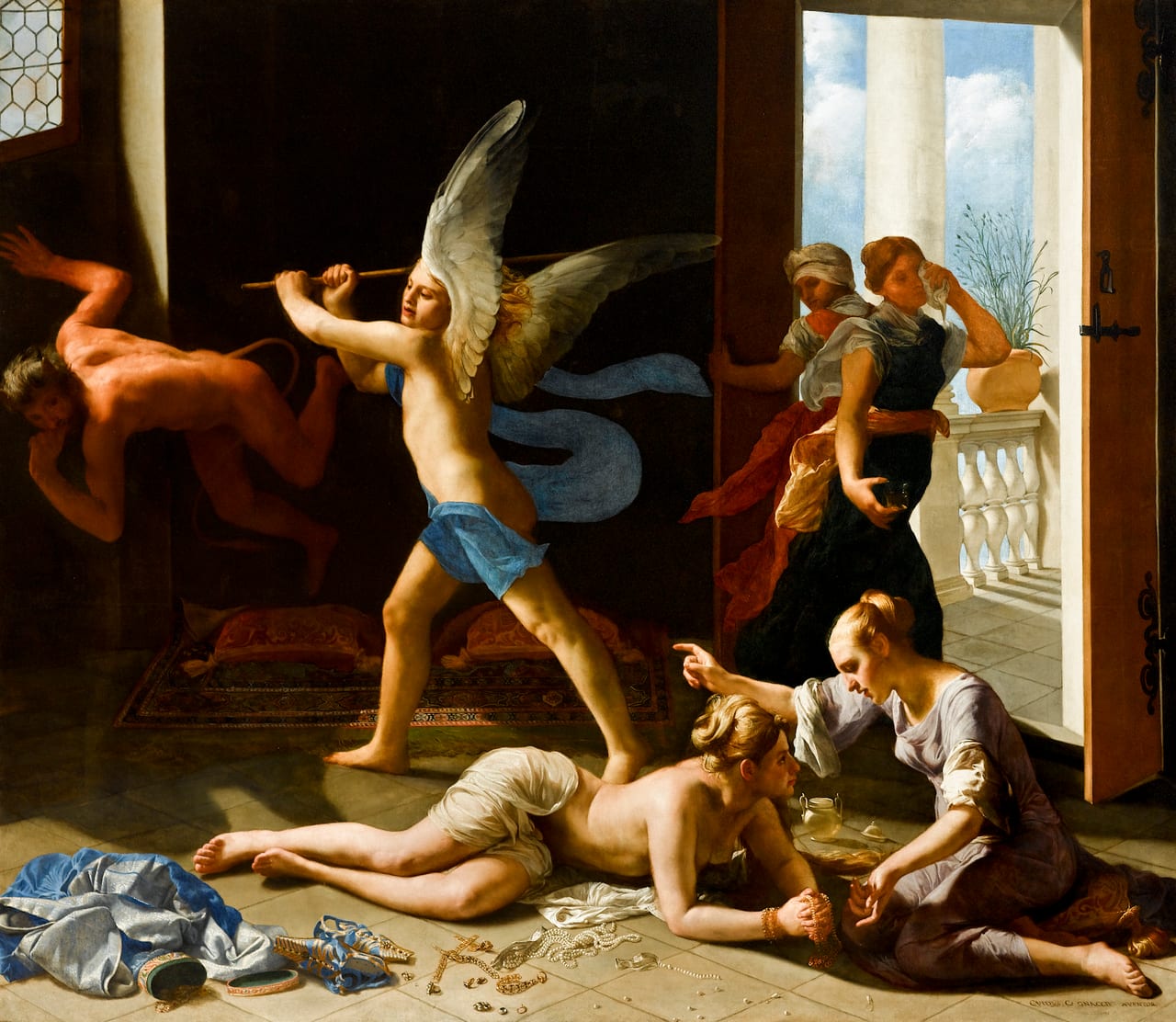
The Repentant Magdalene
Guido Cagnacci · early 1660s
Guido Cagnacci shows Mary Magdalene at the moment of repentance, her sister Martha remonstrating beside her, while an allegorical pair repeats the scene: Virtue, an angel, chasing out Vice, a devil. The Dukes of Mantua had the canvas by 1665; later it belonged to the Dukes of Portland, at Welbeck Abbey and in London, and it was sold at Christie’s in London in 1981 and came to the Norton Simon Art Foundation.
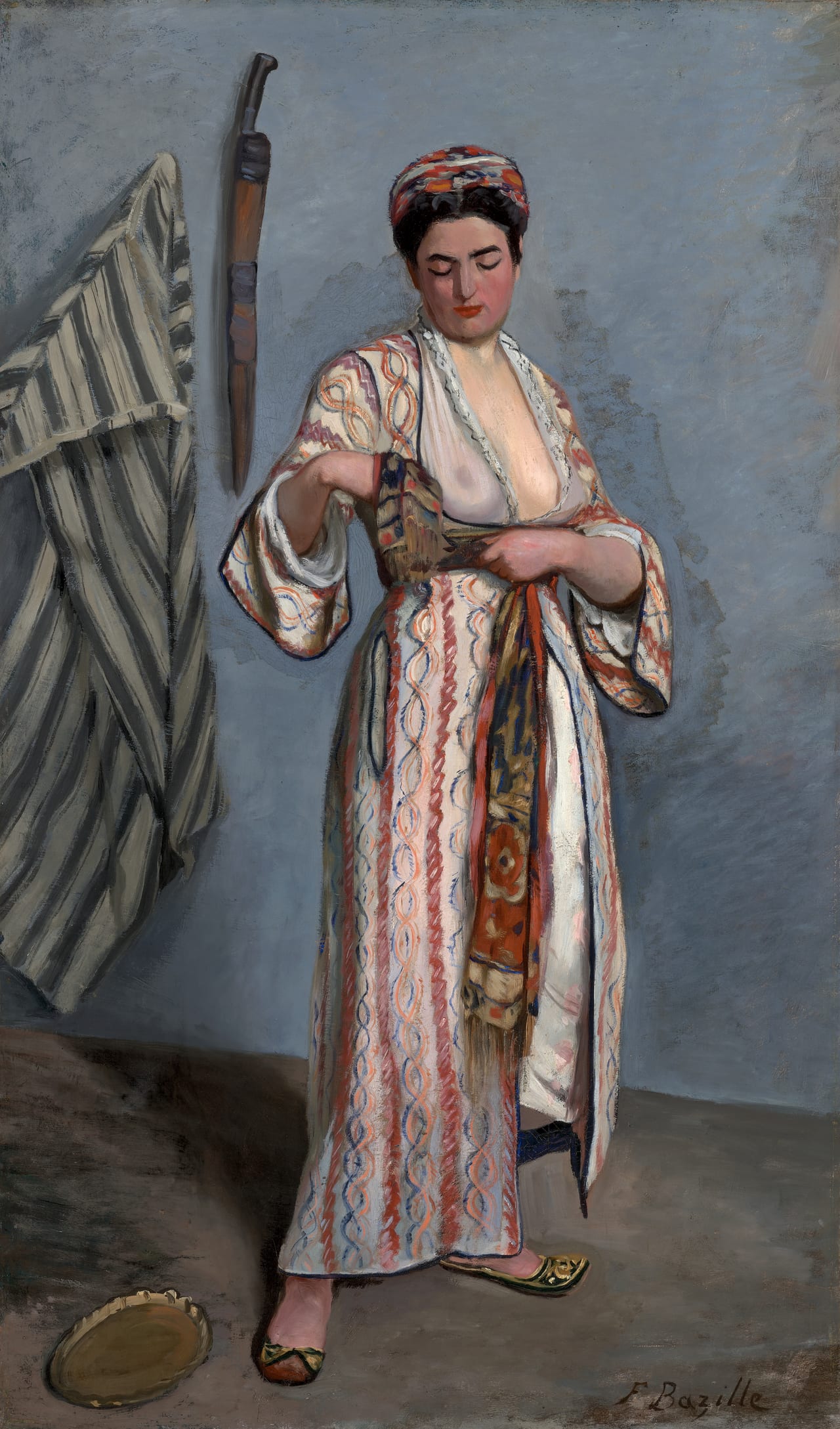
Woman in Moorish Costume
Frédéric Bazille · 1869
Bazille’s model is Lise Tréhot, mistress and model of Renoir, who then shared a Paris studio with Bazille in the rue de la Condamine. Dressed in North African costume, a translucent white chemise under an open, colourful robe, she looks down at a knot she is tying or untying, while a sabre and a striped kaftan on the wall hint at a man’s presence. In August 1870, the year after he finished it, Bazille volunteered for a Zouave regiment and was sent to French North Africa for training, his first visit to Algeria; the imagery here rests not on direct experience but on stereotyped odalisques as Delacroix, Gérôme, Ingres and others had painted them. He was killed in action in November 1870, aged twenty-eight.
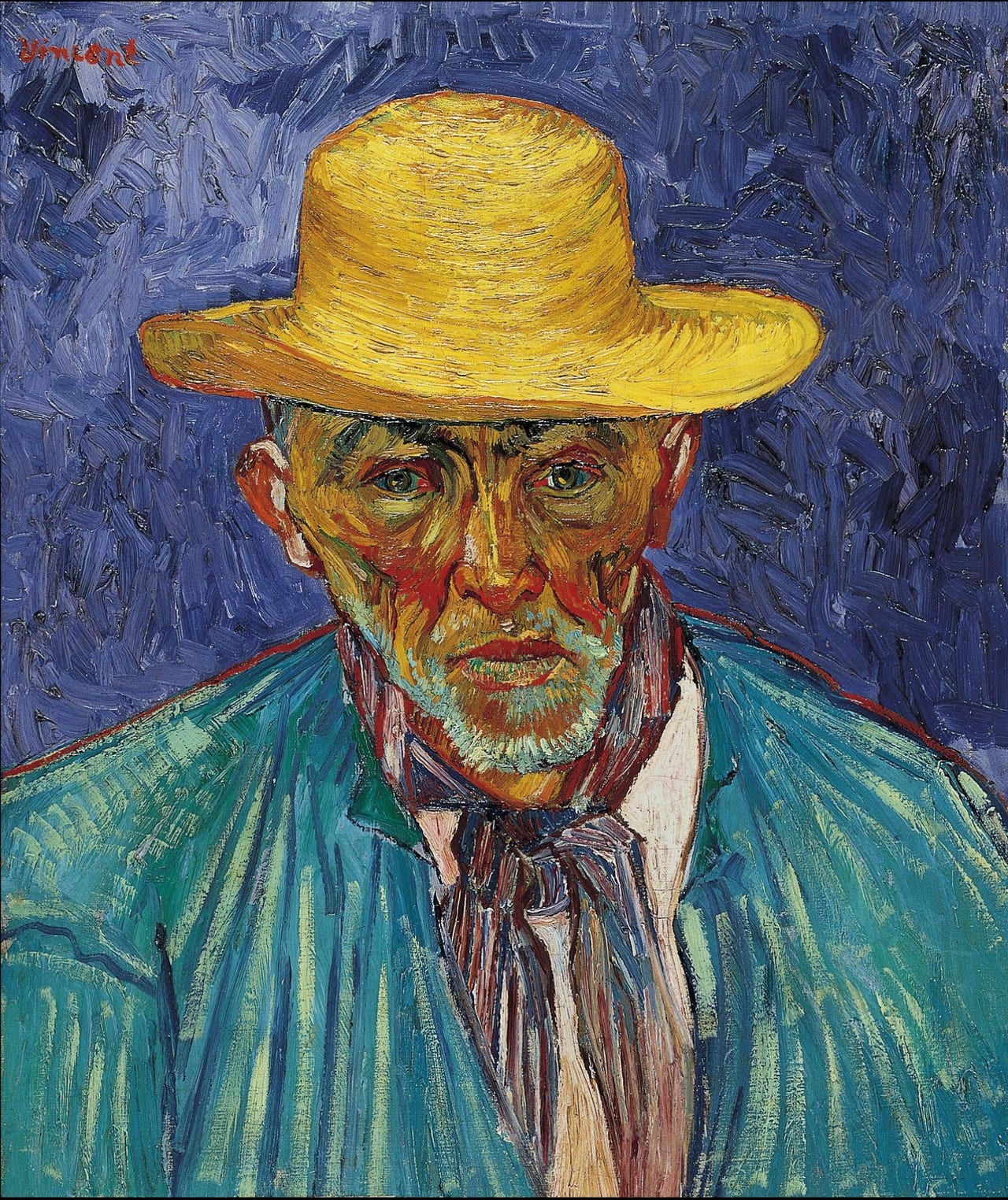
Portrait of a Peasant (Patience Escalier)
Vincent van Gogh · 1888
Van Gogh painted Patience Escalier, a gardener and shepherd, because he wanted to portray an older peasant whose features resembled his father’s. This is the first of the two versions, painted in August 1888; the second belongs to the private collection of Philip Niarchos.
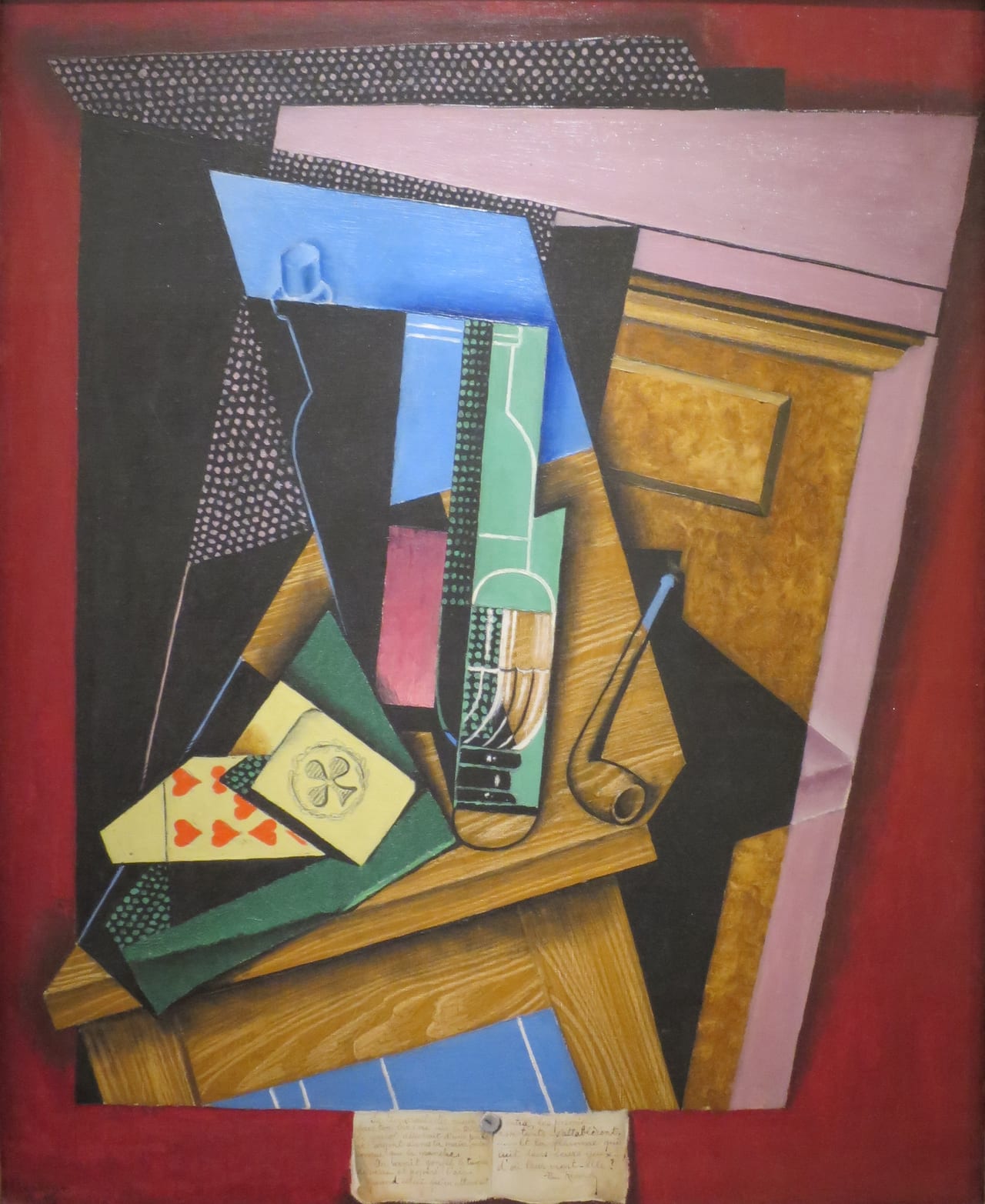
Still Life with a Poem
Juan Gris · 1915
Gris painted the whole picture in oils, imitating a collage on a table of wood grain, A poem by Pierre Reverdy sits at the bottom of the canvas, and the picture seems to compare two separate paintings. It was Gris’s first truly collaborative work: an earlier joint attempt with Reverdy had been given up because printing was so hard in wartime.
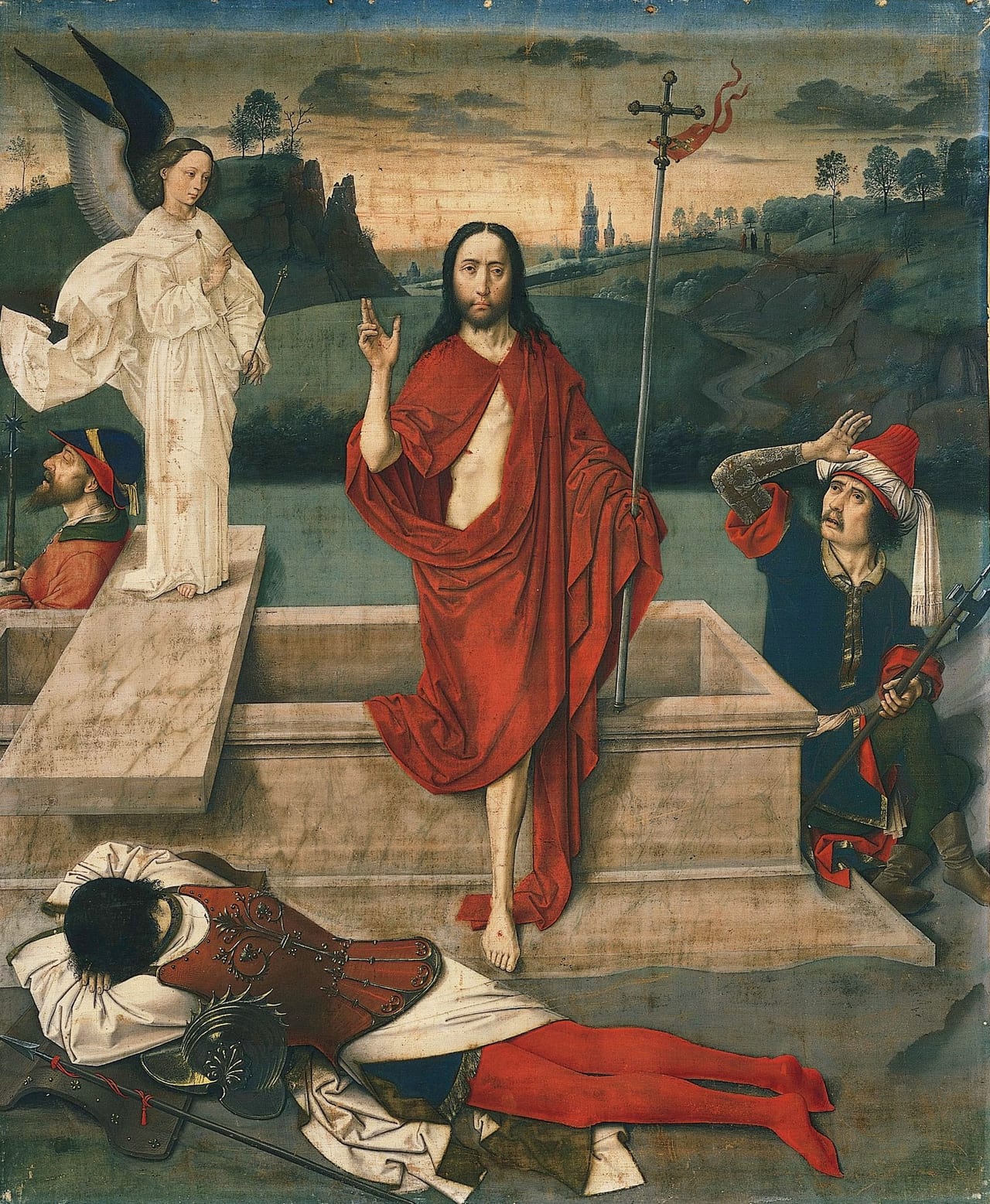
Resurrection
Dieric Bouts · 1455
Dieric Bouts’s Resurrection is named among Netherlandish examples of glue-size, a technique binding pigment to linen with hide glue, which Early Netherlandish painters of the fifteenth century used as a cheaper alternative to oil. With his Annunciation, now at the Getty, and an Adoration of the Kings, it may have belonged to a single polyptych. Few such pictures survive, mainly because linen perishes easily and hide glue dissolves.
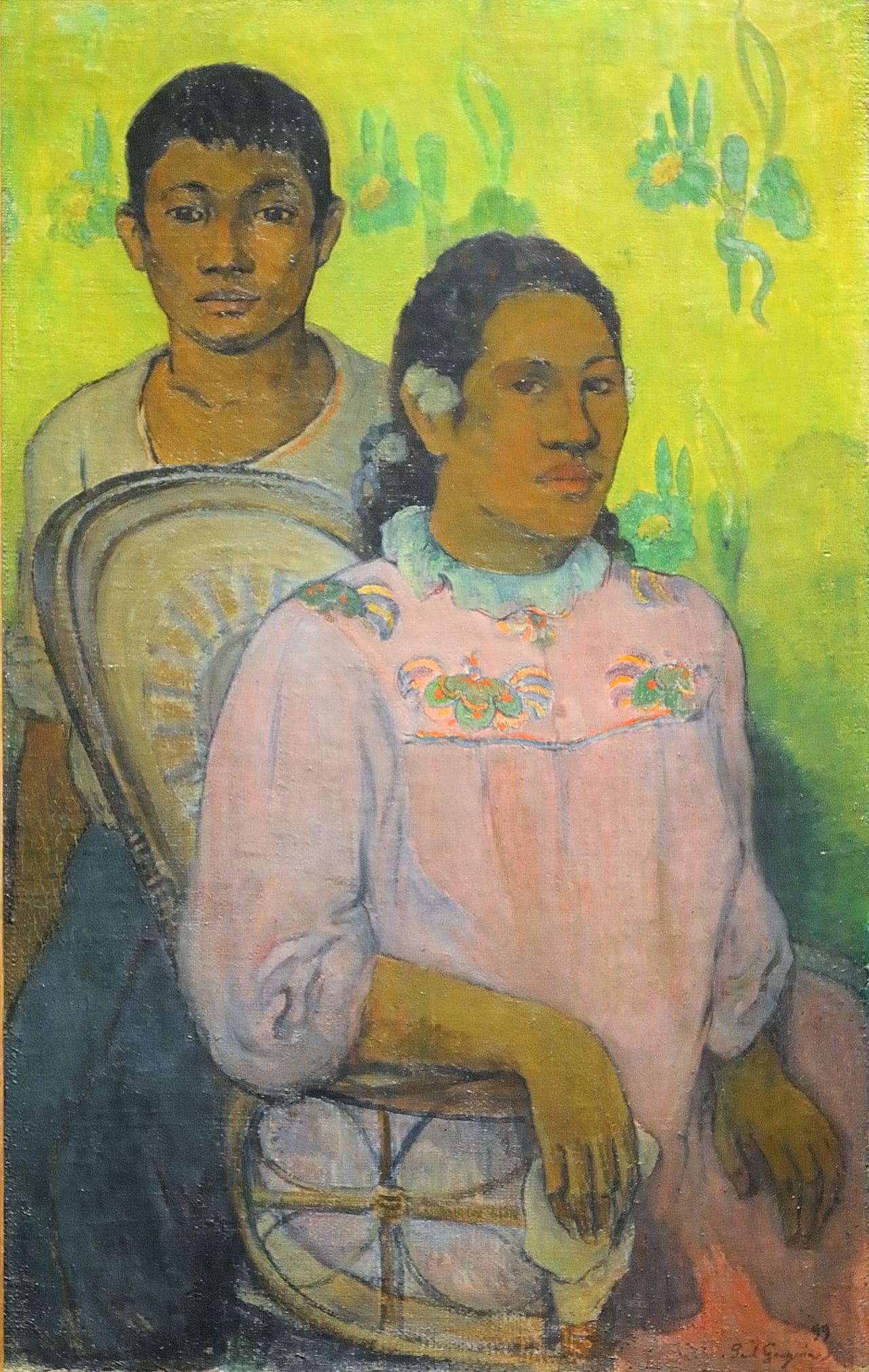
Tahitian Woman and Boy
Paul Gauguin · 1899
For forty years no one knew where Gauguin’s canvas of 1899 had gone. Bought in 1923 for £1,200, it was in fact hanging in remote Ardross Castle in the Scottish Highlands, until the American dealers Hammer Galleries bought it at auction in 1964; it was given to the museum in 1976.
Collections
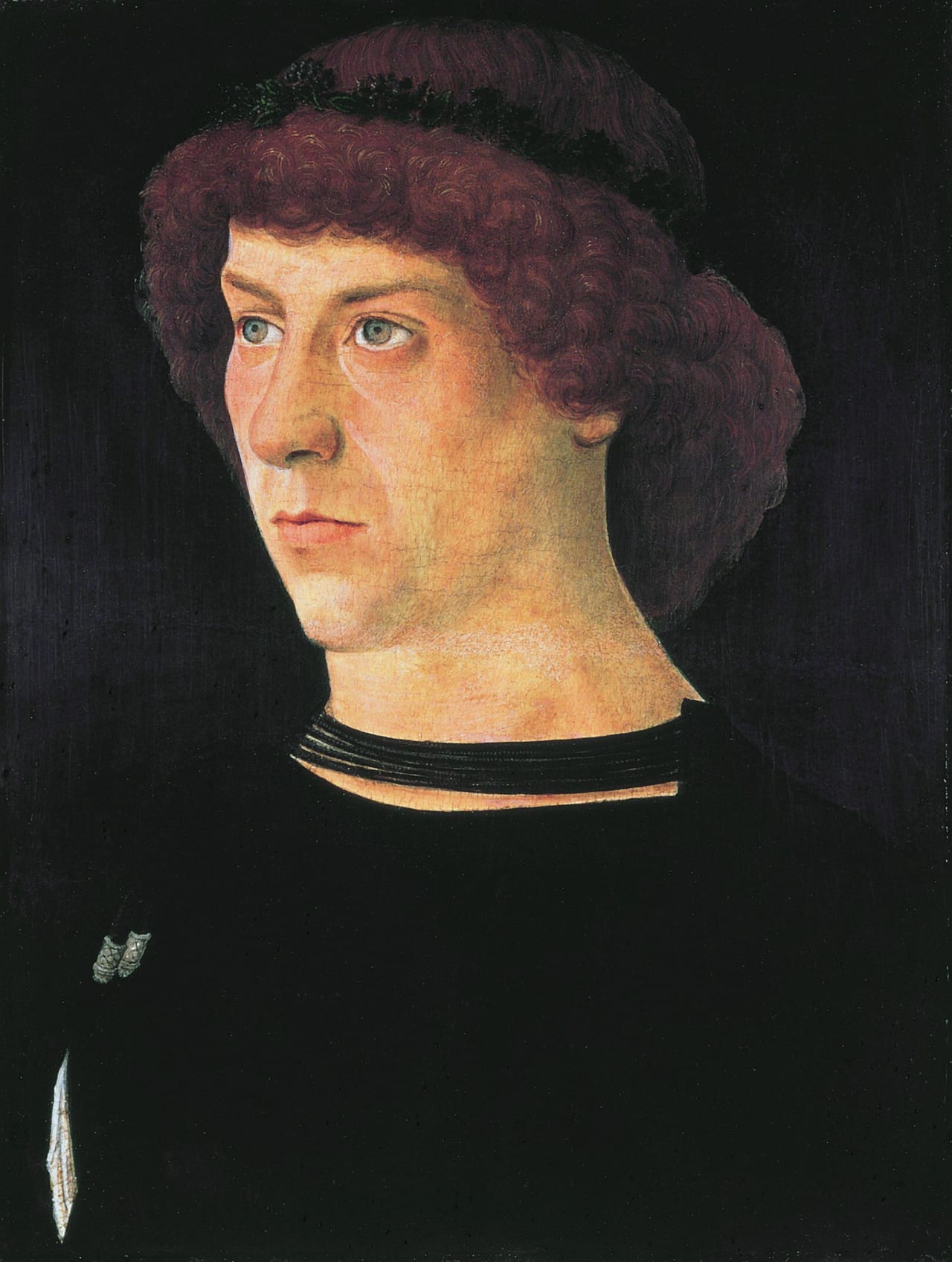
Gold-ground panel paintings and portraits
Portrait of Joerg Fugger · Giovanni Bellini · 1474
Paolo Veneziano, Giovanni di Paolo and an altarpiece by Guariento di Arpo are the core of the gold-ground panels, Botticelli, Filippino Lippi, Jacopo Bassano and Raphael bring religious scenes in oil, and Cranach, Bouts and Memling speak for the north. Giovanni Bellini’s Fugger, head of the German bank’s Nuremberg branch, wears a garland; an inscription on the back, removed in a restoration early in the twentieth century, dated it to 20 June 1474, and it is Bellini’s earliest surviving portrait and among the first Italian paintings in oil rather than tempera.
The Baroque
Unfinished Portrait of a Boy · Rembrandt
Guido Reni, Guercino, Murillo and Zurbarán represent early Baroque painting in Italy and Spain, Rubens the northern Baroque, and three Rembrandt portraits crown a group of seventeenth-century Dutch genre scenes, portraits and landscapes. This oil on canvas by Rembrandt, listed at 65 × 56, is catalogued as an Unfinished Portrait of a Boy.
Seventeenth and eighteenth centuries
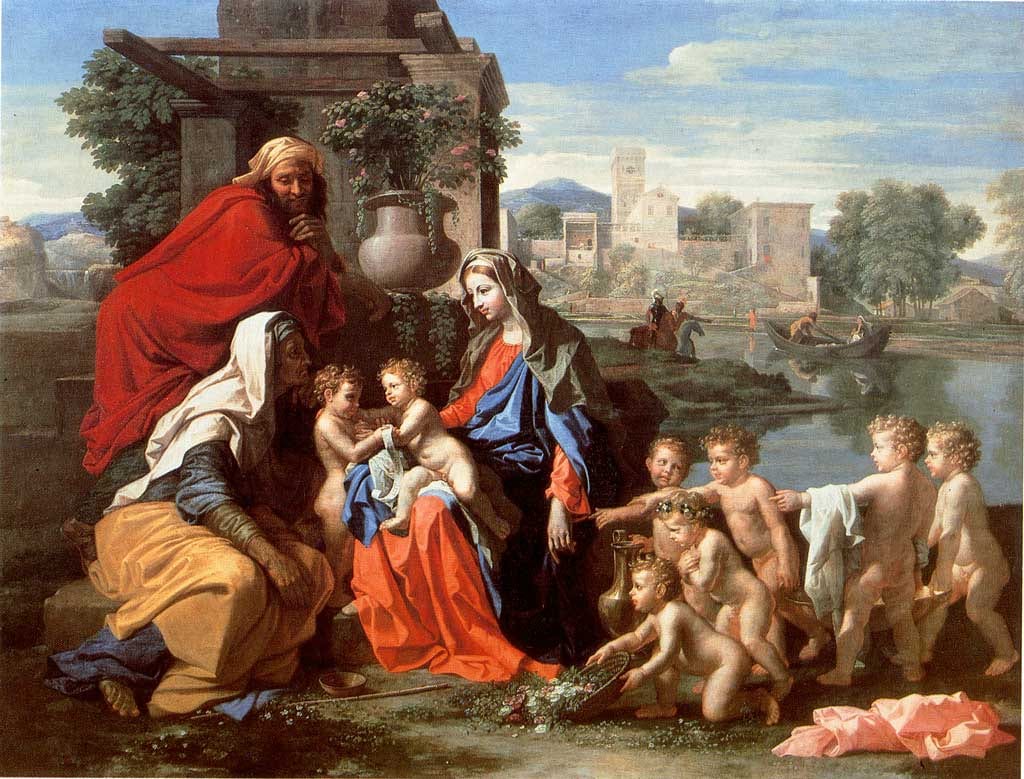
Holy Family · Nicolas Poussin · 1651
Religious landscapes by Claude Lorrain and Nicolas Poussin round off the seventeenth century, and Watteau, Fragonard and Boucher carry French painting into the eighteenth, beside Italian capriccios and glimpses of daily life in Rome and Venice by Longhi, Pannini, Guardi, Canaletto and Tiepolo. Poussin painted this Holy Family for Charles III de Créquy in 1651; it was on show at Chatsworth House until 1981.
Impressionism and after
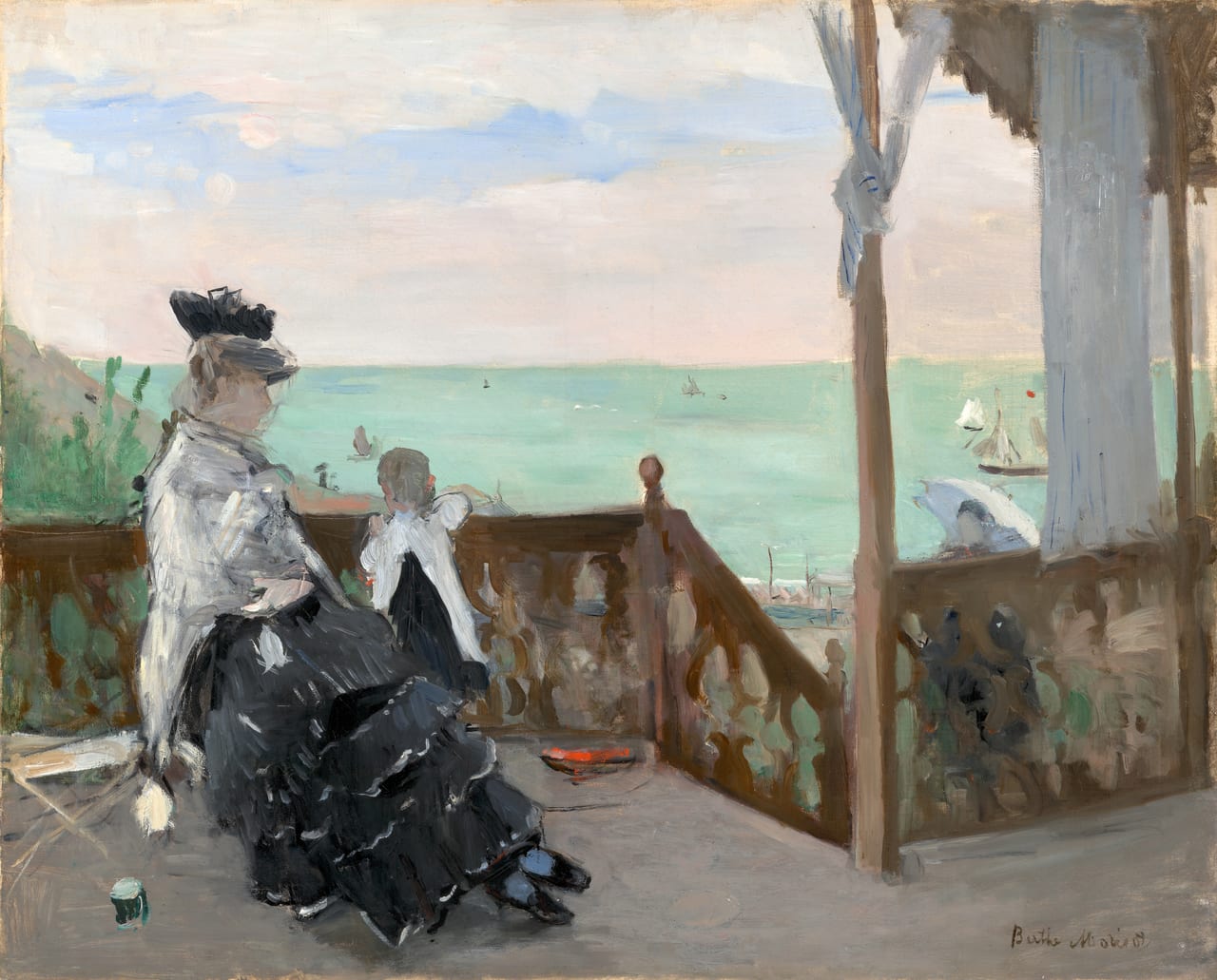
In a Villa by the Seaside · Berthe Morisot · 1874
No collection in Southern California holds more significant Impressionist and Post-Impressionist art: Monet, Renoir and Degas, with over a hundred works by Degas alone, hang with Van Gogh, Cézanne and Gauguin, and Vuillard and Bonnard lead on towards twentieth-century Modernism. Berthe Morisot painted In a Villa by the Seaside in oil on canvas in 1874.
The Blue Four and modern art
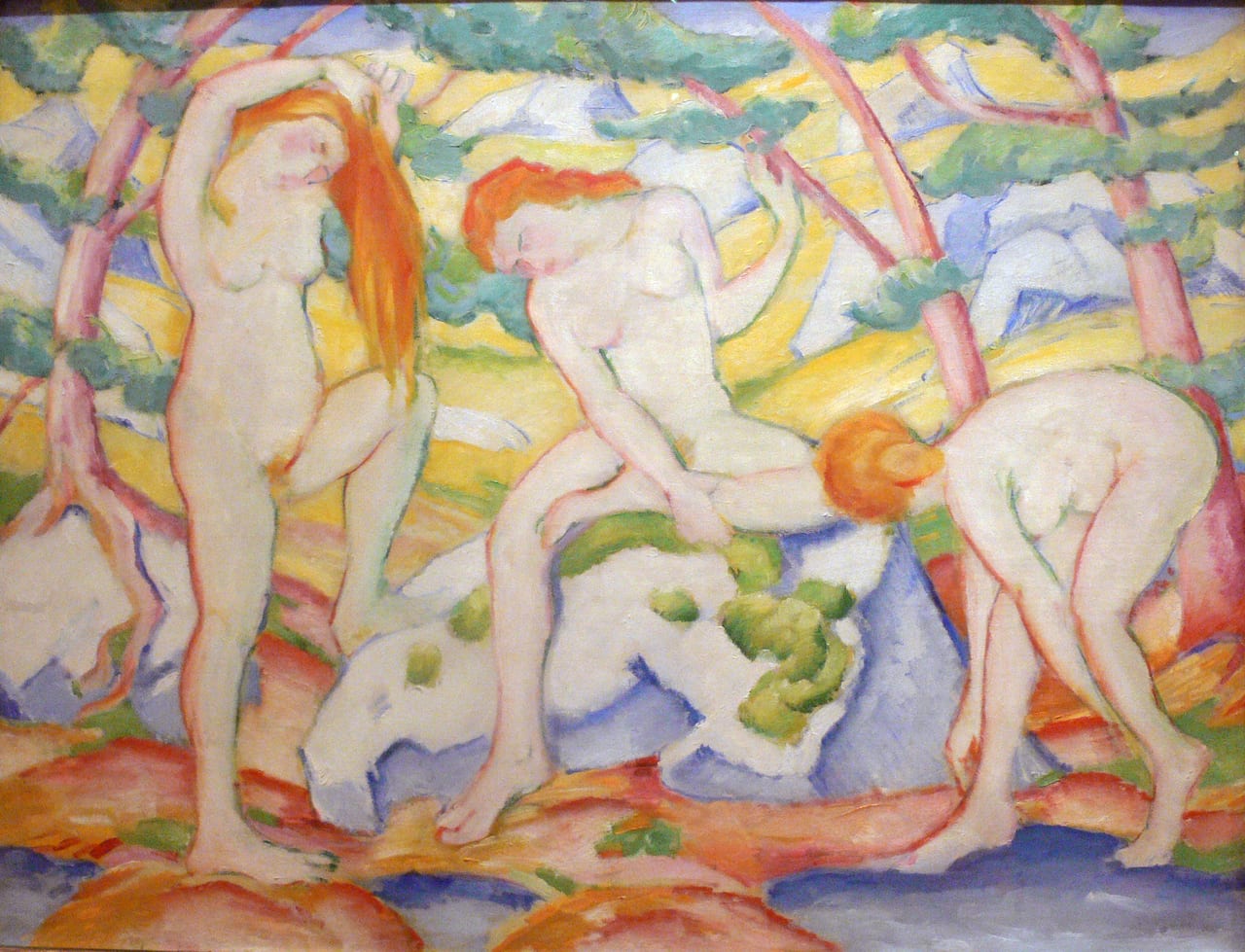
Bathing Girls · Franz Marc · 1910
Galka Scheyer’s collection of the Blue Four brings paintings and works on paper by Klee, Feininger, Jawlensky and Kandinsky, and the modern galleries show Picasso, Braque, Matisse and Diego Rivera. Franz Marc, who founded Der Blaue Reiter with Kandinsky in 1911, painted Bathing Girls (Badende Frauen) in 1910, in oil on canvas, listed at 109.2 x 142.2.
Artists
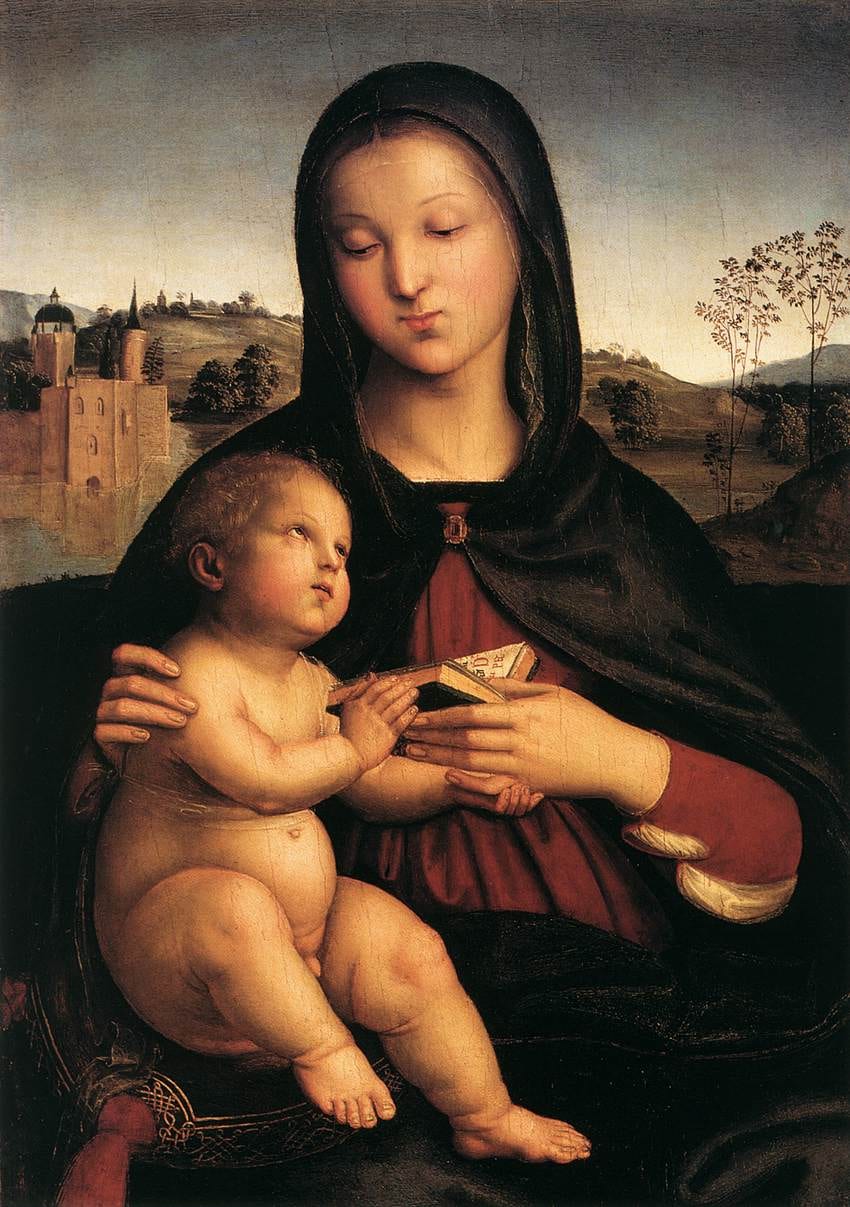
Raphael
Madonna and Child with the Book · c. 1503
The Madonna and Child here, an oil on wood of about 1503, is by the High Renaissance painter and architect known above all for his Madonnas and for his great figure compositions in the Vatican.
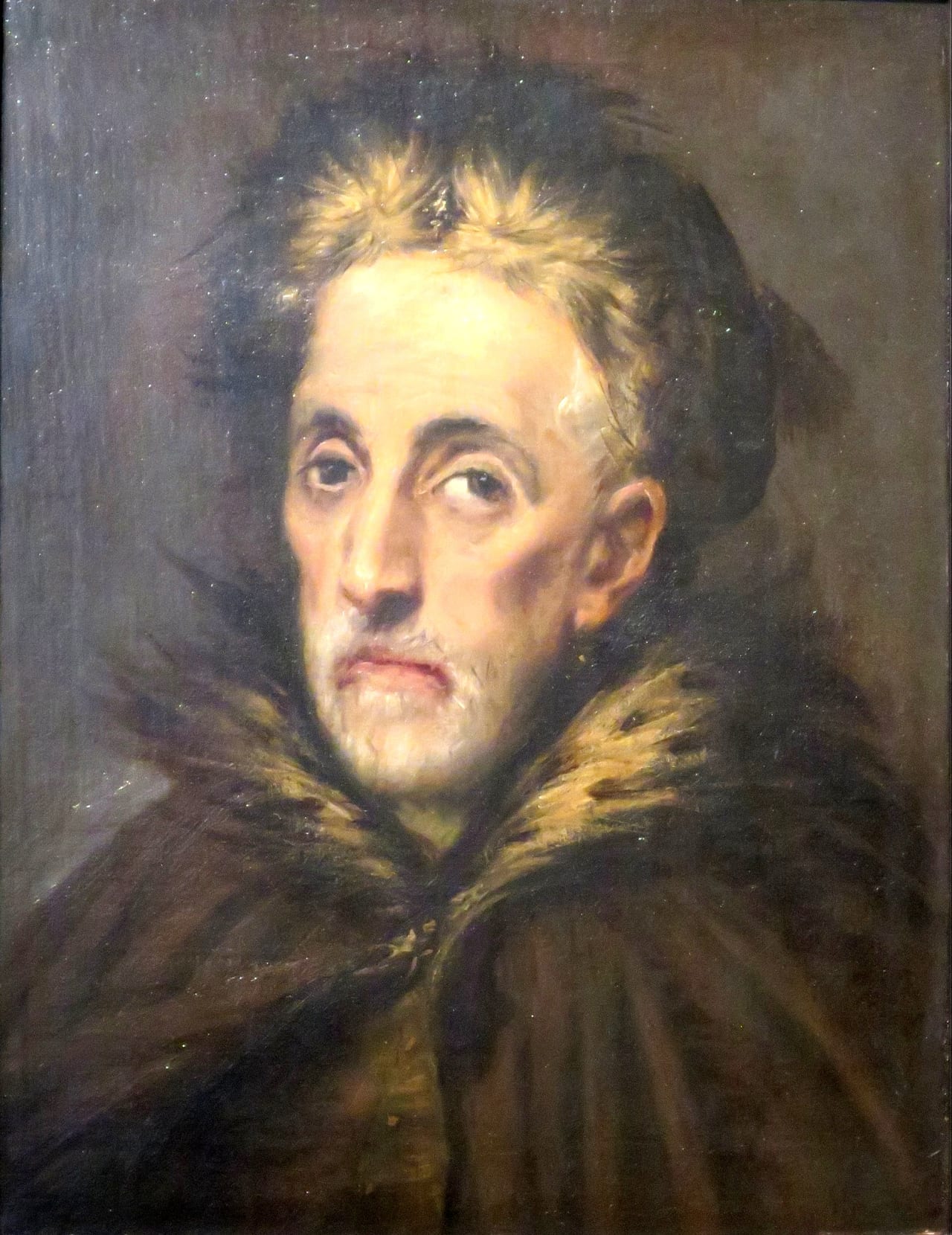
El Greco
Manusso Theotokopoulos · c. 1603
Manusso Theotokopoulos is by a painter born in Crete who died in Toledo in 1614 and usually signed his pictures in Greek letters; his dramatic, expressionistic manner puzzled his contemporaries and won new admirers in the twentieth century.
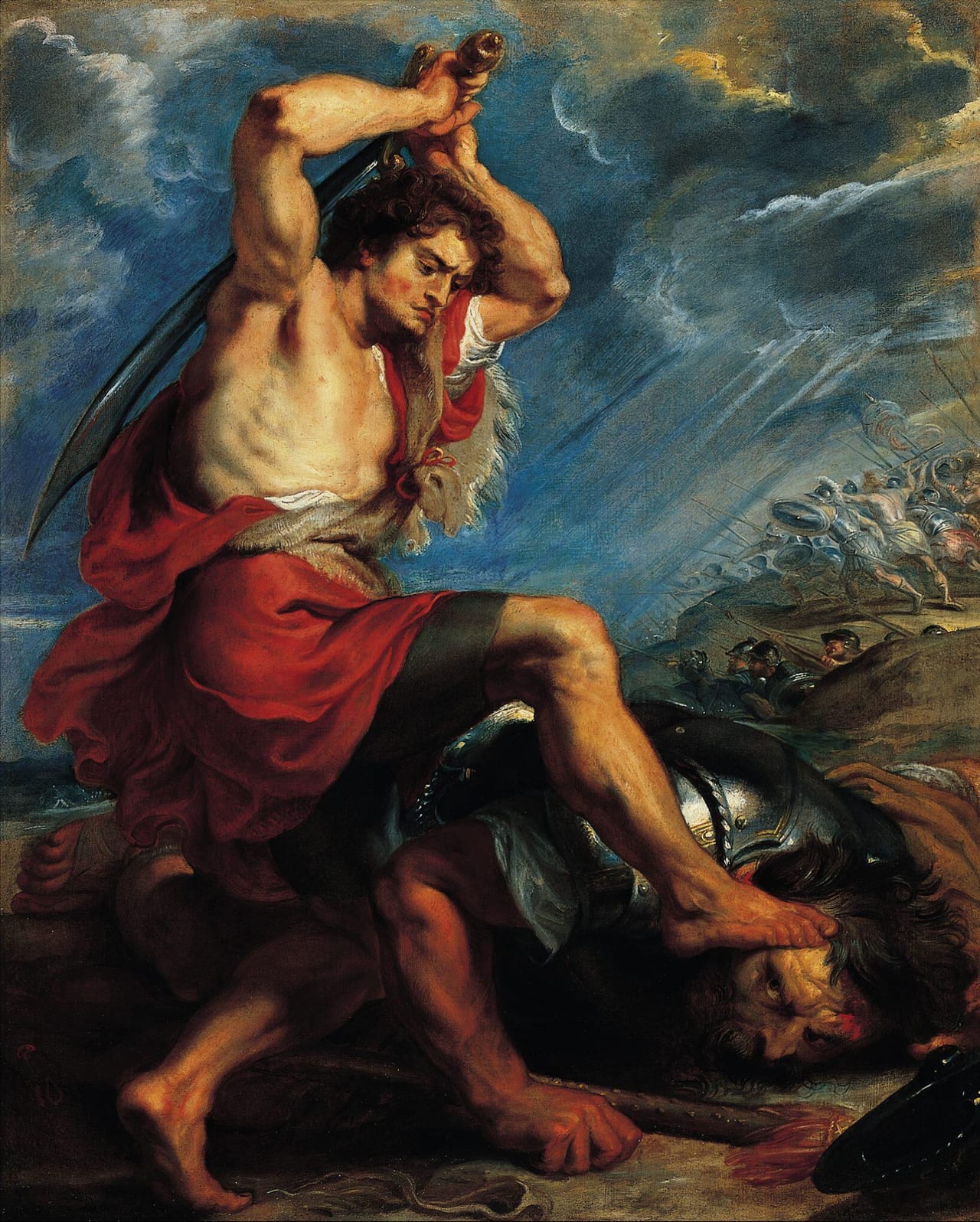
Peter Paul Rubens
David Slaying Goliath
David Slaying Goliath comes from the Flemish master of Baroque dynamism and sensuous exuberance, perhaps best known for religious and mythological pictures, who presided over the most famous painter’s studio in Europe.
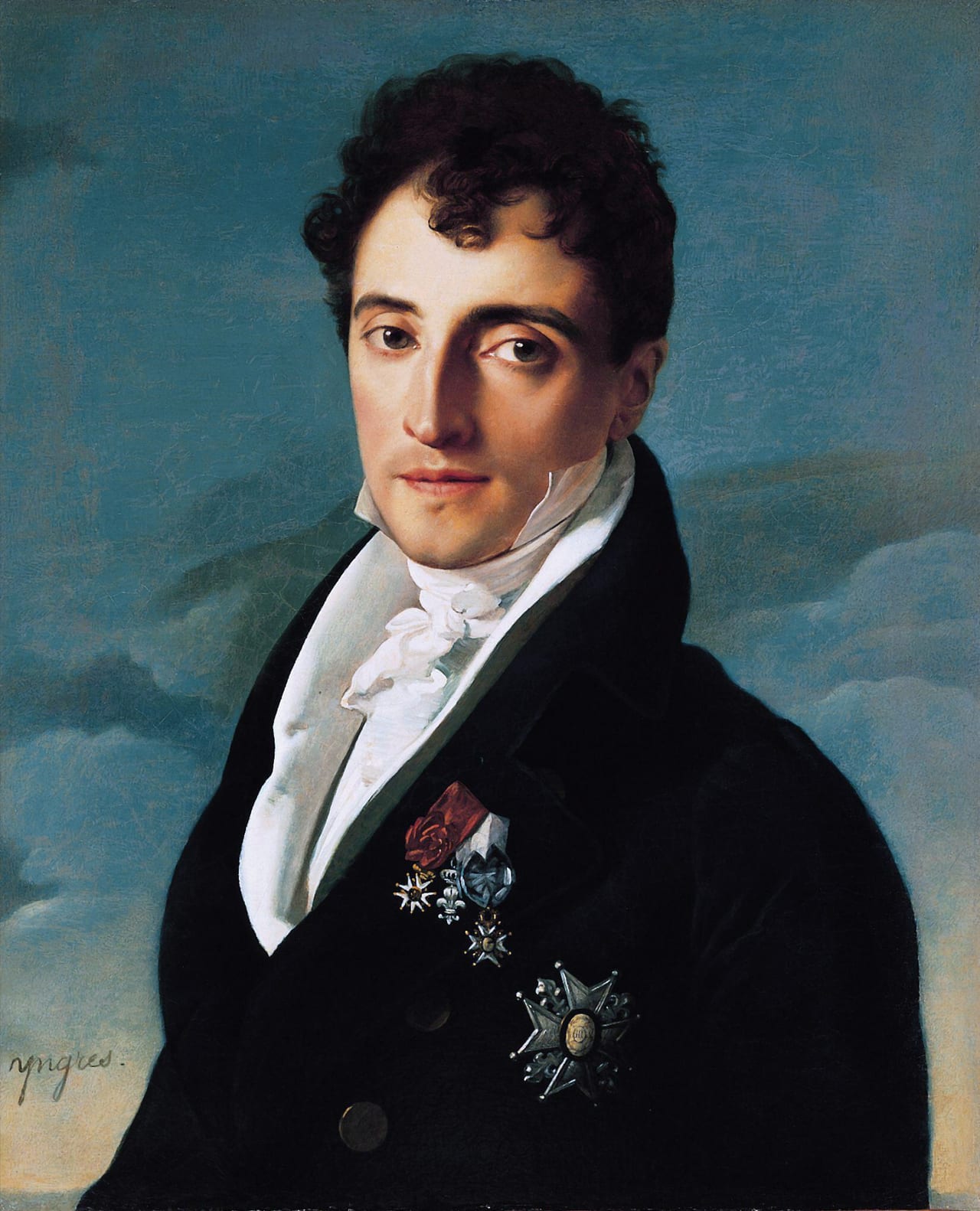
Jean-Auguste-Dominique Ingres
Portrait of Baron Joseph-Pierre Vialetès de Mortarieu
This portrait of the baron is by the painter who, once his mentor Jacques-Louis David had died, led French Neoclassical painting; his cool, minutely drawn pictures stood against the colour and emotion of the Romantics.
Jean-Auguste-Dominique Ingres, CC BY-SA 3.0, via Wikimedia Commons · Licence: CC BY-SA 3.0 · resized
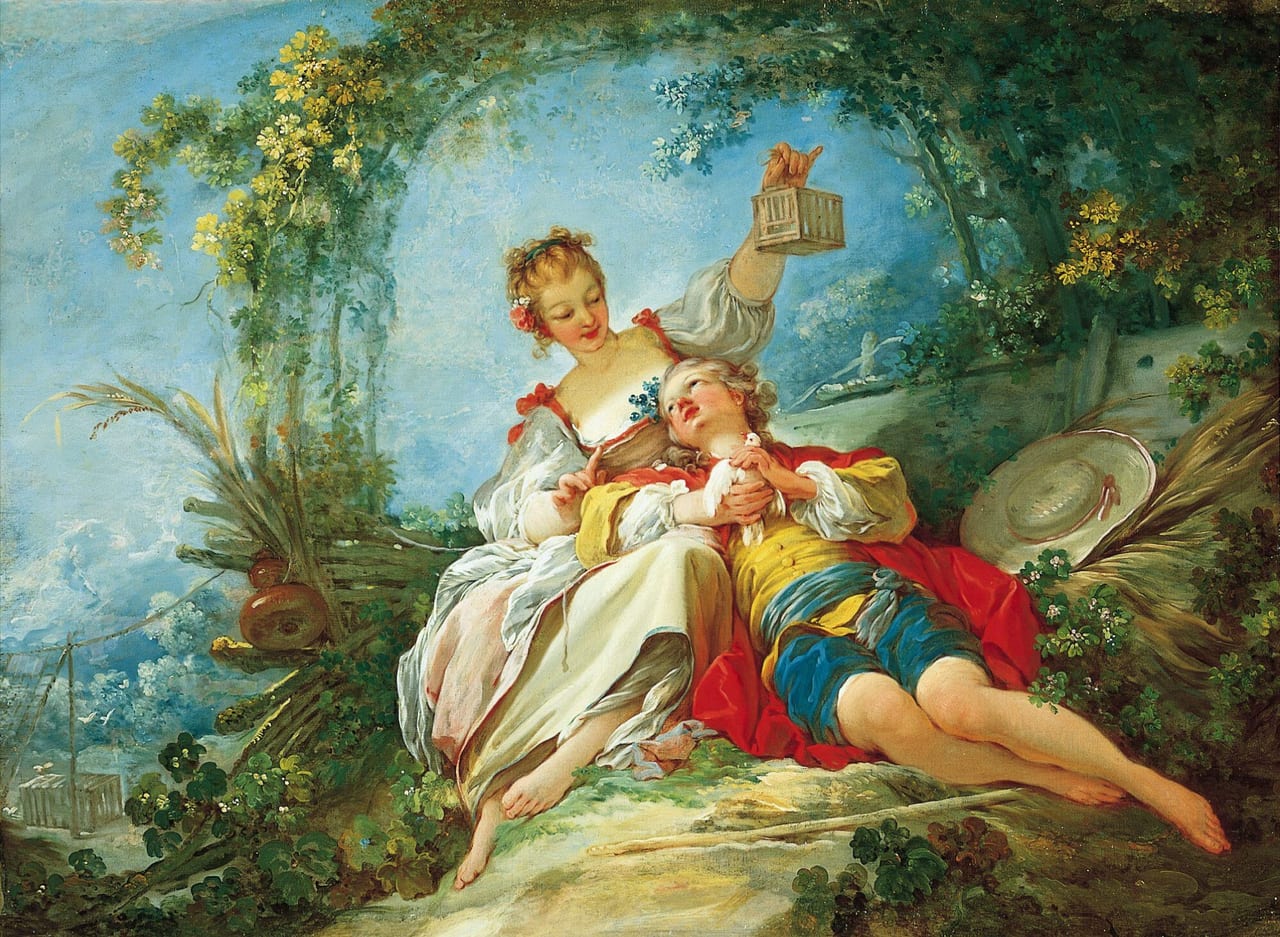
Jean-Honoré Fragonard
Happy Lovers
Happy Lovers is by a French Rococo painter, taught by François Boucher, whose best-known pictures, The Swing among them, are marked by a delicate hedonism.
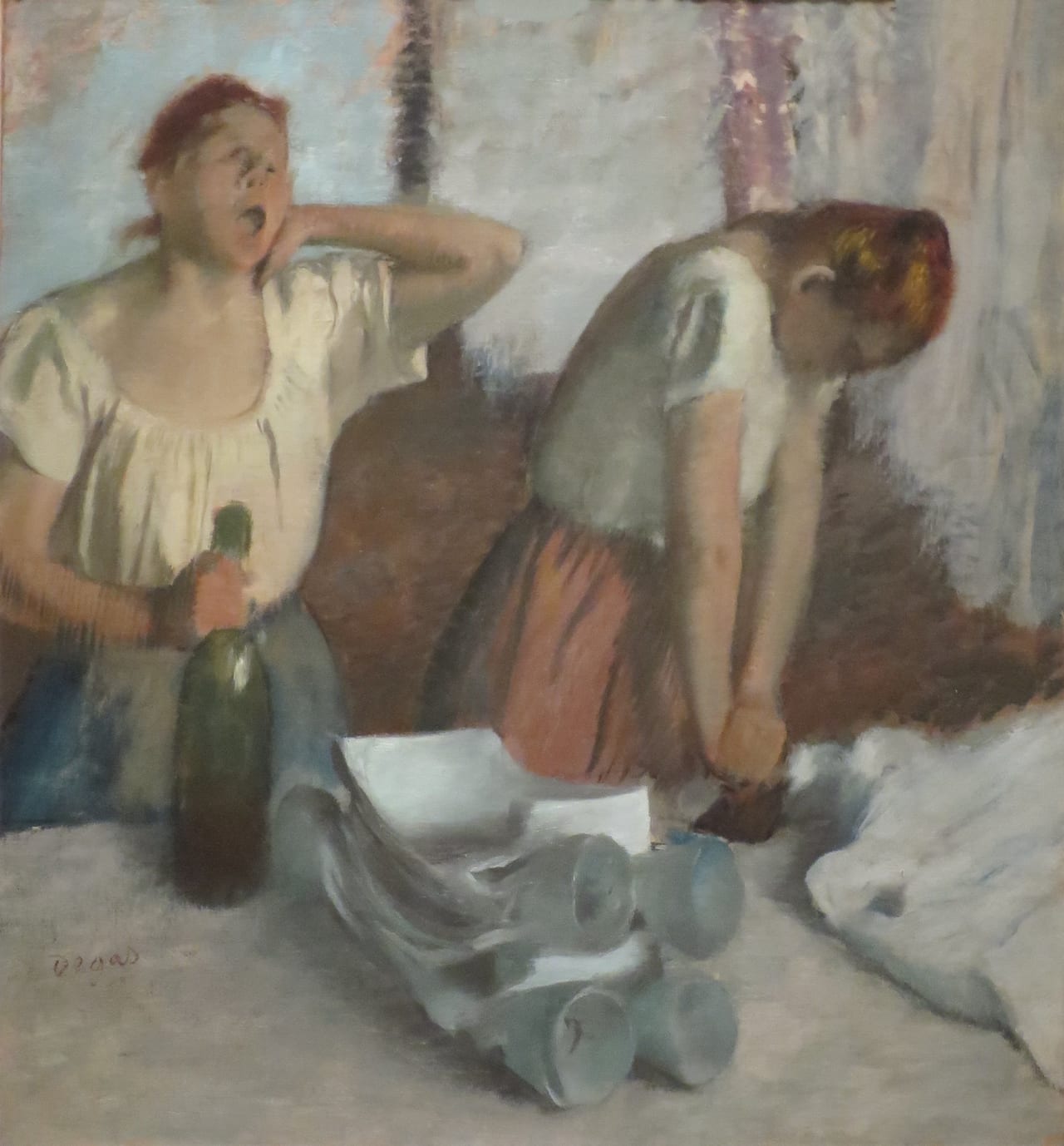
Edgar Degas
Women Ironing
Women Ironing is by Degas, prominent among the Impressionists; the human figure, women above all, was his main subject, and ballet dancers and women at their toilette occupied him all his career.
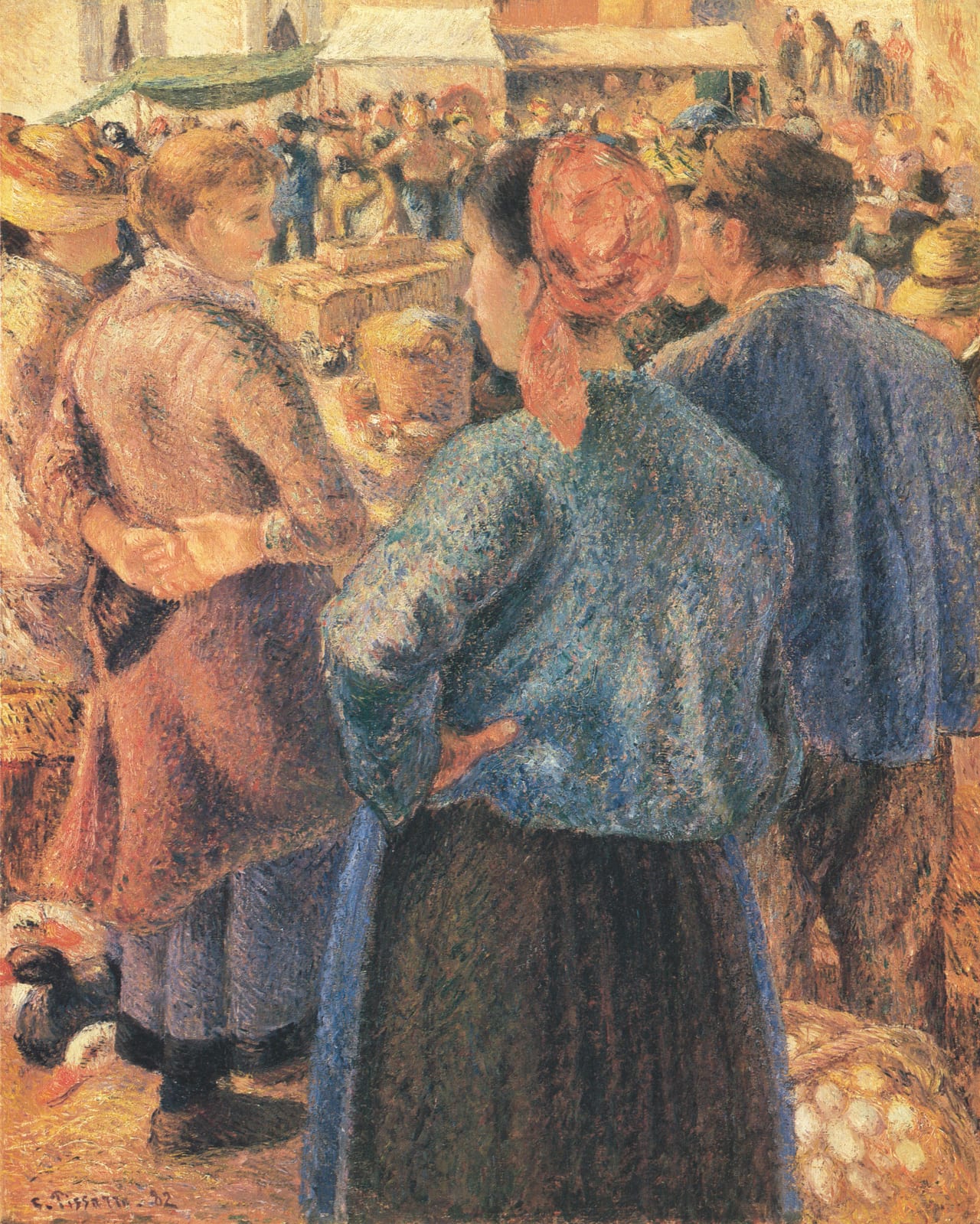
Camille Pissarro
The Poultry Market at Pontoise · 1882
The Poultry Market at Pontoise is by the one painter who exhibited in all eight Impressionist group shows, a supportive friend and mentor to Cézanne and Gauguin, and to many who knew him “Father Pissarro”.
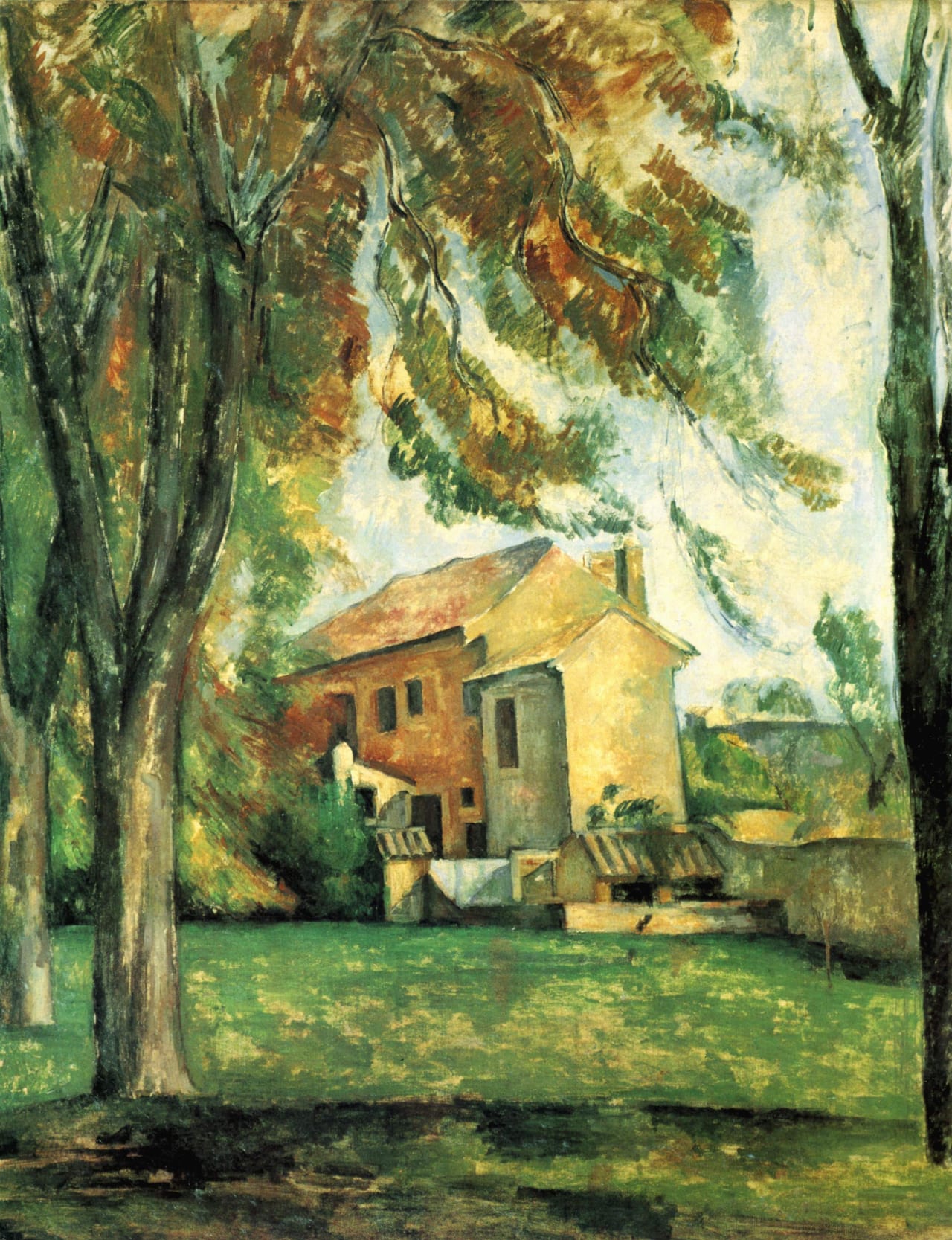
Paul Cézanne
Chestnut Trees and Farm at Jas de Bouffan · c. 1884
Chestnut Trees and Farm at Jas de Bouffan is by the Post-Impressionist from Aix-en-Provence, misunderstood by the public for most of his life, whose insistence on personal expression challenged the conventions of nineteenth-century painting, and whose works and ideas fed many twentieth-century movements, especially Cubism.
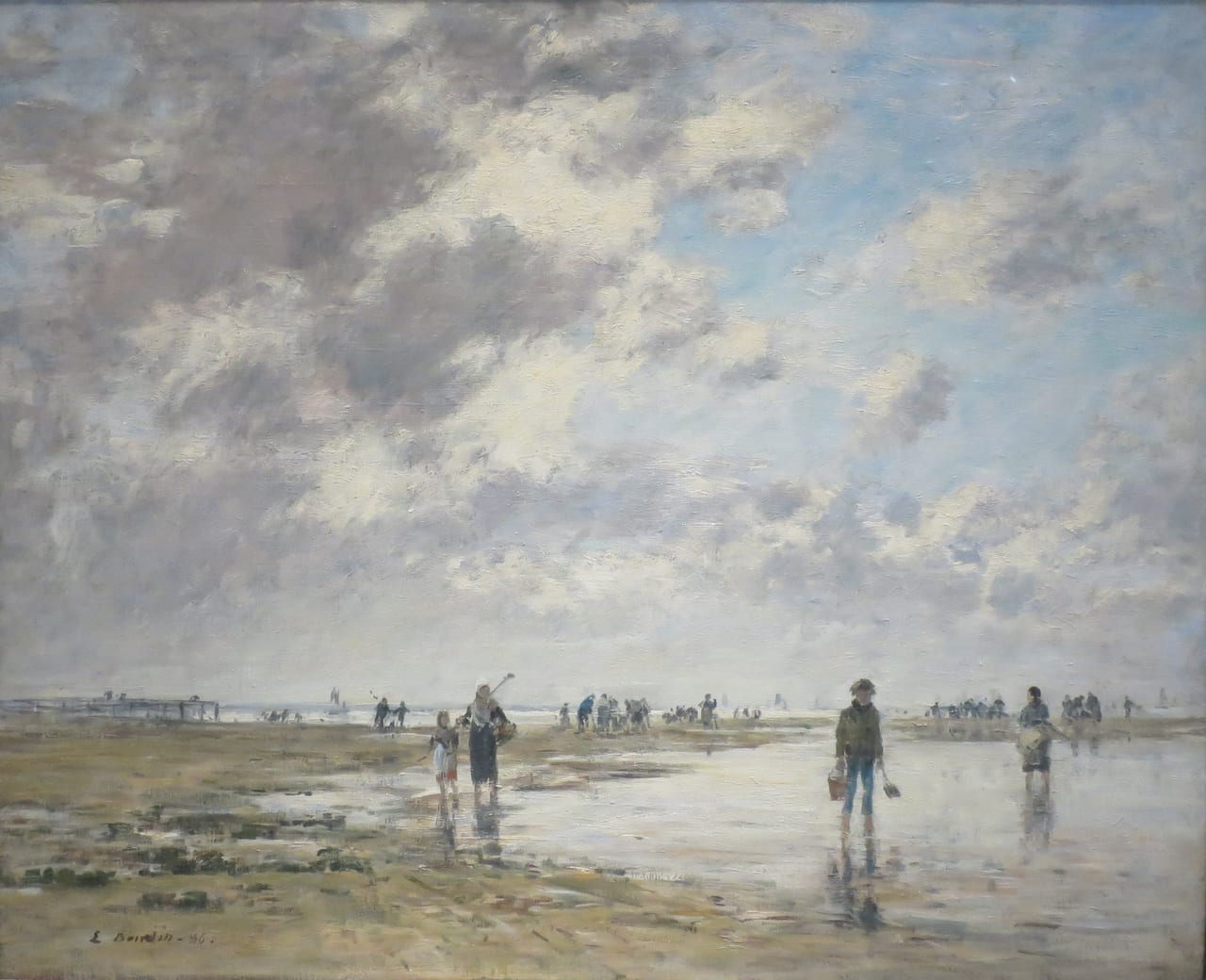
Eugène Boudin
Low Tide, Berck · 1886
Low Tide, Berck is by one of the earliest French landscape painters to paint in the open air, directly before nature, whose many beach scenes bridge early nineteenth-century naturalism and the light, fluid brushwork of Impressionism.
Artworks
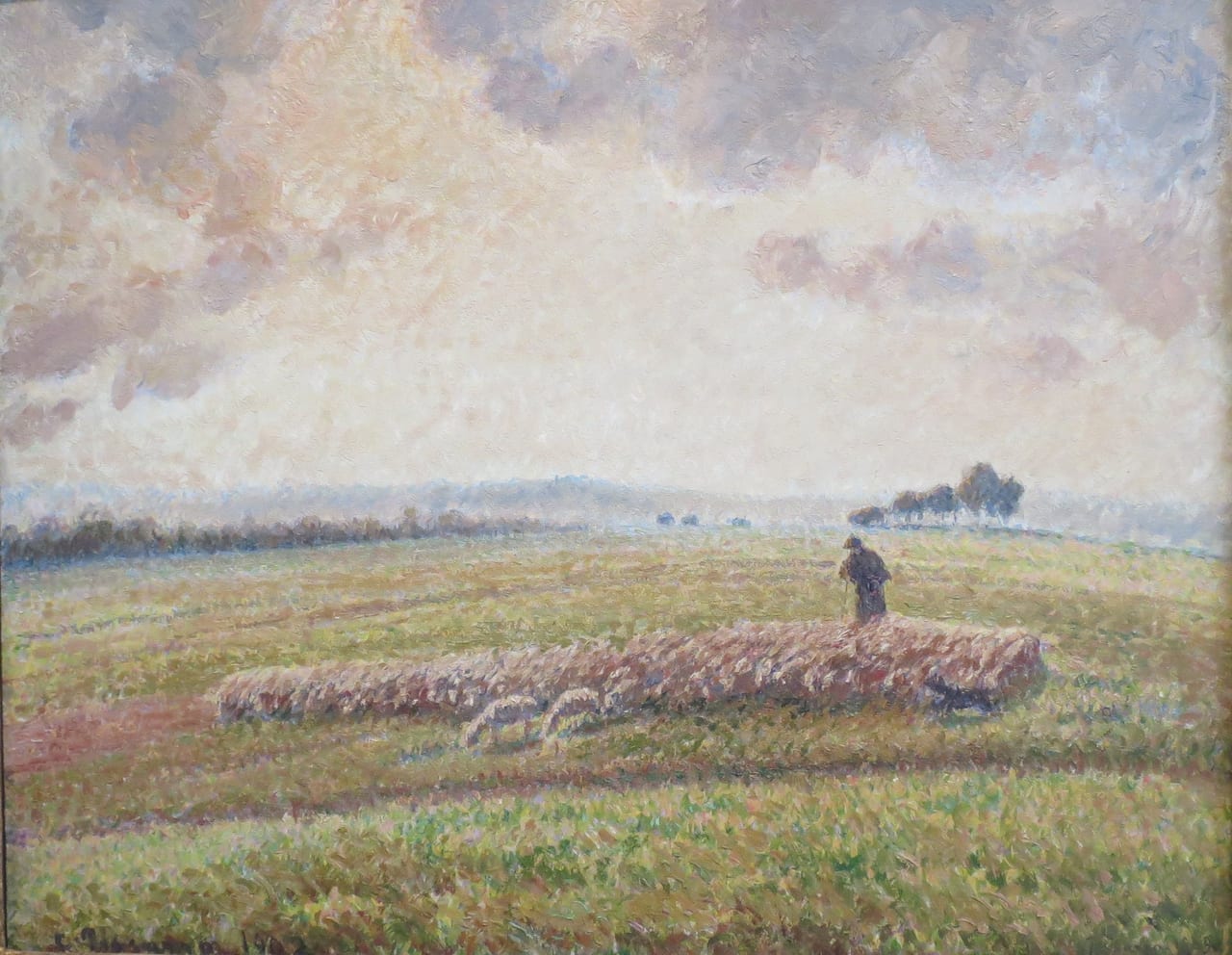
Landscape with a Flock of Sheep
Camille Pissarro
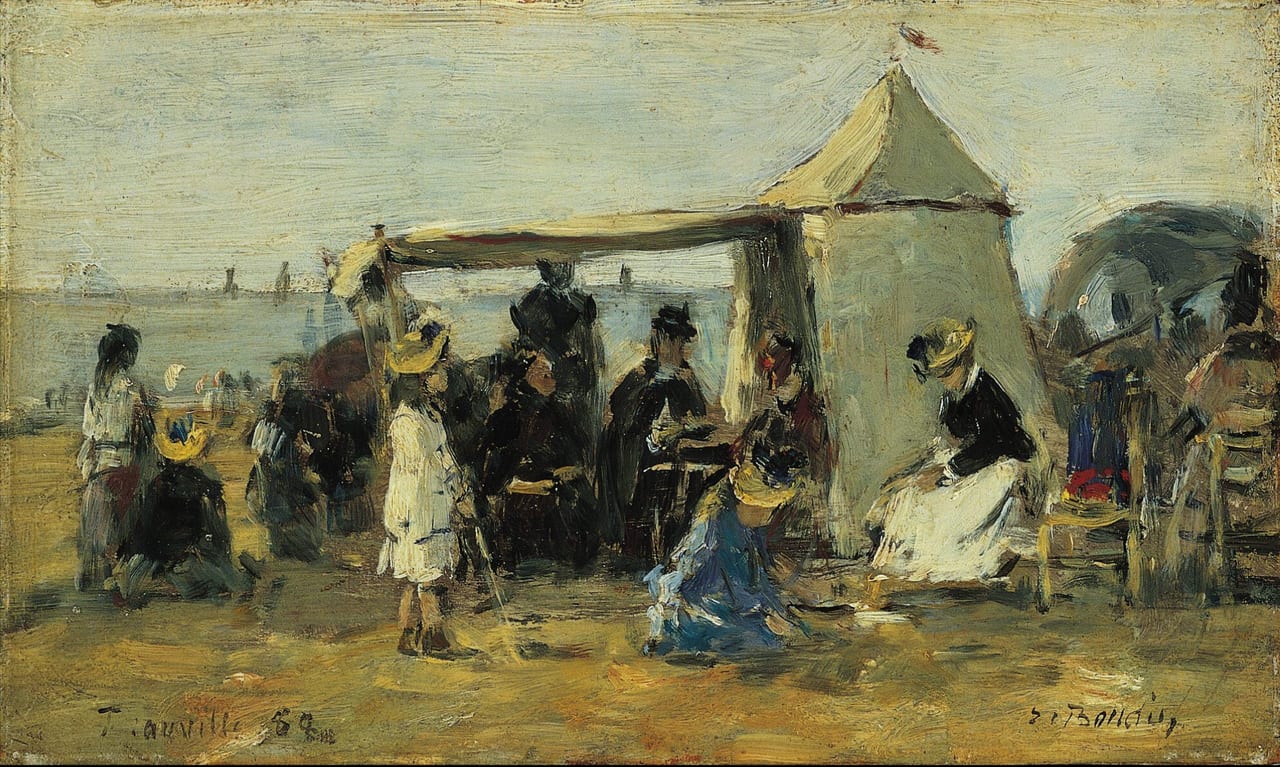
Beach at Trouville
Eugène Louis Boudin · 1888
Sources
- Wikipedia, “Norton Simon Museum”
- Wikipedia, “Norton Simon”
- Wikipedia, “Galka Scheyer”
- Wikipedia, “Rembrandt in Southern California”
- Wikipedia, “Still Life with Lemons, Oranges and a Rose”
- Wikipedia, “Portrait of the Artist’s Mother (Van Gogh)”
- Wikipedia, “The Mulberry Tree (Van Gogh)”
- Wikipedia, “Wine is a Mocker”
- Wikipedia, “The Repentant Magdalene (Cagnacci)”
- Wikipedia, “Femme en costume Mauresque”
- Wikipedia, “Portraits by Vincent van Gogh”
- Wikipedia, “Still Life with a Poem”
- Wikipedia, “Tahitian Woman and Boy”
- Wikipedia, “Glue-size”
- Wikipedia, “Portrait of Georg Fugger”
- Wikipedia, “Madonna and Child with the Book”
- Wikipedia, “Chestnut Trees and Farm at Jas de Bouffan (Cézanne, Pasadena)”
- Wikipedia, “List of paintings by Rembrandt”
- Wikipedia, “List of paintings by Nicolas Poussin”
- Wikipedia, “Berthe Morisot”
- Wikipedia, “List of works by Franz Marc”
- Wikipedia, “List of paintings by Eugène Boudin”
- Wikipedia, “List of paintings by Camille Pissarro”
- Britannica, “Raphael”
- Britannica, “El Greco”
- Britannica, “Peter Paul Rubens”
- Britannica, “J.-A.-D. Ingres”
- Britannica, “Jean-Honoré Fragonard”
- Britannica, “Edgar Degas”
- Britannica, “Camille Pissarro”
- Britannica, “Paul Cézanne”
- Britannica, “Eugène Boudin”
- Britannica, “Franz Marc”
- Boulevard des Fossés, Pontoise — Public domain via Wikimedia Commons (Public domain)
- Still Life with Lemons, Oranges and a Rose — Public domain via Wikimedia Commons (Public domain)
- Portrait of the Artist's Mother — Public domain via Wikimedia Commons (Public domain)
- The Mulberry Tree — Public domain via Wikimedia Commons (Public domain)
- Wine is a Mocker — Public domain via Wikimedia Commons (Public domain)
- The Repentant Magdalene — Public domain via Wikimedia Commons (Public domain)
- Woman in Moorish Costume — Public domain via Wikimedia Commons (Public domain)
- Portrait of a Peasant (Patience Escalier) — Public domain via Wikimedia Commons (Public domain)
- Still Life with a Poem — Public domain via Wikimedia Commons (Public domain)
- Resurrection — Public domain via Wikimedia Commons (Public domain)
- Tahitian Woman and Boy — Public domain via Wikimedia Commons (Public domain)
- Portrait of Joerg Fugger — Public domain via Wikimedia Commons (Public domain)
- Unfinished Portrait of a Boy — Public domain via Wikimedia Commons (Public domain)
- Holy Family — Public domain via Wikimedia Commons (Public domain)
- In a Villa by the Seaside — Public domain via Wikimedia Commons (Public domain)
- Bathing Girls — Public domain via Wikimedia Commons (Public domain)
- Madonna and Child with the Book — Public domain via Wikimedia Commons (Public domain)
- Manusso Theotokopoulos — Public domain via Wikimedia Commons (Public domain)
- David Slaying Goliath — Public domain via Wikimedia Commons (Public domain)
- Portrait of Baron Joseph-Pierre Vialetès de Mortarieu — Jean-Auguste-Dominique Ingres, CC BY-SA 3.0, via Wikimedia Commons (CC BY-SA 3.0)
- Happy Lovers — Public domain via Wikimedia Commons (Public domain)
- Women Ironing — Public domain via Wikimedia Commons (Public domain)
- The Poultry Market at Pontoise — Public domain via Wikimedia Commons (Public domain)
- Chestnut Trees and Farm at Jas de Bouffan — Public domain via Wikimedia Commons (Public domain)
- Low Tide, Berck — Public domain via Wikimedia Commons (Public domain)
- Landscape with a Flock of Sheep — Public domain via Wikimedia Commons (Public domain)
- Beach at Trouville — Public domain via Wikimedia Commons (Public domain)
Invite the Norton Simon Museum into your living room