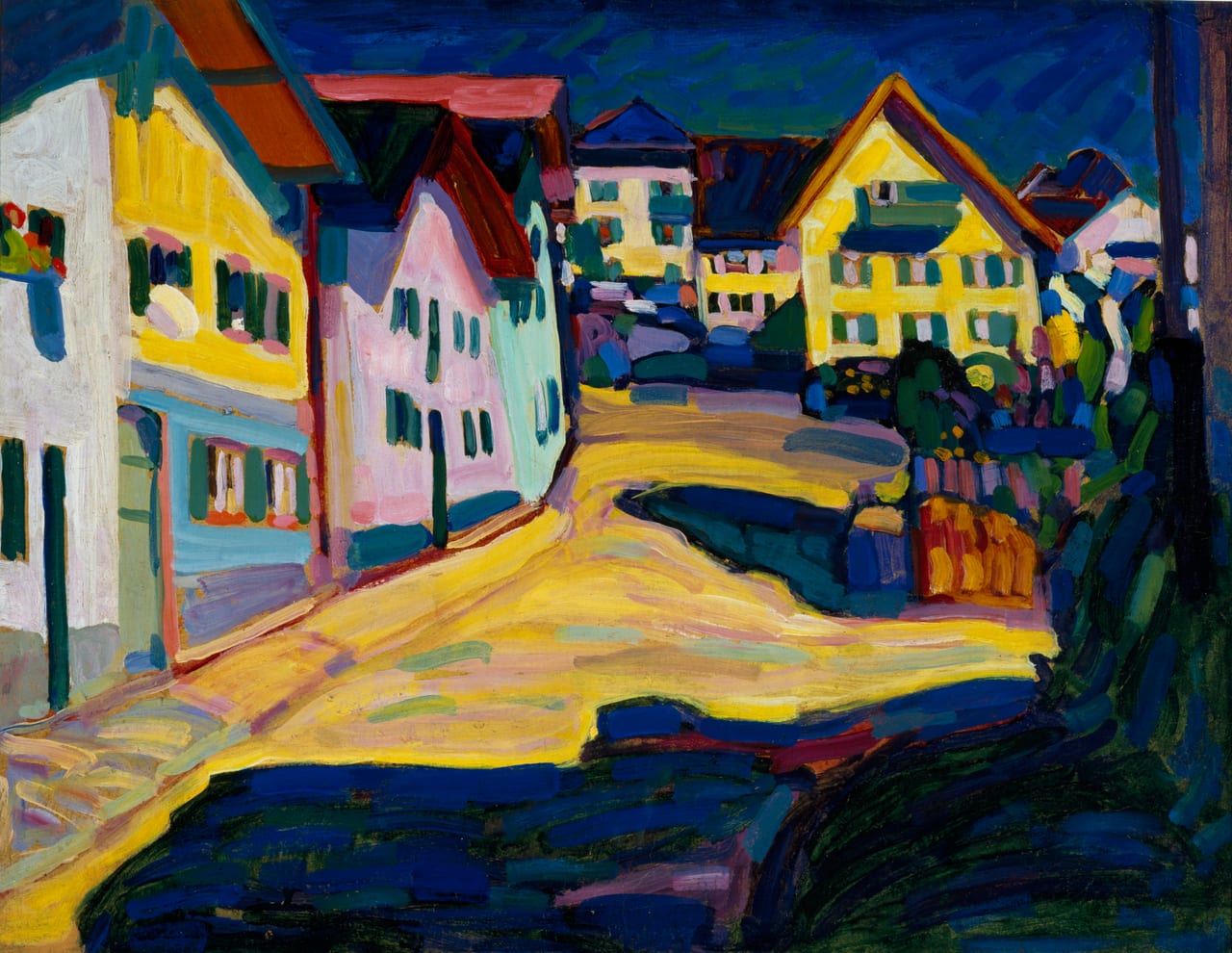
The Storm
August Macke · 1911

Abstract art
Europe
In the four or five years before the First World War, Wassily Kandinsky, Robert Delaunay, Kazimir Malevich and Vladimir Tatlin turned to a fundamentally abstract art, pictures that make no attempt at an accurate depiction of visual reality and achieve their effect through shapes, colours, forms and marks. In its strictest sense it has its origins in the nineteenth century, and Fauvism, Expressionism, Cubism and Futurism had each in some way stressed the gap between art and natural appearances. Malevich and Piet Mondrian were pioneers of ‘pure’ abstract painting from about 1910 to 1920, and since the early 1900s abstraction has been a central stream of modern art.
Roots in the nineteenth century
Form, colour, line, tone and texture, the elements of all art, can be called abstract, but before the twentieth century painters put them to work describing, illustrating or reproducing nature and human civilisation. In its strictest sense abstract art has its origins in the nineteenth century, when a number of painters examined the mechanism of light and visual perception, and Romanticism, turning from classicism’s emphasis on imitation and idealisation, had made imagination and the unconscious the essential creative factors. In 1890 Maurice Denis summed up the feeling of the Symbolists and Post-Impressionists: “It should be remembered that a picture—before being a war-horse, a nude, or an anecdote of some sort—is essentially a flat surface covered with colors assembled in a certain order”.
Romanticism, Impressionism and Expressionism all contributed to the development of abstract art. James McNeill Whistler gave an early intimation of a new art in Nocturne in Black and Gold: The Falling Rocket of 1872, where visual sensation counts for more than the depiction of objects. In the twentieth century, appreciation of the abstract qualities in J. M. W. Turner’s late colour compositions strengthened his standing among the most innovative painters of his century. Fauvism, Expressionism, Cubism and Futurism, the major movements of the first two decades of the twentieth century, each in some way stressed the gap between art and natural appearances; the Cubists and Fauves still took their subjects from the visible world, yet they opened the door to more extreme abstraction.
Abstracting from appearances, even until nothing can be recognised, is a deeply different thing from making art out of forms not drawn from the visible world at all. The word abstract covers both: art that starts from an object, a figure or a landscape and simplifies or schematises its forms, and art made of geometric shapes or gestural marks with no source in external reality, for which some of its makers preferred the names concrete art or non-objective art. Even among progressive artists, the majority looked on the abandonment of every degree of representation with disfavour.
Kandinsky was traditionally regarded as the first modern artist to paint purely abstract pictures with no recognisable objects, in 1910–11, but that account was later questioned, especially in the twenty-first century, as interest returned to the Swedish painter Hilma af Klint, who painted her first abstract work in 1906, though with a goal other than pure abstraction. In Eastern Europe in the late nineteenth century, mysticism and the early modernist religious thought expressed by the theosophist Madame Blavatsky had a profound impact on af Klint and Kandinsky, pioneers of geometric art. Some proposed that art should work as music does, its effects made by pure patterns of form, colour and line as music is made of patterns of sound; the idea, derived from Plato, that the highest beauty lies in geometry rather than in the forms of the real world also runs through discussion of abstract art; and because abstract art does not represent the material world, it can be seen to represent the spiritual.
Kandinsky and the Blue Rider
Wassily Kandinsky, born in Moscow in 1866, later remembered a youthful conviction that every colour led a mysterious life of its own, as a sort of first impulse toward abstraction. He enrolled at the University of Moscow in 1886 to study law and economics, and in 1896, nearing thirty and offered a professorship in jurisprudence at the University of Dorpat, he turned it down and left for Germany to become a painter. In Munich he studied at Anton Azbé’s private school and then at the Academy under Franz von Stuck. In 1909 he and the painter Gabriele Münter acquired a house in Murnau, in southern Bavaria, and working there and in Munich he began the process that led to his historic breakthrough into purely abstract painting. He wanted colours, lines and shapes, freed from depicting recognisable objects, to grow into a visual language that could, as music did for him, express general ideas and evoke deep emotions.
In Blue Mountain of 1908–09 the move toward nonrepresentation is already clearly under way: the forms are schematic, the colours not those of nature, the effect that of a dream landscape. Improvisation XIV of 1910 is practically abstract, as its somewhat musical title suggests, and Encircled of 1911 has no discernible point of departure in recognisable objects. Kandinsky called his most spontaneous paintings improvisations and his more elaborate works compositions. Most art historians see the peak of his achievement in With the Black Arch and Autumn II, both of 1912, and Black Lines of 1913, painted in a slashing, splashing, dramatic manner. His claim to priority rests mainly on an untitled watercolour dated 1910, known as First Abstract Watercolour; research of the 1950s allows it to be dated somewhat later and regarded as a study for Composition VII of 1913. He cannot be called the only founder of nonfigurative painting, but he remains a pioneer of the first importance.
In 1909 Kandinsky helped to found the New Artists’ Association in Munich and became its president. Its conservative members quarrelled repeatedly over his increasingly abstract painting, and after their jury turned down his Composition V in December 1911, Kandinsky, Münter, Franz Marc and others broke away and quickly showed their own work next door to the association’s exhibition. The new circle called itself Der Blaue Reiter (The Blue Rider). It was a loose network rather than an art group in the narrower sense, and its artists’ approaches varied, but they shared a desire to express spiritual truths through art, and their encounters with Cubist, Fauvist and Rayonist ideas carried them toward abstraction. Kandinsky and Marc were sole editors of an almanac of the same name, first published in mid-May 1912, and the exhibitions of 1911 and 1912 toured Germany. Kandinsky’s writing in the almanac and his treatise On the Spiritual in Art defended and promoted abstract art; in his view colour could serve in a painting as something autonomous, apart from describing an object.
August Macke met Marc in Munich in 1909, and the two worked closely together as their style grew more abstract and colourful; Macke joined the Blue Rider in 1911. In 1912 he met Robert Delaunay, who painted in a colourful, Cubist-influenced manner called Orphism. In 1914 he went with Paul Klee to Tunis, and in the series he painted there the subject sits on a grid of pure colours. The outbreak of the First World War in 1914 disrupted the group: Marc and Macke were killed in action in the war, and Kandinsky returned to Russia.
Geometry, the Bauhaus and after
At the Salon de la Section d’Or in 1912, where František Kupka showed his abstract painting Amorpha, Fugue in Two Colours, the poet Guillaume Apollinaire gave the name Orphism to the work of several artists, Delaunay among them. Apollinaire called it “the art of painting new structures out of elements that have not been borrowed from the visual sphere, but had been created entirely by the artist”. Kazimir Malevich finished the Suprematist Black Square, his first entirely abstract work, in 1915.
Piet Mondrian joined the Theosophical Society in May 1909, the year a large group show at the Stedelijk Museum in Amsterdam established him in the Dutch avant-garde, and, inspired by its belief in a harmonious cosmos, he began to free the objects in his paintings from naturalistic representation. In 1911 he made his first bid for international recognition, sending one of his more abstract pictures to the Salon des Indépendants in Paris. In 1917 he and Theo van Doesburg, both pioneers of abstract art, founded De Stijl (The Style), at first a publication; in its first year’s issues Mondrian set out his aims and, perhaps for the first time, used the term neo-plasticism, which became the name of the abstract art he and the De Stijl circle practised. Neo-plasticism kept the basic elements of painting in their purest state: primary colours and non-colours, squares and rectangles, and straight horizontal or vertical lines; Mondrian’s mature pictures combine straight lines and right angles with primary colours and black, white and grey. He left De Stijl in 1923, after Van Doesburg adopted diagonals, and the group had a profound influence on abstract art and on modern architecture and design.
Back in Russia, Kandinsky took part from 1918 to 1921 in the country’s cultural politics, in art education and museum reform, and painted little. In 1921 Walter Gropius, who had founded the Bauhaus at Weimar in 1919, invited him to the school, and Kandinsky taught there from 1922; the Bauhaus teachers included Paul Klee, Johannes Itten, Josef Albers, Anni Albers and László Moholy-Nagy. Geometric elements, particularly the circle, the half-circle, the angle, straight lines and curves, grew ever more important in his teaching and his painting, and his study of points and lines led to his second theoretical book, Point and Line to Plane, in 1926. After the Bauhaus he moved to France, where he spent the rest of his life and became a French citizen in 1939.
Between the two world wars abstract art did not flourish; beset by totalitarian politics and by movements that put new weight on imagery, Surrealism and socially critical Realism among them, it drew little notice. Abstraction-Création, founded in 1931 as a more open group, gave abstract artists a point of reference, and in 1935 England saw the first exhibition of British abstract art. After the Second World War an energetic American school of abstract painting, Abstract Expressionism, emerged and spread its influence widely, and from the 1950s abstraction was an accepted and widely practised approach in European and American painting and sculpture.
Artists
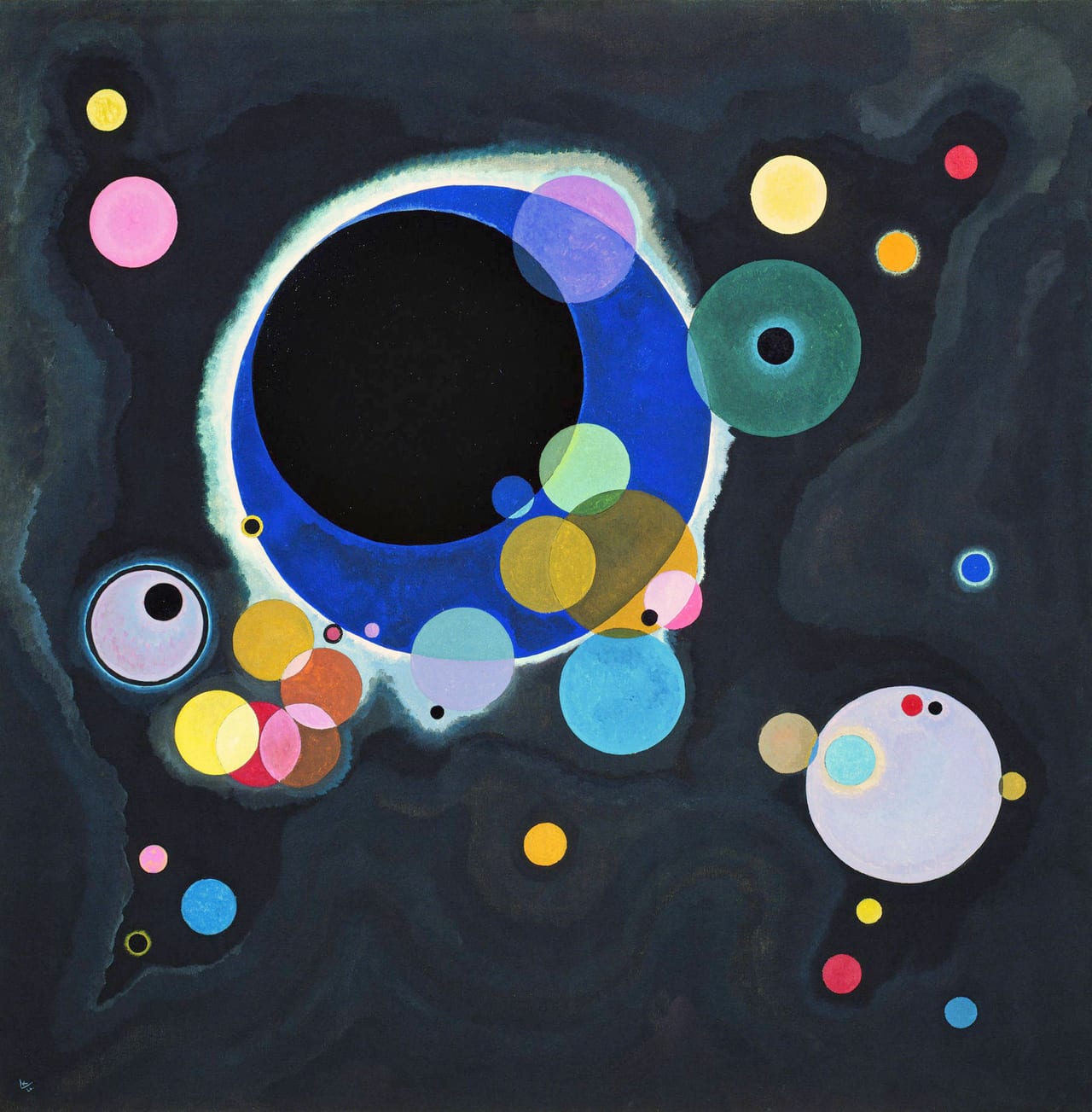
Kandinsky painted Several Circles in January and February 1926: an almost square oil on canvas, an abstraction of coloured discs on a dark ground. It is in the Solomon R. Guggenheim Museum in New York.
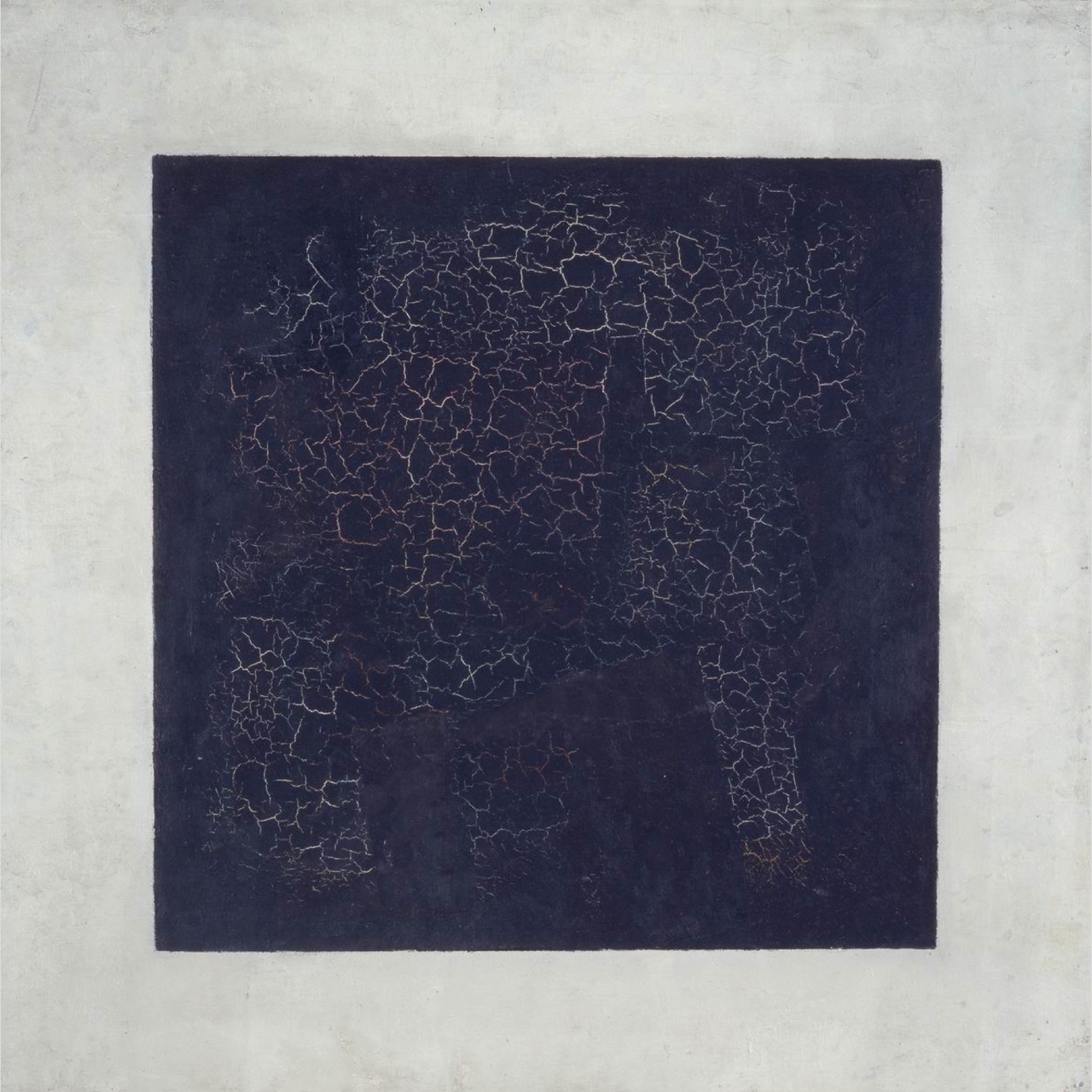
Kazimir Malevich
Malevich painted the first Black Square in 1915 in broad strokes of thick black oil paint on a linen canvas 79.5 cm square, its border and edges in various shades of white and grey. He described it as his breakthrough work and the inception of Suprematism, and called it the “zero point of painting”; it made its first appearance in 1915, at The Last Futurist Exhibition 0,10. Of the four painted versions this is the original, from which he later made repetitions, and it is traditionally held to be the very picture that hung at 0,10; it is in the Tretyakov Gallery.
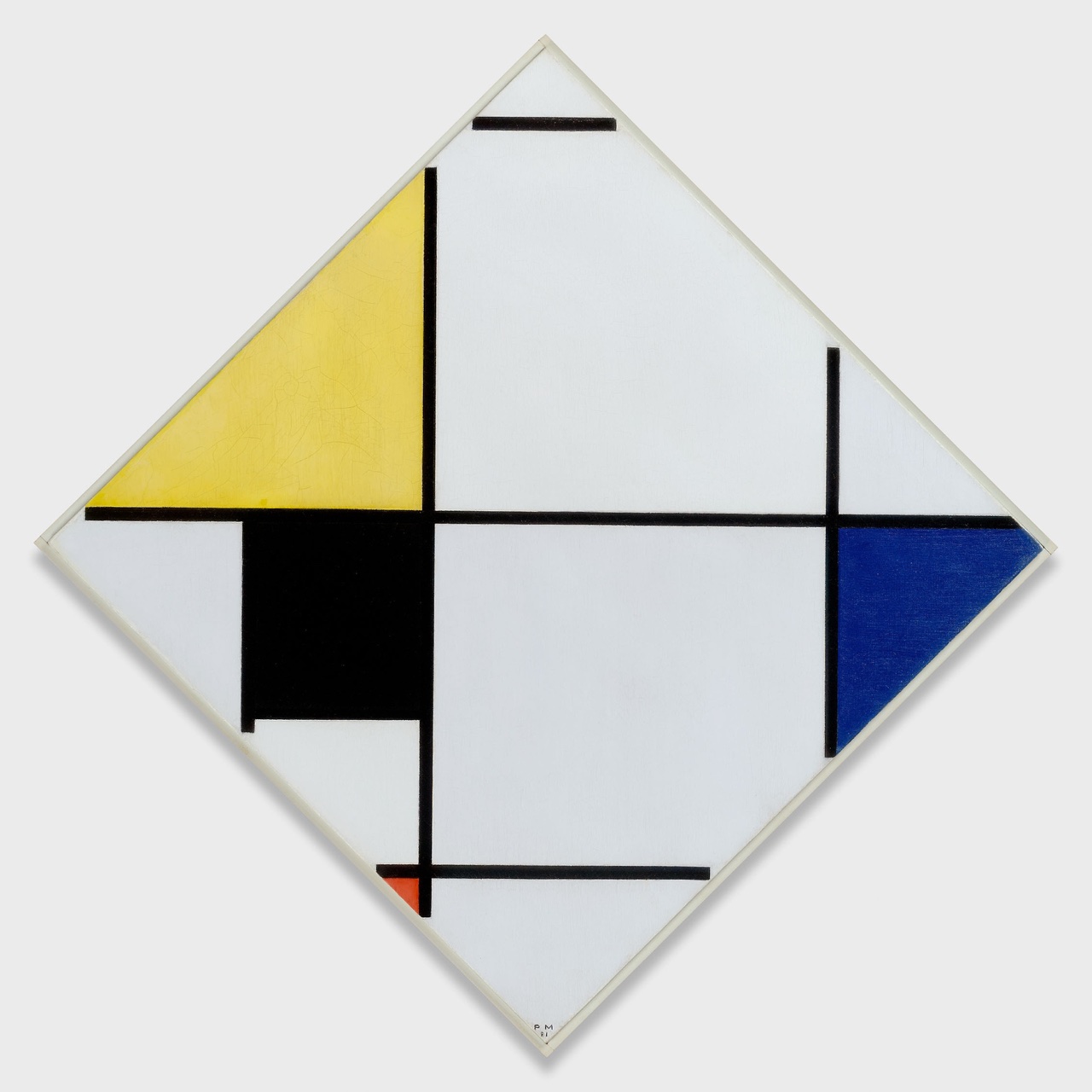
Piet Mondrian
Mondrian, who argued that “the straight line tells the truth”, hung this canvas of 1921 off axis, so that its edges imply dynamic diagonals; among other motives, turning the canvas let him reconsider the relationship between a painting’s contents and what contains them. Its squared-off black lines suggest enclosure; one line, above the blue area, runs out to the slanted edge, hinting at extension beyond the canvas, and the thought of what might lie beyond led him to hang such diagonal paintings well above eye level, invoking the whole wall. It came to the Art Institute of Chicago as a gift of Edgar Kaufmann, Jr.
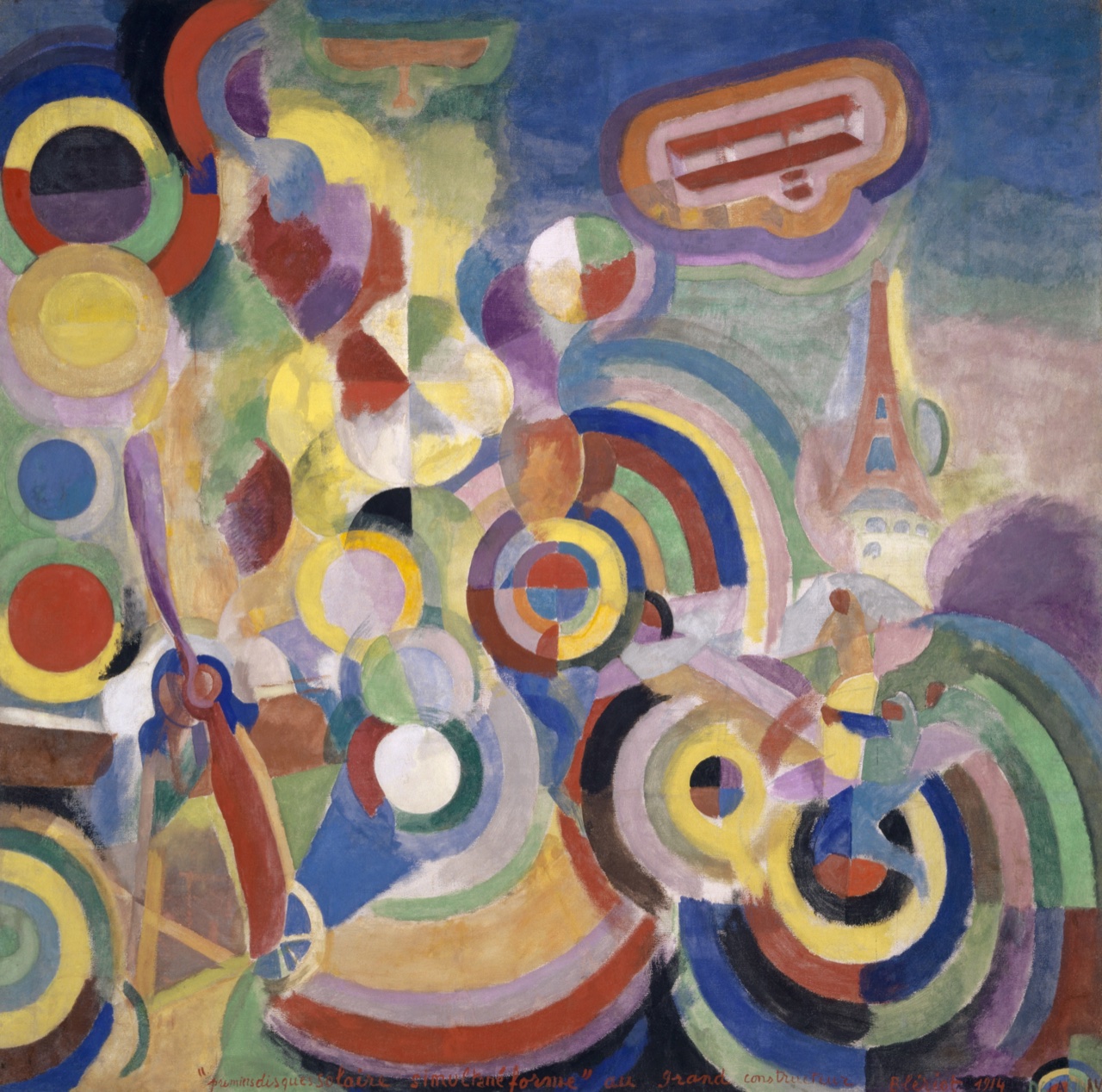
Robert Delaunay
Delaunay was one of the earliest completely nonrepresentational painters. This tempera on canvas of 1914 celebrates Louis Blériot, the aviation pioneer and constructor, in a composition typical of simultaneism: a biplane flies above the Eiffel Tower at the right, a propeller at the left, and Orphic solar disks and geometric shapes fill the canvas. It belongs to the Disks series, inspired by the colour theory of the chemist Michel Eugène Chevreul and the simultaneous contrast of colours. It is held by the Kunstmuseum Basel; another version is in the Museum of Grenoble.
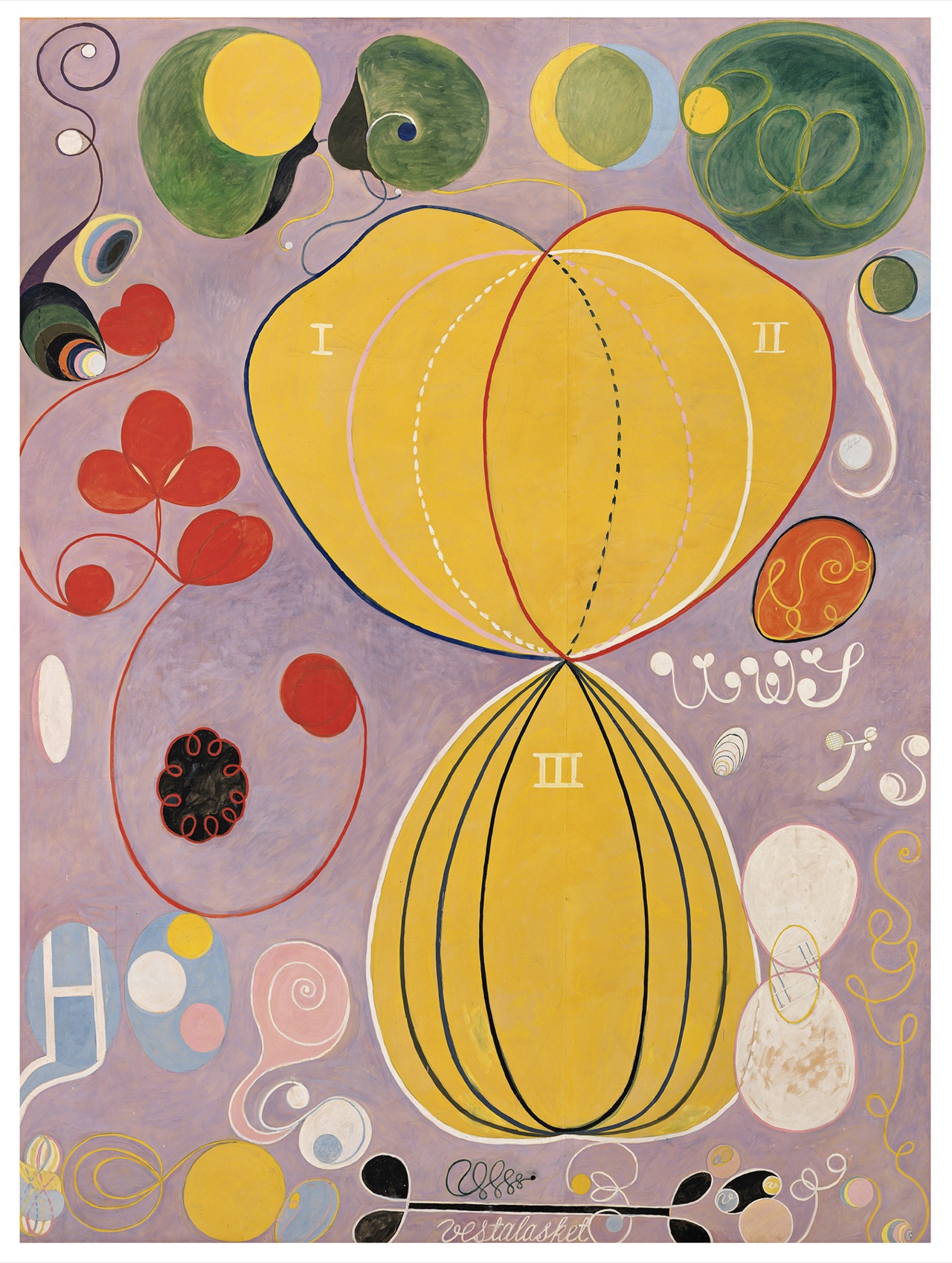
Hilma af Klint
Af Klint painted her first series of abstract paintings in 1906, at the age of 44. The Ten Largest, dated 1907, describes the stages of life from early childhood to old age; each of its major paintings measures about 240 × 320 cm. The collection of her abstract paintings, more than 1,200 of them, is owned and managed by the Hilma af Klint Foundation in Stockholm.
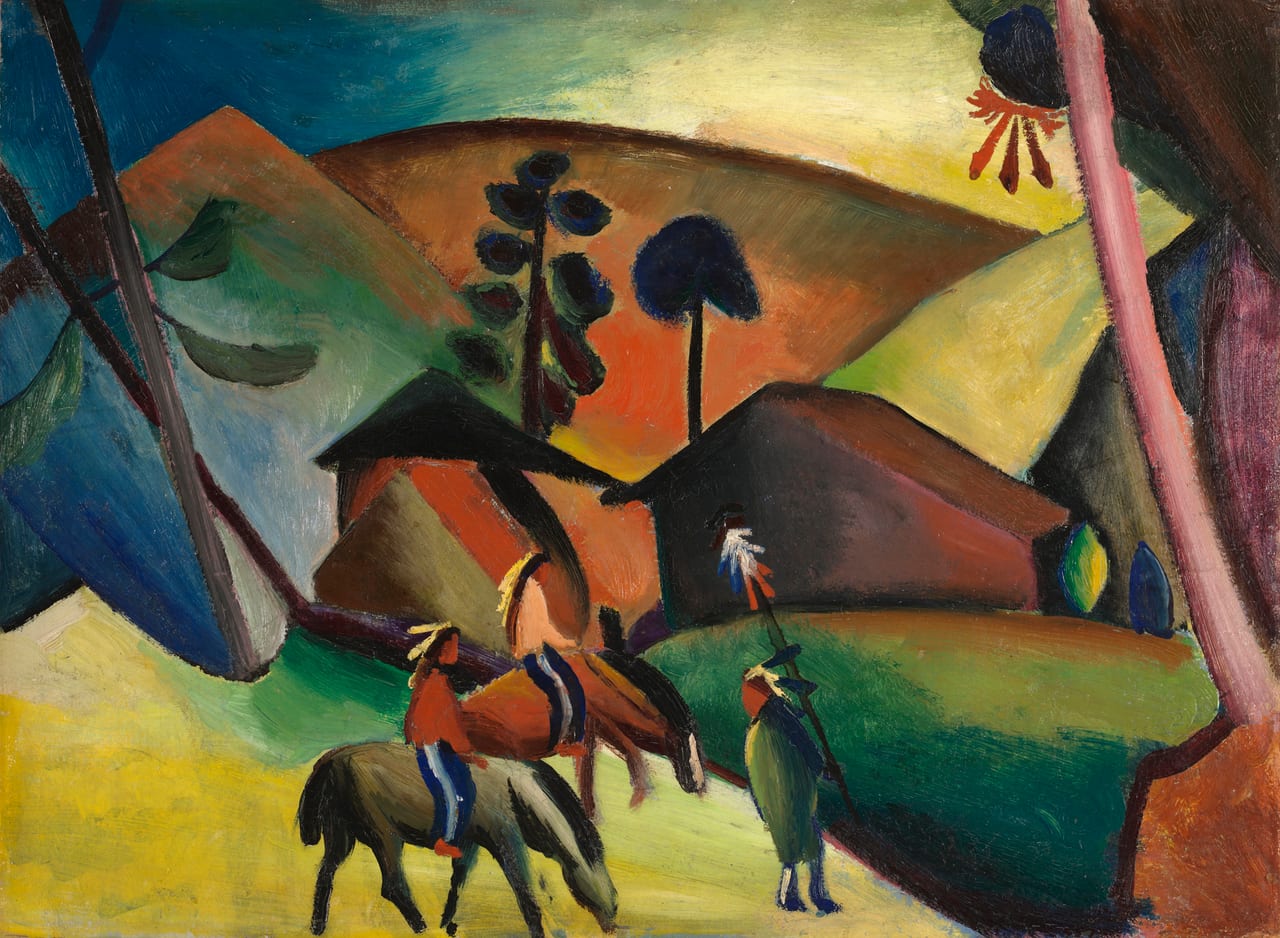
August Macke
Macke painted it in 1911, when he was under the influence of Cubism and had joined the Blue Rider through his friend Franz Marc. The landscape shows three people and two horses; behind them rise sharp, round mountains under a dark yellow sky, and huts stand in front of the mountains. The figures are Indians as Macke imagined them, two on horseback, the third holding a spear decked with blue, white and red feathers. The outlines are sharp while the colours run within the flat areas, as is typical of his painting, and here, for the first time, he took up Cubist influences, if in a moderate way. The Bernhard and Elly Koehler Foundation gave it to the Städtische Galerie im Lenbachhaus in Munich in 1965.
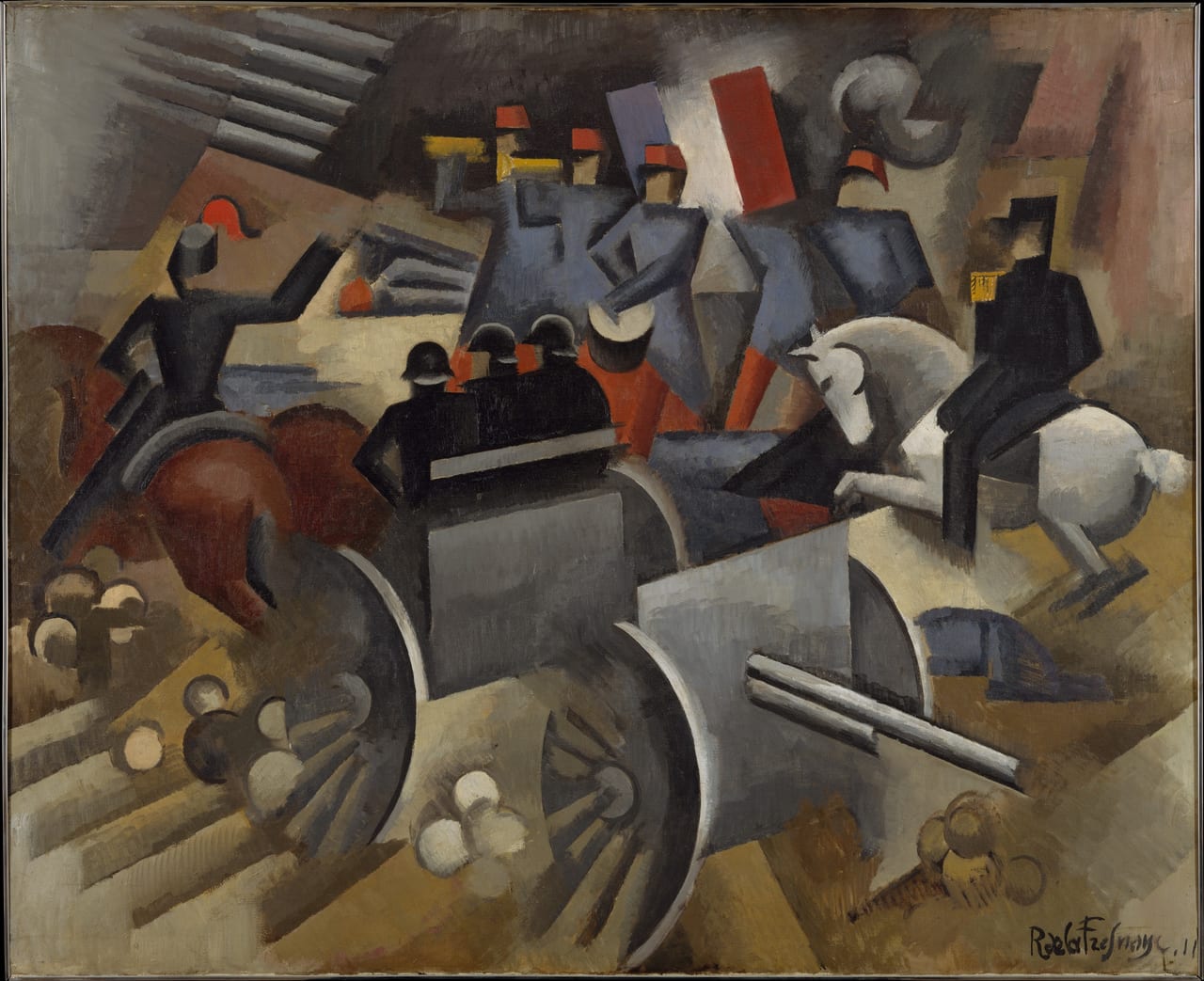
Roger de La Fresnaye
La Fresnaye joined lyrical colour to the geometric simplifications of Cubism. In 1911, on a journey to northern Italy, he began to bring more cuboid and abstract elements into his painting, and that year he painted Artillery, which shows French soldiers, artillerymen, an officer and a field gun under tow. In works such as The Conquest of the Air of 1913 his colourful prismatic shapes recall Orphism, yet unlike Delaunay’s abstract compositions his images are representational. The painting is in the Metropolitan Museum of Art in New York.
Artworks
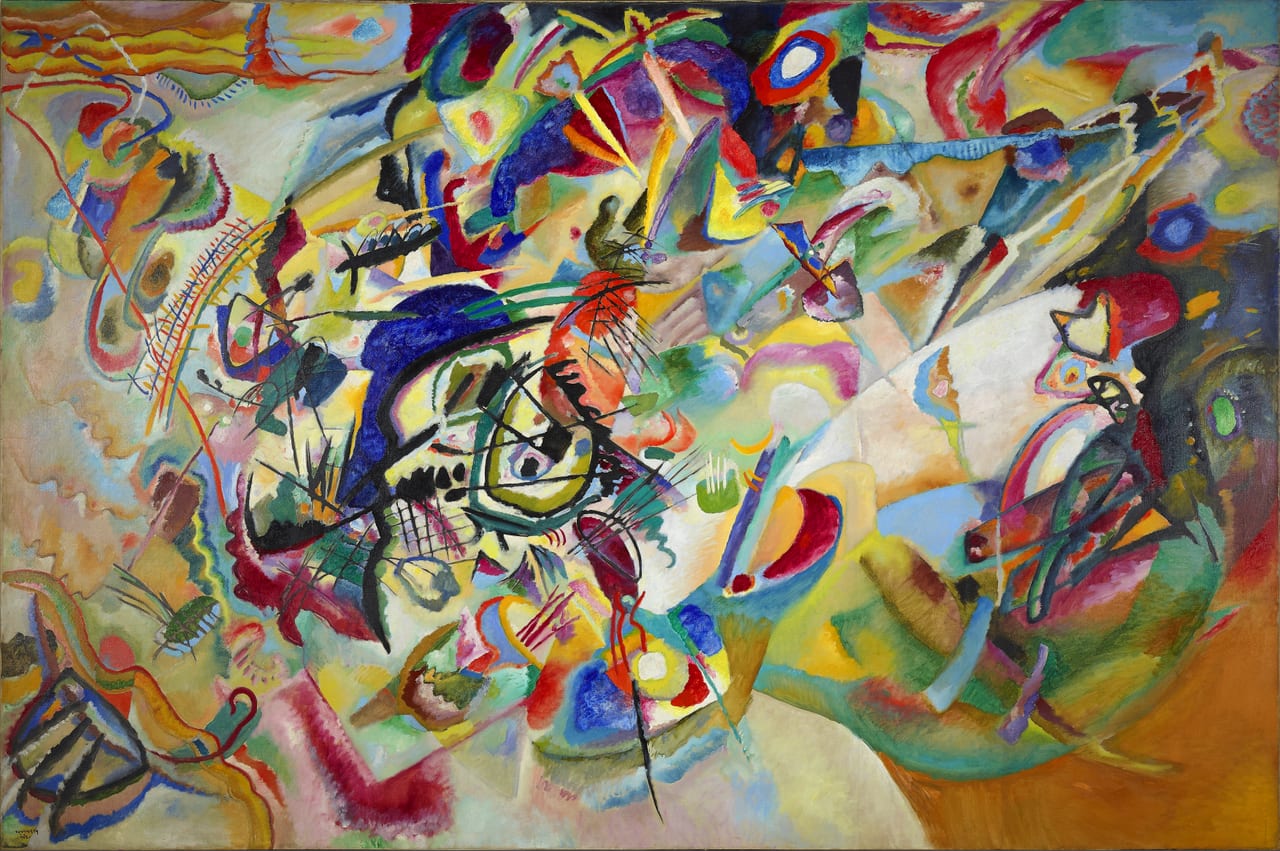
Composition VII
Wassily Kandinsky · 1913
Tretyakov Gallery
Kandinsky painted this abstract oil in 1913, and it belongs to the Tretyakov Gallery in Moscow. Art historians have concluded that it combines the themes of the Resurrection, the Last Judgement, the Flood and the Garden of Eden. The untitled watercolour known as First Abstract Watercolour can be regarded as a study for it. It shows traits of Cubism and Futurism, and it is similar to the abstract work of Hilma af Klint, Piet Mondrian, Robert Delaunay, František Kupka, Francis Picabia and Léopold Survage.
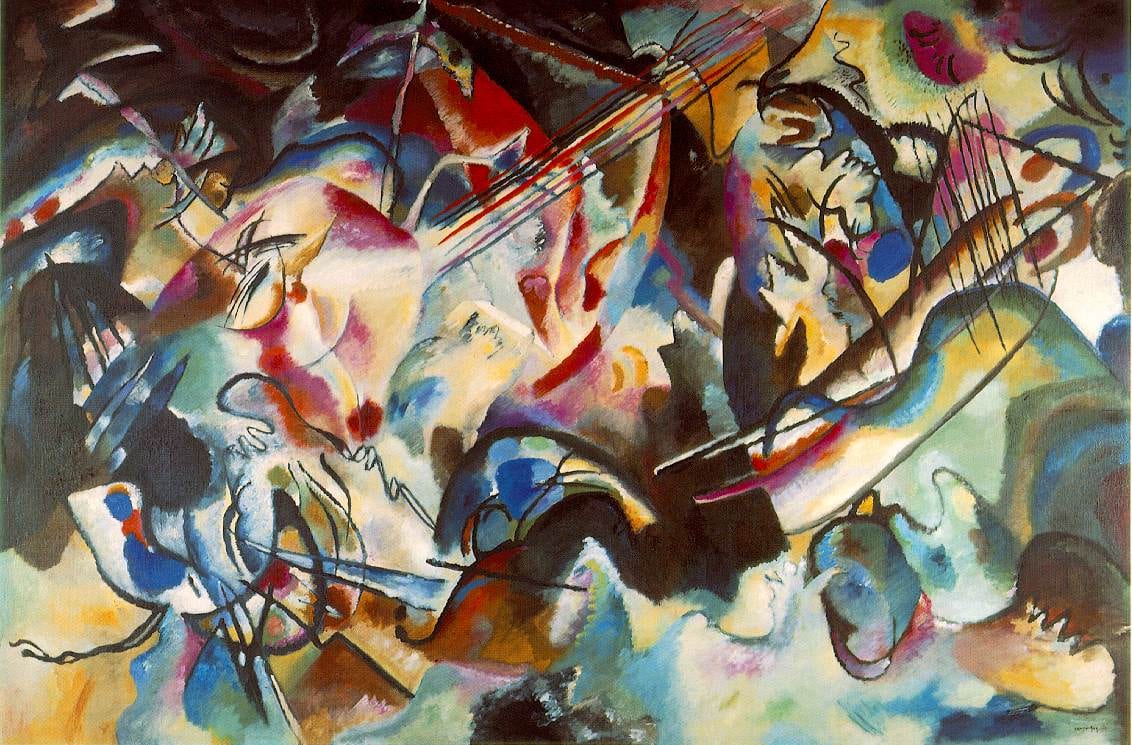
Composition VI
Wassily Kandinsky · 1913
Hermitage Museum
Kandinsky painted this large canvas in 1913, the result of 24 studies and eight months’ work; he wanted to depict a flood, a baptism, and destruction and rebirth. Gabriele Münter advised him to break free of his first outline and think of the German word Überflut (flood) and the sounds it suggested to him, and he finished the painting within three days. It was his main entry for the First German Autumn Salon, organised in Berlin in 1913 by Herwarth Walden, where Macke and Marc also showed. It has been in the Hermitage Museum in Saint Petersburg since 1948.
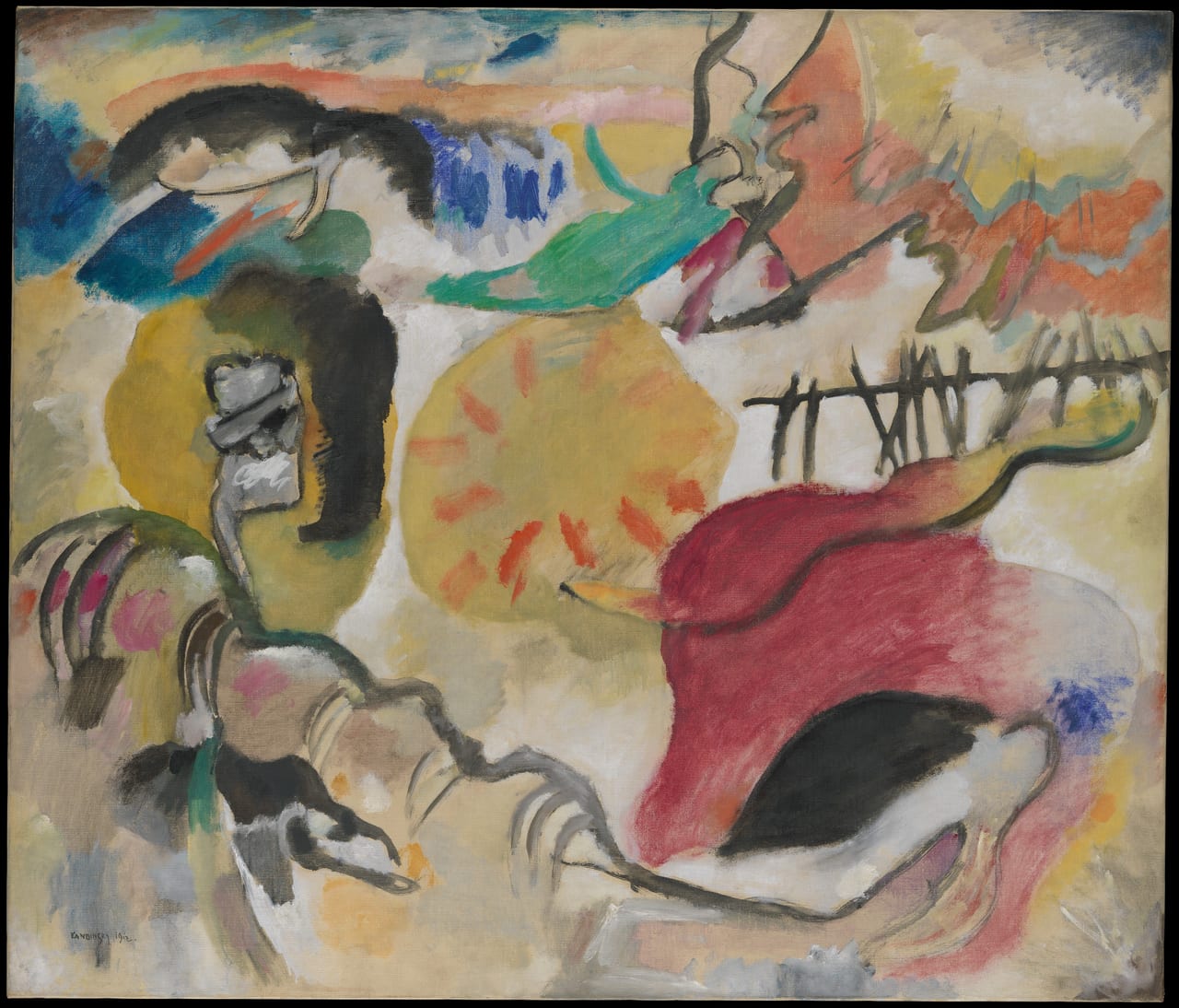
Improvisation 27 (Garden of Love II)
Wassily Kandinsky · 1912
Metropolitan Museum of Art
Kandinsky painted this oil on canvas, better known as Garden of Love II, in 1912. Everything seems to point to the biblical Garden of Eden as its main theme. At the centre a large yellow sun gives off red rays; it is the only clearly recognisable form, and around it are three couples, while the serpent of temptation, and perhaps a grazing horse and a sleeping dog, can hardly be made out. Kandinsky only suggests the human figures and animals, in the conviction that the idea of the garden of love could be expressed without explicit representation of the physical world. In 1913 it was his only work at the Armory Show in New York, where Alfred Stieglitz quickly acquired it for his private collection; it later entered the Metropolitan Museum of Art.
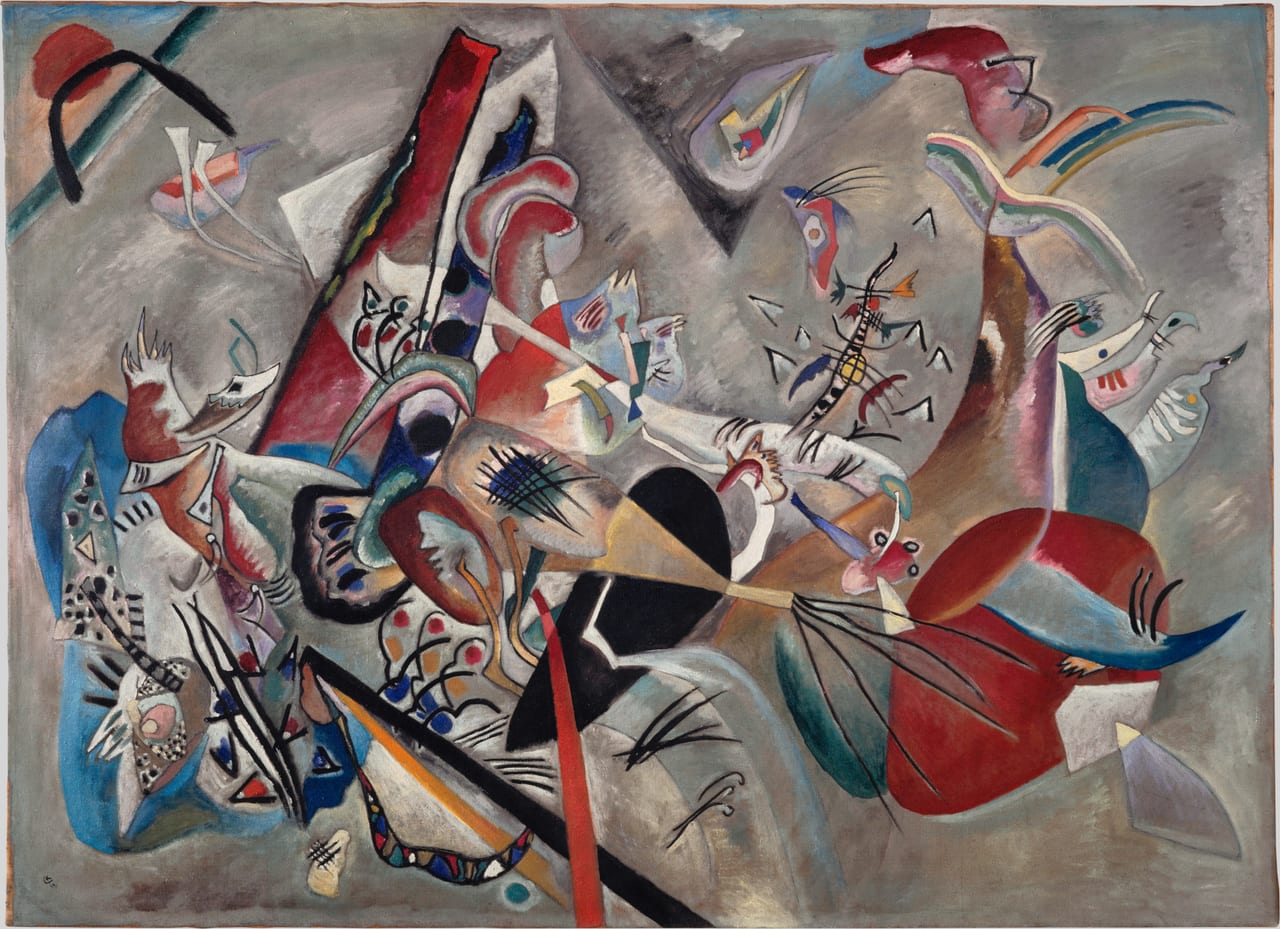
In Grey
Wassily Kandinsky · 1919
Musée National d'Art Moderne
Painted in 1919, it is among the last works of Kandinsky’s Russian period, made a short time before he settled in Germany, and he prepared it in several works on paper, a watercolour among them. Organic elements float on a ground of muted greys; more geometric forms would soon take their place. A motif in the top left corner accounts for the first title Kandinsky gave it, Painting with the Black Bow. In 1936 he wrote that it was the conclusion of his dramatic period, when he accumulated so many forms. Nina Kandinsky bequeathed it in 1981, and it is held by the Musée National d’Art Moderne in Paris.
Upward
Wassily Kandinsky · 1929
Peggy Guggenheim Collection
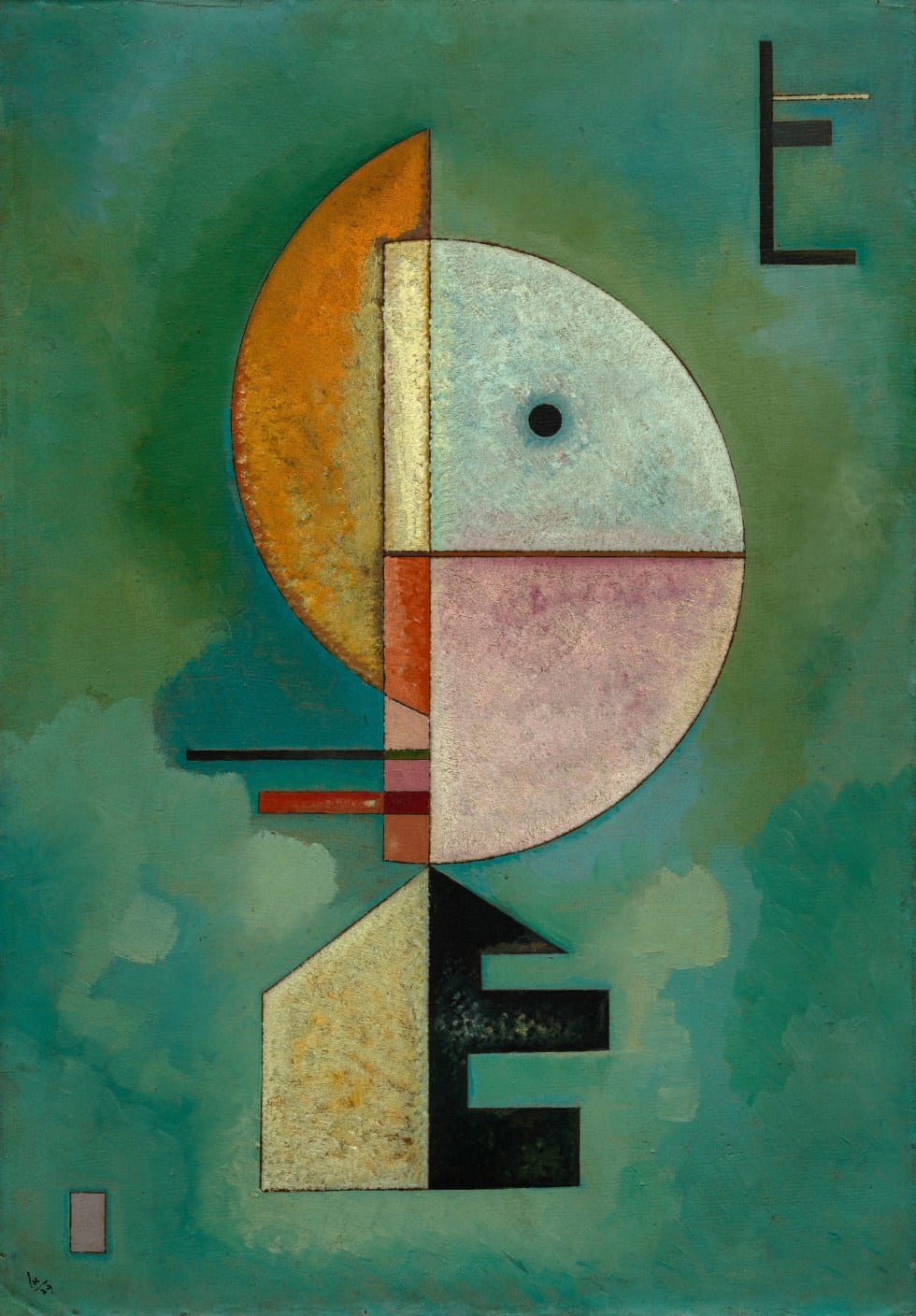
Kandinsky painted Upward in 1929, while he was teaching at the Bauhaus in Dessau. Geometric shapes and sections of circles, balanced on either side of a continuous vertical line, form a structure suspended in a field of rich turquoise and green, with an effect of energy rising upward. A design in the upper right corner resembles the letter E, as does the black cut-out shape at the base of the central motif; these forms may be at once independent designs and playful references to Empor, the painting’s German title. Its face-like character points to his association at the Dessau Bauhaus with Paul Klee and Alexej Jawlensky, his fellow members of the Blue Four. It is in the Peggy Guggenheim Collection in Venice.
Light and Colour (Goethe’s Theory)
J. M. W. Turner
Tate
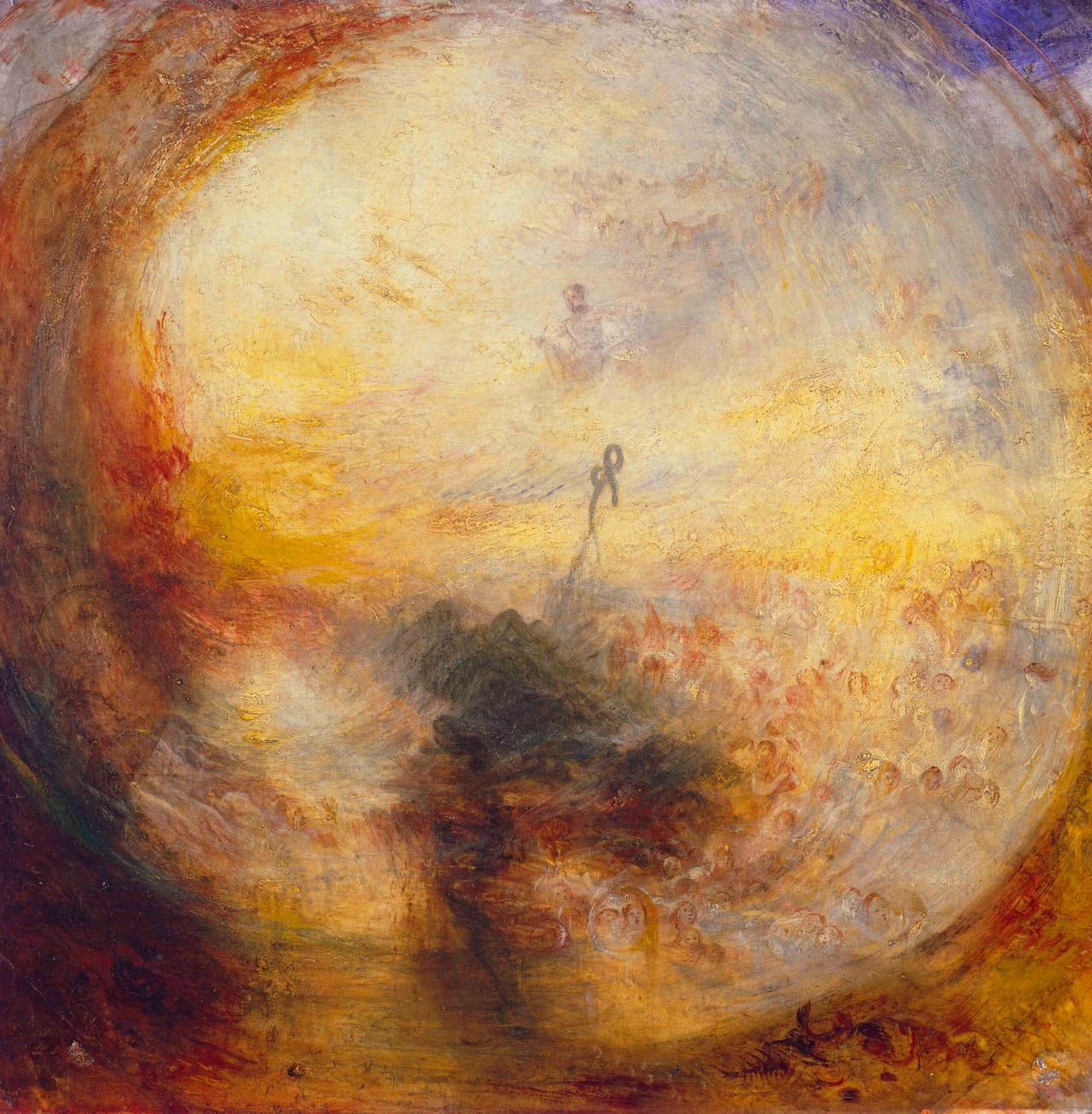
Turner made this painting in the later years of his career, and it was first shown at the Royal Academy exhibition of 1843, as was its companion, Shade and Darkness – The Evening of the Deluge. It shows the aftermath of the Flood told in the Book of Genesis. Its title names Goethe’s Theory of Colours, published in 1810, whose account of light and darkness Turner absorbed: the yellow refers to Goethe’s description of yellow as the first colour transmitted from light, and the circular form stands for the construction of the human eye. It was among the many works by Turner housed at Tate Britain in London.
Sources
- Britannica, “Abstract art”
- Tate, “Abstract art”
- Wikipedia, “Abstract art”
- Britannica, “J.M.W. Turner”
- Britannica, “Wassily Kandinsky”
- Wikipedia, “Wassily Kandinsky”
- Wikipedia, “Der Blaue Reiter”
- Britannica, “August Macke”
- Britannica, “Piet Mondrian”
- Tate, “De Stijl”
- Tate, “Neo-plasticism”
- Britannica, “Roger de La Fresnaye”
- Wikipedia, “Roger de La Fresnaye”
- Wikipedia, “Composition VII”
- Wikipedia, “Composition VI”
- Wikipedia (French), “Composition VI”
- Wikipedia (French), “Improvisation 27”
- Centre Pompidou, “Im Grau (Dans le gris)”
- Wikipedia (French), “Dans le gris”
- Peggy Guggenheim Collection, “Upward”
- Wikipedia, “Upward (Kandinsky)”
- Wikipedia (French), “Quelques Cercles”
- Wikipedia, “Indians on Horseback”
- Wikipedia, “Artillery (Roger de La Fresnaye)”
- Wikipedia, “Light and Colour (Goethe’s Theory)”
- Wikipedia (Russian), “Буря (картина Макке)”
- Wikipedia, “Black Square”
- Wikipedia (Russian), “Чёрный квадрат”
- Art Institute of Chicago, “Lozenge Composition with Yellow, Black, Blue, Red, and Gray”
- Wikipedia, “Homage to Blériot”
- Britannica, “Robert Delaunay”
- Wikipedia, “Hilma af Klint”
- The Storm — Public domain via Wikimedia Commons (Public domain)
- Several Circles — Public domain via Wikimedia Commons (Public domain)
- Black Square — Public domain via Wikimedia Commons (Public domain)
- Lozenge Composition with Yellow, Black, Blue, Red, and Gray — Public domain via Wikimedia Commons (Public domain)
- Homage to Blériot — Public domain via Wikimedia Commons (Public domain)
- The Ten Largest, No. 7, Adulthood — Public domain via Wikimedia Commons (Public domain)
- Indians on Horseback — Public domain via Wikimedia Commons (Public domain)
- Artillery — CC0 via Wikimedia Commons (CC0)
- Composition VII — Public domain via Wikimedia Commons (Public domain)
- Composition VI — Public domain via Wikimedia Commons (Public domain)
- Improvisation 27 (Garden of Love II) — CC0 via Wikimedia Commons (CC0)
- In Grey — Public domain via Wikimedia Commons (Public domain)
- Upward — Public domain via Wikimedia Commons (Public domain)
- Light and Colour (Goethe’s Theory) — Public domain via Wikimedia Commons (Public domain)
Invite Abstract art into your living room