The Kiss
Gustav Klimt

Art Nouveau
Brussels
Art Nouveau flourished across Europe and the United States between about 1890 and 1910, a deliberate attempt to make a new style, free of the imitative historicism that had ruled so much nineteenth-century art and design. Its mark is a long, sinuous, organic line, often shaped like flower stalks, vine tendrils or insect wings, and it was used most often in architecture, interior design, jewellery and glass, posters and illustration. The name was coined in Belgium and in Paris, and other countries had their own: Germany said Jugendstil, Austria Sezessionstil, Italy Stile Floreale or Stile Liberty, and Spain Modernismo. After 1910 it looked old-fashioned and was generally abandoned, until exhibitions in the 1960s helped to restore its standing.
A new art, under many names
In the last decades of the nineteenth century, many artists and designers felt a passionate urge to overturn the tired historicism of traditional architecture and design. The style emerged in several countries under different names, with traits that were distinctive yet broadly alike, and each country read the change of taste in its own way: through natural forms, flowers, leaves, animals and insects among them; through an emphasis on fluid line; through geometric shapes or asymmetrical compositions; and through the joining of structure and decoration. Brussels, Paris and Munich were its epicentres, but it can be seen as a thoroughly international movement.
In the 1880s the Belgian journal L’Art Moderne used the term Art Nouveau for the work of Les Vingt, a group of twenty painters and sculptors who sought reform through art and argued for dissolving the boundary between painting and sculpture and the so-called lesser decorative arts. The term’s popularity is said to stem from the Maison de l’Art Nouveau, the gallery that the influential dealer Siegfried Bing opened in Paris in 1895. In France the style was also called Art fin de siècle, Art belle époque, Style Jules Verne and Le Style Métro, and even Le Style nouille, ‘noodle style’, or Le Style moderne. In Germany it was Jugendstil, ‘youth style’, which the Munich magazine Die Jugend, founded in 1896, popularised; in Austria, Sezessionstil; in Italy, Arte Nuova, Stile Floreale or Stile Liberty, after the London store Liberty & Co.; in Spain, Modernismo; and in America, the Tiffany style, for its link with the glassmaker and jeweller Louis Comfort Tiffany.
In England its immediate forerunners were the Aestheticism of the illustrator Aubrey Beardsley, who leaned heavily on the expressive power of organic line, and William Morris’s Arts and Crafts movement, which made a vital style in the applied arts a matter of importance. On the Continent it drew on the experiments with expressive line of the painters Paul Gauguin and Henri de Toulouse-Lautrec, and in part on a vogue for the linear patterns of Japanese prints. Women became its dominant theme. Overt erotic imagery reached mainstream Art Nouveau from the writings of the Symbolists and the Decadents, from shunga, the erotic Japanese prints, from classical vase decoration and Rococo prints, and, more and more as the century went on, from photographic and literary pornography; many of its artists owned shunga, Beardsley and the painter Gustav Klimt among them.
The style’s distinguishing mark is an undulating, asymmetrical line, often shaped like flower stalks and buds, vine tendrils or insect wings, which may be elegant and graceful or charged with a powerfully rhythmic, whiplike force. In the graphic arts that line subordinates form, texture, space and colour to its own decorative effect. In architecture the whole form is engulfed in its organic rhythm, so that structure and ornament fuse, an approach directly opposed to architecture’s traditional values of reason and clarity of structure. Much of Art Nouveau has come to be defined by one motif, the whiplash, an ornamental S-curve that writhes and coils, derived from studies of the natural world, deep-sea organisms and botanical gardens among them; its sinuous, flowing line is considered a metaphor for artistic freedom.
Iron, glass and jewels
The first Art Nouveau town houses went up in Brussels almost at the same time: Paul Hankar’s house of 1893 and Victor Horta’s Hôtel Tassel of 1892–93, one of the style’s landmarks. Horta had trained as an assistant to Alphonse Balat, architect to King Leopold II, on the monumental iron and glass Royal Greenhouses of Laeken. He wanted a fully integrated environment and designed everything from the framework down to the door handles; stairs, lamps, beams of cast iron and mosaic floors all received a flourish of vine-like tangles. Henry van de Velde, who idolised William Morris and the theories of the Arts and Crafts movement, wrote about the new style in Belgian, German and French periodicals, and in Paris he designed furniture and decoration for Bing.
Hector Guimard came to see the Hôtel Tassel while it was being built, and later declared Horta the “inventor” of Art Nouveau. In Paris, between 1895 and 1898, he built the Castel Béranger, one of the city’s first buildings in the new style and a curious blend of Neo-Gothic and Art Nouveau. Iron was a relatively new building material in the second half of the nineteenth century, and Horta and Guimard broke with tradition by moulding pillars, beams, banisters and grilles, inside and out, into curving, organic forms. Guimard is best known for his metalwork, especially the entrance arches of the new Paris Métro, which brought the style to the attention of the millions who visited the city’s Exposition Universelle of 1900.
The Exposition Universelle of 1900 marked the high point of Art Nouveau and carried it to the world at large, its displays ranging from Émile Gallé’s elegant glassware to the graceful work of the cabinet-maker Louis Majorelle. Gallé, of the École de Nancy, was a master of glass, and his background in botany and his interest in Japanese design together governed his art. Louis Comfort Tiffany, an American maker of luxury objects from stained glass to jewellery, worked out with Arthur Nash, a glassmaker from Stourbridge in England, a way of blending colours of glass while it was molten, and called the blown glass of his furnaces Favrile. René Lalique, Art Nouveau’s most important jeweller, built a new language on sinuous readings of natural forms and championed materials that were not precious, such as enamel, glass and horn. In jewellery the style reached its peak around 1900, when it triumphed at the Paris exposition.
Elsewhere the style took other shapes. The Scottish architect and designer Charles Rennie Mackintosh specialised in a mainly geometric line and influenced the Austrian Sezessionstil in particular. In Spain the architect Antoni Gaudí, perhaps the most original artist of the movement, moved beyond line to turn buildings into curving, bulbous, brightly coloured organic constructions; in the United States Louis Sullivan decorated buildings of traditional structure with plantlike Art Nouveau ironwork. It was a luxury style: it needed expert, highly paid craftsmen and could not be mass-produced easily or cheaply. The pictures here are its paintings and prints, with two of Guimard’s own designs for building.
The poster on the street
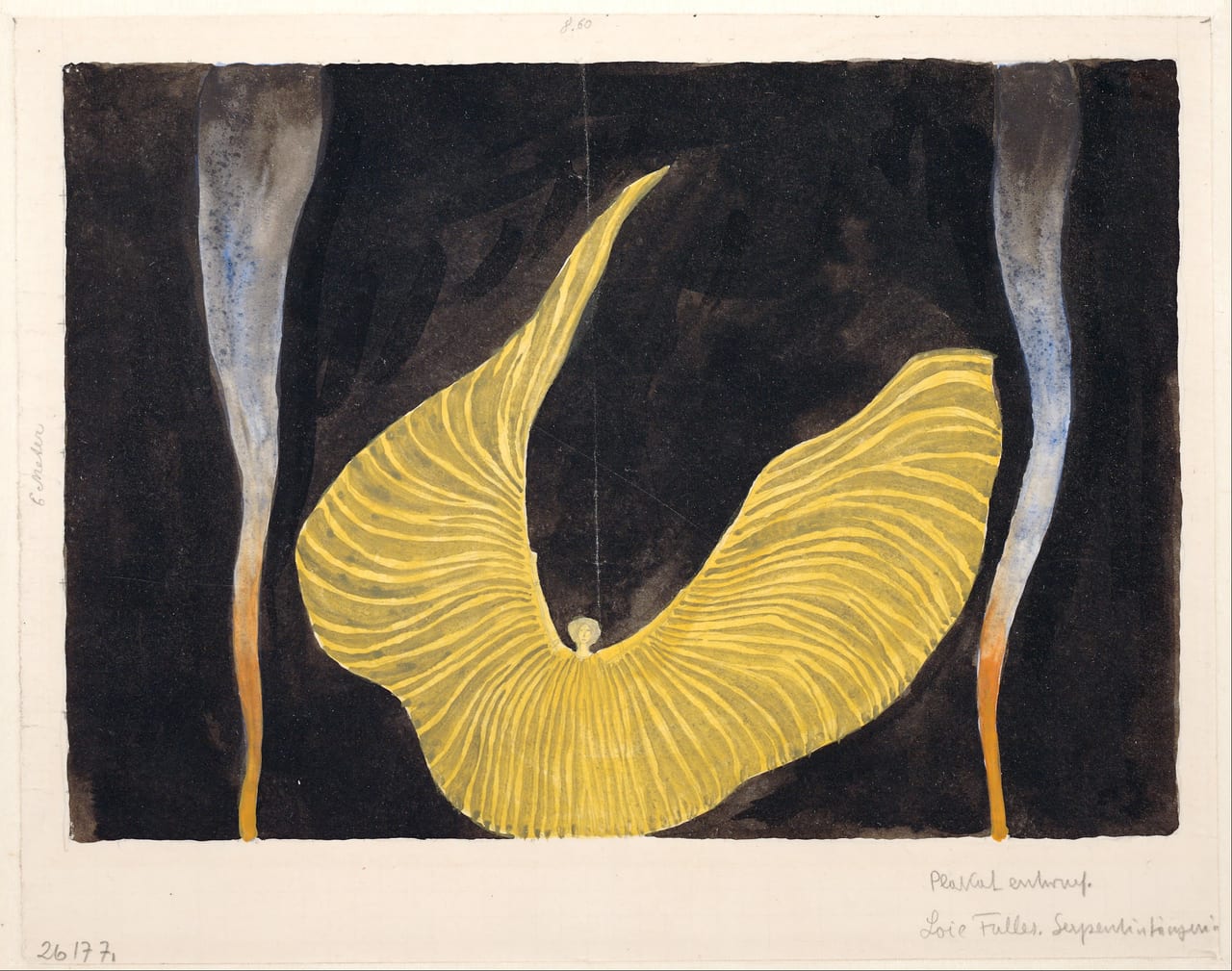
Colour lithography and colour printing made posters and graphic art an important vehicle for the style, carrying it to a vast audience in Europe, the United States and beyond. Jules Chéret, who has been called the father of the modern poster, is credited with the first colour lithograph posters, in 1866: he broke a design down into its colours, drew each on a separate stone and laid them over one another in printing. His posters had a lightness and a sense of movement that captured the imagination of the public. With Chéret’s posters for the dancer Loïe Fuller in 1893, and Alphonse Mucha’s for the actress Sarah Bernhardt in 1895, the poster was no longer advertising alone but an art form.
Mucha, a Czech painter and illustrator who studied art in Prague, Munich and Paris in the 1880s, arrived in Paris in 1888, and in 1895 he made a poster for Bernhardt in Victorien Sardou’s play Gismonda at the Théâtre de la Renaissance. It was an overnight sensation: collectors prized it at once for its exotic, romantic vision of Bernhardt, its subtle pastels and the novelty of its narrow format, and many copies were stripped from the hoardings to hang in private homes. Mucha went on to design posters for each of Bernhardt’s following plays, as well as programmes, sets, costumes and jewellery for her, and the success of those posters brought him advertising work, for JOB cigarette papers, champagne, biscuits, chocolate, beer and bicycles among others. His posters show a fascination with the sensuous side of female beauty, with luxuriantly flowing hair, heavy-lidded eyes and full lips. Although Mucha resisted the label of Art Nouveau artist, his characteristic women became an ever-present and much-copied leitmotif.
Eugène Grasset, a Swiss decorative artist who worked in Paris, was one of the first makers of French Art Nouveau posters. An admirer of Japanese art, he made a celebrated poster of Sarah Bernhardt in 1890, and in 1896 he published a book suggesting Art Nouveau designs based on flowers and plants. Théophile-Alexandre Steinlen, also Swiss-born, was another important early figure, whose work focused more on ordinary people, on life in Montmartre and on political causes; he illustrated socialist and anarchist papers as well as making cabaret posters, and in 1896 he made a famous one for Le Chat Noir. The Belgian Henri Privat-Livemont was regarded as a Symbolist but became better known for his Art Nouveau posters, most famously the one for the Brussels International Exposition of 1897, the fair that brought the style international attention.
In the Netherlands Jan Toorop, who had joined Les Vingt in Brussels, developed a Symbolist style of dynamic, unpredictable lines drawn from Javanese motifs and of highly stylised, willowy figures; his work leaned towards mysticism and symbolism even in his posters for salad oil. In Britain the style’s leading graphic artist was Aubrey Beardsley. At only 21 he rocketed to fame with his drawings for Oscar Wilde’s play Salome, “commonly held to be the first works in a British Art Nouveau style”, and in 1894 he became art editor and illustrator of a new quarterly, The Yellow Book. What startled critics and public alike was the obvious sensuality of the women he drew. He died of tuberculosis at 25. In the United States, the poster artists William H. Bradley and Edward Penfield were both much inspired by his clean, sinuous lines.
Vienna, Barcelona and after
In Austria the style was first popularised by the artists of the Vienna Secession, founded in April 1897 by a group that included Gustav Klimt, Koloman Moser, Josef Hoffmann and Josef Maria Olbrich; Klimt became its president. The Secessionists rejected the conservative academic establishment and favoured a highly ornamental Art Nouveau style. Olbrich’s Secession Building, completed in 1898, bears above its entrance the motto “To Every Age, Its Art. To Every Art, Its Freedom.” In their exhibition posters, and in the layouts and illustrations of their magazine, Ver Sacrum, the members pushed graphic design in uncharted directions, and Moser was the magazine’s lead designer. In 1903 he and Hoffmann founded the Wiener Werkstätte, the Vienna Workshops. Austrian Art Nouveau joins geometric precision, influenced by Mackintosh and the Scottish school, with curving, expressive lines.
Klimt, born in 1862, studied at the Vienna School of Decorative Arts, and his early work had the classical style typical of late nineteenth-century academic painting. Three allegorical murals he painted for the ceiling of the University of Vienna’s auditorium were violently criticised; their erotic symbolism and pessimism caused such a scandal that they were removed. In the early years of the Secession Klimt began to work gold leaf into his paintings, which came to mark the start of his so-called “Golden Phase”, and trips to Venice and Ravenna, both famous for their mosaics, most likely inspired his gold technique. In The Kiss and in his portraits of fashionable Viennese patrons he painted the figure without shadow, surrounded by flat, highly ornamental areas of decoration. Of the Secession painters he became the best known, often erasing the border between fine art and decorative painting, and his mural for the dining room of the Stoclet Palace in Brussels, part of Josef Hoffmann’s decorative scheme for the house, is considered a masterpiece of late Art Nouveau.
In Barcelona the Catalan modernist painters, Ramon Casas and Santiago Rusiñol among them, close to the Paris avant-garde and hugely influenced by Gaudí, met at the tavern Els Quatre Gats, a bar modelled on Le Chat Noir in Paris; Casas’s posters and postcards helped to define the movement known as Modernisme. In Moscow and Saint Petersburg a very colourful Russian variation appeared in 1898 with the journal The World of Art, published by the artists Alexandre Benois and Léon Bakst with Sergei Diaghilev as chief editor. Its most influential contribution was the Ballets Russes, a new ballet company led by Diaghilev, for which Bakst and Benois designed sets and costumes.
After 1910 Art Nouveau seemed old-fashioned and limited, and as a distinct decorative style it was generally abandoned; by the outbreak of the First World War in 1914 it was largely exhausted, and in the 1920s Art Deco and then modernism replaced it as the dominant style in architecture and decoration, and from the early 1920s it suffered a long purgatory. The erotic content of so many of its objects was undoubtedly one factor in its demise; functionality and technical progress now came to stand for modernity. The style was rehabilitated in the 1960s, in part through major exhibitions at the Museum of Modern Art in New York in 1959 and at the Musée National d’Art Moderne in 1960 and a large retrospective of Beardsley in London in 1966; in France the internationally known collector and art dealer Antonin Rispal played a decisive role in its rediscovery. In popular culture its flowery organic lines came back as a psychedelic style in fashion, in the lettering of rock and pop album covers and in advertising.
Artists
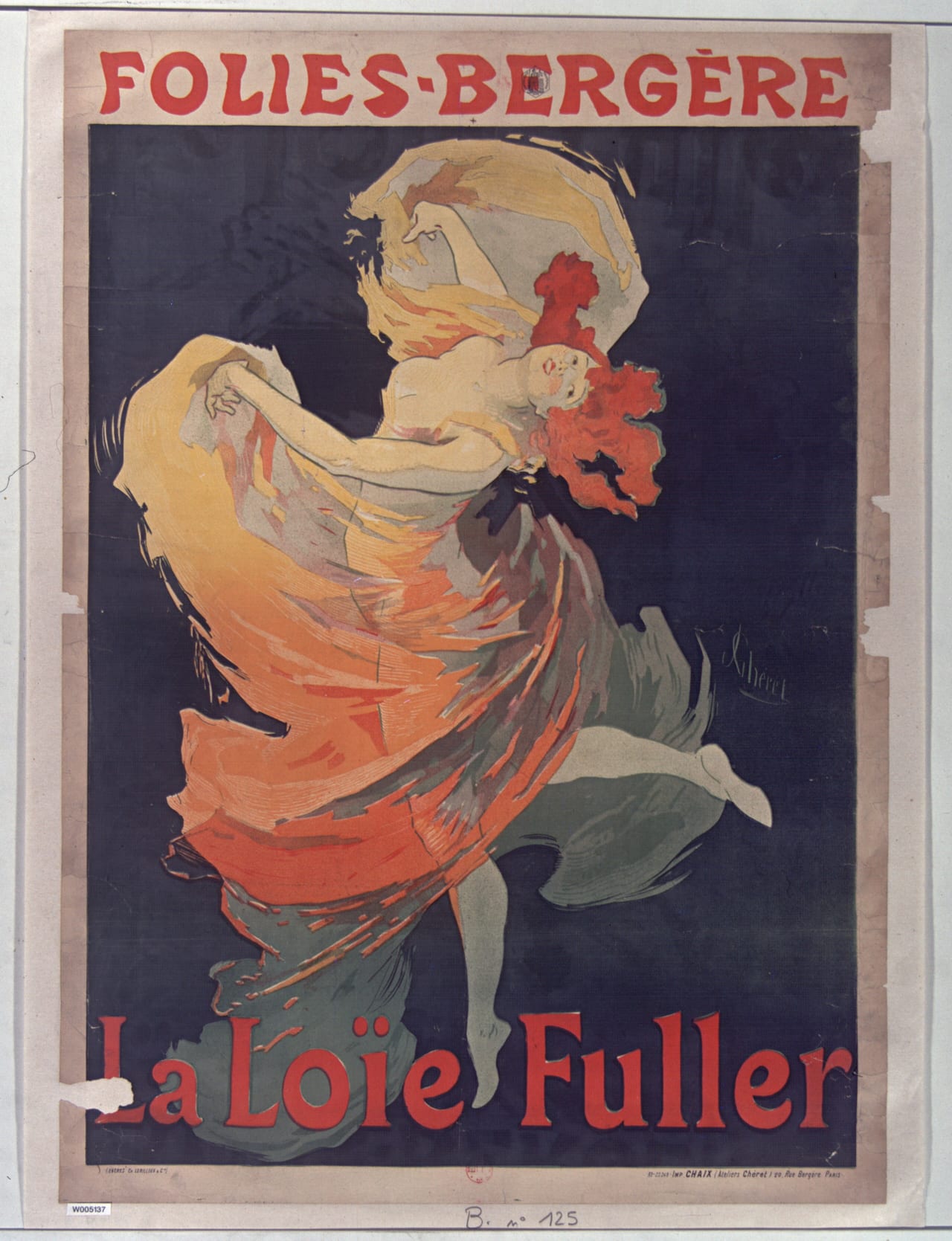
Jules Chéret
Chéret, like Georges de Feure and Toulouse-Lautrec, made posters for the theatres, cafés, dance halls and cabarets of Paris. His posters of 1893 for the dancer Loïe Fuller, followed by Mucha’s for Sarah Bernhardt in 1895, turned the poster from advertising alone into an art form.
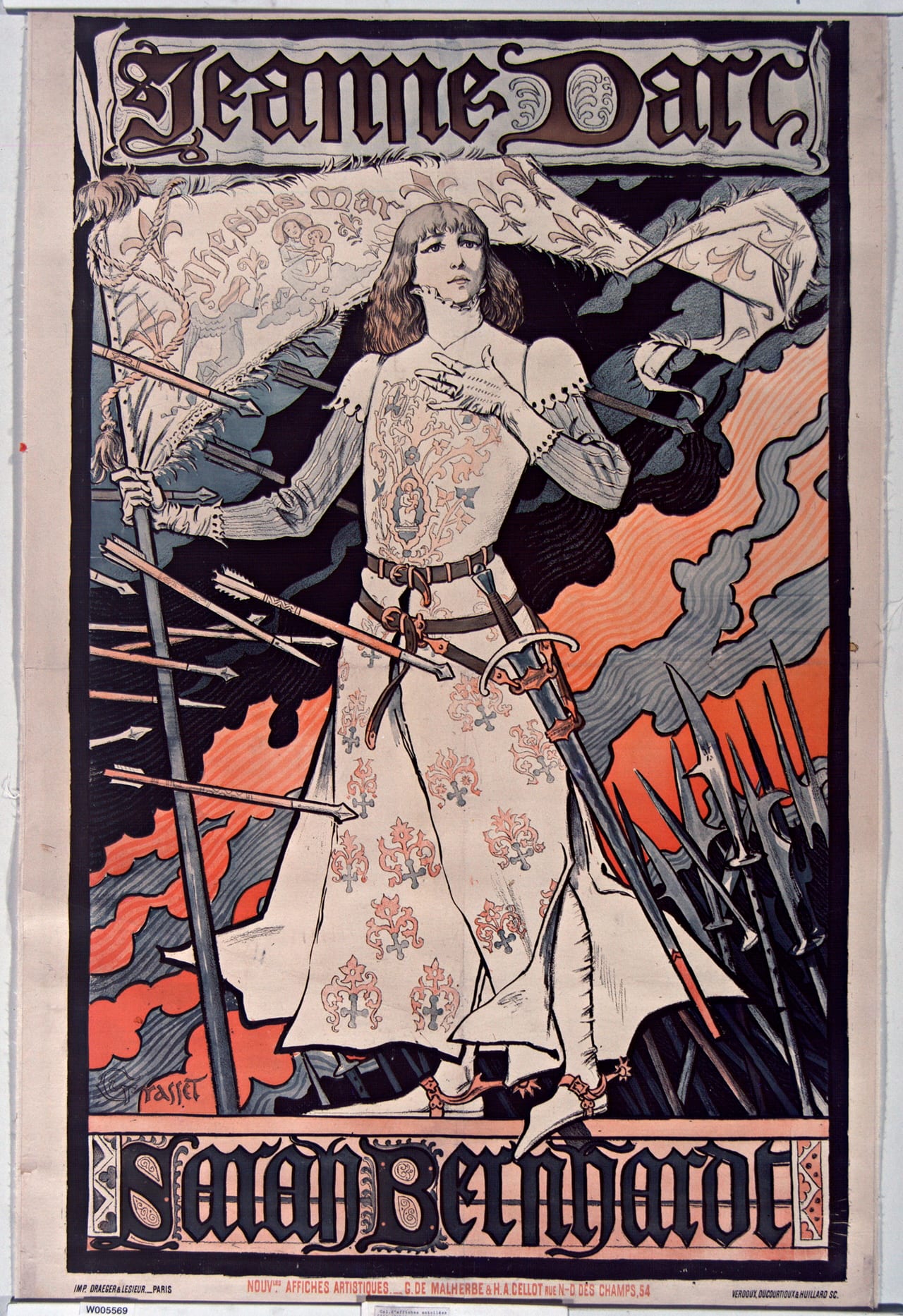
Eugène Grasset
Grasset, a Swiss decorative artist who worked in Paris, is considered a pioneer of Art Nouveau design. He admired Japanese art, which influenced some of his designs, and poster art quickly became his forte; his lithograph Jeanne d’Arc, Sarah Bernhardt was among the works taken into Les Maîtres de l’Affiche.
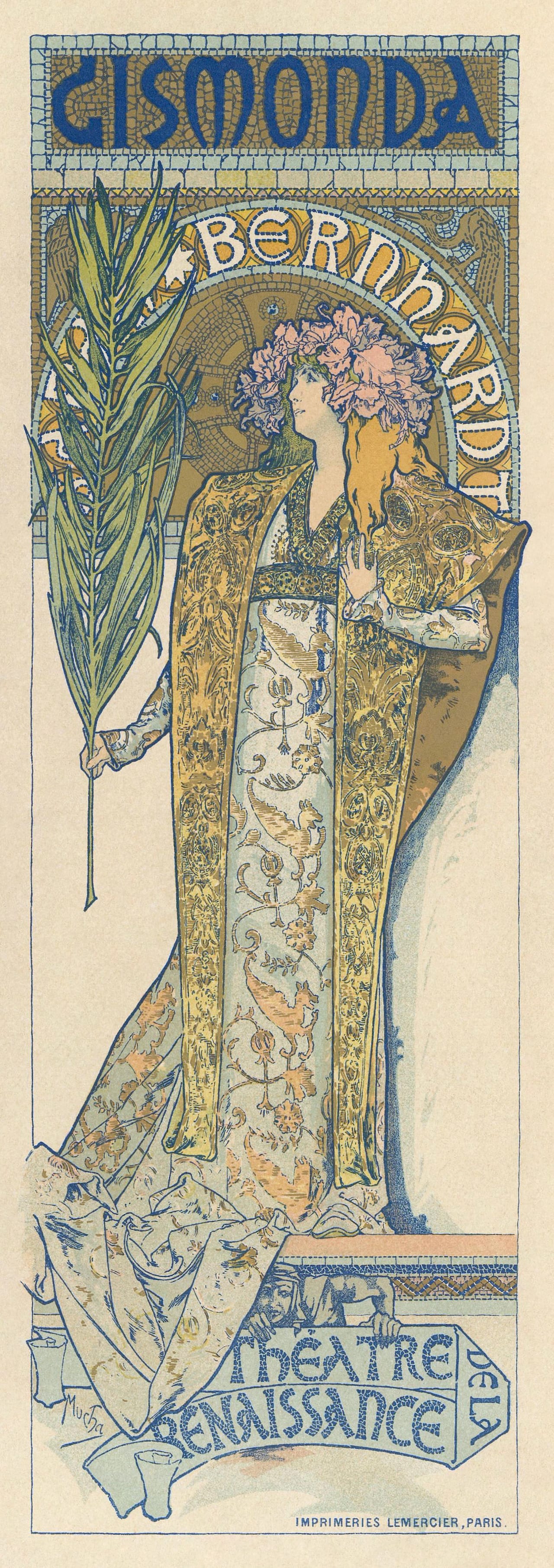
Alphonse Mucha
Mucha’s poster was made to promote the new production of Victorien Sardou’s four-act play Gismonda, which opened on 4 January 1895 at the Théâtre de la Renaissance in Paris, with Sarah Bernhardt as both director and actor. He showed her life-size on an arched platform as an exotic Byzantine noblewoman, in a splendid gown and orchid headdress with a palm branch in her hand, the costume of the last act. Bernhardt was delighted, and kept using the poster for her American tour in 1896.
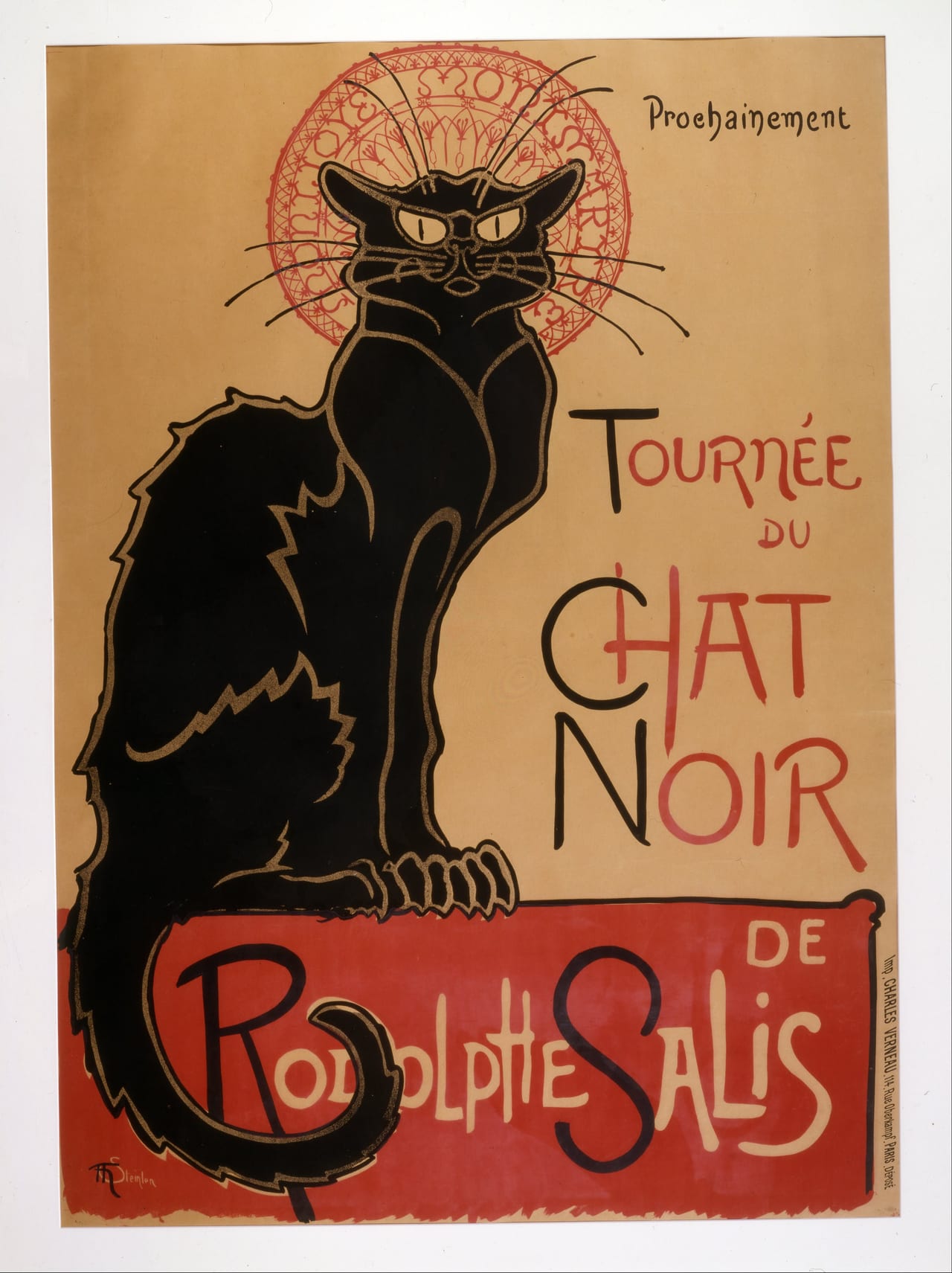
Théophile-Alexandre Steinlen
Le Chat Noir, an entertainment house in the bohemian Montmartre district of Paris, was the subject of an iconic poster by Steinlen in 1896. The spread of shows of this kind succeeded because of his poster for a shadow-theatre tour from the cabaret, “la tournée du Chat Noir avec Rodolphe Salis”.
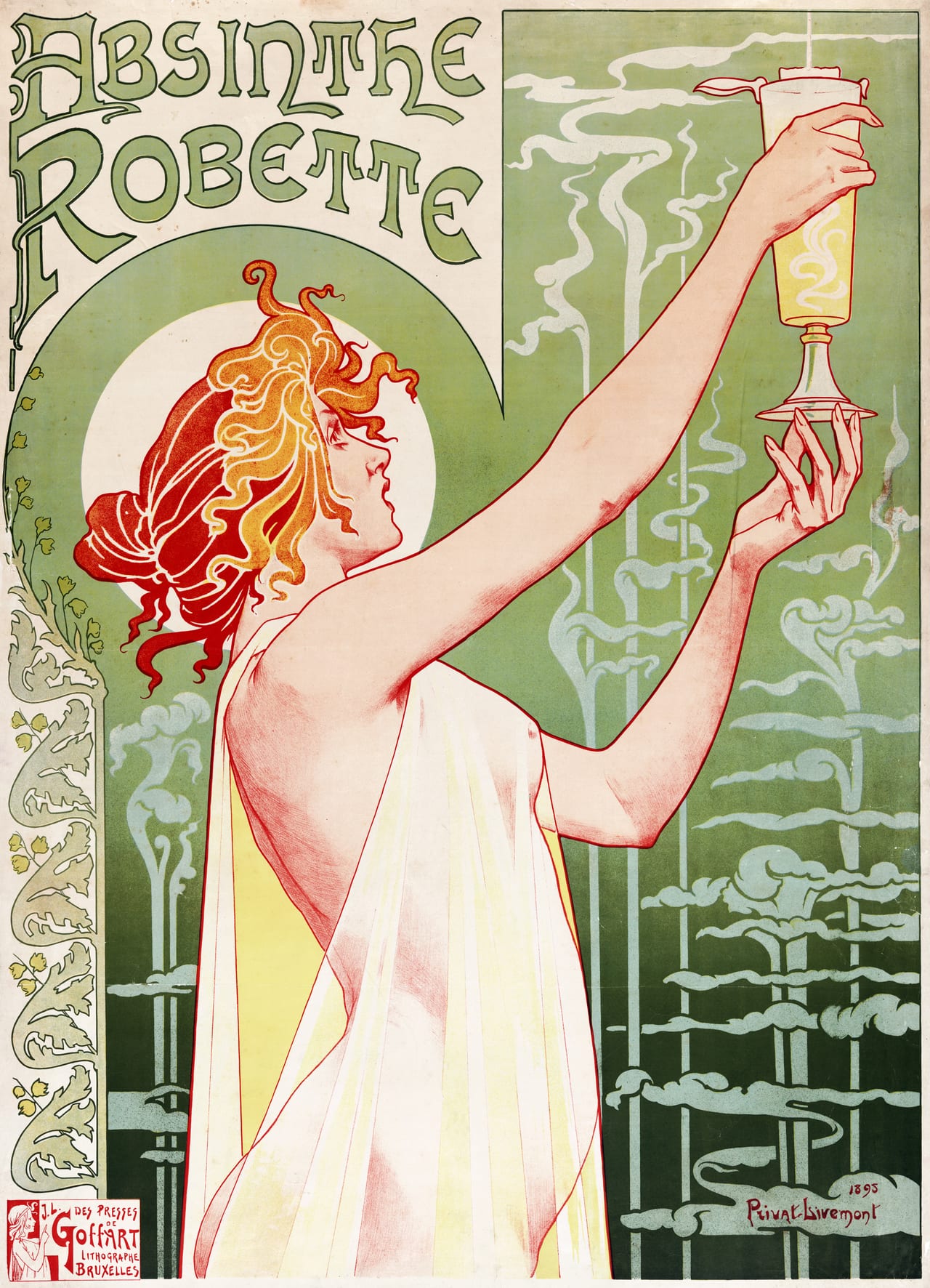
Henri Privat-Livemont
Privat Antoine Théodore Livemont, who sometimes worked as T. Privat-Livemont, was a Belgian Symbolist painter and Art Nouveau decorator. From 1883 to 1889 he worked and studied in Paris, in the studio of Lavastre and Duvignaud among others, which painted scenery for the Comédie Française and the Opéra Garnier. He became better known for his Art Nouveau posters than as a Symbolist, and this one, for Absinthe Robette, was one of two of his posters published in Les Maîtres de l’Affiche.
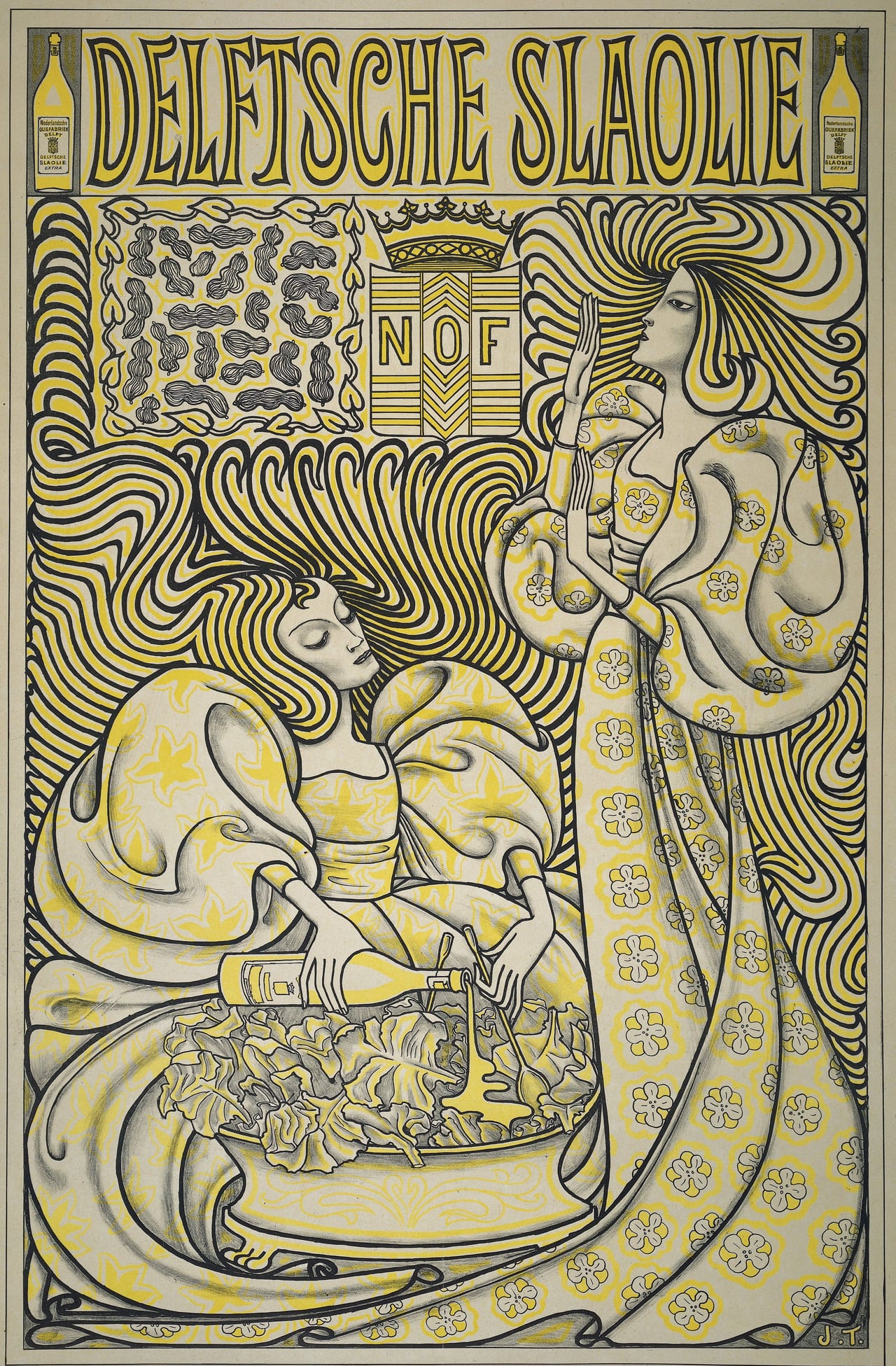
Jan Toorop
The Nederlandsche Oliefabriek, an oil manufacturer in Delft, commissioned this poster. Two women with wavy hair and billowing draperies fill most of it, one of them dressing a salad, and their emphatic contours draw the eye away from what it advertises, the salad oil. It became an icon, and gave Dutch Art Nouveau its nickname, the ‘salad oil style’.
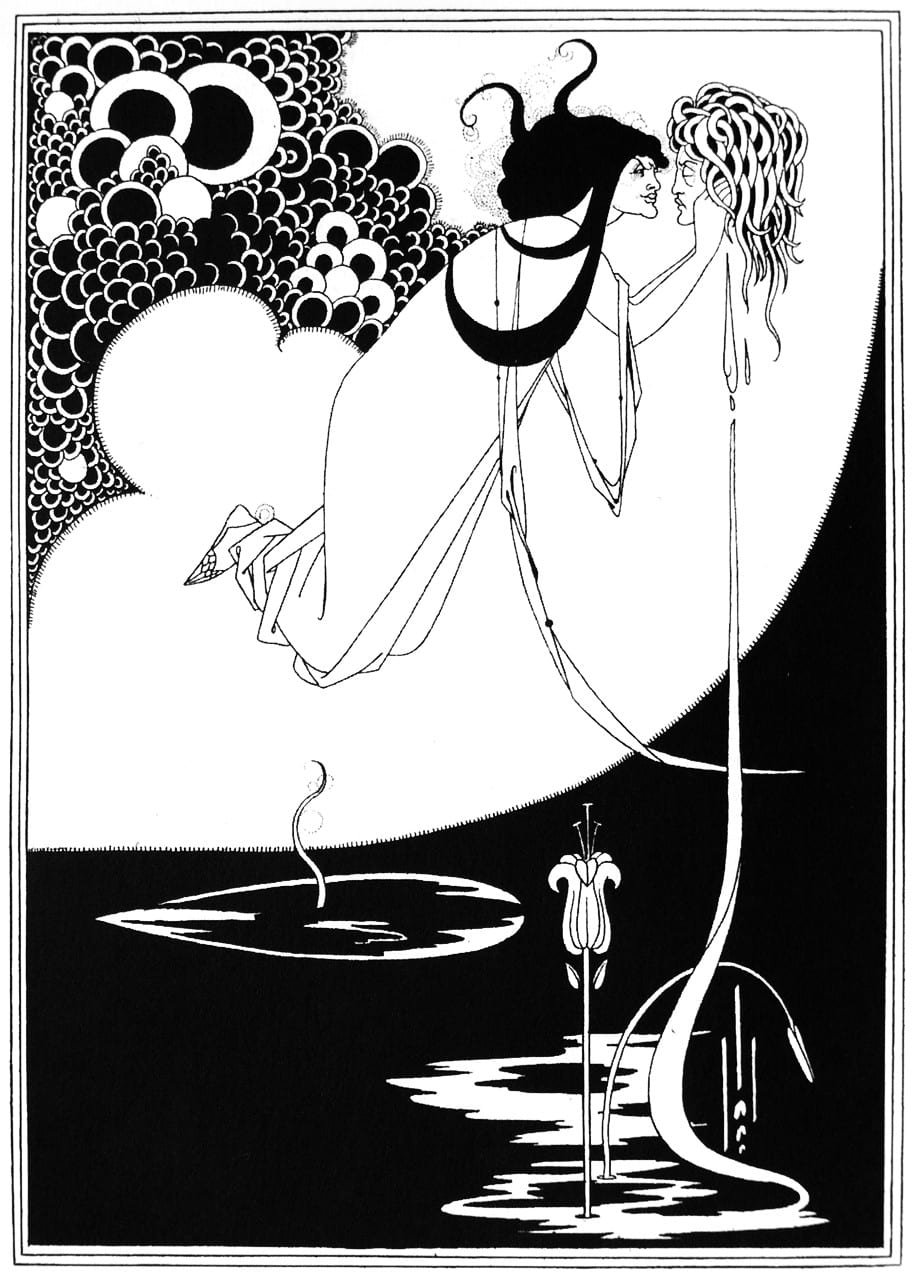
Aubrey Beardsley
A scene from Oscar Wilde’s play Salome: Salome holds the severed head of John the Baptist in her hands, having just kissed it, her hair billowing above her in snake-like tendrils, and blood dripping from the head feeds a lily. The Studio owned the copyright of Beardsley’s first version, J’ai baisé ta bouche Iokanaan, so he redrew it; first published in 1894, The Climax is drawn in strong, precise lines and black ink alone.
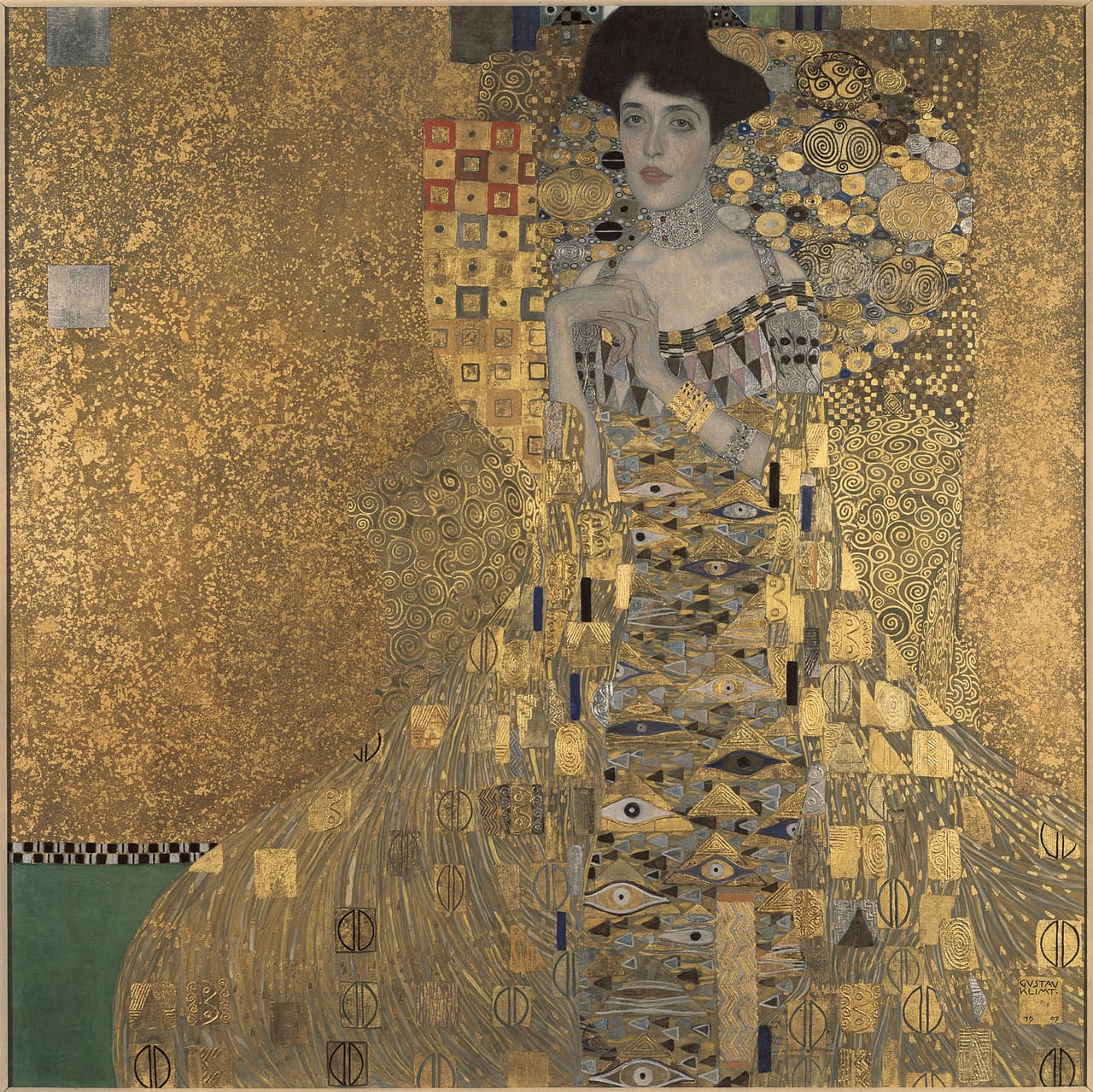
One of Klimt’s portraits of fashionable Viennese patrons, in which the figure has no shadow and the lush sensuality of skin is heightened by flat, brilliantly composed ornament. The Nazis confiscated it during the Second World War, and after the war it entered the Belvedere’s collection in Vienna; it was returned to the Bloch-Bauer family in 2006, sold later that year to Ronald Lauder for a then-record $135 million, and has been on permanent display at the Neue Galerie, New York, ever since.
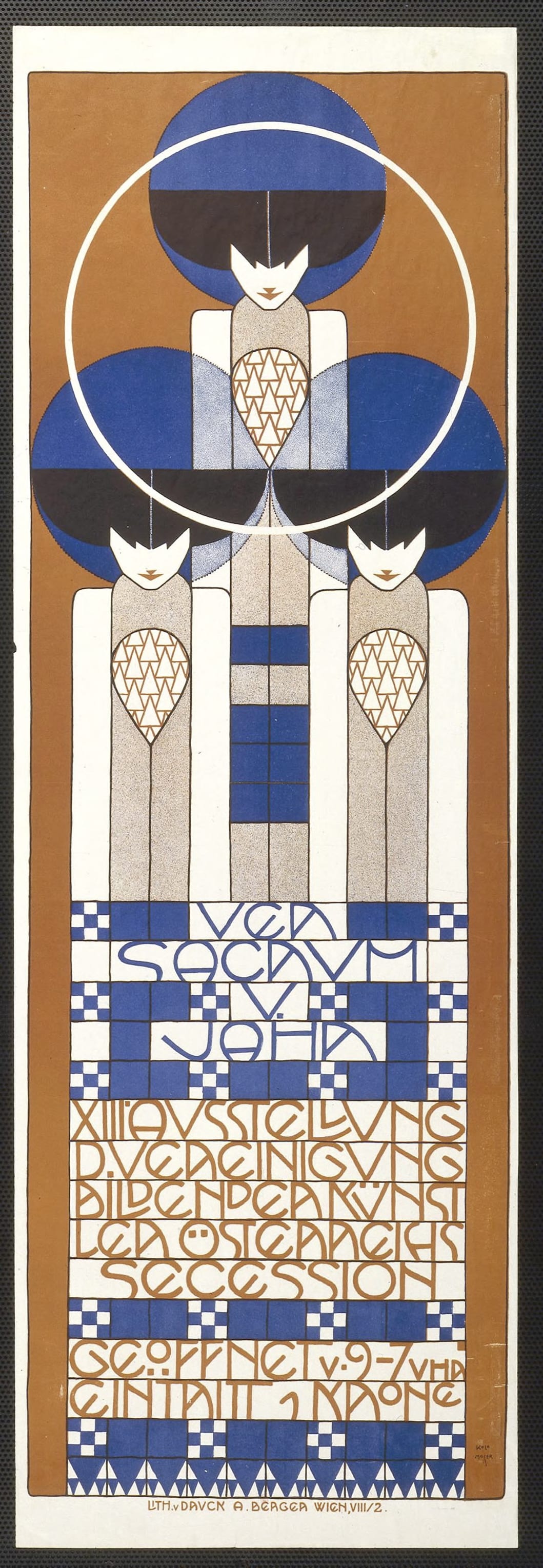
Koloman Moser
Moser’s poster for the thirteenth exhibition of the Vienna Secession, in 1902, joins three figures, lettering and geometric ornament in one modular design. It is built from horizontal, vertical and circular lines that mark out flat shapes of colour.
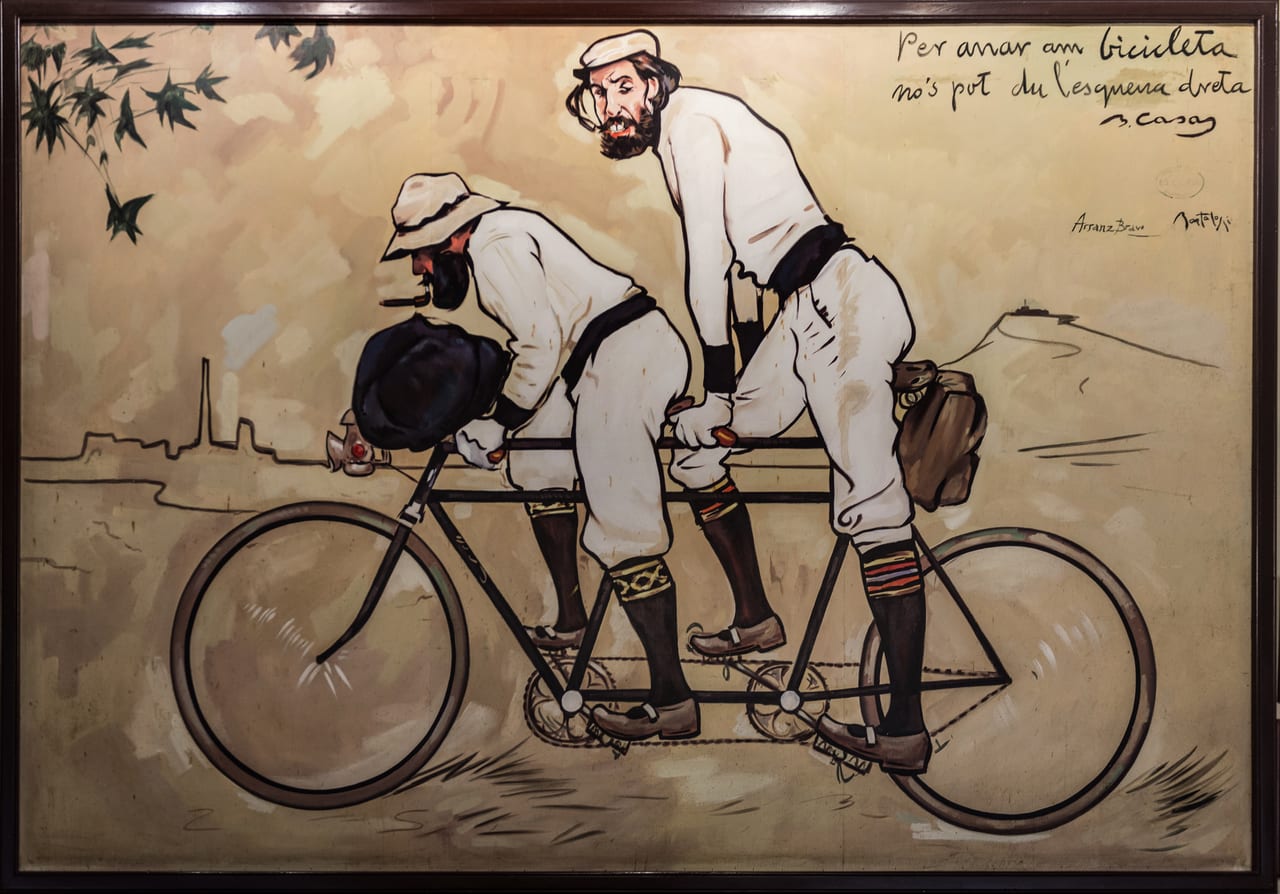
Ramon Casas
Casas painted it in 1897 for the interior of Els Quatre Gats, the Barcelona bar at the centre of Modernisme. He rides in profile with his pipe, and Pere Romeu, one of the bar’s promoters, looks straight out at the viewer. Though it is on canvas, its bold drawing and simplified forms give it the graphic quality of a huge poster; in 1901 Casas’s Ramon Casas and Pere Romeu in an Automobile took its place.
Artworks
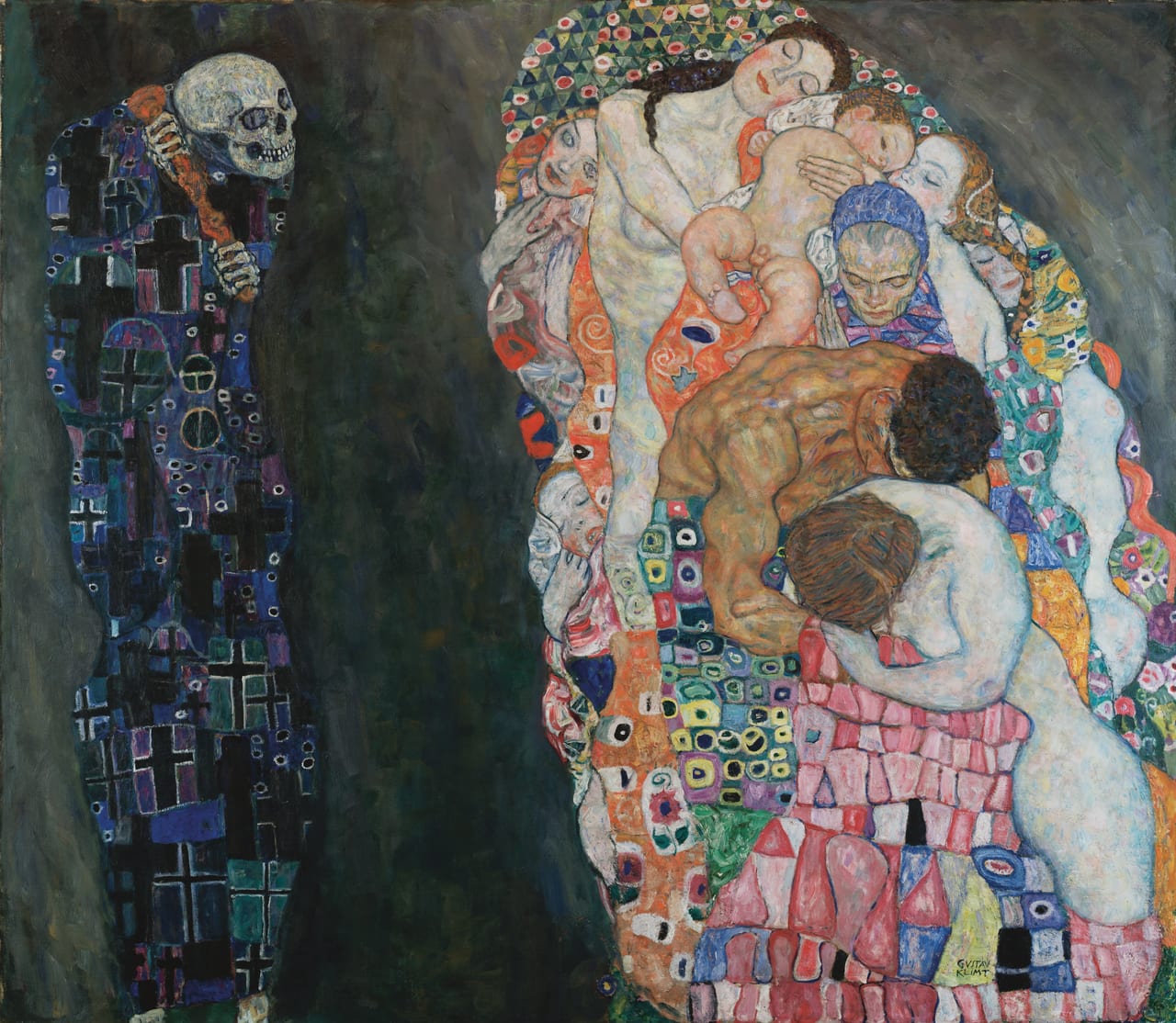
Death and Life
Gustav Klimt · 1908–15
Leopold Museum
Klimt began Death and Life in 1908 and finished it in 1915, an allegory in Art Nouveau style. In 1911 it received first prize at the world exhibition in Rome; in 1915, after its first five exhibitions, he changed the background from gold to grey and added some mosaics. It is in the Leopold Museum, Vienna.
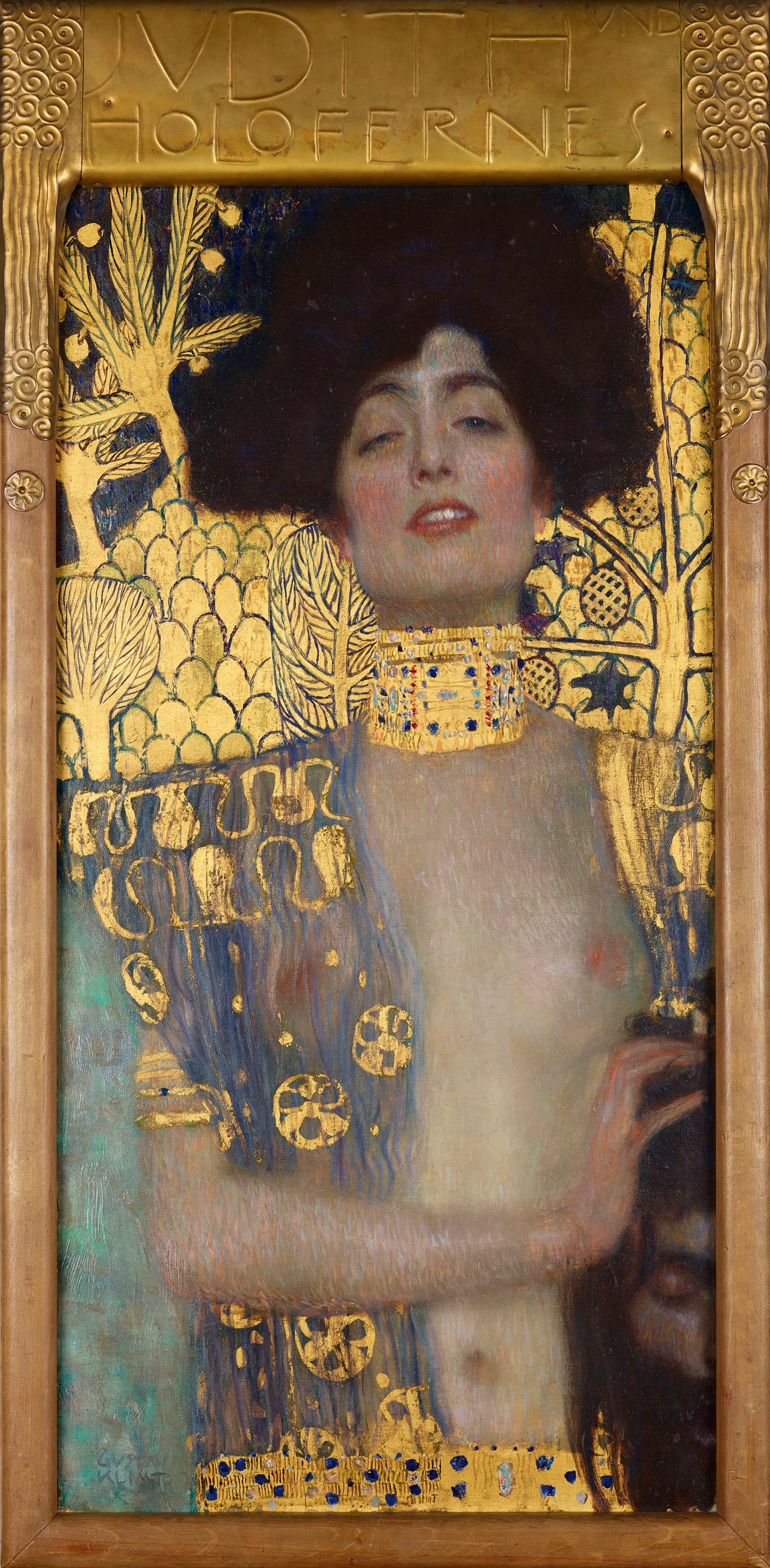
Judith I
Gustav Klimt · 1901
Belvedere
Painted in 1901, Judith I is a notable early work of Klimt’s golden phase. Leaving out any narrative, he gives the picture to Judith alone and cuts Holofernes’ head off at the right edge; though her features are altered, one can recognise in them Klimt’s friend Adele Bloch-Bauer. Here Judith is a paradigm of the femme fatale he painted again and again.
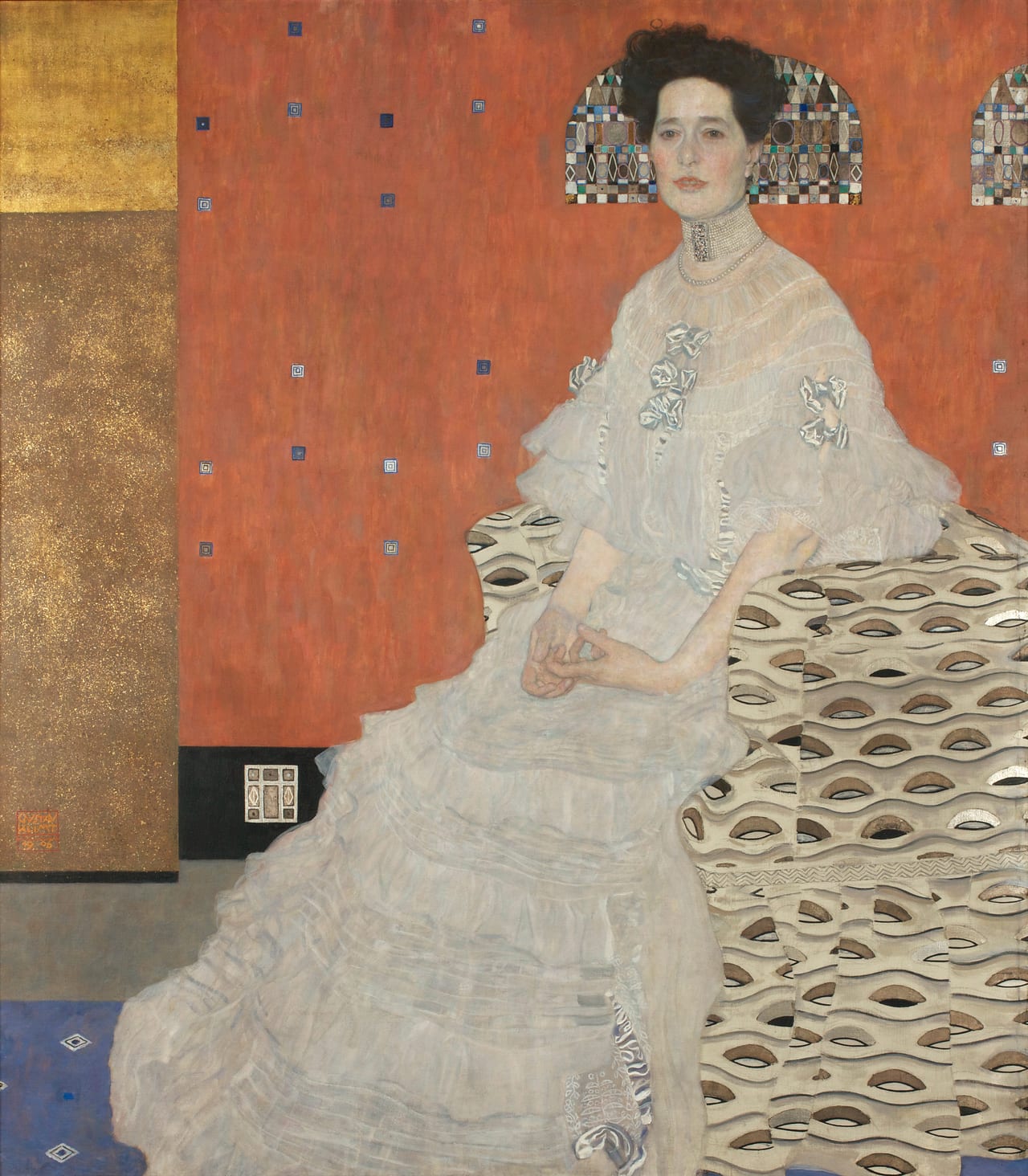
Fritza Riedler
Gustav Klimt · 1906
Belvedere
Painted in 1906, Fritza Riedler is one of the portraits of fashionable Viennese patrons counted among Klimt’s most successful works. In them he treats the human figure without shadow and surrounds it with flat, highly ornamental areas of decoration.
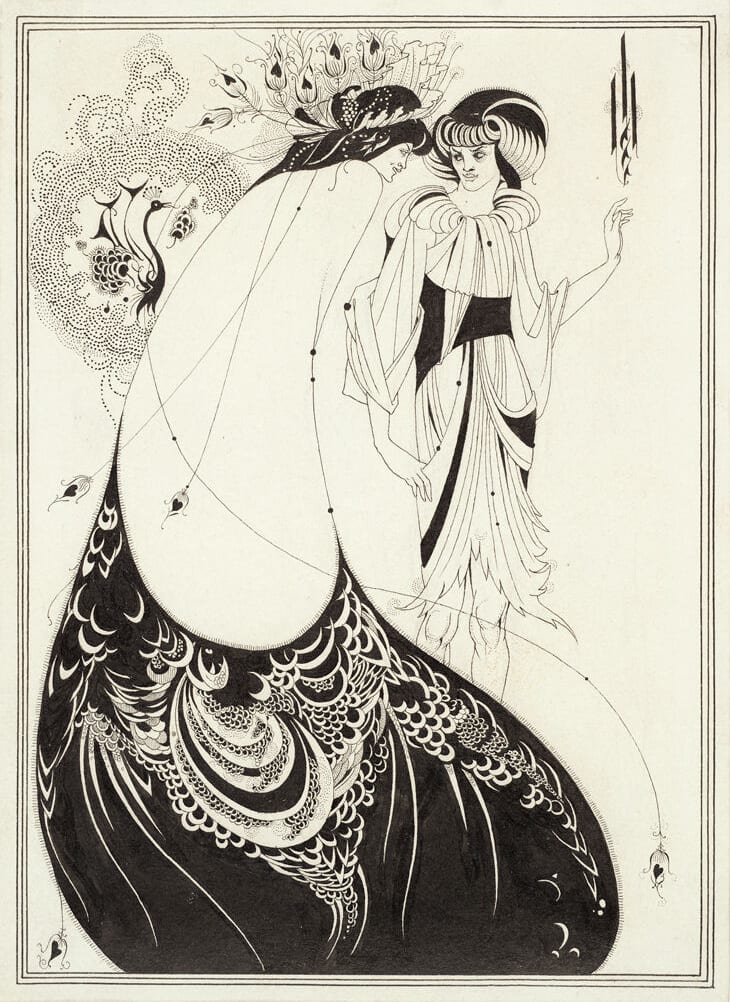
The Peacock Skirt
Aubrey Beardsley · 1893
An illustration of 1893, The Peacock Skirt was the second of the ten plates published with the English version of Wilde’s Salome. Salome, seen from a rear quarter view, wears a long robe patterned with stylised peacock feathers and turns to talk with a second figure, probably the “Young Syrian” of the play. Whistler’s Peacock Room influenced the drawing, and its refined curving lines owe something to Japanese woodblock prints; they anticipate Art Nouveau’s forms.
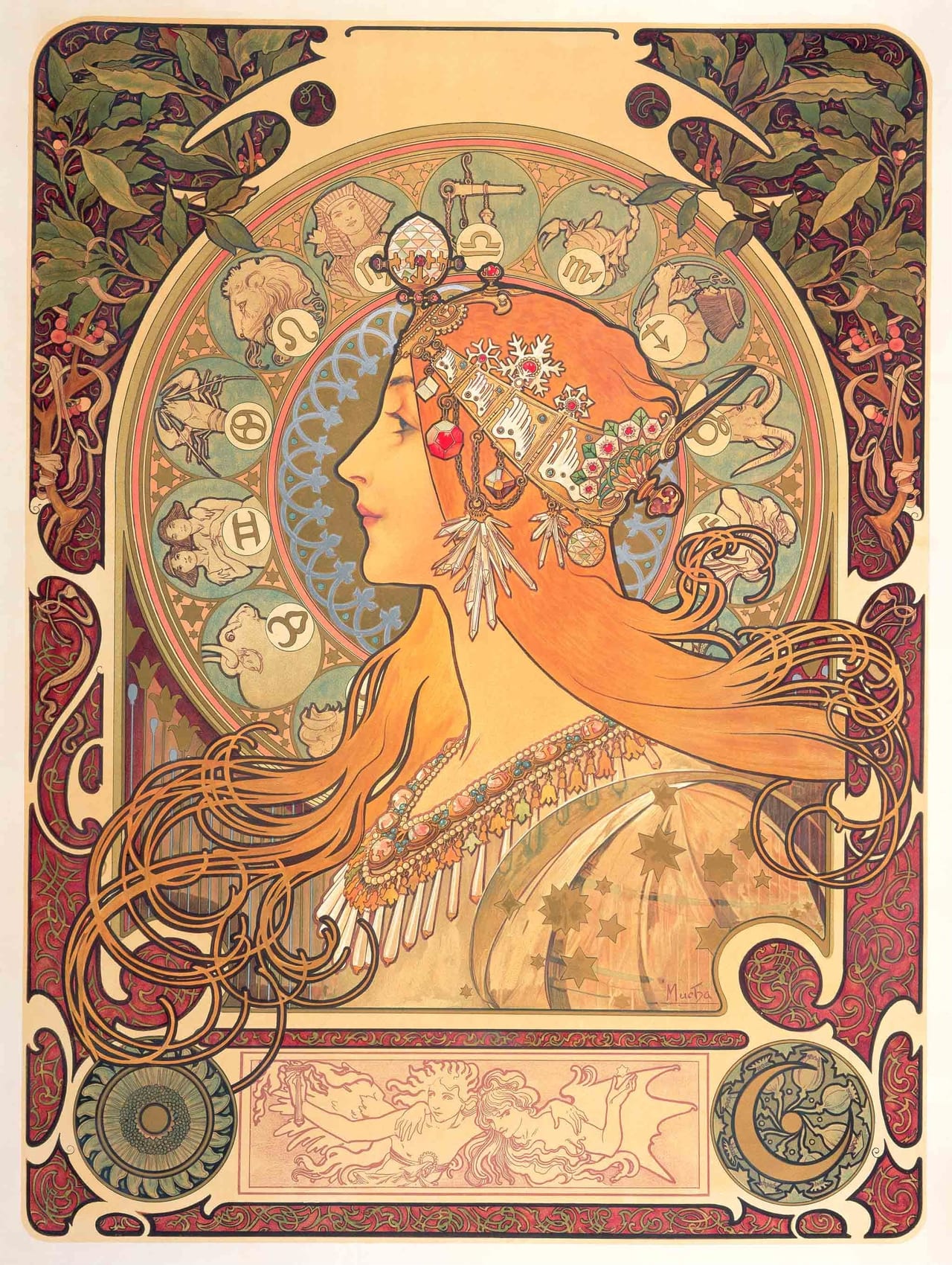
Zodiac
Alphonse Mucha
Mucha also designed a calendar showing a woman’s head ringed by the signs of the zodiac. Its rights were sold on to Léon Deschamps, who edited the arts review La Plume and published it, with great success, in 1897.
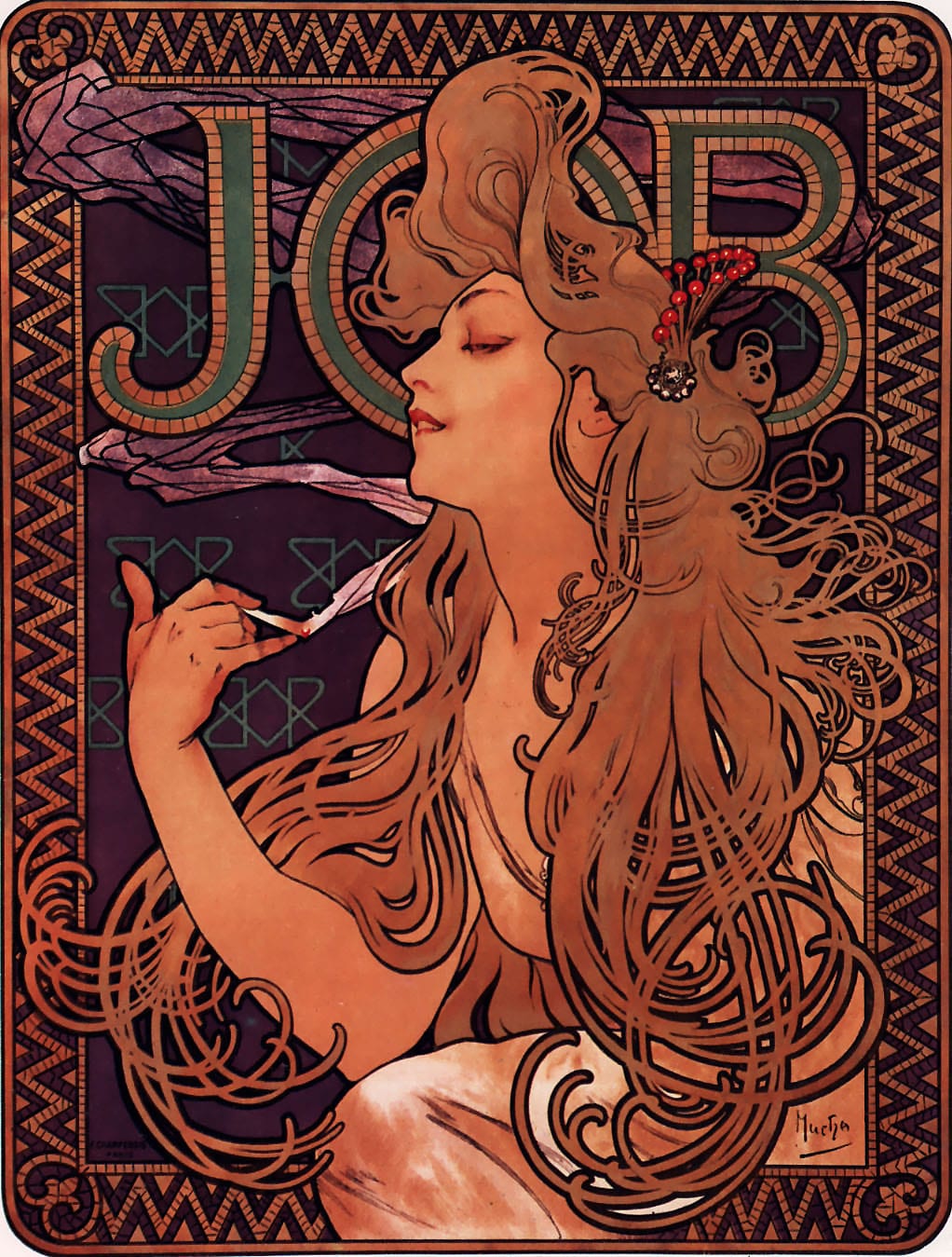
JOB
Alphonse Mucha
Bibliothèque nationale de France
The success of his posters for Bernhardt brought Mucha advertising commissions, JOB cigarette papers among them. His posters centred almost entirely on beautiful women in lavish settings, their hair usually curling in arabesques and filling the frame.
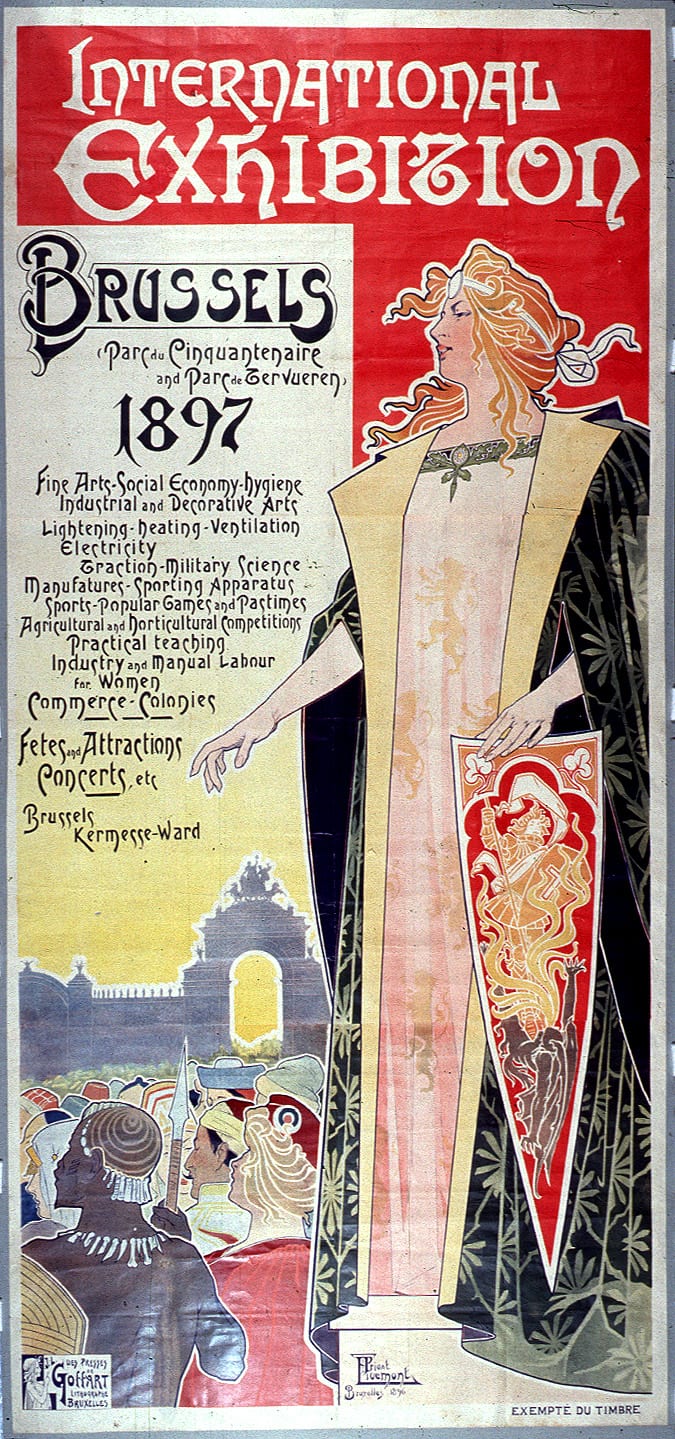
International Exhibition, Brussels
Henri Privat-Livemont · 1897
The Brussels International Exposition of 1897 brought the style international attention. Horta, Hankar, Van de Velde and Serrurier-Bovy were among those who took part in designing the fair, and Privat-Livemont made its poster, the most famous of his Art Nouveau posters.
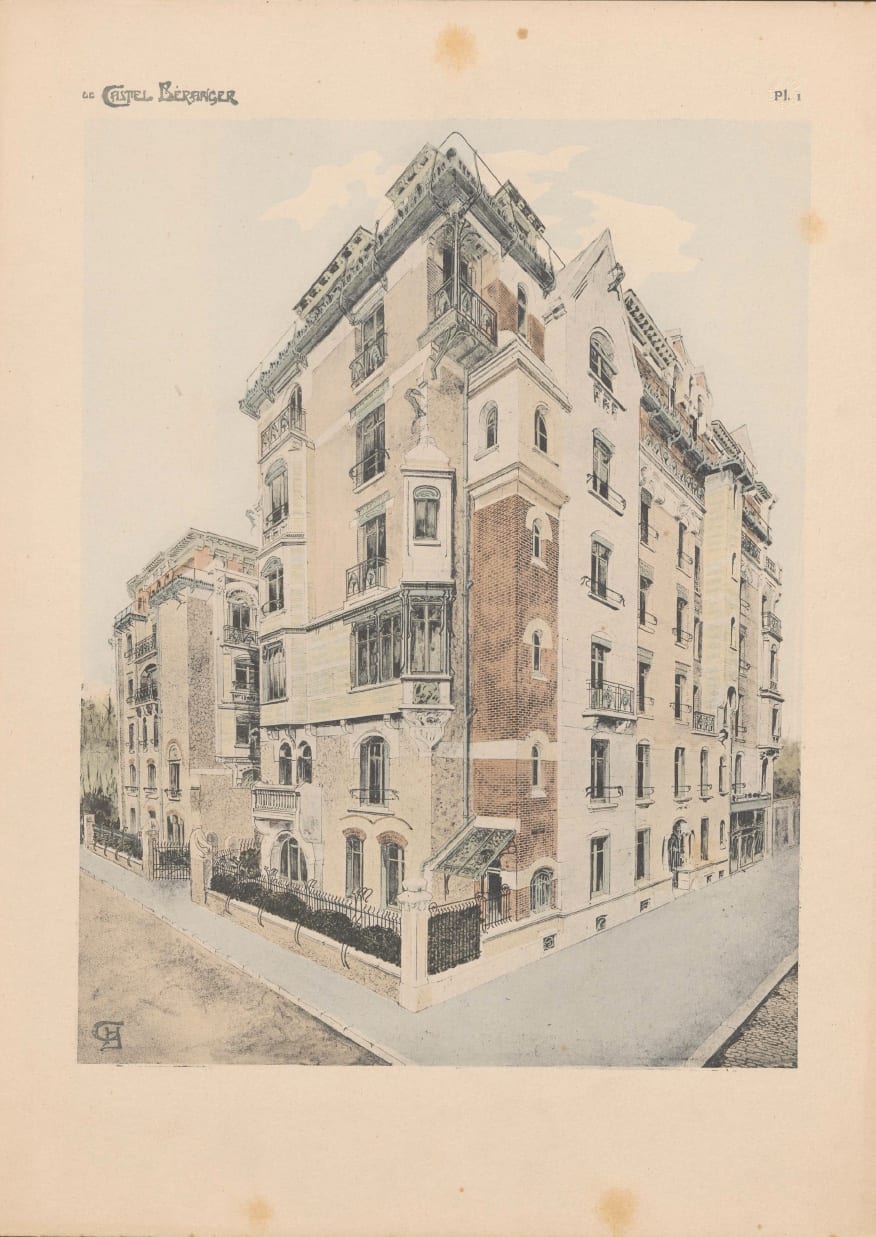
Castel Béranger
Hector Guimard
Hector Guimard designed the Castel Béranger, a Paris residential building of thirty-six apartments, and it was built between 1895 and 1898. Guimard became involved in every detail, designing its furniture, ornamental ironwork, carpets, glass, wallpaper, door locks and doorknobs, and in 1898 it was the winner for the 16th arrondissement in the city’s competition for the most beautiful and original new facades. When it was done, Guimard sent Horta an album of the building’s designs.
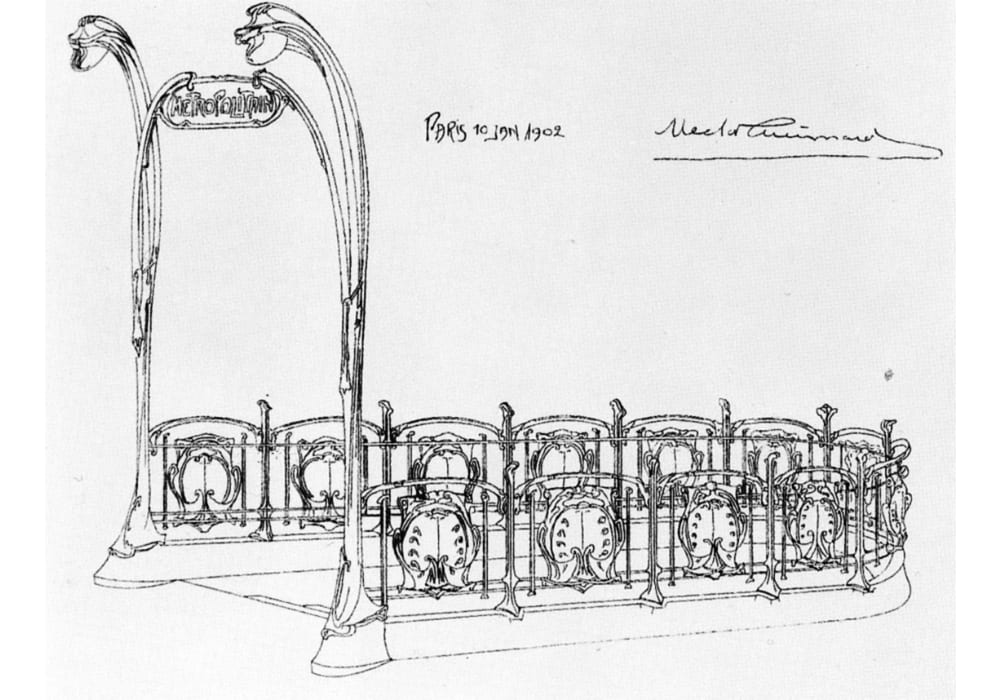
Design for a Métro Entrance
Hector Guimard
Hector Guimard was responsible, between 1900 and 1913, for the first generation of entrances to the Paris Métro’s underground stations. Instead of stone he used cast iron set in concrete, which cut costs and suited the sinuous forms, and he designed standard parts, among them railing cartouches with the letter M; most of the entrances built, 154 of them, were unroofed enclosures, called entourages. Through what became known as the Métro style, the entrances popularised Art Nouveau.
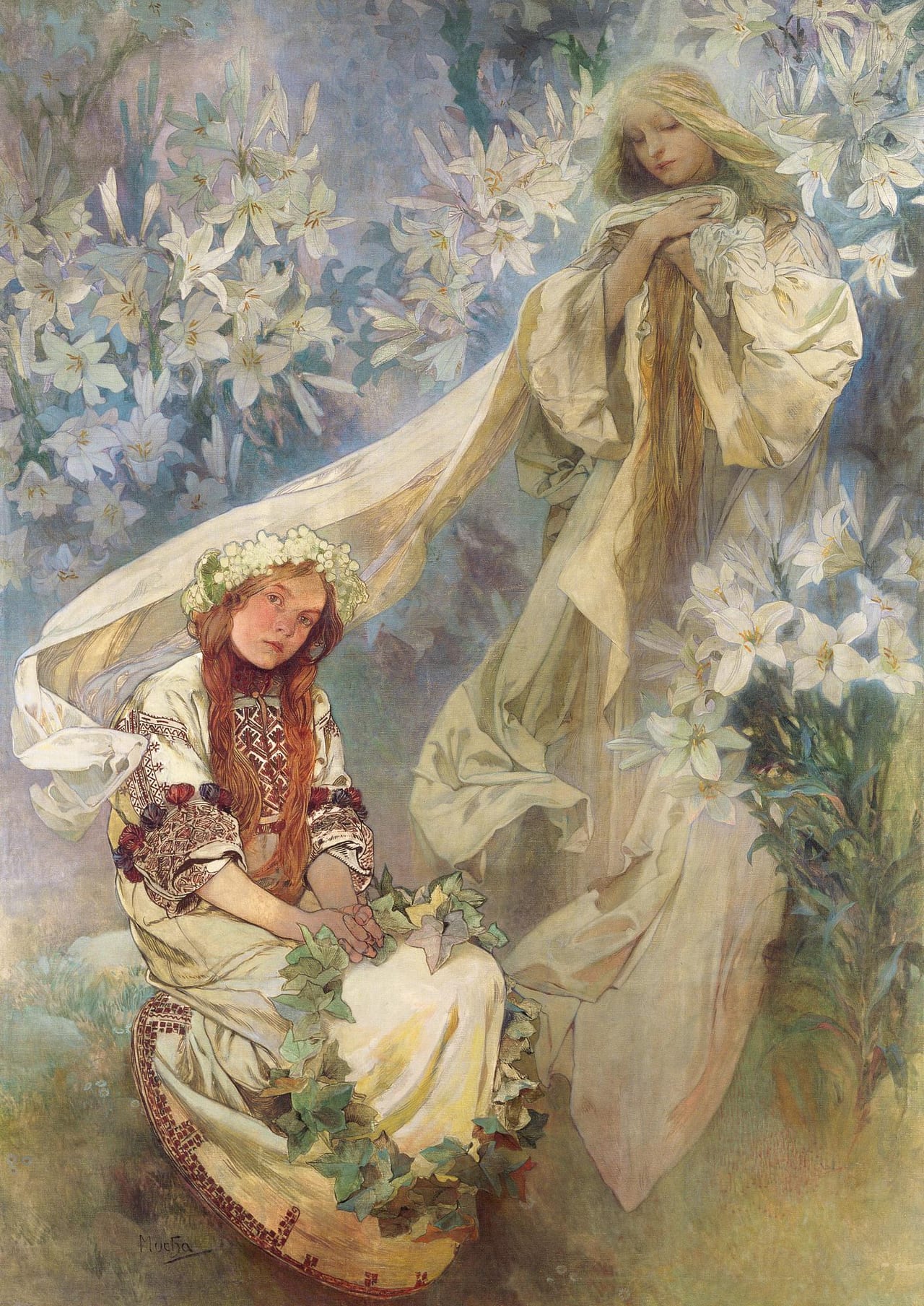
Madonna of the Lilies
Alphonse Mucha
Mucha Foundation
In 1902 Mucha received a commission to decorate a Jerusalem church dedicated to the Virgin Mary; this is the final version of Madonna of the Lilies, one of its murals; the project was later cancelled for unknown reasons. Mucha conceived the subject as ‘Virgo purissima’, a heavenly vision of the Madonna among a mass of lilies, a symbol of purity, while a young girl in Slavic folk costume sits holding a wreath of ivy leaves, a symbol of remembrance.
Sources
- Britannica, “Art Nouveau”
- Wikipedia, “The Kiss (Klimt)”
- V&A, “Art Nouveau – an international style”
- V&A, “Art Nouveau and the erotic”
- V&A, “The Whiplash”
- Wikipedia, “Art Nouveau”
- V&A, “Objects of beauty: Art Nouveau glass and jewellery”
- Wikipedia, “Art Nouveau posters and graphic arts”
- Britannica, “Jules Chéret”
- V&A, “A short history of the poster”
- Britannica, “Alphonse Mucha”
- Wikipedia, “Alphonse Mucha”
- Wikipedia, “Eugène Grasset”
- Wikipedia, “Henri Privat-Livemont”
- Britannica, “Poster”
- Wikipedia, “Jan Toorop”
- Britannica, “Les Vingt”
- Britannica, “Aubrey Beardsley”
- Wikipedia, “The Climax (illustration)”
- Britannica, “Sezession”
- Britannica, “Vienna Sezession”
- Wikipedia, “Koloman Moser”
- Britannica, “Gustav Klimt”
- Wikipedia, “Gustav Klimt”
- Wikipedia, “Ramon Casas”
- Musée d’Orsay, “Decorative Arts”
- Musée d’Orsay, “Around 1900: an Art Nouveau Ensemble. The Rispal Donation”
- Mucha Foundation, “Gismonda”
- Wikipedia, “Le Chat Noir”
- Rijksmuseum, “Poster for Delft Salad Oil”
- Britannica, “Koloman Moser”
- Wikipedia, “Ramon Casas and Pere Romeu on a Tandem”
- Wikipedia, “Death and Life”
- Wikipedia, “Judith I”
- Wikipedia, “The Peacock Skirt”
- Wikipedia, “Castel Béranger”
- Wikipedia, “Paris Metro entrances by Hector Guimard”
- Mucha Foundation, “Madonna of the Lilies”
- The Kiss — Public domain via Wikimedia Commons (Public domain)
- Folies Bergère: La Loïe Fuller — Public domain via Wikimedia Commons (Public domain)
- Jeanne d’Arc, Sarah Bernhardt — Public domain via Wikimedia Commons (Public domain)
- Gismonda — Public domain via Wikimedia Commons (Public domain)
- Tournée du Chat Noir — Public domain via Wikimedia Commons (Public domain)
- Absinthe Robette — Public domain via Wikimedia Commons (Public domain)
- Delftsche Slaolie — CC0 via Wikimedia Commons (CC0)
- The Climax — Public domain via Wikimedia Commons (Public domain)
- Portrait of Adele Bloch-Bauer I — Public domain via Wikimedia Commons (Public domain)
- Poster for the 13th Secession Exhibition — Public domain via Wikimedia Commons (Public domain)
- Ramon Casas and Pere Romeu on a Tandem — Public domain via Wikimedia Commons (Public domain)
- Death and Life — Public domain via Wikimedia Commons (Public domain)
- Judith I — Public domain via Wikimedia Commons (Public domain)
- Fritza Riedler — Public domain via Wikimedia Commons (Public domain)
- The Peacock Skirt — Public domain via Wikimedia Commons (Public domain)
- Zodiac — Public domain via Wikimedia Commons (Public domain)
- JOB — Public domain via Wikimedia Commons (Public domain)
- International Exhibition, Brussels — Public domain via Wikimedia Commons (Public domain)
- Castel Béranger — CC0 via Wikimedia Commons (CC0)
- Design for a Métro Entrance — Public domain via Wikimedia Commons (Public domain)
- Madonna of the Lilies — Public domain via Wikimedia Commons (Public domain)
Invite Art Nouveau into your living room