Dead City III
Egon Schiele · 1911

Expressionism
Germany
Expressionist painters set out to show not the world as it looks but the emotions that things and events stir in a person, through distortion, exaggeration and vivid, often jarring colour. The movement’s roots lay in the work of Vincent van Gogh, Edvard Munch and James Ensor; its principal wave began about 1905, when Ernst Ludwig Kirchner and three fellow architecture students in Dresden founded Die Brücke (“The Bridge”). In 1911 Wassily Kandinsky and Franz Marc founded Der Blaue Reiter (“The Blue Rider”), a Munich group whose art is generally lyrical and abstract and less overtly emotional than Die Brücke’s. Expressionism was a dominant style in Germany in the years just after the First World War; once the Nazis held power, from 1933, modern artists suffered persecution for the so-called ‘degeneracy’ of their work.
From Munch to Dresden
What the Expressionists sought to depict was not objective reality but the subjective emotions and responses that objects and events arouse in a person. Their means were distortion, exaggeration, primitivism and fantasy, and a vivid, jarring, violent or dynamic use of formal elements: in Expressionist painting colours may look intense and non-naturalistic, forms are distorted, brushwork is typically free, and the paint tends to be generous and highly textured. The word can describe art of any era, but the term comes from modern artists working in Germany early in the twentieth century; as a movement it means a number of German artists, together with Austrian, French and Russian artists, active from the years before the First World War through much of the interwar period.
Its roots lay in the work of three painters, Vincent van Gogh, Edvard Munch and James Ensor, who between 1885 and 1900 each evolved a highly personal style, using colour and line to explore dramatic, emotion-laden themes, to convey fear, horror and the grotesque, or to celebrate nature with hallucinatory intensity. Munch’s own style crystallised about 1892: his flowing, tortuous line resembled that of Art Nouveau, but for him line was a means of psychological revelation, not decoration. When he showed a large number of paintings in Berlin that year, at the invitation of the Union of Berlin Artists, their violent emotion and frank treatment of sexuality caused a bitter controversy, and the scandal helped to make his name known throughout Germany. At the heart of his work is a series of paintings on love and death, first exhibited as the Frieze of Life at the Berlin Secession in 1902. In the unity of its form and content, The Scream of 1893 is a pivotal work in the passage from symbolism to the expressionist art of the twentieth century.
The principal wave began about 1905 in Dresden, where four architecture students, Ernst Ludwig Kirchner, Erich Heckel, Fritz Bleyl and Karl Schmidt-Rottluff, who gave the group its name, founded Die Brücke. Emil Nolde and Max Pechstein joined them in 1906 and Otto Mueller in 1910. Rebelling against the superficial naturalism, as they saw it, of academic Impressionism, they wanted to give back to German art a spiritual vigour they felt it lacked, through an elemental, highly personal and spontaneous expression. The Expressionists were also interested in African wood carvings and in Albrecht Dürer, Matthias Grünewald and Albrecht Altdorfer, and they were aware of Neo-Impressionism and Fauvism. In the group’s programme Kirchner called on young people, “who carry the future in us”, to wrest freedom for their actions and their lives from the older, comfortably established forces.
The German Expressionists soon arrived at a style of harshness, boldness and visual intensity: jagged, distorted lines, rough and rapid brushwork and jarring colours, in crowded, agitated pictures of city streets and other subjects of their day. Woodcuts, with their thick, jagged lines and harsh contrasts of tone, were one of their favourite media; Die Brücke drew on the expressive simplifications of late German Gothic woodcuts and on Munch’s prints, and it contributed to the revival of the woodcut. Its first exhibition was held in the Seifert lamp factory in Dresden in 1906. Between 1907 and 1911 the members spent their summers at the Moritzburg lakes and on the island of Fehmarn, and painted themselves bathing nude in the lakes near Dresden. By 1911 the group’s activities had moved to Berlin, where several members lived, and it disbanded in 1913, provoked by Kirchner’s highly subjective accounts of the group’s activities in the Chronik der Künstlergemeinschaft Brücke.
The Blue Rider in Munich
The Neue Künstlervereinigung München, co-founded in 1909 with Kandinsky as its first chairman, was divided by repeated disputes that flared up over his increasingly abstract painting. In December 1911 its jury rejected his Composition V, and Kandinsky, with Gabriele Münter, Marc and others, set up a rival group and promptly organised a parallel exhibition in rooms beside the official show at the same venue, the Thannhauser Gallery; the breakaway group took the name Der Blaue Reiter. Their First Exhibition by the Editors of the Blue Rider opened on 18 December 1911 at Heinrich Thannhauser’s Moderne Galerie in Munich and showed 43 works by 14 artists, among them, besides Kandinsky and Marc, Henri Rousseau, Albert Bloch and August Macke.
The almanac Der Blaue Reiter, edited by Kandinsky and Marc and published in May 1912, set out the group’s position. It reproduced more than 140 artworks, chosen above all from children’s, folk and primitive art, including pieces from Africa and the South Pacific, Japanese drawings and medieval German woodcuts; Henri Rousseau had seven works in it and child artists thirteen, more than the five by Van Gogh, Cézanne and Gauguin together. Der Blaue Reiter was neither a movement nor a school with a definite programme but a loosely knit organisation that held group shows between 1911 and 1914, and its artists’ approaches varied; they shared a wish to express spiritual truths, and a belief in the connection between visual art and music and in the spiritual and symbolic associations of colour. Unlike Die Brücke’s, their expressionism took the form of lyrical abstraction.
Marc believed that civilisation destroys human awareness of the spiritual force of nature, and so he usually painted animals. In his mature works colour had fixed meanings: blue stood for masculinity and spirituality, yellow for femininity and gentleness, red for earthliness. Kandinsky wanted a painting in which colours, lines and shapes, freed from depicting recognisable objects, might become a visual language that could, like music, express general ideas and evoke deep emotions; he cannot be called the only founder of non-figurative painting, but he remains a pioneer of the first importance. For him, blue was the colour of spirituality.
August Macke, who joined Der Blaue Reiter in 1911, avoided the often violent manner of his fellow Expressionists and preferred human subjects to animals; in 1914 he travelled to Tunis with Paul Klee and painted a series of works that set their subjects on a grid of pure colours. Alexej von Jawlensky, though not officially a member, supported the group’s aims. With the outbreak of the First World War, in which Marc and Macke died at the front, Der Blaue Reiter dispersed; Kandinsky returned to Russia, and Marianne von Werefkin and Jawlensky fled to Switzerland.
Vienna, the war and after
Die Brücke’s works stirred Expressionism in other parts of Europe: in Austria Oskar Kokoschka and Egon Schiele took up its tortured brushwork and angular lines. In Schiele, who studied at the Vienna Academy of Fine Arts from 1907 to 1909, the linearity and subtlety of the work owed much to Gustav Klimt’s decorative elegance, but he put expression before decoration and gave his line a feverish tension. From the first his subject was the human figure, and his candid, agitated handling of erotic themes caused a sensation. In 1909 he helped to found the Neukunstgruppe in Vienna, and at a Secession exhibition in Vienna in 1918 a special room was given to his work, shortly before he died of Spanish influenza.
Max Beckmann, who had met Munch in 1906 and been led by his morbid, curvilinear compositions toward an Expressionist style, served as a medical corpsman in the First World War; seeing dead and maimed soldiers was a shock that changed his art and gave his mature work its sordid, often horrifying imagery. Kirchner, after his medical discharge, painted himself in 1915 as a soldier holding up the bloodied stump of his right hand; after a mental and physical breakdown that year he moved to Switzerland. Käthe Kollwitz, a graphic artist, lost her youngest son in battle in 1914, and in a cycle of prints she gave her grief the themes of a mother shielding her children and of a mother with her dead child.
Expressionism was a dominant style in Germany in the years immediately after the war, where it suited a mood of cynicism, alienation and disillusionment; some of its later practitioners, among them George Grosz and Otto Dix, developed a sharper, socially critical blend of Expressionism and realism, the Neue Sachlichkeit (“New Objectivity”). After the Nazis came to power in 1933, modern artists were persecuted, and many were forced to leave for elsewhere in Europe or for the United States. In 1937 the party staged the exhibition Degenerate Art, having taken 20,000 works of modern art from museums owned by the state. Beckmann, forced in 1933 to give up his professorship at Frankfurt’s Städel School of Art, fled to Amsterdam in 1937; Kirchner, whose work the Nazis declared “degenerate” that year, took his own life in 1938. Marc’s Tower of Blue Horses, removed from Berlin’s National Gallery under the Nazis, later went missing. The spontaneous, instinctive and highly emotional qualities of Expressionism were later shared by abstract expressionism, which developed in the United States in the post-war years, and by the neo-expressionism of the 1980s.
Artists
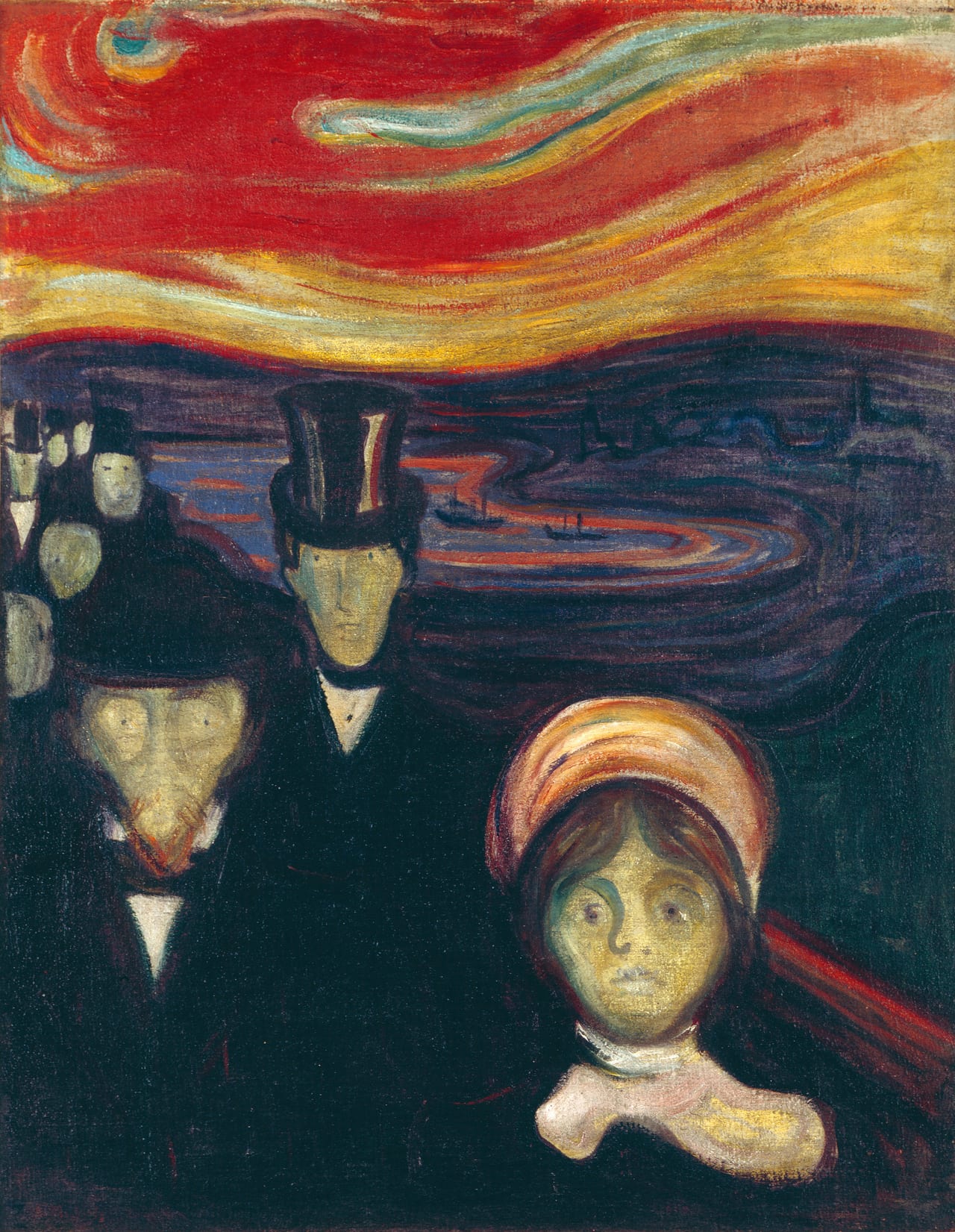
Anxiety borrows the setting of The Scream: a railing cutting diagonally across the picture, a city and a fjord in the distance, and a blood-red sky with stormy clouds. On the bridge people with wide-open eyes and greenish-pale faces stare straight out and seem to press toward the viewer. The painting is part of Munch’s Frieze of Life. Munch, born in 1863, greatly influenced German Expressionism.
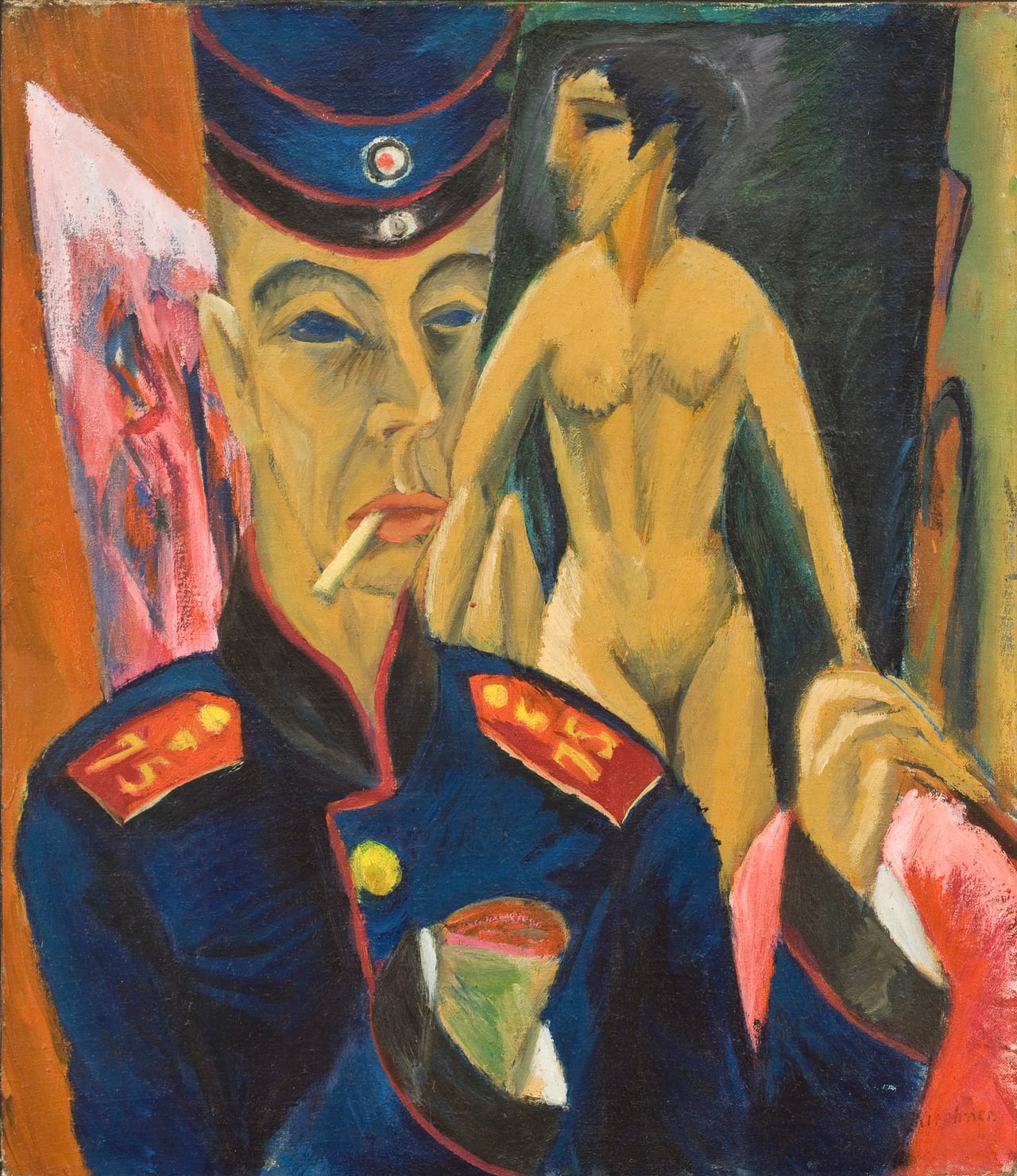
Ernst Ludwig Kirchner
Painted in 1915, after his medical discharge, the picture shows Kirchner gaunt in the uniform of the 75th Mansfeld Field Artillery Regiment, a cigarette hanging from his lips, holding up the bloodied stump of a right hand; the amputation is fictitious. Behind him is a nude woman, in front of a black canvas. Confiscated in 1937, it was shown that year in the exhibition “Degenerate Art”, retitled “Soldier with Whore”. Kirchner was one of the leaders of Die Brücke.
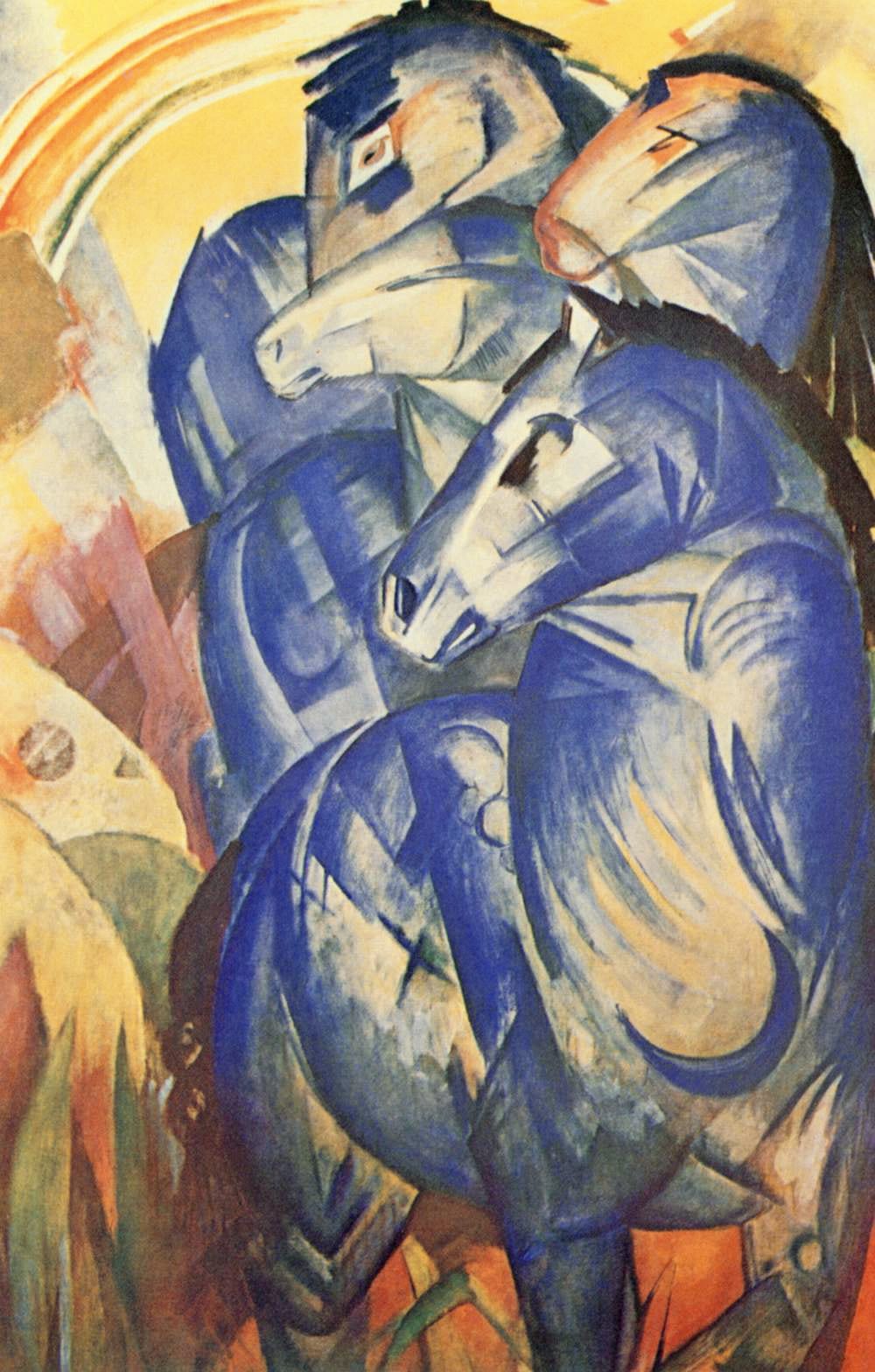
Franz Marc
Four mainly blue horses stand in a tier, facing out with their heads turned to the left; to the left of their rumps lies an abstract landscape, above it an orange rainbow on yellow, and the foremost horse bears a crescent moon on its chest and crosses that suggest stars. Marc painted the large canvas, 200 by 130 centimetres, in the summer of 1913 and showed it that autumn at the First German Autumn Salon. Marc died in 1916, during the First World War; the painting was later acquired for Berlin’s National Gallery, removed under the Nazis, and afterwards went missing.
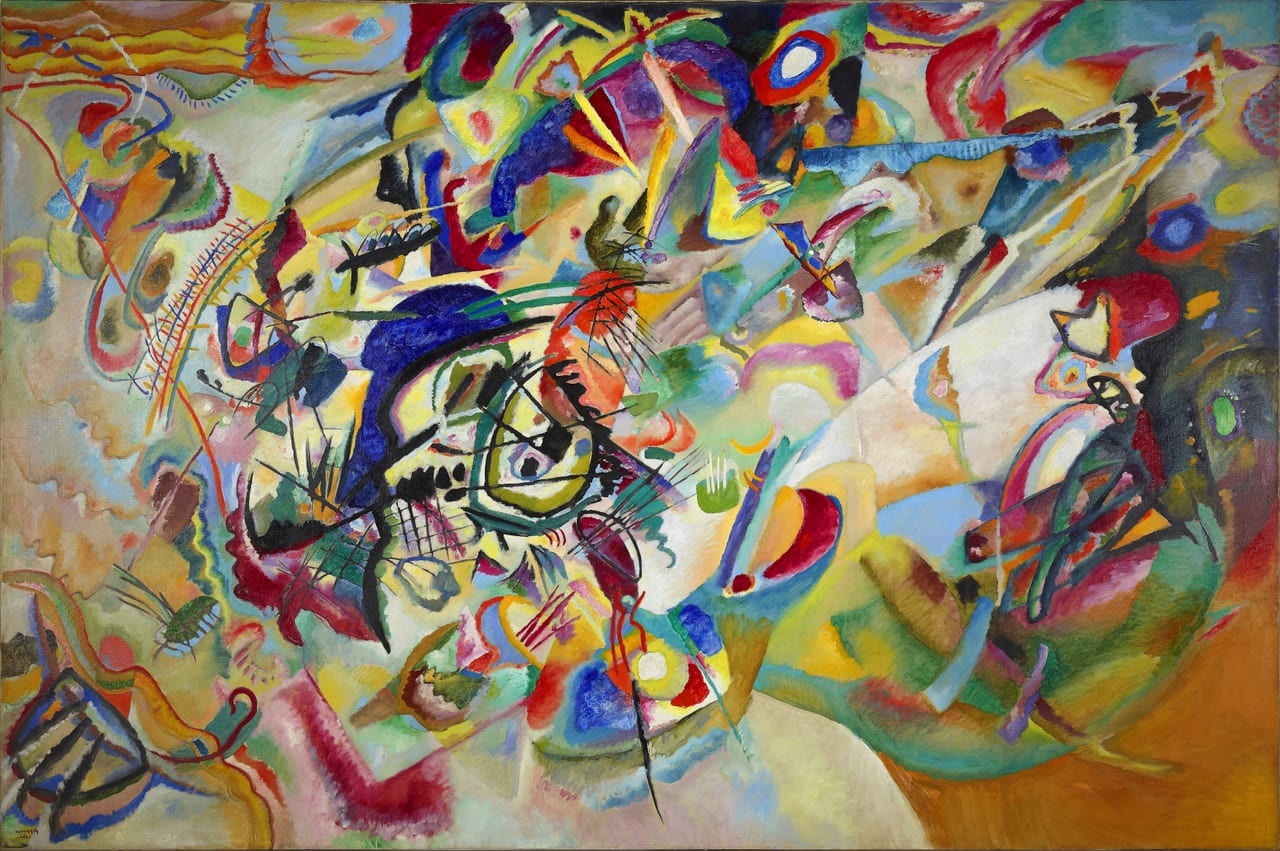
An abstract oil of 1913 in which art historians find the themes of the Resurrection, Judgement Day, the Flood and the Garden of Eden combined; it shows traits of Cubism and Futurism. Kandinsky, born in Moscow in 1866, was one of the first creators of pure abstraction in modern painting. The picture is in the Tretyakov Gallery in Moscow.
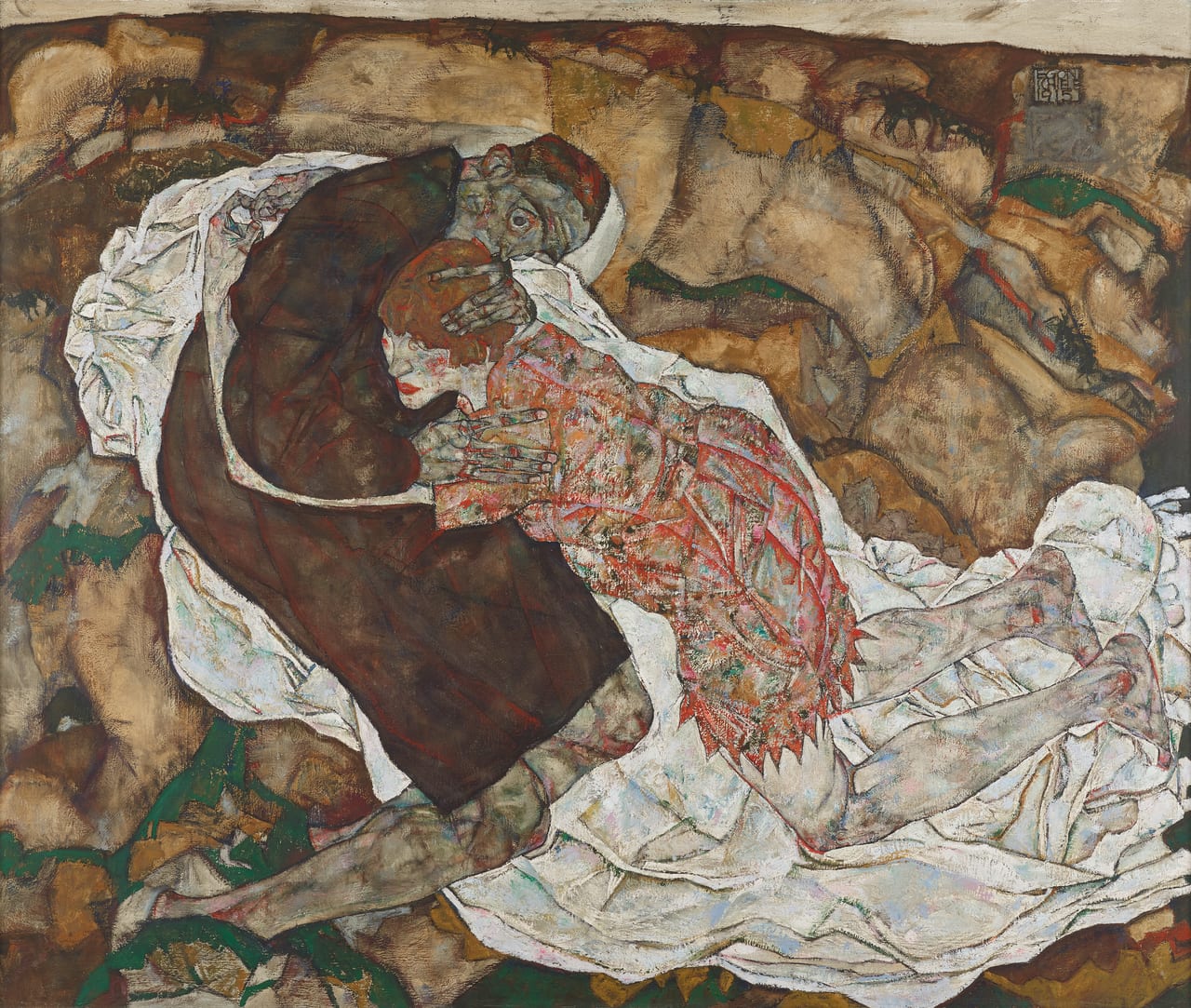
Egon Schiele
Schiele painted the picture in 1915, when, after marrying Edith Harms, he was called up for military service in the First World War: a woman clutches Death, in a monk’s robe, as her lover. On its unveiling its perceived morbidity and erotic undertones drew controversy; it is now counted among his most significant paintings.
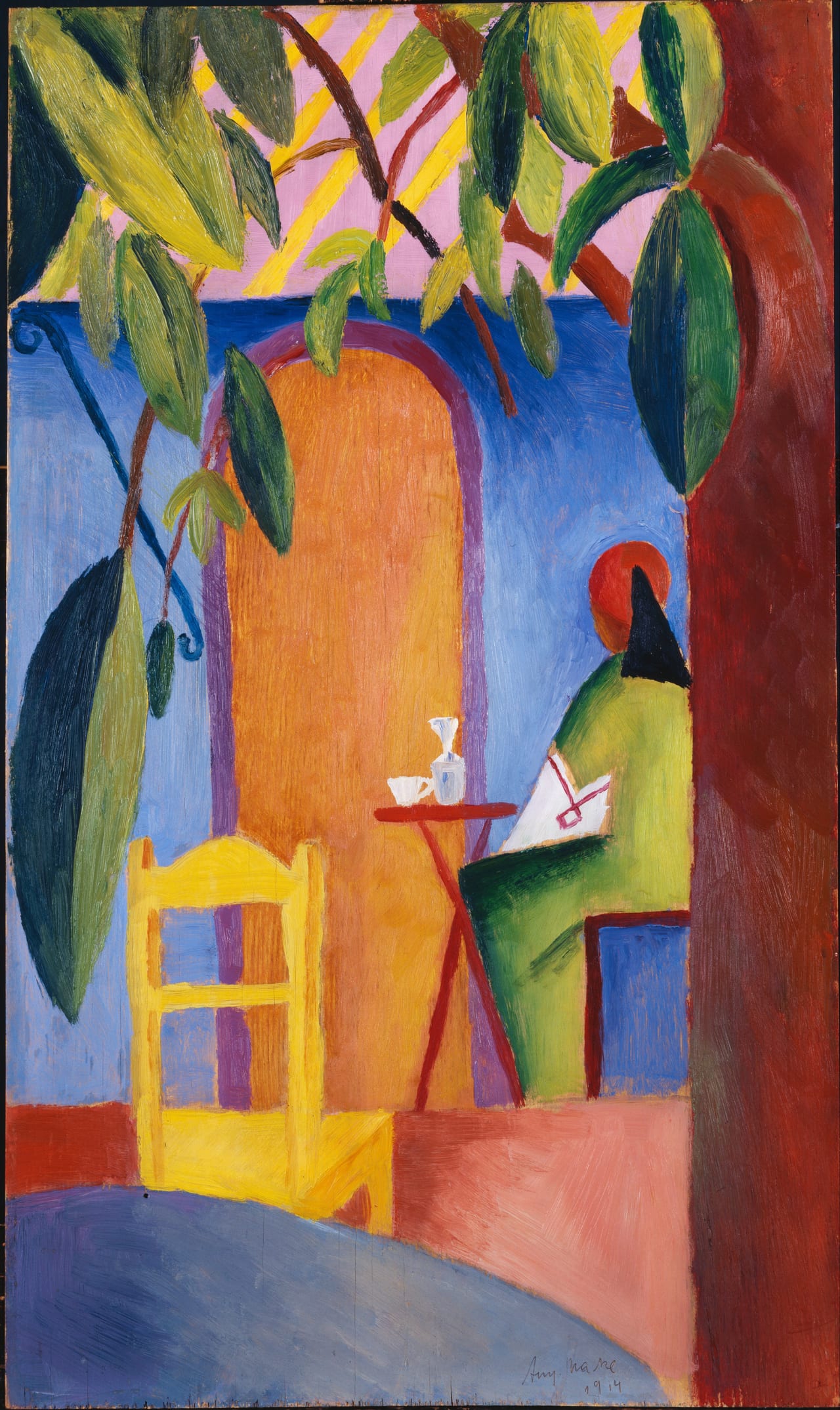
August Macke
Macke went to Tunisia in April 1914 with Paul Klee and Louis Moilliet, and its exotic atmosphere was fundamental to the luminist approach of his final period, when he painted a series of works now considered masterpieces, among them his famous Turkish Café. He had studied in Berlin with Lovis Corinth and, from 1909, worked closely with Franz Marc. He was killed in action in the First World War, in September 1914.
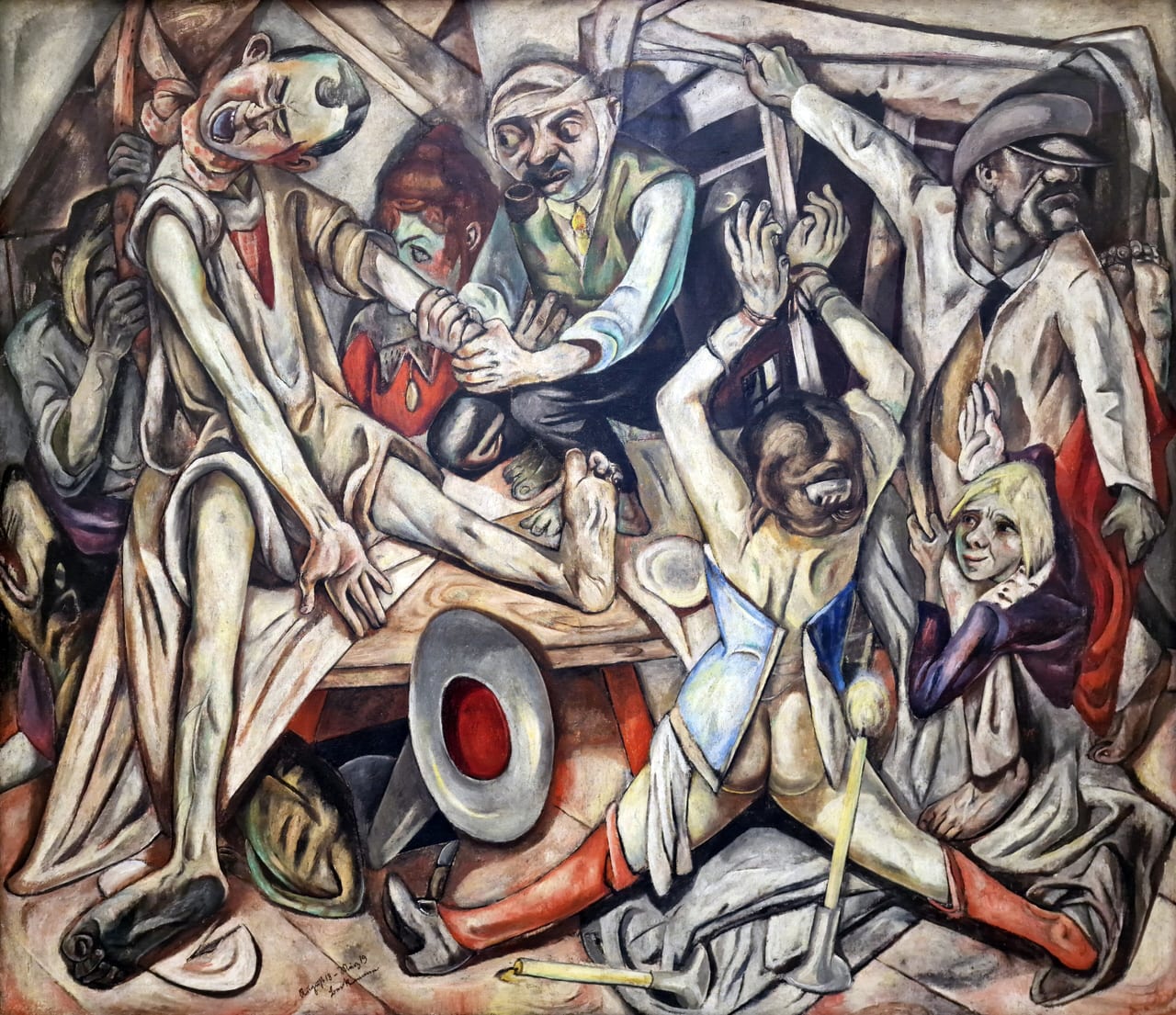
Max Beckmann
Three men appear to invade a small, cramped room and terrorise it: on the left a man is hanged and his arm twisted, a woman is bound to one of the room’s supports, and on the right a child is about to be carried off. Beckmann used himself as the model for the man in the noose and modelled the woman and child on his own wife and son. In this scene of nightmarish sadism the disquieting colours and violent forms convey his pessimism over man’s bestiality.
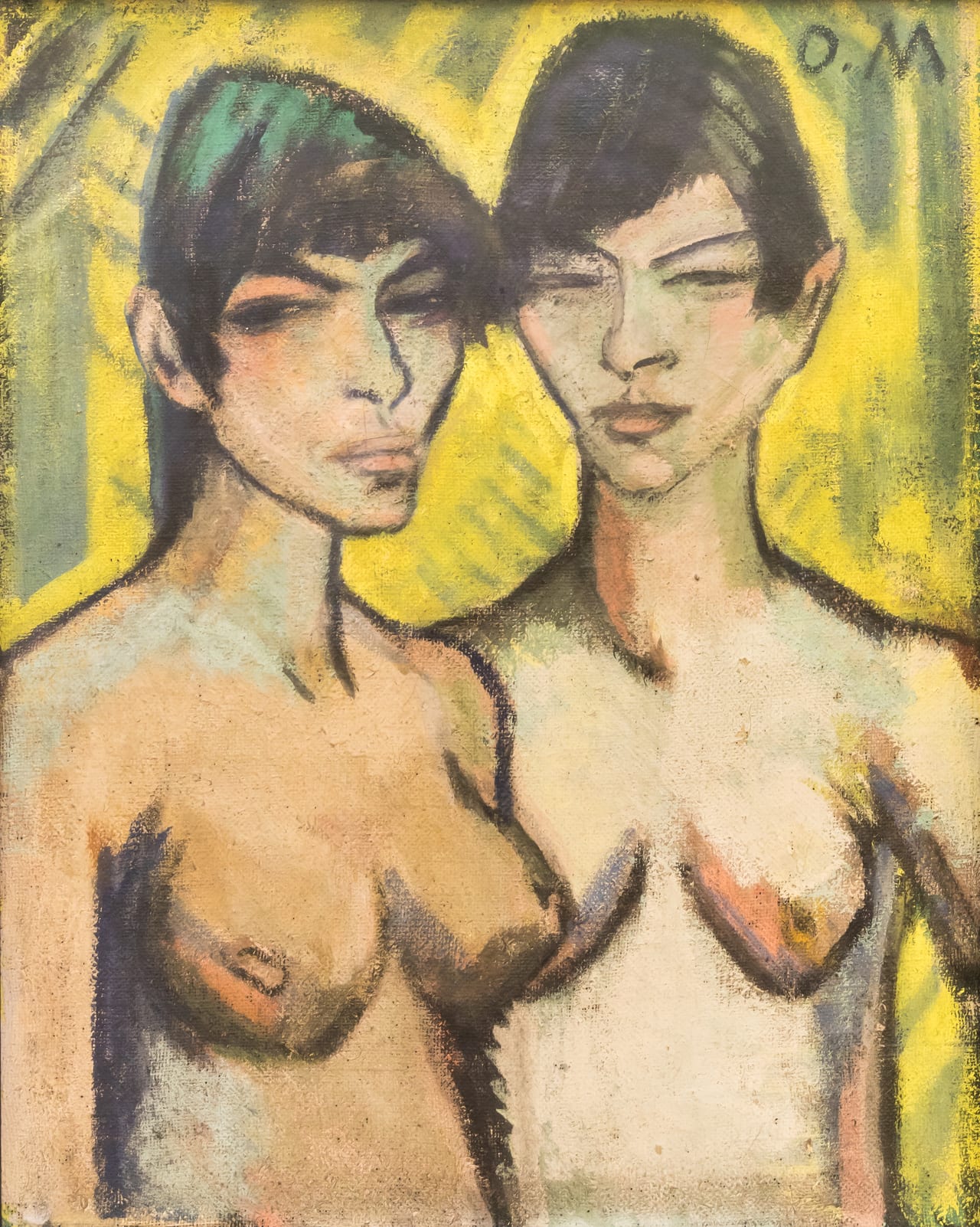
Otto Mueller
Mueller joined Die Brücke in 1910 and kept up his close association with Kirchner and Heckel after it disbanded in 1913. One of the most lyrical of the German Expressionists, he made the unity of people and nature his main subject, simplifying form, colour and contour into harmony, and he preferred to paint in distemper on coarse canvas, which gave a matt surface. In 1937 the Nazis confiscated 357 of his works from museums in Germany.
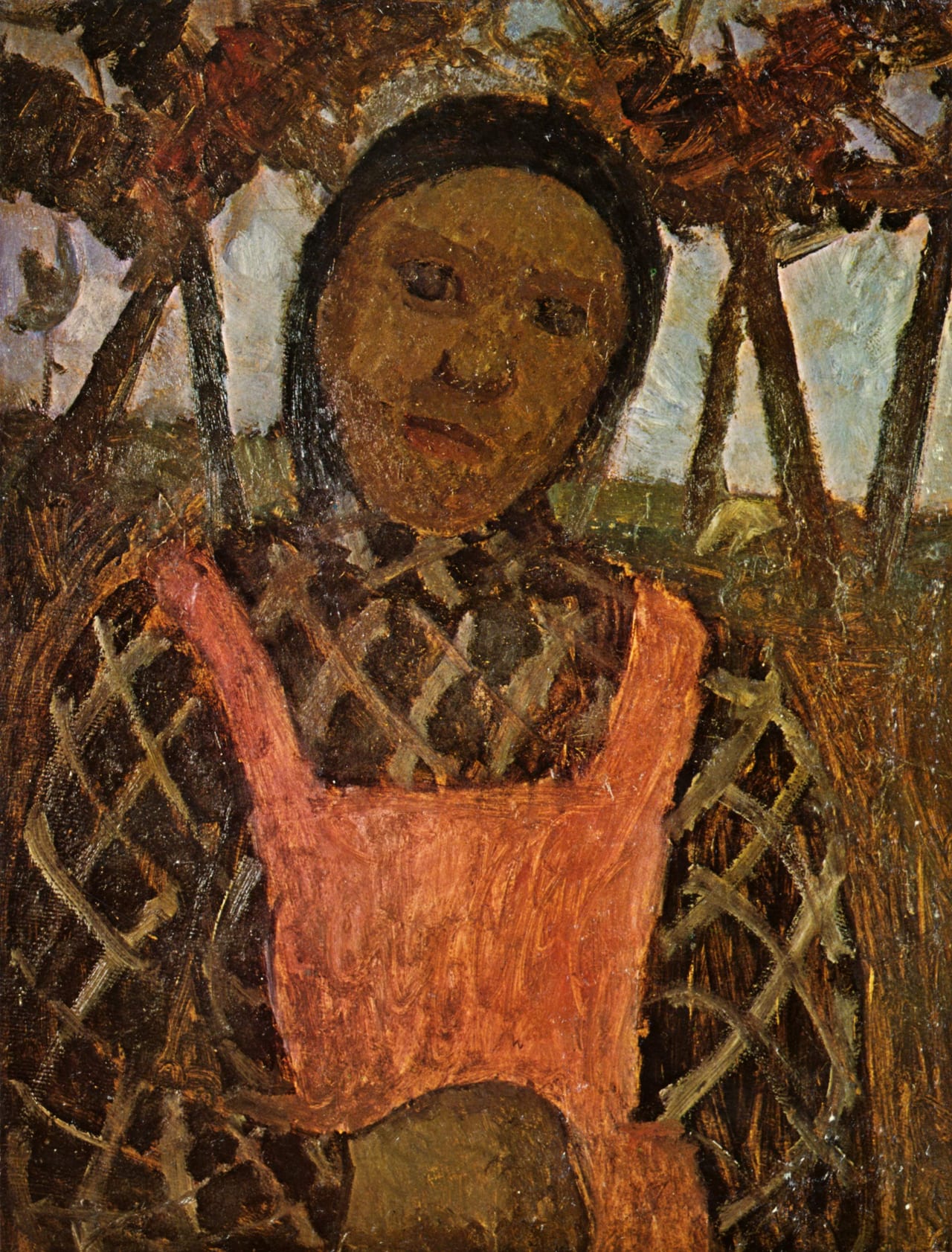
Paula Modersohn-Becker
In 1898 Paula Modersohn-Becker joined the Worpswede school, at an artists’ colony near Bremen; on her stays in Paris the work of Cézanne, Gauguin and the Nabis led her to simplified forms and to colour used symbolically rather than naturalistically. Because she was more concerned to express her inner feelings than to portray reality accurately, she is often associated with Expressionism. She died in 1907, shortly after giving birth to her only child.
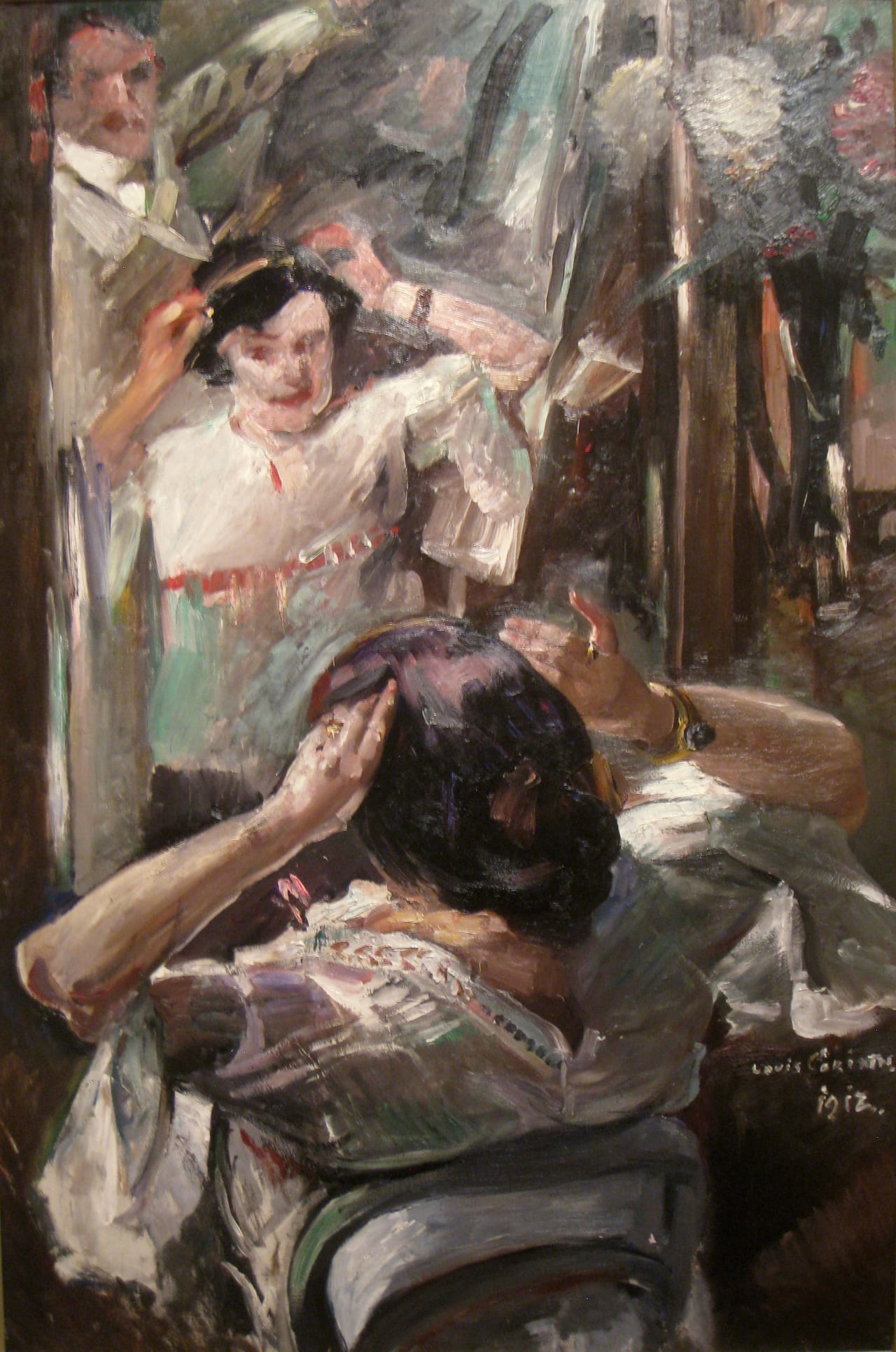
Lovis Corinth
After he settled in Berlin in 1901, Corinth’s loose brushwork and strong colours were often described as Expressionist; yet he opposed the rise of Expressionism by keeping its artists out of Secession exhibitions. He later came to accept its merits and embraced its intensely emotional approach in his own work. After a stroke in 1911 left him partly paralysed, his brushwork grew more vigorous, and the work he did after 1911 is often considered his best.
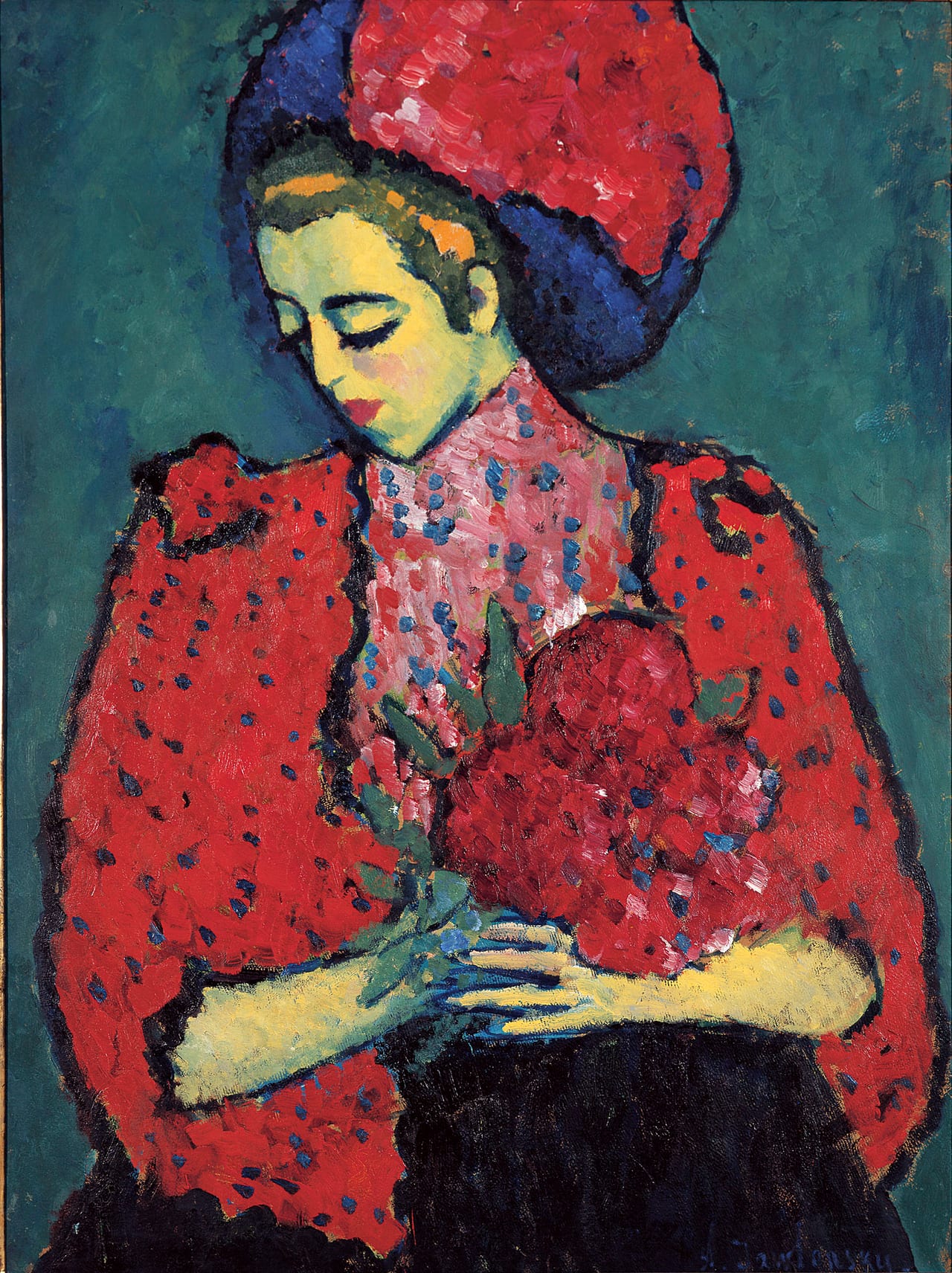
Alexej von Jawlensky
Jawlensky left an established career in the Russian Imperial Guard in 1889 to study painting with Ilya Repin, and in 1896 he moved to Munich, where he met Kandinsky, a lifelong influence. In France in 1905 he worked with Henri Matisse, whose flat areas of vibrant colour also shaped his work. Back in Munich he joined the Neue Künstlervereinigung, though he was more sympathetic to its splinter group, Der Blaue Reiter.
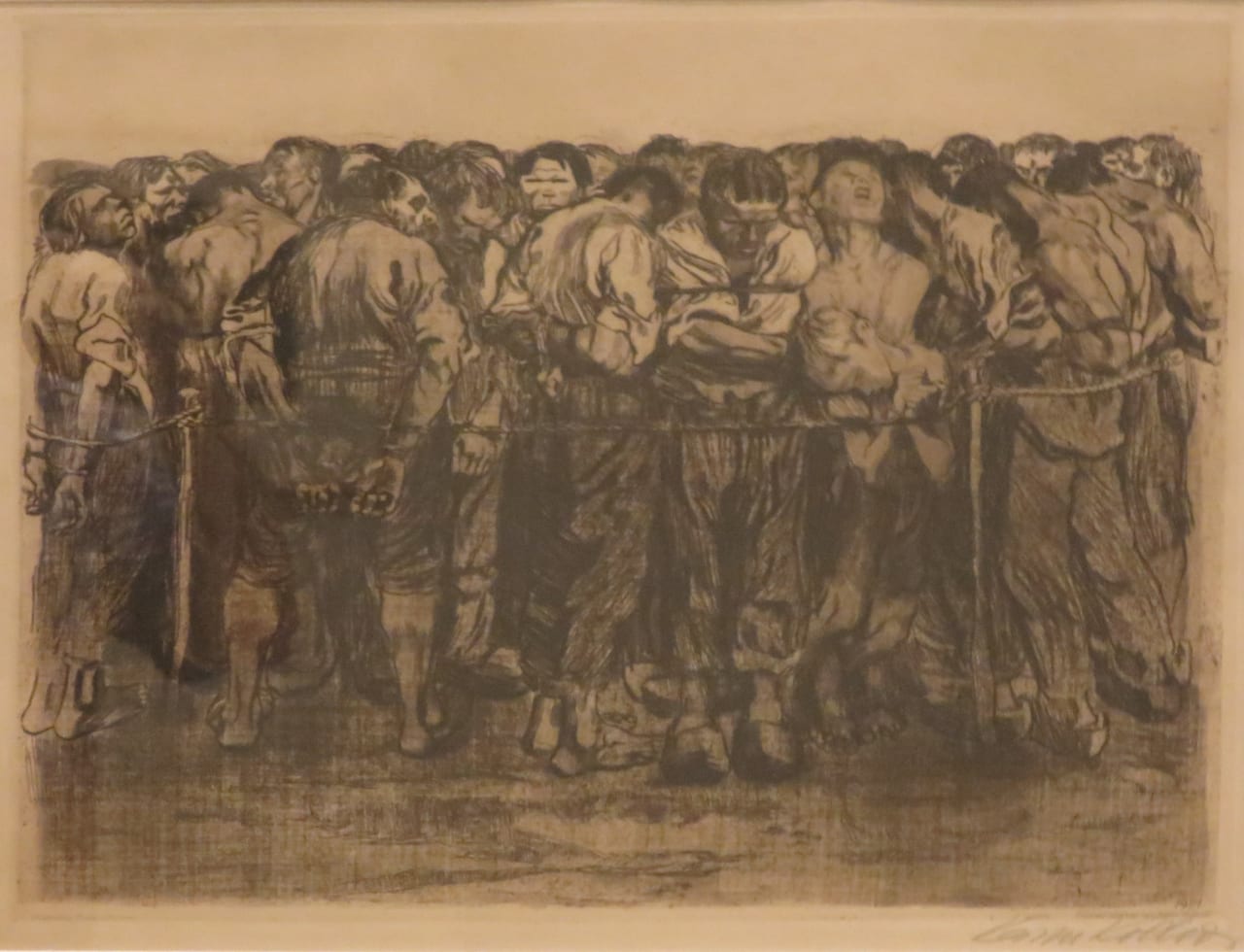
Käthe Kollwitz
The Prisoners is one of the seven etchings of The Peasant War, Kollwitz’s second major cycle. Her most famous cycles, among them The Weavers and The Peasant War, show the effects of poverty, hunger and war on the working class. Impressed by the prints of Max Klinger, she gave herself chiefly to graphic art after 1890. She is often considered the foremost artist of social protest of the twentieth century.
Artworks
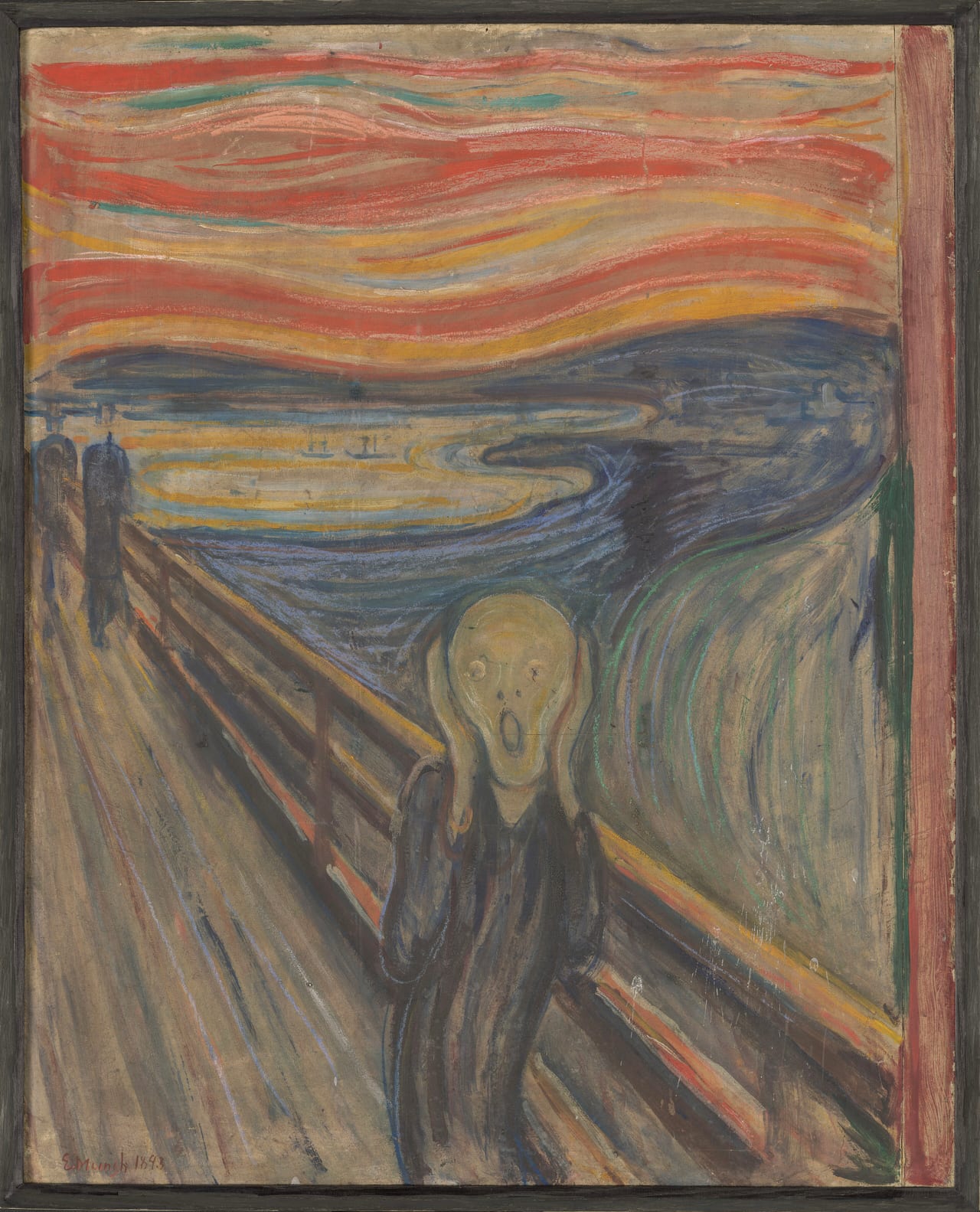
The Scream
Edvard Munch · 1893
National Museum of Art, Architecture and Design
Munch changed the clearly defined man of his earlier painting Despair into a schematic human face that is hard to categorise, and turned it to face the viewer head on, which makes the image confrontational. Behind it the simplified landscape is recognisable as a representation of the fjord of Kristiania seen from Ekeberg, and two men, whom Munch called two friends, stroll in the background on the left. In a prose poem in a notebook he wrote of walking with two friends at sunset when the sky “turned blood red”, and how he “sensed an infinite scream passing through nature”. Of the two painted versions, it is now widely agreed that this one is of 1893 and the Munch Museum’s no earlier than 1910. Olaf Schou bought it in 1910 and gave it to the museum at once.
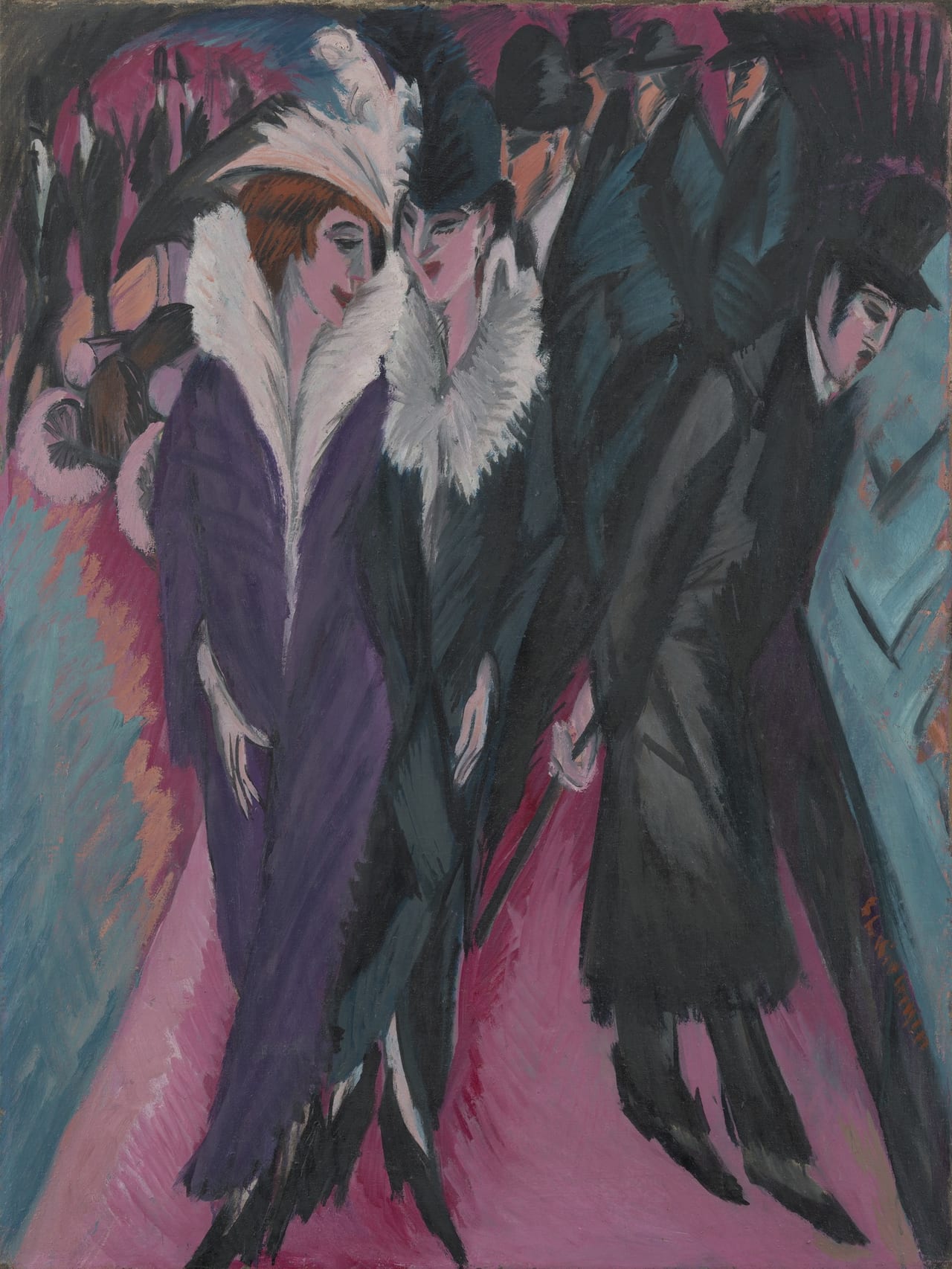
Street, Berlin
Ernst Ludwig Kirchner · 1913
Museum of Modern Art
Kirchner’s second version of Street, Berlin, of 1913, reinforces his sardonic view of Berlin’s jaded society. By 1911 Die Brücke’s activities had shifted to Berlin, where several of its members were living. Kirchner had founded the group in Dresden in 1905 with Fritz Bleyl, Erich Heckel and Karl Schmidt-Rottluff, none of them trained in the visual arts.
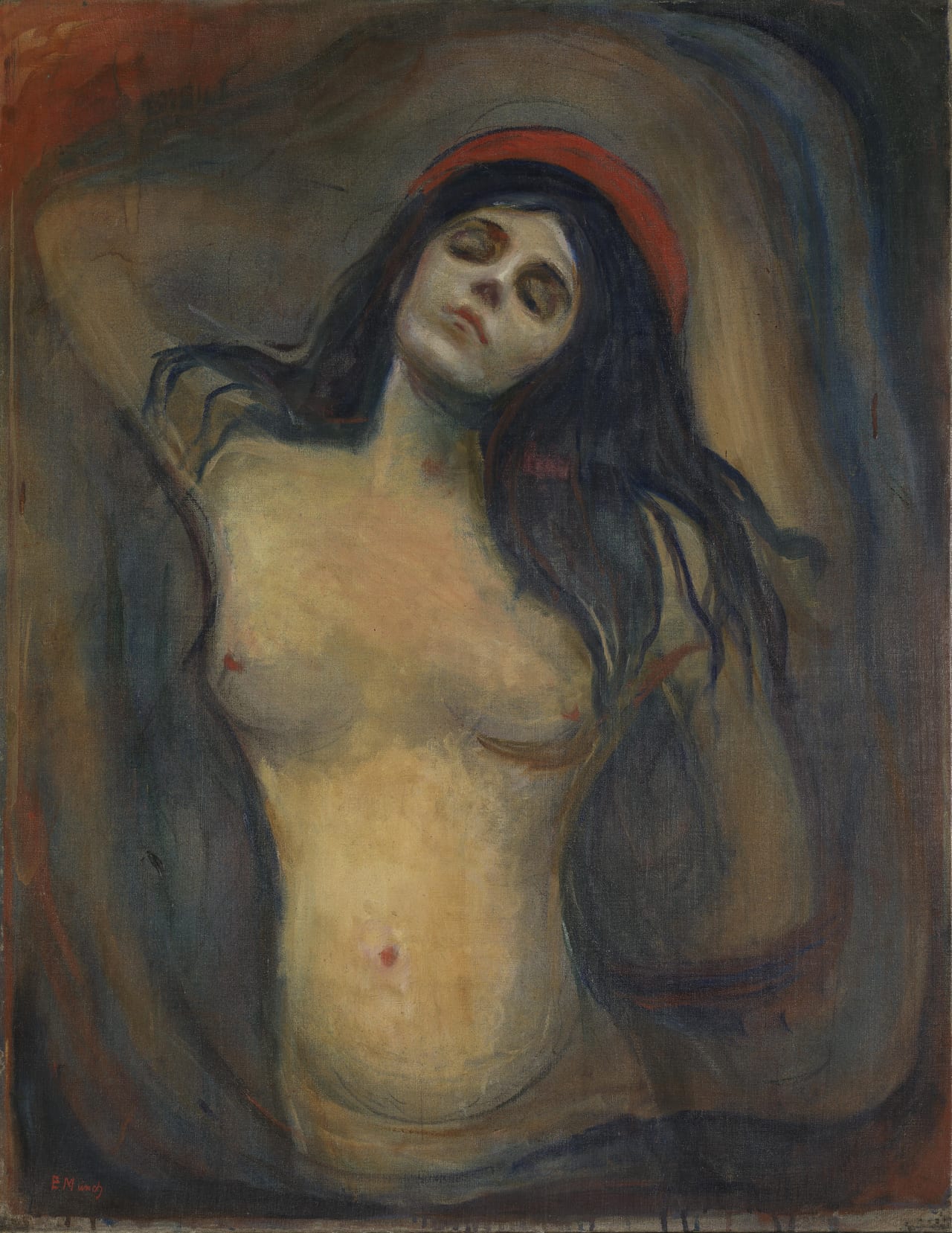
Madonna
Edvard Munch
National Museum of Art, Architecture and Design
A woman seen at half length arches her back, one arm behind her head and the other behind her back; her eyes are closed and she seems almost to float against a ground of undulating, quivering lines. Her halo is red, not gold as it would be in a religious image, and the picture joins erotic and religious associations: the woman is at once a lover and an exalted, holy figure. None of the five versions of the subject carries a date; recent research has confirmed that this one is the first. Olaf Schou gave it to the National Gallery in 1909.
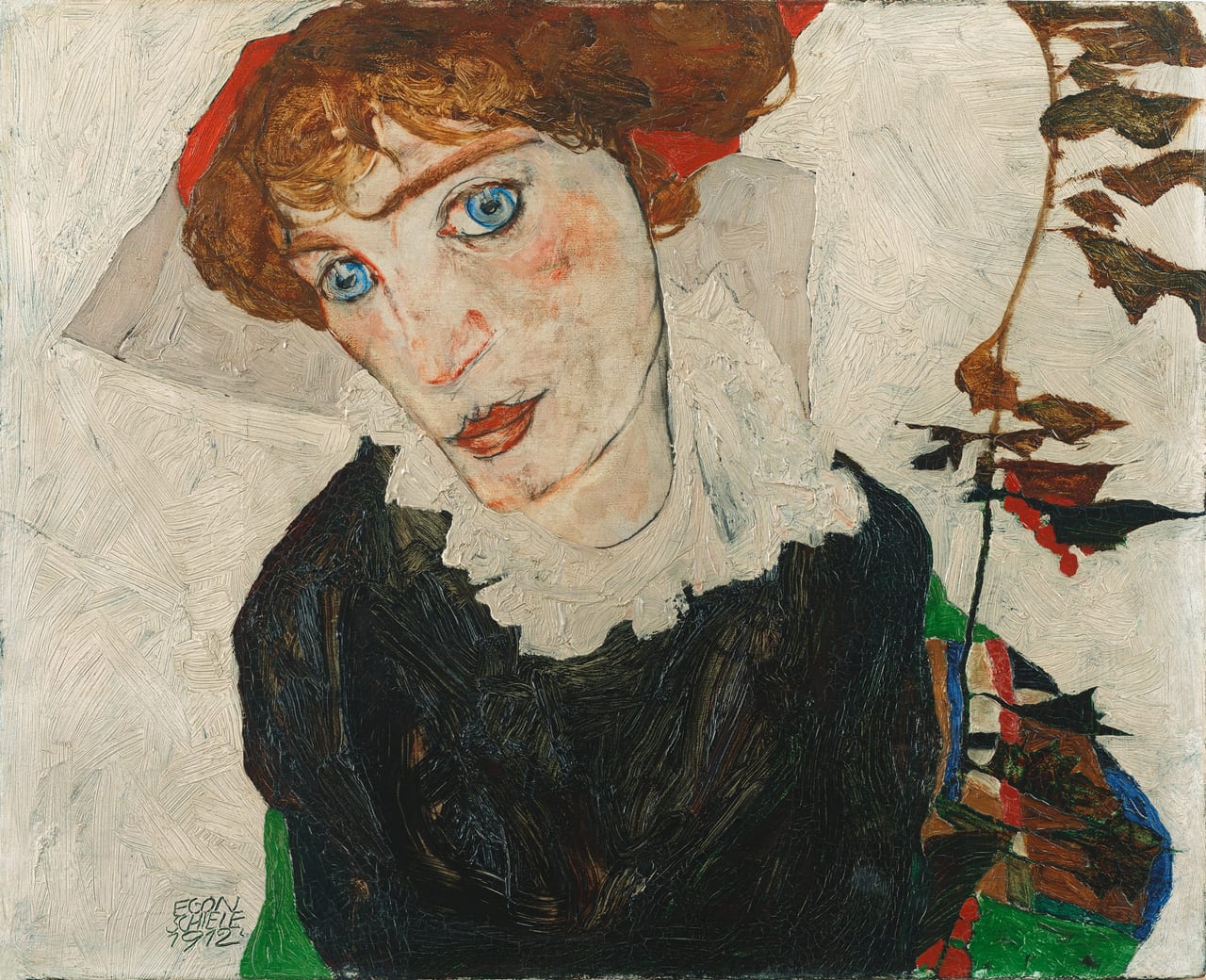
Portrait of Wally
Egon Schiele · 1912
Leopold Museum
Schiele’s portrait of Walburga “Wally” Neuzil, his lover and model for several years. In February 1915 Schiele wrote to a friend that he intended to get married; when he told Wally, she left him at once; she trained as a nurse and died of scarlet fever in Dalmatia in 1917. In 1939 its owner, the Jewish art dealer Lea Bondi Jaray, gave it up under duress to the dealer Friedrich Welz. In January 1998 it was subpoenaed in New York on the claim that it was Nazi loot. In July 2010 the Leopold Museum agreed to pay Lea Bondi Jaray’s heirs $19 million to address all outstanding claims on the painting.
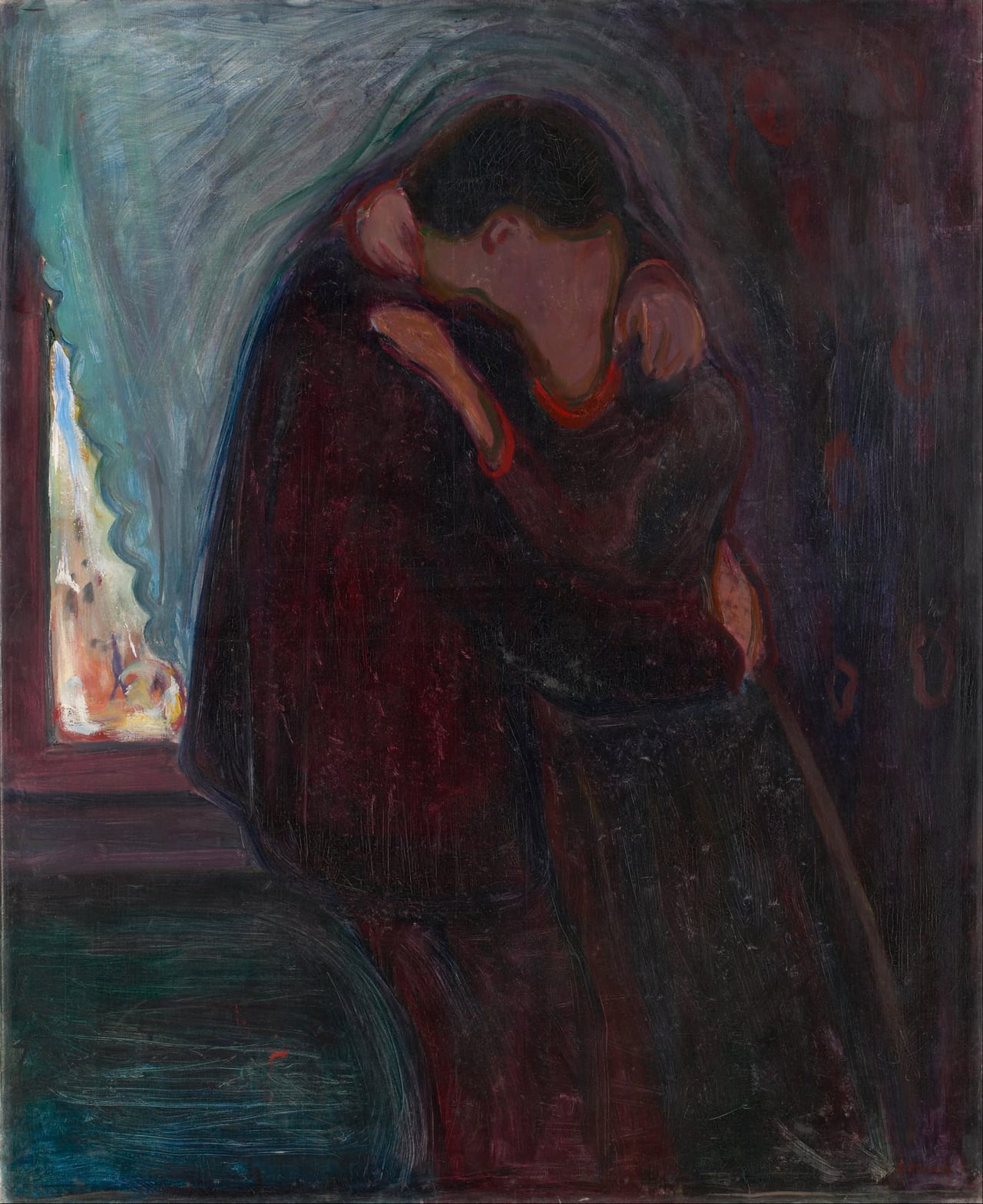
The Kiss
Edvard Munch · 1897
Munch Museum
A couple surrounded by darkness, with only a sliver of daylight through a window mostly covered by a curtain, hold an embrace and seem to merge into one, their faces a single featureless shape. Munch had experimented with the motif of a couple kissing as early as 1888–89; completed in 1897, this painting is part of the Frieze of Life, his cycle on the stages of a relationship between men and women.
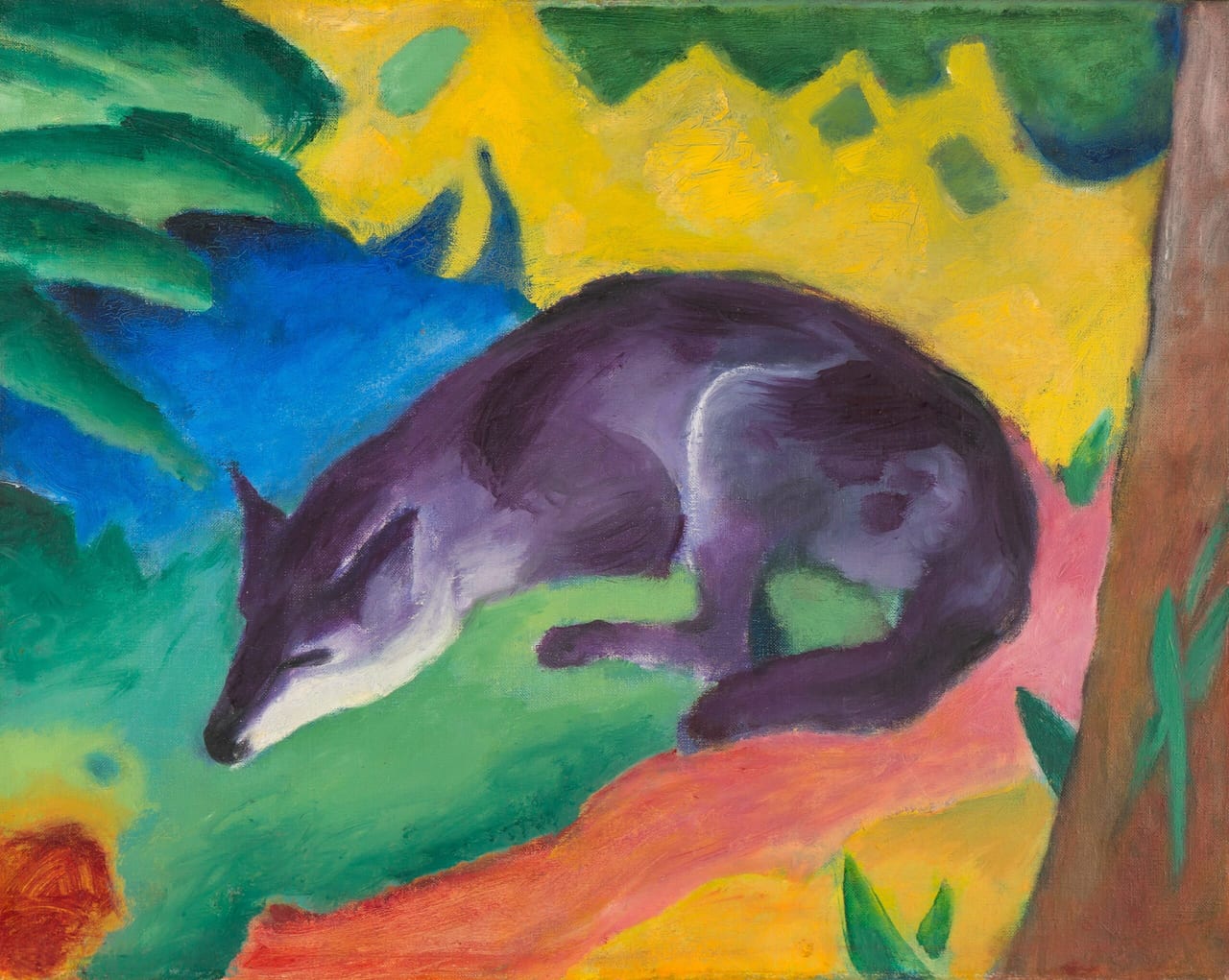
Fox
Franz Marc · 1911
Von der Heydt Museum
Marc painted Fox in July 1911 in August Macke’s studio in Bonn, on his way back from England, a few months before the first Blaue Reiter exhibition. A blue fox lies half-curled under a tree; around it an abstract landscape of strong complementary contrasts, of blue and yellow and of orange, red and green, recalls the effect of French Fauvism on German Expressionism. Marc built its colour on the system of the spectrum, primary and secondary. Eduard von der Heydt gave it to the Von der Heydt Museum in Wuppertal in 1952.
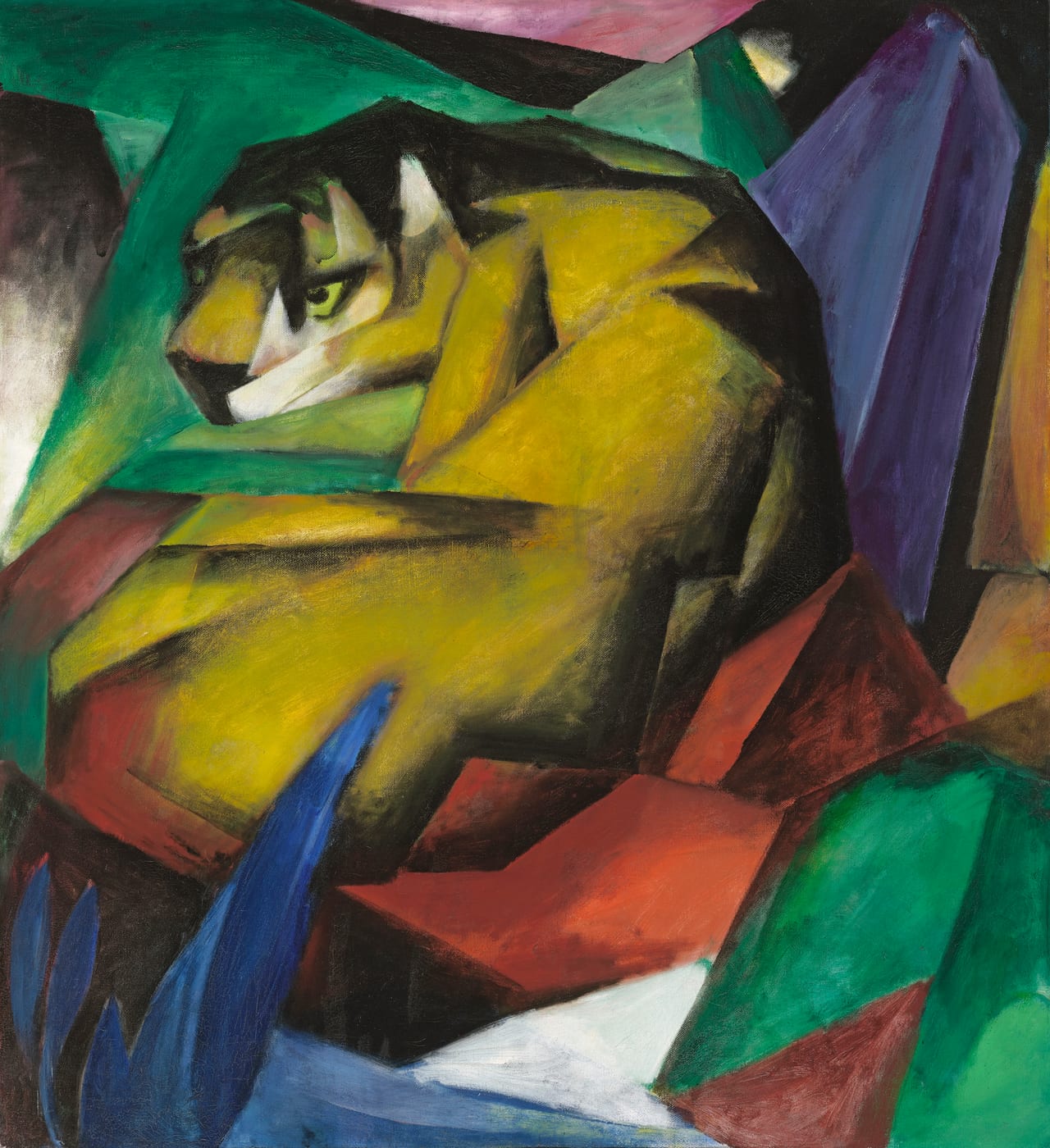
The Tiger
Franz Marc · 1912
Lenbachhaus
Marc painted The Tiger in 1912, and The Tower of Blue Horses and Fate of the Animals the following year. In 1912 his admiration for Robert Delaunay and the Italian Futurists made his art increasingly abstract, and he took up the faceted forms and space of Delaunay’s brightly coloured Orphist compositions to express the brutal power and timorous fragility of animal life.
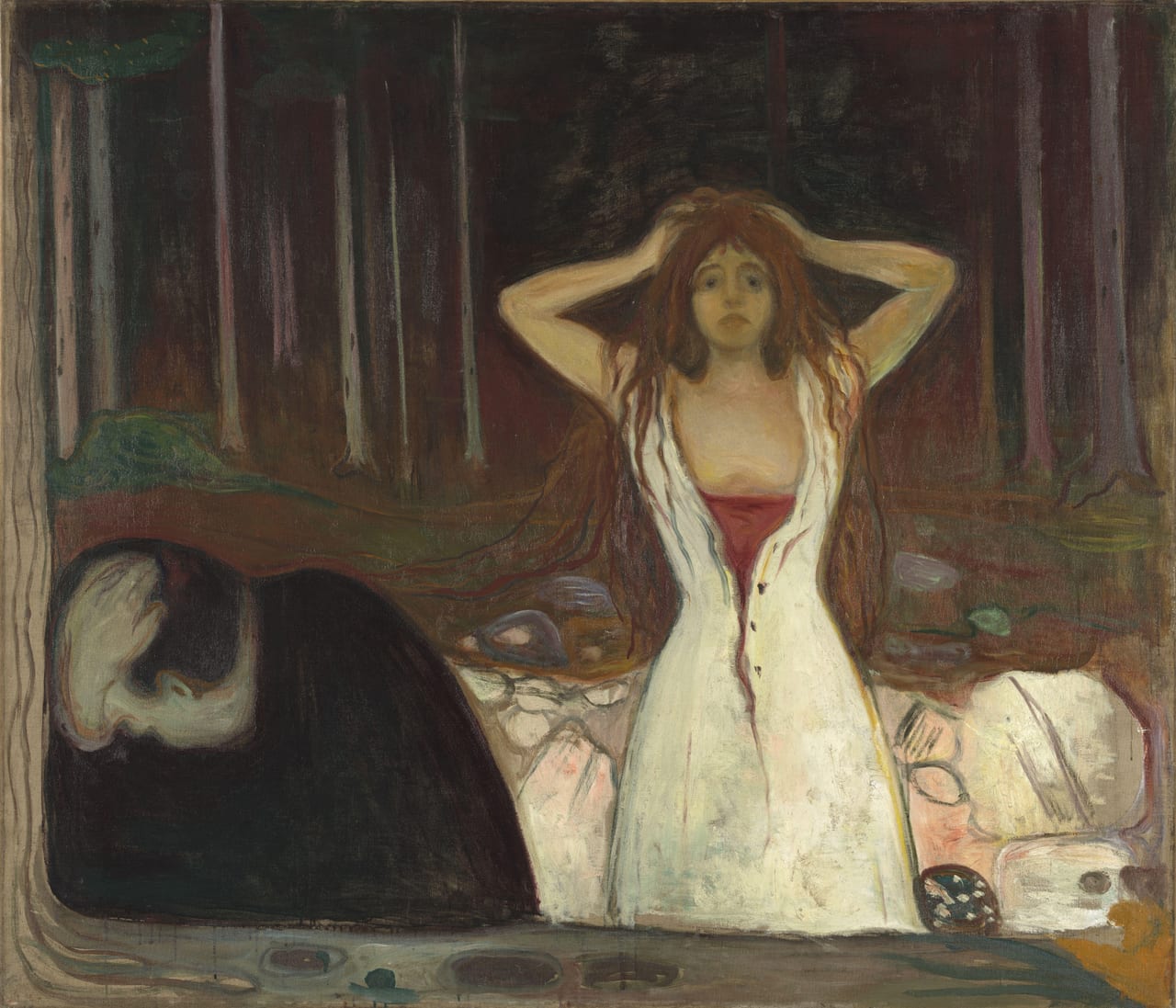
Ashes
Edvard Munch
National Museum of Art, Architecture and Design
A woman in pale clothing faces us before a dark background of slender tree trunks, wide-eyed, her hair loose and her bodice open, her hands high on her head. At the lower left a man sits with his back to her, withdrawn, his hands held dejectedly to his head; her long red hair is the only contact between them. On a lithograph of the motif Munch wrote “I felt our love lying on the earth like a heap of ash”. It was bought for the museum in 1909.
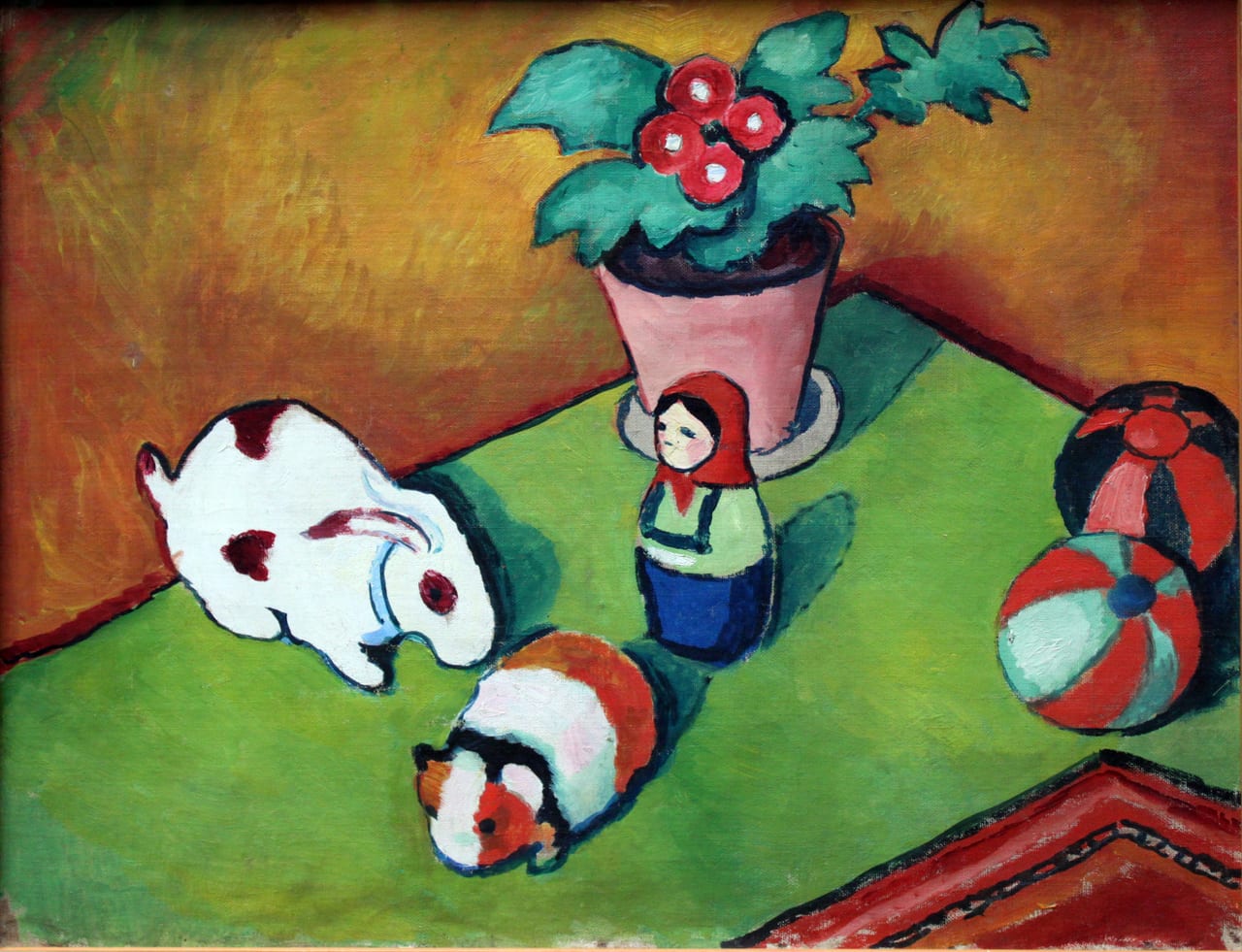
Little Walter’s Toys
August Macke
Städel Museum
Macke often took his portrait subjects from his own surroundings, and he painted his first son, Walter, born on 13 April 1910, again and again. Here the boy is absent, represented by his toys, stuffed animals, balls and a Russian doll that the artist arranged on a tablecloth. Bright colours and outlined objects flatten the picture’s structure, a style that goes back to Macke’s intense study of Henri Matisse. In 1959 the city of Frankfurt could afford to buy only this painting of the two the museum association wanted, the other being Otto Dix’s The Artist’s Family.
Sources
- Britannica, “Expressionism”
- Tate, “Expressionism”
- Britannica, “Die Brücke”
- Wikipedia, “Die Brücke”
- Tate, “Brücke”
- Britannica, “Der Blaue Reiter”
- Wikipedia, “Der Blaue Reiter”
- Britannica, “Edvard Munch”
- National Museum, Oslo, “The Scream”
- Britannica, “Ernst Ludwig Kirchner”
- Museum of Modern Art, “Ernst Ludwig Kirchner. Street, Berlin”
- Wikipedia, “Self-Portrait as a Soldier”
- Britannica, “Franz Marc”
- Wikipedia, “Franz Marc”
- Wikipedia, “The Tower of Blue Horses”
- Wikipedia, “Fox (Marc)”
- Britannica, “Wassily Kandinsky”
- Wikipedia, “Composition VII”
- Britannica, “Egon Schiele”
- Wikipedia, “Death and the Maiden (Schiele)”
- Wikipedia, “Portrait of Wally”
- Wikipedia, “Dead City III”
- Britannica, “August Macke”
- Wikipedia, “August Macke”
- Städel Museum, “Little Walter’s Toys”
- Britannica, “Max Beckmann”
- Wikipedia, “The Night (Beckmann)”
- National Museum, Oslo, “Madonna”
- National Museum, Oslo, “Ashes”
- Wikipedia, “Anxiety (Munch)”
- Wikipedia, “The Kiss (Munch)”
- Wikipedia, “Otto Mueller”
- Britannica, “Paula Modersohn-Becker”
- Britannica, “Lovis Corinth”
- Britannica, “Alexey von Jawlensky”
- Britannica, “Käthe Kollwitz”
- Wikipedia, “Käthe Kollwitz”
- Dead City III — Public domain via Wikimedia Commons (Public domain)
- Anxiety — Public domain via Wikimedia Commons (Public domain)
- Self-Portrait as a Soldier — Public domain via Wikimedia Commons (Public domain)
- The Tower of Blue Horses — Public domain via Wikimedia Commons (Public domain)
- Composition VII — Public domain via Wikimedia Commons (Public domain)
- Death and the Maiden — Public domain via Wikimedia Commons (Public domain)
- Turkish Café — Public domain via Wikimedia Commons (Public domain)
- The Night — Public domain via Wikimedia Commons (Public domain)
- Half-Length Portrait of Two Nude Women — Public domain via Wikimedia Commons (Public domain)
- Girl in Dusk with Plaid Blouse — Public domain via Wikimedia Commons (Public domain)
- At the Mirror — Public domain via Wikimedia Commons (Public domain)
- Young Girl with Peonies — Public domain via Wikimedia Commons (Public domain)
- The Prisoners — Public domain via Wikimedia Commons (Public domain)
- The Scream — Public domain via Wikimedia Commons (Public domain)
- Street, Berlin — Public domain via Wikimedia Commons (Public domain)
- Madonna — Public domain via Wikimedia Commons (Public domain)
- Portrait of Wally — Public domain via Wikimedia Commons (Public domain)
- The Kiss — Public domain via Wikimedia Commons (Public domain)
- Fox — Public domain via Wikimedia Commons (Public domain)
- The Tiger — Public domain via Wikimedia Commons (Public domain)
- Ashes — Public domain via Wikimedia Commons (Public domain)
- Little Walter’s Toys — Public domain via Wikimedia Commons (Public domain)
Invite Expressionism into your living room