Port of La Rochelle
Paul Signac · 1915

Pointillism
France
In pointillist painting, small strokes or dots of colour are applied to a surface so that, seen from a distance, they blend together. The technique is associated with Georges Seurat, its inventor, and with such works of his as A Sunday Afternoon on the Island of La Grande Jatte, painted from 1884 to 1886, and Bathers at Asnières. The showing of A Sunday Afternoon on the Island of La Grande Jatte at the last major Impressionist exhibition, in 1886, beside pointillist works by Paul Signac and Camille Pissarro, established Neo-Impressionism. Seurat died suddenly in 1891, aged only 31; Signac then led the movement, which lasted until about 1906.
- Monumental paintings Seurat left at his death
- 7
- Smaller paintings and sketches by Seurat besides them
- 40
- Drawings Seurat left
- About 500
- Oil paintings by Maximilien Luce
- 2,000+
Seurat and a new Impressionism
Neo-Impressionism, a movement in French painting of the late nineteenth century, turned against the empirical realism of Impressionism and relied instead on systematic calculation and scientific theory to reach effects decided in advance. The Impressionists had recorded nature spontaneously, in the passing effects of colour and light; the Neo-Impressionists brought the principles of optics to bear on light and colour and built strictly ordered compositions. Seurat, its original theorist and most significant artist, led the movement with Paul Signac, also an important artist and its major spokesman. Henri-Edmond Cross, Albert Dubois-Pillet, Maximilien Luce and Théo van Rysselberghe were among the others, with, for a time, the Impressionist Camille Pissarro.
The words divisionism and pointillism both began as descriptions of Seurat’s way of painting, in which dots of contrasting pigment were applied to the canvas. The dots were arranged by calculation, on the basis of optical science, and were meant to be perceived by the retina as a single hue; they covered the whole canvas, defined form without lines, and in each picture were of one size, matched to the size of the painting. The two words are not quite the same: divisionism refers to the separation of colour and its optical effects, pointillism only to the technique of applying dots. Seurat himself called his system “chromo-luminarism”, and it did away with traditional line drawing. In place of the hazy forms of Impressionism, the forms of Neo-Impressionism were solid and clear; its light was as brilliant, but the effect was of a still, harmonious monumentality.
Seurat was born in Paris in 1859. In 1878 he entered the École des Beaux-Arts, in the class of Henri Lehmann, a follower of Ingres, and all through his short career he showed an unusually strong interest in the intellectual and scientific grounds of art. He met the chemist Michel-Eugène Chevreul, then a hundred years old, and experimented with his theories of the chromatic circle of light. When the Salon jury refused his Bathers at Asnières in 1884, he joined in founding the Groupe des Artistes Indépendants, a body “with neither jury nor prizes”, and showed the picture there in June. Paul Signac, for his part, helped found the Salon des Indépendants in 1884, and it was at the Salon des Indépendants that he met Seurat.
Seurat worked on the island of La Grande Jatte through the winter of 1885 and spent the summer at Grandcamp in Normandy, and in this period Signac introduced him to the Impressionist master Camille Pissarro, who was for a time converted to pointillism. Seurat finished A Sunday Afternoon on the Island of La Grande Jatte and showed it at an Impressionist group show from 15 May to 15 June 1886, the eighth Impressionist exhibition, to which Pissarro had invited him and Signac. Its showing at that last major Impressionist exhibition, with pointillist works by Signac and Pissarro, established Neo-Impressionism, and the critic Félix Fénéon, seeing the pointillist works there, coined the name Neo-Impressionists for the small group, which then included Signac, Camille Pissarro and his son Lucien, Albert Dubois-Pillet, Henri-Edmond Cross and Charles Angrand. The picture aroused great interest, and torrents of negative criticism; Fénéon praised Seurat’s method in an avant-garde review.
Seurat’s last pictures
In 1887, while living for a time in a garret studio, Seurat began Les Poseuses, the last of his pictures as large in scale as A Sunday Afternoon on the Island of La Grande Jatte and Bathers at Asnières; he finished it the following year, together with Parade de cirque. He kept to a theoretical approach to the problems of painting, down to reducing the expressive qualities of colour and form to scientific formulas. In 1890, the year Madeleine Knobloch bore him a son, he completed Le Chahut, which he sent to the exhibition of Les XX in Brussels, and that summer, at Gravelines near Dunkirk, he painted a number of landscapes and planned The Circus, which would be his last painting.
Seurat showed The Circus, unfinished, at the Salon des Indépendants in March 1891; he was one of the exhibition’s organisers, and saw to the presentation and hanging of the works. He died in Paris on 29 March 1891, aged only 31. He left seven monumental paintings, along with some 40 smaller paintings and sketches, about 500 drawings and several sketchbooks.
Signac and the south
Paul Signac was born in Paris in 1863. At eighteen he left the study of architecture for painting, and through Armand Guillaumin he became a convert to Impressionism’s principles of colour. With Seurat he developed the method they called pointillism, the basis of Neo-Impressionism: like the Impressionists, they laid on paint in minute dabs of pure colour, but by an exact, almost scientific system rather than in the somewhat intuitive manner of the earlier masters. In watercolour Signac used the principle far more freely. After 1886 he showed regularly at the annual Salon des Indépendants, sending landscapes, seascapes and decorative panels, and as a sailor he travelled widely along the coasts of Europe, painting what he found there.
In his later work Signac used the divisionist technique with growing spontaneity, more in keeping with his poetic temperament. After Seurat’s death he took over as leader of the movement, and his book From Eugène Delacroix to Neo-Impressionism set out the principles of pointillism. In 1888 he had discovered anarchist ideas in the writings of Élisée Reclus, Kropotkin and Jean Grave, and he wrote for Grave’s paper Les Temps Nouveaux, as did his friends Charles Angrand, Camille Pissarro, Henri-Edmond Cross and Maximilien Luce. His painting of 1893 In the Time of Harmony was first called In the Time of Anarchy, until political repression of the anarchists forced him to change the title before a gallery would take the work.
Henri-Edmond Cross, despite his ties with the Neo-Impressionists, did not adopt their style for many years. He began painting in the Neo-Impressionist manner in 1891, the year he moved to the south of France for good, and in 1892 Signac settled nearby at Saint-Tropez; the two often hosted gatherings in Cross’s garden, attended by Henri Matisse, André Derain and Albert Marquet among others. In the early and mid-1890s Cross painted in a characteristically pointillist way, with tiny dots of colour placed close together and at regular intervals. From about 1895 he changed his technique by degrees, using broad, blocky strokes with small patches of bare canvas between them; the surfaces resemble mosaics, and the pictures may be seen as precursors of Fauvism and Cubism.
Matisse painted Luxe, calme et volupté after a summer working at Saint-Tropez beside Cross and Signac, and showed it at the Salon des Indépendants of 1905. It is the most important of his works in the divisionist technique Signac advocated, which Matisse had taken up after reading Signac’s essay. Signac was president of the Société des Artistes Indépendants from 1908 to the end of his life and used the post to encourage younger artists, showing the controversial works of the Fauves and the Cubists.
Brussels, and after
Neo-Impressionism reached beyond France after Seurat and Pissarro were invited to Les Vingt, a Brussels society of the avant-garde, and by 1889 the style had become the dominant one in Belgium. Théo van Rysselberghe, born in Ghent in 1862 and among the founders of Les XX, discovered pointillism in 1886, on seeing A Sunday Afternoon on the Island of La Grande Jatte at the eighth Impressionist exhibition in Paris; with Henry van de Velde he went on to head the many Belgian artists who adhered to Neo-Impressionism. His was a Neo-Impressionism of strictly objective foundations, and perhaps his greatest contribution to it was a series of portraits and group portraits, indoors and out, unique among the Neo-Impressionists. After 1903 his pointillist technique grew more relaxed, and after 1910 he gave it up altogether.
Maximilien Luce, an engraver who turned to painting full time in about 1883, was introduced in about 1884 to the divisionist technique Seurat had developed and began to paint in the pointillist style. Where Seurat was detached, Luce painted contemporary subjects with passion, depicting “violent effects of light”; Fénéon called him a “coarse, honest man, with a rough and muscular talent.” Suspected of involvement in the assassination of President Sadi Carnot, he was arrested on 8 July 1894, held in Mazas prison and released after his acquittal at the Trial of the Thirty. In the early twentieth century he went back to painting in an Impressionist manner.
Jan Toorop, who lived in Brussels from 1882 to 1886 and later joined Les XX there, worked in many styles, Pointillism among them; in 1900 he made a portrait of his friend Marie Jeanette de Lange in the pointillist style. In France, Henri Martin’s canvas at the Salon of 1889 won him the gold medal; the work has been described as pointillist. In Italy the influence of Seurat and Signac on some painters became evident at the first Triennale in Milan in 1891, and these Italian artists merged Neo-Impressionism with Symbolism, making allegorical paintings by a divisionist method.
Neo-Impressionism’s influence was fading by the 1890s, yet it mattered in the early development of several artists of the late nineteenth and early twentieth centuries, among them Paul Gauguin, Vincent van Gogh, Henri Matisse and Henri de Toulouse-Lautrec. Much later, it left its mark on Pop Art.
Artists
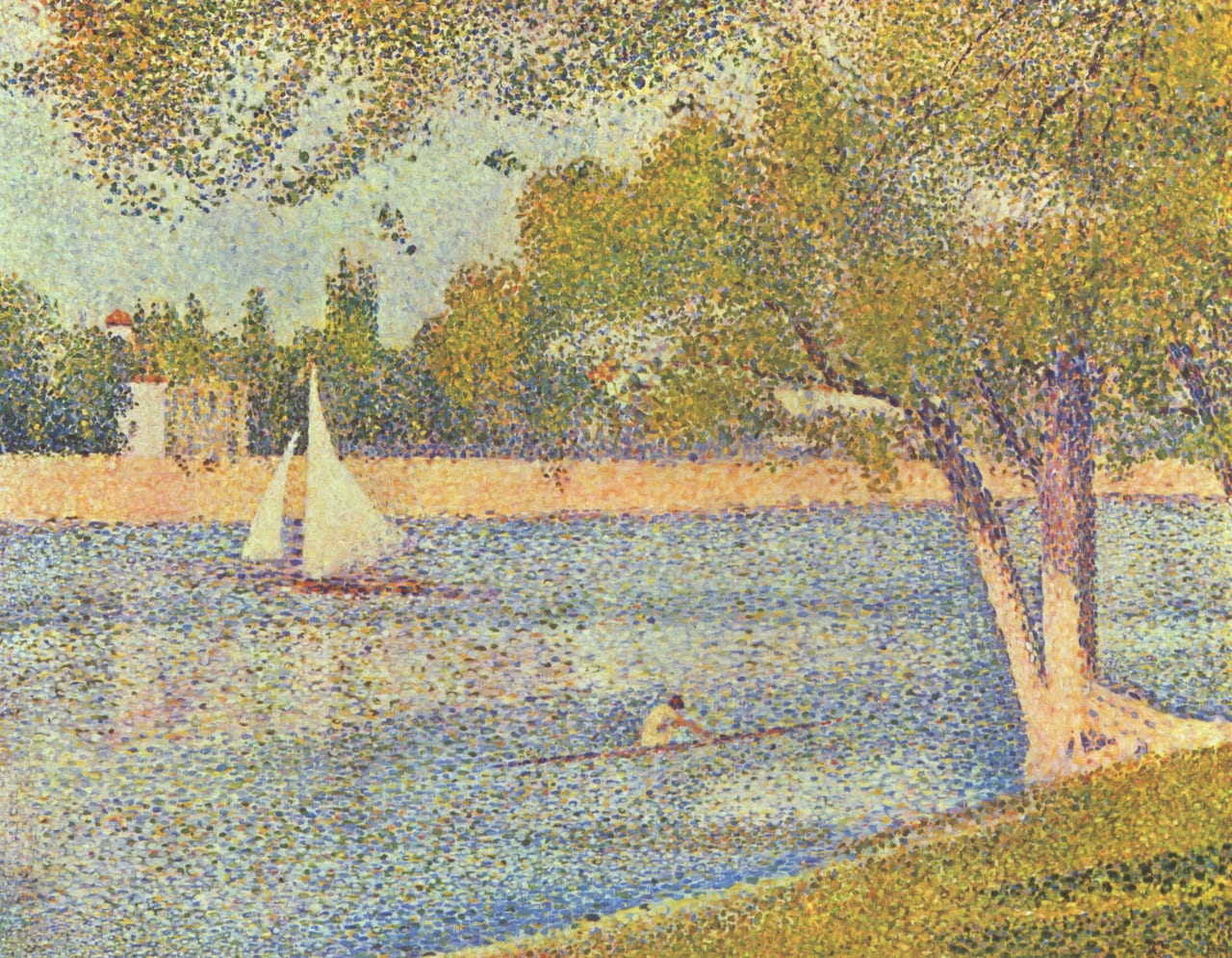
Seurat painted this view of the Seine in 1888 on pointillist principles, laying the paint on in thick dots: close to, each dot can be seen, while from a distance the whole canvas comes together and the dots merge. He used only pure colours, leaving the viewer’s eyes to mix them. The picture is built on triangles; its elements are not symmetrical, but the tree set opposite the sailing boat, with the building behind, gives it a certain balance. It entered the Royal Museums of Fine Arts of Belgium in Brussels in 1937, a bequest from the Belgian painter Anna Boch.
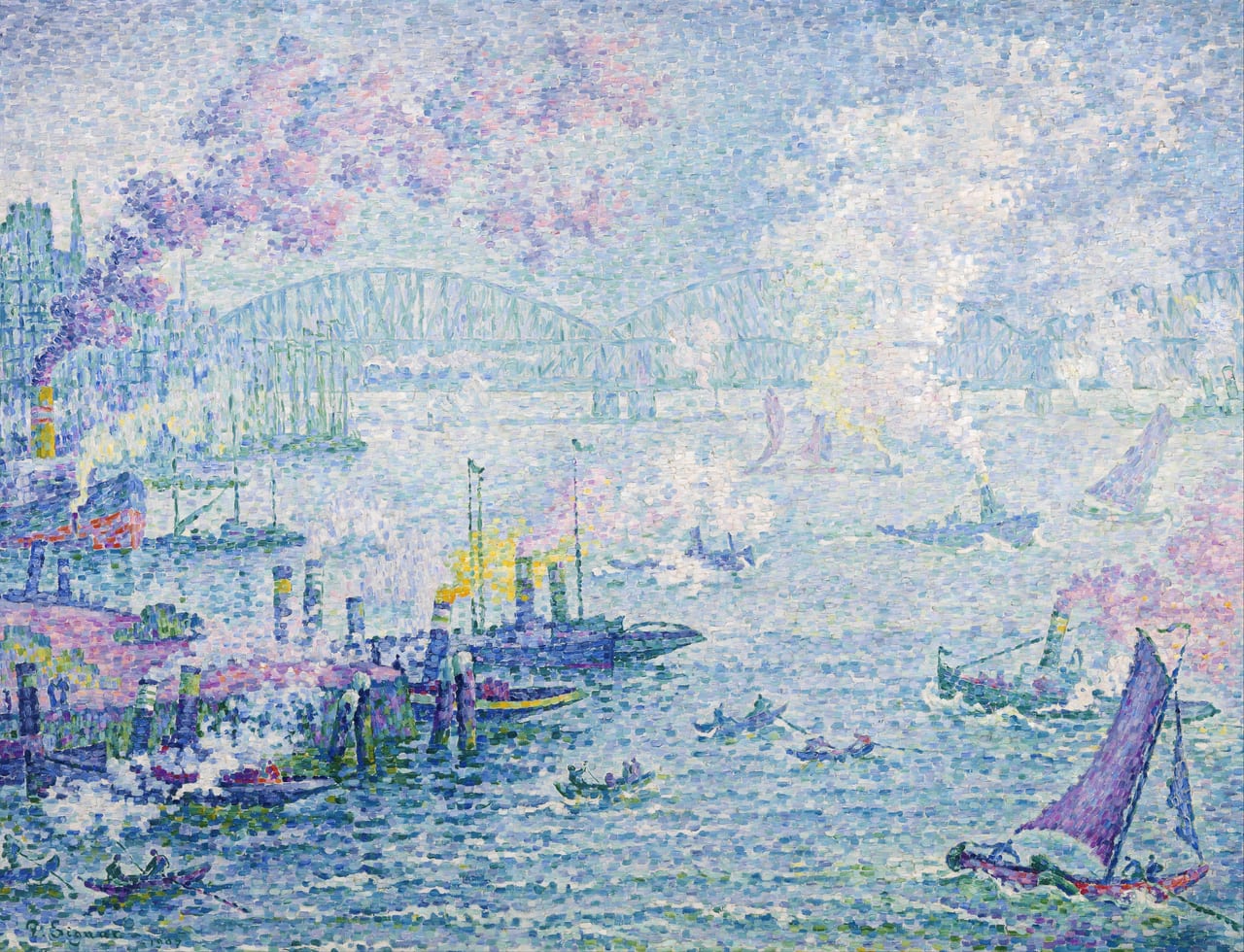
Paul Signac
Greatly impressed by the port of Rotterdam on a visit in 1906, Signac wrote on a postcard with a harbour scene: “From my window! What industriousness! I am enthusiastic, but amazed.” He made this painting the following year from a drawing, which the Museum Boijmans Van Beuningen also holds. Together, the individual dabs of paint create shimmering effects of light.
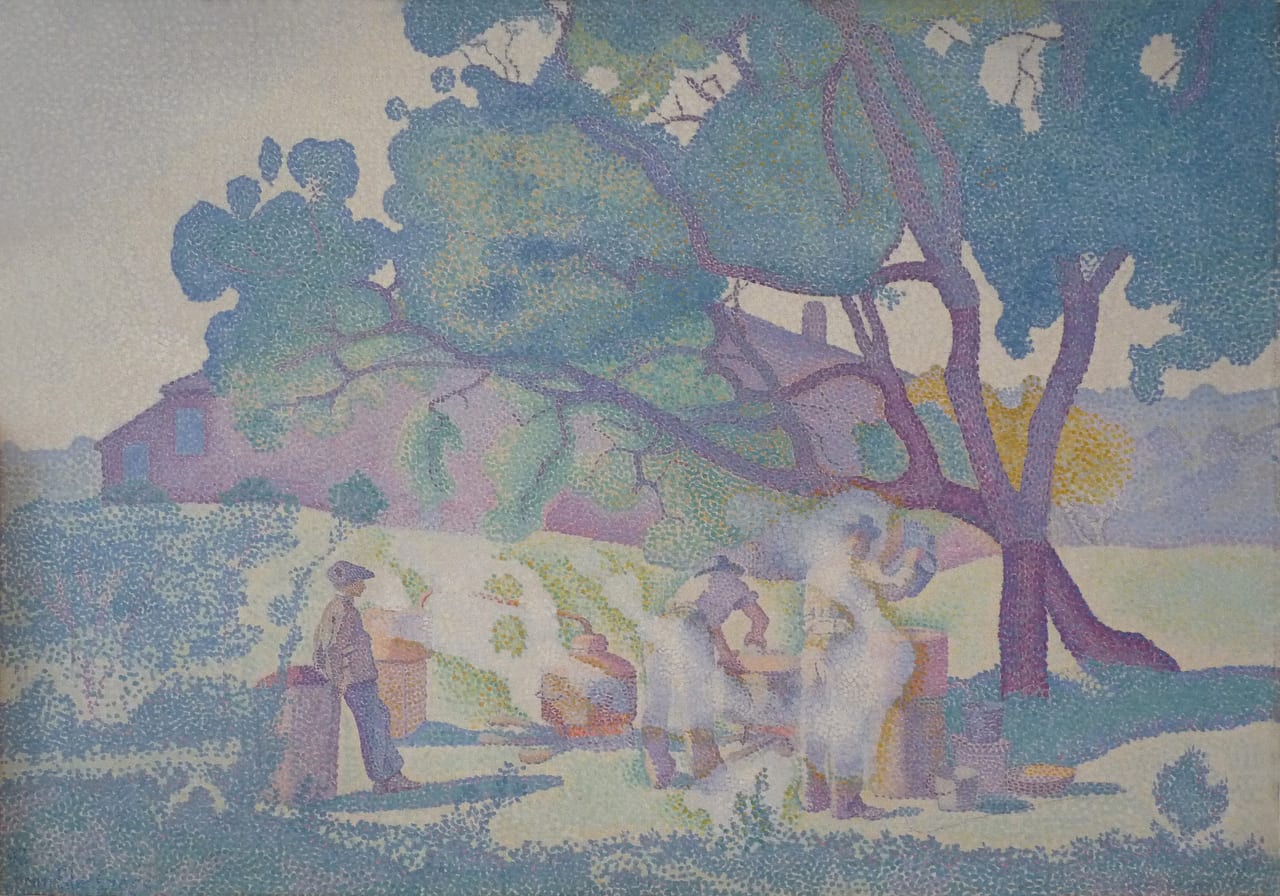
Henri-Edmond Cross
Also called Les Bouilleurs de cru, the painting of 1893 shows home distillers in the morning light, in a pointillist style. The curling smoke and the tree trunks, stylised in sinuous, decorative geometric curves, announce the Art Nouveau style, in particular its inspiration from japonisme. In 1904 Cross gave the picture to Henri Matisse, who gave him in exchange a view of the Luxembourg Gardens and Tulipes Perroquet I.
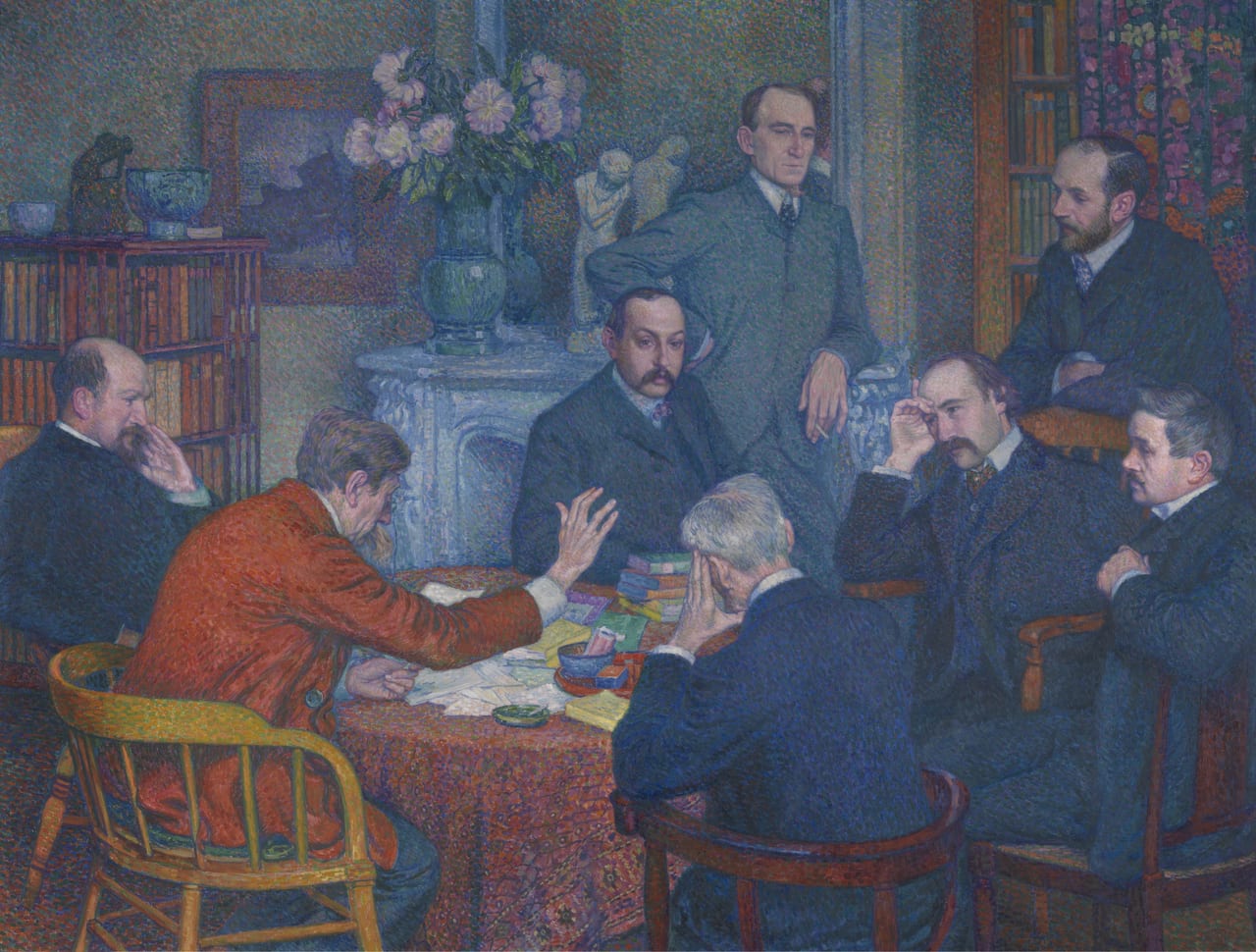
Théo van Rysselberghe
An imaginary gathering in the poet Emile Verhaeren’s flat at Saint-Cloud, where Verhaeren reads aloud from his own work. Among those listening are André Gide, Maurice Maeterlinck, Félix Fénéon, Henri-Edmond Cross, Francis Vielé-Griffin, Henri Ghéon and Félix Le Dantec. Verhaeren wears the bright red he habitually dressed in, against the dull blue of the others’ clothes. The painting, of 1903, is in the Museum of Fine Arts in Ghent.
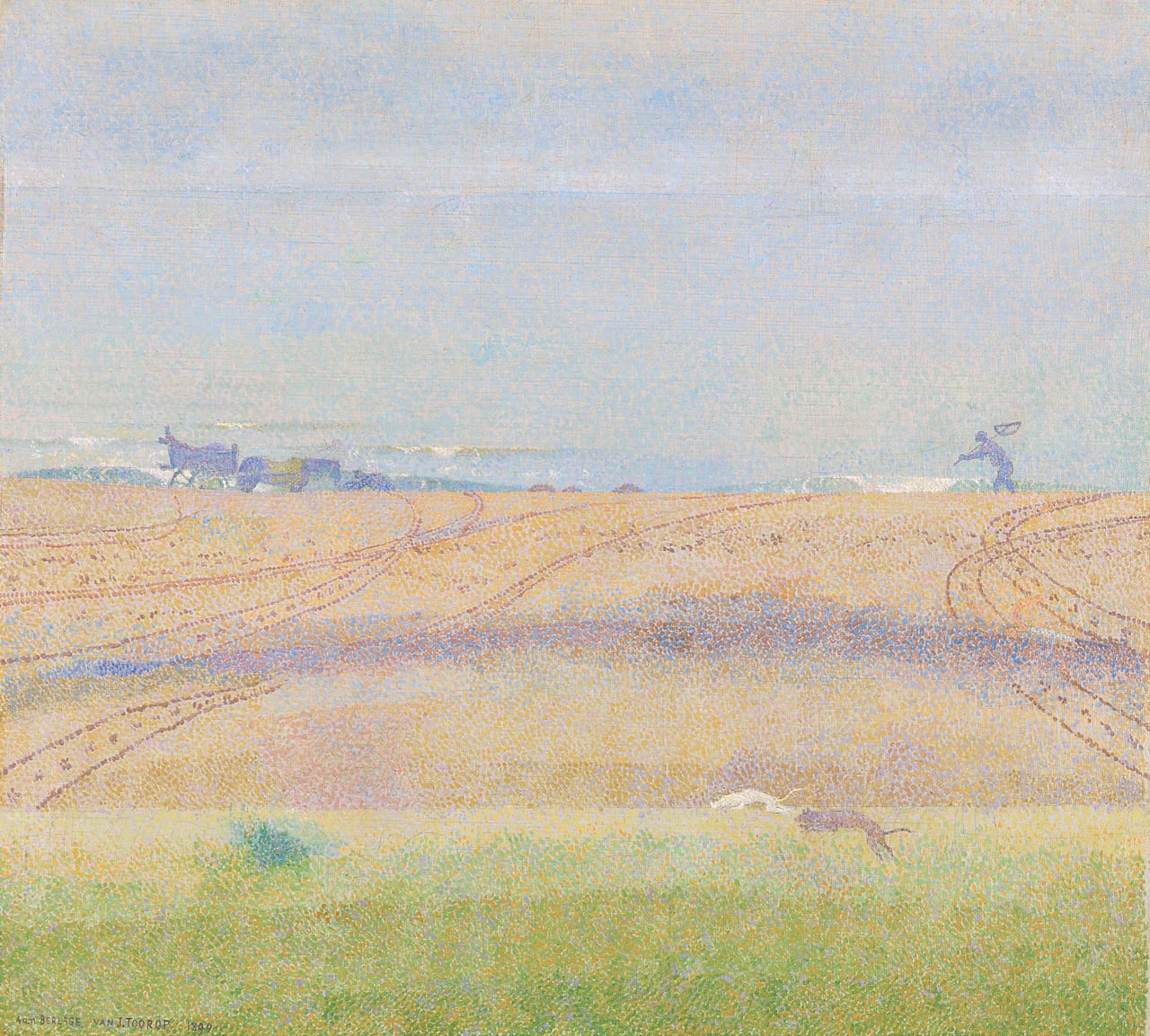
Jan Toorop
Toorop painted this mysterious, insubstantial seascape in the pointillist manner, building an optical effect from hundreds of small dots of pure, unmixed pigment that the eye reads as varied, mixed colours. The light ground shining between the dots gives the picture its luminosity, and its sense of translucency.
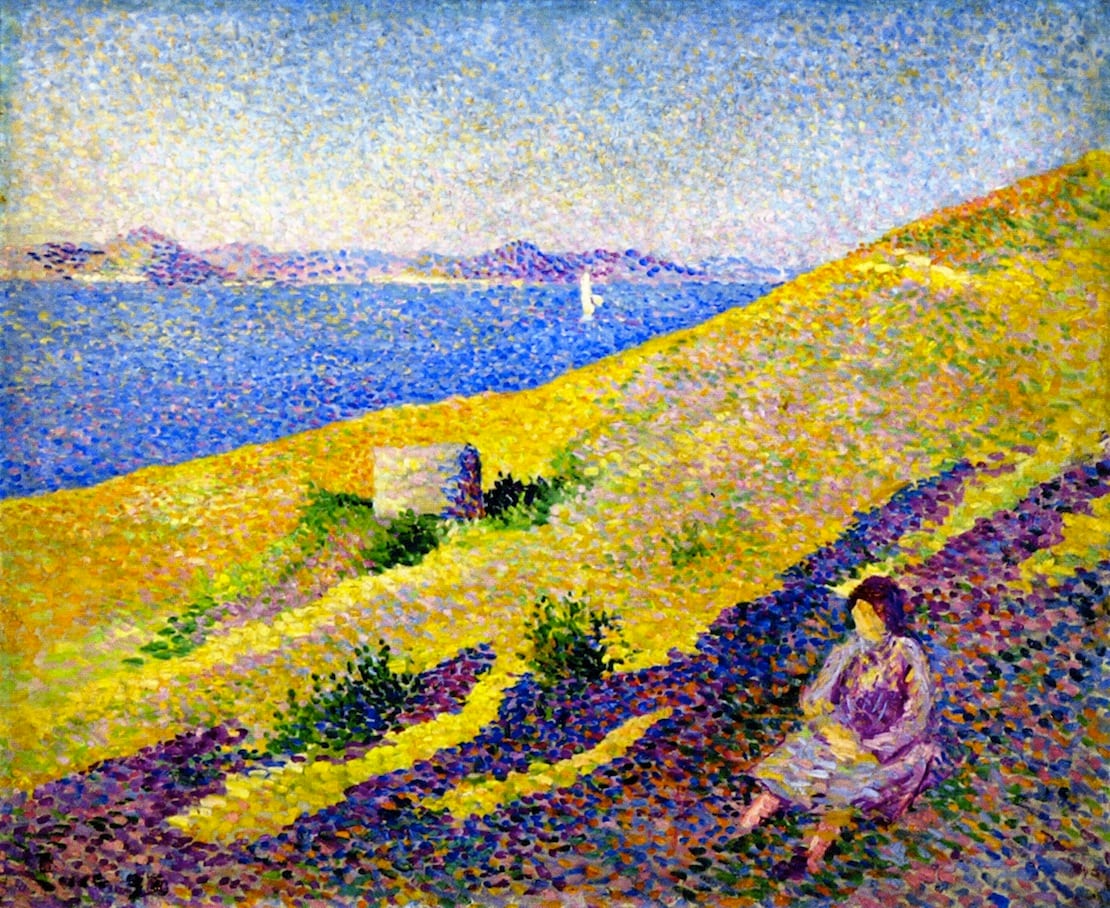
Maximilien Luce
Luce was among the most productive of the Neo-Impressionists, with over 2,000 oil paintings, a comparable number of watercolours, gouaches, pastels and drawings, and over a hundred prints. Most often he painted landscapes, but also portraits, still lifes, bathers and working men such as welders and rolling-mill hands. Except in 1915 to 1919 he showed at every Indépendants exhibition from 1887 until his death; elected president of the society in 1935, after Signac’s death, he resigned in 1940 in protest at Vichy laws that would have barred Jewish artists from it.
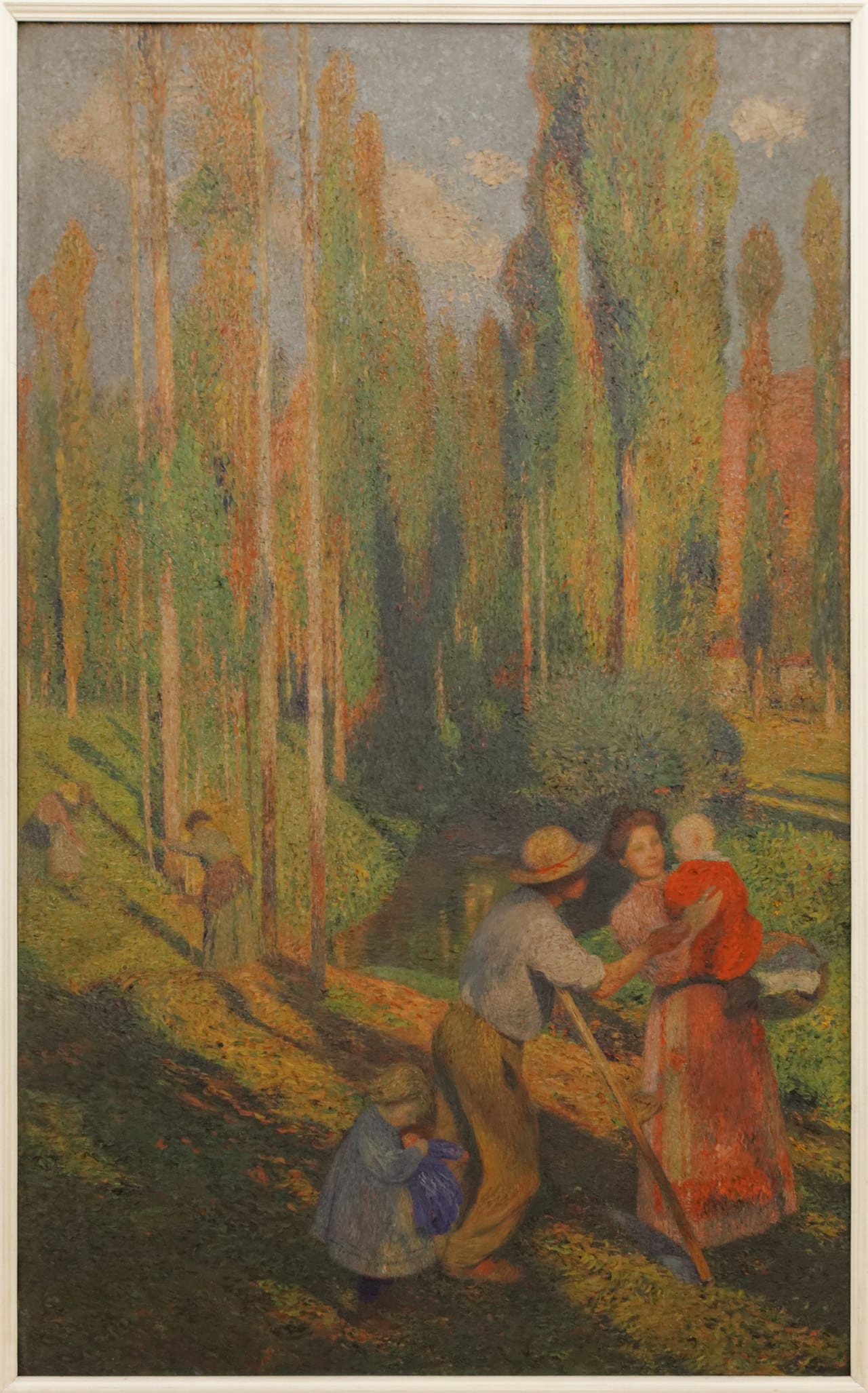
Henri Martin
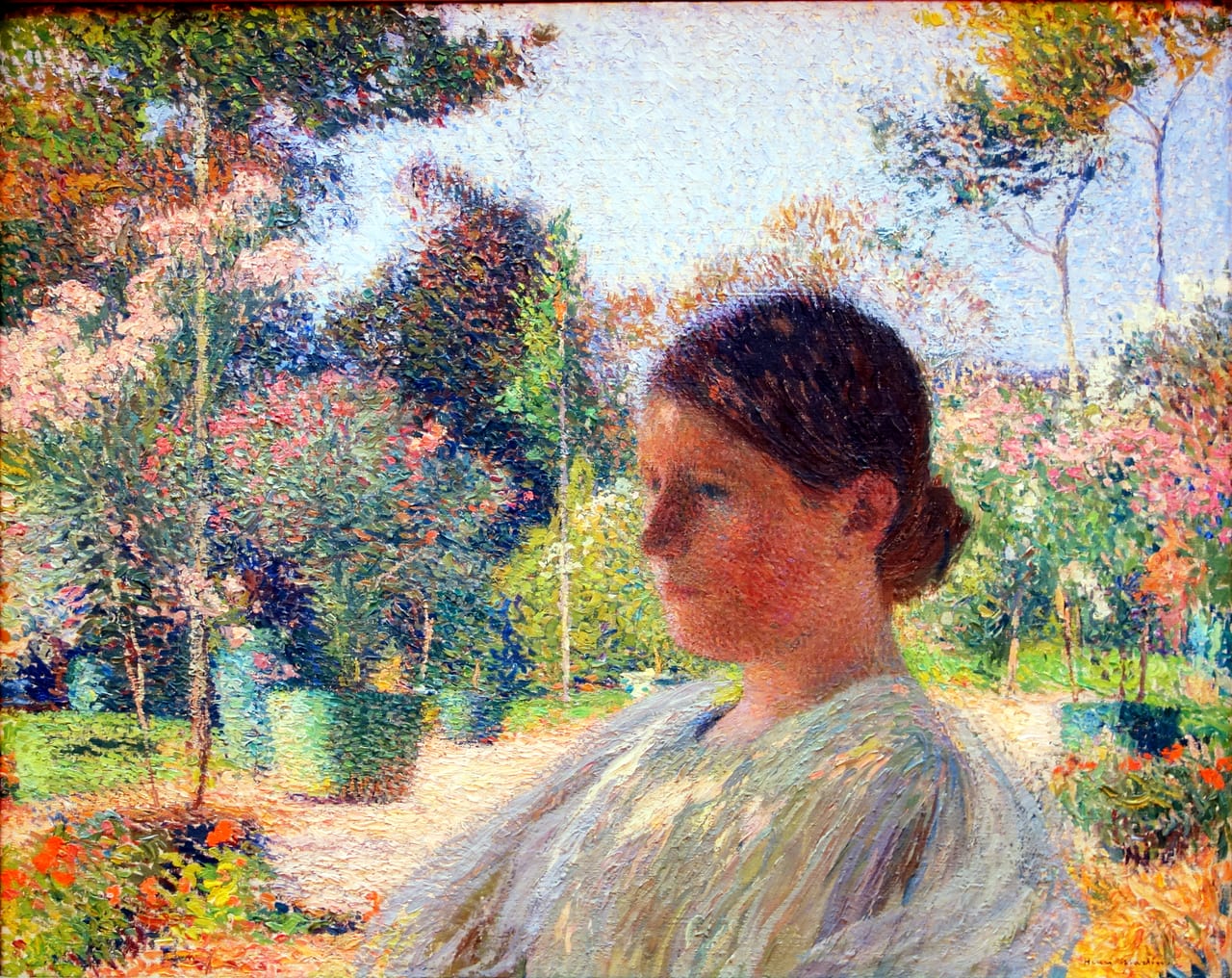
La Famille is by Henri Martin, who was born in 1860, moved to Paris in 1879 and studied in the studio of Jean-Paul Laurens. His work as a Neo-Impressionist is not considered groundbreaking, but it was rather well received, and it has been associated with Puvis de Chavannes. He is known for his wall paintings of the early 1920s in the Salle de l’Assemblée générale, the room in the Palais-Royal in Paris where the Conseil d’État meets.
Artworks
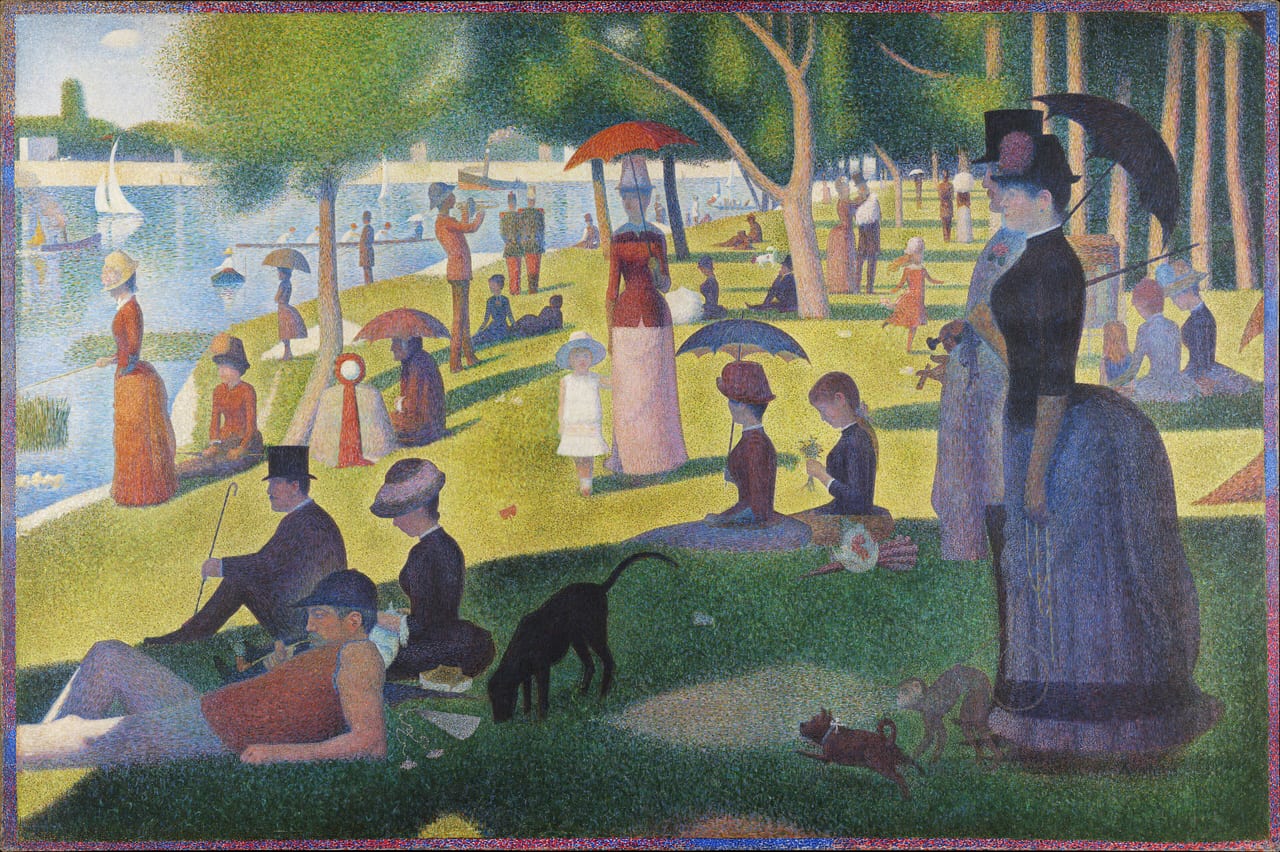
A Sunday Afternoon on the Island of La Grande Jatte
Georges Seurat · 1884–86
Art Institute of Chicago
People of every age and social class spend a Sunday on the banks of the Seine on the island of La Grande Jatte, at the very gates of Paris. Close to, the figures and forms break up into dots and dashes of complementary colour set side by side. Many smaller painted and drawn sketches, and several larger canvases, led up to the picture, and Seurat came back to it two years after he began, amplifying the silhouettes of some figures and adding others, among them the monkey on its leash. To Seurat every decision was essential to his aim: a scene of modern life to match a classical Greek frieze. The painted border was added in 1888–89.
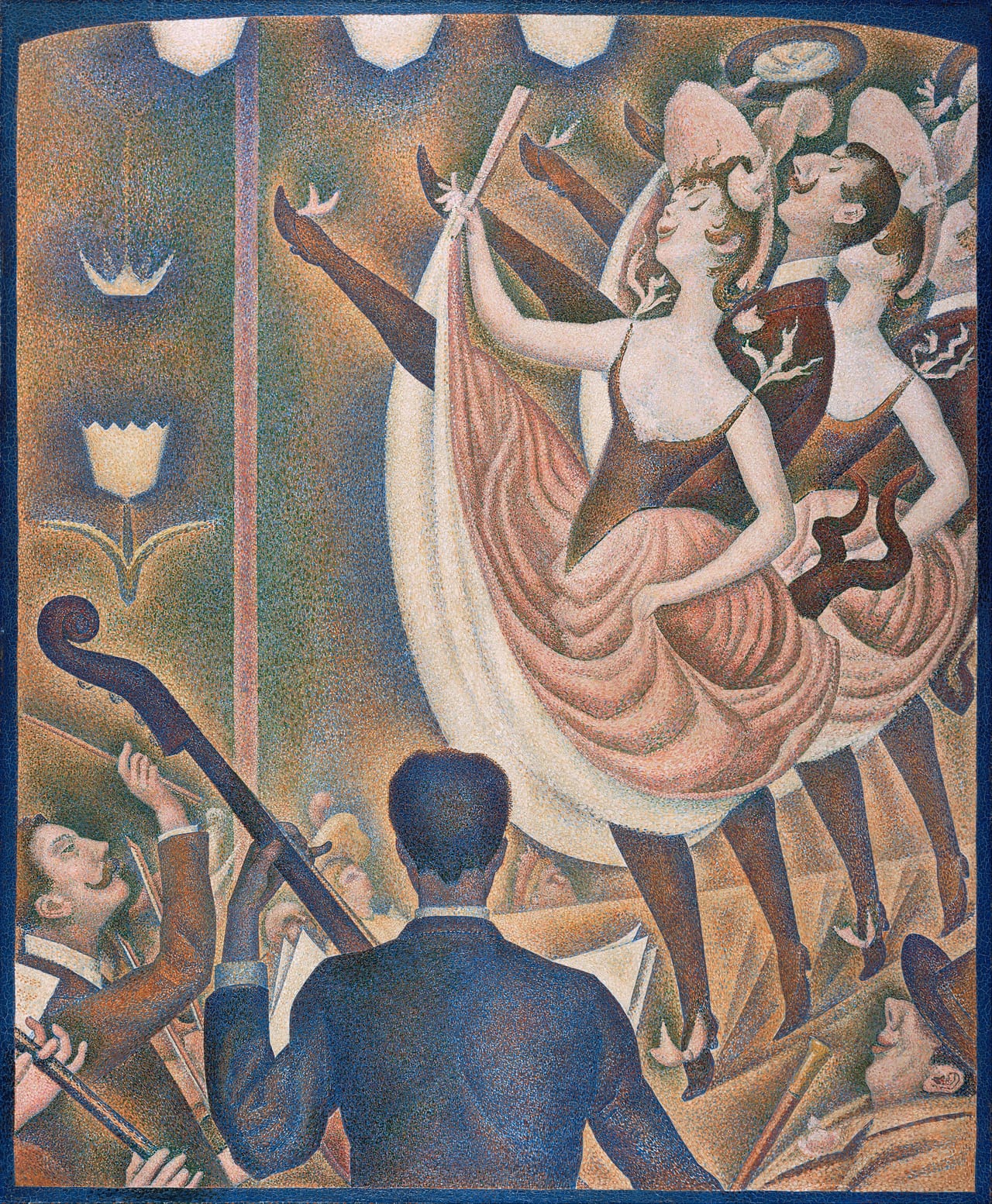
Le Chahut
Georges Seurat · 1889–90
Kröller-Müller Museum
Two women and two men raise their legs in the chahut, or cancan, a risqué dance for its day in which the women lifted their skirts. The subject is lively, but the picture is no passing glimpse of Paris at night: Seurat fixed the dance in a strict system of countless tiny dots, lines and colour combinations, and sent every line upwards, from the dancers’ legs and the conductor’s hand to the neck of the double bass and the flowers behind, to call up the excitement of the music. It was first shown at the Salon des Indépendants of 1890, once belonged to the Symbolist poet and critic Gustave Kahn, and is now in the Kröller-Müller Museum at Otterlo.
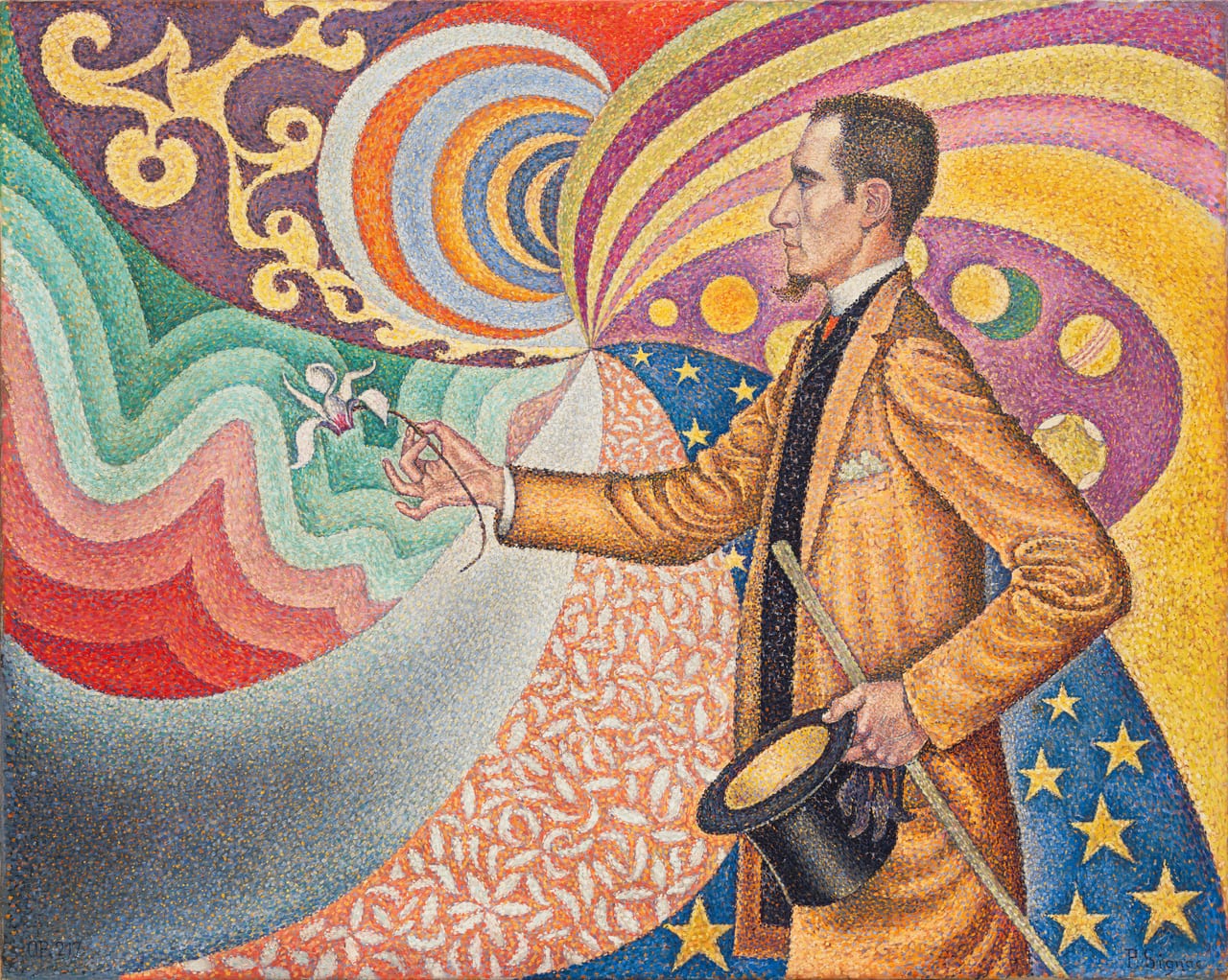
Opus 217. Against the Enamel of a Background Rhythmic with Beats and Angles, Tones, and Tints, Portrait of M. Félix Fénéon in 1890
Paul Signac · 1890
Museum of Modern Art
Signac shows Félix Fénéon, the critic who coined the term Neo-Impressionism, in left profile, a black top hat and cane in his left hand and a cyclamen held out in his right. Nose, elbow and cane fall in a zigzag, like the “beats and angles” of the title, and the flower answers the upward curl of the goatee. The kaleidoscopic pinwheel of the background is probably an allusion to the aesthetic theory of Charles Henry, whose books on colour theory Signac had lately illustrated. The background draws directly on Signac’s own collection of Japanese prints, as Signac’s granddaughter Françoise Cachin identified. Shown in 1891, the portrait drew varied and critical responses; Camille Pissarro called it “bizarre”. It has been at the Museum of Modern Art in New York since 1991, given by Mr and Mrs David Rockefeller.
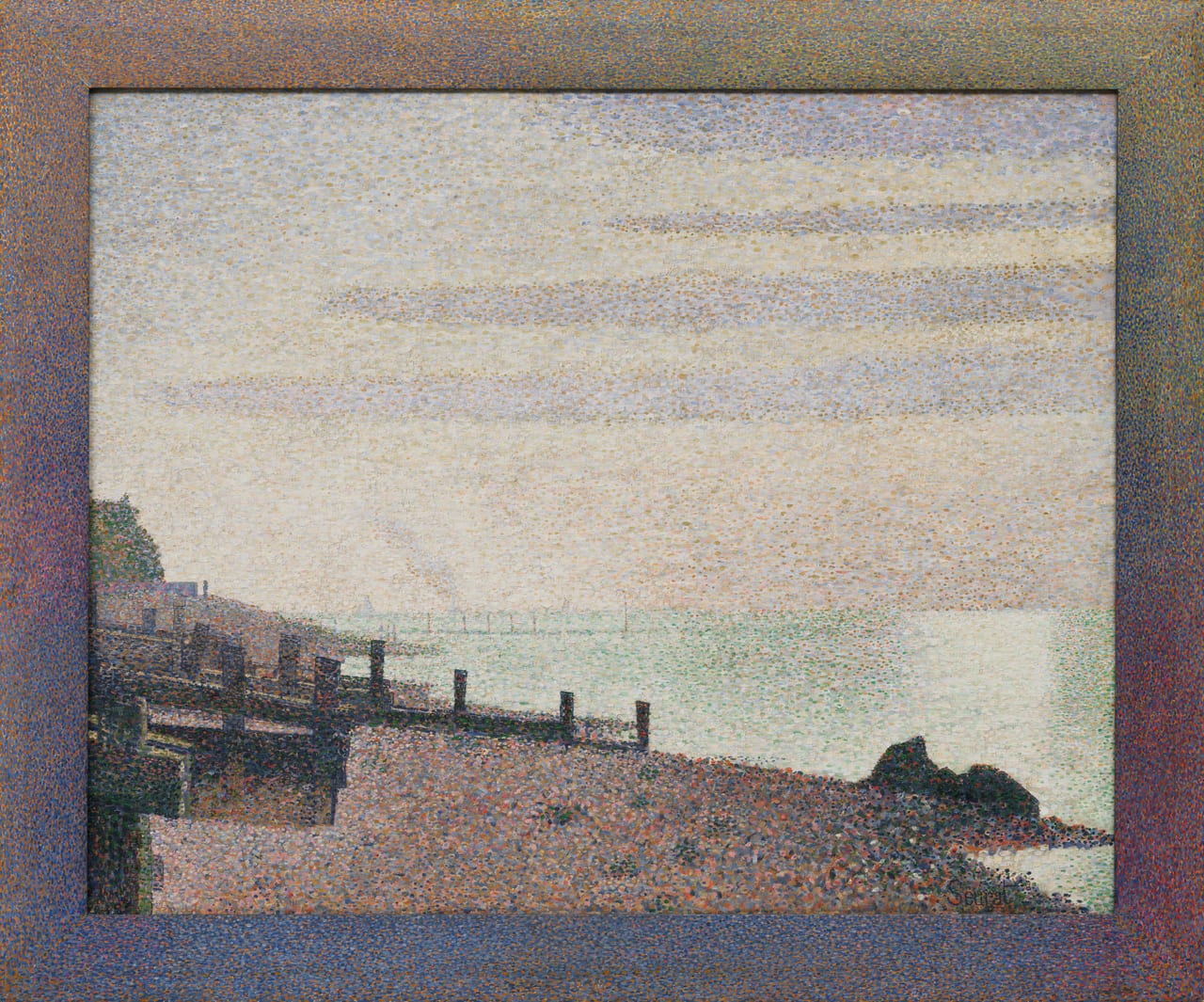
Evening, Honfleur
Georges Seurat · 1886
Museum of Modern Art
Artists had long been drawn to the rough seas and the rugged shore of the northern French coast, and Seurat spent the summer of 1886 there, at the resort of Honfleur; he went, he said, to “wash the light of the studio” from his eyes. His sunset calms the turbulent shore. Sky and sea fill most of the picture, built from at least 25 colours in thousands of separate dots, and Seurat later added a wooden frame painted in the same way, so the image seems to run on past the canvas; in the frame’s upper right corner the dots lighten with the glow of the setting sun.
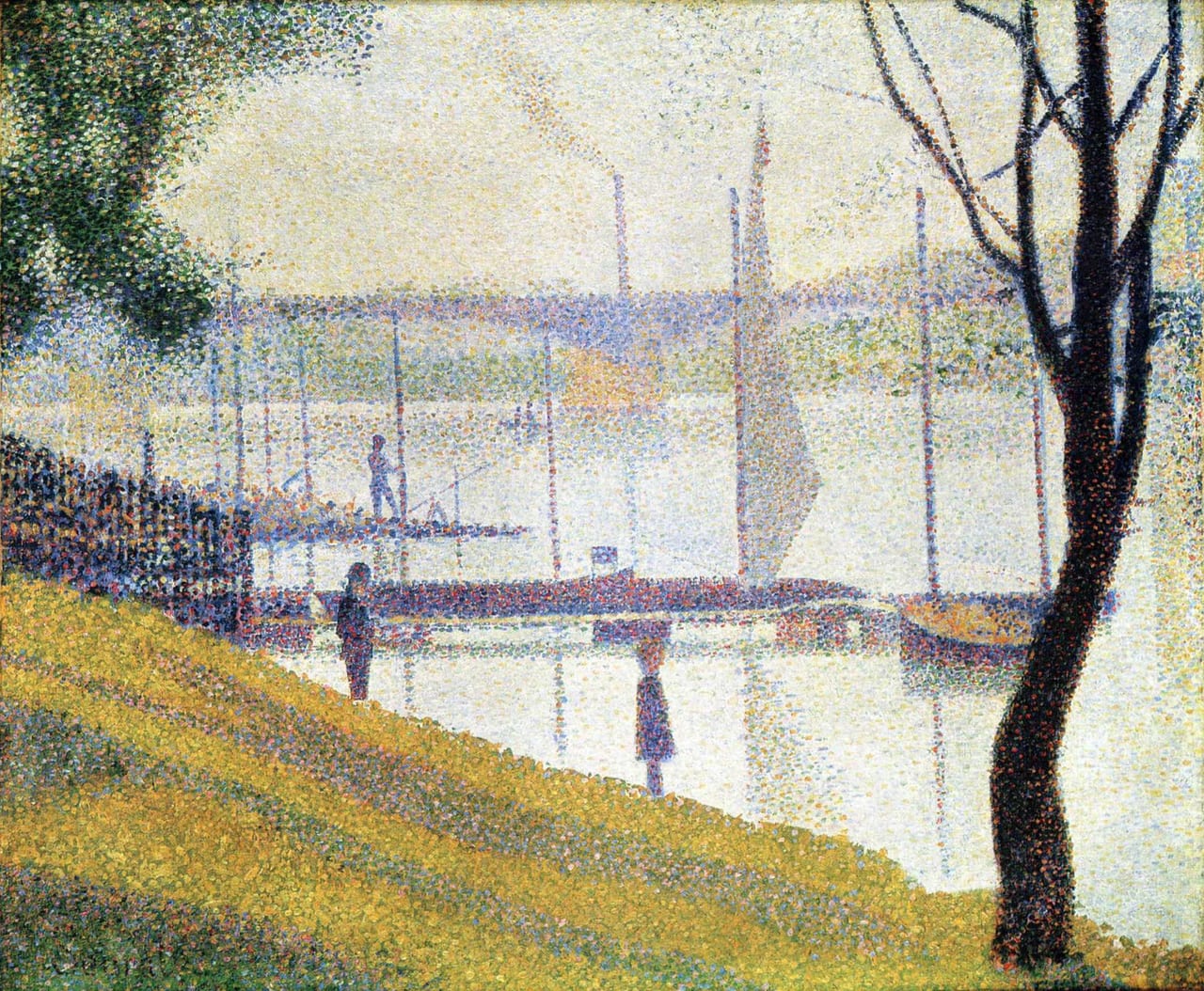
The Bridge at Courbevoie
Georges Seurat · c. 1886–87
Courtauld Gallery
Seurat painted this view of the Seine with the technique he had recently developed: coloured dots placed side by side, rather than colours mixed on the palette, which new optical theories of the time suggested made the surface more vibrant. Yet the mood is still and melancholy, stressed by the upright trees and the masts of the boats, and the factory chimney behind is a reminder that riverside Courbevoie was fast turning into an industrial suburb of Paris.
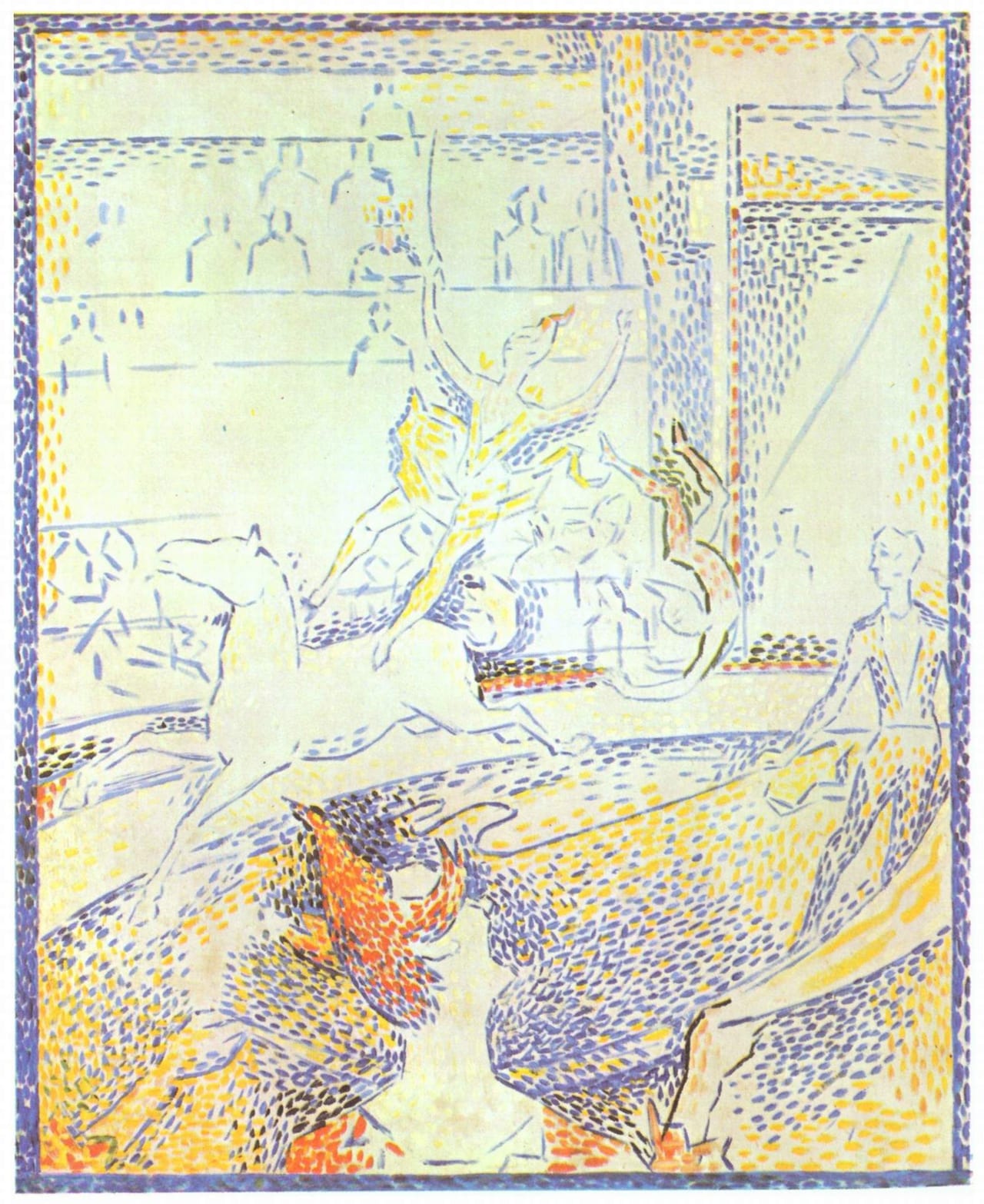
Sketch for The Circus
Georges Seurat · 1891
Musée d'Orsay
A sketch for The Circus, Seurat’s last painting, which he left unfinished at his death in March 1891. The painting shows a woman performer standing on a horse at the Cirque Fernando, with the audience in rows that set out the social classes, from the well-dressed in front to the gallery at the back. This sketch belonged to Félix Fénéon; it was given to the Louvre in 1937 by Mme Jacques Doucet, in keeping with her husband’s wishes, and was assigned to the Musée d’Orsay in 1977.
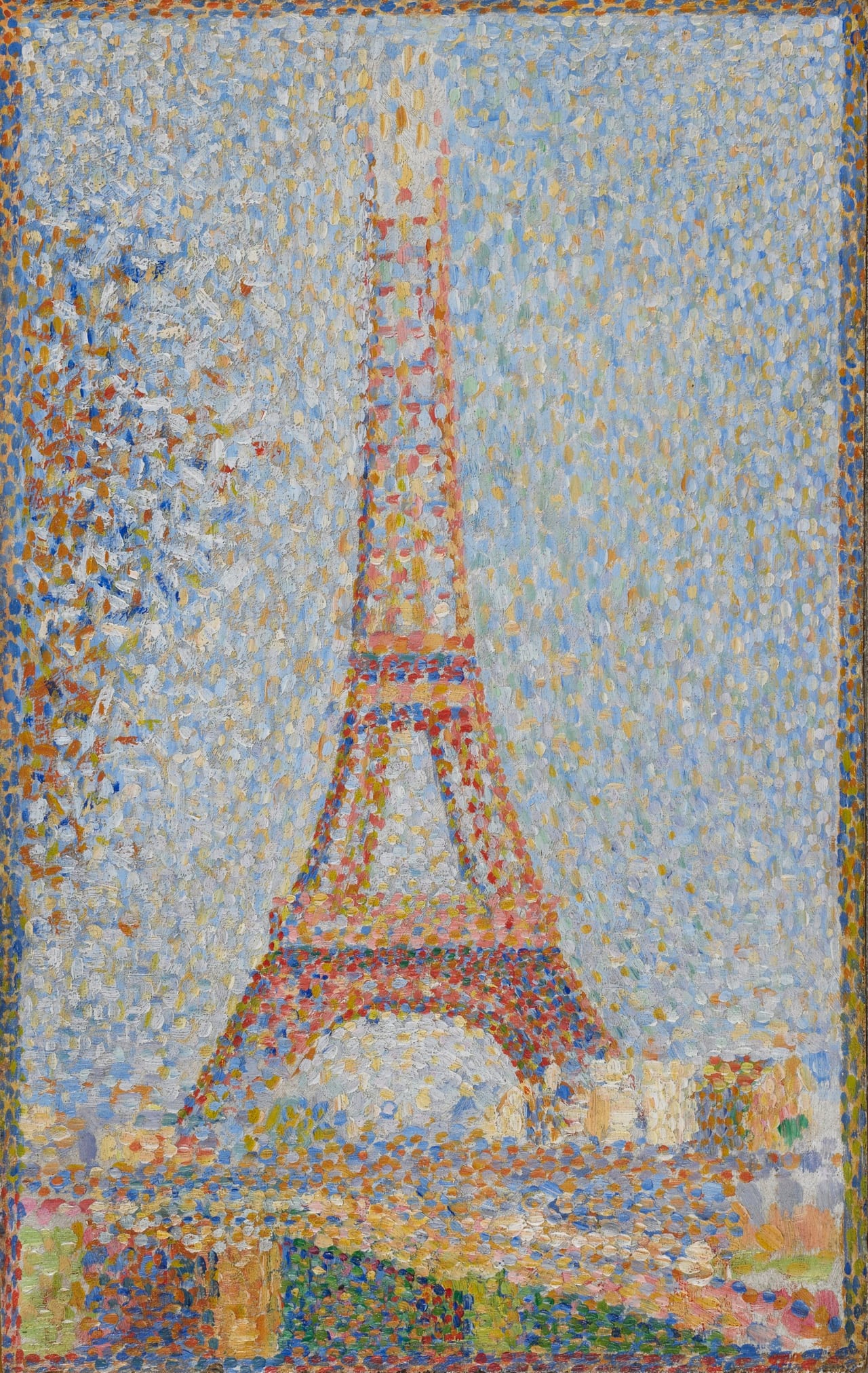
The Eiffel Tower
Georges Seurat · c. 1889
Fine Arts Museums of San Francisco
The Eiffel Tower, built for the World’s Fair of 1889 and then the tallest structure people had made, was almost complete when Seurat painted it that year. He shows it still in the process of becoming, not yet fully built and dissolving at its tip into his network of dots and dashes of colour.
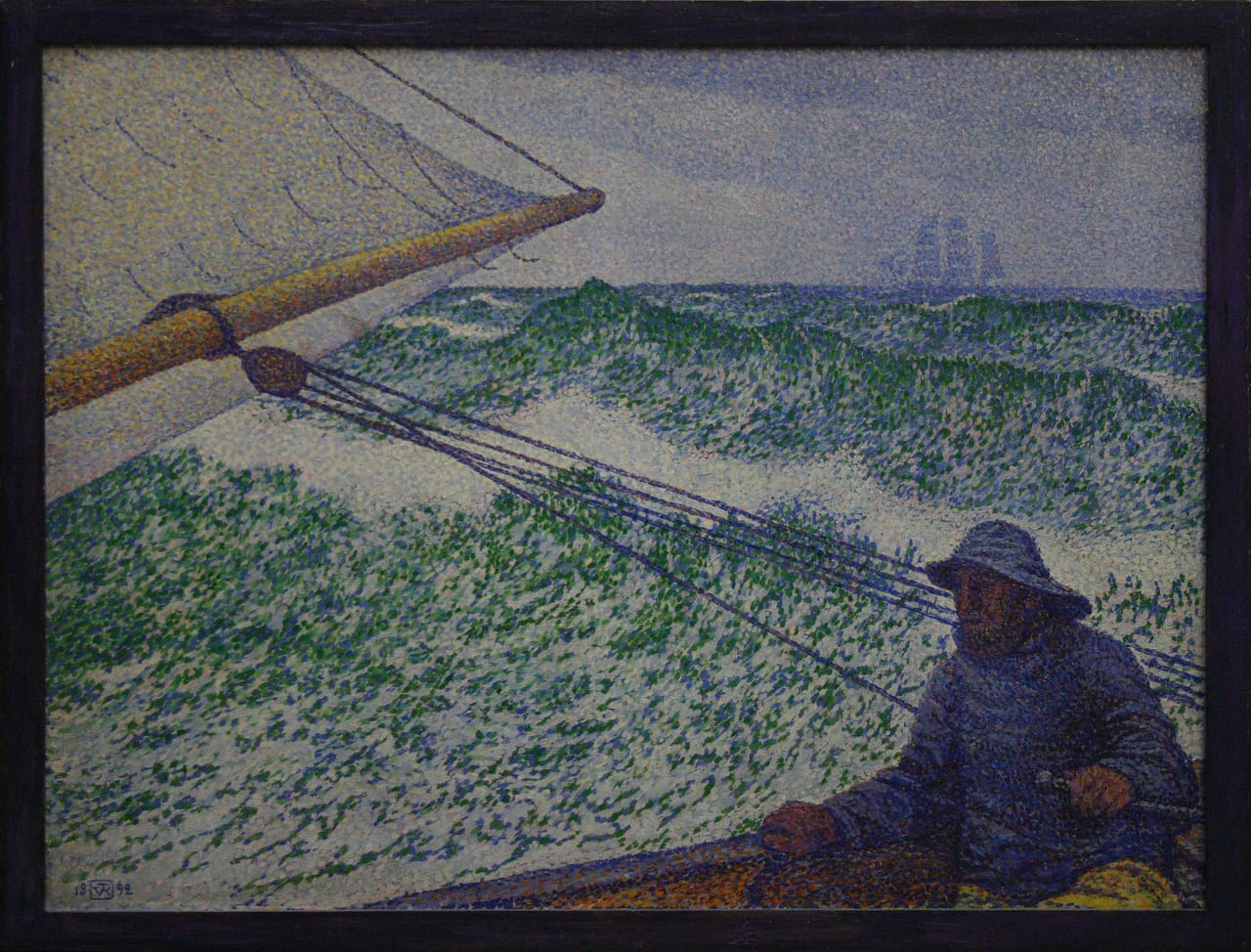
L'Homme à la barre
Théo van Rysselberghe · 1892
Musée d'Orsay
A man in oilskins at the tiller of a small sailing boat, with a three-master on the horizon. Van Rysselberghe painted this seascape in 1892 in a pointillist manner, and placed the sailor in the lower right corner, leaving most of the picture to the waves of the ocean. It belonged to Paul Signac and then to his daughter Ginette, whose gift brought it into the French national collections at the end of the 1970s; it has since been assigned to the Musée d’Orsay.
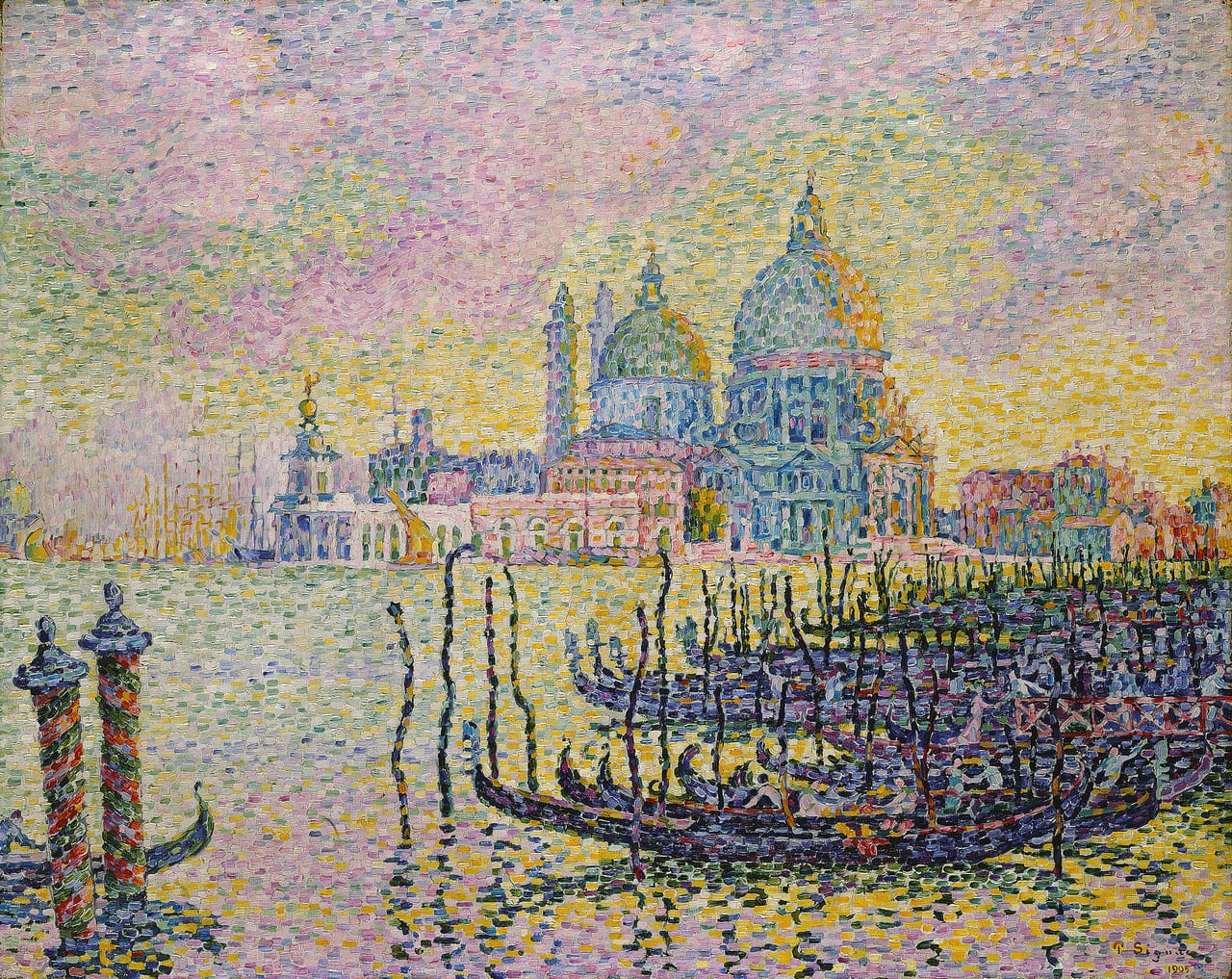
Entrance to the Grand Canal, Venice
Paul Signac · 1905
Toledo Museum of Art
Signac painted the entrance to the Grand Canal in Venice in 1905, with the Dogana da Mar and Santa Maria della Salute behind. The painting is now in the Toledo Museum of Art in Ohio.
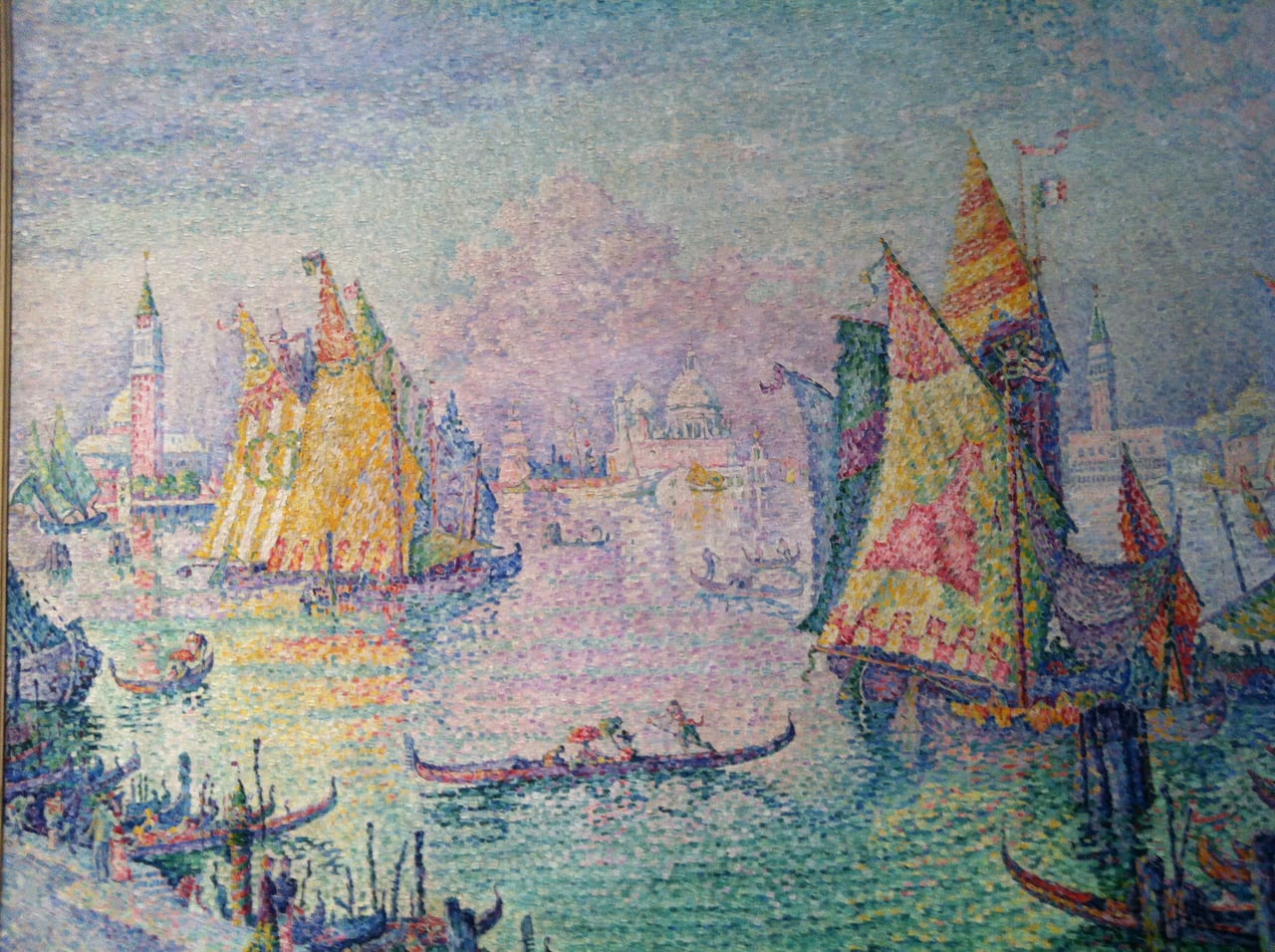
The Lagoon of Saint Mark, Venice
Paul Signac · 1905
Chrysler Museum of Art
In this picture of 1905 Signac shows an afternoon on a lagoon in Venice, built from brilliant blues and greens set against one another, with a gondola in the middle of the painting.
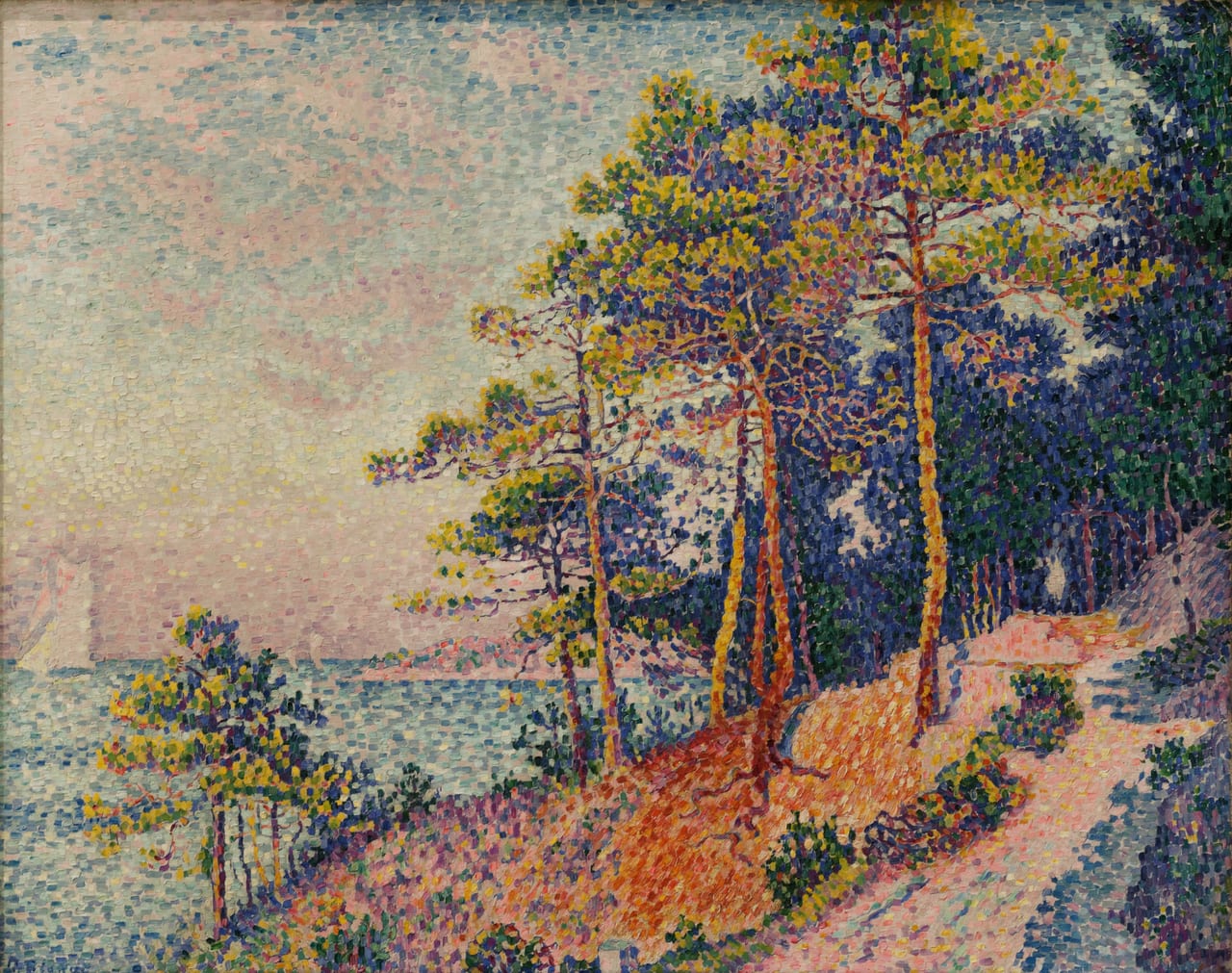
Le Sentier des Douanes
Paul Signac · 1905
Museum of Grenoble
The Sentier des Douanes, a seaside path at Saint-Tropez, at sunset: Signac set the blue-violet of the sea and the shadows against the pink-orange of the earth and the tree trunks, and gave each fall of light its own stroke, oblique for the slopes of the hill, vertical for the trees, horizontal for sky and sea. After crayon, ink and watercolour sketches and a first version in 1902, he painted the final work in his studio in 1905. Georgette Agutte and Marcel Sembat left it to the Musée de Grenoble in 1923.
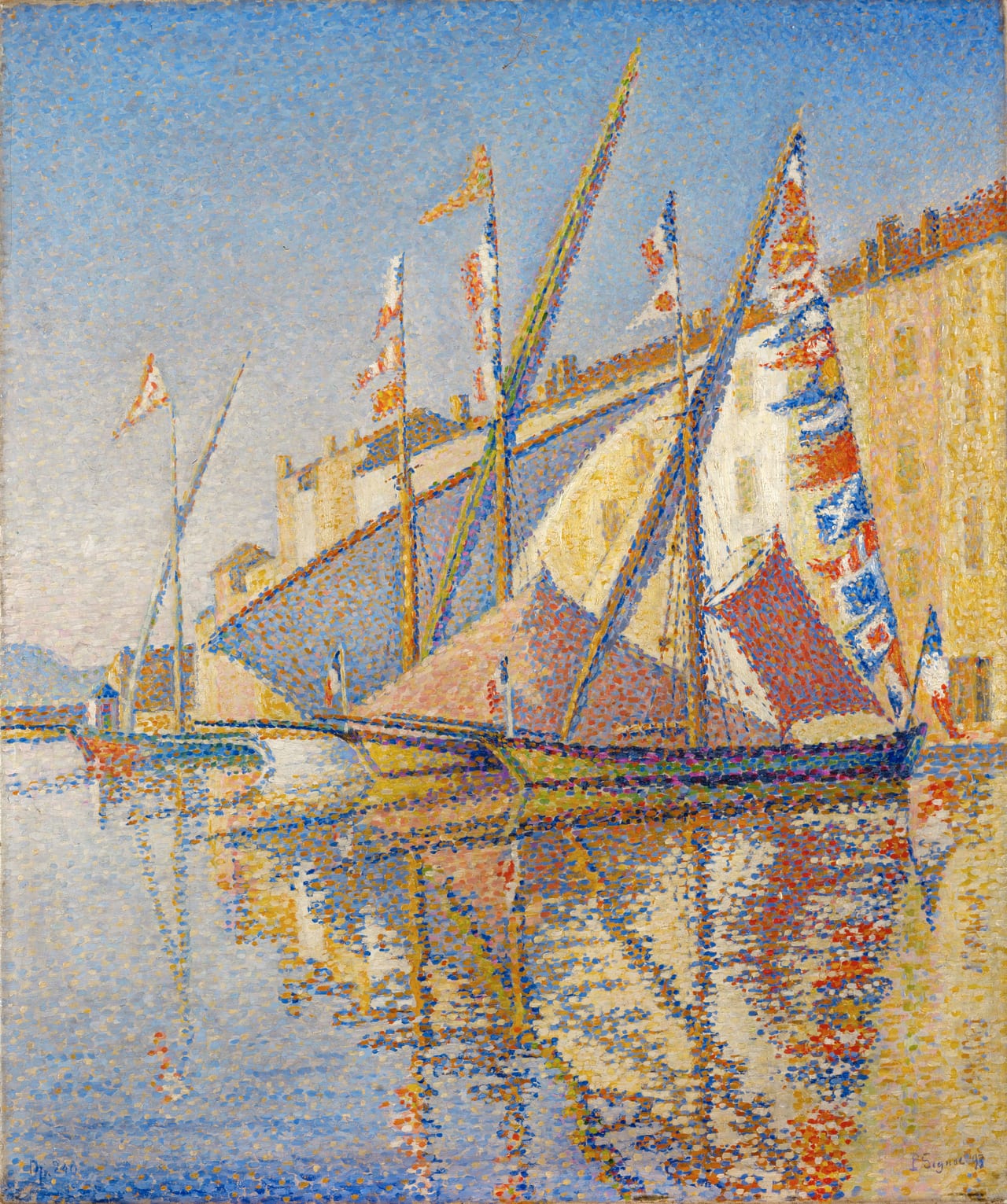
Tartans with Flags
Paul Signac · 1893
Von der Heydt Museum
Signac, a passionate sailor, kept several boats of his own moored in the harbour at Saint-Tropez, and that passion, with the glaring light of the Côte d’Azur, set off a series of luminous harbour and coastal pictures, of which this, of 1893, is an excellent example. The sloping line of the houses behind points the way of the four boats ready to start; the wind stretches their pennants and sails, and the boats lie on the water like arrows, with their pointed jib-booms.
Sources
- Britannica, “Pointillism”
- Britannica, “Neo-Impressionism”
- Britannica, “Divisionism”
- Britannica, “Neo-Impressionism: What Was the Point?”
- Britannica, “Georges Seurat”
- Britannica, “Paul Signac”
- Britannica, “Théo van Rysselberghe”
- Wikipedia, “Neo-Impressionism”
- Wikipedia, “A Sunday Afternoon on the Island of La Grande Jatte”
- Art Institute of Chicago, “A Sunday on La Grande Jatte — 1884”
- Kröller-Müller Museum, “Le Chahut”
- Wikipedia, “Le Chahut”
- Museum of Modern Art, “Opus 217 … Portrait of M. Félix Fénéon in 1890”
- Wikipedia, “Opus 217 … Portrait of M. Félix Fénéon in 1890”
- Museum of Modern Art, “Evening, Honfleur”
- Courtauld Gallery, “The Bridge at Courbevoie”
- Musée d’Orsay, “Le Cirque” (RF 1937 123)
- Musée d’Orsay, “Le Cirque” (RF 2511)
- Wikipedia, “The Circus (Seurat)”
- Wikipedia, “Paul Signac”
- Wikipedia, “Entrance to the Grand Canal, Venice (Signac)”
- Wikipedia, “The Lagoon of Saint Mark, Venice”
- Wikipedia, “Henri-Edmond Cross”
- Wikipedia, “Théo van Rysselberghe”
- Wikipedia, “The Lecture of Emile Verhaeren”
- Wikipedia, “Maximilien Luce”
- Wikipedia, “Jan Toorop”
- Wikipedia, “Henri Martin (painter)”
- Rijksmuseum, “Misty Sea”
- Museum Boijmans Van Beuningen, “Le port de Rotterdam”
- Fine Arts Museums of San Francisco, “Eiffel Tower”
- Wikipédia, « La Seine à la Grande Jatte. Printemps »
- Wikipédia, « L’Homme à la barre »
- Wikipedia, “Le Sentier des Douanes”
- Von der Heydt-Museum, „Segelboote im Hafen von Saint-Tropez“
- Wikipédia, « La Ferme, matin »
- Wikipédia, « Le Port de La Rochelle (Signac) »
- Musée d’Orsay, « L’Homme à la barre »
- Musée des Beaux-Arts de Nancy, « La Rochelle (le port) »
- Port of La Rochelle — Public domain via Wikimedia Commons (Public domain)
- The Seine at La Grande Jatte — Public domain via Wikimedia Commons (Public domain)
- Le port de Rotterdam — Public domain via Wikimedia Commons (Public domain)
- La Ferme, matin — Public domain via Wikimedia Commons (Public domain)
- The Lecture of Emile Verhaeren — Public domain via Wikimedia Commons (Public domain)
- Misty Sea — Public domain via Wikimedia Commons (Public domain)
- Côte de la Citadelle — Public domain via Wikimedia Commons (Public domain)
- La Famille — Public domain via Wikimedia Commons (Public domain)
- A Sunday Afternoon on the Island of La Grande Jatte — Public domain via Wikimedia Commons (Public domain)
- Le Chahut — Public domain via Wikimedia Commons (Public domain)
- Opus 217. Against the Enamel of a Background Rhythmic with Beats and Angles, Tones, and Tints, Portrait of M. Félix Fénéon in 1890 — Public domain via Wikimedia Commons (Public domain)
- Evening, Honfleur — Public domain via Wikimedia Commons (Public domain)
- The Bridge at Courbevoie — Public domain via Wikimedia Commons (Public domain)
- Sketch for The Circus — Public domain via Wikimedia Commons (Public domain)
- The Eiffel Tower — Public domain via Wikimedia Commons (Public domain)
- L'Homme à la barre — Public domain via Wikimedia Commons (Public domain)
- Entrance to the Grand Canal, Venice — Public domain via Wikimedia Commons (Public domain)
- The Lagoon of Saint Mark, Venice — Public domain via Wikimedia Commons (Public domain)
- Le Sentier des Douanes — Public domain via Wikimedia Commons (Public domain)
- Tartans with Flags — Public domain via Wikimedia Commons (Public domain)
Invite Pointillism into your living room